Reach Out Of Inner Space

Richard Diebenkorn, Ocean Park #68

Richard Diebenkorn, Ocean Park #68

Several days ago on a muddy trek through the state park, the dials in my brain spun ever so slightly and I had an epiphany. It was an epiphany that I’ve had before which, to some, might disqualify it as an epiphany but for me the important stuff seems to occur repeatedly, a new layer falls off, and I see a bit more each time. Clarity is movement to a core, a simplicity emerging from what used to seem complex. So, I had a repeating epiphany.

Last year I attended The Chicago Art Expo. To my shock and surprise, rather than being challenged and energized, I ran screaming from the building. It was disconcerting. It was disorienting. Rather than having direct experiences with art that opened my eyes or challenged my world, I had experiences with curators who were compelled to tell me why the work had merit. They felt the need to locate the meaning and value for me. There was, in each booth, an art-high- priest standing between me and the experience. In fairness, I often felt that, without the interpreter, there was no experience to be had. It was a mental exercise.

In the grand scheme of things, Art serves a purpose. It carries the common story, the cultural identity. It is necessary, not luxury. In that sense, for it to serve its purpose, it requires no interpreter. When it no longer serves its intrinsic purpose – or there no longer exists a common center – an interpreter (marketer) is inevitable.

As Quinn once told me, “If someone has to tell you that they are good, they probably aren’t.”

Joseph Campbell wrote a book called The Inner Reaches of Outer Space. Art (theatre, visual, dance, music), for me, has deep value when it serves the outer reaches of inner space. It is immediately accessible, touching a universal nerve. It has to reach. Standing in the mud and muck of the park, we took a break by the shore of a lake and listened. The wind moved the trees, the limbs clacked and groaned. Crows chased an owl. The sun warmed my face. A layer fell off and a core came closer to focus.

This is not a diatribe against abstraction. We recently saw a Sam Francis exhibit at The Milwaukee Art Museum that left me in tears. I’ve spent hours in front of a Diebenkorn, one of his Ocean Park series, and I can’t get enough of it. I visit it often, like a pilgrim on a pilgrimage. It moves something deep within me. It speaks to something bigger than me and makes me want to be better and better. Standing before it I feel a part of a conversation of hearts and imaginations and deep space calls. I feel a part of a bigger story.

Be Clumsy

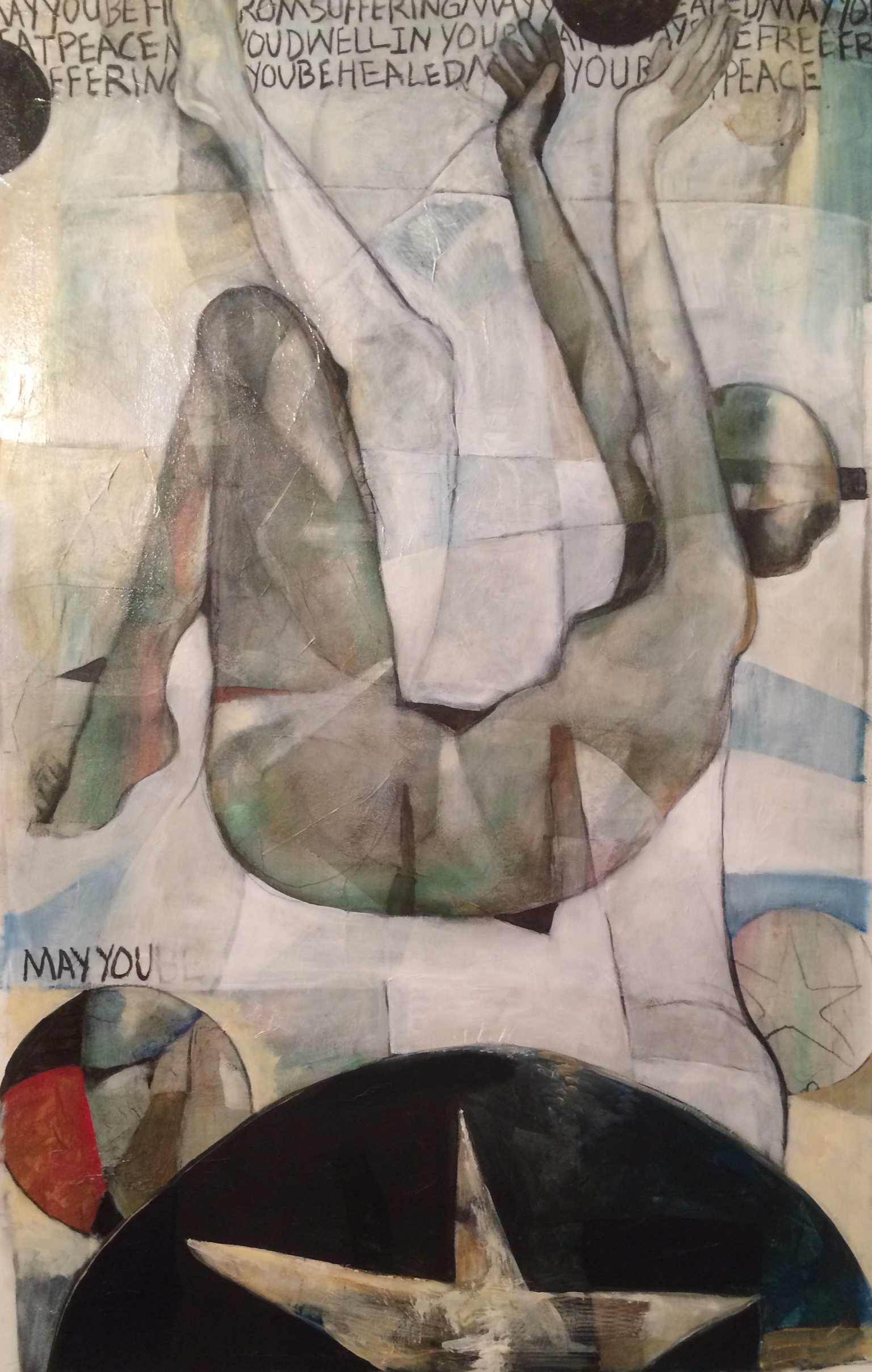
a detail of my painting, May You Be.

a detail of my painting, May You Be.

Clumsy (klum’ ze) adj. 1. lacking dexterity, grace or skill; awkward. 2. ungracefully shaped or made; unwieldy. 3. awkwardly or unskillfully said or done, ill-contrived.

“We don’t allow ourselves to be clumsy,” Kerri said. “Life is clumsy.”

Many years ago I read a commentary that suggested we moderns have a harder time of feeling good about ourselves than people of ages past. The argument went something like this: we have an impossibly high standard to meet and it is mostly illusory. For instance, our predecessors compared themselves and their successes against a relatively small village populace. We are swimming in pool that stretches around the earth. The athletes in our ancestral villages ran against their neighbors, the artists created for a specific purpose that served a tangible need in their community. Our young runners know to the hundreth-of-a-second what greatness requires. They run against the world. Our artists rarely know outside of their own inner imperative why they are creating. With no outer limit they spend a great deal of time wondering if their work has any impact or greater significance. With no outer limit it has no defined audience or community. Stephen, a gifted and prolific artist, used to ask, “Why don’t people recognize the value of art?”

The argument is largely a question of access. Our predecessors had limited and very abstract access to the news of the day, to the happenings beyond their region. We have a 24-hour global news cycle that comes to us on multiple devices that are designed to grab and keep our attention. It is not passive. On our multiple devices we are bombarded with images and messages of what we should look and feel like. Yet, almost all of the images populating our personal measuring stick are constructed. They are manipulated, retouched, powdered and Photoshopped. Legs are stretched. Wrinkles are removed. Sunsets are filtered. We measure ourselves against illusions.

Thus, intermediaries are everywhere. Interpreters abound. I rarely go into a gallery without a curator telling me why the work on the walls is important. The news of the day makes us the rope in a tug-of-war of interpretation.

Art, like life, like deep spirituality, requires direct engagement. It is made rich in the rough draft and the mistake. The broken road is interesting, vital. Learning is a process that takes time. It is messy. It is clumsy. It is not straight, paved, and has no road signs. And, it cannot be walked alone.

There is no forgiveness (of self or other) on the path of perfection; forgiveness is in short supply when the standard is both impossible to attain and an illusion. On the clumsy path, on the messy and muddy road, lives grace, generosity of spirit and deep forgiveness.

Clumsy (klum’ ze) adj. 1. Human

May You Be

May You Be


Be We.

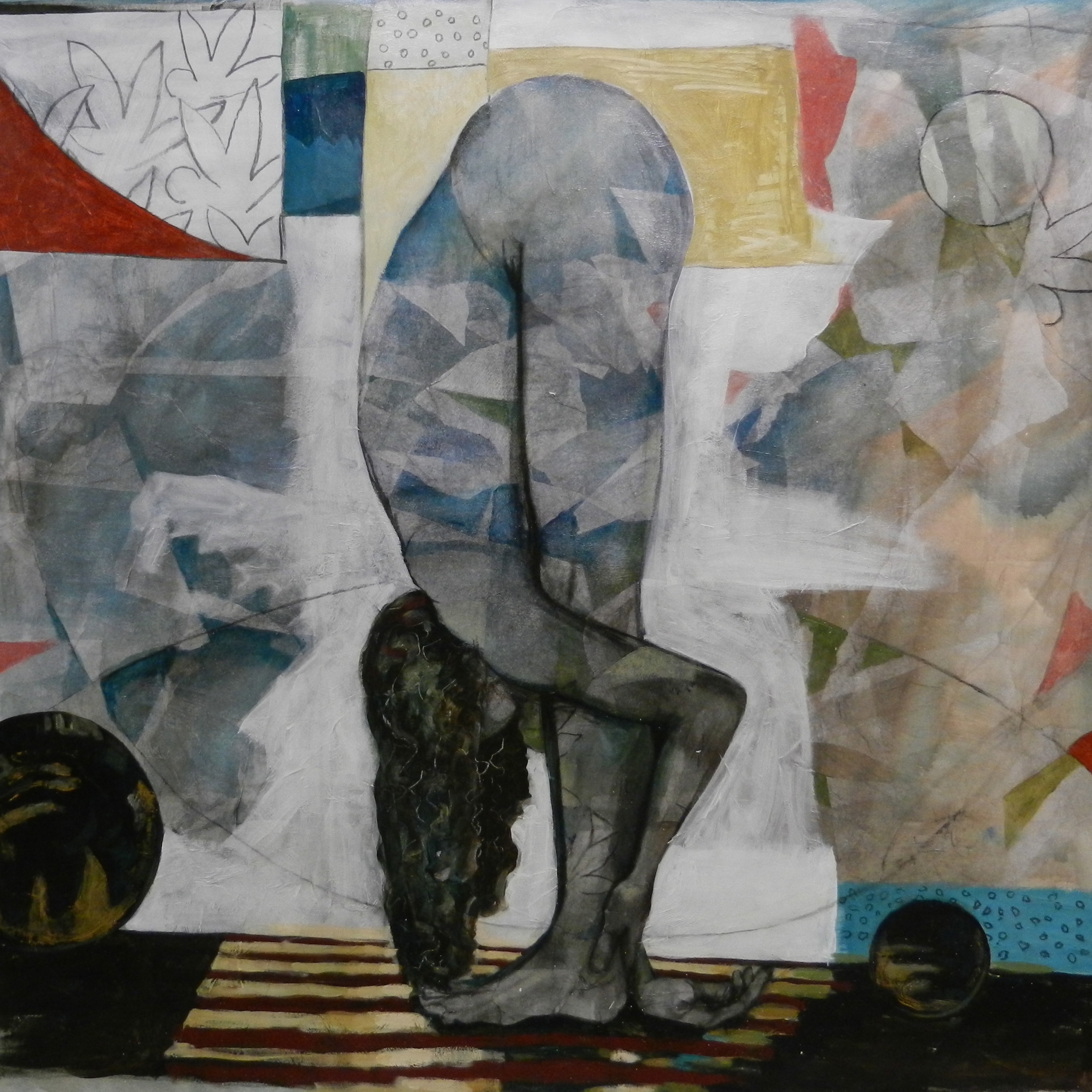
a detail of And Now.

a detail of And Now.

“We need to create this together,” I said. We were discussing a project, a collaboration. 20 whipped out his phone and began searching frantically for something.

“What are you doing?” I laughed.

“Ah,” he said, “Here it is.” He smiled and read to me a definition of the word, ‘we.’ “You and I,” he read, “I and another.” He chuckled, adding, “Oh, I’m not sure I like that word.”

We. It’s a little big word.

At dinner the other night, Brad asked, “Now that you are married does your relationship feel any different?” Kerri and I both smiled. Yes. There is something bigger than ‘you and me.’ It’s hard to explain the change except to say that there is now a ‘we,’ a relationship that takes precedence over any single individual concern.

I was married many years ago and now know why things didn’t work out. We’d established our relationship on the sandy foundation of a bargain: I’ll help you if you help me. Bargains like that do not sound so bad until trouble comes. Bargains are predicated on what you get from the relationship. Marriages, I’ve learned, are built upon what you bring to the relationship. In a bargain there is no ‘we.’

Yesterday Skip and I talked about art (among many other things). It’s been my experience that art happens in the ‘WE’ space. Actors have to bring their gifts in service to the play. In fact, they cannot fulfill their gifts unless they are in service to something bigger than themselves. A self-serving actor essentially locks the audience out of the play; WE is not possible when an actor is oriented to what he or she can get from the experience. Magic happens when an actor is oriented according to what they bring to the experience. It’s the tragic misconception of art in these United States: art is not about self-expression; art, when properly understood, is the creation of WE.

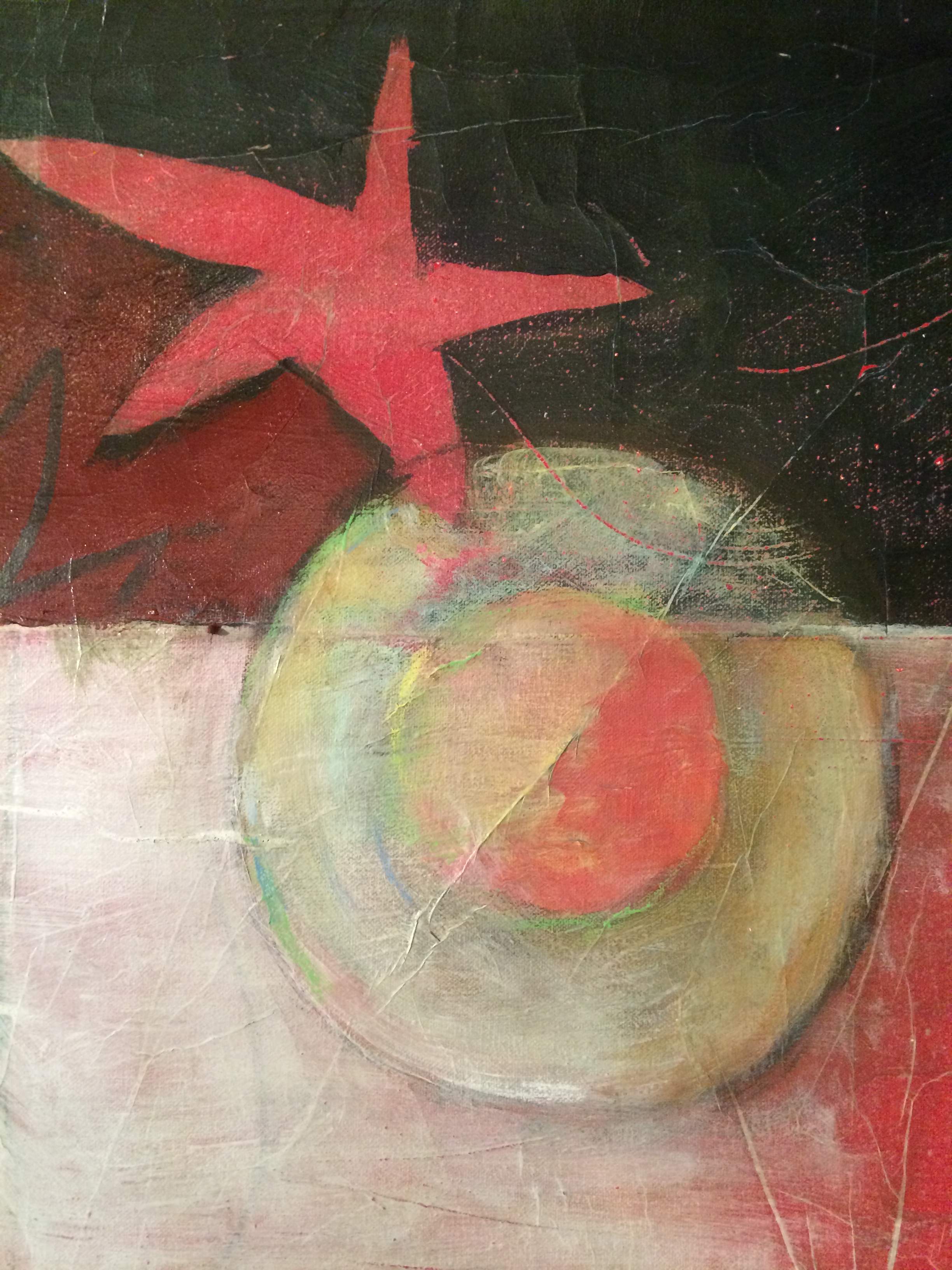
another detail of And Now

another detail of And Now

A few weeks ago we watched a movie, Always, and this line (not a direct quote) jumped out and smacked me on the head: to gain your freedom you first must give it away. Gifts are not fulfilled unless they are given. People are not fulfilled until they give themselves to WE.

[to be continued]

Dance!

A painting called JOY

A painting called JOY

“A dancer’s body breaks down,” she said, “Painters can paint all their lives. Musicians can play until they are old, but a dancer’s instrument, her body, gives out.”

To be a contrarian I responded, “And then there is Martha Graham. She danced into her 80’s, didn’t she?”

She wrinkled her nose and said, “Not very well.”

The lights dimmed, the movie started, and our conversation ended.

She was, in her youth, a dancer, classically trained. She’d spent the bulk of her adult life teaching and choreographing. And, as she told me, “Those things are all you can do when you can no longer dance. They are what’s left.” Had our exchange not bothered me so much I might have felt sadness for her.

Like an art-mantra, Tom used to say, “A writer writes and a painter paints.” I wanted to say to my seatmate, “A dancer dances.” I thought immediately of Linda who dances even when she is not dancing. She is a riot of movement, joy-in-motion; her need to dance is infectious. Even non-dancers find themselves jigging across the floor when Linda is dancing at the party. I once told her that she is my secret weapon for throwing a successful party.

I imagined my seatmate as a young girl. Before all the training, before the technique and expectations, there was enthusiasm. There must have been joy. There must have been lots of joy. She must have known the world by moving, twirling, spinning in it. Artists – before they call themselves artists – make sense through sound, through scribbles, through spinning. They only way forward in life, the only way to make meaning and to learn, is to scribble more, to engage and translate through movement. Lazy educators write off this imperative as self-expression.

The great artist deathtrap is called technique. It is a paradox. It is necessary. It is a kind of language mastery. It is, at first, a struggle of control. How do you say what you need to say when your language is visual, aural, or kinesthetic? Training is necessary. The path to full expression is always paradoxically through constraints, control of breath or brush. Yet, too often, as is the case with my seatmate, technique replaces the enthusiasm. It can turn joy into judgment. It can make an artist forget their WHY and replace it with a too rigid HOW. It is how artists limit themselves with their artistry. It made my seatmate, a healthy ambulatory woman, believe that she is not capable of dancing.

Later, I told Kerri about my conversation at the movies. She said, “That’s why fewer and fewer people are going to symphonies or galleries. People draw lines. Artists not only limit themselves with their artistry but they also limit access to their artistry.” Joy is infectious. Artistry without it is not very interesting (and, arguably, not artistry).

Make Art So.

at one time even this was considered a new technology

at one time even this was considered new technology. numbers, too!

Chet said, “But where’s the human in all of it?” His question took me by surprise. It is a question that often puzzles me. I was telling him about my recent inner earthquake, the moment that the train of technology jumped the tracks and collided with my art engine. Both exploded.

For weeks I’d been looking forward to a full day of exploration at the Chicago Art Expo. Hundreds of contemporary galleries from around the world assembled in one place, each showing their premiere work. As an artist these events have always fed my soul. This time, with the exception of a few older masters (a Chagall, a Picasso), a Hockney that made me smile, and few pieces from The San Francisco Figurative painters, I was unmoved. Worse, I was uninterested. As I wandered through the exhibits I listened to curators over and over again working hard to give context to the art. The viewers had no immediate access to it. They (like me) needed an explanation to access its relevance. I felt as if I was watching art-priests interpreting god for parishioners who had no expectation of direct access to the divine. The art needed a middleman. It required an explanation.

Just before going to the Expo, Skip shared a link with me. It was a video of animator Glen Keane drawing in virtual space. He was literally drawing from within the image. It took my breath away. Glen Keane called the technology a new tool but, like many new tools – so many new technologies, this one has the capacity to change our relationship with life and, therefore, with art because it could change our relationship with time and space. At one point in time, electric light was a new technology. The automobile, the airplane, the telephone, the camera and the phonograph were once new technologies. Each changed our relationship with sound, light, distance, the planet…each other. They changed how we see and experience possibilities. And, at the time of their invention, the community, at first, did not understand the power being introduced into their lives. They, like we, were stepping into the future with their eyes in the rearview mirror. What we know as art changed with the introduction of each of these technologies.

I couldn’t help but see the work at the Expo through the lens of this most contemporary tool. My eyes, for a moment, were wrenched from the rearview mirror and forced to look straight ahead through the windshield. Relative to the tool, the work at the Expo seemed abstract to the point of inaccessibility. It felt academic and I felt distant from it (lots of head, little heart). The tool although incomprehensible, was exhilarating, approachable, and inspiring. It made me want to play. It made me want to create. With this tool, Jackson Pollock would have danced and splashed in 3-D space. Picasso would have explored Cubism from within the cube. And, with this tool, I could see them doing it; I could sit in the same space and get paint on my face. In the video, Glen Keane says, “When an artist makes a line, it is a seismograph to their soul.” This tool, this technology, is a 4 dimensional seismograph.

Eve Ensler wrote, “Art has the power to explode the heart and open up other energetic capacities to re-perceive it. It defies boundaries and leaps tall buildings. It transports, it translates, it transcends. Transcendence is so important right now because our lives are so mechanized, controlled, and commodified; art has the capacity to open our souls and could be our revolutionary, evolutionary salvation.”

Yes. And, yes again. I can draw in the dirt with a stick. I can draw in virtual space. The verb remains the same. The access to others – the reach of the art – changes.

To Chet I wanted to say that humans create technology. And, in turn, technology informs humans and, therefore, art. Our very short attention spans are the result of our relationship with technology –  800 word blog posts are now too long, and 140 character tweets are desirable. Much of the Expo was digital photography or digitally altered images. It was mental and cold and abstract – certainly expressions of our time – expediency allows for little depth of experience. The technology did not make it cold; the way it is wielded by human beings makes it so.

Chase The Butterflies

a detail from my painting, John's Secret

a detail from my painting, John’s Secret

Wisdom butterflies that have recently fluttered across my path:

Soaking up the morning sun and drinking coffee from the deck of Common Grounds, 20 said, “You’ve heard this one, right? There are three sides to every story.”

Standing on the side of the road peering into Judy’s car, she gave us some sage relationship advice. She said, “That’s the secret to life, you know: listen before you talk.”

Kerri was composing a song. I asked her how she starts, how she knows where to start. She said, “I don’t know. Sometimes you just need to put your fingers on the keys and follow the music.”

There is an aging pink post-it note stuck (permanently) to the desk. It reads, “Make The Adventure.”

On a recent phone call, Skip offered wise counsel about how I see my role in a new business, “Find your own metaphor,” he said. ”What is the metaphor that will keep you energized, that taps into your 10,000 hours?”

Sitting behind his drum set, waiting for rehearsal to begin, John said, “Our job is to make the art, not to determine its reception.” And then he said, “What do you think?” and laughed.

Josh took a belly punch from the universe yesterday. He said, “I want to be angry but anger does me no good. I have better things to do with my life than get angry.”

A detail from my painting, An Instrument of Peace

A detail from my painting, An Instrument of Peace

P-Tom weighed in with this: “Faith is scandalous,” he said, “It pushes back against everything we experience.”

Dog-Dog raced across the yard in hot pursuit of a butterfly. I’m wagering that he knew he would never catch it, but the chase was glorious.

Wait For The Flow

The Weeping Man

The Weeping Man

The Weeping Man is finished.

Sometimes the process of painting feels like wrestling with an angel: It will not release me. I will not let it go. We wrangle and discover the truth in each other. It is, as Quinn used to say of all relationships: “corrections as refinements”.

Sometimes a painting follows you for years and chooses its day. It chooses its time and simply steps into the light. It announces itself: “I am here now.” The Weeping Man was like that.

In my life I have painted hundreds of paintings and I can count a handful that are like The Weeping Man. Pure. In laying it out, I corrected one line. I added another. There are relatively few unnecessary brush strokes.

Flow is like that.

Focus On The Important Stuff

an offer from TwoArtistMakingStuffForHumans

an offer from TwoArtistMakingStuffForHumans

A note from the temporary site of TwoArtistsMakingStuffForHumans:

The waxing moon was muted with fog. It made the air shimmer. Avalon was near. Although it seemed too soon, there was a hint of autumn in the air. We sat next to a chiminea talking to friends. Monica told us of her daughter working in villages in South America. She told Monica that, by our standards, the people there have nothing. They are possession poor. But, they were happy, genuinely happy. They didn’t have much money or stuff but they had the essential thing that many of us lack: peace of mind. They focus on different, more important stuff.

It brought to mind my experiences in Bali. When I arrived all I could see was the poverty. By the time I left several weeks later, I’d have given everything I own or will ever own to have what they have: presence. Ease of mind. They weren’t looking for fulfillment, status, or living for retirement. They were living. Life was fulfillment. In a world where all things are sacred, status is gained by the quality of your giving and not by the size of your piece of the limited pie. It is a different focus.

There is a hidden cost to what dominates our focus, the things that take our attention…as opposed to the things we pay attention to.

As artists, both Kerri and I believe the work of our lives has been, one way or another, to help people focus on the important stuff, to see the extraordinary in the ordinary moment, to find inside what people seek outside. We’ve both worked across the boundaries of business, art, and the fine art of living everyday, there is no lack of necessity to refocus the eye, mind, and heart.

In a few weeks we will be launching our business (details to follow). All the many aspects of our work – if you can call art a product and performing a service – are intended to support, exercise and pay forward a focus on the important stuff, the important moments…sometimes the teeniest things that in the chaos pass unnoticed.

We want to do for others what we do for each other. Check out our pre-launch coaching offer. Take us up on it! Or, if you know someone who might benefit from working with us, pass it on, pay it forward.

Meditate On Mistakes

taking advantage of my mistakes: a detail of my latest painting in progress called Weeping Man

taking advantage of my mistakes: a detail of my latest painting in progress called Weeping Man

A meditation on mistakes:

Actors know. In performance, when they forget their line, they come alive. The exhilaration of forgetting shocks them into presence. The mistake achieves the essential thing: presence. The audience may not be aware of the lost line but they cannot help but come into presence when the actor does. That’s how it works. Presence begets presence. Actors also know that, in such a moment, tension is their enemy. Panic is counterproductive. Relaxation is the only path back to their play.

Mistakes wake us up.

Many years ago, I produced a summer theatre company. In the middle of a performance, a storm blew out the power to the theatre. The performance stopped. The emergency lights came on. The actors looked at the audience and the audience looked at the actors. And then, in the ghostly blue-white light, the actors continued their play. It was the one and only time that the play was riveting. Actors and audience alike became invested. They were together in an experience that was unique. It was, as are all true mistakes, unrepeatable.

the under painting and sketch.

the under painting and sketch.

The playwright John Guare wrote that a writer must write ten bad pages to arrive at the one good page. The writer must value the ten bad pages for the single good page to be possible. The ten bad pages, what educators, locked into testing regimens, might call mistakes, are necessary. Up front expectations of perfection are guarantees of mediocrity. No process is perfect – and that’s the point. Perfection, like happiness, comes after the fact. It is the blossom of a rich process. It ensues and only becomes available when mistakes are valued, when exploration is encouraged. A rich process is alive with trial and error, with strong offers that may or may not work. The strength of the offer, the capacity to make a grand mistake, learn, adjust and boldly offer again – is a great definition of freedom. It is otherwise known as vitality.

It’s what artists understand. When nothing seems to be working, when the most powerful offers fall flat, when paintings turn to mud, relaxation is the only path forward. There is comfort in knowing that the single good page is out there somewhere if only you keep making grand, luscious, brilliant mistakes.

Sometimes It Takes More Than A Text

TODAY’S FEATURED IDEA FOR HUMANS

Sometimes It takes more than a text

In a recent post I wrote that we are often slaves to brevity. We want quick and easy answers to life’s big questions. Peter Block wrote that, in 30 years of consulting with businesses, he was routinely asked “How” but never asked “Why.” Relationship is at the heart of almost every big question (like leadership, management, marriage, self-love, the sacred,…) and, in relationship, there is no shorthand.

FOR TODAY’S FEATURED PRINT FOR HUMANS, GO HERE.