Learn To Question

My best place for asking questions

My best place for asking questions

20 (aka John) tells me that his coworker, Amy, aged 22, will have answered all of life’s questions within the next three years. He assures me that she will share her answers when she has them. “We just need to hang on for another three years,” he quips, “…and it’ll all make sense!”

The admitting nurse at the surgery center feels like a threshold guardian. She said, “People who pass through here learn just how little they actually control in life. Surgery is humbling. I’m here when their illusion of control bursts. That moment is hard.” She was quiet for a moment and added, “What gets me is all these people in the world who think they have all the answers – and they think their answer has to be the answer for everybody. All these rules made up by all these people who think they have the right answer for everybody! That’s why people are killing people everywhere.”

“It sounds like more people ought to have surgery!” I tease.

“You got that right,” she said, handing me my gown, hairnet and blue booties. “Put one of these on and you realize how little control you actually have; in this place none of your answers matter and none of your rules apply!”

It should be a mantra for educators and the only argument necessary to dismantle a test-driven system: Life is always found in the direction of the question. At best, answers are relative – and the best answers, if understood, are simply doors to more questions. Learn to question.

The best art follows the same mantra. It steps into big questions, wanders into unknowns and complexities. It tests and tries, explores and experiments. It leads us to explode our answers and like a good trickster does not allow us to hold our gods too tightly. It begs us to question.

“Shall we tell Amy that there are no answers?” I ask 20.

“Nah. Why spoil the surprise.”

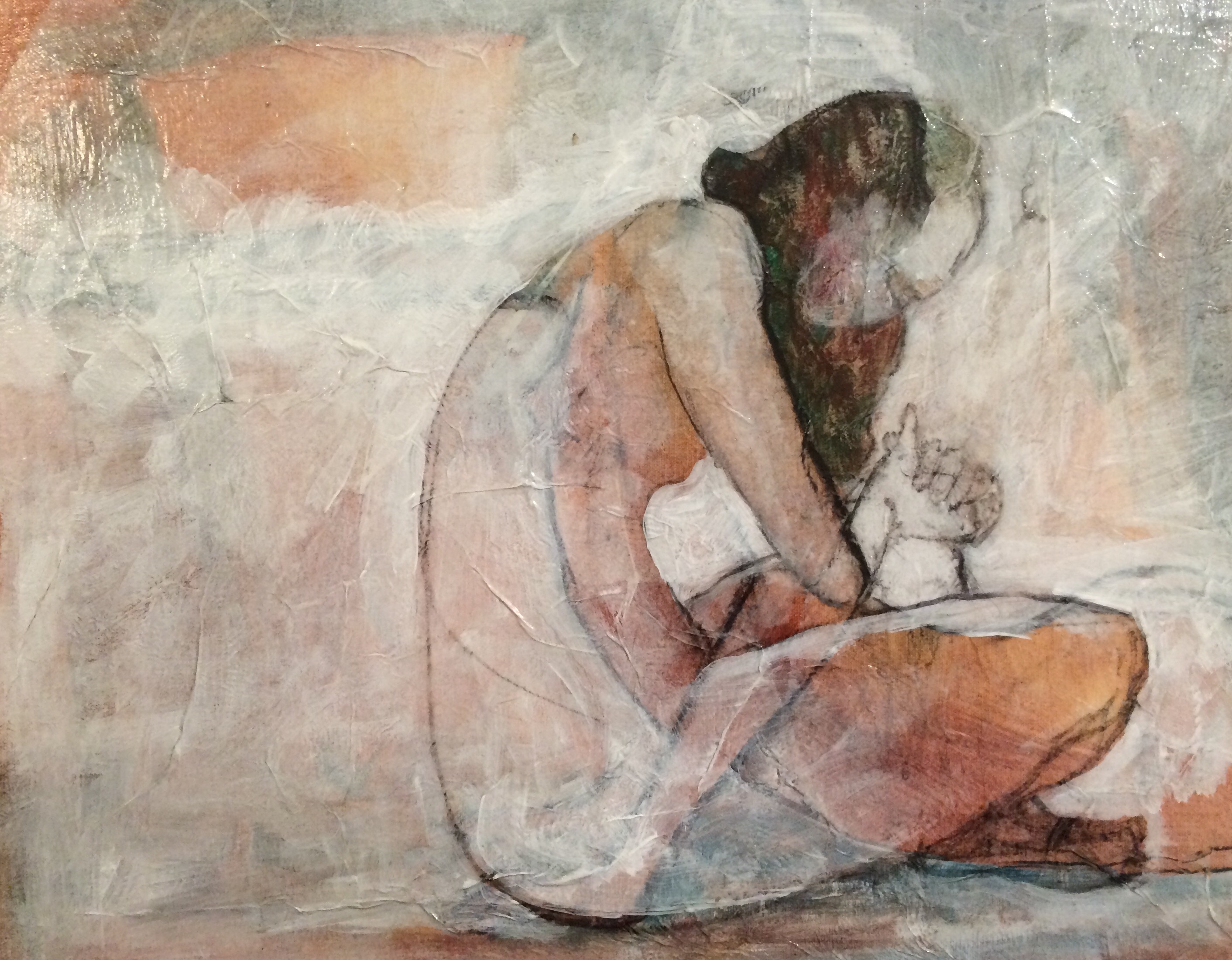
From the archives. This one often calls to me

From the archives. This one often calls to me

Save

Pass It Forward

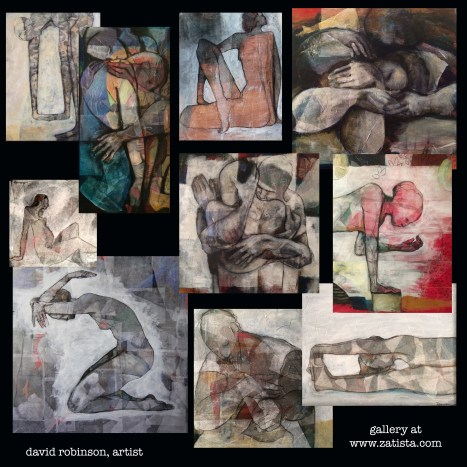
option2compilationartwork jpeg

david robinson at zatista.com

Picture It

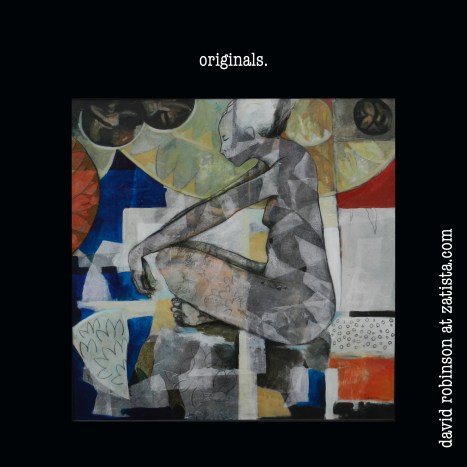
blogblast5 jpeg

david robinson at zatista.com

Bookmark It

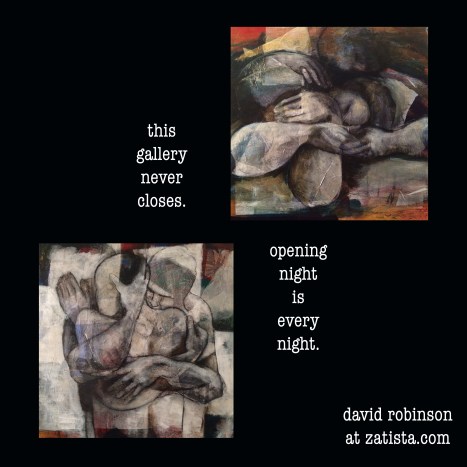
blogblast4 jpeg

painters never sleep. there’s always more to come.

david robinson at zatista.com

Walk The Gallery

blogblast3 jpeg

david robinson at zatista.com

Come See

blogblast2 jpeg

david robinson at zatista.com

Curate With Us

blogblast1unframed jpeg

david robinson at zatista.com

Save

Save

See The Present

photo-4From the stacks we pulled out every painting and considered it. A buyer, those rare and colorful birds that occasionally fly in unannounced, interested in my work generally, wanted a piece. He wanted a selection to choose from. The studio became a hodgepodge gallery organized around possibilities for purchase. I have digital images of every piece but our enthusiasm propelled us into the studio. It had been a long time since I’d spent time looking at the full body of my work.

“This one goes upstairs!” Kerri announced.

“Why?”

“It belongs in the Held-In-Grace series,” she replied.

The Held-In-Grace paintings are my newest series, each completed within the last 5 months. The painting she held was six years old. I told her it was old (obviously) and couldn’t possibly belong in a new series.”It belongs and it’s going upstairs,” she said, giving me ‘that look,’ saying only, “I think it is called PRAY NOW.” I know when I am bested. The old painting with a new name went upstairs to join the current series.

In its former life the painting was named JOHN’S SECRET. John framed all of my paintings during the Seattle years. He was one of those rare people that had no secrets. John was industrious, generous, practical, direct, and artistic. He was a collision of contradictions. He saved my artistic bacon more than once, showing up at just the right moment with just the right tool or just the right sentiment. He was as close to pure as a human can be. No pretense. No mask. No power game or hidden agenda. Just John. He was a rare ally, a consistent angel. I lost touch with him when I moved to the shores of Lake Michigan.

I named the painting JOHN’S SECRET to tease him. To tease me. “Someone’s whispering in your ear!” I quipped. “I’ll never tell,” he replied as he helped me fit the painting into the frame.

It is oddly appropriate that, at this time of my life, JOHN’S SECRET would be renamed PRAY NOW and join the HELD IN GRACE series. It has been too long since I spent time looking at my full body of work. I saw old pieces with new eyes. Some of the paintings deserve to step back into the light, to go upstairs and be seen. I found them surprisingly beautiful, something I would not have been able to admit a few short years ago.

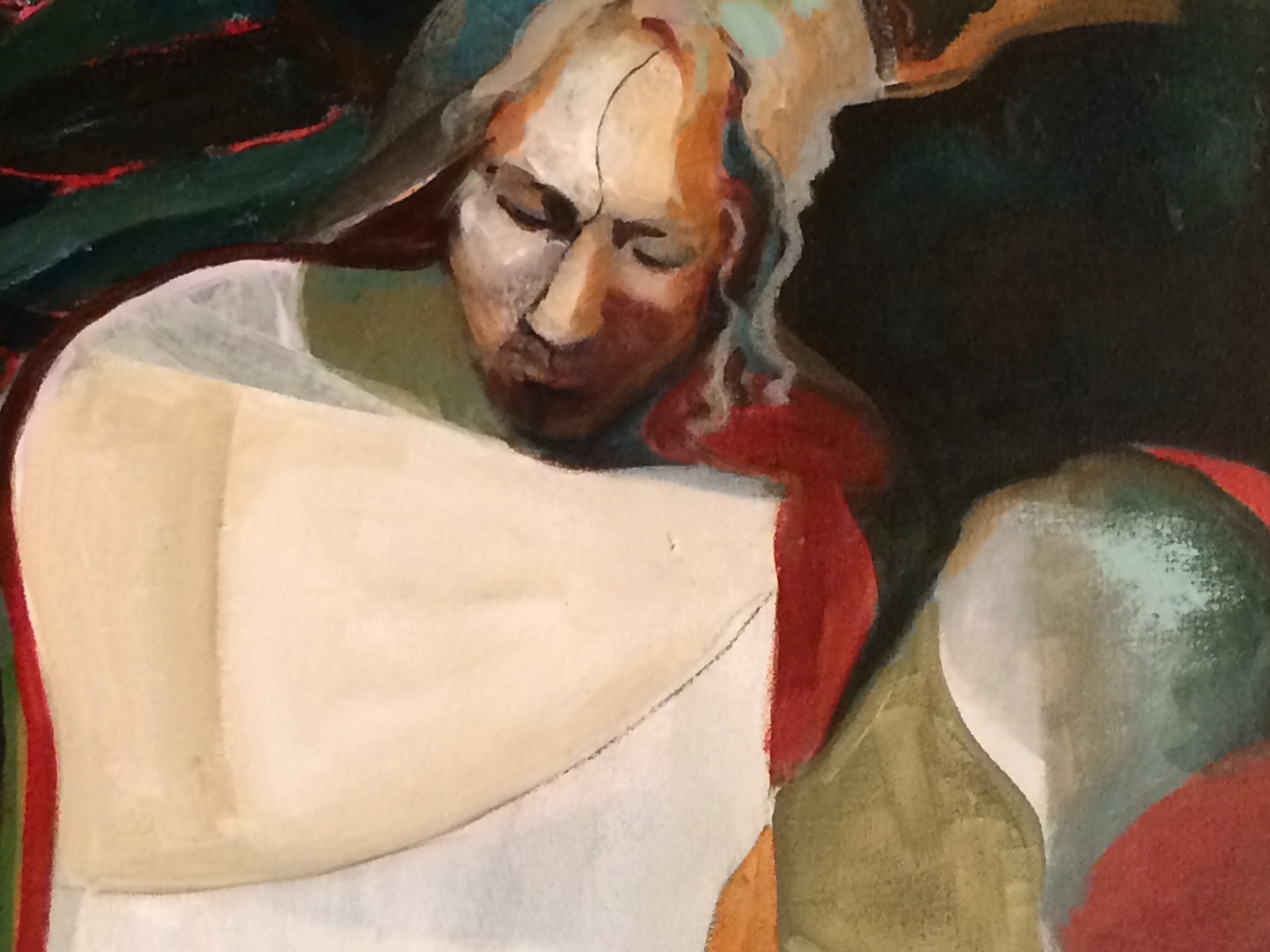
a detail

The buyer, it turns out, was a scam. He was not interested in my work at all. It took two days of negotiations for me to catch on; I am sometimes slow in the uptake. Buyers, those rare birds, it turns out, are truly rare. For a few moments I wanted to cry (only for the amount of time it took me to drink a scotch – “Pa told me to pour you this,” Kerri said when she saw the crush of scam-realization hit my heart and show up in my face). I took my scotch and my wound into the studio to restock the paintings and realized that the scammer had done me an enormous favor. He helped me look at the long-body of my work. He helped me see with new eyes the beauty of my previous life’s work, something that I had not before been able to see. And, he helped me recognize the great good fortune that surrounds me in my present life. He helped JOHN’S SECRET find a path back into the light of day, a new life, renamed – or perhaps, at long last, finding its true identity.

a detail from my painting, John's Secret


Save

Save

Save

Cut A New Path

ComfortNow

The latest in my Held In Grace series. This is Comfort Now

It seems to me that most of our days on this earth are spent moving through patterns, conscious or unconscious. These patterns are the rituals of our lives. Some of the rituals are easy to see. For instance, what is the sequence of actions you perform before going to bed each night? What about your ritual of rising each day? The care and feeding of Tripper Dog-Dog-Dog and Babycat are central to my rising and retreating rituals each day. We move through the same actions every morning and evening and I delight in the warmth of the ritual.

Some of the rituals are not so easy to see. Researchers tell us that most of the thoughts we think every day are the same thoughts we had yesterday. We mostly think in patterns (it makes sense once you recognize that language is constructed of category and pattern). We talk to ourselves, cutting paths through the forest of our minds and, once we’ve established a trail, we like to stay on it. Easy is often unconscious. There’s nothing wrong with staying on the easy trail if the path you’ve cut, your repetitious thought-ritual, is self-loving. The rub: ritual paths of self-loathing and self-limitation are also easy, well-worn paths and that makes them both unconscious and hard to leave.

Cutting a new path through the mind forest begins with recognizing that new paths are always available. They just aren’t easy to establish. They require new practices. They require surrender and the first bit of surrender necessary for cutting a new path is the ritual giving-over of needing-to-know-anything; new paths, by definition are unknown.

New paths are not comfortable precisely because they require attention, consciousness.

My teachers taught me that all stories worth telling are stories of transformation. The main character or characters will know something at the end of the story that they did not know at the beginning and the new knowledge will be hard-won. That’s what makes the story worth engaging. Hamlet is a much different character in Act 5 than he was in Act 1. His peace was difficult to come by. He had to learn to surrender. To cut a new path he had to make a practice of peace.

The same ideal applies to the stories we live off the stage.


Heed The Call

A detail from my painting, Will Is Belief

A detail from my painting, Will Is Belief

“It’s hard to explain to people,” said Chris. “I’m answering a calling. I know in my bones that I’m doing with my life exactly what I’m supposed to be doing. There is nothing else that gives me life. There is only this that I can give my life to. I don’t have a choice and that makes no sense to my family and friends.”

Chris is an artist, a brilliant actor. He acts because he needs to act and that is impossible to understand to those who’ve never had a soul-deep calling. It makes no sense to those witnessing the hardship his life path requires. His family and friends want him to have a better life. They want him to have a big home and two cars. They want him to have a back yard and a barbecue. What they can’t grasp is that Chris, like all artists with a calling, is acting from a selfless imperative. They aren’t doing it for themselves. They are not indulging an ego-need. They are, as Chris said, “creating to translate experiences for others.” Artists are meaning makers in a world that often makes no sense.

It is simple. Artists serve the force of unity in a world dedicated to the forces of division. And, that makes no sense.

Pastor Tom has a calling. He left a big salary career for the meager salary of a pastor because he could no longer ignore the inner voice demanding that he answer his call. It need not make sense because Pastor Tom can say that he answered God’s call. Chris’ calling is coming from the same source though, in our world, the connective tissue of his claim is not as easy to grasp.

Many people can draw, write, dance, act, sculpt, trumpet, and paint. A very few actually need to do it. They can do nothing else. Just as many people are capable of sermonizing and leading a church, it is the rare person who has to do it, who can do nothing else. Chris would wither if he did, as his elders suggest, leave his crazy pursuit and get a real job that pays real money and provides real stability. They do not know what Chris knows: stability has nothing to do with money or jobs that make sense.

Sense-making is a matter of the head. Chris is a servant of the heart.

There is a very powerful Hungarian film, called White God (though if you are a dog lover as I am you should probably steer clear). It is film about violence and suppression begetting nothing but more violence and suppression. It makes sense. In the final scene of the movie, when faced with a tide of horrific violence, a young girl pulls her trumpet from her backpack and begins to play. The beauty of her playing stops the unstoppable. It breaks the cycle of violence. It makes no sense: beauty has the power to extinguish violence.

Beauty has the capacity to unify a world dedicated to division and violence. This is what Chris’ call is all about. This is what he knows in his bones. It is the reason he gets on the stage for meager pay. It is the reason he spends his days going to endless auditions and producing plays on subway platforms and other places where few will ever stop and take notice. It is the reason a big backyard and sensible job make no sense. He is a servant to the power of beauty, the wonders of art, the necessity of illuminating unity amidst the madness of division. With this calling, all other paths are closed. They simply make no sense.