Especially Now [David’s blog on Two Artists Tuesday]

Dear You,

we are trying to regroup, rethink and refocus our melange blogpost writing a bit. we – like you – know what is really happening in our world and do not need one more person – including ourselves – telling us the details of this saddest of descents destroying democracy and humanity. though we know our effort will not be 100% – for there is sooo much to bemoan in these everydays – we have decided to try and lean into another way – to instead write about WHAT ELSE IS REAL. this will not negate negativity, but we hope that it will help prescribe presence as antidote and balm for our collective weariness. ~ xoxo kerri & david

***

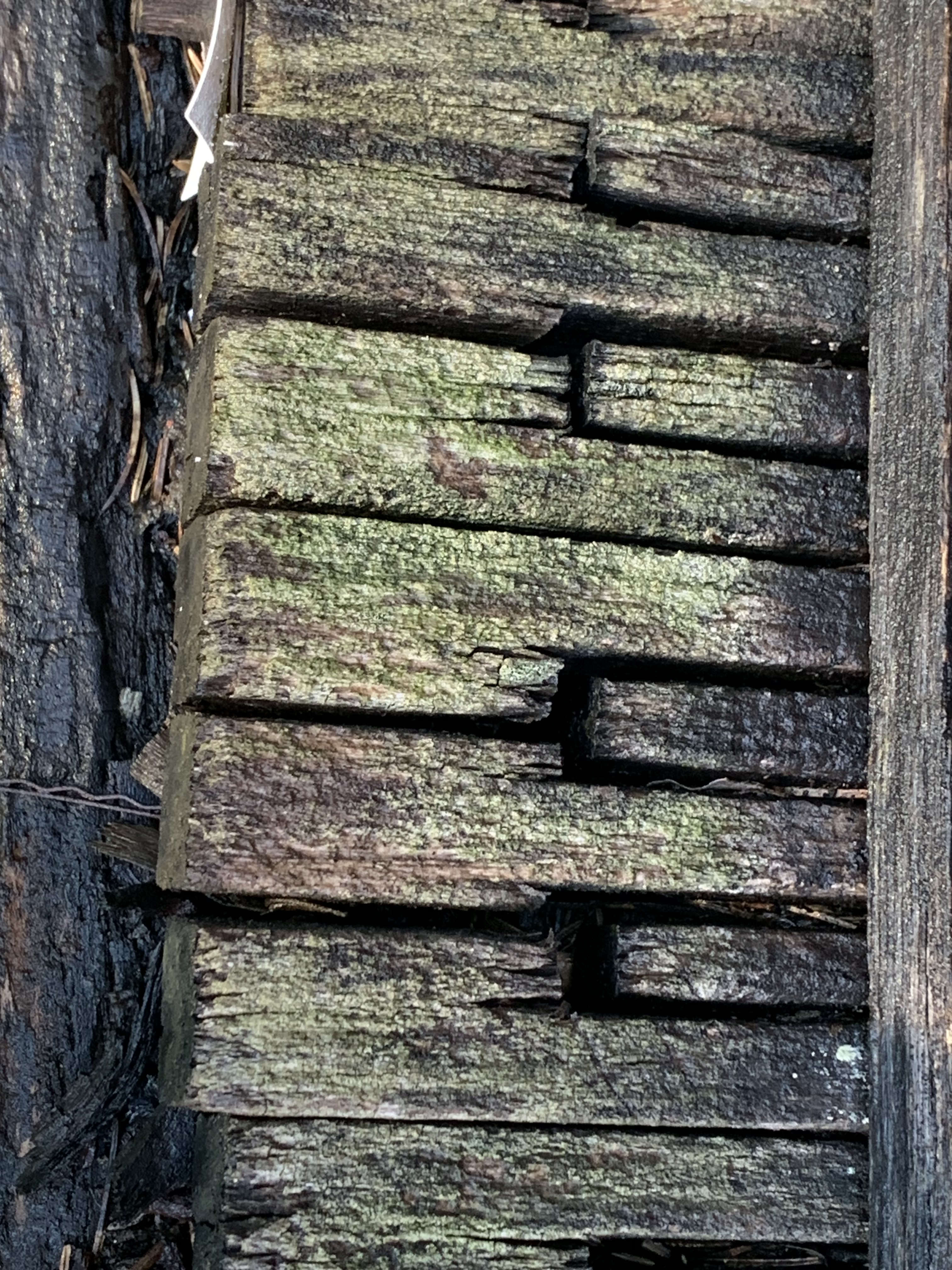
Sometimes what we see is obvious. Sometimes it is not. We showed this photo to 20. Kerri told him it was a painting. I told him it was a granite counter top. He narrowed his eyes. He knows us too well. It could be a photograph taken by the Webb telescope: the surface of an unknown planet or a particular slice of the galaxy analyzed through a monochromatic lens. What else could it be? A satellite image of earth’s weather pattern? A microscope image of lymph moving in the body?

Without context it is difficult – well, it is nearly impossible – to arrive at an agreement of what we see. And isn’t that the epicenter of the interesting times in which we live? Deceptive contexts. Most often dueling contexts. We do not wrangle over what we see; our fight is about context; the loss of shared context. We cannot agree on what we see.

His parents used the railing of the bridge to stretch after their walk. The young boy peered down into the water and said, “Yuck.” The family moved on. We stopped at the yuck spot and looked down. Pollen swirling in the slow moving river.

Kerri whipped out her camera whispering, “Gorgeous!”

Whose interpretation is correct? Kerri’s? The young boy’s?

Both. They share context so neither need be right or wrong. They agree on what they see just not on the aesthetics.

What else is real? It is a good question to ask. Especially now.

read Kerri’s blogpost about WHAT ELSE IS REAL

likesharesupportcommentthankyou

What Remains [David’s blog on KS Friday]

“Only to the extent that we expose ourselves over and over to annihilation can that which is indestructible in us be found.” ~ Pema Chödrön

The super moon called us out into the night. We ran-walked to the grounds of the Anderson Art Center so we might get an unobstructed view of the giant moon perched just above the horizon. Later, we walked the streets and paths that followed the shore so we could watch the moon shrink as it journeyed higher into the sky. An illusion.

My favorite part of our stroll was finding that we weren’t the only people called into the night. People – many people – gathered along the shore, some quiet, some giddy – all attending the march of the moon. “This is just like the old days,” Kerri said. A community joining together to share a common experience. No one cared about the politics or issues of the day. There was a common agreement as we passed others: “Isn’t it beautiful!” Strangers so moved by the enormity of the moment, so connected to this ancient traveller, that they were compelled to speak to each other.

Think about it.

The little stuff disappears in the face of the transcendent moon. I felt as if we were participating in a ritual that is as old as humanity. And, more to the point, this ancient ritual, the awe of the moon, invoked our humanity. We were, to a person, benevolent. In the timeless moon there was no space for the petty. There wasn’t a hint of righteousness or prejudice to be found. We waned in the face of the eternal light of the moon. What remained was a basic impulse to share the moment. To join. Primordial generosity. Kindness sublime.

It’s a Long Story/ This Part of the Journey © 1998/2000 Kerri Sherwood

Kerri’s albums are available on iTunes or streaming on Pandora

read Kerri’s blogpost about THE KEYS

like. share. comment. support. subscribe…thank you.

See Like Seuss [David’s blog on KS Friday]

If you’ve ever pondered where Dr. Seuss got his idea for the fabulous hairstyles on many of his characters, look no further than the dried flowers in the field. Thing One and Thing Two wave to us as we walk by. The Grinch wrinkles his nose and grins.

Of course, I made that up. I have no idea where the good doctor found his inspiration. It’s a good bet that he, like most creators of characters, found a visual spark from the crazy shapes and wild styles in nature. I look at the zany filaments of this yellowing pod and see a cartoon henchman, narrowing eyes beneath a spiky do. Of course, my henchman, like all good cartoon thugs, has no real power. He likes to think he can intimidate, an omega with alpha delusions. It’s what makes him lovable. I’ll name him Thistle.

I personify everything. Projecting my human-ness on everything is a quality that identifies me as uniquely human. We see angry volcanoes. Trees that talk. Cartoons animals are a festival of personification. Wily Coyote. Humorless gods in the sky. A cat in a hat. Mother Earth.

We are a miracle of creativity, whether we recognize it or not. Projecting ourselves, infusing our fears and fantasies, the sacred and profane, on every mountain, rock and weed. Even on other people. What we see is…what we see. A creative lens. Is it any wonder we’ve filled volume after volume seeking but never finding truth? Agreement is the best we can do.

Now, if you’ll excuse me, I think I just saw a fox in socks…

transience/right now © 2010 kerri sherwood

Kerri’s albums are available on iTunes and streaming on Pandora and iHeart Radio

read Kerri’s blogpost about THISTLE

like. share. support. comment. see like seuss. imagine the possibilities. we thank you.

buymeacoffee is an animated feature length movie comprised of characters drawn from nature who unwittingly support the artists that drew them. It’s a must see.

Turn Around And Look [on DR Thursday]

One little line gives reference to the whole. The horizon line. It is how we naturally – visually – orient in space. It is a baseline of perception. It’s the beginning of discernment.

It is a line that disappeared.

Among other things, art is a reflection of its time. In the past century, art leapt into the abstract. We are “post-modern”. Expressions of personal fantasy rule over community truth, a breaking apart of shared ideals, instant doubt of objective theories…we are mirrored in post-modern art. What is art? What is it not? There’s not a whit of agreement to be found.

General distrust is the beating heart of the post-modern ideal. Division, aggression, tribalism, conspiracy…are its blossoms. Our children perform active-shooter-drills in school; a performance we shudder to attend while our leaders smile and look the other way. Post-modernism at its finest. The absence of a baseline.

Shared truth, group trust, community…requires an undeniable horizon line.

What is up? What is down? What has value? What does not? What has merit? What is undeserving? There is a line. Where is it?

Walking through the antique mall, Brad and I discussed chatGPT. I’m playing with it; he’s using it in his work. It’s raising some very big questions. The questions are not new. They are the next step in a series of questions people have been asking for the past 30 years: what is true? A photograph was once proof that something happened. That hasn’t been true for a few decades. A video was once proof an experience occurred. That is no longer true. News – a word that once implied the accurate reporting of an event. No more. No horizon line.

Brad and I turned our discussion to a sorely missing quality in our times: discernment. In the absence of a horizon line, people will – and do – believe anything. We speculated that, with the introduction of chatGPT into our world, perhaps discernment will once again become important. Perhaps the complete absence of a truth-anchor will turn us toward a common center and require us to look at each other, to seek and restore general trust. The post-modern tide will someday turn and we will draw an old/new line in the sand: we’re-all-in-this-together.

I know, I know. Pie-in-the-sky. However, I’d like to point out that shared dreaming brought us here. Shared dreaming is how we stood on the moon. It is how we can talk to someone across the planet using a small device that fits in our pockets. When a dream becomes shared it becomes powerful. Manifest. A shared dream is a form of a horizon line.

If a shared dream isn’t powerful enough to establish trust, try remembering the other one; the original line of discernment. The line that invites curiosity. It need not be debated. Turn around and look. The horizon line is everywhere.

Four-by-Four, 48x48IN, acrylic, (sold)

read Kerri’s blogpost about THE HORIZON

4×4 © 2007 david robinson

Speak Double Speak [on saturday morning smack-dab.]

I’m a big-picture-guy. Kerri is a detail-girl. And, although that sounds like a great country music lyric, it makes for some interesting conversations. We can talk about the same thing and never know it. Or, we can talk about diametrically opposed points of view and think we’re in utter agreement.

With my head in the clouds, I often have to talk things out. Sense-making happens for me when I can get thoughts out of my head via my mouth. One day, a few years into our relationship, while I was in mid-yammer, Kerri looked at me and said, “Gear down.” It had never occurred to me that I might have to find a lower gear when climbing steep-thought-grades. “Gear down” has become a relationship-saving-shorthand.

Her other defense mechanism is to tune me out. I know I need to stop-talking when I see white noise behind her eyes. When I try to pull her into my hot air balloon for a higher view, her detail mind has learned to spin the knob and find another station.

I float to the sky and look at the future. She drops roots into the moment. It’s a wonder that she hasn’t smothered me with her pillow or pushed me out of the car.

read Kerri’s blog post on this saturday morning smack-dab.

smack-dab. © 2021-2 kerrianddavid.com

Disagree [on Merely A Thought Monday]

Months later, she* is still angry with me. I asked her to “stop blowing me off.”

Some things need to be discussed and necessarily require entertaining differing points of view. Finding middle ground or considering alternate possibilities requires hearing what others have to say – and giving others the courtesy of hearing what you have to say. Her standard phrase of choice, when faced with an opinion or idea not her own, is this: “I guess we’ll have to agree to disagree.”

No. I don’t agree to disagree. Especially at the onset of a dialogue. I want to talk about it. I want to hear what you have to say and more importantly why you hold your point of view. I won’t agree to not hearing or being heard.

Opposing points of view, differing opinions, need not be conflicting. They can be highly generative. Mind opening. Thought provoking. “I’ve never thought of that,” is an expression that results when considering a different point of view. In ideal, our nation is based on the notion of two opposing points-of-view extending to each other the courtesy of listening and considering possibilities not yet seen. Yep. And, we are witness to what happens when one side (or the other) rejects the basic premise. Dismissiveness is the strategy of an empty suit.

Why assume conflict?

She followed “I guess we’ll have to agree to disagree,” with the real statement, her actual aim: “You do what you want. I’m going to do what I’ve always done and follow my plan.” In other words, she had no intention of hearing anything that did not support her plan. Why, then, I wondered, did she invite conversation?

When the only tool you have is a hammer, then everything looks like a nail. When the only door you have is a closed door, then every knock sounds like an intruder.

I laughed aloud when I read Bill Murphy’s article in Inc. Magazine about his pet-peeve phrase: “Look, I get it.” He writes, ‘”Look, I get it,'” is almost always inherently untrue…Even worse for our purposes, it’s woefully ineffective.”

It’s dismissive. Just as is “I guess we’ll have to agree to disagree.” The agreement she wanted was for me to agree to be dismissed. An agreement of silence. Why would I – or anyone – agree to that?

[* “She” is not Kerri. We hold each other in high esteem. It’s why the sign in our kitchen reads, “You are my favorite pain-in-the-ass.” We welcome our differing perspectives. Neither one of us dismisses the other nor tolerates being dismissed.]

read Kerri’s blog post about “LOOK, I GET IT.”

Miss The Point [on saturday morning smack-dab.]

Kerri is a detail girl. I’m a big-picture guy and generally live at 30,000 feet. It is common for us to have conversations about diametrically opposed topics and think we are talking about the same thing. It is also common, when we have a spat and are in mid-turmoil – to realize that we are, and have been all along, in absolute agreement. We’re simply looking at the same elephant from radically different points-of-view.

It is the reason that one of the most oft-spoke phrases in our house is: Wait! What are we talking about again?

read Kerri’s blog post about YELLOW AND GREY

smack-dab. ©️ 2021 kerrianddavid.com

Start Here [on Flawed Wednesday]

Let’s start here: a strange attractor. “Chaos has its own pattern, a peculiar kind of order.” This magical definition pairing chaos and order is from the good folks at Merriam-Webster. They provide definitions of words. Words are a collection of symbols, called “letters,” assigned to specific sounds which, when placed in a sequence, carry meaning. For instance, D-O-G points to something unique and different than, say C-A-T. A collection of words placed in a sequence carries even more complex meaning. Dogs chase cats.

Thought. Expression. It’s nothing short of miraculous if you think about it. And, if you are thinking about it, you, too, are a carrier of meaning. The symbols and their sequence are useless without me and you, reaching to each other, agreeing on the general meaning of the sequence of sounds. And, more to the point, we not only carry but we create meaning. With our magical sounds-in-sequence we are capable of generating the high art of story, the supreme gift of understanding each other. We can reach each other, touch each other, move each other. We can find each other with our words. We shape each other with our words.

From the chaos of all-possible-sound, to the pattern of word and alphabet, to the order of sentence, to the power of story. Anyone who tells you that they are not creative is missing the point of their existence.

I suspect the power of story is infinitely more powerful than we might realize. We take it for granted, this extraordinary capacity, this glorious gift. You’d think we’d have more appreciation for our high art of language, our transcendent ability of speech. You’d think we might honor and protect truth and fact. They are the compass, the map through the forest of all possible tales. You’d think we might use our most powerful accomplishment to find, or better yet, to create shared ground. Common good is an intention, a creation.

You’d think.

There’s a vast difference between disagreement, conflicting points of view, and lie.

The point of a disagreement is to find agreement. After all, single-point-perspective begins from two disparate points of view. It is a “coming together.”

The point of a lie is to mislead. To deceive. To create false impression. False ideals. To foster disagreement. It is a tool for exploitation. It is meant to render apart.

Because we so easily sequence our words, pattern our thoughts, we are capable of using our magic, our ordered language to create…order. We are also capable of using it to create chaos. Disorder.

To help. To hurt. To accomplish. To disrupt. It’s a matter of intention. The direction of intention. How do you intend to use your precious gift?

The real power comes when we learn to think beyond our belief. To question. To ask.

The first rule of education, an essential rule in shaping precious words into thoughts, into actions, is simple: check your sources. Make sure the story you’re embracing, the piper you are following, arises from a well spring of good intention. That it has an ethical center. Check that it seeks to clarify and reach rather than obscure and demonize. Check that your thought-house is not built on a lie.

Check your sources. Of information. You, too, are a source of information, so…check your sources.

With our most powerful capacity to pattern, to create, to think in words and sentences and stories, we can be a carrier of the lie-virus or we can be part of the cure. Reach or reject. It is our choice, through how we use our miracle words and language, what we agree to create together.

Let’s start here.

read Kerri’s blog post on AGREE

Think “And”

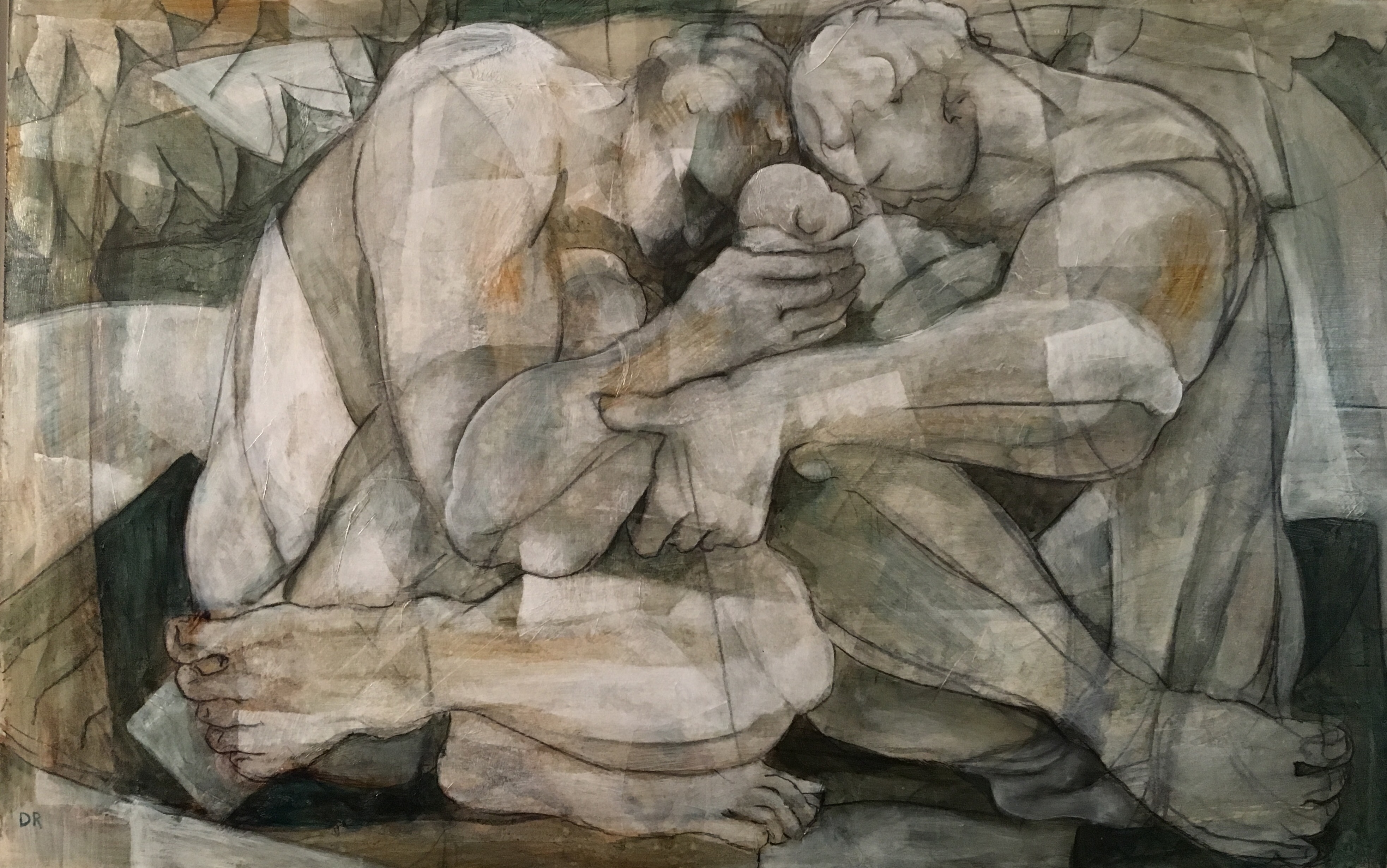
a second version, a second point of view of my painting Shared Fatherhood

I suppose it is the great trap in human nature to define life through oppositions. Was your experience good or bad? Are you liberal or conservative? Are you your brother’s keeper or is it every man for himself? Oppositions provide the illusion that there is a right way or a wrong way, that any issue can be reduced to a simplicity, a singular path. One way. Oppositions are great language devices for dictators and the righteous. They remove the grey tones and blunt the grey matter. With an opposition, us or them, “god” can be exclusively on your side (a small god, indeed) which self-grants permission for all manner of abuses enacted by “us” on “them.” The problematic word when employing oppositions is “or.”

“And” is a much more useful (and honest) term to employ when dancing with oppositions. Can you be your brother’s keeper AND take care of yourself? Certainly. Can you survive entirely by yourself without the participation of your brothers and sisters? Certainly not. No one lives in a vacuum; “or” is the great creator of illusory vacuums. “And” guarantees a conversation and perhaps a host of useful, challenging and robust perspectives. Both/And is always more functional than Either/Or.

AND the first version of Shared Fatherhood

The snag in “Or” is that there is very little truth in any reduction that ultimately lands on just One. This or that. All life is movement and all movement stops in One. Creative tension requires at least two points and a desire for someplace place to go. There is no single arrival station in real life. There is no achievement that stops all the presses. Every answer inspires new questions. Each question opens doors to multiple possibilities. Agreement is a fluid target at best and must be nurtured. Compromise is never an end state; it is a relationship imperative. Life is never found in the static “or.”

Do an experiment: go to the grocery store, choose any item and ask yourself how many people it took to bring your chosen item to the shelf at that moment. If you are not astounded by the complexity of participation, how dependent we are on actions of others, your imagination has most certainly failed you. Skip, entrepreneur extraordinaire and mentor to entrepreneurs taught me that a business cannot succeed until it serves its customer’s customer. Note the word “serves.” Businesses serve. Not simply a customer but the complexity of a customer’s customer. Entrepreneurism is a service to the creative genius of a community and multitudes of communities beyond.

Entrepreneurism, like artistry, ….even, yes, like governance…like all things vital, moving, complex and growing, live in service according to the good graces of AND. Anything else is a mirage.