Blur The I [on Not So Flawed Wednesday]

We capture quotes all week. Some we see. Some we hear. Some find their way into the Melange. Most do not. We usually note where we heard or found the quote so we remember the context. It’s a practice. It’s not as if we are perpetually eavesdropping on conversations. We’ve simply tuned ourselves to immediately write the amazing words and phrases that catch our attention.

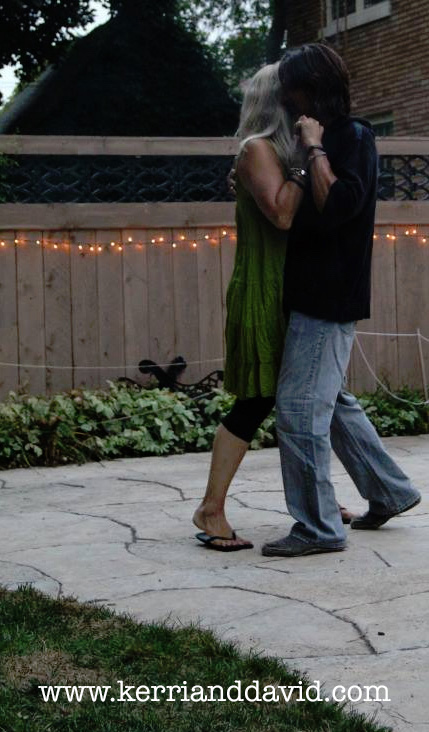
A common phrase is mind-over-matter. Athletes and actors and dancers are conditioned to ignore the limits of their bodies. To keep going. The mind as master over body. I loved this quote because it is the flip side. The mind, the “I”, wanted to stop but the body did not listen. It kept going.

Lately I’ve been reading about – so, paying attention to – the false separations that language necessitates: Mind and body are spoken of, thought of, as separate things. And, the question is this: where does one begin and the other end? Mind over matter. Body did not listen. I made myself do it. Once you start listening for it, it is ubiquitous. Exactly where is the line between “I” and “myself”? When your toe is in pain, isn’t your whole body is in pain? Follow your gut. What does your heart say?

When Dogga gets excited, his little body bounces. He runs in circles. He has to work hard to sit still. Say, “Do you want to go…” and he’s bouncing before the words “on errands?” reach his ears. He knows he won’t actually go on errands until he first sits on the rug. Eventually, he bounces his way into compliance. Control follows unbridled enthusiasm. Control is a means to an end. Rug before errands. Sit before snack.

Dogga might say, while bouncing enthusiastically, “I wanted to stop but my body kept going!”but I doubt it. Given his unified happy spirit, I’m certain the phrase would come out of his muzzle this way: I wanted to stop but I kept going. Watching him is like reading the I-Ching: no separation.

read Kerri’s blogpost about I AND BODY

Feed It [on KS Friday]

“The devaluation of music and what it’s now deemed to be worth is laughable to me. My single costs 99 cents. That’s what a single cost in 1960. On my phone, I can get an app for 99 cents that makes fart noises – the same price as the thing I create and speak to the world with. Some would say that the fart app is more important. It’s an awkward time. Creative brains are being sorely mistreated.” ~ Vince Gill

I am the first in line to tell you that everyone has a creative mind. Everyone. That river of ridiculousness running between your ears is nothing other than creativity-run-amok. What else? Telling yourself that you are not creative is, in itself, a creative act. Seeds planted early in life grow into mighty obstructions. Creative wastelands are created. If you want to hear a terrific appeal to educators to nurture rather than stifle the creative mind, listen to Sir Ken Robinson’s 2006 Ted Talk. It’s appropriately titled “Do Schools Kill Creativity?”

I’ve listened to numerous school boards tell me how much they truly value the arts – until it’s time to pay for it. Sadly, it’s not a question of whether or not they value the arts; it’s that the arts, the creative minds, do not fit any of the standards of valuation against which all things are measured. They do not know how to value the creative minds that they steward. Arts organizations and artists, mostly, are not money makers. Creative minds, creative acts, do not fit in the boxes and are not measurable on standardized tests. Thinking outside of boxes is, after all, the point of a creative mind. Metrics and goals stop a creative mind and heart in its tracks. The cruelest thing you can ask any artist to do is write a grant.

And yet, an artist has to make a living. Yaki asked me if I had to choose between making a living and making my art, which would I choose? I answered, “Art, of course,” but that it was really a question of Maslow’s hierarchy: it’s hard to make art when you are not surviving. What I didn’t say is that his question perfectly captured the reason schools kill creativity and creative brains are sorely mistreated: it is assumed one must choose between. Making a living and thriving creativity are understood as oppositional.

How many parents have tried to dissuade their children from following their passion for the arts? How many times have I heard Kerri say of the stacks of music on her piano waiting to be recorded, “What’s the use?” How many times have I sat in my basement studio looking at my stacks and rolls of paintings and wondered, “Why bother?” We do it to ourselves, too.

And then, the phony metric falls and we breathe, pick up our brushes and sit at our keyboards. There is a river of riches that runs deeper than money. It is, after all, a creative act to kill a passion. It’s also a creative act to feed and nurture an artistic soul. Both. It’s what the school board doesn’t understand: the choice is not between making a living or living as an artist, the choice is between feeding inspiration, expanding a creative mind, or smothering it.

read Kerri’s blogpost about CREATIVE MINDS

Kerri’s albums are available on iTunes and streaming on Pandora

watershed/as it is © 2004 kerri sherwood

Wander In Wonderland [on Two Artists Tuesday]

I’ve re-read his email several times. Skip’s explanation of the development of the computer. Subject/Object. Noun/Verb. Items/Action. It’s a story of cause and effect. This causes that. I’ve learned more from this single email than from my very expensive graduate degree. And, it’s sent me down the rabbit hole and I am currently in a world easily as miraculous as Alice’s Wonderland.

Does the moon cause the tides? It does if you are an English-speaker. Causation is the foundation structure of the English language. An action needs an initiator. The noun is king. He kicked. The sea rocked the boat. The moon causes tides. If you speak Mandarin, the moon and the tides are inseparable, not perceived or described as separate events but as interconnected. The same dance, differentiated forms.

Where does an action begin? A consequence end? I warned you. A rabbit hole.

Our perception of the world has everything to do with the language we use to describe it. Our creating of the world has everything to do with the language we use to imagine it. In a world where actions are separate from items, verbs from nouns, this causes that, it’s easy to believe that order is separate from disorder, cosmos is separate from earth, humans are separate from nature. Death is separate from life. Is it?

Each year that passes I’ve noticed the world of written communication includes more emojis and fewer words. Attention spans are shorter – mine, too. Tweet and text. Images carries the bulk of the message. If you could see the analytics on my blog you’d note that if I use more than 600 words, you are less likely to read what I write. We are slowly moving toward ideograms and slowly away from alphabets. Whatever will we do, what might we see, when nouns and verbs blend into image? When the eyes of dedicated separation begin to see through the eyes of interconnectivity – or, as Skip says, “When actions become central.”

It’s called a Wolf Moon, I read, because wolves are particularly loud and vocal during the first months of the year. One questioner asked if the moon causes the wolves to howl. Noun/Verb. Subject/Object.

read Kerri’s blogpost about THE WOLF MOON

Point The Way [on Merely A Thought Monday]

“You can accomplish with kindness what you cannot by force.” ~ Publilius Syrus

It’s one of the most interesting Wikipedia pages I’ve come across. Publilius Syrus. A life described in two sentences that conclude with this: “…but by his wit and talent he won the favor of his master, who freed and educated him. The rest of the page are maxims attributed to him. A Syrian. A Roman slave. An observer of human-kind.

We live in a world of ubiquitous maxims. They are posted everywhere, in stores, billboards, and elementary school signboards. Appeals to our better nature. Choose kindness. There are, of course, plenty of appeals to our worse nature, too. It’s as if our maxims are in a tug-of-war. I imagine that Publilius Syrus experienced in his short life both ends of the rope, the cruel and the kind, which is why he wrote so many maxims.

This quote came across my screen so I wrote it on a lilac colored post-it note and stuck it to my monitor. It may or may not be from Christina Wodtke: “When you make complex things, words eventually fail.” Life is a complex thing that words will always fail to describe or contain. The best a word can do is point to something, or the way to something. A maxim, an ideal, is, after all, a signpost, a direction. A choice of path. A point-of-view is created during those moments of choosing.

Kindness is not a thing. It’s not a word – not the word. The word simply points the way to something so complex, so boundless, that the word will always fail. But, we know it when we see it. We know it when we offer it. We know it when we receive it. We know with certainty when we choose it and when we do not.

read Kerri’s blog post about CHOOSE KINDNESS

Speak Double Speak [on saturday morning smack-dab.]

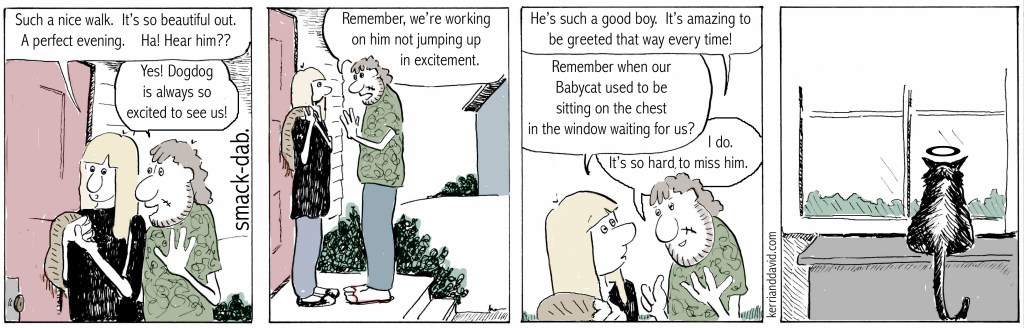
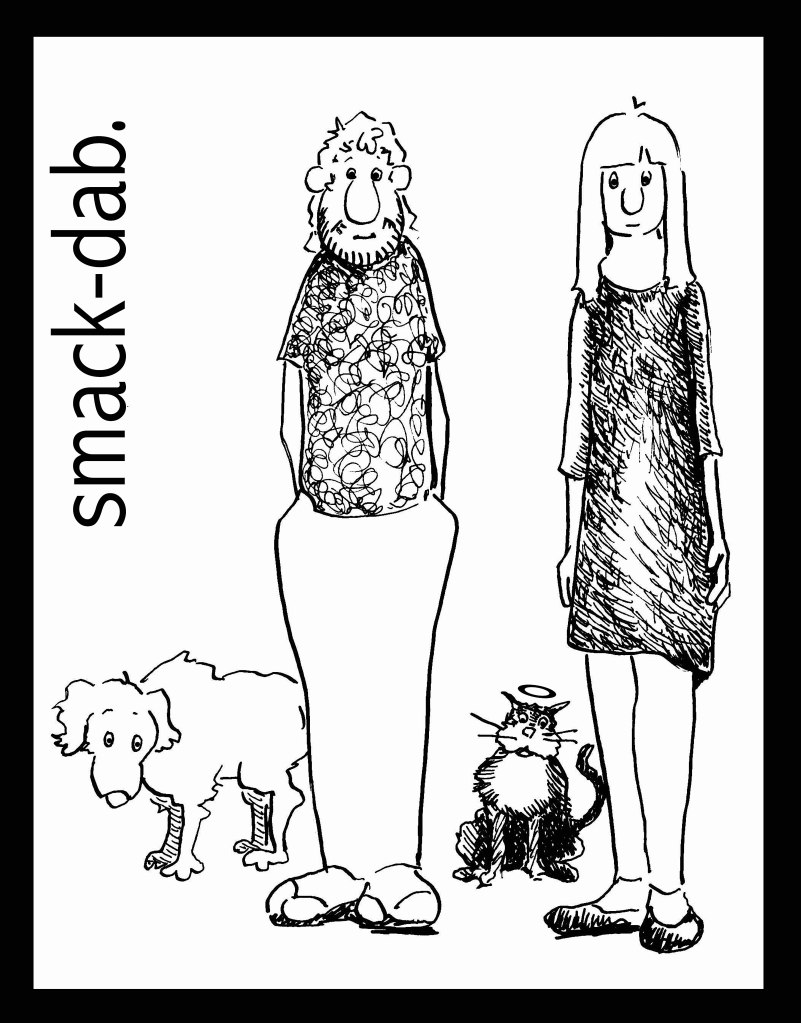
I’m a big-picture-guy. Kerri is a detail-girl. And, although that sounds like a great country music lyric, it makes for some interesting conversations. We can talk about the same thing and never know it. Or, we can talk about diametrically opposed points of view and think we’re in utter agreement.

With my head in the clouds, I often have to talk things out. Sense-making happens for me when I can get thoughts out of my head via my mouth. One day, a few years into our relationship, while I was in mid-yammer, Kerri looked at me and said, “Gear down.” It had never occurred to me that I might have to find a lower gear when climbing steep-thought-grades. “Gear down” has become a relationship-saving-shorthand.

Her other defense mechanism is to tune me out. I know I need to stop-talking when I see white noise behind her eyes. When I try to pull her into my hot air balloon for a higher view, her detail mind has learned to spin the knob and find another station.

I float to the sky and look at the future. She drops roots into the moment. It’s a wonder that she hasn’t smothered me with her pillow or pushed me out of the car.

read Kerri’s blog post on this saturday morning smack-dab.

smack-dab. © 2021-2 kerrianddavid.com

Connect The Poles [on KS Friday]

Though it is not, this could be a close-up of an x-ray. Arteries carrying blood away from the heart, veins carrying blood back to the heart, and the capillaries that connect the them. Outgoing. Incoming. And the connection between the two. And, as is always true of language, in the naming and the action-describing, the whole system is obscured. This part does this. That part does that. Mechanical mind applied to a miracle of pulsating life.

In North Carolina I overheard an old guy grousing about climate change. He is a sceptic. “There’s record snow in California!” he decried, “And, we’re having record heat here! You can’t have it both ways!” His reluctant listener bobbed her head. “It’s either warming or it’s not!” he railed. “Explain that to me!” Mechanical mind. Parts-thinkers cannot see the whole system. The capillary-word that tumbled from his mouth but bypassed his mind was “record.” The poles are, after all, connected.

I am fascinated by my current work. I am witness to and a participant in the creation of software. The language is familiar though the meanings are new: epic and story. Bug. My mind, lately, has been awhirl. The developers necessarily talk of information as content-objects. Items. The language of “fixed” things. Yet, the problems in the world that they design and solve for are “fluid.” Information, in our day-and-age, never stops. It grows exponentially everyday. It is movement, constant motion. More/faster. Sometimes I get a glimpse behind the curtain and see the developer’s work of content-items-in-motion. You’ve never seen a faster moving current of symbols. Is it a particle or a wave? It depends.

The tree in our front yard reaches toward the house. Kerri tells me that our children climbed through the branches when they were young. When the crew had to clear some branches to trench the yard, Kerri winced each time a branch snapped and fell to the ground. “I can’t look,” she said, not taking her eyes off the tree. Holding vigil. Holding her heart.

It’s easy to forget that, in all cases, no matter the eyes though which we see, the movement is always back to center. To the heart-of-the-matter. The pieces are never isolated. This tree is not separate or distinct from the sky or Kerri’s heart. The poles are always connected, whether we recognize it, see it, acknowledge it, or not. Breathe in. Breathe out. Two actions or one?

read Kerri’s blog post about THE TREE AND SKY

Kerri’s albums are available on iTunes or streaming on Pandora

Share Appreciation [on Not So Flawed Wednesday]

“I’ve got an old mule and her name is Sal
Fifteen miles on the Erie Canal”

~Low Bridge, Everybody Down, music and lyrics by Thomas Allen, 1913

She’s a donkey, not a mule, yet I couldn’t help but appreciate the collision of power sources present in this photograph. From donkey to solar.

I’ve read that the innovations of the industrial age were meant to spare humans of muscle-toil. If an engine could power it, a human didn’t have to. The innovations of the information age are meant to spare us mental and sense toil: why stress to parallel park your car if the car can do it all by itself? Why add the numbers if the spreadsheet does it for you? Why look up information if Siri or Alexa can bring it to you? What does it now mean to stay in touch? Text and facebook and tweet and email and zoom and facetime and slack and chat and…call.

Oil, coal and gas are the energy systems of the past. They are donkeys and mules standing next to renewable energy sources like wind and power. It takes time for an infrastructure to be built. It takes time for people to wrap their imaginations around a different way. Do you remember the loud resistance in the early days of the credit card proclaiming that plastic would never replace paper money? That was not so long ago. There were similar angry voices declaring the auto-mobile was a flash-in-the-pan. “Nothing will replace the horse!” Our local supermarket just installed banks of electric car charging stations. Energy systems are slowly moving away from grids: the power source and the property will (mostly) be one and the same.

Industries, like people, either adapt or die. Most retail chains that came late to online shopping are going or already gone. Many have said that they didn’t see the change coming. Or that they couldn’t imagine a world in which people bought stuff without first touching it. Cars are in vending machines. Isaac Asimov would have loved it!

Did I mention that the solar panel in the photograph senses and moves with the sun? As it turns out, the donkey does, too. Much for the same reason. Only, for the donkey, the heat of the sun feels good and I doubt the solar panel cares or feels anything. Sensing and feeling are still on opposite sides of the change-line. At least so far. There may come a day in the not-so-distant-future that the donkey and the solar panel share appreciation for the heat of the sun. The donkey will wag its tail. The solar panel will stretch and sigh. The stuff of children’s books or sci-fi. At least for now.

read Kerri’s blog post about DONKEY & SOLAR PANEL

Color The Language [on saturday morning smack-dab.]

In the cartoon version of our life, Kerri cleans up my language. I never use the word “beeswax” when there are more colorful options available. I’m an artist. Color is my thing.

It’s hard to explain the inner imperative that drives an artist to spend their precious life composing or painting or dancing, even amidst the knowledge that heeding their inner call might never pay the bills. I know many, many people who’ve snuffed their artistry because it simply doesn’t make financial sense. They are now like boiled fish. The ‘”good living” that they make doesn’t replace the vitality-in-life that they ignore. Source is source.

I also understand that the answer, “Because I have to…” must sound childish to someone who has never operated out of an inner necessity or something more meaningful than making-money. I actually understand their eye-roll and less-than-subtle-but-always-predictable response about the need to “take responsibility…” They’re really saying, “Grow up.”

What I’ll never understand is the gap. For instance, Kerri’s music is all over the world. She is regularly stopped on the street or contacted by people who reach to tell her that her music moves them, touches their souls, makes their day, opens their hearts, calms their fears… And, then, she’s asked what’s she’s really going to do (for a living). Or, better, if she’ll play for free. Or why it bugs her that Pandora or Spotify make money – lots of money – on her music – and that is the reason why she is not. The gap between those two poles is…mind boggling. And, into the gap, the question is always dropped: What are you really going to do?

So, I paint the question with vivid colorful language because it makes my love laugh but definitely needs scrubbing before publication.

read Kerri’s blog post about BEAUTY

smack-dab. © 2021-2 kerrianddavid.com

Look Down [on DR Thursday]

To all the rugged individualists out there living under the grand illusion that you are blazing a new trail, I have only one thing to say: look down. Someone has been there before you. It’s why there’s a path. And, more to the point, someone – a crew of someones – worked very hard to make and maintain the trail you now tread. It’s true in the forest. It’s true in the big-bad city. Every time we flick a switch and the lights come on it might not be a bad idea to recognize how many people were – and are – involved in the maintenance of our comfort and our self-reliance-fantasies.

On the Pink Bed trail there’s a boardwalk that elevates hikers over the swampy sections. I stopped in utter admiration at the section that took a hard left. Someone – a crew of someones – spent a long time making my corner not only easy to walk but beautiful. Certainly there are more efficient ways to build a turn in a boardwalk and they could have chosen any number of simpler solutions but they didn’t. They took the time to make their work functional, sturdy, AND aesthetic.

Daniel was building a house on the lake. He only builds one a year these days, mostly for fun. He invited us in. Far from being finished, the craftsmanship was exposed. The joints were meticulous. The lumber he chose was solid. The materials mattered. There was beauty in the structure and he was proud to point out the love taken in every step, even the roughest stage of the build. The eventual buyers would never see or know the care alive behind the drywall. They might never fathom the depth of effort and design involved in making their comfort – their triumphant lake home – a possibility.

Horatio and I talk often of the deep philosophical divide in these un-united-united-states. The every-man/woman-for-him/herself camp is at odds with the I-am-my-brother/sisters-keeper folks. I understand the appeal of the self-made-man/woman story but I also recognize it to be mostly a fantasy. Sir Edmund Hillary understood that standing atop Everest, celebrated as the first, was only made possible by the efforts of hundreds of Sherpa, months of expedition planning by John Hunt and team, financing, travel arrangements, government officials, 8 previous unsuccessful expeditions, and the good graces and guidance of Tensing Norgay.

We’d be better off if periodically we stopped and simply looked down.

read Kerri’s blog post about the BOARDWALK

prayer of opposites © 2003-4 david robinson

See The Subtle Color [on Not So Flawed Wednesday]

“The most colorful thing in the world is black and white, it contains all colors and at the same time excludes all.” ~ Vikrmn

I loved watching Kichom facilitate groups. His specialty was impasse. He spent years developing and refining processes that opened pathways in hopelessly divided communities. He helped them find a third way. His was not a process of compromise. I’d describe his work as escalation-to-breakthrough. In minds and hearts entrenched in black-and-white, he’d reveal the nuance of color. He loved the moment when eyes-squeezed-closed-against-possibility opened ever so slightly to see.

Kichom understood that, to fully open a story, it was necessary to first look at the full story.

I often think of Kichom and wonder what he would do if these un-united states were his client. I wonder what he say to a nation built on slavery that refuses to discuss something as simple (and obvious) as critical race theory. Every healing path begins with acknowledgement of the wound. Perhaps Kichom would tell me that our current escalation might very well lead to a breakthrough. That is my inner idealist speaking.

It was a very cold day. Even wearing gloves, the tips of our fingers were growing numb. When Kerri said she wanted to leave the trail and step into the grove of trees, I jumped up and down to stay warm. She waded into the thicket, took off her gloves, and pointed her camera to the sky. A few minutes later, as I jumped up and down, she waded back through the thicket to the join me on the trail. “Isn’t this cool!” she exclaimed, red fingers holding the camera for me to see. “People will look at this photo and think it’s black and white but it’s not! It’s winter!”

Looking at the photo, divided on the diagonal, I heard Kichom’s laughing voice. “It’s never black and white,” he giggled. “It only seems that way. Keep looking and soon the eyes will open to a world filled with subtle color.”

It’s something to be hoped for. The opening of the eyes. The acknowledgement of a problem. A good hard look at the full story. A breakthrough in a community that is dedicated to seeing in black and white.

read Kerri’s blog post about BLACK AND WHITE