Gear Down, Baby!

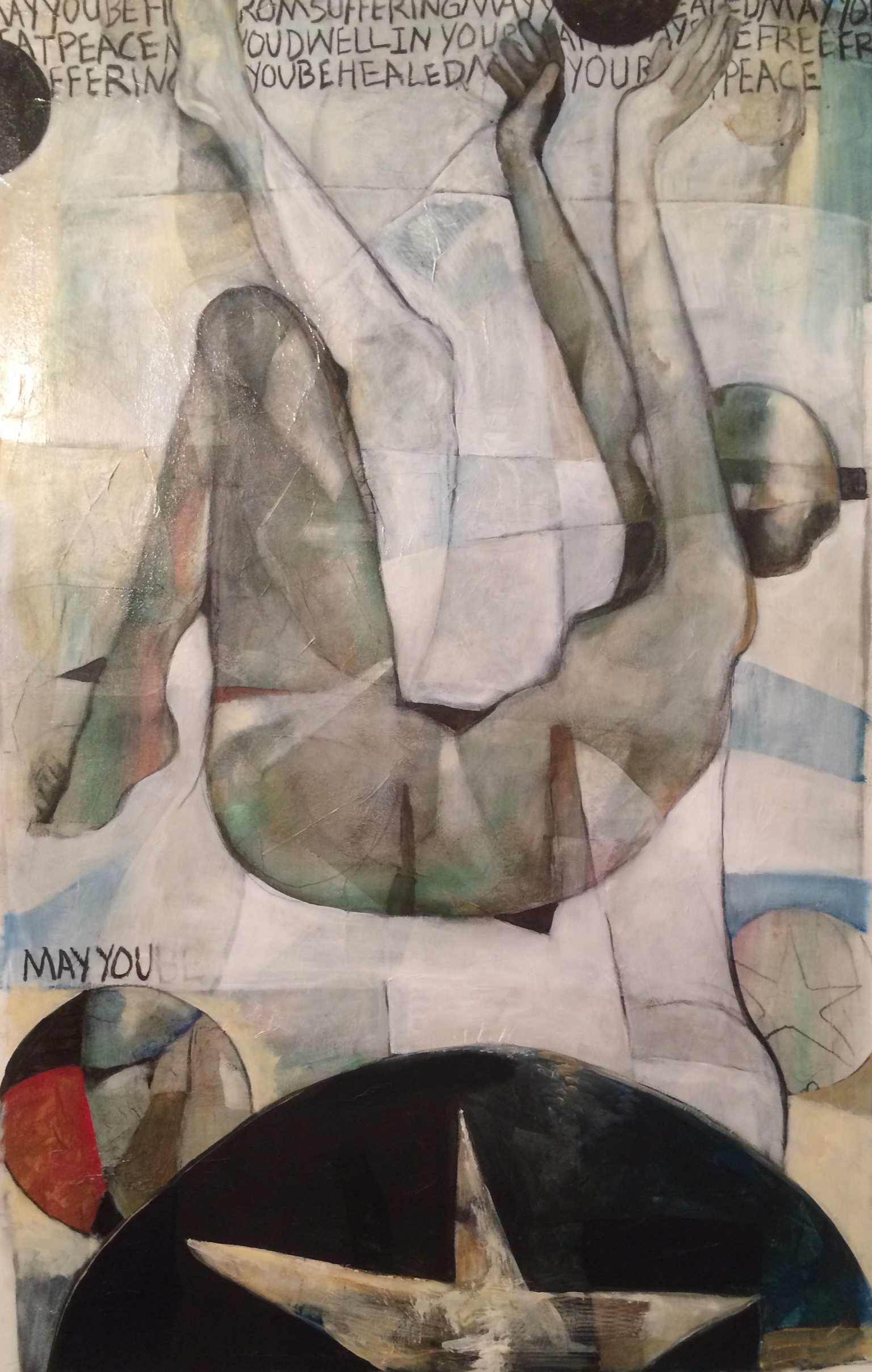
a detail from my painting, John's Secret

a detail from my painting, John’s Secret

When writing The Seer I showed the early chapters to some pals and the response was unanimous: break it down into smaller bites. The conceptual steps were too big for readers to connect the dots.”What!” I exclaimed. “Are you kidding me!” I protested. “Are you telling me that people need me to spell it out for them? Am I supposed to hit them on the head with a hammer?” I cried in disbelief to my bemused pals. Their response to my inner adolescent was, again, unanimous: yes. You need to go slower, take smaller steps, and come a bit closer to earth. The details matter. The job is not to be understood. The job is to create understanding.

After gnashing my teeth and tearing my clothes I took their sage advice. And, it was sage advice. The book that I published was comprised of only the first three chapters from the original manuscript broken into smaller thought-bites. Breaking it down was one of the hardest and best things I’ve ever done. Like Horton the-hearer-of-a-Who, I discovered complete new universes in the details, in the things I’d deemed too insignificant to mention or simply didn’t see with my head so firmly in the clouds. Ironically, while writing a book entitled The Seer, I learned a lesson in seeing.

Skip laughed when we first met. He’s a very-big-thinker and, like me, sees the world from 30,000 feet. He exclaimed, “Oh, No! You have the curse, too!” From 30,000 feet, small steps and details are almost invisible or easy to ignore. From 30,000 feet, everything is inter-related, one great big dynamic flowing motion. From 30,000 feet, the ubiquitous question is, “Don’t they see?” The runner-up question is, “What’s the problem?”

As we learned in school, the devil is in the details so, with my head in the clouds I have often been surprised by the detail-devil. People on the ground plant flags and guard territory. People on the ground choose sides and assume a defensive posture before thinking to ask a single question. Fear drives swifter action than does lofty reason. People are much more complex than they seem from the conceptual heights.

And, the only way of working with a complexity is through a simplicity. Connect the dots. Do not assume that “they” will “know” or “understand.” Do not assume that “they” see what I see or believe what I believe – or that what I see or believe is better or more valid than what they see. Opening a heart is a slow affair. Listening is best done when leaning in. Asking questions before making statements is good artistic process. Be a dot that connects to the other dots. Art, in all of its forms, is meant to serve as the great dot connector.

John's Secret by David Robinson

John’s Secret by David Robinson

Kerri, no stranger to my 30,000 foot rants, has developed a short-hand phrase for those too-many-moments when I need to move slower and pay attention to the details. She is helping me with this life lesson by applying a simplicity to my complexity. Now, when I have assumed that the dots are already connected and am perplexed by the breakdown, she simply says, “gear down, baby.” Move to a lower gear and open your eyes. Connection always happens in a lower gear. What is really there is infinitely more important (and often more beautiful) than what we want to be there. Releasing the “shoulds” opens eyes and hearts for shared experiences. So, gear down, baby.


See It Blaze

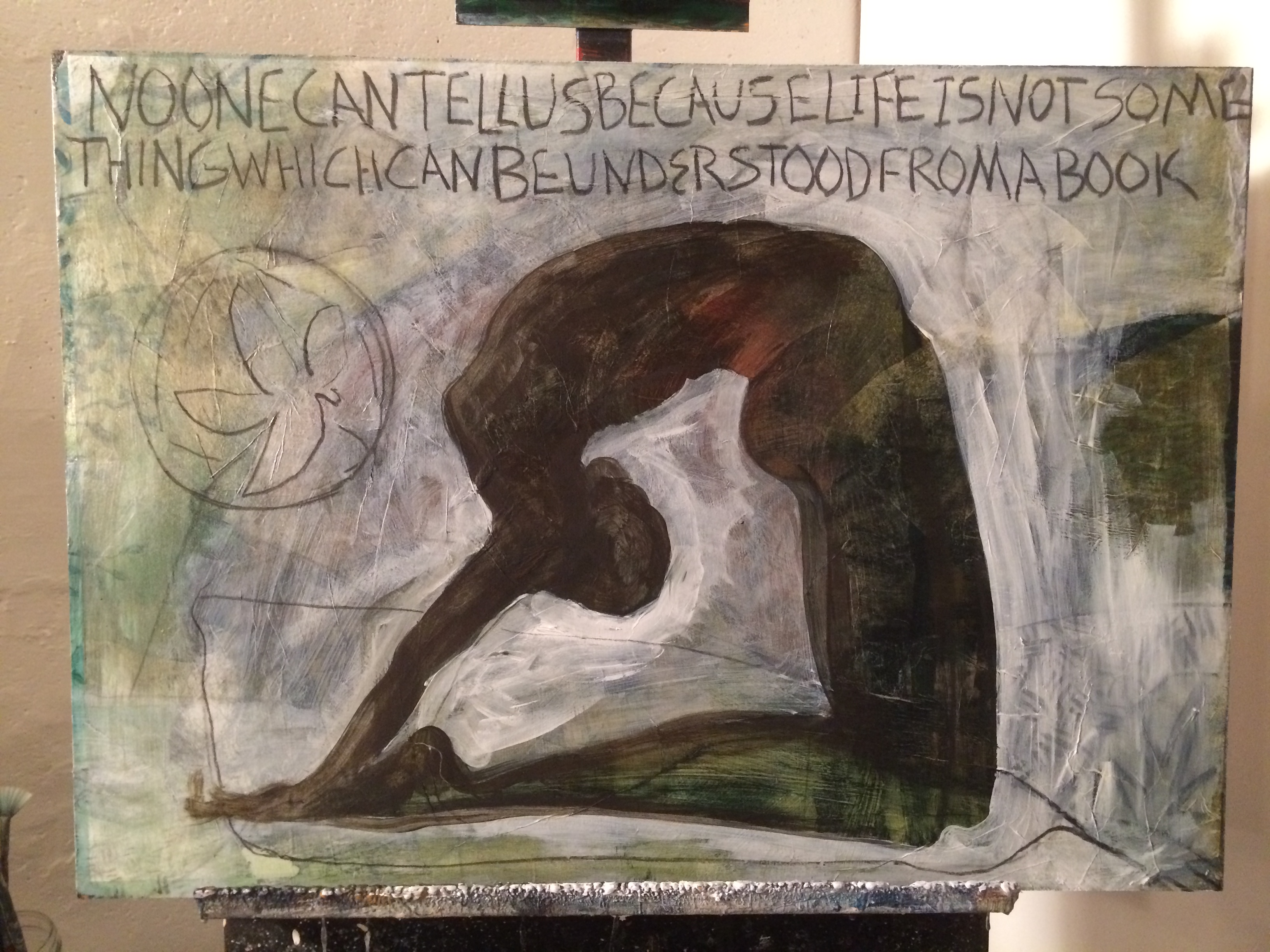
text from Krishnamurti as it appears in my painting

text from Krishnamurti as it appears in my painting

Every once in a while the things I read, the experiences of my life, seem to coordinate. Like a thought-confluence, the books, the poems, the errands, the conversations, run into a single thought-stream. It’s as if they called each other last week and asked, “So what are you going to wear?” Often, this is how the universe places its hammer on my head.

A few stanzas from a Mary Oliver poem, Morning Poem (read the whole poem sometime. It’s breathtaking):

each pond with its blazing lilies
is a prayer heard and answered
lavishly,
each morning

 whether or not
you have ever dared to be happy,
whether or not
you have ever dared to pray

Did you catch the word, ‘lavishly?’

Here’s a bit from Carlos Castaneda, A Separate Reality:

What makes us unhappy is to want. Yet if we would learn to cut our wants to nothing, the smallest thing would be a true gift…. A warrior knows that he is waiting and what he is waiting for; and while he waits he wants nothing and thus whatever little thing he gets is more than he can take.

Prayers answered lavishly. Whatever little thing he gets is more than he can take.

For me, there are a few important words that have, from over-use, fallen into the bin of meaninglessness:

presence, transformation

Actually, they are in the bin because we’ve managed to make them (like the word, ‘art’) commodities, marketing terms, something owned or purchased with coin or wile or reason. Something possessed or not possessed. Something available to a few but not all.

Sometimes the words open again, the experience opens again, when said another way. For instance, the phrase, “cutting our wants to nothing,” is another way of saying ‘presence.’ Don Juan would have made a good Buddhist! When present, the ordinary pond blazes, it teems with life and isn’t the experience of teeming life at the heart of any good prayer? The last time you caught your breath, a sunset or watching your child sleep, you were present, you wanted for nothing,  your prayers were lavishly answered.

my latest work-in-progress

not yet finished – maybe never will be – an, perhaps, that is the point.

The message of the hammer on my head: The pond is always blazing. The transformation is not in the pond but in our ability to see it.


Make It So

Pasta. Meat sauce. Warm Bread. Wine.

Pasta. Arugula salad. Wine.

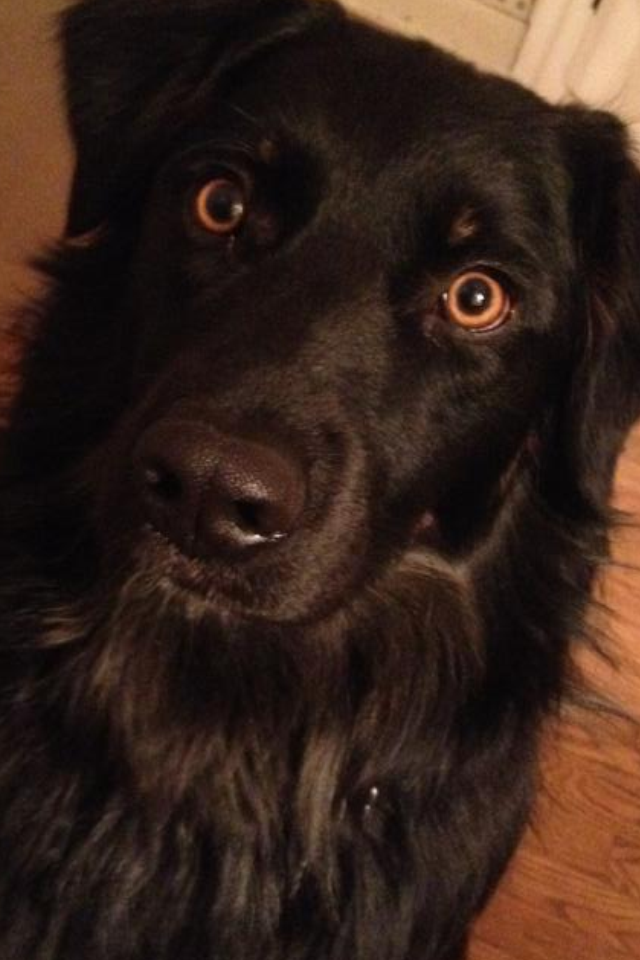
Tripper Dog-Dog-Dog knows the world through his nose. He sniffs everything. It is not uncommon after we finish a meal to come face-to-muzzle with a scent-curious Dog-Dog. Lately, as the objects of his sniffer, we’re given to staring into his amber eyes and offering the menu, saying something like, “Pasta. Arugula salad. Red wine,” or “English muffin. Peanut butter with black cherry jam. Banana. Coffee.” Satisfied with our description, he moves on to the next smell-enticing investigation.

I delight in our Dog-Dog food reports. They’ve become commonplace and matter of fact; “Chocolate chip cookie. Espresso.” Our reports never contain qualifiers, so, for instance, we never say, “A great chocolate chip cookie. Delicious espresso.” We provide the minimum, the noun.

Our Dog-Dog reports have rekindled an age-old fascination of mine: the power of words, specifically, the enormous power of the labels we attach to our experiences.

Language is a sword that cuts both ways. It can liberate and it can imprison. The difference is in how it is used. Language is the primary tool we use to make meaning. Big magic happens the day a person realizes that meaning is not something that is found, rather, it is something that is given and it is given the moment we apply a word-label to an experience. Nothing is good/bad, hard/easy until our label makes it so.

Applying a label to an experience is an act of creation. It is not passive. Take note of the word-judgments you apply to yourself or to others. For a week make a game of flipping them over and applying the label “beautiful” to where you usually apply a judgment. So, for instance, instead of, “I am fat,” why not say to your self, “I am beautiful.” Both are labels. One imprisons while the other liberates. The difference is a single word.

The label determines the possibilities we see (or don’t see). In a past life I used to facilitate organizational change and I came understand that my role was to help my clients ask better questions (use different language). They always came to the table with a “how” question: how do we change without feeling any discomfort? Response: what might you see if you stopped pre-labeling what you might feel as “discomfort?”

The mantra: have the experience first, make meaning second. And then, recognize the great capacity and opportunity you have to make meaning. Why not make a better meaning? Why not take a step and let it be a step merely?

Try this: do the Dog-Dog and, for one week, eliminate the qualifiers so that nothing is good or bad or right or wrong. It just is because you choose to make it so.

Appreciate It

#5

#5 in the process shots

Spring came fast. At this time last week there was a four-foot drift of snow on the back patio; it was Tripper Dog-Dog-Dog’s favorite plaything, leaping in and out of the snow monster. Today, a mere seven days later, the monster is gone, the back yard is snow free. Dog-Dog has already found a new favorite game: plucking leaves floating in the pond and then racing the circumference of the yard as if the newly plucked leaf was valuable treasure.

John’s dad passed yesterday. His passing was both sudden and not a surprise. His dad was an artist, a brilliant painter, and the celebration of his life will include much of his life’s work. “That’s what he would have wanted,” John said. After the call with John, Kerri looked at me and said, “There’s no time to waste.” Life happens so fast.


#6

#6

I went down to the studio and worked (yes, Skip, these are the next two process shots and the sketch;-). While I worked I listened to Kerri’s album, This Part Of The Journey. She came down to see how the painting was progressing and heard her music. She asked me to listen to a moment, a swelling of the strings, and told me of the day she and her producer mixed the track. It is a moment of music that can break your heart or make you yearn for home. “This is a piece I wrote for Wayne,” she said. Wayne was her brother; cancer took him many years ago. We listened in silence, appreciating the fullness of the moment, appreciating the power of her music, appreciating the painting that was emerging; appreciating life happening.

photo-4

from the sketchbook.


Study Your Practice

During his recent visit, Skip wanted to see my latest paintings so we went down to the studio. He is a great studier of people and processes and while flipping through my work he asked if I’d ever taken process shots or filmed my process of painting. Occasionally I take photographs of a painting in process – not to record the stages of development but so I can see what’s there. I’ve learned that a photograph can sometimes help me see what I’ve grown blind to seeing. I agreed to take and share some process shots. Yesterday, I started a new piece and here is the day’s progress:

#1

#1


#2

#2

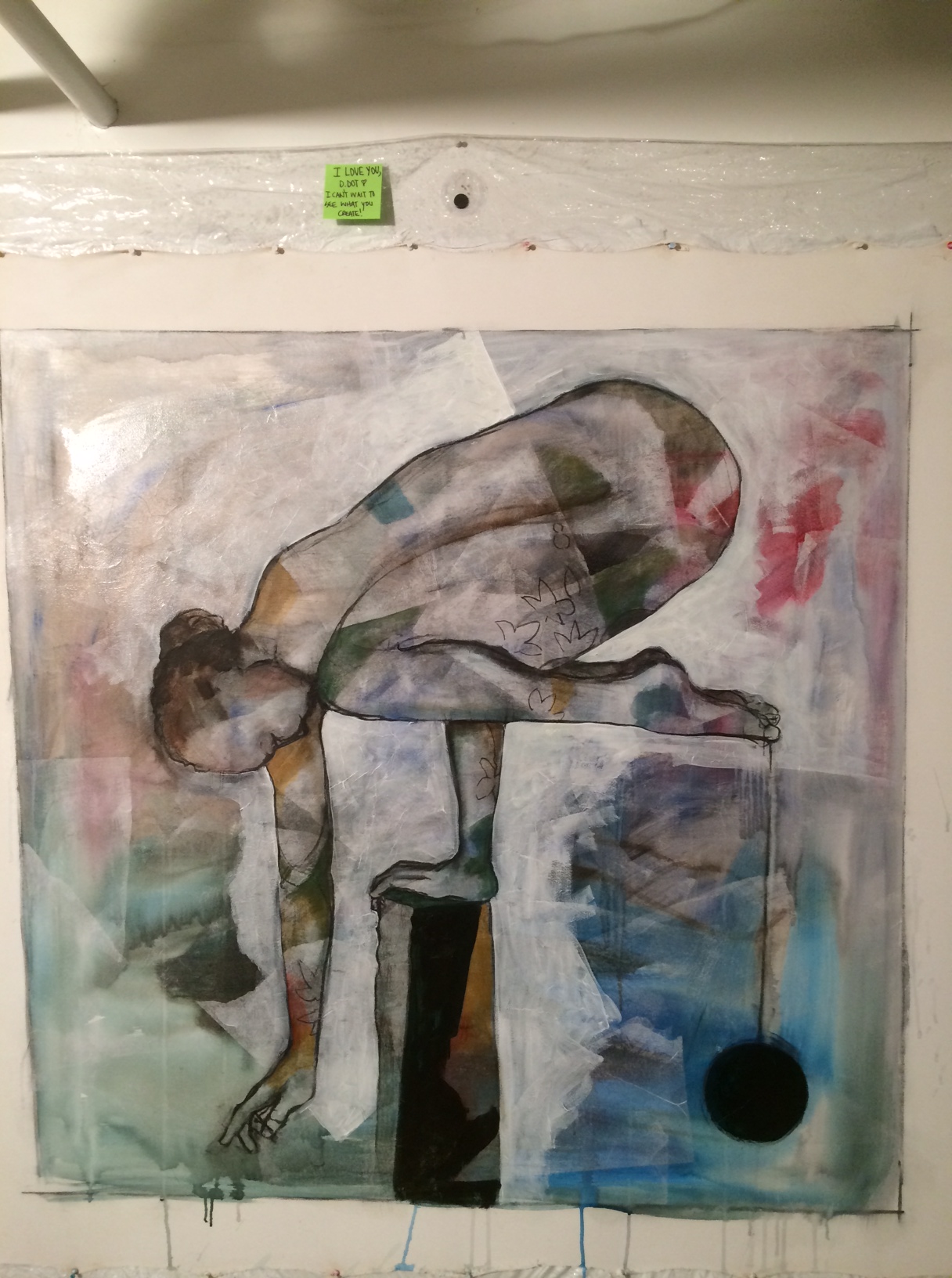
This is the next in my “Yoga series” of paintings. A “yoga” is a practice and I started this series because I was curious about my practices: I was meditating on this question:what is the difference between what I actually do and what I think I do? For most of us the gap is vast between those two points. This series is my ongoing meditation/inquiry into the gap.

#3

#3

A study of your practices will surprise you. What you do and think each day is a practice – it is your yoga; your actions and thoughts constitute the rituals of your life. So, for instance, when I was younger (lots younger) I believed my paintings were “not good enough.” Each day I’d approach the easel and practice “not good enough.” It’s amazing the transformation that becomes possible when you simply change your practice. Practice dropping the judge from your menu. Why not?

Last night I had a conversation with someone who asked, “Why don’t people care?” I suggested that people do care but you have to practice seeing it. It’s all around us if we refocus our eyes. And, in cultivating the practice of seeing the acts of kindness and caring, we become kind and caring (because that is the object of our focus).

photo-5

#4

My yoga series has brought me to this (so far): The world does not need changing; we need, as Doug used to say, to close the gap between what we think we do and what we actually practice doing.

Capture The Essence

Dog-Dog and treasure

Dog-Dog and treasure

Tripper Dog-Dog-Dog gathers his stuff around him. He has two stinky blankets that he pulls from his crate each morning, a red Kong, a blue chew bone with a handy looped rope pull, another blue toy that once looked like a jack but has been chewed beyond recognition, a once-stuffed moose from Josh that is now an unrecognizable shredded mess though he carries it around as if it was precious cargo. There is also a muddy tennis ball, a raw hide bone and usually a sock pilfered from my sock basket. If Kerri and I shift locations within the house, move from the living room to the sun room, Dog-Dog’s worldly possessions will slowly migrate with us. He is subtle and I rarely see the migration in progress; I suddenly realize that I am sitting within a nest of Dog-Dog treasure.

My favorite section in The Lost Boy is a series of questions that Tom asked: 1) if you were given a cardboard box and it was all that was going to be allowed to provide proof that you walked on this earth, what would you put in your box? 2) Beyond proof, what would you put in the box that captured the essence of who you were, that distinguished you from all the others? 3)What are the collections, the things you gather around you that are somehow supposed to tell others who you are? These questions might seem simple but are surprisingly complex. How does your stuff tell the story of who you are? Or, a better question: does your stuff define you? Can your stuff – your car, your house, your granite counter tops, your clothes, your jewelry,…, – capture your essence?

Tom asked two other related and relevant questions: In packing your box, would you be tempted to scrub your life of its messiness? Would you try to eliminate the mundane, the everyday? Would you throw away your rough drafts? Would you ignore the relationships that didn’t work out? Would you explain away the ugliness, the ruthless choices? Would you burn your personal journals so that the future might never glimpse your doubt, your struggles, your frailty?

I would add these questions: What if your essence was only available to you once you value the messiness? What if, in throwing away the mundane, you actually eliminate what is truly special about you? I’ve often taught and touted a tenet from improvisational theatre: drop your clever and pick up your ordinary – most of us diminish/neglect our greatest gifts because we label them as ordinary. They come naturally to us so we don’t always recognize them. In trying so hard to be clever, to be right, to be flawless,…to be other, we regularly overlook the real treasure and relegate ourselves to that most shameful pile labeled ‘ordinary.’

Scrubbing life to a sterile, conflict-less blandness is a recipe for….boredom and, at the end of the day, a very uninteresting box. Of this I am certain: if Dog-Dog had to pack his box today, I would be proud to sit amidst the stinky blankets, blue bones and remnants of moose toy. Dog-Dog hides none of his messiness.


Step Into The Field

photo-5[continued from “Jump!]

I wrote this phrase: “The one facilitates the journey for the many.” And, today, I would add: the one facilitates the journey for the many so that the many can experience the one. This little phrase is the point and the purpose of the theatre.

I’ve come to believe, at this stage in my artist life, that all processes of art-making are actually exercises in presence. And, presence, for me, has come to mean transcending any experience of separation. For instance, when I am fully engaged with painting a painting, “I” am nowhere to be found. Time disappears. There is only rolling creation. To use a cliché: something comes through me. Language is incapable of grasping what really happens and all we are left with is “something comes through” – a statement of separation.

A week ago today we were preparing to perform the closing of The Lost Boy. This play is unique in my experience for many reasons (it would require a book or two to explain the many layers of this cake), one of which was that we only had two performances: an opening and a closing. We hit our stride on the closing – and by that I mean we let go of thinking, preparing, adjusting…, and entered presence. We stepped onto the stage with no thought of “what’s first” and “what’s next.” The play happened with no effort. The Chili Boys played like never before. We were, to use another cliché, in the flow. I have never felt more alive, more connected, more present. It was fun!

50 minutes before stepping onto the stage

50 minutes before stepping onto the stage

Years ago, I had the opportunity to assist Jim Edmondson in a series of plays and I riddled him with questions. He introduced me to the notion that the art of acting was the art of presence (though he used a different language). He taught me that words like “focus” and “intention” are merely tools for cultivating the capacity to be present. Presence is the portal and the actors’ (artists’) job is to step into presence so the audience can join them. Literally, join with them in the field of the present, the place of common story. To be. Together, in a single story. And, although he did not say it this way, he taught me that “to be” is infinitely more powerful than “to become.” “To be” is not an arrival platform; it is an experience of the many recognizing itself as the one [could you ask for a better definition of art!].

Mike, our stage manager extraordinaire, came down from the booth and told us that our performances were different than the first night. We were more potent; we found nuance and greater depth. He was right. We were finally able to surrender to the work, get out of our own way, and step into the field of shared story.

See Again and Again

A detail from my painting, An Instrument of Peace

A detail from my painting, An Instrument of Peace

It has become my habit, when I finish a painting, to take photographs of sections of the piece. It helps me see it again. Often, I like these detail photographs as well or better than the painting. There are always discoveries in the details.

My paintings always surprise me. Years ago, I was showing my paintings to Jim Edmondson and he asked why all of my pieces had three spheres in the composition. I didn’t know what he was talking about. He laughed, our roles reversed, and he began showing me my paintings; each piece included three distinct spheres. I literally did not see them. They were apparent only after he made me look at sections of the paintings. I was both shocked and delighted. Perception is not universal.

Another detail from An Instrument of Peace

Another detail from An Instrument of Peace

The mastery of art (the mastery of life – same thing) is to transcend the notion that you “know” and that what you know is “right.” Krishnamurti wrote that, the moment you judge something, you cease to experience it. The fullness of life is in the experience and not the translation of the experience. All of us assume that we see the whole picture. We assume that we see is reality (truth) – and that reality (truth) for me must be reality for you. It is not. To have an “open mind” and “clear vision” is to release the notion that there is one truth, one way of seeing.

Once, I directed a production of God’s County by Steven Dietz and I knew it was a good production because half of the audience left angry and the other half left inspired. One play, many interpretations and the interpretations were, like all things we name as reality, rooted in each individual’s personal experience. What matters is not that our interpretations need to be the same, but a recognition that what you see is just as valid as what I see. As my friend Joe once said, “We come to know ourselves through other people’s eyes.”


An Instrument of Peace

A rough shot on the studio wall of An Instrument of Peace

title_pageGo here to buy hard copies (and Kindle) of my latest book: The Seer: The Mind of the Entrepreneur, Artist, Visionary, Innovator, Seeker, Learner, Leader, Creator,…You.

For all digital forms, go here (Leanpub)

Look To Each Other

my latest work-in-progress

my latest work-in-progress

Josh laughed from the back seat of the car. He read aloud the text that made him laugh: I’m in MoMA (the museum of modern art) and someone dropped a glove. Now, people are walking around it because they don’t know whether it is art or not!

I’ve spent a goodly amount of my time on the planet in museums of contemporary art and know that most folks passing through the museum have the same confusion about the pieces on the walls. What makes something art and something else not-art?

Almost a century ago Marcel Duchamp entered a urinal in an exhibition and gave it the title, “Fountain.” At the time it was scandalous and now represents a major milestone in art history. Today, a urinal in a museum exhibition would get the same treatment as the glove on the floor: confused consideration. Is it or is it not art? The beauty of the glove moment, the thing that binds it to the urinal moment, is that, in both cases, the gallery goers looked to others, perfect strangers, to ascertain a proper response: it is art if they say it is. Art, in this case, is an agreement.

This agreement, looking for approval about how to behave when confronted with the art-or-not-art question may seem superficial until you consider that recently people in Paris lost their lives over a disagreement of what was art and what was not. In recent history (2001), the Taliban destroyed centuries old giant statues of the Buddha in the Bamiyan Valley. They considered the statues idols (not art) and dynamited them off of the face of the earth (I will leave you to discover and ponder the irony between my Paris and Bamiyan Valley examples).

the words written into my work-in-progress

a close-up: the words written into my work-in-progress

Art is meant to open our perspective, to make us question, to help us see. A society that is capable of seeing is also a society that is capable of questioning; they go hand-in-hand. Questioning is always present when people are growing – so is art. Questioning also begets tolerance – it requires us to doubt our perspective and consider the view from someone else’s shoes. In these times when I hear someone bemoan the end of civility and the horrors in the world, I wonder if they’ve argued to cut art from the schools or  recently attended a concert to hear music to move their soul. Art is dangerous to leaders who like their people blind. Art is offensive to people who want their community thought-less. I delighted that somewhere in the world, in a museum of modern art, a group of people walked around a lost glove and looked to each other for guidance.

title_pageGo here to buy hard copies (and Kindle) of my latest book: The Seer: The Mind of the Entrepreneur, Artist, Visionary, Innovator, Seeker, Learner, Leader, Creator,…You.

For all manner of digital SEER copies, go here

Yoga.ForwardFoldFor posters and prints of my paintings, go here.

Do What Is Most Natural

IMG_0817The snows have come. The temperatures are grindingly low. Sitting at my desk, staring out the window at the world’s hibernation, I had a few thoughts about transformation. Actually, just before coming to the desk I flipped open the Bibles of Mankind for my random-thought-of-the-day. Today I landed on the Tao and specifically, this line: “By a transformation they live. By another transformation they die.”

In our births and our deaths we are all experts at transformation. In fact, in our progression through the many bodies we will in habit, the many phases we will navigate during the span of our singular life, we need not think about transformation or try to achieve it. Transformation is what we do. It happens. Track the progression of any life from infant to old age and you will witness a remarkable transformation.

I’ve just completed the first full cycle of seasons in my new home. Because it is all new to me, I’ve had the eyes to see the nuances, the profound changes in the trees, the lake, the rhythms of life including the migrations of geese. Nothing is normal (yet) so everything is special and alive. The cycle of the seasons, like the continual movement through the long body of life, is an ever-present transformation. The seasons do not try to transform; they are transformation.

People think they need to intend transformation. We seem to think we need to work at it to achieve it and somehow do not transform if we don’t marshal the process. Consciousness, like the body and the cycles of the seasons, transforms whether we intend it our not. That is the nature of consciousness. That is the natural movement of awareness.

title_pageGo here to buy hard copies (and Kindle) of my latest book: The Seer: The Mind of the Entrepreneur, Artist, Visionary, Innovator, Seeker, Learner, Leader, Creator,…You.

'Dancing In The Front Yard' by David Robinson

‘Dancing In The Front Yard’ by David Robinson

Go here to get posters and prints of my paintings.