Be Clumsy

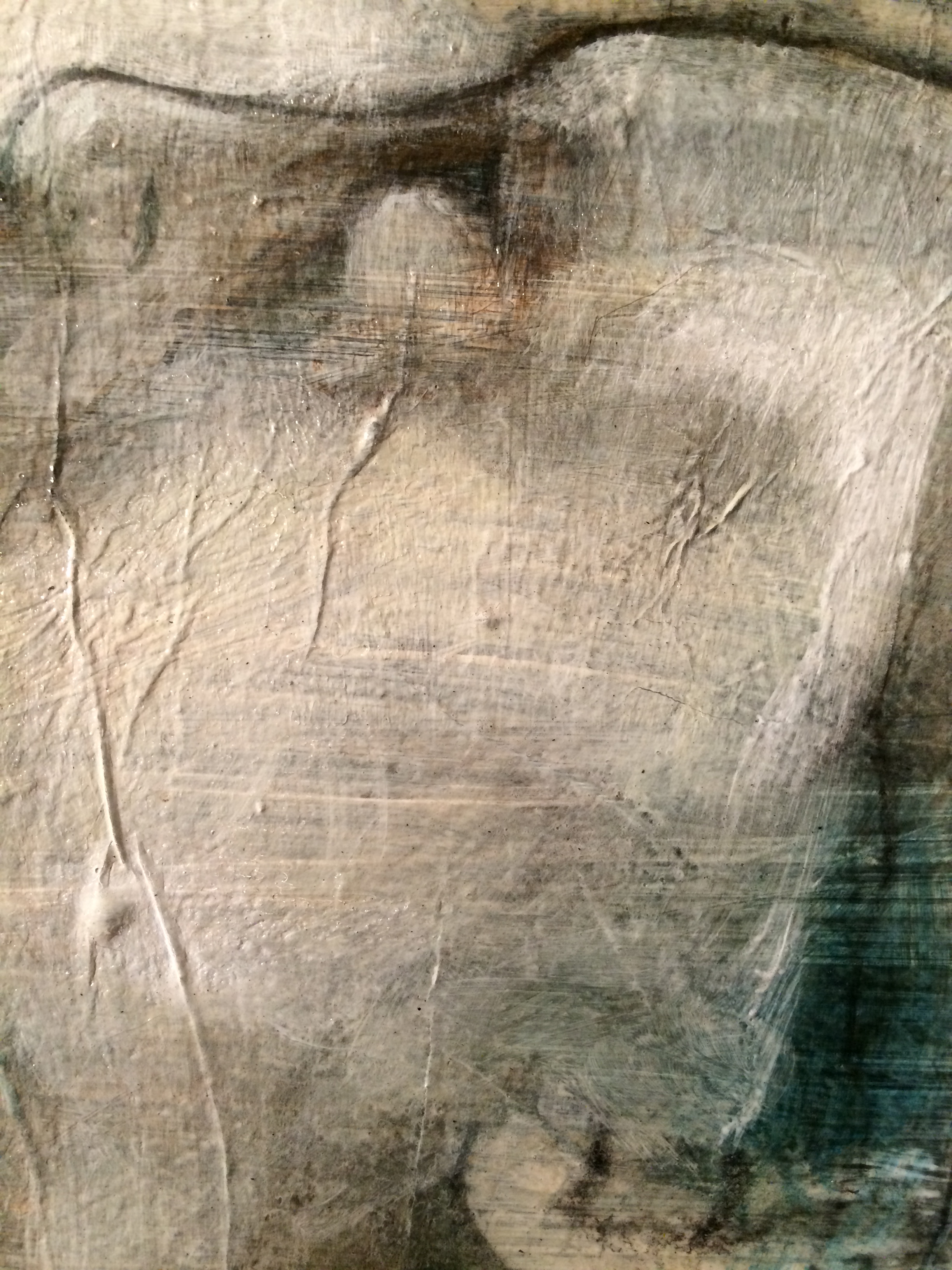
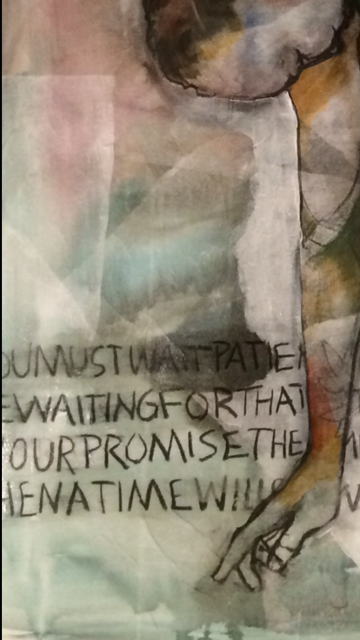
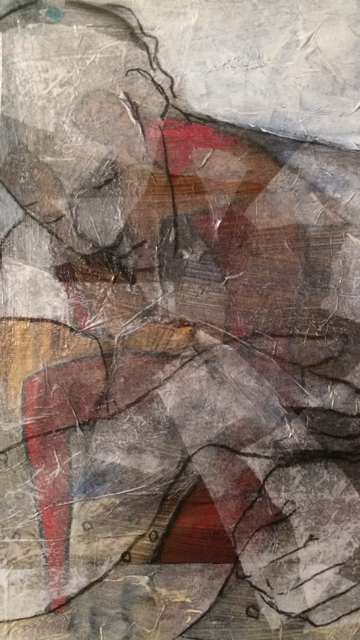
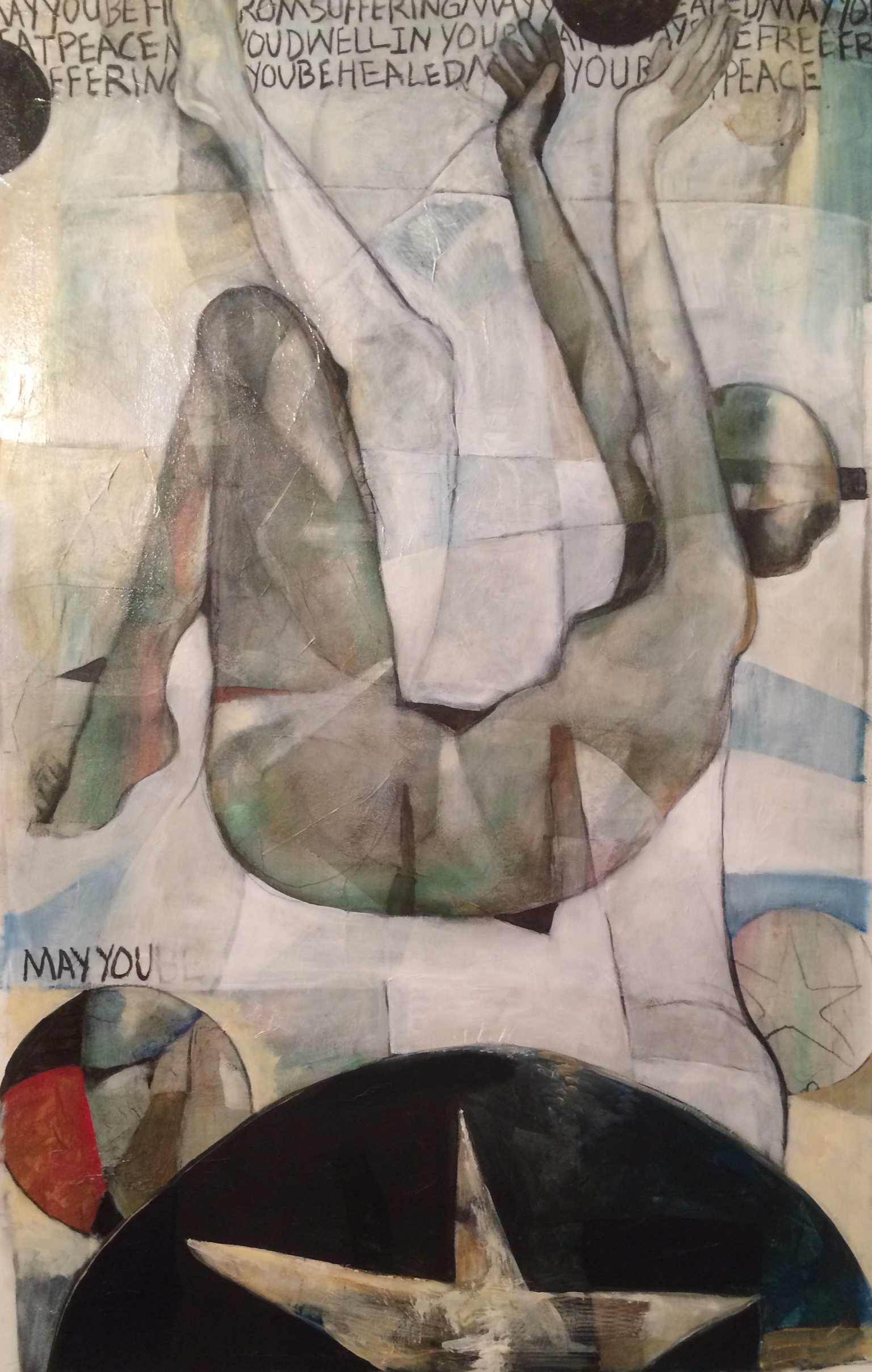
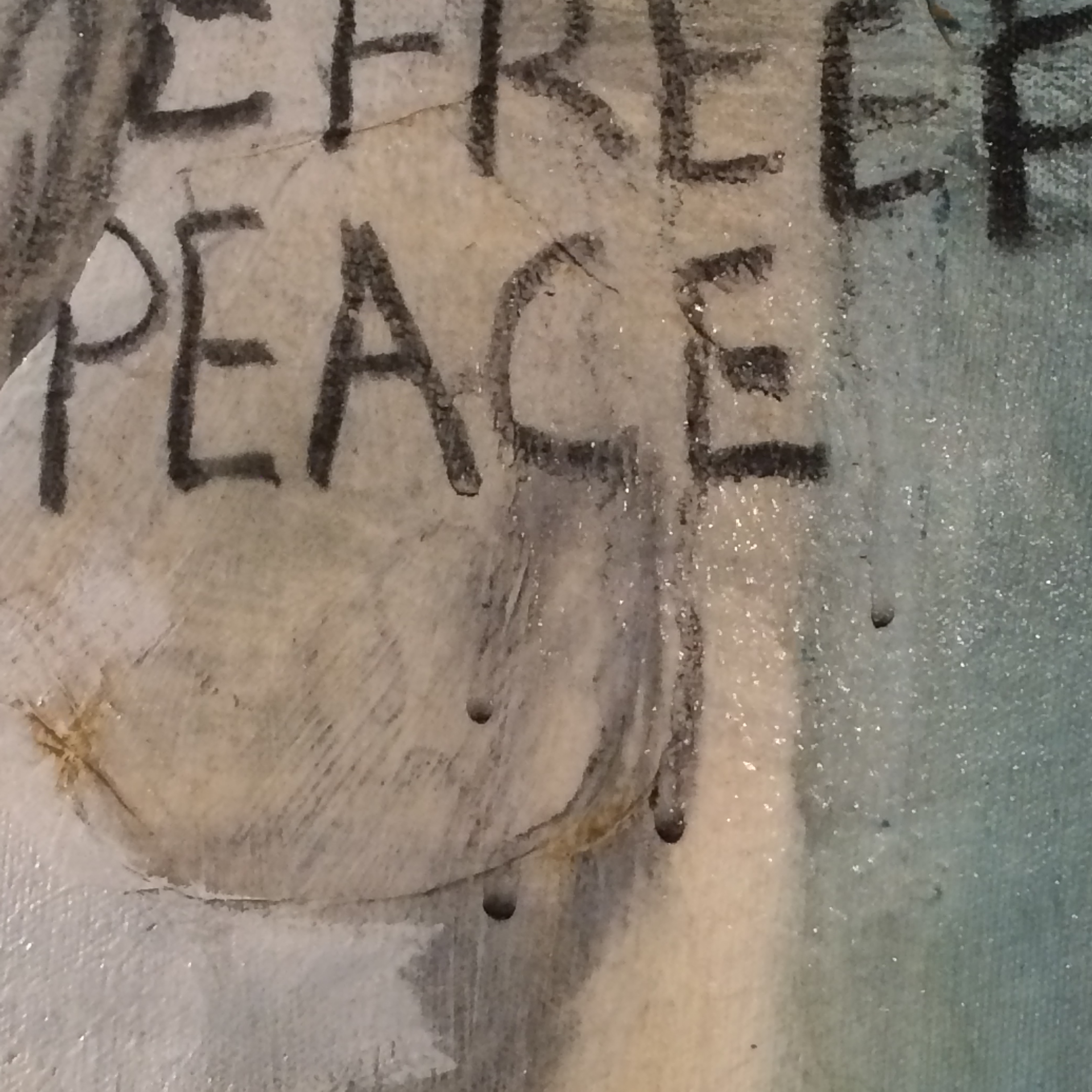
a detail of my painting, May You Be.

a detail of my painting, May You Be.

Clumsy (klum’ ze) adj. 1. lacking dexterity, grace or skill; awkward. 2. ungracefully shaped or made; unwieldy. 3. awkwardly or unskillfully said or done, ill-contrived.

“We don’t allow ourselves to be clumsy,” Kerri said. “Life is clumsy.”

Many years ago I read a commentary that suggested we moderns have a harder time of feeling good about ourselves than people of ages past. The argument went something like this: we have an impossibly high standard to meet and it is mostly illusory. For instance, our predecessors compared themselves and their successes against a relatively small village populace. We are swimming in pool that stretches around the earth. The athletes in our ancestral villages ran against their neighbors, the artists created for a specific purpose that served a tangible need in their community. Our young runners know to the hundreth-of-a-second what greatness requires. They run against the world. Our artists rarely know outside of their own inner imperative why they are creating. With no outer limit they spend a great deal of time wondering if their work has any impact or greater significance. With no outer limit it has no defined audience or community. Stephen, a gifted and prolific artist, used to ask, “Why don’t people recognize the value of art?”

The argument is largely a question of access. Our predecessors had limited and very abstract access to the news of the day, to the happenings beyond their region. We have a 24-hour global news cycle that comes to us on multiple devices that are designed to grab and keep our attention. It is not passive. On our multiple devices we are bombarded with images and messages of what we should look and feel like. Yet, almost all of the images populating our personal measuring stick are constructed. They are manipulated, retouched, powdered and Photoshopped. Legs are stretched. Wrinkles are removed. Sunsets are filtered. We measure ourselves against illusions.

Thus, intermediaries are everywhere. Interpreters abound. I rarely go into a gallery without a curator telling me why the work on the walls is important. The news of the day makes us the rope in a tug-of-war of interpretation.

Art, like life, like deep spirituality, requires direct engagement. It is made rich in the rough draft and the mistake. The broken road is interesting, vital. Learning is a process that takes time. It is messy. It is clumsy. It is not straight, paved, and has no road signs. And, it cannot be walked alone.

There is no forgiveness (of self or other) on the path of perfection; forgiveness is in short supply when the standard is both impossible to attain and an illusion. On the clumsy path, on the messy and muddy road, lives grace, generosity of spirit and deep forgiveness.

Clumsy (klum’ ze) adj. 1. Human

May You Be

May You Be


Taste It Fully

ice circles on the lake

ice circles on the lake

We heard the angry barking of crows before we saw them. They were haranguing an owl. It flew into a tree only a few yards in front of us. For several moments, through the ruckus of the crows, we stared at the owl and it stared at us. Time stopped. Nothing else existed. The owl’s eyes, our breathing, the crow’s chorus.

For our wedding gift, H and Teru sent several collections of poetry, “Manuals on marriage,” they wrote in the note that came with the poems. Kerri and I are savoring the poems, reading one or two aloud to each other every day. They are a source of warmth and inspiration during these cold dark winter months. A poem cannot be rushed or read merely. It must be slowly tasted. It is meant to be entered like a meadow; to be experienced. Try to make sense of a poem and you will miss it. Just like life.

She said, “inner quiet is low maintenance,” and I laughed. Yes it is. The trick is in getting quiet. It is not something that can be found or achieved. It is not a place or a state-of-being. It is what happens when you stop looking for it. Like the hermit says to Parcival when the Grail Castle suddenly reappears, “Boy, it’s been there all along.”

For years Sam the poet was afraid of his poems. Like all great art, his poems, his art, revealed the artist, and so he kept them locked up, un-tasted. He came alive and supremely dissatisfied when he finally unleashed his poetry. He let himself want more but also refused to let himself experience more; one foot on the gas, one foot on the brakes. To taste fully one must be willing to be tasted.

A snippet of a poem (a koan imbedded in a poem), RELAX by Ellen Bass:

The Buddha tells a story of a woman chased by a tiger.
When she comes to a cliff, she sees a sturdy vine
and climbs halfway down. But, there’s also a tiger below.
And two mice – one white, one black – scurry out
and begin to gnaw at the vine. At this point
she notices a wild strawberry growing from a crevice.
She looks up, down, at the mice.
Then she eats the strawberry.

Taste your moment. Taste it fully.

I wrote in my black and red notebook a simple recognition. The field of possibilities cuts both ways: in your despair you must remember that anything is possible. In your joy you must remember that anything is possible. Tiger above (the past), tiger below (imagined future). Do not reject your moment or attempt to hold on to it – both are methods of missing the moment. Taste it regardless of the circumstance. Taste it fully.


Let’s Be Us

a detail from my painting, May You Be

a detail from my painting, May You Be

[continued from Put Down The Hammer]

It is night and I am sitting alone in the sanctuary. I’ve been setting up chairs for a performance and now that the job is complete I’m taking a moment to savor the silence and review this day.

The temperatures have been unseasonably warm and when I opened the back door this morning for Tripper Dog-Dog-Dog I was greeted by the sound of birds singing. It was an April sound in the middle of December. I was so taken by the sound that I called Kerri, “Come and listen to this!” We stood in the doorway for many minutes. It was beautiful as well as a little disconcerting. “El Niño or global warming?” I asked.

Arnie wrote a comment to my last post. He asked: Can it be that we don’t want the ‘we’ in our society – we aren’t comfortable with the ‘we’ and only feel our identity by living out the “us and them”? I am an idealist but, of course, he is right. David Berreby wrote a terrific book called, Us and Them. We are hardwired to perceive the world through a lens of Us and Them. It’s a survival imperative to distinguish between friend and foe. However, a point that is most salient to me: the delineation of Us is mutable. It is not a fixed state but largely circumstantial. That is especially true in this modern age. There is an out of fashion phrase used to describe these United States: a melting pot. There could not be a better metaphor for an ever fluid definition of US. We need not melt but we do need to acknowledge that we are in the same pot. “Give us your tired, your hungry, your poor,…” is central to our national identity (not always central to our national rhetoric) and is a sacred, central statement of an ever-changing US.

We are among the first humans in history to have the pleasure of seeing our planet Earth from space and, as it has been said, from space there are no visible borders. The definition of US depends upon how far out we pull the camera. From space WE are the human race. There are a bevy of alien invasion movies that carry a common theme: when attacked WE inhabitants of Earth will pull together. Or, said another way, until there is a THEM that invades from another planet, WE will be incapable of recognizing full inclusion in the Earth pot.

To Arnie’s point, there is a lot of responsibility that comes with WE. A few months ago, Kerri and I were in Chicago for the day and passed a homeless man, holding a filthy cardboard sign asking for help. He was young, in his early 20’s, and more filthy than his sign. He was suffering. We walked by him. On the train home we had a long conversation about our responsibility to that young man or to any member of our community that is suffering. Many years ago I was with a student group in Bali. We were invited to Udayana University and one member of our group gave a talk about homelessness in America. Our Balinese hosts were shocked. “How could a member of your community be without a home?” they asked. The concept was abhorrent to them, unthinkable. “You are the wealthiest people on Earth…,” they stammered. Later, a Balinese professor said to me, “When you came here today, we wanted to be like you Americans. As you leave, we are proud to be Balinese.”

Us. Them. We. Like me. Not like me. Me. Little words with far-reaching impact. I am not the same person I was only a few years ago. I find it infinitely hopeful – especially now – that, just like me, the delineation of US is mutable, ever changing. It begs the question, Who are WE? And, to another of Arnie’s points, the answer to the question depends upon where we decide to place our focus.

Put Down The Hammer

photo-3[continued from BE WE]

The woman behind the counter at Starbucks, someone I’d never seen before, leaned forward, and chirped, “David! I loved your wedding!” She laughed at the look of confusion that must have crossed my face and added, “No, you don’t know me.” One of our invited guests brought her as a date. “Best wedding ever!” she exclaimed as Kerri joined us. Because the day is a blur, Kerri and I enjoy hearing people’s accounts of our wedding day and she enthusiastically told us of her experiences. It was nice. It was personal.

We took our coffee to a table and joined some friends. After a few moments, the woman behind the counter came to our table. She brought some samples, some health supplements and cosmetic products, “I only do this Starbucks job for the health insurance,” she said, “This is really my business,” she said, sliding the tiny packages in front of Kerri. “You never know who might be interested,” she chirped and blushed before making an exit. It was awkward. It felt awful. We went from personal to prospect in one inelegant step.

There is an old saying that came to mind: When the only tool you have in your box is a hammer, everything looks like a nail.

Many years ago, in a time of great financial desperation, I worked with some financial folks who recruited me to sell their stuff. I learned their processes, got my licenses in record time, and for a few horrid months, tried to sell their wares. I hated it. The work was highly profitable but the cost was highly destructive. Everyone looked like a prospect. To every social encounter, every friendship, every casual meeting, I brought an agenda. For a few months I looked through a lens that made every person, every circumstance, a commodity-opportunity. It reduced life (my life) to an ugly basic. It was toxic. Anna taught me the very appropriate word for what I felt: vampiring. It was a great lesson. It made me pay attention to the intention I bring to my life.

It’s what the woman at Starbucks felt, too. She was desperate. She, like a former version of me, sold the greater need to satisfy the lesser. Vampires are insatiable and stuck in an untenable lifeless-lens: everyone looks like a food source. Desperation is like that. It is easy when desperate to sacrifice friendships for prospecting. No one likes to be a food source.

As I perused this years bountiful crop of ugly images of Americans fighting and crushing each other for cheap toys and electronics, the annual product-stampede/people-crush-and-fist-fight on Black Friday (formerly known as Thanksgiving), I couldn’t help but think about the Starbucks lady. Desperation wears many masks but always makes others look less-than-human. Communities thrive when they feed each other and die when they feed on each other. This is not a mystery.

Commodity is supposed to service community, not the other way around. Vampiring is the only visible path when community loses itself to commodity; it inadvertently tosses away its many tools and leaves itself with only a hammer. It’s a question of order as much as a question of values. There is nothing wrong with commodity when the order of value is respected. Without a WE there can only be a very confused, desperate, and lonely I. It should not come as a surprise that desperate and lonely people do desperate and lonely things.

This is the season of the return of the light. We need do nothing more to create the miracle than put down the hammer and look at others as if they are more than nails.

[to be continued]

Make Art So.

at one time even this was considered a new technology

at one time even this was considered new technology. numbers, too!

Chet said, “But where’s the human in all of it?” His question took me by surprise. It is a question that often puzzles me. I was telling him about my recent inner earthquake, the moment that the train of technology jumped the tracks and collided with my art engine. Both exploded.

For weeks I’d been looking forward to a full day of exploration at the Chicago Art Expo. Hundreds of contemporary galleries from around the world assembled in one place, each showing their premiere work. As an artist these events have always fed my soul. This time, with the exception of a few older masters (a Chagall, a Picasso), a Hockney that made me smile, and few pieces from The San Francisco Figurative painters, I was unmoved. Worse, I was uninterested. As I wandered through the exhibits I listened to curators over and over again working hard to give context to the art. The viewers had no immediate access to it. They (like me) needed an explanation to access its relevance. I felt as if I was watching art-priests interpreting god for parishioners who had no expectation of direct access to the divine. The art needed a middleman. It required an explanation.

Just before going to the Expo, Skip shared a link with me. It was a video of animator Glen Keane drawing in virtual space. He was literally drawing from within the image. It took my breath away. Glen Keane called the technology a new tool but, like many new tools – so many new technologies, this one has the capacity to change our relationship with life and, therefore, with art because it could change our relationship with time and space. At one point in time, electric light was a new technology. The automobile, the airplane, the telephone, the camera and the phonograph were once new technologies. Each changed our relationship with sound, light, distance, the planet…each other. They changed how we see and experience possibilities. And, at the time of their invention, the community, at first, did not understand the power being introduced into their lives. They, like we, were stepping into the future with their eyes in the rearview mirror. What we know as art changed with the introduction of each of these technologies.

I couldn’t help but see the work at the Expo through the lens of this most contemporary tool. My eyes, for a moment, were wrenched from the rearview mirror and forced to look straight ahead through the windshield. Relative to the tool, the work at the Expo seemed abstract to the point of inaccessibility. It felt academic and I felt distant from it (lots of head, little heart). The tool although incomprehensible, was exhilarating, approachable, and inspiring. It made me want to play. It made me want to create. With this tool, Jackson Pollock would have danced and splashed in 3-D space. Picasso would have explored Cubism from within the cube. And, with this tool, I could see them doing it; I could sit in the same space and get paint on my face. In the video, Glen Keane says, “When an artist makes a line, it is a seismograph to their soul.” This tool, this technology, is a 4 dimensional seismograph.

Eve Ensler wrote, “Art has the power to explode the heart and open up other energetic capacities to re-perceive it. It defies boundaries and leaps tall buildings. It transports, it translates, it transcends. Transcendence is so important right now because our lives are so mechanized, controlled, and commodified; art has the capacity to open our souls and could be our revolutionary, evolutionary salvation.”

Yes. And, yes again. I can draw in the dirt with a stick. I can draw in virtual space. The verb remains the same. The access to others – the reach of the art – changes.

To Chet I wanted to say that humans create technology. And, in turn, technology informs humans and, therefore, art. Our very short attention spans are the result of our relationship with technology –  800 word blog posts are now too long, and 140 character tweets are desirable. Much of the Expo was digital photography or digitally altered images. It was mental and cold and abstract – certainly expressions of our time – expediency allows for little depth of experience. The technology did not make it cold; the way it is wielded by human beings makes it so.

Chase The Butterflies

a detail from my painting, John's Secret

a detail from my painting, John’s Secret

Wisdom butterflies that have recently fluttered across my path:

Soaking up the morning sun and drinking coffee from the deck of Common Grounds, 20 said, “You’ve heard this one, right? There are three sides to every story.”

Standing on the side of the road peering into Judy’s car, she gave us some sage relationship advice. She said, “That’s the secret to life, you know: listen before you talk.”

Kerri was composing a song. I asked her how she starts, how she knows where to start. She said, “I don’t know. Sometimes you just need to put your fingers on the keys and follow the music.”

There is an aging pink post-it note stuck (permanently) to the desk. It reads, “Make The Adventure.”

On a recent phone call, Skip offered wise counsel about how I see my role in a new business, “Find your own metaphor,” he said. ”What is the metaphor that will keep you energized, that taps into your 10,000 hours?”

Sitting behind his drum set, waiting for rehearsal to begin, John said, “Our job is to make the art, not to determine its reception.” And then he said, “What do you think?” and laughed.

Josh took a belly punch from the universe yesterday. He said, “I want to be angry but anger does me no good. I have better things to do with my life than get angry.”

A detail from my painting, An Instrument of Peace

A detail from my painting, An Instrument of Peace

P-Tom weighed in with this: “Faith is scandalous,” he said, “It pushes back against everything we experience.”

Dog-Dog raced across the yard in hot pursuit of a butterfly. I’m wagering that he knew he would never catch it, but the chase was glorious.

Answer The Question With A Question

carrying on the tradition (and my heroes): mike and sabrina bartram

carrying on the tradition (and my heroes): mike and sabrina bartram at Changing Faces Theatre Company

Many years ago at the start of my career I bumbled into running a summer theatre company. It would become one of the great gifts of my life. At the time I decided that it would be my laboratory. I’d be able to experiment with directing processes and actor training techniques. What I didn’t realize until much later was that I would also be running an experiment in business and, more importantly, how to create a community mindset of support and empowerment (and, therefore, achievement). I was free to succeed because I gave myself permission to focus on the quality of the process instead of worrying about hard and abstract words like ‘achievement.’ My bottom line was the inner growth of everyone in the company, the inner growth of the community that we served.

When the company was up and running, when it was mature, company members swept the parking lot because they knew it would make the play better (improving the audience experience always impacts the performance). The people running the box office prided themselves on their kind service and efficiency because they knew that it would make the play better. The actors understood that they were in service to the play and not themselves. In fact, everyone in the company was in service to something bigger than themselves. That was the culture of the company. When pushed to articulate the success of what we created together, I’d say, “We’re focusing on the important stuff.”

Yesterday with great intention I sent that phrase (focus on the important stuff) out into the e-stratosphere. I lobbed it in association with the company that Kerri and I are in the process of creating to see what would come back at me. Like the summer theatre company, this new venture is our laboratory. What came back was the question, “What’s the important stuff?”

Sometimes the only way to answer a question is with another question. Take a look around your world. Take a moment to look at the difference between what you say and what you do. What do you see? What do you want to see? Big power comes to people when, like my company members (students) of so long ago, they realize that their “seeing” isn’t passive. The greatest single power any human being has is to choose where they place their focus. The greatest single revelation any human being has is to recognize that what they see impacts everyone around them. No one does this walk alone.

the very first painting in the Yoga series. It was an experiment, a walk of discovery. It's also about being alone

the very first painting in the Yoga series. It was an experiment, a walk of discovery. It’s also about being alone.

It’s easy to place a focus on an obstacle. It’s very easy to fix a gaze on the problems. It’s easy because, left alone, believing we are alone, that’s where most people default. Place yourself in a community that knows there is something bigger, something more important to see and serve, and the field of possibilities becomes easy. My company members of so long ago didn’t know what they couldn’t do so they did everything they imagined. That was only possible because they imagined it together. So, answering a question with a question, to you, what’s the important stuff?


Focus On The Important Stuff

an offer from TwoArtistMakingStuffForHumans

an offer from TwoArtistMakingStuffForHumans

A note from the temporary site of TwoArtistsMakingStuffForHumans:

The waxing moon was muted with fog. It made the air shimmer. Avalon was near. Although it seemed too soon, there was a hint of autumn in the air. We sat next to a chiminea talking to friends. Monica told us of her daughter working in villages in South America. She told Monica that, by our standards, the people there have nothing. They are possession poor. But, they were happy, genuinely happy. They didn’t have much money or stuff but they had the essential thing that many of us lack: peace of mind. They focus on different, more important stuff.

It brought to mind my experiences in Bali. When I arrived all I could see was the poverty. By the time I left several weeks later, I’d have given everything I own or will ever own to have what they have: presence. Ease of mind. They weren’t looking for fulfillment, status, or living for retirement. They were living. Life was fulfillment. In a world where all things are sacred, status is gained by the quality of your giving and not by the size of your piece of the limited pie. It is a different focus.

There is a hidden cost to what dominates our focus, the things that take our attention…as opposed to the things we pay attention to.

As artists, both Kerri and I believe the work of our lives has been, one way or another, to help people focus on the important stuff, to see the extraordinary in the ordinary moment, to find inside what people seek outside. We’ve both worked across the boundaries of business, art, and the fine art of living everyday, there is no lack of necessity to refocus the eye, mind, and heart.

In a few weeks we will be launching our business (details to follow). All the many aspects of our work – if you can call art a product and performing a service – are intended to support, exercise and pay forward a focus on the important stuff, the important moments…sometimes the teeniest things that in the chaos pass unnoticed.

We want to do for others what we do for each other. Check out our pre-launch coaching offer. Take us up on it! Or, if you know someone who might benefit from working with us, pass it on, pay it forward.

Change They to We

photo-2

the next step in my painting, The Weeping Man. He’s nearly complete

The word that’s captured my recent attention is the word “they.” I’m captivated by language choices that might at first seem insignificant but, once unpacked, are profound. “They” is one of those words.

“They” caught my attention when 20 was making us dinner. His recipe included fennel and, until we googled it, we thought anise and fennel were the same thing. While we Googled for truth, Kerri asked, “Why would they name something twice?”

“Good question!” I replied and then asked, “Who are ‘they?'”

“Good question!” she echoed as the Google oracle brought us clarity about our fennel/anise confusion (as it turns out they are two different plants). Google was not very useful in clarifying who “they” were.

So, this week I listened for samples. Some of what I heard: “Why would they do that?” (a conversation about women in another culture). “They don’t care about us.” (what else, politics). “Don’t you think they cause their own problems?” (referring to a situation in a local minority community).

“They” can be a word of distancing, a word of exclusion. If you want to mess with the meaning, simply change the pronoun. For instance: why would we do that? We don’t we care about us. Don’t you thing we cause our own problems? “We” is inclusive. “We” makes us participants. “We” makes us culpable.

a detail of Weeping Man.

a detail of Weeping Man.

What if, in our current state of mis-education for instance, we stopped asking about our policy makers, “What are they doing?” And, instead, asked, “What are we doing?” What kind of action or meaningful discussion might ensue if we simply refused to use the word “they?” What if, as artists, we stopped asking, “Why don’t they get it?” and instead asked, “What don’t we get?” Artists do not create in a vacuum. Our expression might be individual and unique but without a community to receive, debate, appreciate, revile and otherwise engage it, has little purpose. After all, “they” are “we” if our language will allow us to see it.

the previous photo/stage I posted

the previous photo/stage I posted

The Way You Frame The Question

TODAY’S FEATURED REMINDER FOR HUMANS

The way you frame the possibilities

There is a vast difference between the questions, “Why is this happening to me?” and, “What’s the opportunity in this?” Both questions are frames that we place on our experiences. Both questions determine the range of possibilities and choices we see in our lives. Why not place a frame that opens a vast range of possibilities instead of placing a frame that closes most of the doors?

Screen Shot 2015-08-22 at 2.41.31 PM

FOR TODAY’S FEATURED REMINDER FOR HUMANS, GO HERE.