Embrace Wabi-Sabi [on Not So Flawed Wednesday]

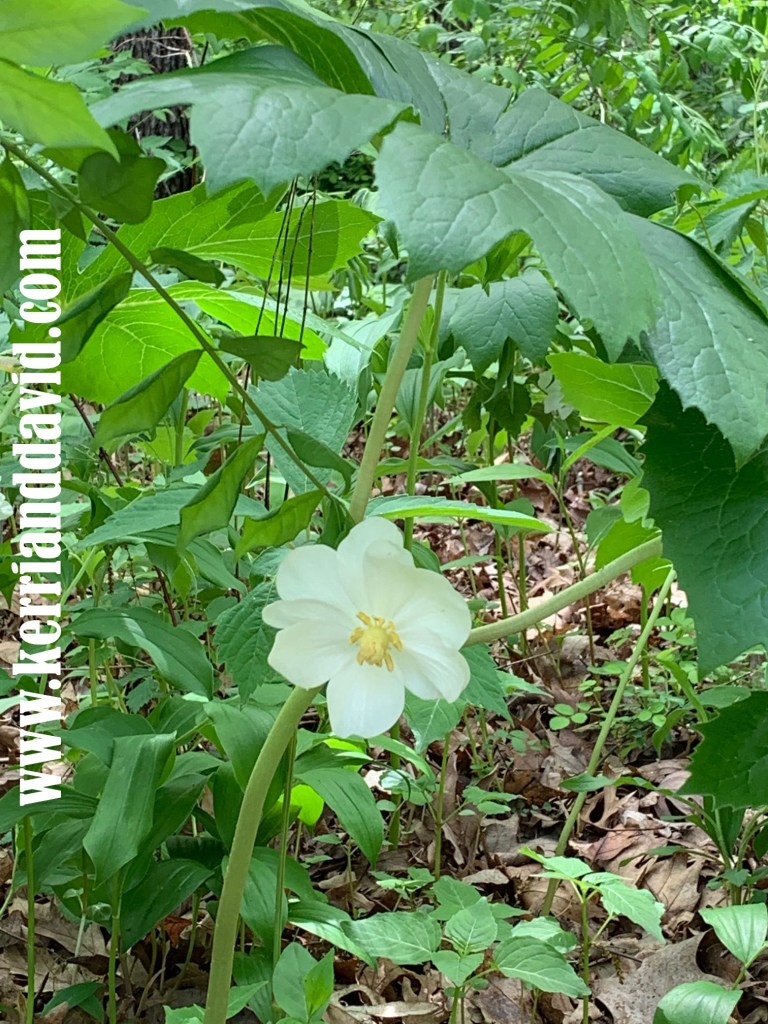
“I love this photo,” she said, “because the flower isn’t perfect.” Wabi-sabi. Appreciation and acceptance of impermanence and the absence of perfection. The full embrace of ‘what is’ rather than some imagined belief or ideal.

I read that the church leaders refused to look through Galileo’s telescope because their book already explained to them how the universe worked. I don’t know if this account is true or not but I’m given to believe it. I see the same story playing out in all shapes and sizes of blind-belief systems today. The wily Fox has millions refusing to look through the telescope in favor of an abstract and angry conviction.

Imperfection. Appreciation of nature and its forces. Look up. Open eyes. Open mind. Open heart. Direct experience that has the power to challenge the staunch and rigidly held opinions. Modesty.

Wabi-sabi. I love this photo.

read Kerri’s blog post about THE WHITE BLOSSOM

Watch For Turtles [on DR Thursday]

“The art of living… is neither careless drifting on the one hand nor fearful clinging to the past on the other. It consists in being sensitive to each moment, in regarding it as utterly new and unique, in having the mind open and wholly receptive.” ~ Alan Watts

The ferns have returned. Last week they were sharp tendrils poking through the leaves and earth; little green aliens. A mere seven days later, they are over three feet tall, fern-flags unfurling.

Driving to our trail we saw a turtle crossing the road. Kerri whipped a u-turn and I jumped out of the car, picked it up, expedited its journey, moving it from the pavement to the grass. There’s something special about the turtles. Throughout March and April, while walking on our trail, we’d cross the bridge over the Des Plaines River, and look for the turtles’ return. The turtle in the road was our first sighting of the season. Later, on the bridge over the river, we saw a dozen. “They’re back!” she said and smiled.

Lately we’re given to walking the same trail. We’ve seen it change through several seasons. We followed our loop last week and I swear, this week, it’s an entirely different trail. The trees are flowering. The trillium are showing their purple.

I used to wonder how Emily Dickinson thrived looking at the same garden for years and years. How did she write such beautiful poetry with such a small window to the world? Now I know that her world was enormous and my question was too small.

“Hope is the thing with feathers…”

read Kerri’s blogpost about FERNS

iconic © 2010 david robinson

Call It Realism [on Not So Flawed Wednesday]

This garlic could have been painted by Jan Vermeer. To my eye it looks like the work of a Dutch master, an artist more concerned with realism than the ideal.

Art that reveals the beauty in the ordinary. For a few weeks in my surly youth I studied with a realist painter. I was wowed by his technique but could not yet grasp his dedication to capturing the everyday. Only later did I come to understand that his art was not about the technique but about bringing attention to the experience of the everyday. He rejected the aloof and desired to pull art down from the pedestal so it might reflect the lives of the “common people.” He believed that people needed to literally see themselves in the paintings to have access to the painting. They needed to see their hardship and toil as well as the objects that surrounded them.

Bertolt Brecht believed the opposite. In order for people to have access to the deeper messages of a play, they needed to be removed from their circumstance. So, in his way of thinking, people are more capable of seeing themselves in a piece of science fiction than in a reality-mirror.

David is working on a re-imagining of Pirandello’s play, Six Characters In Search of an Author. One of the questions of the play is, “Who is telling your story?” And, how are they telling it. I reread the play and was struck by how relevant it is to our times.

The beauty in the ordinary. The turmoils and struggles of the everyday. Ours is a time of tumultuous story tug-of-war. I wonder, in a hundred years, what historians will write about our time. I wonder what aspect of artistry – if any – will be considered “realism.” As defined by Vermeer and Pirandello, it’s to reach across a social line, from the privileged to the working class. For Brecht it is spatial: step out to look in.

One thing is constant, while reaching across time and artificial boundary, it is always the role of the artist to help their community ask the questions: Who is telling my story? Whose story am I telling? What is the story that we are telling?

I imagine those someday-historians will write tomes on our messy struggle to sort out what is “real” and what is not.

read Kerri’s blogpost about GARLIC

Know Their Name [on Merely A Thought Monday]

As I let Dogga out each morning, I stand for a few moments and listen to the birdsong. Our particular spot on the earth is alive with birds: starlings, finches, sparrows, robins, hawks, crows, owls… The Mourning Doves always stop my motion. Their song is hypnotic.

The pandemic changed – and continues to change – many things. Our world became significantly smaller. The table in the sunroom. The backyard. Our trails. As someone with his head in the clouds I am a dedicated generalist. I have always appreciated bird song yet never, not once, thought of identifying the specific birds and their song. “Sparrow? Finch? Who cares! They are beautiful and that’s enough for me! I spend too much time in my left brain as it is! The last thing I want to do is categorize the birds!”

COVID changed that. Sitting on the back deck or at the COVID table staring out the window for hours on end, our relationship with the birds grew. From general appreciation to specific experience. From passive appreciation to personal connection. We began to see nuance. Pattern. We wanted – and want to know more about these beings that sing us awake each morning, that alert us to changes in the weather, that signal alarm in the neighborhood.

While visiting the Botanical Gardens, Kerri found a small book, coded by color, that identifies the birds in our region. In a flash we can open the book and identify the bird. “Hey! Look! That’s Paul!” I say.

“Stop!” Kerri scowls. “It’s Martha. Paul’s on the fence.”

Just kidding. House Sparrow. Carolina Wren. My favorite to pronounce is Grackle. Great-tailed Grackle to be exact. I’ve decided that, were I to somehow achieve tough-guy status and ride a Harley to breakfast, my motorcycle-dude name will be Grackle. “Hey, Grackle,” the waiter will say, as I come through the door en route to my usual stool. “Hey,” I respond. Motorcycle-dudes named Grackle are birds of few words.

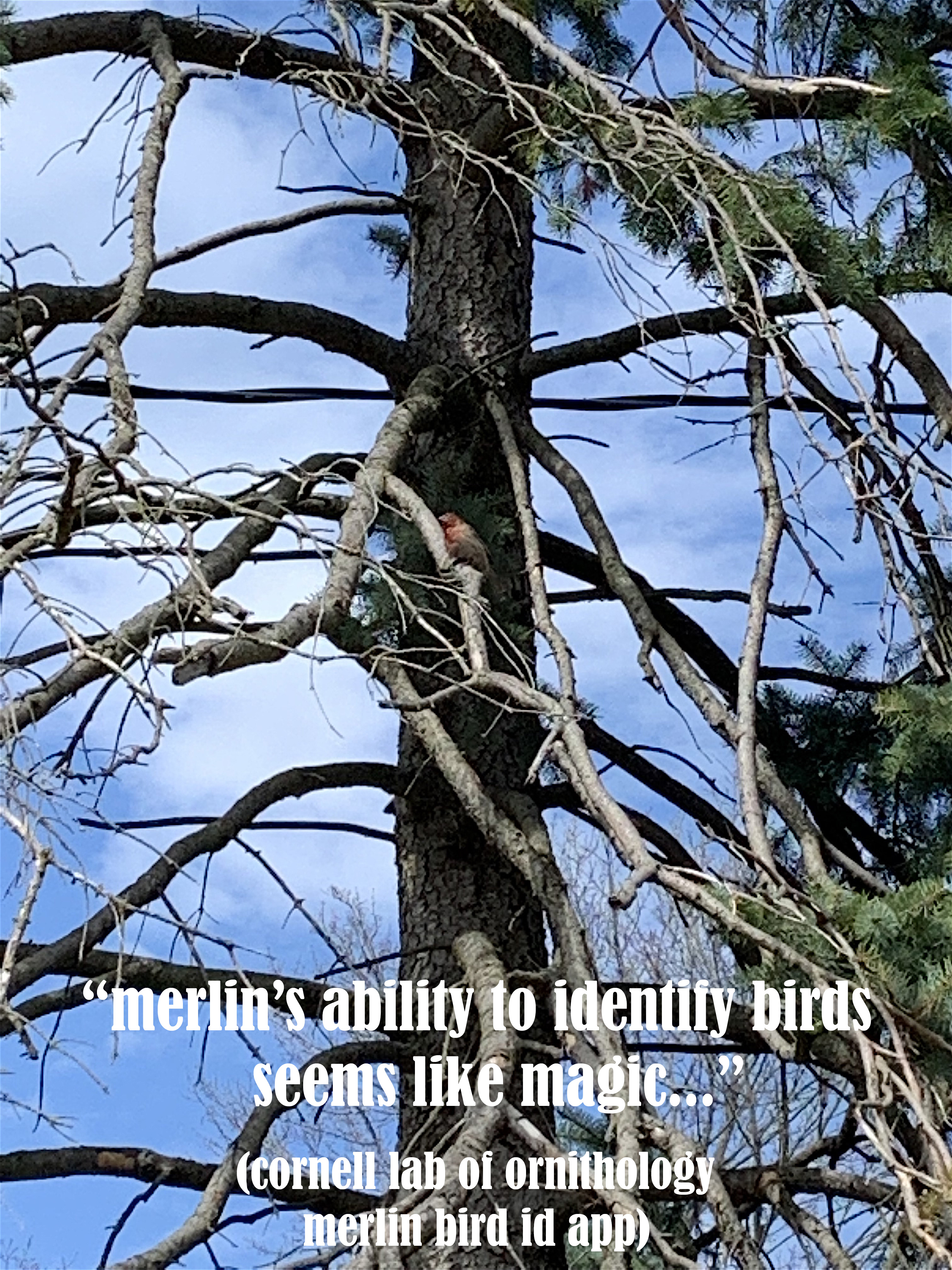
Deb showed us an app. Merlin. It identifies birds by their song. Now, armed with our book from the Botanical Garden and our Merlin app, when I ask, “What’s that?” Kerri – who is always alarmingly way ahead of me – has the answer. “Eastern Towhee,” she says.

“You’re making that up!” I cry, knowing she can’t stand to be challenged so will immediately jump to prove to me that she is right (it’s my secret fast-track to knowledge).

“Look it up!” she insists, showing me both the book and the Merlin return.

“Wow,” I say. “Towhee. Who knew. Maybe my pen name should be Grackle Towhee!”

She yanks the book from my hands. “Oh, Look!” she exclaims. “Merlin has identified you: Midwest DoDo.”

read Kerri’s blog post about BIRDS!

Breathe At Human Pace [on KS Friday]

We live in a time in which cars are capable of parking and braking themselves. I am able to type a message into a little box that I carry in my pocket and my message, through space and time to anywhere in the world, is delivered immediately. I write my thoughts in this device and then publish all over the world. I’ve learned of a software that is able to write my thoughts without me – faster and with fewer grammatical errors at the outset. I think and write in a pattern capable of being recognized. I am, therefore, capable of being approximated. What is amazing today is common tomorrow. So it goes with the pace of change.

I read in The Dream Society, written two decades ago, that the aim of the industrial era was to spare humanity physical toil and the aim of the information age is to relieve us from the exertion of thought. We’re producing data at a staggering rate and, ironically, the explosion is both serving the intention and overwhelming our capacity to keep up. We can’t possibly process the tsunami of information that washes over us everyday. We are human. We have a tough time sussing out truth from belief-fantasy even when not washed down the roaring information streams.

It is why I hang out with Desi. Desi is the little tree sprout that we rescued from the Des Plaines river trail over two years ago. When Desi came home with us, her tiny trunk was needle thin. She is thriving in her pot and has more than doubled in size, yet, by the standards of data, her growth is glacial. And that is precisely why I visit her each day. She is in no rush. Efficiency for Desi has nothing to do with speed. Health is about good soil and light. Like all plants, she could be pushed artificially, but why? Pushing might get her to adulthood faster but would also damage her systems. Efficiency and health, for Desi, are all about natural pace. Slow, slow, slow to human eyes.

Desi reminds me that the pace of my life is artificial. A choice. The pace, the incessant noise vying for my attention, are human-made, unnatural. Don’t get me wrong. I delight that Google maps gets me where I want to go. I appreciate having a phone available while walking a backwoods trail. One of the great joys of my life is watching Kerri photograph – with her phone – the world she sees. I love to write and push a button to share. I am, despite my advertising, not a luddite. I’m also aware that the media – the medium – is the message. We are – we become – what we consume and how we consume it. It is a necessity in our age of rolling miracles to keep both eyes open.

I think it is healthy (although virtually impossible) to occasionally crawl out of the stream and breathe at human pace. To think without the expectation of assistance. Each day, for a few minutes, I hang out with Desi, a reminder that an inch of growth every year is sometimes fast enough.

Kerri’s albums are available on iTunes and streaming on Pandora

read Kerri’s blogpost about DESI

taking stock/right now © 2010 kerri sherwood

Imagine The Possibilities! [on Two Artists Tuesday]

Mastering others is strength. Mastering yourself is true power.” ~ Lao Tzu

I’ve had this quote sitting on my desktop for months. I’ve been on a Lao Tzu kick, a Kurt Vonnegut kick, a Rainier Maria Rilke kick…all at the same time. They are, not surprisingly, in alignment on many topics, among them self-mastery. “The secret?” they whisper. “Stop trying to control what other people think or see or feel and, instead, take care of what you think and see and feel.” Their metaphoric trains may approach the self-mastery station from different directions but the arrival platform is the same.

It’s a universal recognition: take the log out of your own eye.

Sometimes a penny drops more than once and so it is with Saul’s advice to me. “Look beyond the opponent to the field of possibilities.” “And, just what does that mean?” you may shout at your screen. It sounds like new-age hoo-haw.

Ghandi said, “Nonviolence is the weapon of the strong.” It is the height of self-mastery to bring ideas to the table rather than a gun. It is the height of self-mastery to bring to the commons good intention and an honest desire to work with others to make life better for all. Power is never self-generated but is something created between people. Power is distinctly different than control. Power endures since it does not reside within a single individual. Power lives, as Saul reminded me again and again, not in throwing an opponent but in helping the opponent throw themself. “Focus on the possibilities,” he said again and again. Throw yourself to the ground often enough and, one day, it occurs that there may be another way.

Work with and not against. It seems so simple. The bulb hovering over my cartoon head lights-up. Work with yourself, too, and not against. Place your eyes in the field of all possibilities. Obstacles are great makers of resistance, energy eddies and division. Possibilities are expansive, dissolvers of divisiveness.

I am writing this on the Sunday that Christians celebrate their resurrection. The day that “every man/woman for him/herself” might possibly and-at-last-transform into “I am my brothers/sisters keeper.” All that is required for this rebirth is a simple change of focus; a decision to master one’s self instead of the never ending violent attempt to exercise control over others.

It’s the single message, the popcorn trail left for us by all the great teachers. Instead of fighting with others, master yourself. Imagine the possibilities!

read Kerri’s blogpost about THE CEILING LIGHT

View The World [on DR Thursday]

Dogga is a wrecker of backyards. He’s a destroyer of pristine spaces. His joyful enthusiasm propels him in rapid circles and his circles have become etchings in our smallish yard. Initially, we tried to cover his etching path in stone. Were you to visit you’d find flat stones covering a wide spiral around the pond, his first velodrome. To no avail. He is a living Spirograph, a dervish of delightful circles. Viewed from the air, I’m certain our backyard smacks of alien visitation, mysterious crop circles.

We’ve learned. Rather than resist nature, attempt to control it or cover it up, it’s a much better plan to work with it. I knew we’d crossed a thought-bridge the day Kerri suggested we install a round-about sign. We had to be direction-correct so we bought one for right-sided drivers. The details matter. If Dogga was to suddenly switch and run in the opposite direction we’d have to issue a citation or get a new sign.

If there is a devil in the details there must also be an angel. As I’ve previously noted, I am not naturally a detail-guy; my head is at home in the clouds. I’m conceptual and can see great distances. It’s why metaphors are my currency, movement and pattern my friends. Please do not ask me to write a grant or make sense of the world through a spreadsheet. I can. I have, mostly out of necessity. But the cost to my soul is mighty. Luckily, as this great world spins, and the draw to a comfortable center is the force-at-play, I’m currently surrounded by teachers-of-detail, Kerri and Dogga are my favorite two but there are many in my circle. Angels, all.

Kerri runs to show me the photo she’s just taken. A close-in shot. A texture. A bud. An entire world in minutiae. See the beauty in the detail. For me, that’s the passage to the center. There’s entire universes to be found in the smallest detail. The up-in-the-clouds and close-in are relative terms. There’s a whole other worldview available from the grasses.

Lay on the ground and the Dogga will run circles of joy around you, his center point. There’s nothing better and that’s the kind of detail that’s not to be missed.

read Kerri’s blogpost about FROM THE GROUND UP

face the rain © 2019 david robinson

Dream [on Not So Flawed Wednesday]

When does a dream turn into a goal?

Lately, I’m having conversations that confuse me. Business thinking, engineer minds, make models for creation. Creativity plans as action templates and guides.

Screen writers make plans, too. Step outlines. The difference is in the process. A creative mind makes models and plans with full intent to throw them away. To discover the best story, their plan involves making space for the better idea. Open up by tossing the model. Clear the deck by shuffling the plan. Sketches and rough drafts. It’s a conversation with the muse. Muses are notoriously structure resistant until the story makes an audience sit forward. Movement first. Then, the structure begins.

The engineer mind works in the opposite direction. The dream must wear the mask of a goal or it is considered invalid. Too squishy. Construction begins immediately with targets and tasks. Order. It is, in fact, the same process as the creative mind, only it is less forgiving of space. It forces the muse to move. Time is of the essence. Structure first. Then movement. Efficiency is a tree with shallow roots.

It confuses me. Dreams do not wear ties or leather shoes, yet, scrape the blueprint and you’ll find a dream every time. Perspective requires stepping away from the canvas. Standing too close for too long and loss of vision is the result. Every time. It’s not a mystery or voodoo. It’s physics. Great ideas and idea-break-throughs happen in the shower or walking on the trail. A clear mind. A different focus creates space. Too tight thinking, too close in for too long, sucks energy.

Once upon a time I worked with organizations and educators. They also confused me. Squeezing the air out of their space they’d gasp, “We can’t breathe.” A little bit of space, some play, a refocus on the relationships was good medicine. Fresh air. Step back and see the painting. The point of perspective is to see. The secret: permission to remove the status games and need to be an authority and, for a moment, reconnect the players to their dream.

At the nucleus of every goal beats the wild heart of a dream.

read Kerri’s blog post about DREAM

Look Out [on Two Artists Tuesday]

Perhaps the most useful and profound lesson I’ve learned happened under the water. I was doing my first night dive. I was scared. I was not yet a confident diver. As we descended the world became inky black. All I could see was where I pointed my light.

It was that simple. I can see where I point my light. That’s it. And, more to the point, I choose where I point my light. I have the capacity to choose what I see. I can…and have…chosen to focus on hardship and lack. I can…and have…chosen to focus on what I love. On any given day my focus bounces full spectrum between complaint and appreciation. And then I remember: it’s my light, where do I want to aim it?

There’s a second aspect of the lesson. My focus is a beam. My light is not all encompassing. Each of us looks at life through a soda straw. None of us has the big picture. That’s why the commons is so important. In order to know what to do, we need to bring our many perspectives together to approximate something close to a full picture. Rather than fight about disparate points of view – who is right – it’s more useful to try and assemble all of those differing views, like the pieces of a jigsaw puzzle, into a bigger picture. No one wins when the pieces refuse to interlink.

With two broken wrists the cello became impossible to play. It has sat in her studio, the case unopened, since her fall over two years ago. I remember the day we bought it. We were early in our relationship, not yet married. I knew she was having cello dreams. We went to the music store for some other purpose, I can’t remember. The cello was sitting in the corner. She sat. She began to play. It was a perfect fit. And, although we could not afford it, we also could not leave it behind. It was a perfect fit.

Our lives these past two years have been a descent into dark water. We’ve worked hard to shine our light at our good fortune in a dark and inky landscape. As we make our way back to the surface, we are cleaning out. Taking stock. “The cello needs to be played,” she said, deciding to sell it. “I’ll never be able to play it, now.” She took photographs of her cello. Sent out a message through the network.

At the end of the day she showed me the photo. Edges. The view from inside the empty cello case, looking out. A slice of the world visible outside the case.

What’s “out there” is rarely clear. We see a small slice. It tickles our curiosity. The cello dream moves on making space for…? Who knows? We can’t see that far. In the meantime, we keep our eyes and hearts uplifted as we slowly kick our way back to the surface.

read Kerri’s blogpost about EDGES

Break It [on KS Friday]

Breaking space with a line changes the dynamic of the entire composition. I played with those dynamics for years. Vertical breaks. Horizontal lines that read like confused measure bars, segments of inconsistent time. Sometimes the lines tilted and pulled to the past. Sometimes they leaned into the future, urging the image forward. All of those interpretations were, of course, in my mind; I have no idea how others interpreted the lines on my canvases.

We are in the season of fog. Sometimes it’s so dense that we stand on the rocks and cannot see the water. Lake Michigan is hard to hide! The fog is a worthy magician.

The fog-magician also has the capacity of pressing three dimensional objects into seeming flat two dimensional images. The sudden silhouetting of the world pulls Kerri out onto the deck every time. “Can you believe it?” she asks, grabbing her camera and stepping through the door and into the fog. Dogga and I watch. We are happy in three dimensions and resist the call of stepping into flatland.

When she returns to our dimension, she shows us her photographs. “I love this one because the wire made a line,” she says. “It breaks the image.”

I smile. Vertical breaks in the composition. I say, “It reads like an abstract painting.” Three dimensions becoming two, a line breaking space, capping or pulling or simply interrupting.

Jackson Pollock believed his paintings were recordings of movement. Paint dancing. Who really knows how others interpret his paintings. Beyond the curator or art historian, who cares, really? The relationship between art and audience is meant to be direct, pure. No third party interpretation necessary.

“What do you think?” she asks.

“I love it,” I say. “It makes me want to paint.”

kerri’s albums are available on iTunes & streaming on Pandora

read Kerri’s blogpost about FOG

when the fog lifts/this part of the journey © 1998 kerri sherwood