Stroll [on Two Artists Tuesday]

Yesterday, for some reason, I revisited days of early childhood. I played four-square in the driveway. I threw dirt clods at the site of new home construction. I raced my cars off the side of the abandoned building above Del and Dorothy’s house in the mountains; the cars tumbled and I ran to retrieve them so I might send them flying again and again. I ran home in a panic the day I learned that Nancy’s little sister had drowned in utility hole that was filled with water. It was on the route I walked to school and passing the hole filled me with trepidation, it was a dark portal, my first experience of death. I didn’t really understand it.

Late at night, Kerri and I sometimes talk about everything that has happened in the short time of our relationship. We’ve lost parents and lost careers, spiraled in a free fall of uncertainty, had surgeries and broken bones. We’ve also climbed mountains, watched sunrises and meteor showers, we hold hands when we walk, we write together every day. We dance in the kitchen. I am the sous chef to her cooking artistry.

I’m not sure if we practice paying attention to our moments or it’s something that has come naturally to us. She is rarely without her camera, noticing the smallest flower, capturing the angry sky. I hold the space and hope someday she stops apologizing for stopping again to take a photo; I love watching her discover the shapes and colors of this world. Besides, I get to see what she captures in her lens with an excited, ‘Lookit!”

Today the plumber comes. Yesterday we appealed to the company that destroyed our yard replacing the waterline to come back and strip off the top layer of soil, now filled with hardware and concrete and asphalt. Slowly, we are digging out, repairing and replacing all that was destroyed or delayed in our free fall. Our lessons seem to be about stress – or, rather – not stressing. We are having experiences, rich and varied. Some things we can control. Most, we cannot. The best we can do is hold hands and stand together in each experience. Appreciate them no matter whether they look like tragedy or comedy. We’ll make meaning of them later down the road.

The artist dances with death. The appreciation of the fragility of life. Each day I walk by that metaphoric utility hole, only now it does not fill me with trepidation. It makes me squeeze her hand and fills me with gratitude for this life, this moment, this shadow we cast together as we take our time strolling through the garden.

read Kerri’s blogpost about THE SHADOW

See The Glue [on Not So Flawed Wednesday]

It’s a new phrase to me but I liked it immediately. I liked it because I have known some amazing people, those rare birds who keep the runaway-egos focused on the project, who naturally and seemingly without effort coalesce disparate talents into a cohesive creative team. The ‘glue people’ is a perfect description.

Glue people intuitively understand power as something that is created between people, not something wielded over people. I suspect that is the epicenter of their glue-gift: they see beyond the parts to the sweeping possibility of the whole. They know that “every man/woman for themself” is a recipe for disaster.

Despite our dedicated cowboy mythos, innovation is never the province of a single person. There may be a single visionary but the vision is never accomplished in a vacuum. Inventions, like organizations or nations, come to fruition through the efforts and skills of the many-working-as-one. Glue people generate “the-working-as-one.”

Stage managers, production managers, executive assistants, contractors…those highly overlooked people at the center of the information, who quietly make sure the work of creation happens without collision while also making certain all the parts and pieces know how much they are valued.

Meaning makers. Making value explicit. Glue people. Just try to get an idea off the runway without them.

read Kerri’s blogpost about GLUE PEOPLE

Do It Together [on Two Artists Tuesday]

Our house is beginning to breathe. As each bag or box leaves, as another load goes to Goodwill, space opens. Air moves. Stuck spaces relax. New possibilities circle our imagination. And, as the house takes a deep inhale and long slow exhale, so do we.

This is a task she must do on her own. In the past I tried to make it happen and only created more turmoil. I am a relative newcomer to this house so my memories do not run as deep. What looks like junk to me might carry a sacred family story.

That is the continual lesson of my life. My eyes can never see the full extent of your story. Your eyes can never see the complexity of my story. The creation of “our” story requires constant tending. It’s always best to ask a question. “Our” story becomes vital, rich, and inspiring the moment I cease trying to get you to see my way. There’s a space between – called “relationship”- that we can both see because, together, we create it. Together, we speak to it.

Those few simple lessons apply to all relationships, even the most casual.

And so, while I’m working upstairs, she is downstairs unpacking boxes and bins. Sometimes I hear her sigh. Sometimes there is laughter and I know a good story will come my way. Each day, before I climb the stairs, I ask, “Is there anything I can do to help?” Her reply is always the same. “I don’t know but, if there is, I’ll let you know.”

read Kerri’s blog post about CLEANING OUT

Look Closer [on KS Friday]

As the cowboy rode passed us he asked if we’d noticed the Mayapples. We laughed. This same cowboy, a few years ago, taught us about the Mayapples. He’d forgotten but seemed pleased when we reminded him. “That cowboy loves his Mayapples,” I said as he rode on down the trail.

We see each other through soda straws. A few brief encounters, a man on a horse dressed as if he just rode in from Wyoming, a lover of Mayapples. I really know nothing of his story or the realities of his life. I thought about him as we continued our walk. He might be a surgeon or a professor of botany. He might be an apparition. I doubt that “cowboy, lover of Mayapples” is the totality of his identity. I have many story-possibilities rolling for the cowboy, yet, my bet is that I’d be surprised if I had more than a straw’s view into his life.

Most of our judgments about others is a result of the straw’s view. We are master storytellers and only require the slightest prompt to spin a full tale. We see a 30 second news spot and believe we have the complete story of someone’s life. I suspect most of what we fear about other people is mostly soda-straw concoction. Laura Blumenfeld’s book, Revenge, is a great reminder of what is possible when the soda-straw view, the assigned role, expands into a full human portrait. A closer look always reveals a richer human story.

Later down the trail I howled with laughter. We’ve been fans of the Mayapple since our first encounter with the cowboy yet never knew there was a blossom hidden beneath the canopy of leaves. “Oh, my god!” Kerri exclaimed, lifting the broad leaf, exposing the white bloom. We lifted a few more leaves, each hiding a surprise flower. “I had no idea!” we chirped in unison.

“Have you noticed the Mayapples?” asked the cowboy. Apparently not.

Kerri’s albums are available on iTunes & streaming on Pandora

read Kerri’s blogpost about MAYAPPLES

nurture me/released from the heart © 1995 kerri sherwood

See Down The Pike [on Flawed Wednesday]

“Age and stage,” 20 says, to explain the behavior of people. Age and stage.

I pulled up Shakespeare’s Seven Ages of Man soliloquy. Jaques from As You Like It. “All the world’s a stage…” We perform the role of ourselves in this drama of life. In a funny coincidence, I’m spending some time inside Pirandello’s play, Six Characters In Search of An Author. David is updating the script and preparing for a production. I’m fortunate enough to play witness to his journey. ‘All the world’s a stage’ meets ‘who will tell our story?’

In the final lap of his career, Tom was an assistant superintendent at a school district. He’d shake is head and say, “Parents forget that they were once children and expect their kids to do things that they themselves could not do as children.” Each age grows blind to the previous stage. We forget the great learning-power of making a mistake.

My favorite of Tiago Forte’s 10 Principles of a Second Brain is to make it easier for your future self. It’s a great idea and I wish the bevy of my past selves had been kind enough to consider me at this age and stage. When I turn and look at the rough wake of my passage I know that, with some better choices, I might have scribed a more direct path. Or not. My past selves caution me to fully appreciate the messes and the mistakes that they made. My life is better today because of the rampant foolishness of those former-me’s.

The Balinese believe that we come back every seventh generation. They are an ancestor returned. As such, they are less likely to foul their nest believing they will themselves be the future inhabitants of the nest. Looking down the long-road, they see themselves dealing with the world they currently create. And so cooperation, sustainability, and peace are much higher on their priority list than guns and every-man-for-himself. To care for another is to care for their future self. They find a society like ours, that allows anyone in the community to be homeless, to be broken. Diseased. Or simply adolescent.

I can’t help but think they are mature while we are mewling toddlers. Considering the impact of your actions seven generations into the future is surely a sign of maturity. Thinking of others, understanding betterment as a shared responsibility, is an adult perspective. Currently, we allow our children to be slaughtered and protect the gun that killed them. Surely there’s some growing-up to be done.

I wish I had a penny for every recent conversation I’ve heard that began with the phrase, “I don’t understand what’s going on in this nation.” 20’s voice pops into my head, “Age and stage,” he says in my mind. “Age and stage.” Let us hope that there’s some maturity coming down the pike, that we survive this stick-your-finger-in-the-socket stage.

Perhaps we will someday look back and appreciate the mess, the rampant foolishness, the mishmash we are making.

read Kerri’s blogpost about AGE AND STAGE

Stand Still [on Merely A Thought Monday]

“The understanding of what you actually are is far more important than the pursuit of what you should be.” ~ Krishnamurti, Think On These Things

I wrinkled my brow the first time I heard Kerri say it: “We don’t change. We just become more of who we already are.” I didn’t like it. I wanted to pop the notion with pithy ideas of transformation. Something made me hold my tongue. “Consider it,” I said to myself.

Now, a full decade into the latest phase of my life-long-onion-peel, I see the wisdom in her words. The layers of protection, the suits of armor, the wall of respect, the race from shame, the measuring sticks and self-inflicted-social-expectations stripping away. Trying-to-be falls to the floor like a robe. The story-husks and fear-shells and false skins, false faces, false labels and roles and masks falling to the forest floor.

And, there you are. Just as you are. Naked and vulnerable and oh, so passingly human. Standing still. No ghosts to chase. No monsters chasing you.

And, there you are.

No distance between you and what you desire to create or experience. Finger painting. A child with a crayon and an empty wall for scribbles.

Kerri looks for hearts. She finds rocks shaped like hearts and leaves, heart-impressions in walls and heart-shaped clouds. Each one is a first-and-only and evokes delight. Last week on the trail, it occurred to me that she finds them everywhere, not because she looks for them, but because she expects to see them.

Seeing old friends. There you are.

read Kerri’s blog post about the HEART LEAF

Embrace Wabi-Sabi [on Not So Flawed Wednesday]

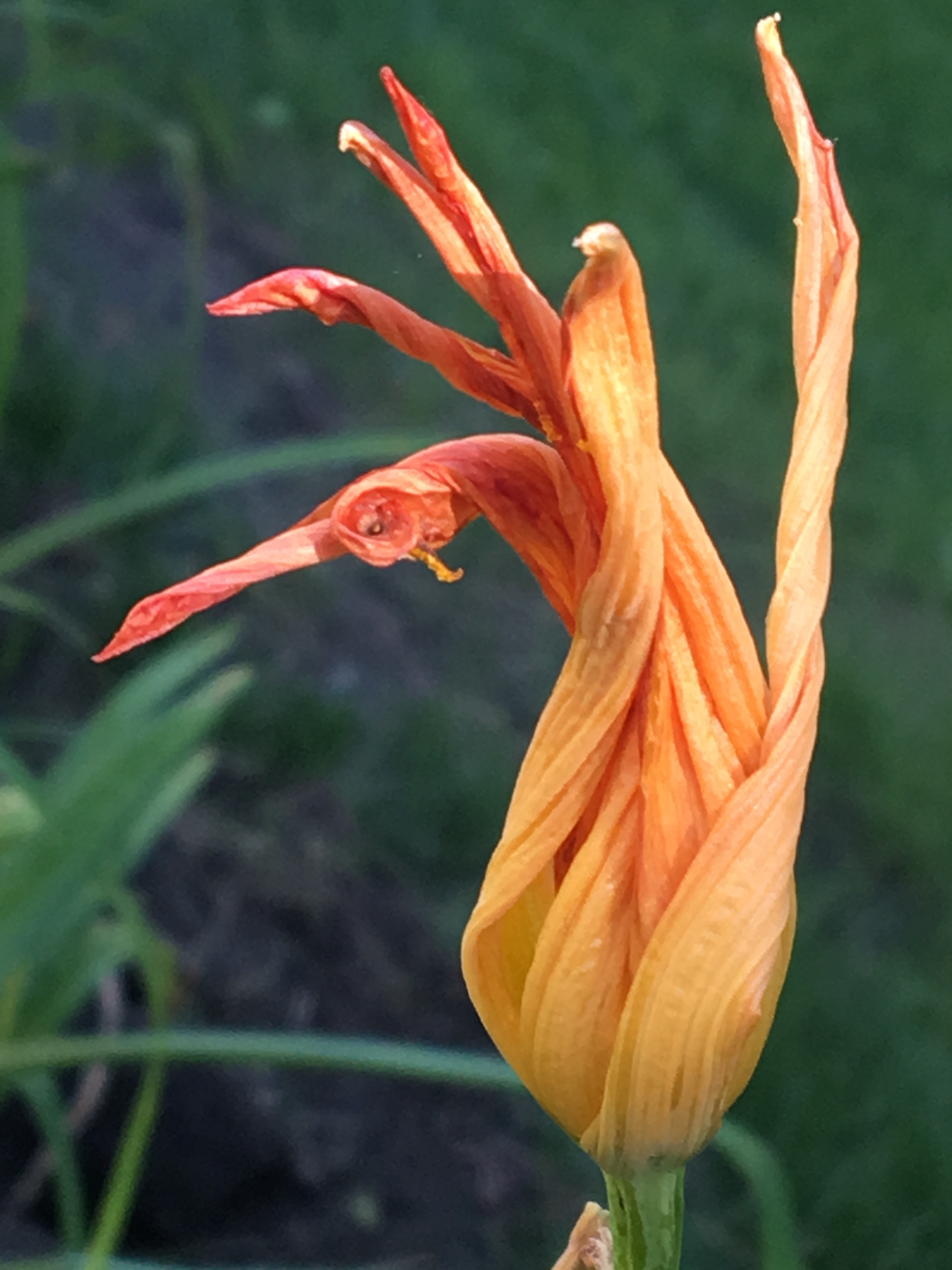
“I love this photo,” she said, “because the flower isn’t perfect.” Wabi-sabi. Appreciation and acceptance of impermanence and the absence of perfection. The full embrace of ‘what is’ rather than some imagined belief or ideal.

I read that the church leaders refused to look through Galileo’s telescope because their book already explained to them how the universe worked. I don’t know if this account is true or not but I’m given to believe it. I see the same story playing out in all shapes and sizes of blind-belief systems today. The wily Fox has millions refusing to look through the telescope in favor of an abstract and angry conviction.

Imperfection. Appreciation of nature and its forces. Look up. Open eyes. Open mind. Open heart. Direct experience that has the power to challenge the staunch and rigidly held opinions. Modesty.

Wabi-sabi. I love this photo.

read Kerri’s blog post about THE WHITE BLOSSOM

Watch For Turtles [on DR Thursday]

“The art of living… is neither careless drifting on the one hand nor fearful clinging to the past on the other. It consists in being sensitive to each moment, in regarding it as utterly new and unique, in having the mind open and wholly receptive.” ~ Alan Watts

The ferns have returned. Last week they were sharp tendrils poking through the leaves and earth; little green aliens. A mere seven days later, they are over three feet tall, fern-flags unfurling.

Driving to our trail we saw a turtle crossing the road. Kerri whipped a u-turn and I jumped out of the car, picked it up, expedited its journey, moving it from the pavement to the grass. There’s something special about the turtles. Throughout March and April, while walking on our trail, we’d cross the bridge over the Des Plaines River, and look for the turtles’ return. The turtle in the road was our first sighting of the season. Later, on the bridge over the river, we saw a dozen. “They’re back!” she said and smiled.

Lately we’re given to walking the same trail. We’ve seen it change through several seasons. We followed our loop last week and I swear, this week, it’s an entirely different trail. The trees are flowering. The trillium are showing their purple.

I used to wonder how Emily Dickinson thrived looking at the same garden for years and years. How did she write such beautiful poetry with such a small window to the world? Now I know that her world was enormous and my question was too small.

“Hope is the thing with feathers…”

read Kerri’s blogpost about FERNS

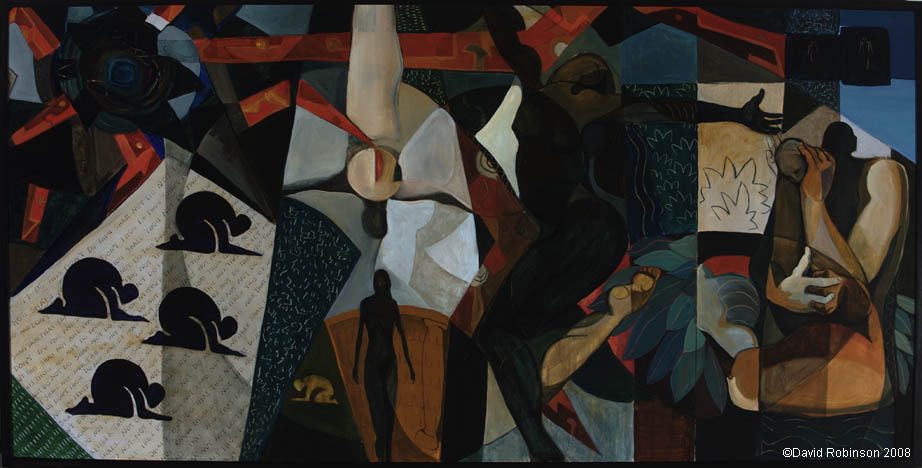
iconic © 2010 david robinson

Call It Realism [on Not So Flawed Wednesday]

This garlic could have been painted by Jan Vermeer. To my eye it looks like the work of a Dutch master, an artist more concerned with realism than the ideal.

Art that reveals the beauty in the ordinary. For a few weeks in my surly youth I studied with a realist painter. I was wowed by his technique but could not yet grasp his dedication to capturing the everyday. Only later did I come to understand that his art was not about the technique but about bringing attention to the experience of the everyday. He rejected the aloof and desired to pull art down from the pedestal so it might reflect the lives of the “common people.” He believed that people needed to literally see themselves in the paintings to have access to the painting. They needed to see their hardship and toil as well as the objects that surrounded them.

Bertolt Brecht believed the opposite. In order for people to have access to the deeper messages of a play, they needed to be removed from their circumstance. So, in his way of thinking, people are more capable of seeing themselves in a piece of science fiction than in a reality-mirror.

David is working on a re-imagining of Pirandello’s play, Six Characters In Search of an Author. One of the questions of the play is, “Who is telling your story?” And, how are they telling it. I reread the play and was struck by how relevant it is to our times.

The beauty in the ordinary. The turmoils and struggles of the everyday. Ours is a time of tumultuous story tug-of-war. I wonder, in a hundred years, what historians will write about our time. I wonder what aspect of artistry – if any – will be considered “realism.” As defined by Vermeer and Pirandello, it’s to reach across a social line, from the privileged to the working class. For Brecht it is spatial: step out to look in.

One thing is constant, while reaching across time and artificial boundary, it is always the role of the artist to help their community ask the questions: Who is telling my story? Whose story am I telling? What is the story that we are telling?

I imagine those someday-historians will write tomes on our messy struggle to sort out what is “real” and what is not.

read Kerri’s blogpost about GARLIC

Know Their Name [on Merely A Thought Monday]

As I let Dogga out each morning, I stand for a few moments and listen to the birdsong. Our particular spot on the earth is alive with birds: starlings, finches, sparrows, robins, hawks, crows, owls… The Mourning Doves always stop my motion. Their song is hypnotic.

The pandemic changed – and continues to change – many things. Our world became significantly smaller. The table in the sunroom. The backyard. Our trails. As someone with his head in the clouds I am a dedicated generalist. I have always appreciated bird song yet never, not once, thought of identifying the specific birds and their song. “Sparrow? Finch? Who cares! They are beautiful and that’s enough for me! I spend too much time in my left brain as it is! The last thing I want to do is categorize the birds!”

COVID changed that. Sitting on the back deck or at the COVID table staring out the window for hours on end, our relationship with the birds grew. From general appreciation to specific experience. From passive appreciation to personal connection. We began to see nuance. Pattern. We wanted – and want to know more about these beings that sing us awake each morning, that alert us to changes in the weather, that signal alarm in the neighborhood.

While visiting the Botanical Gardens, Kerri found a small book, coded by color, that identifies the birds in our region. In a flash we can open the book and identify the bird. “Hey! Look! That’s Paul!” I say.

“Stop!” Kerri scowls. “It’s Martha. Paul’s on the fence.”

Just kidding. House Sparrow. Carolina Wren. My favorite to pronounce is Grackle. Great-tailed Grackle to be exact. I’ve decided that, were I to somehow achieve tough-guy status and ride a Harley to breakfast, my motorcycle-dude name will be Grackle. “Hey, Grackle,” the waiter will say, as I come through the door en route to my usual stool. “Hey,” I respond. Motorcycle-dudes named Grackle are birds of few words.

Deb showed us an app. Merlin. It identifies birds by their song. Now, armed with our book from the Botanical Garden and our Merlin app, when I ask, “What’s that?” Kerri – who is always alarmingly way ahead of me – has the answer. “Eastern Towhee,” she says.

“You’re making that up!” I cry, knowing she can’t stand to be challenged so will immediately jump to prove to me that she is right (it’s my secret fast-track to knowledge).

“Look it up!” she insists, showing me both the book and the Merlin return.

“Wow,” I say. “Towhee. Who knew. Maybe my pen name should be Grackle Towhee!”

She yanks the book from my hands. “Oh, Look!” she exclaims. “Merlin has identified you: Midwest DoDo.”

read Kerri’s blog post about BIRDS!