Sing It Into Existence [on Two Artists Tuesday]

Lately I am awake for the sunrise. I know it is coming because, very slowly, the birds begin to sing. At first there is one voice, then a few more and then more. By the time the light through the window glows soft purple and gray, the full bird chorus is in session. They sing the sun into rising.

Although I didn’t recognize it at the time, these lawn-art-birds would come to represent to me threshold guardians. Harbingers of the test that my move to Wisconsin would bring. In story terms, threshold guardians are not friendly; they serve as the test of readiness: are you willing and able to greet the challenges that come with change. Or will you run away? Sometimes they are monsters. Sometimes they require the answer to a riddle or solving a puzzle. The new world will open after the obstacle is met. In facing and overcoming the challenge, the guardians often become allies. In truth, they are allies all along. They help you find your self by testing every idea that you have of your self.

Driving the Budget truck on my move from Seattle, filled with the artifacts of my life, Kerri and I stopped in a little village, Stockholm, just as we crossed the Mississippi River into Wisconsin. We wandered down the street and into a gallery. We were drawn to these simple bird-sculptures. They are the first thing we bought together. They represented our step into relationship. Us. They would stand together in our yard.

My first few years in Kenosha were akin to being lost in the woods. My livelihood disappeared. My networks disappeared. Art opportunities vanished. Many of my friendships faded. Every project I tried to pitch or create stalled, every path I attempted to plow broke the plow. I felt stripped. Of little or no value. Even in arenas where I was once appreciated, I was invisible. I’ve done extraordinary consulting work in organizations but learned in my new life that my experience and observations were not welcome. So, silent as well as invisible.

More than once I went out back and sat with the sculptures. They remained silent when I asked of them my questions. Who am I now that I have no useful purpose? What do I do now? In the absence of an answer, the sculptures and I listened to the birdsong.

Often the test brought by the threshold guardians is one of letting go. You cannot become a butterfly if you insist on remaining a caterpillar. The armor must fall. The known shape must go to mush. The what-the-hell-is-happening-to-me necessarily falls unanswered into the void. What’s happening is not complex: you are changing. The old stuff isn’t working because it is too small for the new shape. Let go.

It is not complex but it is uncomfortable. Dark night is cold when you’ve shed your skin. The sun will rise. The birds will sing it into existence. Warmth will return in the moments beyond the soft purples and greys.

We recently moved the bird sculptures from their spot by the pond to a new home by the fence. I hadn’t realized how invisible they were when standing over the pond. By they fence, they are glorious! They are also a metaphor, standing tall, made more vibrant and dynamic by their incorporated shadows. They are transformed. They are present, standing together in the yard. They are signaling the path to the new world, singing into existence the new day.

read Kerri’s blog post about THE BIRDS

Imagine It [on Flawed Wednesday]

Malidoma Somé wrote that a society with locks on its doors is a sick society. Something has broken down when a home needs protection from the other members of the community. Acquiring stuff takes precedence over honoring your neighbor. Can you imagine living in a community built upon mutual respect and trust, that valued and protected its members over its acquisition of stuff? Pie-in-the-sky? That might be the problem: we can’t imagine it.

Societies betray themselves. Despite the values inscribed in library cornices, despite the commandments we hold up as sacred ideals, we lock our houses against each other. We turn away when we see a person in need, their cardboard sign an appeal for help. The gap between the espoused and lived value-set is wide. In a society that claims greatness but practices mediocrity, is it no wonder that so much energy is dedicated to perpetuating a big lie? The lie is not the exception, it is the norm. The lock on the door.

Apparently, there is so much road rage on a particularly beautiful stretch of road rolling into Aspen, Colorado, that signs are posted giving travelers the number to call when the need for help is dire. Societies betray themselves. Why would a road through so much beauty, a road that dead ends in to some of the world’s great ski areas, a place where the elite retreat for some peace and quiet, why would there be so much rage on the road to such a place?

It must be a metaphor.

We tell a good story, that all are created equal, but we fight like hell to keep the full story untold. It’s happening now. Again. Still. Why are we so afraid to tell the whole story of a nation touting equality but built upon slavery and a rolling metamorphic racism? Like an individual, a society can’t address its problem until it admits it has one.

Gaps between espoused and lived values usually fill up with rage. Our gap is textbook. So many guns, so many locks on the door, so many patterns of violence and suppression that repeat over and over again.

Can you imagine living in a society that was proud of its story and need not dunk it in a lie? Or feast on an orgy of guns in order to feel potent and protected? Or post signs warning of the ubiquity of rage? That just might be the problem: we either can’t or won’t imagine it.

read Kerri’s blog post on ROAD RAGE

Consider The Intention [on Merely A Thought Monday]

My least favorite character in Romeo and Juliet is Capulet, Juliet’s father. A few years back I thought it would be a good exercise to tell the story from his point of view. In his world of privilege and order, he has an out of control daughter, a teenager no less, ignoring the rules of the house and society, having sex with the son of a sworn enemy. He imagines a better future for her (and himself) and has worked hard to protect her and match her with royalty. Like every parent I know, he just wants his daughter to behave and thrive.

Every story has an agenda. That’s true of the stories we tell of ourselves at parties, it’s true of the stories we shout at each other when we are having fights, it’s true of the stories we tell when we are falling in love, it’s true of the stories we tell when breaking up. Every story has at least two sides and each side has an intention.

Stories are never neutral or passive. It’s precisely why Blind Justice is so important to the health and well being of a society: between two opposing/competing stories there is a point of equilibrium that we call “fact” or “truth.” Blind Justice carries a scale to symbolize that place of story-equilibrium, ideally free of status, privilege, sway…weighing the stories to arrive at fairness and equity.

Health is the capacity to consider the other side of the story.

It is the truly despicable character that steps with intention into the gap between competing narratives solely to create discord. To lie for gain. Iago is just such a character. He creates an illusion with no greater intention than to hurt, to destroy. Desdemona dies. Othello murders because he cannot see through the lie Iago is telling. Othello’s love turns to hate. He cannot or will not hear the other side, the love story, the truth of Desdemona.

Hatred is a territorial flag planted in a one-sided story.

The modern GOP is Iago. Othello is a cautionary tale relevant in our times. What or who will be murdered before the lie is laid bare?

I have always been a lover of myth and parable, stories that reach with intention to deeper truths. It is why I stepped into the theatre in the first place. Art, like Blind Justice, uses story to reach deeper truths, truths that can rarely be captured in words. It’s the paradox of art and truth is always found there.

No story has a single point of view. No truth is singular – that is the hallmark of the truly important challenges that every society faces. It is why successful governments tell their story with truth as their intention. It is why successful relationships sail through stormy seas. The intention is pure. The desire to stand in the shoes of the other-side-of-the-story is genuine and necessary in order for the relationship, the community, the country to thrive.

Capulet is not a bad man. He has good intention. The play ends when he becomes capable of standing in and considering the other side of the story. Hope and equity is the promise rising from the pain.

Iago, on the other hand, is a wholly different story. His play ends in a cage with a nasty celebration of the pain, death and havoc he’s wreaked, gloating about his capacity to snare others in his big lie. All are made fools.

read Kerri’s blog post about THE OTHER SIDE OF THE STORY

Seek The Old Gods [on KS Friday]

I’m thinking a lot about gods and goddesses these day. No, it’s not a weird fixation. It’s a project, a story that involves the old gods and the new. The elemental and the angry. The unified and the divided. We make ourselves in the images of the god[s] we embrace. It’s a story about reaching back to the old gods, to a time before the worship of the great divide.

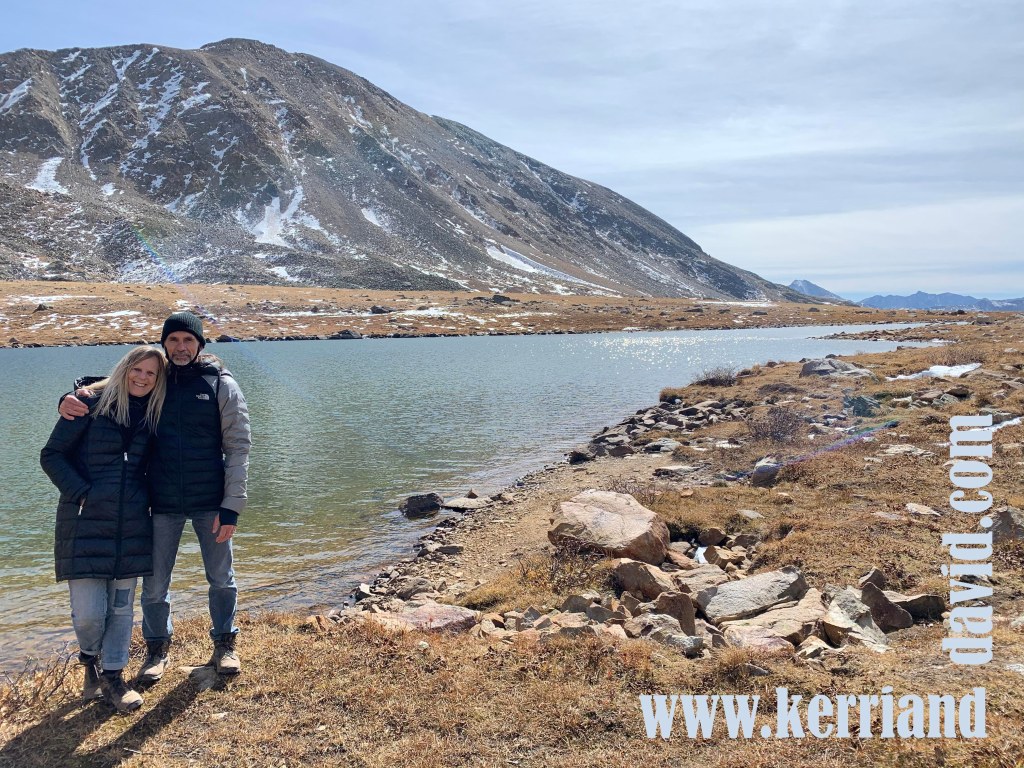
We took a walk along a trail just behind our airbnb. We were only in the mountains for a short time, long enough to have dinner and a day with our daughter and her beau. On the trail we turned and gasped. The mountain towered above all things. It reached to the sky. So majestic in its presence, it did not look real. “Now, there’s an old god,” I whispered to no one. It challenges one to know it, to climb it and participate in the beauty and the ascent – with no opinion at all about who might deem themselves chosen or not. It does not discern nor divide. It reminds. You are this. Climb and breathe the fresh air.

Kerri saw hypericum berries [“You say hypernicum, I say hypericum, let’s call the whole thing off…”] in the grocery store. “These would look lovely on our table!” she exclaimed. They came back to the airbnb with us and found themselves placed in a fine Ball jar sitting in a prime spot on the table. She was right. Lovely. We did a bit of research and discovered that 1) no one can agree on the spelling of the berry [or they’re two different things but we could not discern the difference], and 2) it is often used as a winter wedding flower. Winter’s daisy. Red on green giving its color and presence at unions. “Another old god!” I declared to no one. Elemental. Till death do us part where we will once again unite.

She wrote a note of gratitude and placed the corner beneath the Ball jar that held the hypericum. “Our host will love these!” she said. Gratitude adorned with beauty. We hated to leave but had run out of time. We had to hit the road. We stood at the door and breathed deeply of the mountain air. More gratitude. The blue sky ringing against the red rock of the western slope. Old gods everywhere.

“We’ll be back soon,” I said.

“Maybe we shouldn’t leave,” she whispered.

“But oh if we call the whole thing off then we must part,
And oh, if we ever part, then that might break my heart.”

You say hypernicum. I say hypericum. Winter wedding. Both/And. Gratitude and mountains. Old gods. Old gods everywhere.

read Kerri’s blog post about HYPERICUM

kerri’s albums are available on iTunes

Care Enough To Question [on Merely A Thought Monday]

“Have you noticed that people all over the world are divided into groups, calling themselves Hindus, Muslims, Buddhists, Christians, and so on? What divides them? Not the investigations of science, not the knowledge of agriculture, of how to build bridges or fly jet planes. What divides people is tradition, beliefs which condition the mind in a certain way.” ~Krishnamurti, Think On These Things

John helped me carry a treadmill downstairs into the basement. It was a beast, a one-step-at-a-time affair. After the job was done we fell into a conversation about how baffling we find our divided nation. He confided that, of late, he’s completely unplugged from the news. “I’m happier, less anxious,” he said, though somewhat conflicted about his decision.

I told John about my dear friend whose strategy for navigating the division and the noise was to read only The Wall Street Journal. It aligns with his conservative values and provides the business and financial news that he enjoys. For his mental health and well being, he’s eschewed all other sources.

On our drive from Wisconsin to Colorado and back again, Kerri and I were amazed by the rabid roadside proclamations of belief. A bumper sticker trumpeting Extreme Right Wing, a pick up truck, weaving through traffic, flying a Confederate flag. We stopped to get gas and went into the convenience store to use the restroom. We were wearing masks which apparently was an affront to the other patrons; I literally locked myself in a stall to avoid being assaulted.

I thought all night about my conversation with John. What are our strategies for surviving the toxic noise? Note the word, “survive.” John suggested (and I agree) that the division is intentional, a strategy. “They’ve learned to monetize hate,” he said, “Both sides.” Our strategies of survival are indications of the problem. Like my dear friend, we seek a source of information – a single source – based on our belief, what we align and are comfortable with, and not based on any measure or expectation of truth.

This is not a new revelation. We’ve been talking about the problem with info-bubbles for years. John’s question, “Why don’t people care enough to ask questions of what they are being told?” is, I think, exposes the root of the challenge. People have to want the truth, expect the truth, before they care enough seek it.

Questioning is the basis of education. Curiosity is what drives progress. Belief asks adherents to stop questioning. We are, apparently – at least 50% – a nation of believers. Not a question in sight. Witness the circus in Arizona, the implosion of the GOP, the restrictive voting laws sweeping our nation, the undying support of a lie that undermines the pillars of our democracy. Belief without question is a toxic soup.

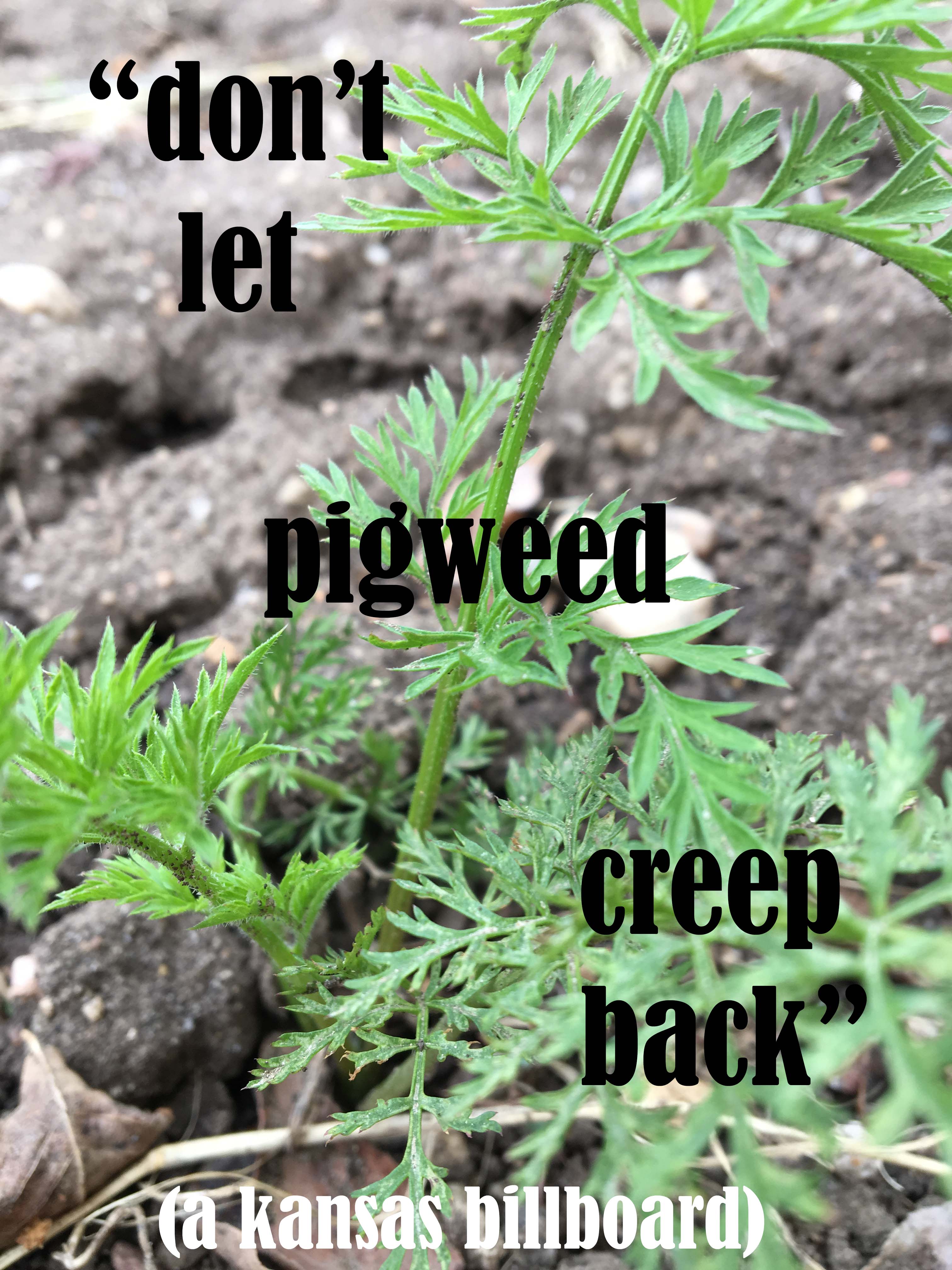
It’s become a metaphor that is easy to grasp: the Kansas billboard read, “Don’t Let Pigweed Creep Back.” A warning to vigilant farmers, pigweed strangles crops. It is toxic to farm animals. To keep the fields and the farm prosperous, a farmer must wage a consistent and conscious battle to keep the invasive weed from overrunning their fields. Our nation is no different than the farmer’s field. We are overrun with pigweed. It seems our information sorting mechanisms are out of whack. We no longer know – or care – to sort out what is edible and what is toxic.

We eat the weed and ignore the vegetable. John’s question is more and more relevant, “Why don’t people care enough to ask questions about what they are being fed?”

Belief without question. Conditioned minds. Mental farms overrun by pigweed.

read Kerri’s blog post about PIGWEED

Take It Home [on KS Friday]

A Double Haiku

“It smells like mountains,”

she said, nose deep in blankets.

“Can we take it home?”

Mount Sopris’ towers

above nose, bed, and blanket.

A coyote howls.

read Kerri’s KS FRIDAY HAIKU

Step Into The Next [on Two Artists Tuesday]

There is a plot of ground in the backyard of my growing-up-home, as Kerri calls it, that for many years served as my father’s garden. He has not tended it nor planted it for quite some time and yet, a few intrepid carrots have pushed their green shoots up through the crusty soil. The impulse to life never ceases to amaze me.

In the back of our refrigerator we found a red onion. It was not ancient and forgotten. We used half of it in a new recipe a month ago and laughed aloud when we pulled it out and found it sprouting. In the dark and cold recesses of the refrigerator drawer, it sent out explorers to find the sun. It looked like an alien creature, these pale arms reaching, reaching from a purple half-orb.

Before we drove away, I walked through the empty rooms of my growing-up-home, touching walls, gathering memories, shedding the skin of my childhood. We’d already moved my dad to a memory care facility. Now, my mother is settling into her new apartment. Closing a chapter as another opens.  All are reaching through a necessary uncertainty for what is next.

We left Denver and drove up the mountain into and through a furious snowstorm. Cresting the continental divide, we descended again into spring. There was snow and then, within a mile, there was a blanket of green climbing the hillside. This morning, outside of our door, the birds are in full chorus. The dandelions are in a heated competition with the grass and it’s anyone’s call which will win, though, left to their own devices, I’d put my money on the dandelions.

We think we are in control of nature but the last laugh is always on us. We are nature. Our control fantasy crumbles with age, making space for new life and next seasons. Whether we want to or not, we send out new shoots of pale green from our dark purple skin, hoping to punch through crusty soil to find the sun. Either way, we change form, stepping into the next, leaving well-known houses and used skin, filled with rich remembering, opening to welcome the new. The impulse to life.

read Kerri’s blog post about THE ONION

See The Story [on Not So Flawed Wednesday]

Inosculation is a natural phenomenon in which trunks, branches or roots of two trees grow together. ~ Wikipedia

I’m re-writing my Creatures of Prometheus script. Yaki, the conductor of the symphony, asked that I re-imagine it so the story-within-the-music might better speak to the issues of our day. The original performance was in 2008 and the world has changed mightily since the last time we performed it.

Beethoven wrote his ballet, The Creatures of Prometheus, as a creation story. Zeus ordered Prometheus to fashioned a human male and female. Zeus wanted them to be crudely made, their sole purpose, as he imagined them, was to worship the gods. Instead, Prometheus created something more powerful, more beautiful, more god-like. He knew Zeus would never allow something so beautiful to exist so Prometheus stole the spark of life so he might ignite the hearts of his creatures. That’s how the story begins; Prometheus steals fire to bring life to his beautiful creatures. The rest of the story is biblical. The creatures gain knowledge (separation). The gods corrupt the creatures and teach them division and the game of war, essentially booting them out of the garden. The gods like to watch war games like humans like to watch football on the weekends. It is a story of Prometheus’ punishment for daring to create something so beautiful, so capable, as human beings: he must watch them corrupt themselves for all eternity.

It’s a big story in a big ballet.

I take back what I wrote a paragraph ago. The world hasn’t changed so much. Our ancient and epic divisions and challenges have surfaced. They’ve bobbed to the top. The story Yaki asked me to specifically address is the black-white racial divide in these un-united-united-states. I have more thoughts on this story than I care to admit. And the story I will tell – so similar to the original – is a story of unity corrupted. The revision is a gift from Plato, a seed from The Symposium.

It was a common practice in colonial times, when the wealthy were vastly outnumbered by the locals and laborers – and the King’s army was an ocean away, to divide the commoners along some imaginary line. In the American colonies, the imaginary line was a color line. It’s explicit in our colonial logs and legislation. The fear. The solution. The cleaving. Any gain made by blacks is an automatic threat to white power. It’s a game the gods love to watch, like football on the weekends.

I have long thought that our division is impossible to heal when approached through a racial lens. It acts – and has always acted – as a trigger. Just as it was intended to do. The trigger is built into the system: approaching the racial divide as a racial divide will only serve to reinforce the divide. The division is knit firmly into our national DNA.

A systemic flaw must be addressed systemically. The division was designed in our colonial history because the colors united. For a brief moment the united colors were more powerful than the ruling class. The colors were cleaved and then knit back together through inequity. Keep ’em fighting. The dance of supremacy and suppression. United in discrimination. Unnatural inosculation.

Epic stories always end on a promise. There will be an awakening. The lost brothers will find each other. The Creatures of Prometheus, black and white, divided for the security and sport of the gods, will recognize that they are being used, distracted from their original state, and will join hands and together walk off the field. And only then will the natural inosculation, the branches and roots growing stronger together, become possible.

read Kerri’s blog post about INOSCULATED

See The Moon [on Not So Flawed Wednesday]

From Japan comes the story of the Crescent Moon Bear. It is a story of rage and patience. A young wife must pluck a single hair from the crescent moon shape at the throat of the ferocious bear. The single hair is a necessary ingredient for a medicine that will cure her husband. I told the story at a facilitation. After the telling, the vice president of the company said to the gathering, as an apology and a revelation, “I am the bear.”

Sometimes bears are necessary. Just like the wolf in Little Red Riding Hood, without the bear or the wolf there would not be a story. The purpose of a fear is to face it. It is a catalyst. The lesson is almost always concealed in the obstacle.

I once had a terrifying dream. I was being chased by monsters. I ran but could not get away. Finally, desperate, I saw a warehouse and ran for the door. I was certain there would be plenty of places to hide. Bursting through the door I was horrified to find the vast space empty. Swept clean. With no other exit available, I had to turn and face the monsters rushing toward me.

Do a little research on the symbol of the crescent moon and you’ll read that she represents cycles and instinct, mystery and immortality. Change. Fecundity. Many years ago I took a class on art and transformation. One of the projects, guided by an elder, was to make medicine shields. The face of the shield was decidedly male, sun. Bull. The back of the shield was feminine, moon. Lizard. Two aspects of power that dance. One is incomplete, superficial and out of balance, without the other.

In the Crescent Moon Bear story, after an arduous journey through the forest of her fear, the bear allows the young wife to pluck the hair. The magic ingredient is not taken, it is given. The obstacle, the monster, the locked door, opens and offers its potion. Insight ensues.

Insight, literally, the sight from within.

All of this, whispers from the psyche, bubbles of deeper wisdom, regeneration, emergence from the dark wood forever changed; could there be a better symbol for our times, a better symbol of promise as we stand with no place to hide, facing our raging pandemic, our ferocious bear of racial injustice, our masculine disequilibrium, than the promise of the crescent moon.

read Kerri’s blog post about the CRESCENT MOON

Walk In Sync [on Merely A Thought Monday]

My Seattle studio was on the 4th floor. It was a corner space so I had windows on two sides. On one side, across the railroad tracks, were the stadiums. Out of the other set of windows I could see the streets that bordered the International district. People scurrying to and fro.

Many afternoons, working on a painting, I’d hear the roar of the crowds, touchdowns or home runs. The light rail pulling into the station. The Amtrak train pulling out of the station heading north. Sirens, car horns honking. I loved my studio because, although I was surrounded by the hustle and bustle of city life, I felt somehow removed from it, a witness.

Sometimes, when I was too much in my head or I could no longer ‘see’ my painting, I’d walk the streets. I’d wander to clear my mind or refresh my vision. I’d walk slowly, people rushing, rushing by. People trying to get somewhere. Trying-to-get-out-of-a-too-active-mind requires a much different pace than trying-to-get-somewhere. They are opposite actions. In my slow walk I’d feel the wind of impatience as people dodged around me. I was an irritant. I was a slow moving rock in a rushing river of humanity.

The wind of impatience.

I’ve always understood the artist’s role to be a witness, to live on the edges looking in. Master Marsh recently sent Wendell Castle’s “My 10 Adopted Rules of Thumb.” Rule # 2 is “It’s difficult to see the whole picture when you are inside the frame.” An artist’s job is to sit on the frame, to see and share what those inside the frame cannot see. Pattern. Movement. Illusion.

One of the first things I noted the day I met Kerri is that we had exactly the same stride. We were walking and our steps were weirdly identical. We strolled in sync. It made us laugh.

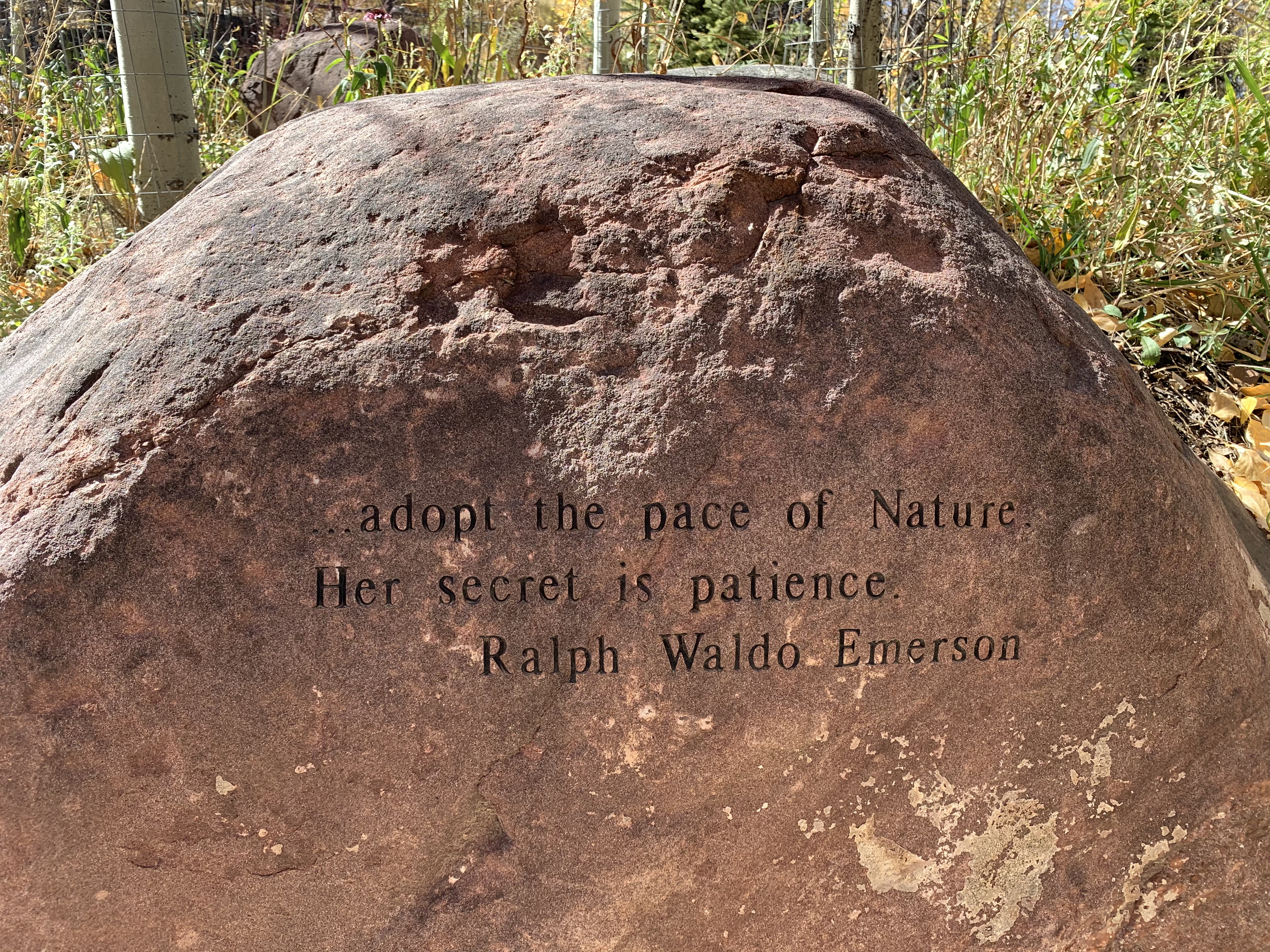
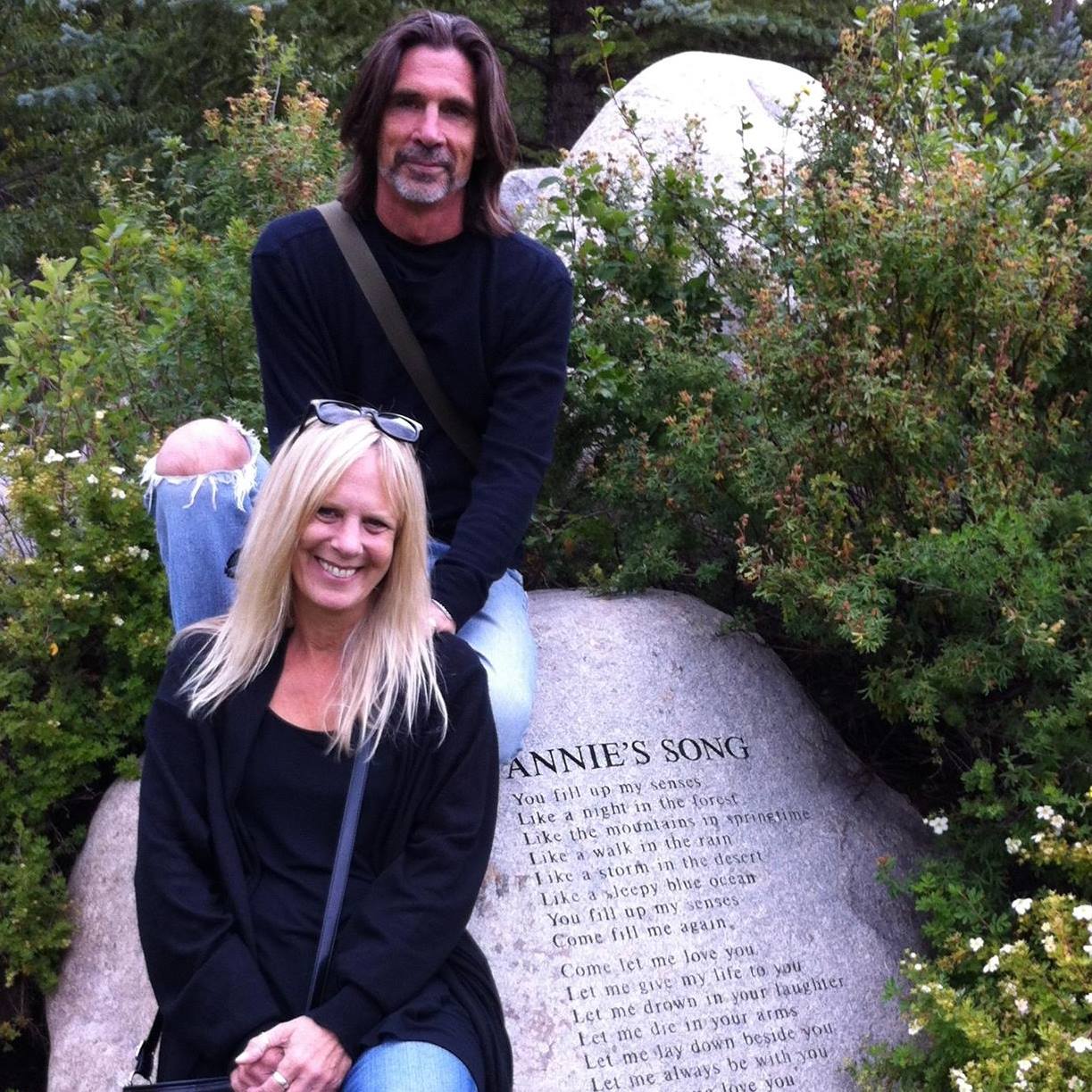
There is a special place in Aspen, Colorado. The John Denver Sanctuary. We make a pilgrimage to the Sanctuary when we travel to visit Kirsten. It is a place designed to make people slow down. Babbling brooks. Aspen leaves. Monolithic stones carved with the lyrics of John Denver’s songs, stones that carry the words of writers and artists and thinkers who appeal to the heart. It asks the visitor to sit for a spell. To listen. To breathe and see. To be, as nature teaches, no where other than here. It offers the gift of the artist: to fill-up with quiet before jumping back into the life-of-hurry-up-and-get-it-done. To remember what is natural and walk with exactly the same stride as nature.

read Kerri’s blog post about PATIENCE