Stop and Turn [on Merely A Thought Monday]

“We have no reason to mistrust our world, for it is not against us. Has it terrors, they are our terrors; has it abysses, those abysses belong to us; are dangers at hand, we must try to love them.” Rainier Maria Rilke, Letters To A Young Poet

Open the door to the monster in the closet. Walk into the wound. Throw light onto the dark. Nothing is broken, nothing needs to be fixed. All stories of resistance released into flow. Deliverance of fear.

How many times have you heard or said, “I don’t know what to do with what I feel?” Or, the partner statement, “I don’t know where to put what I feel.” Feelings as spatial.

In an earlier chapter I dreamed that I was being chased by giant monsters. I quickly ducked into a warehouse thinking I could easily find a place to hide but, much to my horror, the warehouse was vast and empty. Open space. Nowhere to hide. No other door. There was only one thing to do: turn and face the monsters. Surrendering to my fate, I stopped and watched them come at me, certain they would gobble me. But, as they approached, they shrank. The closer they came the smaller they became. By the time they reached me, they were smaller than my toe. They dissipated the moment they touched me. When I looked up I saw an older version of me standing across the room, transformed.

It was a Rilke moment.

“How should we be able to forget those ancient myths that are at the beginning of all peoples, the myths about dragons that at the last moment turn into princesses; perhaps all the dragons of our lives are princesses who are only waiting to see us once beautiful and brave. Perhaps everything terrible is in its deepest being something helpless that wants help from us.” Letter Eight, Letters To A Young Poet

A shorthand phrase from my coaching era that I’m certain Rainier would particularly appreciate; a phrase well known to the older version of me now standing across the room looking back: Invite your dragon to tea.

read Kerri’s blogpost about FEELINGS

Hold Space [on Not So Flawed Wednesday]

I just realized why the stripped forest is having such an impact on me. While opening the back door to let Dogga out, my dials spun and it slapped me in the face. I am like the forest.

For several minutes, staring at the photograph, writing then rejecting, then writing and again rejecting what I’d written, I decided to get up and let Dogga out. This picture was making me anxious. Moving around has always been good for me when I’m thought-wrestling.

I am like this forest. Exposed. Chips and debris are everywhere. Water is overtaking the trees.

I was writing about a question Justin asked one night at dinner. “What’s your stance about secular Calvinism?” he asked.

“I don’t think I have one,” I replied. Justin’s eyebrows hit the ceiling and I made a snap decision not to follow my reply with an explanation. He was sorting his belief and searching his heart. Empty space was more useful than cramming my erudite-and-empty justification into the moment.

Insight requires space. Lots of space.

I wish I could express how rare it is for me to keep my mouth closed when I have a thought on a topic. Kerri will laugh aloud when I read this to her. “No joke!” she’ll say. I wanted to say to Justin, “I don’t have a stance because I think it’s a given.” His question was akin to asking about my stance on the existence of the moon. No culture sees itself clearly.

No person (me) sees himself clearly.

Chips and debris. The river has overrun its banks. One half of the photo is the result of natural forces. The other half is man-made. Choices. Circumstance and intention. This landscape, once so familiar, will never be the same.

I’ve spent my life cultivating my capacity to see pattern and metaphor. It’s an artist’s prerogative to make the strange familiar and the familiar strange. I am the forest. Familiar, yet completely unknown. Stripped for rejuvenation.

Insight requires space. Perspective requires distance. Perhaps the reason I left open space in my conversation with Justin is something I need do for myself, too. Searching my heart, I am the forest. Stripped of invasive plants I can see all the way to the river. So much space.

What is my stance? Right now, thankfully, I don’t think I have one. I’m holding the space for insight to come.

read Kerri’s blogpost THE FOREST

React [on Two Artist’s Tuesday]

The answer is herbicide. That blue coloring sprayed on stumps and shards of stumps along our path is meant to prevent the invasive species from sending up new shoots. Eliminating the invasive species so the native plants might someday make a comeback is the point. It only looks like total plant decimation with performance-art-blue dotting the eradicated forest. It is, in actuality, rejuvenation.

We met a couple walking the path. They were bird watchers and thrilled about the rejuvenation project. They explained how the work would allow the river to return to its natural course. The invasive plants were choking the waterway. With the removal of the invasive plants, the wildlife, like the plants, might have a renaissance. They assured us we’d see the difference when spring returned.

When I lived in the pacific northwest, there was deep concern about the salmon. Damming the rivers interrupted the natural cycle of the salmon’s return to spawn and the entire ecosystem was suffering because of it. Salmon are considered a “keystone” species; without the keystone, the ecosystem falls apart.

As we walked our loop I wondered how the invasive plants were introduced and how long had it taken for the invaders to choke the native plants? What prompted the preserve to act now?

Most likely, the invasive plants were introduced unknowingly by people. We cultivate land. We “utilize” nature as a resource. We study. We explore. We develop. We trade. We migrate. We are a force of nature. We walk well tended paths constructed for our ease and enjoyment. Sometimes conscious and sometimes unconscious of our impact.

I had a great conversation with a forest ranger about the re-introduction of wolves into Yellowstone. The thought of “managing” nature has always struck me as paradoxical. We eradicated the wolves and then felt the impact. We re-introduced the wolves to try and correct the mistake before the ecosystem collapsed, and set off another chain reaction of unintended consequences that required further intervention. It’s like prescribing a drug to manage the side effects of a medication.

As we walked I wondered if the concept of natural balance is just too hard for us to grok. We generally don’t realize that interdependence applies to us, too. We believe we are nature’s managers rather than part of the chain. That prevents us from seeing ourselves as invasive, responsible, reactive.

We manage. And sometimes that looks like forest-performance-art-devastation with accents of green-shade-blue.

read Kerri’s blogpost about HERBICIDE

Ask The Bird [on Merely A Thought Monday]

“I think we consider too much the good luck of the early bird and not enough the bad luck of the early worm.” FDR

I laughed aloud when I read this quote. Luck certainly comes from a point of view. The good luck of the early bird is not great for the worm. I’ll add that tasty tidbit to my book of low-bar-wisdom: It’s never good news when you are on the breakfast menu.

Luck, good or bad, is never an incident isolated in time. That’s the point of the famous Chinese fable. Is it good luck or bad? Who knows. It’s all dominoes. I met Kerri because my career (and life) was collapsing. Was my career collapse good luck or bad? Ask Kerri if meeting me was good luck or bad and her answer will probably waver given the events of the day.

These past few months, after the software start-up went away and we tumbled into our latest reinvention, I’ve been pondering the Chinese fable more than usual. It felt like great luck when the opportunity appeared. If feels like bad luck in its disappearance. Both/And. I was certainly prepared when the opportunity came along. No amount of preparation-meeting-opportunity kept the company from vanishing. Bird or worm? We’ll see.

I love the notion that luck, the good side, is out there, looking for us. I imagine Luck standing on the horizon each day, shielding her eyes and whispering, “Where are they?” With us standing on our horizon looking for Luck and Luck standing on her horizon looking for us, it’s only a matter of time before we spot each other.

And, maybe we already have. That’s the tricky thing I’ve learned about Luck. She sometimes comes in disguises. That wily Luck is a trickster and has a wicked sense of humor.

This is all I know: if I was writing the children’s-book-for-adults-about-luck, the worm would have just crawled out of a tequila bottle and the newly intoxicated early bird would be left with an important question: was that worm good luck or bad?

read Kerri’s blogpost about LUCK

Ask A Simple Question [on DR Thursday]

It’s existential. What you see changes depending upon where you stand. That’s true when engaging any piece of sculpture. It’s true when engaging anything in life. Point-of-view is fluid and relational. This sculptural reminder is Olafur Eliasson’s Rainbow Bridge.

In another era of my life facilitating diversity and inclusion workshops, the same surprisingly simple concept was usually a revelation to people. What you call “normal” is merely a point-of-view. Most importantly, it’s not everyone’s point-of-view. Your “normal” is unique to you, not universal. Most hopeful: it’s not fixed in stone. It’s changeable. Relational. Capable of growth. A mature point-of-view recognizes that it need not, it cannot, be the center of the universe. A mature point-of-view necessarily asks an all important question: “What do you see?”

It’s not only possible to look at the same sculpture and see a myriad of differences, it’s necessary. It’s human. Sharing what we see is how we, together, create community. A common center is created by a circle of differing points of view. A common experience is borne of sharing disparate points-of-view of the same event. A common center is made functional when everyone in the circle is capable of asking with sincerity a simple question: What do you see? It is made vibrant when everyone in the circle expects the answers to be different than their answer.

Art is one way of responding to the simple question.

Instrument of Peace, 48x91IN, mixed media

read Kerri’s blogpost about RAINBOW BRIDGE

instrument of peace © 2017 david robinson

Welcome Home [on Not So Flawed Wednesday]

I realized on a night dive, 90 feet below the surface in the darkest dark I’d ever experienced, that my consciousness was like the flashlight I held. I saw only what was in the small space illuminated by my light. There was a vast world beyond what I could perceive in my limited view. I understood that the most potent choice I have – or will ever have – is where I decide to aim my light.

“Welcome home!” she said as we stepped into the gallery with three magnificent sculptures by Barbara Hepworth. The soft light, the floor-to-ceiling windows drawing us toward the lake. An open clean space. She was imagining this room was what our future home might feel like. I lapsed into studio fantasies.

I’ve always appreciated this room in the museum but for some reason, on this day, the sculptures were magnetic. While Kerri took photographs, I communed with Barbara Hepworth. The pieces are totems. Sacred symbols. Barbara Hepworth was a woman sculptor in a century that pretended the arts were the province of men. Her life spanned both world wars. She reached beyond the horror of her time to something more elemental. I found hope in her work. Guidance. Perseverance. She was shining her light on what humankind might become. Form and emptiness, perfectly balanced.

“Look,” Kerri said, showing me the photo. “It’s a porthole.” A perfect circle. A horizon. “I could stay here all day,” she closed her eyes and breathed in the space.

“Me, too.” Welcome home.

read Kerri’s blogpost about THE PORTHOLE

See The Frame [on DR Thursday]

The lake was angry. Had you dropped me in from outer space I’d have sworn I was standing on a beach of the stormy Atlantic Ocean. “I just can’t capture it,” she said, after snapping several photographs. The roiling waves hit the shore with thunderous power and intensity. I felt it in my chest. Distilling the energy within the frame of a photo sublimated the dramatic waves to an everyday image. The frame successfully abolished the fear and eliminated the awe.

On the trail this past Sunday, he quipped that the world as we knew it began its decline when CNN invented the 24 hour news cycle. It’s a lot of time to fill and, to keep people hooked (ratings), the importance has to be exaggerated. When everything becomes ‘Breaking News,’ the really important stories are lost amidst the manufactured dross. Scrolling through our news app this morning I felt as I once did while waiting in line at the grocery store check-out surrounded by the screaming headlines from The National Enquirer. Sorting to the grotesque. Manufactured awe has successfully amped up our fear. A very strange frame, indeed.

The real power of a frame-of-reference is that it is mostly invisible yet it determines the potency of the composition. Focus is largely a function of frame. I’m in the habit of taking “snippet” shots of my paintings. Altering the frame of what I see helps me…see. It promotes inquiry.

A fluid frame is like an open question. It facilitates engagement. A fixed frame does the opposite. It closes the question options: yes or no. A 24 hour news cycle necessarily defaults to a fixed frame. It pretends to be inquiry while promoting dogma. If you wonder why we are at each other’s throats, why we’ve reduced ourselves so severely to a community defined by two primary colors instead of the full palette available in our color-full nation, do an experiment: pay attention to the story-frame you are being fed.

Ice crystals formed on our kitchen window during the latest storm. Kerri rarely takes a single close-up. She takes many shots of the same subject. In a digital age, she is also able to pull a single photo into several different focuses and takes screenshots of the possibilities. A fluid focus. She composes. She questions. She asks. It’s a pure artist’s action. Turning to me she never asks, “Which is better?” Instead, knowing the power of a frame and with full respect for the difference that I might perceive, she asks, “Which do you like and why?”

joy. 50x56IN mixed media

Two frames. Can you see them? [the new site is like a good wine…taking its time to mature]

read Kerri’s blogpost about ICE

joy © 2014 david robinson

See The Cycle [on Not So Flawed Wednesday]

I want to re-read Hermann Hesse’ book Siddhartha. Lately I’ve been thinking about cycles of nature, cycles of growth, cycles of life. Chaos-to-order and back again. Daylight-to-dark-night and back again. Nature, Hesse writes, is a self-fulfilling continuous cycle.

In the book, Siddhartha “achieves” illumination when he realizes the lesson of the cycle: that inside every “truth” is the potential for its opposite. Arrival is departure. Birth is death. Both/And.

The demands of language necessitate slicing single moments from the cycle. Isolating a “truth” from its opposite thereby fragmenting the wholeness inherent in the cycle. Slicing the cycle stops the fluid motion and calcifies the “belief,” making it hard, rigid in separation.

And then there’s this, the reason I want to re-visit the book. At the end of his life Siddhartha, as the ferryman, watches the river in full knowledge that what he sees moment-to-moment is never the same river. In the cycle, the moment is always unique. Both/And.

Standing on our trail, having stopped and witnessed many, many sunsets, the thought was so pure it swept the dullness from my eyes. This sunset is Siddhartha’s river. I’ve never seen THIS sunset or this forest or lived this moment. Quietly electric, I watched Kerri, caught in the beauty of the moment, point her camera as if for the first time toward the trees and the setting sun.

read Kerri’s blogpost about SUNSET

Sip The Hope [on Merely A Thought Monday]

I keep a Post-It note by my computer. It reads: Grace. Questions not answers. It’s there to remind me to write about possibilities rather than rants. There’s so much in this world that seems upside-down to me; it’s easy to get lost in the weeds. For instance, in preparation for this post I was doing a comparison of the percentage of GDP dedicated to the arts, to education, and to the military. What if we lived in a world in which the percentages were flipped? What might be possible?

And, then, I saw my note. Get out of the weeds! To embrace a world of possibili-teas begins with embracing the world as it is.

Possibilities. Wouldn’t it be lovely if a cup of tea opened hearts and minds to hope? In fact, I believe a hot cup of tea is capable of such a monumental feat. I warm my hands on the cup. I smell the comfort. I sip the hope. There are other, similar, small gestures capable of big-heart-opening: A smile. A hug. A helping hand.

I stared at the word “grace” on my Post-It note. Simple elegance. Refinement of movement. I like this definition: courteous goodwill. Or. combine both definitions: to move in the world with simple courteous goodwill. Intentional benevolence.

As I’ve learned, the flaw opens space for grace to enter. Wabi-sabi. Beauty in imperfection. Compassion in our world is possible, especially if we embrace it as more necessary than lobbing insults or bombs. Friendliness, thoughtfulness, decency…As my Post-It note suggests, I am left with a question: What if we lived in a world in which amity garnered more attention than aggression? What might be possible?

Just like a cup of hot tea: a wee-bit of warming hope.

read Kerri’s blogpost about POSSIBILI-TEAS

Step Off The Path [on DR Thursday]

At first we were horrified. The forest filled with machinery. Trees down and the underbrush annihilated. Our beloved trail decimated. We read that the seeming destruction was part of a woody invasive species clearing project. The clearing would allow the native species to rejuvenate.

Later, after the machinery was removed and the air cleared of diesel fumes, we returned to walk the obliterated forest trail. And, on our walk, I learned – or re-learned – a very valuable lesson. The change pulled us from our well-worn path and invited us to explore. Because we could now see all the way to the river, we left the trail. We stepped into the unknown. What had been comforting and known now beckoned us to see anew. To wake up.

We walked in places where previously we could not because the brush was too dense. We followed an animal trail through the snow into a part of the forest we’d never been. It was a place we’d never before considered investigating. We deviated and hiked all the way to the train tracks. We took photos. We felt the thrill of stepping into new territory. Our eyes wide open, our ears attuned to every nuance of sound, we took nothing for granted. Everything was pristine and unknown.

Change is like that. It makes you pay attention.

Returning to the trail so we could make our way back to the car, enlivened by our off-trail adventure, we wondered aloud about the wildlife. We worried for the deer. And, just as the words left our mouths, Kerri stopped and motioned to the forest’s edge. A deer was watching us. And then there were two. Three. Five. After determining that we were not a threat, they nibbled on branches. We stood very still; quiet appreciation.

It felt like a reward for taking the step off the beaten path. It felt like reassurance that the devastation was akin to a forest fire; necessary for renewal.

From a cue invisible to us, the deer leapt in unison, white tails flashing, and disappeared into the forest. It broke the spell. We returned to the car, eyes scanning the forest in case the deer returned. Our senses keen, I felt fully alive.

Change is like that. A clearing project, disrupting comfortable complacency, nothing can be taken for granted, making way for new seeing and discovery. Anything becomes possible.

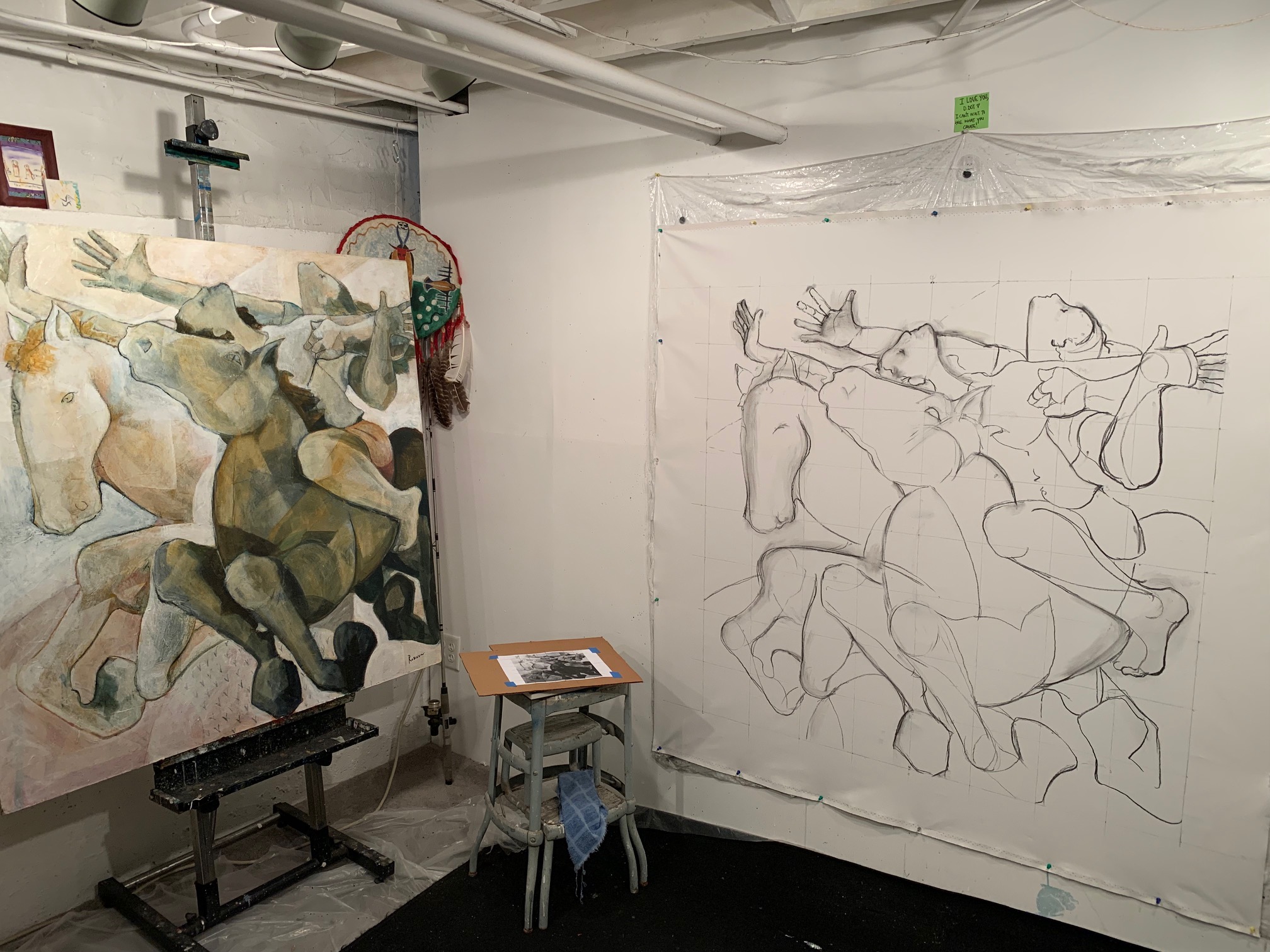
a work in progress: train through trees, 48x48IN

read Kerri’s blogpost about RIVER BEND

train through trees (in progress) © 2023 david robinson