Borrow A Cup Of Belief [on Merely A Thought Monday]

The sun is streaming through the windows. It is an immediate spirit lift. We sip coffee and our conversation wanders in no particular direction.

We inevitably discuss of the absence of normal, our rolling wave of disruption. “I wonder what will happen this week?” We laugh, “Knock on wood!” For a moment we sit in silence. We’ve stopped asking, “What else can happen?” We keep the question to ourselves. We’ve grown superstitious.

For us, this pandemic time will always be known as the era of disruption. All recognizable patterns are shattered. New patterns have yet to find a foothold. Each day a tumbling unknown.

I often write about “not knowing.” It is the land where learning becomes possible. The first caveat: Have the experience first and make meaning second. The second caveat: Suspend your judgements and learn. Both are rooted in the intentional suspension of knowing. Open to life.

We are definitely having experiences. We are careful not to arrive too soon at meaning.

Yesterday I read that, when life tosses us the uncontrollable, we default to imaginary controls. We do the dishes, we vacuum the rug, rather than face what is out of our control. There is great comfort in the imaginary.

Sometimes belief in yourself is hard to come by. “Knowing” that you can do it. “Knowing” that you can stand firmly in the “not knowing” is never a given. Especially in times of continuous disruption. It is only after the fact that you “know” with certainty that you can do it. “One step at a time,” we chant.

It is, in these times of disruption, that we borrow belief from each other. You tell me that I can do it. I tell you that you’ve got this. Others “know” what we do not. They see our fortitude. We see theirs. It is why human beings are a herd animal; we come to know ourselves through the eyes of the other. We go next door to borrow a cup of belief.

Beaky’s note now sits on Kerri’s bed stand. A treasure newly found in a long forgotten purse. One of our imaginary controls, cleaning out the closets, produced this gem. Beaky, no stranger to disruption, reaches across time and the threshold to offer timely encouragement, “I know you can do it.”

“Momma says we got this,” Kerri says. If I’ve learned anything, it’s to never argue with Beaky.

read Kerri’s blog post about KNOWING

Be The Miracle [on Merely A Thought Monday]

“The infinity in the microscope is as dazzling as that of the cosmos.” ~ John O’Donohue

After my surgery, the doctor said, “You my friend are now a modern medical miracle.” It’s true. Had I been born in another century I would not have survived. In fact, had I been born in another century, I would have met the average life expectancy of 30-40 years. Each and every one of us, walking the streets with an expectation to live beyond our thirties, are modern medical miracles and indebted to the brave explorers of the microscopic cosmos.

Early in this pandemic, before it hit the shores of these divided-united-states, we watched the movie Contagion. So much of the world painted in the film was spot on. Pandemic deniers decrying the virus as a made-up assault on their freedom. Charlatans selling miracle cures and misinformation. Conspiracy theories run amok. The initial panic emptied shelves at the grocery store. Quarantine. An economy in tatters. A weary and anxious populace awaiting a vaccine that would stop the micro-assault. A microscopic threat vanquished by a microscopic man-made-miracle.

When we pulled into the abandoned-drive-through-bank to receive our vaccines, I felt that I was in the movie. We’d placed our names on a list to receive vaccines that would otherwise need to be discarded. The call came on a Friday afternoon, “Come now!” We jumped into the truck as the sun was setting on a frigid snowy day and raced to the given address: an abandoned bank turned into public health center. We were directed to stop at cone number 1. Nurses in snow pants, knit caps and mufflers came out to the truck. It was so cold that we had to open the door to communicate, the windows were frozen and would not roll down. A bit of paperwork, coats shed and arms exposed, and the vaccines were administered. Coats and gloves and hats were quickly donned again. We were asked to wait at cone number 1 for 15 minutes. They gave us a flag to wave if we needed help.

As we waited, engine running to beat back the bitter cold, we admired those amazing women who gave us our shots. They were absolutely delightful, upbeat, and incredibly kind. Pandemic. A blisteringly frigid day. They’d been giving vaccines since early in the morning, repeatedly taking off their gloves in frostbite conditions. We were the last two of the day. And there wasn’t a hint of exhaustion or suffering or complaining from the cold. “People can be amazing,” Kerri said. “It’s good to remember that sometimes.”

It was good to remember. Dedicated people selflessly serving others in the face of a deadly virus, enduring extreme cold, extreme misinformation, tip-toeing across ice and politics to bring big-heart-comfort and a bit of modern miracle to the dazzling cosmos called my body and yours. My health is your health. Intimately linked as we pass in the grocery store or on the street or trail, across the nation and the world. The microscopic world does not know us as individuals and cares not about our investments or beliefs or freedoms, imagined or not. All that I know is that I am, once again, a modern medical miracle, and owe a deep debt of gratitude to the men and women at the microscope and those that stand for hours in the cold.

read Kerri’s blog post about VACCINES

Embrace Orbisculate [on Merely A Thought Monday]

A family is trying to get ‘orbisculate‘ into the dictionary to honor their dad who died of Covid-19

Compromise. Accuse. Jaded. Dishearten. Tranquil. Swagger. Mimic. These are just a few of the over 1,700 words that William Shakespeare invented or adapted. Making up words, playing with sounds and meanings and clever twists of usage was appreciated in his lifetime. Audiences went to hear plays like we go to hear concerts. The sound of the word was more important than the visual on the stage.

During Shakespeare’s lifetime, Robert Cawdrey toyed with a thing that would someday be called The Dictionary though it wasn’t something Will had to consider. Spelling was phonetic. Teachers did not think to circle his words with red pencil. That bit of standardization was still a few centuries away. Spend time within the unedited-for-our-eyes First Folio and you’ll find yourself sounding out words just as the poet did. Tasting the sounds. Shaping meaning in your mouth en route to making meaning in the world.

Language is fluid. Each year new words come into being and others drop from sight. For instance, our word “google” is a “creative spelling of the word googol, which implies an unfathomable number. It was coined in the 1930’s. Our version is in the dictionary as a verb: to search for information. And, you’ve probably already heard that it’s also a company that facilitates the search for information. Which came first, the verb or the company? Some words, over time, come to mean the opposite of what they originally meant. The archaic meaning of the word “egregious” is “remarkably good.” From remarkably good to outstandingly bad is quite a journey!

Definitions are discoveries and agreements made according to how we use the tasty sounds we call “words.” Each word comes into being from necessity.

Orbisculate is a tasty word that William Shakespeare might have created and enjoyed. But, he didn’t. Neil Krieger did. It is a word for juice squirting in your eye. Neil died of COVID and, to honor this good man and his good life, his family is attempting to get Neil’s good word into common parlance and, ultimately, to the dictionary. They are appealing to poets and pedestrians alike to embrace their necessity and use Neil’s word. If you visit their site, check out their 50 Goals. Never was a single word so lovingly brought into the lexicon. Help them if you will. Will would have. He’d have used orbisculate in one of his comedies. Or many of his comedies.

I have a sneaking suspicion, if they are successful in their quest, that, over time, orbisculate will come to have another meaning: an act of familial love.

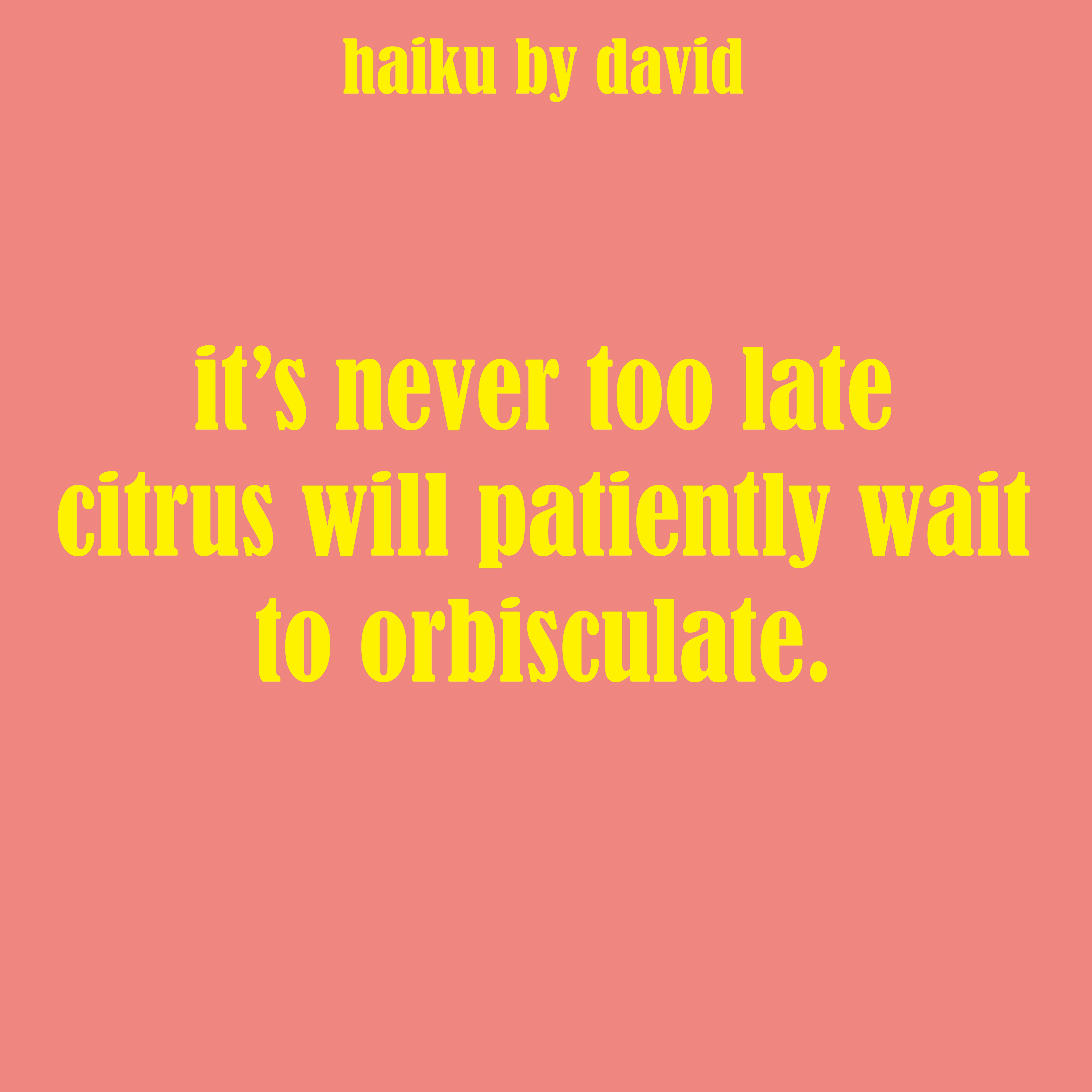
The Orbisculate haiku challenge! Here’s mine:

Now, it’s your turn. Make sure you let the family know.

read Kerri’s blog post about ORBISCULATE

Understand That Little Is More Than Enough [on Merely A Thought Monday]

I think that maybe\ I will be surer\ of being a little nearer.\ That’s all. Eternity\ is in the understanding\ that that little is more than enough.” ~ R.S. Thomas [via Anam Cara by John O’Donohue]

And so our dear H is gone. I have written about him before, about how I learned from him how to age well. To “have a wonderful urgency to live life to the full” [John O’Donohue]. H was a study in wonderful urgency. He did not grow cranky as he grew old. He did not darken his sight with what he could no longer do. He gently pushed the edges of what he could do. He was a master of focus-placement.

I have known many people who proclaim a spiritual life. They are quick to advertise their illumination. They live to stand on the mountain top and call attention to their heights. H was not one of those. He simply lived his faith as he lived his life – without need for acknowledgment or recognition. No trumpet necessary. I suspect that his why I was drawn to him. He was simon-pure. Genuine.

“We’re afraid you’re going to take her from us,” H said to me, more warning than salutation, when I sat next to him in choir. It was my first rehearsal in my first choir and, as an avowed non-singer, I was intimidated. Kerri was the director. She’d recently asked H, at 87 years old, to rap Via Dolorosa. He’d jumped at the challenge and, as I heard the story, performed brilliantly, complete with costume and bling. He and Kerri were thick as thieves.

He guided me through that first rehearsal, laughed when I honked a bad note – which was often, and, by sweet example over time, steered me through my confusion until I found more joy than fear in singing. At the end, as he was moving into his 94th year, just before the pandemic made rehearsals impossible, it was my joy to help him find his place in the music. A perfect circle.

This morning, just before we received the news of his passing, I spent some time in the final pages of Anam Cara. The last words are a Blessing for Death and this phrase struck me: May you live compassionately and creatively and transfigure\ everything that is negative within you and about you. When the news came of his passing, I was certain it was H who’d tapped me on the shoulder and whispered, “Pay attention to this phrase.” It describes him perfectly. It encapsulates what I believe, H, without words, was trying to teach me. Through compassion and creativity, transfigure everything that is negative within you and about you. That is how to live well and age with wonderful urgency. No trumpet necessary.

read Kerri’s blog post about H

Make Noise [on Merely A Thought Monday]

I am conflicted. I wrote a version of this post and then tossed it away. I’m trying to be less argumentative in my daily writing. And then, Toni Morrison collided with Albert Einstein:

“In times of dread, artists must never choose to remain silent… This is precisely the time when artists go to work. There is no time for despair, no place for self-pity, no need for silence, no room for fear. We speak, we write, we do language. That is how civilizations heal.” ~ Toni Morrison, No Place for Self-Pity, No Room for Fear

I am an artist. Is it argumentative, is it confrontational, to write what I see? Yes. Sometimes. Once, I saw a park service truck, on a trail, quickly backing up. The driver did not see the man in the wheelchair right behind his truck. I screamed and ran and banged on the side of truck until the driver stopped, a few inches from hitting the man in the wheelchair. Sometimes it is necessary to shout and make noise.

All of my life I’ve understood the first rule of being educated, namely, to check your sources, as simple sage advice. It’s a good idea, if you are going to anchor your identity in a narrative, to make sure that your narrative-of-choice is solidly anchored in verifiable substance. Doubt and questioning, used properly, are necessary tools of an engaged mind.

Years ago, Robert Cialdini wrote, “The world abounds with cults populated by dependent people who are led by a charismatic figure.” In other words, people are easily led and – as we have recently witnessed – with disastrous results. All that people ever need do to avoid a nasty drink of purple Kool-Aid is to check their sources. In our day and age it is almost easier to check the veracity of the story-we-are-being-fed than it is to be misled. Almost. One must first desire to be fed the truth, even if the truth challenges rabidly-held belief.

Checking takes less than a minute.

Just ask the now-jailed-and-soon-to-be-tried capitol insurrectionists claiming that they were led astray by a flimflam-president-man. The Big Lie was easy to check. It remains easy to check. Yet, none cared to check it or perhaps refused to believe what they found. Checking the lie, listening to the data, would undermine the tightly held power-narrative of an entire political party. A pathological lies requires more and more effort, more and more outrageous lies, to sustain itself. It should have been easier to check the story than it was to storm the capitol.

Now I see the first rule of being educated, the necessity of checking sources to verify fact, as a dire necessity. It is the flashing red warning signal to these de-united-united-states that there is a cliff ahead. It is no longer a sweet bit of sage advice; it is a survival imperative. Respect for the line – truth or fiction – will determine whether we as a nation unite and grow or divide and collapse.

Many years ago, Robert Cialdini also wrote,“Audiences have been successfully manipulated by those who use social evidence, even when that evidence has been openly falsified.” Openly falsified. He wrote those words decades before tweets, Fox News, and the mega-amplification of all the openly falsified big lies. His words might now serve as the sad single credo of the Republican party.

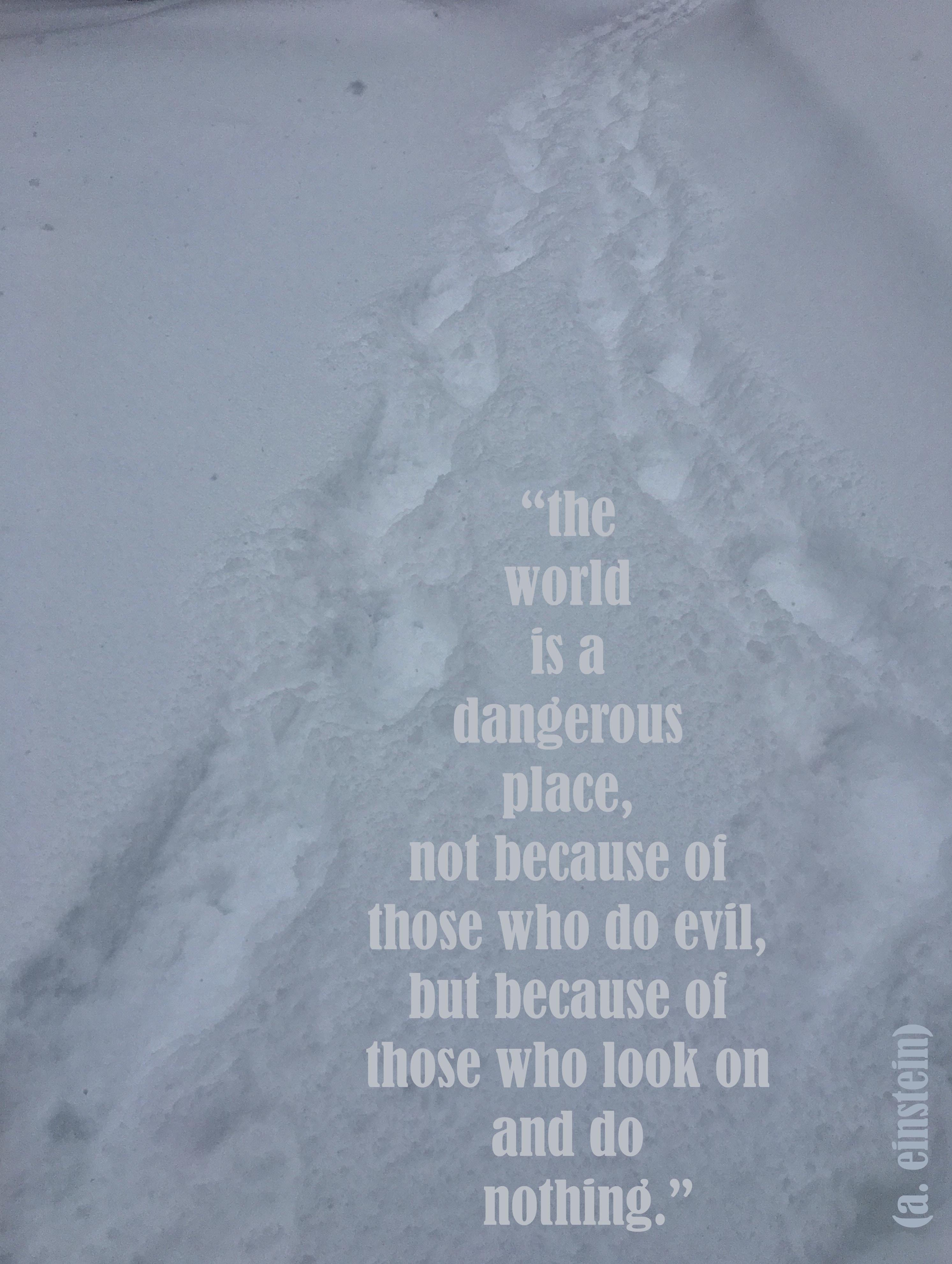
It is not shocking that a political party lies. It is most shocking how little the followers of the party care to check the sources of the enraged hype it daily swallows like so much anger-candy. Dependent people. Easily led. Believe wholeheartedly. Ever expanding lie. No facts necessary. It is far beyond Einstein’s observation of people doing nothing in the face of evil; our nation is in peril because the evil we face is an openly falsified narrative. So many of our people, so many of our leaders, know it is a lie, feed the division, and actively look the other way.

read Kerri’s blog post about DOING NOTHING

See The Action. See The Motivation. [on Merely A Thought Monday]

“It’s discouraging to think how many people are shocked by honesty and how few by deceit.” ~ Noel Coward

Lately, I’ve been rereading books on playwriting. Put them on the stove, boil them down and you will have a fine reduction of action and motivation. The actions a character takes. The reason a character takes them. A playwright’s tool box is filled with words but a playwright’s creation is a sequence of motivated actions.

Tom McK told me that plays are about one moment. A moment of choice. A moment of revelation. A moment of truth. A moment of reckoning. All of the actions of the play lead to the moment. And the world will never be the same.

I began rereading my dusty old playwriting books because of the impeachment trial. I feel as if I am witness to an ancient Greek drama. Power falls. Courage fails. Morals collapse. Act One: the temple is sacked. The actions and motivations for the assault could not be more clear. Naked sedition. Act Two: the trial. The ideals of the temple are gutted. Blind justice is made a mockery as nearly half of the jurists fail in their courage, choosing personal gain over public good. They defend sedition. They kneel to it. Their actions and motivations could not be more clear.

Like every Hallmark movie, the end of this play was known before the actors took the stage. We watched the play to confirm what we already knew.

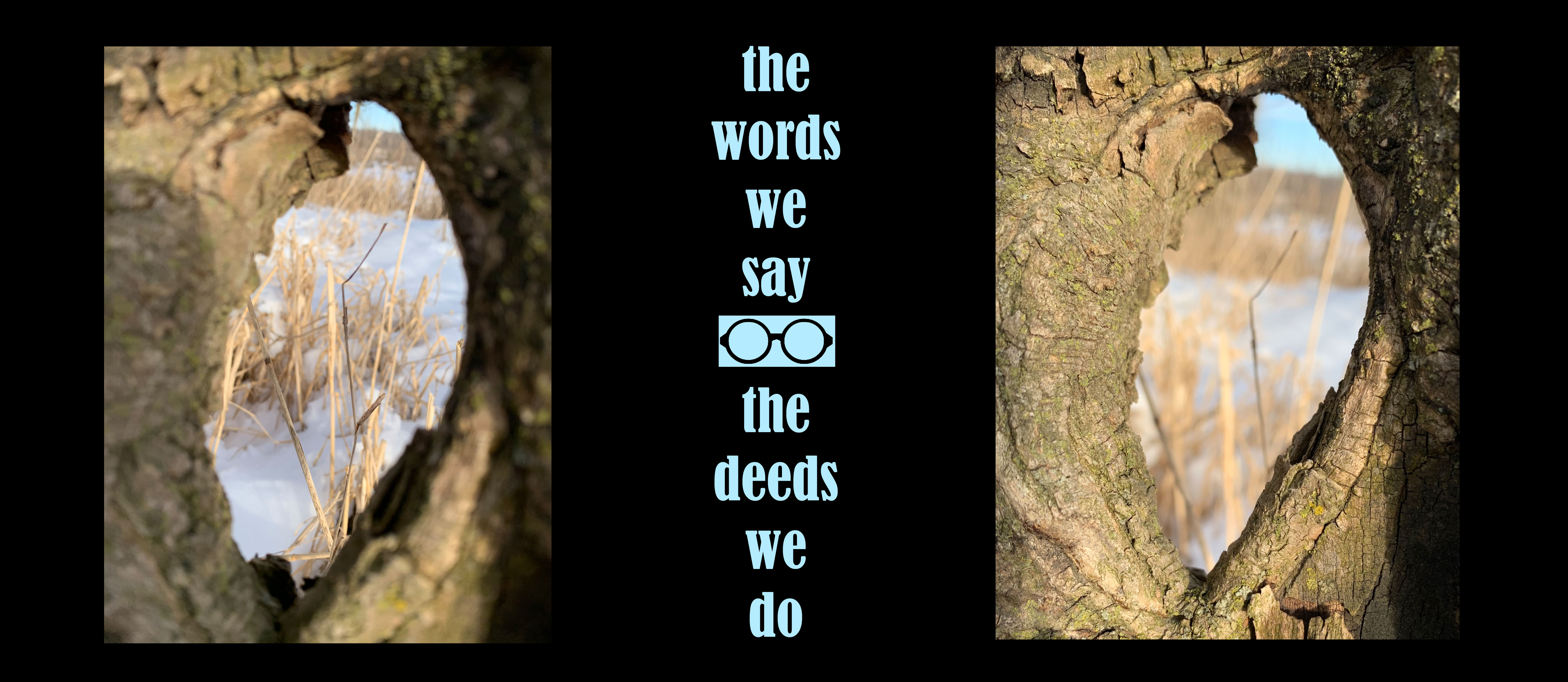
Doug had a saying: health was a measure of the distance between who-you-say-you-are and who-you-know-yourself-to-be. The shorter the distance, the healthier the person. By Doug’s account, the actions and motivations of the 43 jurors who protected sedition could not be more clear. Despite what they say. Despite what they proclaim. The distance between who-they-say-they-are and who-they-know-themselves-to-be is vast. They are unhealthy. Shiny suits that are rotten to their core.

The climax of the play. The one moment. The realization. Just as in a horror movie, the recognition that the person in the passenger seat is the murderer. All of the actions of the play lead to this one moment, this single recognition: their defense of sedition is not aberrant to this jury’s character. It is their norm. Their fall from grace, their collapse of principle, happened long before their vote to acquit.

Action. Motivation. Expressed through character.

“Character,” Tom McK taught, “is how you do what you do.” This is who they are. It is a matter of character. Their actions and motivations could not be more clear. And the world will never be the same.

read Kerri’s blog post about WORDS & DEEDS

Pay Attention [on Merely A Thought Monday]

I read this morning in my brainpickings, “We have to try and cure our faults by attention and not by will.” Simone Weil.

Kerri and I walk almost everyday. We head for our known, usual trails, and only occasionally go in search of something new. Even though we walk a well-known path, it never fails to seem entirely new. Kerri attends to the details, taking photographs of unusual pine cones, a downy feather on a limb, the sun streaming through the trees. She pays attention. My awareness is more global, the movement of forest, the orchestra and dance of trees and wind. I pay attention.

Our walks bring us perspective when all else seems dark and disorderly. Our walks refill our well of hope when our circumstance seems bleak. Mostly, our walks “cure our faults,” they bring us into a present moment where all of life’s judgments and fears fall away as the illusions that they are. Our walks, if only for a few hours, wipe clean our canvas and return us to a childlike curiosity.

Sometimes, after a snowfall, we arrive at our trail and it is untouched. It never fails that we stand at the trailhead and marvel at the unblemished snow. Sometimes we hold hands and jump in with both feet and laugh. Sometimes we step carefully, quietly. Reverently. Either way, it seems a special gift. First steps are to be noted. Last steps are to be noted.

This morning I read an article about How Aging Shapes Narrative Identity. How the story-we-tell-ourselves-about-ourselves changes as we age. Our investments change. We become less interested in pursuits and achievements, in willful purpose. We become more interested in appreciation of our precious, limited moments. And, so, we begin to tell a different story. New snow on an old path.

The article was timely. Kerri and I lay awake most of the night. Among other things we pondered my dad’s dementia, the stories that he weaves and realities he inhabits. He is obsessed with going home.

Deep in the night, we talked about the stories that we currently weave together as we grow older. It seems that this time in our lives is a blank canvas, a path of new and untouched snow. Standing at the trailhead of our next chapter, no steps to follow or map, neither of us has any desire to reinvent or become different than what we are. Certainly, the circumstances of our lives are changing, but more and more we merely want to pay attention. To hold hands and jump into the unbroken snow. To laugh. To note the downy feather in the tree. The wind song, the deer that surprise us, leaping through tall grasses. “Did you see them?” I whisper. Kerri nods and smiles. Reverence. Nothing in the world, at that moment, is more important.

read Kerri’s blog post about UNBROKEN SNOW

Say “Look” [on Merely A Thought Monday]

“Look” is the new “um.” It now lives among the tribe of words used as placeholders, thought-launching-pads, or mental-composition-vocables.

I had a professor that cleared his throat when composing his thoughts. That semester nearly killed me. I lost all contact with the content of his lectures in the cacophony of throat-clearing. I spent entire lectures either writhing in my seat or wondering what happened in his life to develop such an odd vocal tick. I’m certain Sarah Jessica Parker based her throat-clearing-character in The Family Stone on my professor. Each week I sat in the lecture hall and wondered if he was terrified when speaking in public or perhaps he was fearful of not expressing thoughts clearly. That odd-socks-thought-train sent me down a rabbit hole of pondering weird karma. It’s a wonder I passed his class (or any class, for that matter).

“Look” is significantly different than “um” or throat clearing. There’s a very important nuance to note: it assumes authority. It’s a directive. “Take note!” “Consider this!” It’s a placeholder with a purpose. It’s as if everyone on the public stage secretly doubts their credibility or must demonstrate their sway.

Perhaps it’s the cabin fever that comes with believing in the pandemic, perhaps it is the state of politics and pundits in these media-cleaved-united-states, but we’ve become fascinated by the ubiquitous “Look.” It regularly launches politician replies and reporters’ reports. At first we merely glanced at each other, “Did you hear it, too?” Then we counted. We passed through the cheering phase. We even considered making it a drinking game – take a sip every time we hear “Look” – but decided against it for obvious reasons.

Instead of a drinking game we’ve lapsed into mimicry. “What do you want for dinner?” Kerri might ask. My reply, “Look, I’ve surveyed my belly and 85% of tummy-grumbling prefers pasta over all other candidates.”

Without missing a beat, she counters, “Look, your data is clearly partisan since the people are voting for chicken soup.”

“Look,” I say, gathering my thought for a response, “I’m willing to work with you here. My caucus will support your chicken soup if you’ll guarantee chocolate sometime before bedtime.”

She stares her best stare of thoughtful consideration. “Well, look,” she replies, extending her pause, “I think we can make that happen.”

read Kerri’s blog post about LOOK

Follow The Conversation [on Merely A Thought Monday]

I met Horatio on an airplane. With his wife, Teru, we were seatmates on a flight from Washington D.C. to Seattle. I’d just finished facilitating a workshop at the Smithsonian about story, he was stepping toward directing films, and Teru is passionate about writing life histories. We talked about storytelling clear across the country and our conversation continues to this day.

David and I sat next to each other at a conference. I’d only just moved to Seattle, I knew no one. I saw a sign for the conference and wandered in. It was my good fortune to pick a seat next to a brilliant visual and theatre artist. We started talking about life and art. Years later, every gallery I enter, every play I attend, I have conversations with David in my mind – and hurry home to write him or call him and share what we talked about.

To this day, MM is my greatest collaborator. We used to sit in my office and dream big dreams – and then go out and make them happen. He is the ultimate player-of-infinite-games, playing-to-play. When I need my mind opened, my pot stirred, or my obstacles surmounted, I turn to MM.

I was visiting Tom McK at his ranch. When he asked me to help him tell a story I had no idea that his simple question, the story that he needed to tell, would take more than a decade and would only be possible after his death. His story became my story to tell.

It was Tom’s story that I told to Horatio that day on the flight from D.C. to Seattle. It was multiple good conversations over many years with David about writing plays that finally brought me to clarity. MM was my constant companion. With his band, Mom’s Chili Boys, he composed the music that supported the telling of Tom’s story. He built the world of the play and then, together, we stepped into the world and fulfilled Tom’s request.

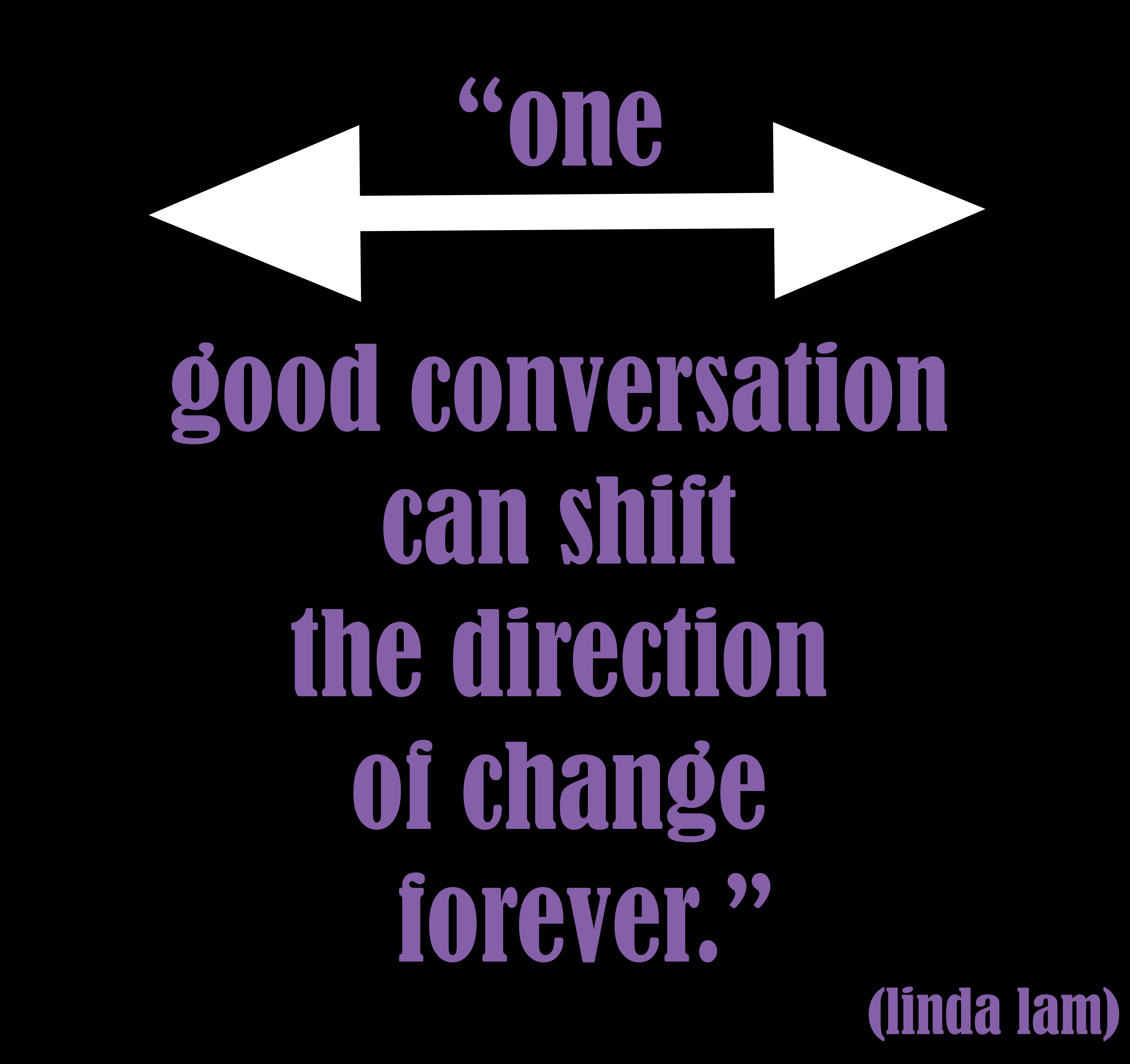
Fortuitous seat assignments on a flight. Following an impulse into a conference and taking any old seat. Playing an infinite game. One good conversation, again and again, and nothing will ever be the same.

read Kerri’s blog post about ONE GOOD CONVERSATION

Line Up Behind “They” [on Merely A Thought Monday]

When the world is just too much to ponder, one of our favorite bits of escapism is to catch an episode of Highway Thru Hell. Heavy rescue tow trucks working miracles clearing the highways of impossible wrecks. Flipping large semi-tractor-trailers, pulling them off of icy bridges and out of ditches. The physics of their work is mind-bending. Angles of lift, leverage, and thrust. Marvels of nuance in heavy metal. It is a symphony of paradox: crude meets delicate, tender masculinity.

On the surface, it seems an odd choice of wellsprings to refill our faith in humanity. But, every time we indulge in our flight from the news-of-the-day, I find myself whispering, “Unbelievable.” Not only do they willingly wade into impossible messes, they do it with a singular and clear understanding: they are serving a greater good. They are trying to open or keep open a highway. Connectivity. Commerce. Community. Like any doctor removing a blockage, they are servants to communal flow. I think that is why we visit them on the highway.

At the shop, they work out their pecking order. There is no lack of flexing muscles and man-drama. But, once they are called to a crash, all the “I” flees the scene. There are police, and flag people. There is traffic backed up for miles; each and every car and truck a person with a place to be. And the tow truck operators know it. They talk about it. Their service outruns their egos. They do not hesitate to call for help. They make choices based on the needs of others. The fantasy-world of “I” dissolves into the hard reality of “Us.”

In that hard reality of “Us,” you’d be hard-pressed to find a more thankless job. They work long hours in extreme weather. The conditions are dangerous and dirty. They clear the wreck, get back into their trucks, and move onto the next, with little or no thanks from the community they serve. Yet, they show up everyday. They take extreme pride in doing their work. There is a mastery that they acknowledge in the older drivers and strive to achieve it themselves. They learn from each other. They mentor each other. They celebrate each other.

They.

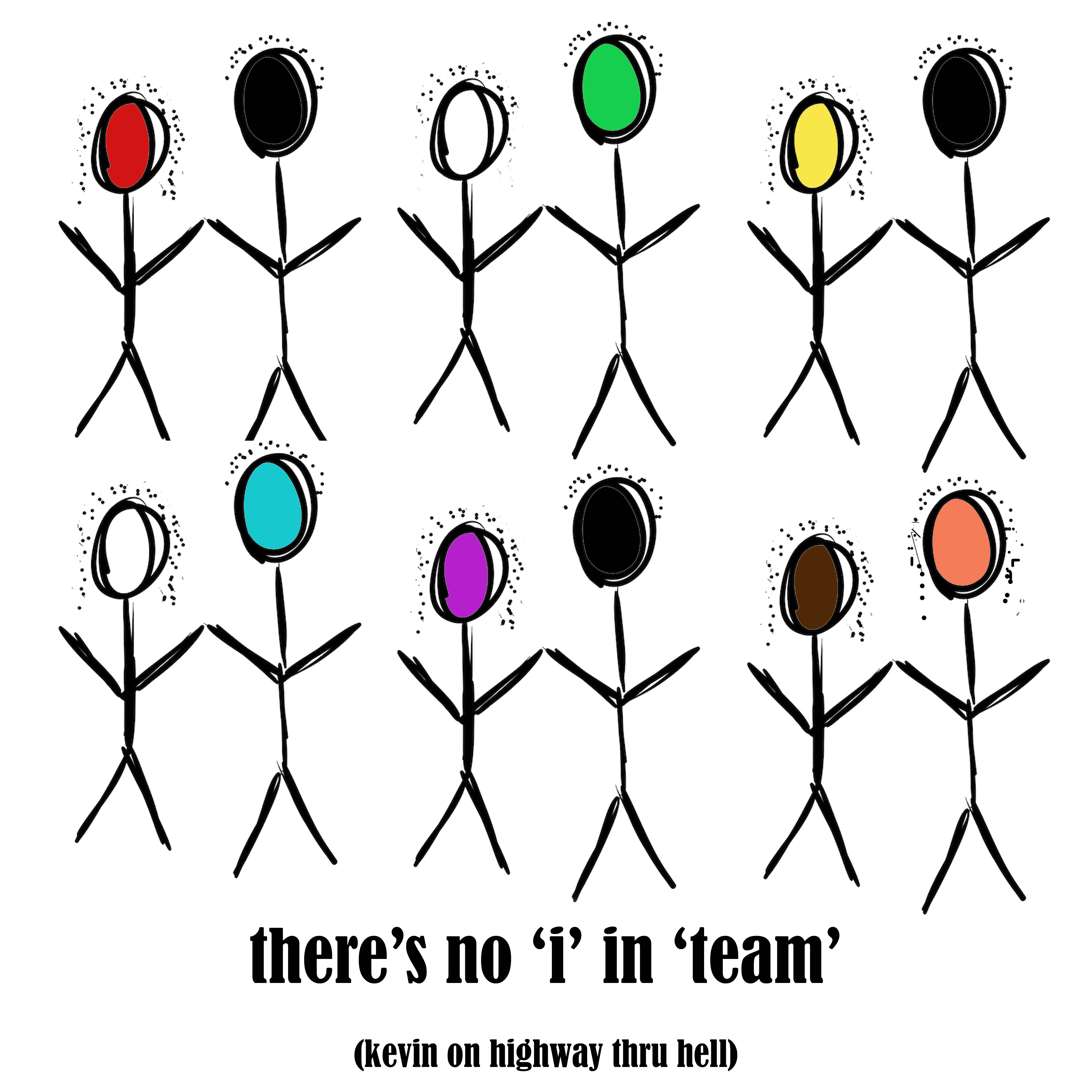
When Kevin, one of the tow truck operators, driving away from an exhausting job that took many people and many hours to complete, said with tired satisfaction, “There’s no ‘I’ in team,” I thought, that’s exactly why I escape from my highway thru hell to this Highway Thru Hell.

These Highway Thru Hell guys are plugged into the simple reality of existence. They know unequivocally that no one walks this earth alone. They know that their work on this earth, amidst the mess and chaos and dirt, is about keeping the flow going, and that requires an “I” that lines up behind service to “They.”

read Kerri’s blog post about NO I IN TEAM