Hold A Greater Space [on Merely A Thought Monday]

The sun was setting as we drove away from the memorial service. A celebration of life. We were quiet, lost in our thoughts. “I don’t know if I’ve ever before been to a celebration of life where I LEARNED something about life,” Kerri said. I was thinking the exact same thing. I’d just received a master class on how to live a good life. I just learned about the untenable nature of love.

It was Nancy’s service. Her husband of many years spoke. Her daughters spoke. Her stepchildren sang and read poetry. She was a longtime member of the church so the pastor told stories about her. The service was alive with laughter and with tears. Both. People applauded at the end of the slideshow, a photographic journey of a life that began in 1933.

We are inundated with notions that ‘the good life” should have no pain. It should be above hardship. Nancy’s life did not support that half-narrative. She experienced canyons of loss. As her daughter said, “She could have become hardened and bitter.” But, she didn’t. She didn’t ignore her pain or deny it, she allowed it. It was part of the color of her life. She did as the Buddhists recommend: joyfully participated in the sorrows of the world. She participated. She chose. She decided. She created.

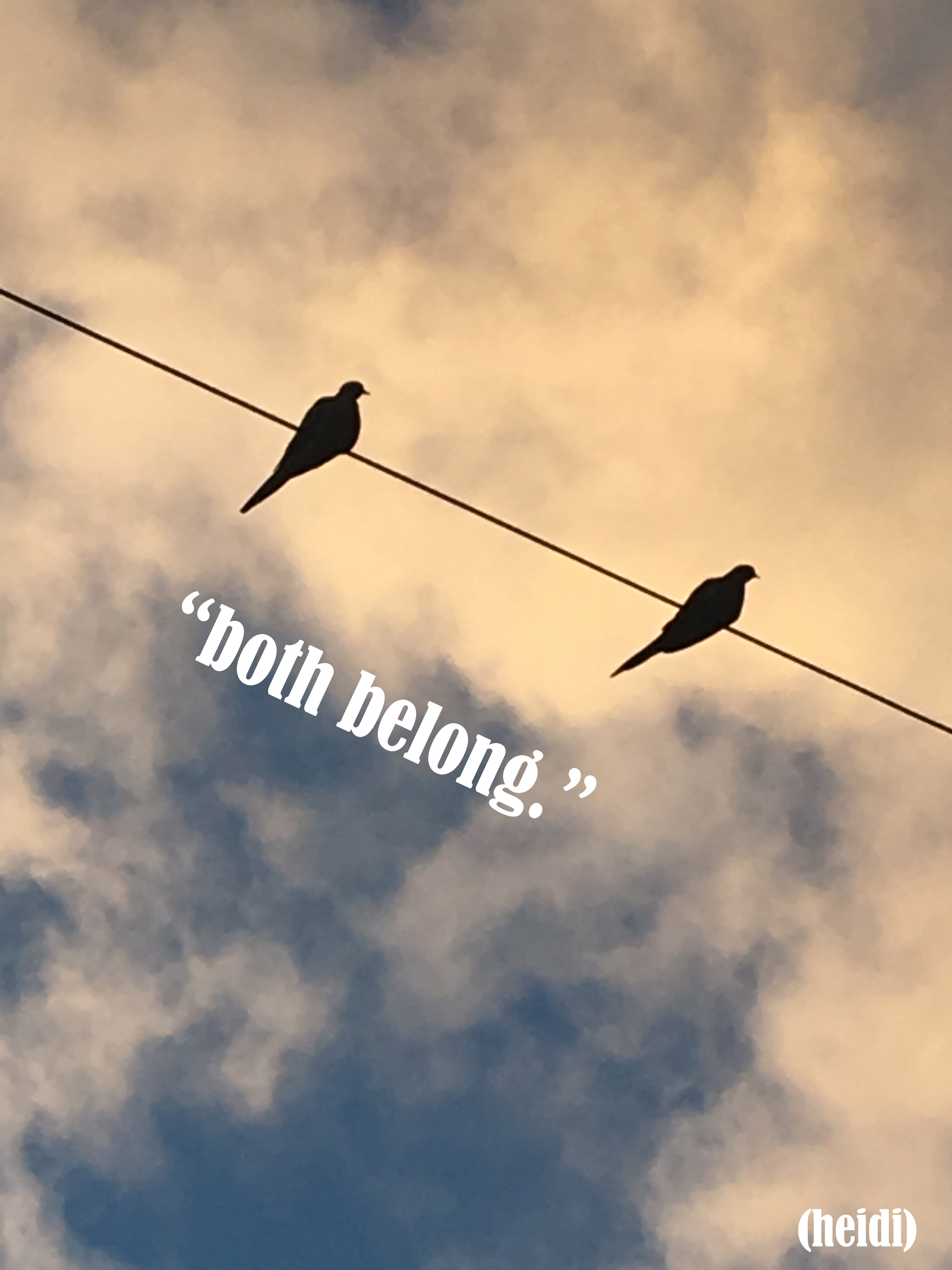
She surrounded herself with flowers and loved her garden. She made her table a magnet for family and friends. She did not sit and complain, she had no time for woe-is-me. She found opportunities to give and engage. Story after story of a woman, even in the heat of cancer, while awaiting the results of the latest scans that would determine the number of days she would have on earth, turned trips to the doctor into opportunities to shop with her daughters. Lunches. Expeditions to a beloved bakery. Create the extraordinary in the simple moment, regardless of the circumstance. We heard again and again these companion phrases, “She chose love.” The pain and the love, “Both belong,” Heidi said.

In an intentional life, one does not negate the other. Tragedy and triumph. Devastation and joy. It’s a decision. Where we focus will determine our experience of life. Nancy stood in her pain and uncertainty; she had every opportunity to become bitter. Instead, she focused on love. She created it. Nurtured it. Grew it. Offered it. She didn’t deny her pain. She held space for it in a greater container.

It was apparent in the laughter evoked in the stories told, it was apparent in the generosity of the service we experienced. This was not a Hallmark movie. It was a celebration of a life of texture, of impossible mountains to climb and of enormous blessings. It was the lesson Nancy lived because it was woven through every story told about her. “It’s what she taught me,” Heidi said, “Both belong.”

read Kerri’s blog post about BOTH BELONG

Try To Explain [on Merely A Thought Monday]

It’s nearly impossible to explain. I’ve had the conversation a thousand times and I know it’s fruitless from the outset. Why did I choose a life without a safety net? A life with stability and benefits? Why was I willing to work 80 hour weeks for not-very-much-pay? I’ve heard more than once that “Artists are indulgent.” Or, “Artists are fools.”

Maybe. I’ll never know because it is impossible to explain to someone who operates from a different imperative. I’ve thought myself foolish more than a few times, and, usually, when I measure myself by the standards of 9-to-5.

For me, like all the artists I know and admire, there has never been a distinct line between work and play. Given any amount of free time, I’d rather be in the studio than anywhere on earth. When I was directing plays and running theatre companies, I couldn’t wait to get up in the morning and get back to work. The time between productions or studio time, what most people call “vacation,” was-and-is meant to catch up on sleep and fill up the well for the next project. Often, this thing called ‘vacation’ was an opportunity to visit museums, drink in art/inspiration or stand in a castle or sit in the city where the next play is set.

For most of my life, even before I really thought about artists or artistry, vacation involved a sketchbook. I sat in the back of the station wagon and drew Colonel Sanders from the bucket of chicken or tried to copy a photo from the National Geographic magazine. Fun and play involved a deep dive into the world I could create/discover through a pencil on blank pages.

I can spend hours sitting and watching people. Small dramas. Gestures. Manipulations. Kindnesses. A little burst of love that would otherwise go unnoticed. Traveling for work meant time spent in airports, a goldmine of observation-time. Work or play?

Perhaps that is why there is no line between work and play. I see it in Kerri, too. We are constantly noticing. Paying attention to what is beautiful or interesting. Feeling what is needed and what is not. We’ve talked endlessly about being empathic. Feeling what others feel. I’ve watched Kerri walk into a rehearsal and “know” where there is pain, where there is joy, know when she needs to wrap some humor around a bruised community. Many years ago, a wise-old-artist told me that I had to learn to distinguish between what was my “stuff” and what was not. What were my feelings and what was not. Sage advice. I’ve been witness to many artists imploding, carrying other people’s garbage as their own.

When we walk, Kerri takes photographs. “I’m sorry,” she says, stooping to focus on a leaf or stone. Why does she apologize for noticing? Here’s a hint: all of her life she’s been asked to explain why she stops to notice. What value can there possibly be in stopping forward motion, especially in a world hell-bent on “getting there faster.” What is the value-proposition of noticing? “Can you please explain why you have to stop and see and, of all things, make it into music?” Or a story. Or a painting. Or a dance.

“Why did you climb that tree?” the adults asked. “It’s where I write poetry,” she explained. Work or vacation? Is it play?

Every Saturday we go through Kerri’s photos from the week and choose five as prompts for our Melange. We collect phrases we hear, words that inspire or disturb. Those end up in the Melange, too. Are we working? Is this play? We delight in sitting each day and writing together. We laugh at our Smack-dab cartoon. They are fun to write and draw and color. None of this makes us any money. Is it work or is it vacation?

I’m currently drawing cartoons and tossing thought-bombs into a community of software entrepreneurs – the boss understands that I notice things and can translate what I notice into other shapes and expressions. Is there value in that? Is it work? Is it play? Will it make money?

Are there possibly other measures of value?

It’s nearly impossible to explain.

read Kerri’s blog post about VACATION

See The Point [on Merely A Thought Monday]

“When we are no longer able to change a situation, we are challenged to change ourselves.” ~ Viktor Frankel

There is a new mantra cycling through my circle of friends. Once, highly frustrated with people refusing to participate as a community in the relatively benign measures necessary to end the pandemic, they’ve now forged their frustration into a different shape: there’s no point in trying to change “them.”

The circle is closed. Or, perhaps, it has been closed all along. Us. Them.

We spent the weekend in a special cabin with The Up North Gang. Walks in the woods. Pontoon boat rides seeking a sunny spot to anchor. Friends that heal what hurts. Laughter and wine. Occasionally, our conversation wandered into politics and pandemics, usually spurred by a local man posting cryptic and apocalyptic messages from deep within his conspiracy well. He is one of “them.”

“How can he believe this stuff?”

“Imagine everything he has to ignore to believe this stuff!”

“He’s always been a bit kookie.”

“There’s no point in reasoning with him.”

“There’s no point in writing a response, he’d just deny the facts, the court cases, the data, the science, the…”

There’s no point. That’s the mantra. There’s no point.

Us and Them. Together in the same boat. One half trying to rock the boat. The other half trying to keep it from flipping.

Exhaustion? Surrender?

“It’s like they’re drowning in bad information,” she said,

He replied, “And, there’s no sense throwing them a rope, they’d refuse to take it.”

“We have thrown them a rope,” she added. “It’s called the vaccine.”

We laugh a sad laugh, shaking our heads. What’s the point?

read Kerri’s blog post about Safe Together

Know Why [on Merely A Thought Monday]

I’m working with a software start-up company. Upon returning from travels I found our conversation has shifted into articulating mission and vision and purpose. None of us are keen about writing these kinds of statements but the exercise is useful and necessary. Why do we do what we do? What, exactly, do we do? In that order. Why. What.

Why? It seems as if this should be an easy answer. To support other people. To support other people in doing what they need to do.

I couldn’t help but think of our experience last week. We shared our story of breaking down in Hays, Kansas. It was late in the afternoon. It was the day before my dad’s funeral in Denver. We hobbled into the dealership. They were jammed with customers and couldn’t help us. There wasn’t a rental car to be found. It looked bleak. The dealer recommended a garage on the other side of town. Davis Automotive. We limped into their parking lot. We told our tale. They moved heaven and earth to help. Why?

It was nearing the end of their day. They, too, were jammed. Yet, they helped. They took the time. They made our problem theirs to solve. They took to heart my need to make it to my dad’s funeral. My need became their personal mission.

I returned to work with a new view on mission statements. They need not be lofty or abstract. In fact, they should be visceral. Tangible. Everyday. Support other people in doing what they need to do. Why? Because they need it. Just like I need it. Or you need it. These good mechanics fix cars. That is their “what.” Their “why”: help people get where they need to go. Help people do what they need to do.

Help people.

It’s how interconnection works. My mission is, in a real way, to make your path easier just as your mission is to make my path easier. I need mechanics because I do not have that mind or skill set. They need software designers because cars are computers and they can no longer diagnose problems without them. I am an artist, a teller-of-stories. Mechanics and software designers need my mind and skill set to remind them that, beyond their role, their mission, their job, they are human beings living a universal story. Nothing they do will matter, nothing I do will matter – ever – if it is not in service to the support of others’ growth, or need, or desire or fulfillment. I cannot be fulfilled if my work does not support you. And vice versa.

So, why are these good men and women, these software engineers and entrepreneurs creating their software? They see a real need. They see people struggling. And, like good mechanics who encounter a brokenhearted son en route to his dad’s funeral in a truck that will not run, they know exactly what to do. And, they know why.

read Kerri’s blog post about SERVICE

See The Wonder [on Merely A Thought Monday]

What is this thing called ‘wonder’ and where does it go? Awe. Astonishment. Surprise. The stuff of sunrises and sunsets. The first. The last.

I am of the opinion, like most people I know, that wonder does not go away. We simply stop looking through eyes that see it. Been there, done that. Nothing new. The daily grind. If you’ve seen one, you’ve seen them all. It’s too bad. It’s no way to live.

We moved our chairs to catch the sliver of sun. We sat, closed our eyes, bathed in the warmth, and sighed. Wonder need not be complicated. Tom Mck, his mind already slipping, forgetting why we came to the cemetery, heard the grieving husband across the way wail in pain. “Listen to the wind!” he said to me, eyes wide in amazement.

“We are such stuff/ As dreams are made on and our little life/ Is rounded with a sleep.” ~ William Shakespeare, The Tempest. We are such stuff. It is a very short window, a single moving moment, rounded with a sleep. The real question is: What moment in this brief life is NOT alive with wonder?

read Kerri’s blog post about WONDER

Look For Joey [on Merely A Thought Monday]

It’s been a life-long fascination of mine. In the most individualistic culture on earth, we like to display our status by wearing brand names and shop the same stores in malls that look the same across the nation. We are the inventors of the chain store, the strip mall. The one-size-fits-all. The suburb and cookie-cutter-house. Here in the cult of the individual, we like to do what every one else is doing.

Kerri and I tease about writing a book. It’s called “Looking For Joey.” Google Joey Coconato or his YouTube channel, My Own Frontier, and our blogs pop up at the top. We’ve not written much about Joey Coconato – a few posts – but to our great amusement, we top-the-google-list. And, so, these days, we are regularly contacted by people who are looking for Joey. They think we know him. They think he’s editing his next video in our basement.

Joey lives off the grid. He backpacks the American wilderness and documents his treks with videos. We became avid Joey fans when pandemic-isolating last year and vicariously got “out there” through Joey’s films.

After watching a few of his films it becomes abundantly clear that Joey is what everyone on the grid pretends to be. An individual. His clothes are ripped. His gear is constantly in disrepair. His food is what he can get his hands on at the moment. He is not climbing any ladder. In other words, he is not invested in how he looks, what he wears, or whether or not he’s doing things the way he ought to do them. He’s doing life in his way. At his pace. In his place. According to his star.

After receiving the latest: “Do you know where Joey is? It’s been 8 months since he posted…” I decided that, in these un-united-united-states, everyone is looking for Joey. He has, for me, ascended to the level of metaphor. He is authentic in an age of thin veneer.

While people are draping themselves in tribal-hate-flags and crying “individual freedom”, sticking their heads in the Q-sands as an act of liberation, blinding themselves in a rabid-festival of group think, all the while shaking their fists declaring, “No one can tell me what to do.” Insisting without any connection to reality that an election was stolen, that vaccines in a pandemic are filled with micro chips, that January 6 was an ordinary day at the Capitol – we are a mess of lockstep inanity.

I think everyone is looking for Joey. They – we – no longer know what is real so they -we – are splintering into disparate group-fantasy. Lemmings singing a chorus of My Way as they – we – plummet off our collective cliff.

Honesty is not that hard to spot if you want to look for it. Much of the fight falls away when you are prepared to acknowledge that much of what we profess is cotton-candy, that we are terrified of looking at our full history. Shops and malls and online outlets are not great places to look for answers. Running from critical race theory does not make our past go away.

A walk about in nature has a way of making the absurd abstractions fall away. Carrying your food on your back and looking for water when you need it strips away the investments in the ridiculous.

Individuals – people truly living out of their own center – generally don’t have to wear brands or broadcast their individuality. They are not seeking validation. They are not fighting for their freedom. Like Joey (I imagine) they simply live it.

[ the cool Dr. Seusss plant is called white baneberry or doll’s eyes.]

read Kerri’s blog post about STAND OUT

Stand In The Narrow Place [on Merely A Thought Monday]

“Western civilization has been a 2,000 year long exercise in robbing people of the present. People are now learning the joys that hide in the narrow place of the hour glass, the eternal moment.” ~ George Leonard, Mastery

The observation has become something of a yearly ritual. Every 9/11, I hear or participate in this conversation: one day, people got out of bed, drank their coffee, brushed their teeth and went to work or boarded an airplane. And then, they never came home.

We are fairly smothered in sentiments about appreciating life, seizing-the-day, living in the present moment, take nothing for granted… “You never know.”

Quinn gave me his copy of Mastery. As was his practice, he underlined significant passages in red pen – and the book was a festival of underlined passages. For years I kept the book on my desk or beside my bed. I’d flip it open and read the red sections. They served as a daily meditation. They gave my busy mind something generative and hopeful to occupy.

George Leonard called presence, “the plateau.” Eckhart Tolle calls it “the now.” In one of the gospels NOT included in the bible, Jesus is reported to have said, “The kingdom of heaven is on earth but men do not see it.” The Way of the Buddha leads to the present moment.

What do we see if we stop thinking long enough to experience the present moment?

2996 people died in the terrorist attacks on 9/11. These people could do nothing about what happened to them on that day. They brushed their teeth. They left for work or got on an airplane.

“You never know.”

This year, there was a new river-of-thought that ran through the annual ritual observation: the daily COVID death toll last week in these un-united states was above 1,000 a day. On January 7th, 2021, 4,147 people died of COVID. In the divided-united states, more than 660,000 people have died of COVID. World-wide 4,550,000 people have perished.

It’s impossible not to look at the numbers and wonder why-and-how we became our own terrorists.

In the past year, with the availability of a vaccine, with the proven effectiveness of masking and social distancing, these people, had they united with the help of their friends and neighbors, had choices. They – we – could have done everything to save their lives. We did not. We divided. 1000 yesterday. 1000 today. 1000 tomorrow. And growing.

Sometimes we know.

Appreciating life is – and always will be, at the narrow place of the hour glass – a community affair. In presence, on the plateau, the line between me and you blurs. It is the reason why all of those firefighters and first-responders ran into the towers that day. My life cannot be precious if I cannot see that yours is also precious. Why – on earth – on any given day – would I not do everything possible – anything possible – to protect your life? Why would you not do the same for me?

read Kerri’s blog post about BLESSINGS ABOVE GROUND

Decide To See [on Merely A Thought Monday]

My thoughts while watching the wedding:

Oprah asked Gary Zukav this question: Where is soul? His response: Where is it not?

Exchange the word ‘love’ for the word ‘soul.’ Where is love? Where is it not?

In the English language, words like ‘love’ and ‘soul’ are nouns. Things. And, things must have limits. It is a remarkable misunderstanding, a miracle of minimization. Love, the single hardest ‘thing’ to define, in fact, impossible to define, is undefinable because it is without limit. The best we can do is point toward love-made-visible. A newborn in the arms of its mother. The moment the couple, standing before their community, stares into each other’s eyes and promises, “I do.” Watching a sunrise on an anniversary. A mother dancing with her son, the groom.

Love is. Where is it not? That means, of course, that it is “in” everything, everywhere. The air we breathe. The thoughts we think. The actions we take, big and small. It is in how we treat our neighbors. In how we see ourselves. In how we report our news. In how we tell our lies and our truths. Love is.

It is the province of no-single-religion. In fact, it is where every religion on earth goes off the rails. To claim to be “the way” or “the one true…” is to attempt dominion over love. To place rules and boundaries on the boundless.

The question Oprah didn’t ask: if it is everywhere, in everything, in war and in peace, hate and acceptance, does it have any meaning at all? If it is ubiquitous, unchangeable and indescribable, why bother? Gary’s answer, I imagine, would be something like this: we choose the form we give to our love, do we not? We can choose to put the accent on unity. We can choose to put the accent on separation. Love is. We can choose to put the accent on division or we can choose to offer our support.

There is never more or less love. Isn’t that the point? Love is beyond definition. What changes is not the love or the amount of love. What changes is what we decide to see. What changes is how we decide to see, especially how we decide to see ourselves in this world with so many “others.”

read Kerri’s blog post about JUST LOVE

Meet The Saw [on Merely A Thought Monday]

As the magician saws the woman in half, he tells her that, “Magic is not an exact science.” It is among my favorite Flawed Cartoons.

“There’s nothing sadder than a forty year old production assistant,” she said, sipping her drink, looking across the room at a man she clearly thought was a loser. I was living in Los Angeles and was at a party with movers-and-shakers. The gathering also included a few of the people who carried the cables, loaded the trucks, moved the electrics – the lowest rung on the ladder. The runners. I swallowed hard. At the moment she said it, I was thinking the exact opposite. There is nothing more interesting than a forty year old production assistant. I wanted to be standing with the very man she considered a loser. He’d have stories to tell. Experiences to share. The movers-and-shakers bored me. Dulled by their dedication to security, thoroughly protected from the unknown or surprising experiences, they sneered at the people who’d actually lived. I found my way across the room and spent the rest of the evening sitting in the kitchen talking with a man who traveled the world.

Were I at the party today, she would look across the room at me and whisper, “Sad.”

Life is like magic. It is not an exact science. Ideals collapse. Dreams implode. Yet, the luckiest people I know are the few who have stepped out of their seats and volunteered to climb on to the stage. They’ve taken chances. Built wood buses or put their lifeblood into starting a theatre company or went boarding instead of dying in a cubicle. They’ve stepped beyond traditions and expectation. They’ve been cut in half, opened, challenged, surprised, disappointed, scared, triumphant, awed. They’ve learned. They’ve questioned their beliefs and perceptions. They’ve made titanic mistakes. They’ve stared down their demons. They’ve opted for curiosity rather than being right. They stepped off the edge. They followed, “What if…”

There’s no shortage of people who watch life from the safety of their seats. As Tom used to say, “They paint with a limited palette.” There are those lucky few who, if you see them at the party, most likely the people serving drinks, who’ve been cut in two and know from scary experience that there’s nothing more numbing or illusory than certainty. Follow them into the kitchen and ask about their lives. You’ll be amazed at the full spectrum of colors you find in them.

read Kerri’s blog post about SAWED IN HALF

flawed cartoon ©️ 2016 david robinson

Make Life Better [on Merely A Thought Monday]

Lately, the universe has pitched me headlong into a master class on efficiency. Maximum productivity with minimum wasted effort. A useful concept in certain arenas and an intensely destructive concept in others. For a person who’s spent his life in a study of curiosity, art, and the creative, it’s an unexpected study at this stage of the game. It is sometimes uncomfortable but I consider it an opportunity for balance. Artists rarely meditate on efficiencies. We’re more of a discovery clan and efficiency is generally the enemy of discovery. No one ever sailed to the edge of the world with efficiency-on-their-lips.

Once, I made the argument to a school board that daydreaming was highly productive. It seems a no-brainer to me that exercising the imagination should be highly valued in a learning environment. Einstein’s Theory of Relativity came to him in a dream about cows. It is not an accident that many insights and revelations come in the shower or while driving or peeling a carrot. Newton’s apple did not fall on his head while he was exercising maximum productivity. The mind, to be efficient, needs space to breathe, fields to roam. It is the most elegant of paradoxes but mostly lost on worshipers at the altar of efficiency. In the modern business world, efficiency is all about time since time is billable. You know the mantra: time is money. Do more with less. Somehow, we’ve turned that nonsense into a virtue, a thing to be desired. A reason to squeeze.

There’s another, more admirable side to efficiency-seekers. How to make work less arduous. Grease the wheels and remove the friction. Relieve the burden. Not faster but easier. Ann used to say, “Find a need and fill it.” She’d look at people toiling and ask, “How can I ease their struggle?” Beaky was that way, too.

Near our home there is a stretch of shoreline with an ineffective seawall. It was built with stones and debris that become projectiles when hit by forceful waves. The locals know to avoid that stretch during a storm. It’s deadly. After the storm, it has become our ritual to walk the path to see the destruction. It’s always impressive. How far can a wave throw a heavy stone? The answer: farther than you think. Mother Nature yawns when we think we can control her. The seawall has become my metaphor for human hubris but also masterful inefficiency. It would cost money to build a proper wall. So, instead, after each storm, crews collect the rocks and pile them back on the shore, readying them to be hurled by the next storm.

We saw a double-rainbow and turned toward the shore. Kerri never misses an opportunity to capture a little miracle or a slice of beauty. We parked in front of the seawall-of-inefficiency and I laughed out loud. A budding Banksy sprayed a message on the rubble: love. The secret message-maker could not have found a more appropriate word: Love. Can you imagine anything more inefficient and, at the same time, more potent? Love moves mountains but is not billable. It transcends time. What better reason to do anything? Well, perhaps reason has nothing to do with it and never has. Reason has the worshipers-of-the-efficient perpetually re-stacking stones.

It’s easy to be seduced but let’s face it, life reduced to billable hours is not life at all. On the other hand, there is nothing more inspiring, nothing more curiosity-invoking than asking, “How can I make life better for everyone?”

Love on a rubble pile. What could be better? On second thought, what could possibly be more efficient?

read Kerri’s blog post about LOVE ON A ROCK