Look To 3 [on Not So Flawed Wednesday]

My long-ago-business-partner used to tell groups that every human being wears an umbrella hat called “normal.” That is, we try to maintain and make sense of the world according to our personal (and cultural) criteria. We carry the criteria around with us – it does not exist beyond us. We are comfortable when wearing our umbrella hats. We get really uncomfortable when something comes along that knocks our hats off of our heads.

When we lose our hats, we’ll do anything to regain our comfortable “normal.” The fear of losing our hats is what makes change – personal and cultural – so difficult. Despite what they say, no one wants to lose their hat. Organizations have a nifty phrase, change-management, to shield against the reality that change – real change- requires discomfort. How to prevent discomfort? Manage it! No worries! Everything is under control!

The other strategy – also not very effective in the long run – is to pretend that the hat is still on your head. No worries! It’s all made-up! Everything is normal!

The pandemic blew our collective hats off of our heads. We’ve had a front row seat to the realities and responses of a disrupted normal. The recent photos from Miami Beach, the aggressive non-mask-wearers, the absurd and deadly politicization of a pandemic…all in the name of hat retention and recovery.

In our circle of life, we’ve had the ubiquitous conversation about the return of normal. “When can we get together again?” Prior to the pandemic, our week was patterned on, our lives were grounded in, our Sunday and Thursday night dinners with 20. In a fluid artistic life, dinner with 20 was the shape-giver to our otherwise formless weeks. One day last March, we tossed our hats to the wind. It wasn’t safe to gather.

Over the year we left groceries at his door. He dropped goodies at our door. We waved from the car. We had regular phone calls. A few times, when the weather was nice, we sat in the back yard at great distance and discussed how weird life had become.

We looked for our new-normal-hats but they were nowhere to be found. It’s what happens when change cannot be denied: the management of discomfort is the best that you can do. Keep stepping. Chop wood/carry water. One day at a time. A new normal will surface sometime. A new pattern will be established. Pattern making is what we homo sapiens do.

In the past few months we three were vaccinated. We waited for a few weeks. We diligently read our CDC guidelines. And then, as if a year had not passed in the interim, we gathered to share a meal and drink a bottle of wine. Nothing had changed and everything had changed.

2 at the table is once again 3. We are slowly reestablishing what we once knew as normal. Our laughter is easy as it has always been. But the nation we inhabit, the community we see and experience, is transformed. There are stores we will never again support. There are relationships that will always be superficial. There is a bald ugliness exposed as never before in the nation. Ruthlessness. So many dead amidst such fatuous games of denial. The hot wind that blew our normal-hats away exposed the geography – the actual geography – beneath our nation that espouses equality but has deep division and favoritism woven into its DNA. Control by division. It is a mechanism: black gain is seen as white loss. White gain is built upon black loss. It is a seesaw, an angel/devil game. It’s a system doing – brutally – what it was designed to do.

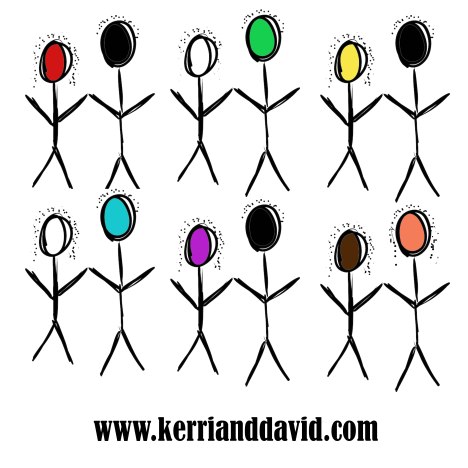
Disruption is an opportunity for change. With so many lost hats, with so much ugliness exposed, a good look in the national mirror is possible. As we struggle to find our new normal hats, it occurs to me that angel/devil games, deep divisions, are never “solved” in twos. Movement is created by two points. Insight is a three-legged stool. Complexity is addressed through triangles, through a focus on relationship. Opposition-in-twos will keep us forever on the systemic seesaw.

Laughter is restored, possibility uncovered, through the lens of three.

read Kerri’s blog post about 3

Evolve And Laugh Heartily [on Merely A Thought Monday]

I find the notion of evolution to be hopeful. Evolution of species. Evolution of consciousness. I assume in my wild idealism that the evolution is toward betterment. Reading Ken Wilber’s thoughts on our chaotic and troubled post-truth times, we are, he suggests, in the throes of an evolutionary step. Evolution is not a smooth stepping dance. It’s more a stumbling forward drunkard.

Last week I posted about the lake in my studio and how the clean up facilitated a life-work review. I was surprised by how many notes I received from life-long friends asking me not to burn my paintings this time. I’d forgotten that, after my move to Seattle, I took most of my paintings and drawings to a fire pit on a beach and burned them. I had so much work that it took three days to complete the purge. That life-work-review ended in fire. This latest life-work-review began with water. I actually loved, post flood, going through my paintings. The paintings that went to the fire felt like a burden, a weight. From heavy burden to love; not a bad progression in my personal stutter-stepping evolution.

We drove to Colorado last October to see my parents. In his dementia, my dad cast me in the role of his college roommate and took me on a tour of the basement. We stopped in front of a large photograph taken at his parents 50th wedding anniversary celebration, a photo of the whole clan. He pointed to my twenty year old face in the photograph and said, “Now, I don’t believe you ever met this one.” It was true. As I listened to his description, I had the overwhelming feeling that he was right. Later, I returned to the photograph and visited that version of myself. I thought, “I think dad’s right. I don’t believe I ever met this one.”

The months that followed set the stage for my flood-inspired-work-review. I’ve discovered that I am more apt to be kind, more given to the positives, than I was a decade ago. Evolution has softened me. Or, opened me.

I’m not alone in reaching back, in sifting through the evolutionary drunken stumble to the present. This pandemic era serves as a marker-in-time as well as a great disrupter of pattern and path. It has inspired many a life review among those in my circle. Together, we ask the questions that have no answers, Quinn’s big three: Who am I? Where am I going? What is mine to do?

There are no answers but from time-to-time it’s necessary to ask.

There’s a fourth question that kept Quinn in stitches every time I asked it. What’s it all about? He’d howl and snicker and snort whenever the question came up. I am now the age he was when that younger version of me sat in his study and wrinkled my brow, disconcerted at his hearty laugh. Now, I know without doubt what’s so funny. I find myself laughing to tears when I hear the un-answerable-fourth-question. It’s about what you make of it as your illusion drops away in the course of your own personal evolution.

What else?

read Kerri’s blog post about EVER EVOLVING

Prepare For The Jump [on DR Thursday]

On the upside, an in-studio-waterfall, after the shop-vac-a-go-go, the sodden-carpet-padding-removal, the baking-soda-ballet, amidst the-we-are-still-hunting-for-the-proper-gasket-to-stop-all-leaks-quest, an opportunity arises. It’s been awhile since I sat with my life’s work. It’s been awhile since I made time to stare at my paintings, each and every single one.

I confess that this year has been rife with artistic mourning. I have barely picked up a brush. I have sat in my studio like a visitor at a wake. I feel the emptiness as a loss and have asked myself the fear-question again and again, “Where did it go?”

One of my favorite books is Art & Fear. Recently, I flipped it open and read, “Your reach as a viewer is vastly greater than your reach as a maker. The art you experience may have originated a thousand miles away or a thousand years ago, but the art you can make is irrevocably bound to the times and places of your life. Limited by the very ground on which you stand.”

A second flip brought me to this passage about change: “Yet it’s demonstrably true that all of us do (from time to time) experience such conceptual jumps, and while ours may not affect the orbits of the planets, they markedly affect the way we engage with the world around us.”

The times of our life. The world, for us, stopped when Kerri broke her wrists. She was in casts when the pandemic washed over all of us. Our jobs disappeared. Our community fragmented. Our city burned with civil unrest, a young militia-boy murdered two people a few blocks from our home. My father took rapid steps toward the abyss. Kerri took a second fall, tore ligaments in an already injured wrist. Our BabyCat left us. We talk about 2019 as if it was decades ago. “Doesn’t it seem like years since we…”

I know this death I feel will find its springtime. There was a “me” before this time. There will be another “me” after. Sitting on the stairs, looking at my paintings, I know for the first time in a-year-that-feels-like-a-century, that a conceptual jump is bubbling. I remember the man who painted these paintings. I look forward to meeting the man who will one day pick up his brushes and dance with the muse again.

In the meantime, I sit with my paintings. I stand in the ground of my times. I will find the right gasket so water no longer rains into my studio. I will prepare for my jump by putting all of my pieces back together again.

read Kerri’s blog post about THE WATER STUDIO REVIEW

See The Verb [on Not So Flawed Wednesday]

Random fact of the day: my waking thought this morning was about The Geography of Thought. No kidding. It’s a terrific book by Richard Nisbett. The subtitle is “How Asians and Westerners Think Differently…And Why.” Somewhere in the recesses of my brain I must have been pondering the bumper sticker we recently saw: I’m With Earth.*

One of the points made in the book, the one that permeated my dream state, is that different languages place different emphasis on different parts of speech. For instance, many Asian languages place emphasis on the verb. English speakers place the emphasis on the noun. In listening to mothers talk to their infant children, an English speaker will say, “Look at the red truck! Do you see the red truck?” An Asian mother will say, “Look at the red truck go!” Do you see the red truck go?”

Why does it matter where the emphasis lands in a language structure? Noun or verb?

The language we use shapes our thinking and seeing. It shapes basic worldviews. Earth as a noun or earth as a verb. Earth as a stand-alone-thing or earth as a moving interrelationship. These are vastly different worldviews.

This was my thought/image coming out of sleep: earth and sky. In a noun world, earth and sky are two distinctly different things. In a verb world, earth and sky are not separate things, they are verbs, actions, interplay of a dynamic relationship. In a noun world, I am also a distinctly different thing. In a verb world, earth, sky and I are not separate things, we are a dynamic inseparable relationship. We.

The bumper sticker is a declaration: I am with earth. It makes perfect sense in a noun world because it is also possible, in a perceptual world of separate things, to be against earth. Nature needs to be conquered, tamed. In a noun world, earth, once tamed, is a resource and resources are meant to be used. In a noun world, we are capable of believing that our actions have no impact on our environment. Action and environment are nouns, separate things.

In a verb world, what you do to the earth is what you do to yourself. No separation. In a perceptual world of relationship, of verbs, it is understood that your actions not only have impacts, your actions are impacts.

We woke to the news of yet another mass shooting. This one in Colorado. As usual, we know that our community and leadership will offer thoughts and prayers but nothing really – not really- will be done to address it. In a noun world, we protect the rights of the individual, the separate thing. In a verb world, there are no mass shootings. None. Violence done to one is violence done to all. In fact, more people are gunned down in the United States in a day than are killed by gun violence in Japan in a decade. The differing linguistic emphasis extends to differing understanding of rights and responsibilities.

Language matters. Where we focus matters. What we emphasize matters. The story we tell is determined by the language we use to tell it. I am with earth. Or, I am earth. I go to worship. I am worship. I seek purpose. I am purpose. Separation. Relationship. A whole philosophy of living reduced to a simple bumper sticker.

So, when we ask complex questions like, “Why can’t we do anything about gun violence?” or, “How is it possible that people in a pandemic refuse to wear masks to protect each other,” our answer is really very simple: our language makes it so.

Perhaps in a world of nouns a declaration is the best we can do. It is a step toward the middle way, a declaration of responsibility to the commons. Black Lives Matter. #MeToo. Stop Asian Hate. I’m With Earth.

*The “I’m with Earth” sticker is from the very cool company Gurus

read Kerri’s blog post about I’M WITH EARTH

Stroll The Esoteric Garden [on Not So Flawed Wednesday]

Lately, I am strolling the esoteric gardens and have picked for you these wild blossoms.

First, my favorite quotes of the week:

  1. “Life is mysterious and transcends logic, so the living thing can never be fully analysed, taught or learned…The doctor may explain why the patient is dead, but never why the patient is alive.” [Declan Donnellan].

2. “Samuel Beckett is a wonderful writer who has meditated deeply on the mystery of death…All of Beckett’s works, especially Waiting For Godot, are about death. In other words, because death exists, time is radically relativized. All we do here is invent games to pass the time.” [John O’Donohue]

DogDog and BabyCat are food-driven. The levels of excitement in our house escalate when the food bowls are filled. DogDog performs his vertical-jump-and-counter-clockwise-spin dance. BabyCat uncorks an excited verbal symphony that sounds a lot like “now, now, now, now, now…” The anticipation of the bowl, it seems, is far more satisfying than eating of the food from the bowl. The anticipation lasts longer and I am certain that, in the gobbling, neither DogDog or BabyCat actually taste their food.

3. “After a time, you may find that having is not so pleasing a thing after all as wanting. It is not logical, but it is often true.” ~ Mr. Spock. I laughed the first time I heard this in an episode of Star Trek. Capitalism reduced to a simple, single phrase. The economics of desire, wanting and having en route to wanting.

I have crossed paths with many a seeker. Mostly, they talk of presence or mindfulness or being as a noun. A thing to achieve or possess or gobble. Food in a bowl. The anticipation of unity in a path devoted to separation, thus, we are seekers. The Buddhist’s remedy to the dedication of separation is to chop wood and carry water. In other words, being is a verb.

With the notable exception of how-to-go-on-a-walk-without-pulling-our arms-out-of-the-socket, using the promise of a treat, Kerri can teach DogDog anything. There is no end to the tricks he will perform, the indignities he will suffer, en route to a treat. He sneezes on cue. He counts, high-fives, sits, jumps up, jumps down, wears paper plates on his head…his little Aussie body quakes with excitement, his eyes firmly locked on the promised treat.

We wrinkle our brows daily and ask, “How can they possibly believe that?” Horatio would respond, “It’s game theory. What are the incentives, the promised pay off?” Anticipation. Treat. We might as well ask, “How did hate, division and lie become food in the human bowl?’ There is no end to the tricks people will perform, the lies they will embrace, the funny hats they will wear, the indignities they will suffer or inflict, eyes firmly locked on a promised treat. Superiority. Or mattering?

I have crossed paths with many a power player. Mostly, they talk of winning, and owning, and being-on-the-top. There is never enough food for the bowl. The anticipation of achieving abundance through eyes that only perceive a pie with limited pieces. Owning this piece and then the next and the next and the next…

“Life is mysterious and transcends logic.”

Yearning meets obstacle.* The strange alchemy necessary to invent a story.

Dogs and cats living together, oh my!

“All we do here is invent games to pass the time.” I wonder, as I wander through my esoteric garden, what might it take for us to invent more inclusive, life-giving games, a more generous story?

*this definition of story courtesy of Robert Olen Butler

read Kerri’s less esoteric blog post on ANTICIPATION

Make Noise [on Merely A Thought Monday]

I am conflicted. I wrote a version of this post and then tossed it away. I’m trying to be less argumentative in my daily writing. And then, Toni Morrison collided with Albert Einstein:

“In times of dread, artists must never choose to remain silent… This is precisely the time when artists go to work. There is no time for despair, no place for self-pity, no need for silence, no room for fear. We speak, we write, we do language. That is how civilizations heal.” ~ Toni Morrison, No Place for Self-Pity, No Room for Fear

I am an artist. Is it argumentative, is it confrontational, to write what I see? Yes. Sometimes. Once, I saw a park service truck, on a trail, quickly backing up. The driver did not see the man in the wheelchair right behind his truck. I screamed and ran and banged on the side of truck until the driver stopped, a few inches from hitting the man in the wheelchair. Sometimes it is necessary to shout and make noise.

All of my life I’ve understood the first rule of being educated, namely, to check your sources, as simple sage advice. It’s a good idea, if you are going to anchor your identity in a narrative, to make sure that your narrative-of-choice is solidly anchored in verifiable substance. Doubt and questioning, used properly, are necessary tools of an engaged mind.

Years ago, Robert Cialdini wrote, “The world abounds with cults populated by dependent people who are led by a charismatic figure.” In other words, people are easily led and – as we have recently witnessed – with disastrous results. All that people ever need do to avoid a nasty drink of purple Kool-Aid is to check their sources. In our day and age it is almost easier to check the veracity of the story-we-are-being-fed than it is to be misled. Almost. One must first desire to be fed the truth, even if the truth challenges rabidly-held belief.

Checking takes less than a minute.

Just ask the now-jailed-and-soon-to-be-tried capitol insurrectionists claiming that they were led astray by a flimflam-president-man. The Big Lie was easy to check. It remains easy to check. Yet, none cared to check it or perhaps refused to believe what they found. Checking the lie, listening to the data, would undermine the tightly held power-narrative of an entire political party. A pathological lies requires more and more effort, more and more outrageous lies, to sustain itself. It should have been easier to check the story than it was to storm the capitol.

Now I see the first rule of being educated, the necessity of checking sources to verify fact, as a dire necessity. It is the flashing red warning signal to these de-united-united-states that there is a cliff ahead. It is no longer a sweet bit of sage advice; it is a survival imperative. Respect for the line – truth or fiction – will determine whether we as a nation unite and grow or divide and collapse.

Many years ago, Robert Cialdini also wrote,“Audiences have been successfully manipulated by those who use social evidence, even when that evidence has been openly falsified.” Openly falsified. He wrote those words decades before tweets, Fox News, and the mega-amplification of all the openly falsified big lies. His words might now serve as the sad single credo of the Republican party.

It is not shocking that a political party lies. It is most shocking how little the followers of the party care to check the sources of the enraged hype it daily swallows like so much anger-candy. Dependent people. Easily led. Believe wholeheartedly. Ever expanding lie. No facts necessary. It is far beyond Einstein’s observation of people doing nothing in the face of evil; our nation is in peril because the evil we face is an openly falsified narrative. So many of our people, so many of our leaders, know it is a lie, feed the division, and actively look the other way.

read Kerri’s blog post about DOING NOTHING

Recognize The Art [on Flawed Wednesday]

The snow was too dry. My snowman fell apart when I put the head on. “It doesn’t have to look like a snowman to be a snowman,” Kerri said to cheer me up.

“Maybe it’s modern art!” I quipped, using my if-it’s-a-mess-call-it-art default statement. As I walked down the trail, away from my unsuccessful snowman, I wondered when incoherence had become included in my definition of art.

I am and have been these many months doing some soul searching and life review. Walking down our snowy trail I remembered working with a dying theatre company. The first step in restoring their health and vitality was to help them face a simple truth: that they made the “art” did not necessarily make the “art” good. In fact, the “art” could not be good until their criteria for “good” wasn’t about them.

The challenge with “art” in the modern era is that it is nearly impossible to define. For purely masochistic reasons I looked up the word ‘art’ in the dictionary and nearly fell asleep before I finished reading the definition. “A diverse range of human activities involving the creation of visual, auditory, or performing artifacts…” Artifacts? The last lap of the definition reads, “…intended to be appreciated primarily for their beauty or emotional power.”

Beauty. Emotional power.

Of course, the contemporary world is awash in conceptual art and I read in my dictionary that this form of art, dating back to Duchamp in 1917, “…abandoned beauty, rarity and skill as measures.” Bananas taped to the wall. Statements.

Beauty abandoned. No emotional power necessary. But still “art.”

Art is, I’m told by historians and other scholars, a mirror of society. It is reflective of the era in which the artist lived. What a society values is made apparent in their art. It’s true.

Art, I believe, has a power and purpose far beyond mere appreciation. It is more than a mirror. It generates identity. It pulls disparate individuals to a common center. It affirms connectivity. It awakens us – and provides access to – that which is greater than any single individual. It bonds. It affirms. It transforms.

I wonder if our art, often so unrecognizable, sometimes incomprehensible, dependent upon curatorial interpretation, not concerned with beauty or rarity or skill or any other discernible measure, is not the perfect reflection of us. Narcissistic. Statements. Each day I am, like you, met by a tsunami of stories in the daily news revealing our collective confusion, our collapse of values, a commons at war with itself fueled by leaders stoking division for personal gain. Bananas taped to the wall. It is – we are – in our daily tales – so conceptual – so void of beauty or rarity or recognizable skill or measure – that it requires an anchor/curator to tell us why it – or we – might have meaning.

And then, just when I wonder if we are hopelessly lost, Amanda Gorman stepped up to the mic. The one true test of artistry is that we know it when we see it. No curator necessary. We are, we were, for a moment, bonded together in a way that no politician, no historian, no concept will ever understand or achieve.

I see it alive in Mike, and David, and Mark, and Chris. It glistens every time Kerri sits at the piano or composes a poem. It is not a mess though sometimes skill meets a happy-accident and, like penicillin, something healing emerges.

When we are washed away into the annals of time, what will be our art-love-letter to the future? What legacy – and art is a legacy – will we leave behind? What will I leave behind?

read Kerri’s blog post about SNOWMAN

for kicks, Kerri made a Snowman mug. Go here to get it

Pay Attention [on Merely A Thought Monday]

I read this morning in my brainpickings, “We have to try and cure our faults by attention and not by will.” Simone Weil.

Kerri and I walk almost everyday. We head for our known, usual trails, and only occasionally go in search of something new. Even though we walk a well-known path, it never fails to seem entirely new. Kerri attends to the details, taking photographs of unusual pine cones, a downy feather on a limb, the sun streaming through the trees. She pays attention. My awareness is more global, the movement of forest, the orchestra and dance of trees and wind. I pay attention.

Our walks bring us perspective when all else seems dark and disorderly. Our walks refill our well of hope when our circumstance seems bleak. Mostly, our walks “cure our faults,” they bring us into a present moment where all of life’s judgments and fears fall away as the illusions that they are. Our walks, if only for a few hours, wipe clean our canvas and return us to a childlike curiosity.

Sometimes, after a snowfall, we arrive at our trail and it is untouched. It never fails that we stand at the trailhead and marvel at the unblemished snow. Sometimes we hold hands and jump in with both feet and laugh. Sometimes we step carefully, quietly. Reverently. Either way, it seems a special gift. First steps are to be noted. Last steps are to be noted.

This morning I read an article about How Aging Shapes Narrative Identity. How the story-we-tell-ourselves-about-ourselves changes as we age. Our investments change. We become less interested in pursuits and achievements, in willful purpose. We become more interested in appreciation of our precious, limited moments. And, so, we begin to tell a different story. New snow on an old path.

The article was timely. Kerri and I lay awake most of the night. Among other things we pondered my dad’s dementia, the stories that he weaves and realities he inhabits. He is obsessed with going home.

Deep in the night, we talked about the stories that we currently weave together as we grow older. It seems that this time in our lives is a blank canvas, a path of new and untouched snow. Standing at the trailhead of our next chapter, no steps to follow or map, neither of us has any desire to reinvent or become different than what we are. Certainly, the circumstances of our lives are changing, but more and more we merely want to pay attention. To hold hands and jump into the unbroken snow. To laugh. To note the downy feather in the tree. The wind song, the deer that surprise us, leaping through tall grasses. “Did you see them?” I whisper. Kerri nods and smiles. Reverence. Nothing in the world, at that moment, is more important.

read Kerri’s blog post about UNBROKEN SNOW

Turn Around And Look [on KS Friday]

When we were at the other end of life, Roger and I often discussed the “bodies” of artists’ work. The overview of their lifetime of work and what it revealed. We speculated about what our bodies of work might someday reveal. He is, and always has been, singular, a director of plays, certain of his path. His body of work would be – and has become – the plays he’s directed and the actors that he’s instructed. It’s an impressive body of work. I am, as Horatio calls me, a polymath. My body of work has never been certain. As Roger knew with clarity the destination of his path, I knew with curiosity that I would be a wanderer. The path was and continues to be my destination.

In other words, I’m all over the map. It’s visible in my paintings. I dare anyone to make linear sense of my resume.

Tom Mck hired me because, in his words, I was a “Johnny Appleseed.” When he was old, he told me that he turned me loose in the schools to see what I’d stir up and also what I’d plant. It was one of my favorite “jobs” because it came without a description. I followed the fires. I found the need. I brought art and stories to hearts and minds grown arid from the pursuit of dusty answers.

Tom was a brilliant theatre artist and teacher. His body of work was immense. I was surprised, at the end of his life, when he told me that he rarely thought of the plays he’d directed. He believed his best work, the work that he most loved and defined him – his real body of work – was at the very beginning of his teaching career. He was assigned a 2nd grade class and had no idea what to do with them. So, his curriculum was to invent stories with them. They traveled the world as pirates, went on safari, designed and priced supply lists and mapped routes. Math and history and geography. For weeks they prepared for a day of being blind. What would they need to do to spend an entire day safely learning what it was to be without sight? Curiosity and discovery. Empathy. Inner and outer worlds. He ignited and followed their imaginations. Tom was a polymath, too. He was a Johnny Appleseed.

Today marks Kerri and my 156th week of consecutive posts. 3 years, 5 days a week. My wife is a poet and composer and pianist and teacher and singer/songwriter and recording artist and business owner and photographer and designer. A polymath. After breakfast each morning, we write. It occurred to me recently that my body of work, when all is said and done, will be my posts. I’ve directed many plays, performed many plays, written some really bad plays and a few good ones, consulted with corporations, performed stories at conferences and with symphonies, painted and shown paintings, written children’s books, taught and facilitated workshops and dug ditches and delivered warm bread to grocery stores. I started an experiential learning school, a diversity and inclusion training company, and coached people from all over the world. All of my wandering has provided a rich field of experiences to pull from, to ponder and reflect.

Sometimes (more times than I care to count) I ask myself, “How did I get here?” These days, in the pandemic era, I have plenty of time to look back on my road, on my body of work. “How” is a question that can only be answered after the fact. ‘How do we do it?” tops my list of most useless questions. How did I get here? What is my body of work? I turn around and look where I’ve traveled, where I’m from, and write myself into coherence.

where i’m from/blueprint for my soul is available on iTunes

read Kerri’s post about WHERE I’M FROM

where i’m from/blueprint for my soul ©️ 1997 kerri sherwood

Start Thinking [on DR Thursday]

“As Huxley remarked in Brave New World Revisited, the civil libertarians and rationalists, who are ever on the alert to oppose tyranny, ‘failed to take into account man’s almost infinite appetite for distractions.”‘ ~ Neil Postman, Amusing Ourselves To Death

Any day now I’m going to watch the 1976 movie, Network. It’s the film equivalent of a crystal ball to our current predicament. A veteran news anchorman loses it on air, threatens to kill himself, but instead goes on a full-blown rant. The network’s ratings skyrocket. An ambitious producer recognizes and exploits the opportunity by creating more and more outrageous programming. Fact falls prey to profitable fiction sold as truth. Ratings imperatives eclipse the north star of accuracy-in-reporting. Roger Ailes created his Fox News Network on the same premise; no veracity necessary. People like a good train wreck, just ask Jerry Springer. It is why the nation is so divided. The blues use news to sort out the lies; the reds use lies to siphon off the truth.

“Contrary to common belief even among the educated, Huxley [Brave New World] and Orwell [1984] did not prophesy the same thing. Orwell warns that we will be overcome by an externally imposed oppression. But in Huxley‘s vision, no Big Brother is required to deprive people of their autonomy, maturity and history. As he saw it, people will come to love their oppression, to adore the technologies that undo their capacities to think.” ~Neil Postman, Amusing Ourselves To Death

Neil Postman wrote Amusing Ourselves To Death before Facebook and Twitter were glimmers in their inventors’ eyes, before the internet hit the personal computer, before multiple channels on cable networks. We have, as Postman wrote, an infinite appetite for distraction with nary a need for honesty. And, as we are witnessing, distraction has arrived in the halls of Congress. We’ve now a party in government that actively shuns verity and raises funds on peddling fallacy.

“When a population becomes distracted by trivia, when cultural life is redefined as a perpetual round of entertainments, when serious public conversation becomes a form of baby-talk, when, in short, a people become an audience, and their public business a vaudeville act, then a nation finds itself at risk; culture-death is a clear possibility.” Neil Postman, Amusing Ourselves To Death.

We are a nation that finds itself at risk. In my post yesterday I wrote that I no longer wonder how a society can willingly and knowingly take itself down. We have front row seats. And yet, the road to our recovery is as simple (and as difficult) as a collective valuing of the truth over ratings or poll numbers or bubbles. We worship at the wrong altar. We are inundated with info-dross. We would be better off if ratings plummeted every time a pundit ranted, a politician bullied, or a commentator lied. We’d be better off if thinking, if fact-checking, was a prerequisite to posting or tweeting or speaking. We’d find ourselves in a shared center, a place of possibility built on a generous commitment to probity.

“For in the end, he [Huxley] was trying to tell us what afflicted the people in ‘Brave New World’ was not that they were laughing instead of thinking, but that they did not know what they were laughing about and why they had stopped thinking.” ~ Neil Postman, Amusing Ourselves To Death

read Kerri’s much more positive post on LEARNING FROM TV