Consider The Donkey [on Not So Flawed Wednesday]

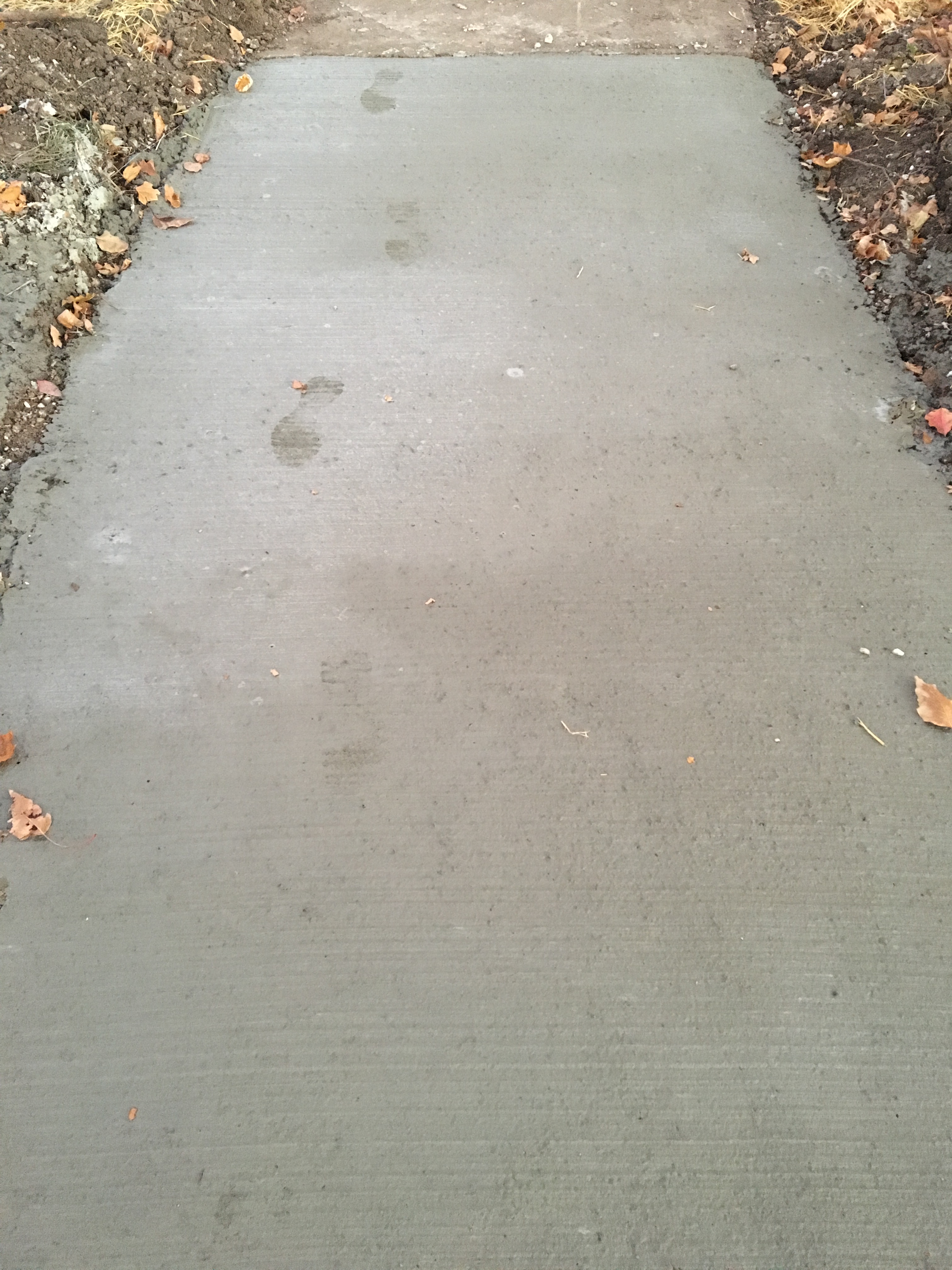
What you can’t see are the barriers and signs on either side of the wet cement declaring, “Sidewalk Closed!” I took a break from work, came down the stairs and Kerri said, “Some a**hole just walked across the wet cement.”

When the waterline to the house broke, when the process of fixing it became complex, when the heavy machinery arrived and the crew size doubled, when the guys from the city arrived to observe and inspect, the first thing the big machinery did, before digging the very-deep-moat, was to break out the sidewalk. And then they broke out the sidewalk to the porch. And then they trenched. And then they drilled a hole through the foundation of the house. That’s when the new pipe was installed. Those guys worked into the night. They were stalwart and steady.

The next day dawned and we saw in the light of day the destruction the fix caused.

Our front yard looks like a giant gopher dug a tunnel from the house to the street. We’ve considered finding a giant inflatable gopher but rejected it as “over-the-top.” Sometimes we have standards. A giant gopher is a step too far. The theory beneath the inflatable gopher is sound: if you can’t do anything about it, lean into it. We put a round-a-bout sign in the backyard when it became apparent that our dog was a secret velodrome maker and nothing we could do would stop his capacity to carve circles. It helped that he almost always circles in the same direction so the sign makes some sense. To us.

“We’re those people,” Kerri said, hands on hips, surveying the front yard damage. The grass is gone. Straw and mud are our new normal. “We look like a stable,” she said.

“Maybe this is the moment to get that donkey you’ve always wanted,” I replied. She really does want a donkey but the timing of my suggestion must have been off. She huffed, gave me the evil eye, and went inside. I counted to ten before following. Sometimes my brilliant suggestions take a few moments to penetrate and it’s best if I’m absent during the revelation.

The footprints across the concrete was too much to bear. That little patch of temporary concrete was the only new and unblemished area of the front yard. It’s as if our giant sore thumb had a nice and newly polished nail. The cement-stepper made certain that the destruction was complete: blemish, blemish everywhere. Giant gopher, old (donkey-less) stable, with a touch of marred cement.

The new permanent cement will come in the spring. “We’ll put up better barriers,” I said.

“We’ll sit out there with big sticks and a bad attitude,” Kerri replied.

Our reputation is certain to grow. “We really are those people,” I smiled. The evil eye – twice in a few short minutes – wiped the grin off my face. “I think I’ll go back to work,” I said and headed up the stairs, saying, “Think about the donkey.” Sometimes it takes a few minutes and a little prompting for the brilliant penny to drop.

read Kerri’s blog post about WET CEMENT

Sing Red! [on Not So Flawed Wednesday]

We were awake much of the night so we ate bananas and talked. Our conversation rambled over miles and covered acres of territory. In the wee-hours, Kerri explained to me the compositional elements of a symphony, the placement of a solo in a piece, and the foundational support offered by the other instruments. In other words, it takes a village to raise a solo.

There’s a famous story of Leonardo Da Vinci, paintbrush in hand, staring all day at his mural-in-progress. Finally, after hours of staring, he approached the wall and added to his composition a single brushstroke. If you are a painter you understand that the story is not about the single brushstroke but where it was placed. Color lives or dies relative to other color. Leonardo spent his day assessing relationships.

We are new gardeners. It may seem silly to expert growers, those who’ve been around the farm a time or two, that through the fall, we jumped out of bed every morning, ran to the kitchen, to see our cherry tomatoes. When we pulled the plants at the frost, the vines were laden with green tomatoes. Not to worry, Kerri told me; put the little green orbs together in a sack (ours landed in Tupperware and never left because we delighted in watching them) and they will make the journey to red. They’d help each other to ripen. And so it was. Each day the palette changed until, one day, the entire tomato choir sang red. I am filled with wonder.

It is a cliche’ that every great journey begins with a single step. A single step and lots of encouragement. A single step and a team of support. Explorers need financing. Too often we place the accent on the single player and ignore the symphony. We get a big kick out of the crowds of individuals standing in line to stand atop of Mt. Everest, thrusting their hands like Rocky Balboa in the very-thin-air, playing conquerer of the mountain, forgetting that a Sherpa carried their gear, set up their tent, cooked their food, set their ropes, tended their wounds, warmed their tea, hauled away their waste and sometimes carried their bodies back down when they couldn’t make the round trip.

No one walks this walk alone. Individualism is like Leonardo’s brushstroke: it only works if it furthers community, when it makes life better for all. How’s that for a paradox!

We are tomatoes, all. Green and small by ourselves. But when brought together in our little Tupperware crossroads, red, red, red, red, red!

read Kerri’s blog post about TOMATOES!

See The Subtle Color [on Not So Flawed Wednesday]

“The most colorful thing in the world is black and white, it contains all colors and at the same time excludes all.” ~ Vikrmn

I loved watching Kichom facilitate groups. His specialty was impasse. He spent years developing and refining processes that opened pathways in hopelessly divided communities. He helped them find a third way. His was not a process of compromise. I’d describe his work as escalation-to-breakthrough. In minds and hearts entrenched in black-and-white, he’d reveal the nuance of color. He loved the moment when eyes-squeezed-closed-against-possibility opened ever so slightly to see.

Kichom understood that, to fully open a story, it was necessary to first look at the full story.

I often think of Kichom and wonder what he would do if these un-united states were his client. I wonder what he say to a nation built on slavery that refuses to discuss something as simple (and obvious) as critical race theory. Every healing path begins with acknowledgement of the wound. Perhaps Kichom would tell me that our current escalation might very well lead to a breakthrough. That is my inner idealist speaking.

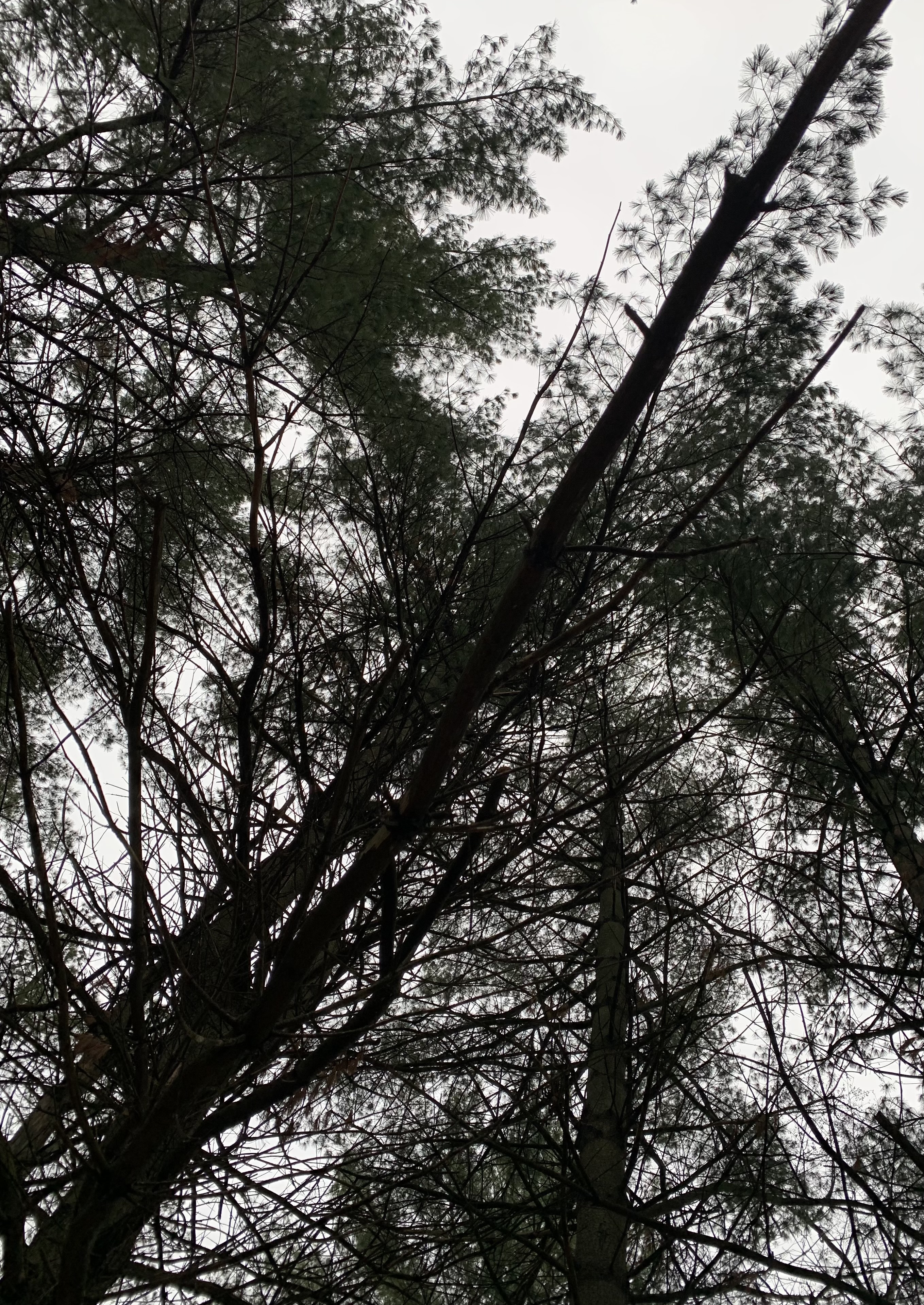
It was a very cold day. Even wearing gloves, the tips of our fingers were growing numb. When Kerri said she wanted to leave the trail and step into the grove of trees, I jumped up and down to stay warm. She waded into the thicket, took off her gloves, and pointed her camera to the sky. A few minutes later, as I jumped up and down, she waded back through the thicket to the join me on the trail. “Isn’t this cool!” she exclaimed, red fingers holding the camera for me to see. “People will look at this photo and think it’s black and white but it’s not! It’s winter!”

Looking at the photo, divided on the diagonal, I heard Kichom’s laughing voice. “It’s never black and white,” he giggled. “It only seems that way. Keep looking and soon the eyes will open to a world filled with subtle color.”

It’s something to be hoped for. The opening of the eyes. The acknowledgement of a problem. A good hard look at the full story. A breakthrough in a community that is dedicated to seeing in black and white.

read Kerri’s blog post about BLACK AND WHITE

Lose The Rant [on Not-So-Flawed Wednesday]

I wrote a post and decided not to publish it. I was deeply disturbed by the news. A parade. More violence. Senseless. More and more. And more. Jim wrote that he was going to chisel into his sidewalk the now ubiquitous (to us) phrase: I just can’t believe it.

I wrote about my escape fantasy. A quiet place. A place where people know how to hold differences of opinion as a constructive force for good instead of a destructive pout to be right.

This weekend, people gathered at the gallery to see art. To experience art. Painting and sculpture and photography. I have not been in a crowd since the pandemic began and I was both wary and encouraged. I wonder about the new normal.

After the opening we made dinner for 20. Kerri’s inner composer broke through and we saw, for the first time in a long time, the light and warmth of her artistry lift and shine. She turned up the sound and asked us to listen. The music soared. I cried. It was nice to see her again.

Tomorrow is the day – just a day – isn’t that odd – that is set aside for giving thanks. I am thankful to have had a glimpse of the composer. The artist. The lift of her music. I am thankful for people who gather to share art. I am thankful for a dinner with 20, laughter, and our shared nonsense. I am thankful for Mike who finds a way forward against all odds. I am thankful that Bruce passed this way and stopped to say, “Hello.”

I am thankful that I believe that the people of the world are better than the news leads us to believe. I am thankful that I did not publish my rant. I am thankful for my escape fantasy, my quiet place.

read Kerri’s blog post about THE PATH

Decide To Learn [Flawed Wednesday]

[No image today. My technology is having a rough morning]

I spent my day yesterday thinking about lines of perception. I’ve known for a long time that where a focus is placed will largely determine the dynamic reality, the movement, that is created. For instance, a focus on opposition will always produce a chaotic, explosive pattern. The moving energy locks up, tension builds, explosion. Repeat again and again. Focus on the relationships, the spaces between, and the movement, the energy, will harmonize around a common center. The behavior of a system is visible if you know where to look.

Points. Spaces between. Analytics or Synthesis? Break it into parts or look at the whole. Is it a particle or a wave? Both/And.

Tom used to say, “Teaching is a relationship.” It’s not about the material-to-be-covered. It’s never about the test. It’s always about the spaces between. Learning, at its best, is not about coverage. It’s about incorporation. It’s about meaning made from relevant experience. Experiences made relevant.

Every action has an intention, even if the intention is to stir the pot, to see what happens.

A few blocks from our home, outside the courthouse, protestors face each other across a perceptual dividing line. The energy is locking up. Tension is building. Last year a boy, too young to legally order a beer in a bar, legally brought a big gun to a protest. His mom brought him to the protest, big gun and all. He killed two people and maimed a third just a block or two from where he now stands trial. In the year since, he has been made a symbol, a well-financed icon of those who desire a dividing line. The pressure builds, just as the system demands. We await the explosion. It will be here, a few blocks away, or elsewhere, but it is coming just as the system requires.

There’s a less understood truism when the focus is placed on the points & oppositions: the tension builds and the explosion happens again and again because no one ever learns. It’s a repetitive pattern that perhaps feels like progress but is actually an eddy. Empty movement.

The only way out of the eddy is to attend to the relationships, to turn the focus to the spaces between.

read Kerri’s blog post about DIVIDING LINES

Reboot [on Flawed Wednesday]

I’m not going to lie. Yesterday was textured and difficult. Because our internet connection was spotty – and because our work depends upon a reliable connection – we called our provider to upgrade our service. And, rather than an easy upgrade, we lost our service altogether. And, as I write, almost a full day later, in a world brimming with messages of fast-and-easy, we are still in the internet no-fly zone. After eleven hours, a full five hours on the phone, a trip to the store to get new equipment, ethernet tests on everything but my heart, after a series of pleasant but not-very-helpful service representatives, after the fifteenth (not a joke) suggestion that we “reboot one more time just to see,”we gave up for the night. 

Giving up looked like this: “The problem is on our end,” a pleasant tech offered when there was still light in the sky. “There’s a ticket and our engineers are working on it.” Later, much later, after being passed to two of the engineers-that-were-working-on-it, we heard that they had no idea what the problem was. “We could try to reboot one more time,” he said. “Just to see.”

Kerri looked at me, exhausted, and said, “I can’t do it. Not again.” A battle to be waged another day.

Surrender. I’ve learned this lesson again and again in my life. Sometimes it is best to give over. It is best to stop pushing. Sometimes, there is no solution. Time and a bit of sleep, a new day, will bring another point of view. What was impossible yesterday will resolve today.

In surrender, we sat in the quiet night and talked of our day. The quiet. Nothing dinging or binging or pulling at our attention, nothing notifying us of another message. Nothing trying to keep us hooked for the sake of being hooked. The static was gone. The incessant, “Look at me,” of news apps and Facebook and Instagram and… Life as perpetual “Breaking News.” Within the constant pull, the only thing breaking is our focus. We sat and enjoyed a moment when nothing was breaking.

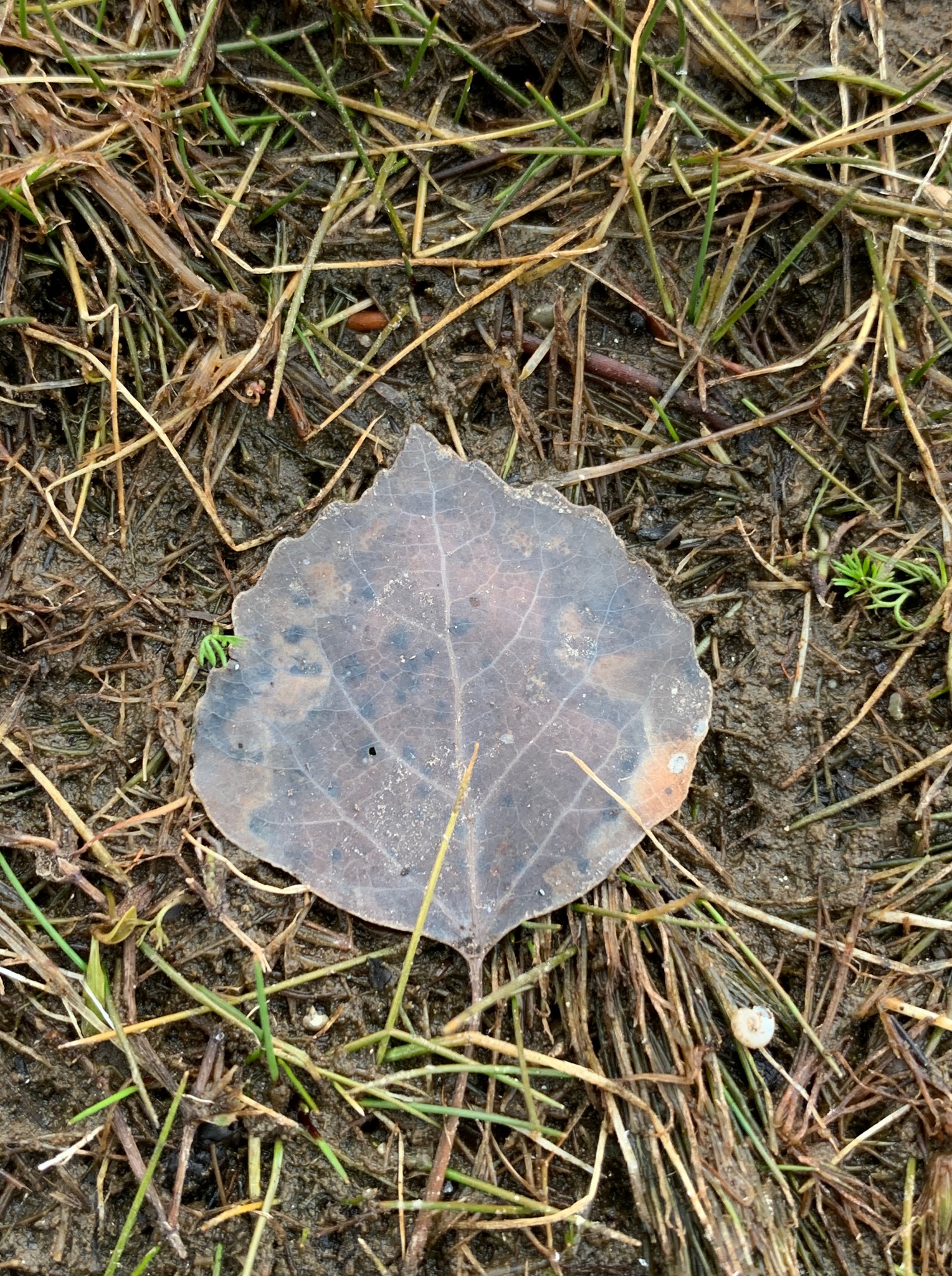
For a moment during the madness, I looked out the window of my office. The day before yesterday the leaves on our tree were still green. It’s late in the season. Yesterday, in a seeming flash, they were vibrant color. They changed overnight. I was taken, as I always am, by the recognition that the best way to learn color is to go outside, take a walk in nature. See. If there is ever a question about, “Does this color work with that color?” – go outside. Look around. The answer is right there. Crimson and dusty grey. A bit of sage green. Charcoal. Polka dots are not a human invention. The patterns are there, too. Texture. See it.

This morning, while we await the visit from our tech who-will-fix-everything, we’ll go outside. We might play in the leaves. We’ll certainly enjoy the moment without the bings and pings and tech-sounds of made-up-importance. We’ll kneel and coo over the polka dots and salmon pink, the electric yellow and revel in the rare simple moments that a good surrender brings.

[*a hefty thank you to Matt the technician who just spent hours sorting out and fixing what ailed our internet. This post is proof positive that we are, at long last, out of the internet-no-fly zone]

read Kerri’s blogpost about POLKA DOTS

Turn The Shield [on Not So Flawed Wednesday]

The rains have come. The light retreats. This is the time of year when we say, “I’m tired. Are you tired?” It’s the lack of light. The coming change of time. “It feels later than it is,” we rub our eyes and sigh.

I’ve always thought of this time as an in-between. Not-this-and-not-that. The leaves have dropped but the snow has not yet arrived. The sun and the wet clouds jockey for position and neither gains the advantage. Were we bears, nature’s indecision would signal that the time had come to look for a proper cave, a comfy spot to sleep through the winter. We are people and the signal is similar: it’s time to pull in, reflect, attend to the inner places, nestle into our bear-dreams.

Many years ago I took a class from an elder who taught us how to paint medicine shields. The exercise was not about the painting or the technique of stretching the skin over the willow, the exercise was about identifying the symbols. One side of the shield was the outer life, the sun. This face of the shield was seen by all. The other side, the inner face, was personal. The symbols were private. The moon. This is the season when the attention to the outer face shifts to the inner. The bear considerations turn to the owl, the lizard.

Just as each season is both a leaving and a return, both sides of the shield are beginnings and ends. Barney taught me that, in the winter, the energy of the plant retreats from the branch and, instead, goes to the root. Rejuvenation happens beneath the soil. I feel that shift in this time of increasing cold and rain, the shield flips. My eyes turn inward.

We huddle in the early dark and tell stories of the year past. We attend to our rest, move more slowly in our expeditions. We decide more often to stay in. We open the bin with gloves and scarves, prepare for a different rhythm of walking. We recount the past seasons, not yet ready to dream of the time to come.

read Kerri’s blog post about RAIN

Trust The Symbol [on Not So Flawed Wednesday]

“Perseverance, secret of all triumphs.” ~ Victor Hugo

It is nearly November and the tomato plants are still producing. I’ve come to think of our tomato proliferation as a dance between Kerri and the plants. Each morning, all summer long, with the good advice of 20, she tended the tomatoes. And, the tomatoes tended her. They continue to inspire quiet in her. I’ve watch the gentle morning dance from the window, DogDog circling the yard, Kerri with the watering can, pinching leaves, securing supports, or simply admiring yet another green orb that appeared overnight.

There was also the basil, mint, and lavender. After the tomatoes were nurtured, they joined the dance. Presence.

You know things are not going well when your friends start comparing you to Job. I’m not a bible guy but even I was keen to the reference. We’ve had a few years of rolling bad luck and molehills turned into mountains. 20 is fond of saying, “Karma is a long game,” and there were days that I asked Kerri what she did in a past life to deserve the most recent disaster. After punching my arm, we’d chant in unison, ‘One day at a time.” Take this step. Enjoy this day. The circumstance doe not define us. And, mostly, we lived it, staying in the center of the hurricane.

And, then, about the middle of May, the winds changed. It was palpable. Somethings actually began to tip in our favor. And, for reasons I cannot explain, we needed to grow tomatoes. Kerri needed to grow tomatoes. Last summer we made an anemic attempt at growing lettuce. We ate a salad or two from our mini-farm, but it was more of an exercise, something to do, rather than a symbol of the arrival of better times. The tomatoes came as harbingers, heralds of a new era.

To say that they’ve been prolific is an understatement. All summer long, lines of tiny red miracles sat on our table, ripening. The plants have withstood pounding rain, excessive heat, and withering humidity. Not only have they withstood it, they’ve prospered in it. It’s a hopeful symbol. Somewhere deep down inside, we hope to follow their lead. After a few years of the-other-shoe-always-dropping, we’re slow to trust our symbol. But, like our symbol, we’re taking our time, not getting ahead of ourselves, and will harvest our good fruit when the time is right.

Until then, we persevere, one day at a time, grateful for the portent our good tomatoes bring.

read Kerri’s blog post about TOMATOES

Glance Sideways [on Not So Flawed Wednesday]

It came as quite a shock. Our beloved plant, Snake-In-The-Grass, was hosting a community of Gnomes and Faeries. We haven’t actually seen the Gnomes and Faeries – they are notoriously hard to spot. They are not fond of human beings since we are famously territorial and also so easily eschew our imaginations. Fearing all things “wild,” we generally erect fences and street lights, build dams and make management plans for “nature.” If we could see them, I suspect we’d notice how often they roll their eyes at us.

When I was playing the role of consultant in public school systems, I took note of a central mandate of the adults, playing the role of teacher or administrator: clamp the imagination of the young people, those imaginers playing the role of students. The students would enter the system with wide-open imaginations, free from limitation, and the oldsters found it necessary to kibosh or contain that wide-open meadow. This is not meant to disparage those actors playing the role of adults; when young, they’d been recipients of the imagination whammy, too. They were simply carrying on the tradition. The imagination is apparently considered a wild-thing so necessary of damming.

Dammed imaginations do not die, they distort. Imagination, as a wild thing, will run in circles when put in a cage. It will gnaw its leg off when caught in a snare. It will invent monsters and madness as it paces to-and-fro. It will get angry as it descends into madness. You might say that millions of Americans are gnawing their legs off, angry at the swirl of dark imagining run amok in their caged craniums, seeking reasons and someone-to-blame for their dark imagining. The caged imagination will lead all the lemmings over the cliff with the shout, “Where we go one, we go all!” It seems that we are awash in imprisoned imaginations howling to be freed.

I took it as a positive sign that the Gnomes and the Faeries took up residence in our house under the good protection of Snake-In-The-Grass. While the world outside our doors goes deeper and deeper into the cage-of-its-own-creation, the world inside our house seems to have become a refuge, a safe haven, for those beings still alive in their imaginations.

David recently wrote that he was dedicating himself to being a better artist. He’s been making art with his son again, a wild imaginer that has pulled his daddy (and me, too) out of our cages and into the open meadow. I can’t wait to see what David will do next. Who he will now become. What role he will shed. He’s already a great artist so the possibilities are…wild.

I confess that I regularly wander into the sunroom and glance sideways at Snake-In-The-Grass. Sideways – so they say- is the only way we humans can catch a glimpse of the Gnomes and Faeries. I want them to know that I’m looking.

read Kerri’s blog post about TINY MUSHROOMS

See Through It [on Flawed or Not-So-Flawed Wednesday]

Light passes through. Transparent. Trans; across or beyond. A prefix of movement.

Last night we had snacks with some pals. Our conversation turned to politics and how resistant we are as a nation to tell our full story. Opaque. The opposite of transparent. Impenetrability of light. “It’s just history,” someone said. “History is history.”

Narrative. With a point of view. The winners of wars tell one story. The opposite side has another tale to tell. History is never just history. A country as deeply divided as ours is warring over its history. What happens if we actually tell our full story? Who are we if we acknowledge our shadow? Shine the light or snuff it?

Boiling our times down to the essence, we’d arrive at these two words. Transparent. Opaque. Isn’t it always the way that people who have something to hide proclaim transparency? Isn’t it always the case that people who lie claim to be holders of the truth? Opacity is a tricky business.

I recently watched again Simon Sinek’s first TED talk. He said, “There are leaders and there are those who actually lead.” We could call it a simple truth: we know those who actually lead because they boldly shine-the-light. They are not afraid of being seen or seen through. They are, however, a threat to those who call themselves “leaders,” those that fear the revelations of light. Reveal-ations. Those leaders will fight to-the-death to maintain their opacity. They will sacrifice the greater for the lesser if necessary to remain opaque.

We are watching – and participating in – history being written. Our question – as has been true from the beginning: will we shine the light without fear of transparency or hide behind the wall of opacity? It’s just history.

read Kerri’s blog post about TRANSPARENCY