Knit A Better Structure [on Not So Flawed Wednesday]

impact 2 copy

“…the test of a civilization is how it cares for its helpless members.” ~ Pearl Buck

As a nation, we are currently enamored with tests, and it is not a stretch to say that we’d receive a failing grade on this test of civilization. The helpless members do not fare well.

As Horatio pointed out, much is lost between the cracks of the quintessential conundrum built into the DNA of these United States: the dueling philosophies of every-man-for himself versus I-am-my-brother’s-keeper. Republicans versus Democrats. Corporate greed versus social need. Black and white thinking that leaves gaping voids into which the helpless members disappear. There is no both/and to be found. Division has been a useful tool of control since the inception of the American experiment. The ideological cleaver is sharper than ever these days.

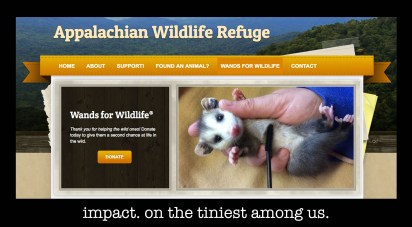
Yet, there is hope that reveals another side to our character.  Kerri said, “Look at this!” The Appalachian Wildlife Refuge put out a call for used mascara brushes. They are a useful tool in saving small critters and returning them to health. They received so many brushes, the response was so great, that they had to put limits on when they would accept new brush donations. It’s my bet that people of all political stripes and social strata sent their used mascara brushes to the Refuge. It’s my bet that the critters and the caregivers were grateful in every case.

When tragedy strikes, we rush to meet the need. When a photo moves us, we respond. Something pierces the superficial divide and reaches into our communal heart.

Robert Fritz teaches that behavior is like water, it follows the path of least resistance. If you want to change behavior, you must first change the underlying structure of the land. What might it take for us to challenge this superficial concocted divide, to reach deep  into our DNA and knit a better structure of the land – something more useful and more profound than perpetually dueling philosophies? What might it take for us to put down our cleaver and pick up our mascara brushes? What might we imagine and create together that would help history give us a better grade on our test?


read Kerri’s blog post about IMPACT


bonfire website box copy

Tickle Open The Closed [on Merely A Thought Monday]

eleanor roosevelt copy

It used to be one of my favorite exercises to facilitate. Ask one person in a small group to tell a story of blame. Ask the rest of the group to invest in the story. In no time the small groups would be indignant, talking over each other in disgruntlement. A klatch of agitated victims, howling.  They’d laugh in their aggravated frenzy. They’d devise clever revenge or ways to torment the object of their blame story. They’d grow a monster.

Blame stories are like sugar. They are easy to eat and highly addictive. There’s rarely any real substance, so much gossip-cotton-candy, but there is an odd pleasure in playing the role of  “the injured party.” The groups would always reflect that the exercise was fun. So much so that they’d often forget it was an exercise. Commiseration and validation, after all, are the point of a blame story. That, and making someone else responsible for how we feel.

Ask the same groups to tell a story of choice or opportunity and most times, after only a minute or two, they’d sit in silence. Their, “Great. That’s really great,” support would dwindle. Feeding an idea is not nearly as easy as feeding a story of blame.

Quinn used to tell me that creativity is not for the faint of heart.

The groups were always shocked to discover how much of their lives were spent chewing the gristle of discontent, of feeding the notion that someone else was to blame for their choices or their circumstance. They’d generally comment on how easy it was to commiserate and how difficult it is to question, challenge or stop the blame-game. Mostly, they were shocked to discover how little of their time they dedicated to feeding ideas, theirs or another persons.

Blame stories are easy because they are reductive. They engender tight little balls of closed minds and closed circles. They close hearts. They take almost no energy at all to spark but, once burning, like a wildfire, they are capable of consuming entire forests.

Idea exploration is expansive. Seeing possibilities requires eyes that look up and out.  It takes much more energy to imagine, to question, to ponder. To try. To experiment. To ask. To challenge what you think you know. Opening minds, opening circles and hearts requires a deep sense of self-responsibility. It requires an even deeper sense of responsibility to others.

One of the purposes of the artist is to open closed circles, to tickle open closed minds. To help their community see anew and entertain never-before-imagined possibilities.

It takes more effort and courage to sail to the edges of the known world than it does to hang out around the water cooler and complain about others. Great minds do not have more capacity than any other mind, but they do require a very different focus.


read Kerri’s blog post about GREAT MINDS & IDEAS


k&dbw backs website box_ copy


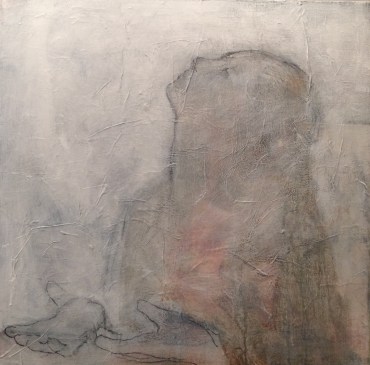
FaceTheRain

feel the rain, mixed media, 2019

Do Like Duchamp [on Two Artists Tuesday]

doorknobs copy

Roger used to say that Picasso’s paintings determine the shape of our cars. He meant that “seeing” is not passive. Just as audiences in a play wiggle in their seats at seven minutes into the play, the usual time for a commercial break on television, our visual sensibility is also patterned and mostly culturally uniform. Beauty is in the eye of the beholder and that eye has been conditioned.

One of the great moments of visual conditioning came in 1917 when Marcel Duchamp entered his “readymade” sculpture, FOUNTAIN, in an art exhibit. FOUNTAIN is a urinal. He signed his readymade scultpture R. Mutt. It is possible to spend many days of your life reading about FOUNTAIN, the symbolic meaning of a toilet, the then-new art term “readymade” and the challenges readymade-as-art posed to the art world, how Duchamp came to enter a urinal in an art exhibit. In that moment of time, a whole new genre was born: conceptual art. The idea behind the work is more important than the finished piece.

You can draw a straight line from Duchamp’s toilet to the recent banana duct taped to the wall by Maurizzio Cattelan. And, you might ask, just what was the idea behind the banana?

You can draw a straight line from Duchamp’s FOUNTAIN to Kerri’s out-door-voice-exclamations in a gallery, “ARE YOU KIDDING ME?” The idea behind the conceptual work generally needs a curator’s explanation. “I WANT TO EXPERIENCE IT, NOT HAVE IT EXPLAINED!” she gestures wildly, sending other patrons fleeing. In that moment, my wife becomes exquisite performance art.

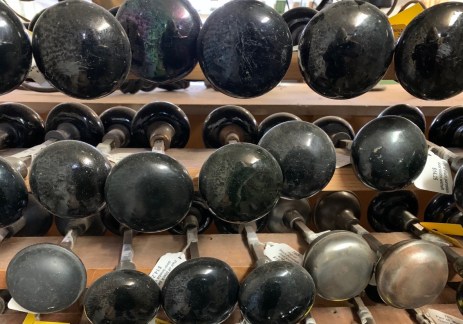
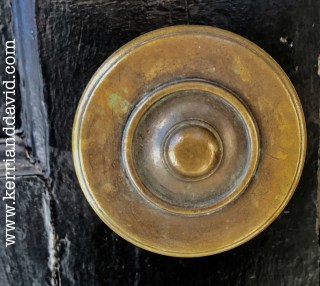
You can draw a straight line from Duchamp’s urinal to my inability to walk through an antique store and not see elegant design worthy of Louise Nevelson. Racks of door knobs. Stacks of suitcases. A wall of bric-a-brac, the wall composition more meaningful and beautiful than any of the individual pieces displayed.

A statement from Captain Obvious: artists live in a time and the art they produce is an expression of that time. Duchamp put his toilet on a pedestal in 1917, the year the world was nearing the end of the first war to end all wars. It was a horror story. The manufacture of stuff was hitting its stride.  The Royal Academy had a lock on determining what was considered art and what was not. The rules of polite society felt dangerous and suppressive. Duchamp, like all change agents, pushed against the norm.

There is composition and design in the everyday. There is human-created beauty all around us. We learn in school that form follows function and form is design. We learn in school that one of the purposes of art is to create beauty. Another purpose is to shock people out of complacency, to see what is in front of them and not what they think is there. Beauty usually lives beyond what we think.

We live in very confusing times. We are asking fundamental questions about truth, about social norms and what is acceptable. We are asking questions about who we are and what we believe. You can draw a straight line from Duchamp’s FOUNTAIN to our current confusion. Is it art? Is it not? If the idea is more important than the final expression then what happens when all that is left to see and touch is absent of the idea? What happens when the curator is gone and only the urinal remains? Sense breaks down.

What happens to  the eye and ear that is shocked open but refuses to see what is right in front of them and, instead, retreat behind the fortress of what they think?  What happens when form no longer follows function but things flip the other way around? What happens when form IS function? Propaganda, mostly. A naked emperor and plenty of people passionately swearing that they see clothes. Readymade thought.

We live in those times. Sense breaks down. We tape bananas to walls and issue a certificate of authenticity.


read Kerri’s much-less random blog post about DOOR KNOBS


frontdoorknob website box copy


Thank The Muse [on KS Friday]

two wrists copy

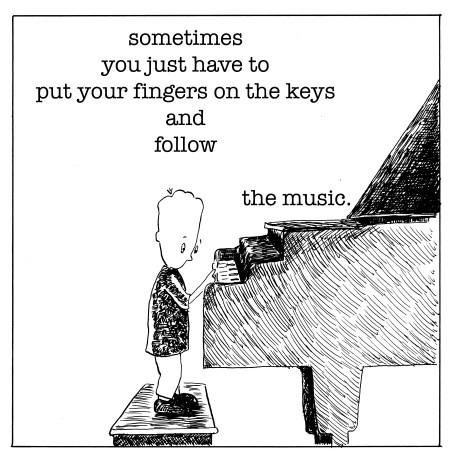
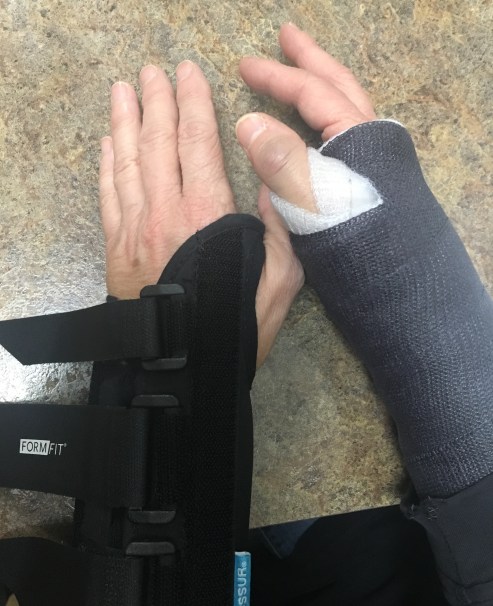
She said in jest, “I should take the next two weeks and record an album. I’ll call it Two Broken Wrist!” I would have laughed except she was playing the piano when she said it. Four days after the fall. The day after the cast. Were I blindfolded I would not be able to tell that she has no use of her right thumb and limited use of her right fingers. The fingers on her left will spread as far as the sprain will allow. I muttered in my new role as mother hen, “Don’t hurt yourself.” And then I closed my eyes.

Her playing left me slack-jawed. She has her doctor’s permission to play (“It’ll be good to move your fingers but don’t expect too much and don’t push it.”). I wish her doctor was standing beside me. She’d have laughed at the absurdity of the image. The disjoint of sound and image. I’d ask the doctor if this was what “pushing it” looked like?

It is, of course, what most people do not grok. Artists need to do-the-thing-they-do. If they don’t, they implode. It makes no sense but very few life-callings make sense. There is a deeper imperative at play. A muse must have satisfaction. Monet painted when blind. Was he pushing it?

Kerri played the piano. She had to. Her greatest fear, the largest monster in her closet, is the loss of her hands. She had to approach the keys, to visit the abyss, to see if the monster had her by the wrists or if she could push it back into the dark. Her words, ” “I should take the next two weeks and record an album…” was a celebration. It was a moment of soul-sighing-relief. The monster whined and vanished. I closed my eyes, not to spare myself the image of her possible pain, but to whisper a thank you to the muse. In my estimation, there has never been a more beautiful piece of music played.

There is a long road ahead.

I hope she records that album. The clucking you hear in the background will be me, reminding her to go slow, to take it easy. You won’t be able to hear her eye-rolling reply, but it’s there, too. Trust me.


read Kerri’s blog post about TWO BROKEN WRISTS


ks website header copy


their palettes website box copy

Spin Off Center [on Merely A Thought Monday]

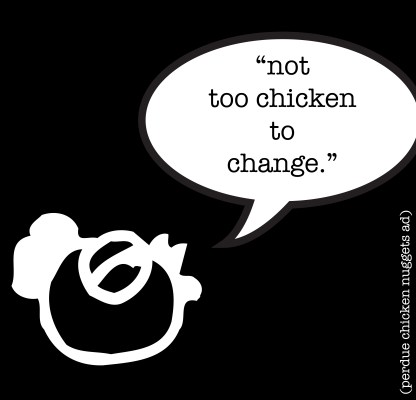
not too chicken copy

I’ve always been a bit mystified by the hyper-charge surrounding the word ‘change.’ It doesn’t matter which way the word slices, it will either evoke great fear and trepidation [we’ve always done it this way!] or it will reach to the deepest depths of yearning and impatience [we need to be different!]. Guard the bastion. Explore new worlds.

Organizations try to manage change. Yet, organizations sell their products as cutting edge. They promote themselves as leaders of change.

We celebrate change-makers. Game changers. We also honor the keepers of the flame. Rule keepers. We pride ourselves on our innovative spirit while pondering the loss of tradition.

Creative tension. Push, pull. It’s a balancing act, yes? A continuum. Where exactly is the hard line between progress and tradition?

Stepping into the unknown is never easy though, isn’t it true that each day of life is, in fact, a step into the unknown? The wheel spins on and on and on.

Growing old is not for wimps. That’s what Beaky said. We all do it. Movement is life and life is change.

We live in an interesting time. Everything is recorded. Evidence of change is everywhere. Actors get old. Politicians vehemently defend the opposite of what they vehemently defended 20 years ago.

The question is not about change or not change.  It is more about what we desire to be  steadfast in the midst of change. Circumstances change. Opinions change. Beliefs change. Traditions change. But, what is in the center of the wheel? Values like ‘honesty’ and ‘truth?’ Agreements of decency? A constitution?

What happens when those hubs are manipulated and simply fall away?


read Kerri’s blog post about CHANGE


snowsteps website box copy

Change Your Mantra [on Merely A Thought Monday]

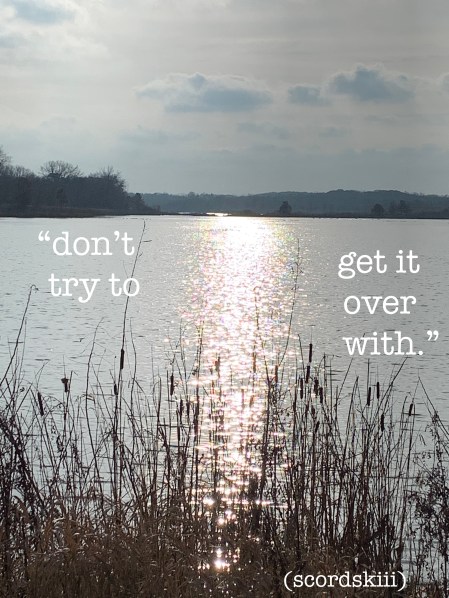
dont try to get it over with copy

It was only after the dive that I realized my folly. Rather than enjoy it I repeated to myself, over and over, to just get through it. I’d be fine once I was back in the boat. I was afraid.

It was a very deep dive, the deepest I’d ever attempted. There were sharks swimming beneath me. There were sharks swimming above me. The Blue Hole. The wall was gorgeous, an explosion of red, orange, and yellow. Looking up was a miracle of sunlight on water. Looking down was a study in the color blue, layers of turquoise, cerulean, disappearing into a bottomless (aptly named) ultramarine.

My mantra, just get through it, was a wall between me and extraordinary beauty of it.

Later, in the boat, I appreciated it. I also appreciated that my experience was unnecessarily fearful. Rather, I understood that the only real danger in The Blue Hole was my doubt in myself. The sharks were not man-eaters. The depth was the limit for amateur divers but not extreme. The dive master was world class. I had plenty of oxygen.  I was safe everywhere but in my imagination.

The dive made me wonder how much of my life I’ve spent telling myself fear tales? Instead of having an experience of wonder, how often have I storied myself in fear? How often have I made up monsters and raced to the other side of the moment, raced to get it over with rather than be in it?

Sitting in the boat, I realized that it wasn’t the fear that I was wrangling with. Fear is natural, especially in alien environments like deep water, especially when sharks are involved. It was my mantra that plagued me. Get through it.

Next time, I told myself, I will have a new mantra. Be in it. Fear is an experience, too. It’s part of life and, at the end of my days, I will be sad if the story of my life was simply getting through it. Or over it. I want to know that I was in it, all of it; the fear, the joy, the ugly, the angry, the beautiful blues, the sad days, and the quiet wandering.


read Kerri’s blog post about GETTING IT OVER WITH


bonfire website box copy

Sing A New Song [on KS Friday]

christmas composing copy

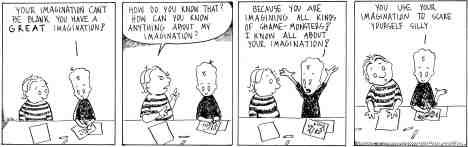
If there is anything certain about we human beings, it is that we are uncertain. We are a festival of questions and doubt. The good news is that our questioning, our doubts and uncertainty are also the epicenter of our adventure impulse. Creativity begins with equivocation.

No explorer, sailing into the unknown to find the edge, brought along a barrel full of answers. No artist ever stood in front of a blank canvas with a brush loaded with certainty. A good relationship with the mystery necessitates a healthy ambivalence. We follow the impulse to an unknown, often unreasonable expectation.

Kerri was preparing for a final rehearsal with the band for the Christmas program.  She played one of the selections  and exclaimed (just as she did during the previous rehearsal), “I don’t like this piece!” Most of us would simply make peace with it or go to the drawer and find a replacement. Not this time. I watched the muse tug her. She got that far away look in her eyes. Some inner horizon beckoned. She stepped back  and then returned to the piano and began to play. She scribbled notes. She sang a few lyrics and wrinkled her brow. Sang again. Muttered, “That’s no good.” Played some more. Scribbled.

She sailed her ship into the vast ocean of promise, a new song. By the time guitar Jim arrived at the rehearsal, she was smiling. “What do you think of this?” she asked.


read Kerri’s blog post about HOLIDAY SONGS


trinitychristmasphoto website box copy

It’s a gorgeous song and someday I might convince her to record it. In the meantime, you’ll just have to take my word for it.

Return To Base Camp [on KS Friday]

made it through songbox copy

Among my wife’s quirks, one  of my favorite is that she is obsessed with watching films about mountain climbing. If there is a movie about scaling Everest, a documentary about climbing K-2, free climbing, extreme climbing… we’ve seen it. And, here’s where my full adoration comes in: she likes to watch them right before sleeping.

Usually, she is asleep five minutes into the film but she ALWAYS awakes at the moment the climbers summit. She is fully awake for the triumph [she also opens her eyes if there is a tragedy. I tease her that the only reason she likes watching the films is to see climbers fall off mountains. For this sentiment I get punched].

Reinhold Messner speaks about climbing as an inner journey. An expansion of spirit and self. Making it through is about grasping a greater sense of self. The accomplishment, standing on the summit, is not a goal as much as finding a personal edge and stepping over it. And, as I’ve learned in my midnight viewing of climbing films, the real challenge, the greatest danger, is in the descent. More climbers perish on the way down than on the way up. Making it through is more about the return than it is about the mountain top.

It’s the hero’s journey. It is the course we all climb in this life. There is a call to adventure. For some it is a mountain. Somewhere along the way we can all expect an abyss, a reduction to dust, the void, the belly of the whale. Whatever the variation, it is always transformational. And then comes the journey home.

In the films, there is the moment when the climbers see the base camp, a different kind of thrill than the summit. People bang pots in celebration. Exhilaration infuses exhaustion. The realization floods the transformed climber: I made it through. Kerri’s eyes, blink open for just a moment. She whispers, “See. I knew it.”


MADE IT THROUGH on the album THIS PART OF THE JOURNEY is available on iTunes & CDBaby


read Kerri’s blog post about MADE IT THROUGH


prayerflagsinsnow website box copy


made it through/this part of the journey ©️ 2000 kerri sherwood

Unlock The Lock [on DR Thursday]

“The confidence of creativity knows that deep conflict often yields the most interesting harmony and order.” ~John O’Donohue, Beauty

To me, the most interesting moment of the story happens when Sisyphus has managed to chain Death to a post. No one could die. And, although suffering continued, famine raged, people begged Sisyphus to keep Death locked to the post. They’d rather have certainty than experience change. They’d rather suffer with what they knew than face the scary unknown.

Krishnamurti once wrote that people fear death because they are afraid to live.

Over and over we hear stories of soldiers or mountaineers or extreme athletes who felt the full force of living when they understood that they had little or no control over their life.  On the battlefield. Leaping off the mountaintop. Climbing without ropes.

There is an equation between releasing the illusion of control (locking Death to the post) and experiencing fully this crackling unpredictable life. Brad said it best, “Bored people are boring people.” Break the pattern. Step out. Go do something new. Julia Cameron called it an artist’s date. Get out of your comfort zone. Heed the call. Live a little.

Sisyphus did what we all must finally come to do: even though he knew it would mean the end of his life as he knew it. He walked over to the post, unlocked the lock, and set Death free.


read Kerri’s blog post about PRAY NOW


k&dbw backs website box_ copy

held in grace series: pray now* ©️ 2010 david robinson


*Originally titled “John’s Secret. John was my framer and I gave him the wrong measurement for this painting; I was a quarter of an inch short. We had to release one end of the canvas and add a small spacer so the painting would fit the frame. Now you know John’s Secret. Don’t tell!

Ask A Simple Question [on Not So Flawed Wednesday]

everything to lose copy

Here’s a very sexy beginning to a blog post: this morning I read that sales of durable goods in these United States are up .06%. Stoves. Washing machines. Dryers. It is a dubious statistic. The week before our wedding, our washing machine AND dryer died. The nice salesman at the appliance store, an older man, began his sales pitch with reminiscence. “I remember when we actually made good products built to last. Now we make crap built to fall apart.” The next 45 minutes was a lesson in what’s built to break in 5 years or less. He steered us away from more appliances than he tried to sell. It was eye opening.

“Durable” goods, these days, are built to be less than durable. They are built to be replaced. They are built to be thrown away. They are built to produce nice looking economic statistics. [note: Kerri and I have and still cook on a stove that is at least 40 years old. It looks like hell but works like a dream. It was built in the era before planned obsolescence was considered a consumer best-buy]. The seedy dark side of our consumer culture is 1) the mountains of refuse we leave behind and 2) how rarely we turn and look at the consequences of our consumption.

The Great Pacific Garbage Patch , one of five garbage patches gyrating around our oceans, is at least twice the size of Texas and growing. When I was in graduate school I took a class about my city and the environment. Like me, none of my classmates knew what happened to our trash. None of us knew our watershed. None of us knew how our trash impacted our water.  We take our refuse to the curb. It goes away. Magic!

Where does it go? The latest National Geographic Magazine (12.2019) has an eye-opening article on our addiction to plastics and the pollution/environmental devastation it creates. One of the chief denials of the modern era is that humans are somehow separate from the environment in which we exist. We can do whatever we want to do to “it” and “it” will have no impact on “us” at all. According to the story, we are above it all. And, as is true of all denial tales, we either wake up and reorient or we hold fast to our delusion and drown as the unsinkable ship goes down.

Speaking into steadfast denial often requires a new, courageous, and unlikely voice. Enter Pattie Gonia, an environmental advocate drag queen. A modern berdache.  A powerful presence, an artist, standing in the trash, wearing the trash, asking (and answering) a very simple question: what do we have to lose?


Watch this short documentary to learn more about EVERYTHING TO LOSE and PATTIE GONIA:


read Kerri’s blog post about EVERYTHING TO LOSE


heart in island sand website box copy