Just Look [on DR Thursday]

“There is love enough in this world for everybody, if people will just look.” ~ Kurt Vonnegut

There’s really no reason Breck should be alive. This tiny aspen tree survived a too-packed-car ride from Colorado to Wisconsin, three years root bound in clay pot, a first bad planting among the ferns, a relocation to a better spot, and a serious pruning to clear the already dead branches. Yet, despite all the odds stacked against her, Breck is budding like never before. Breck is thriving.

My theory for Breck’s resilience? She knows she is loved. Never before in the annals of tree-dom has more warmth and attention been heaped upon a tiny living thing. Consequently, each bud feels like a full-circle-love-return. Each new bud fills us with hope, infuses us with possibility.

It is simple.

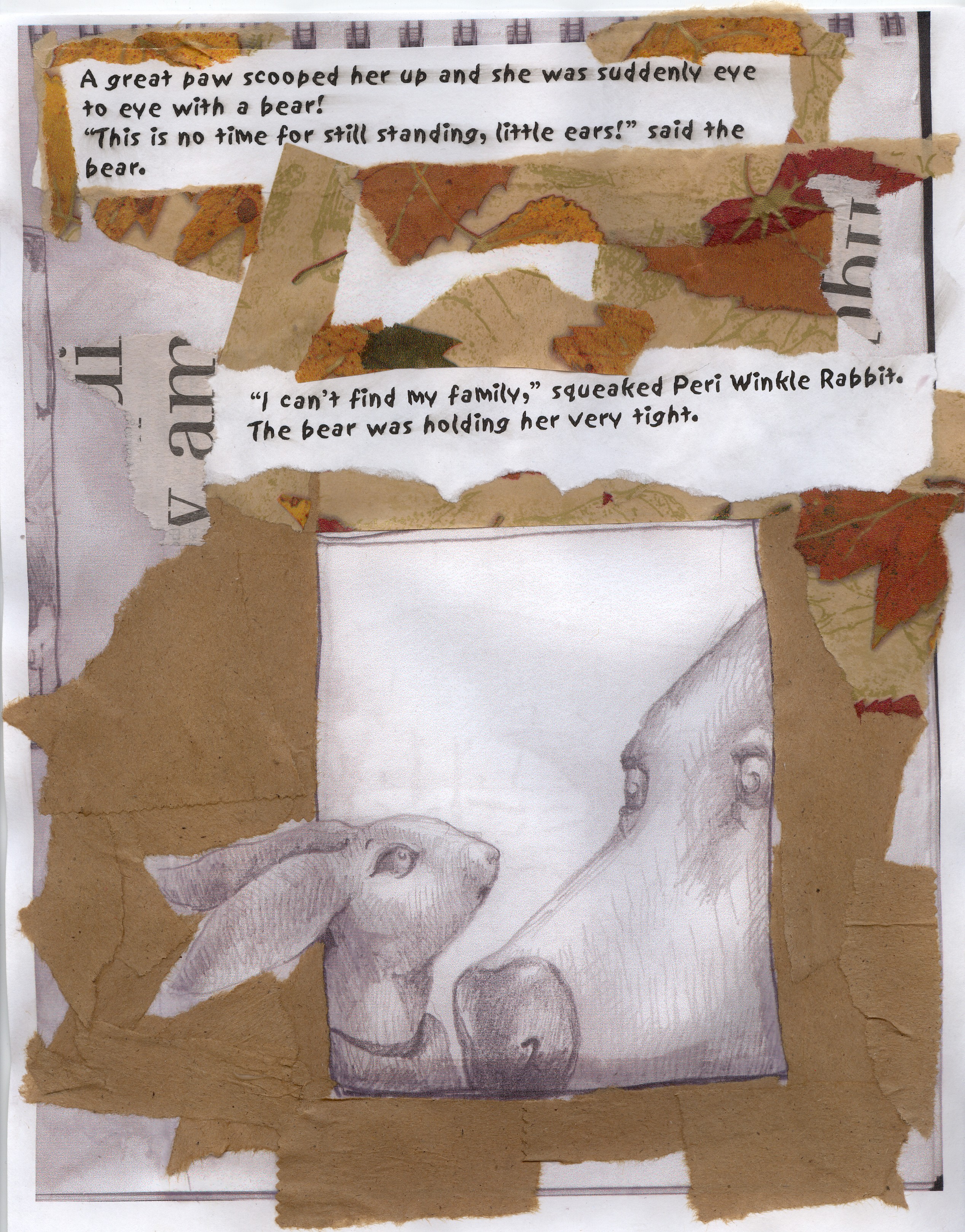
It’s been a few days since Kerri snapped the photo of Breck’s buds. This morning, while I was out with Dogga on my bunny watch, I was literally gobsmacked: the buds have burst into tender leaves! When did that happen? It’s worth noting that the bunny nest is in the tall grasses at the base of Breck’s trunk. I’ve been paying attention, or so I thought. I’m double-in-wonder at the sudden transformation from bud to leaf.

Paying attention. Seeing what is right in front of our noses.

As I sat on the deck and watched Dogga sleuth the bunny pathways through the yard, I wondered about all the buds-a-poppin’ that I have missed in my life, so focused on, “what I didn’t have,” or lost in the weeds of, “should.” I thought again of the closing sequence of the movie Love Actually. [Hugh Grant voice-over]: Love actually…is…all around us. It’s so pervasive that we miss it.

If only people – myself included – would just look.

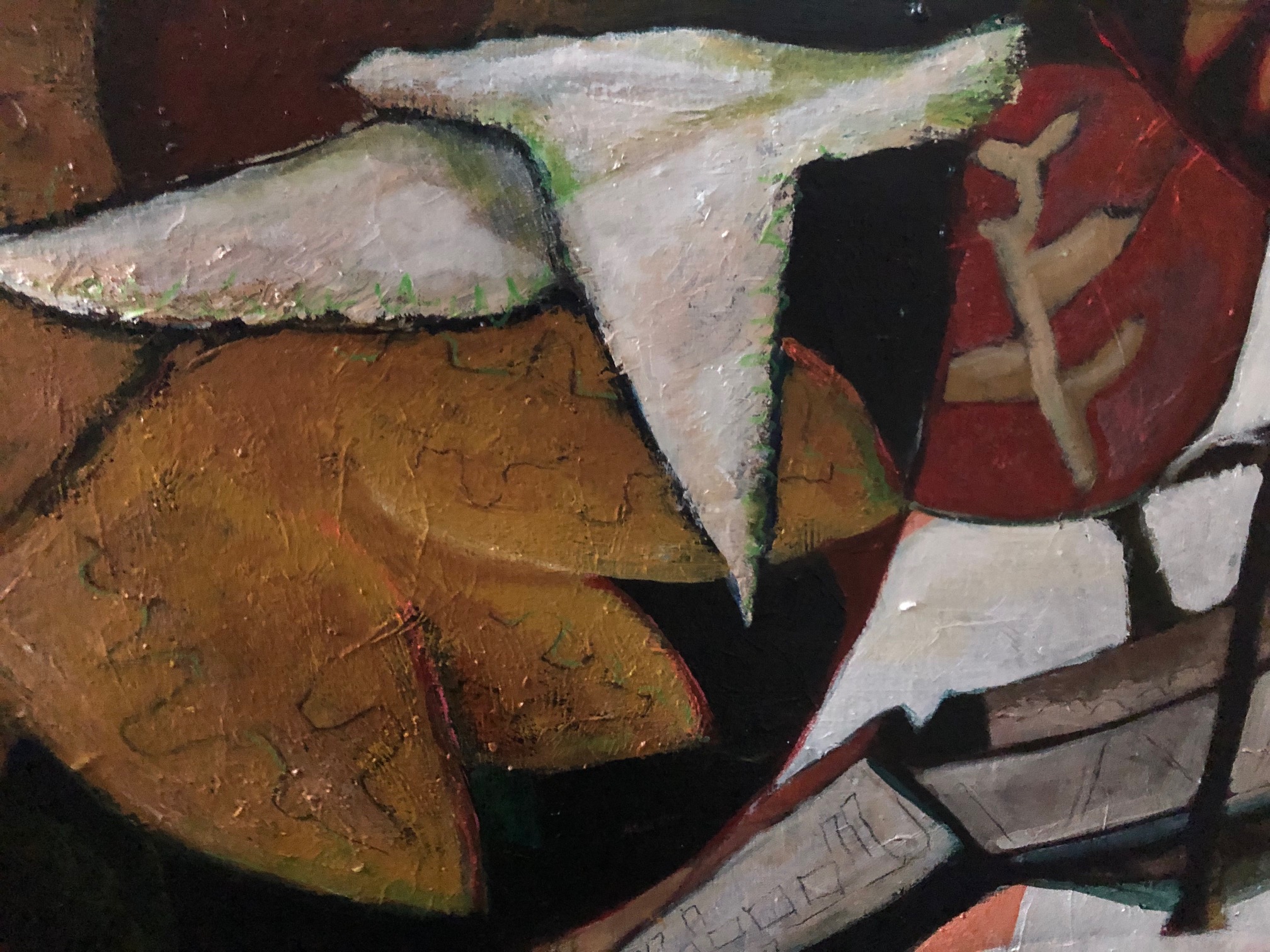
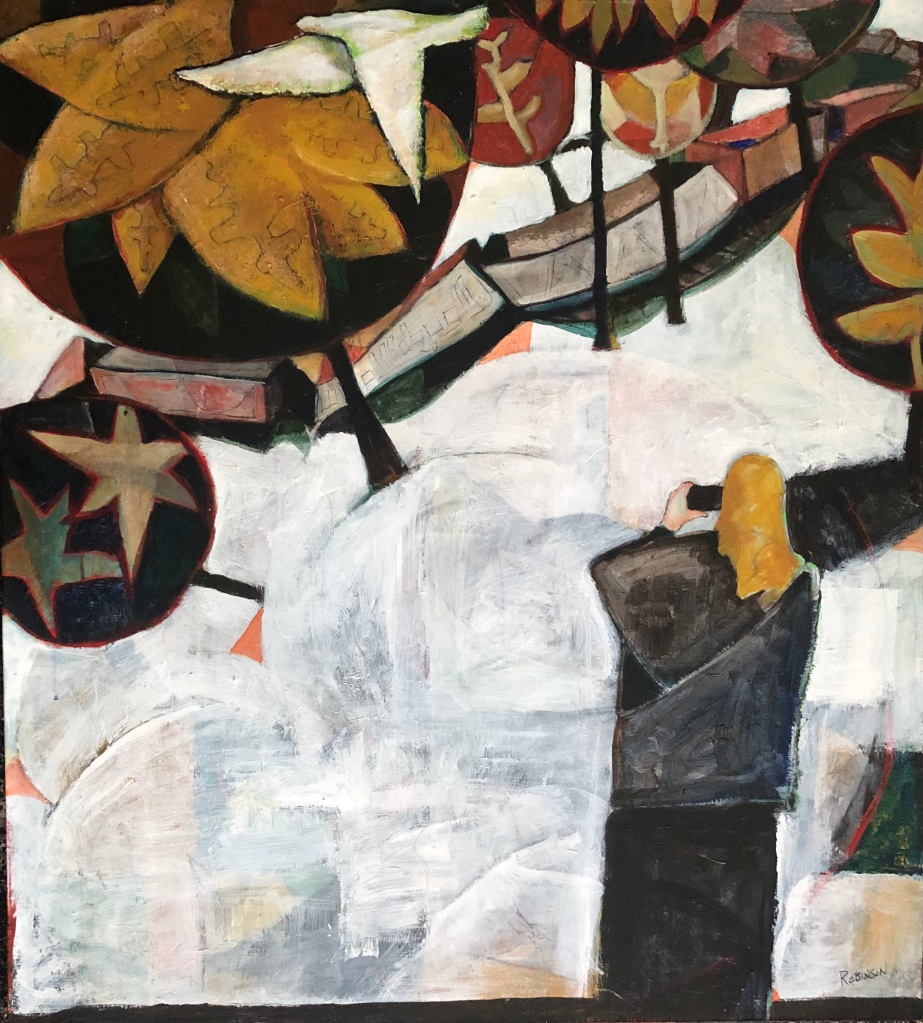
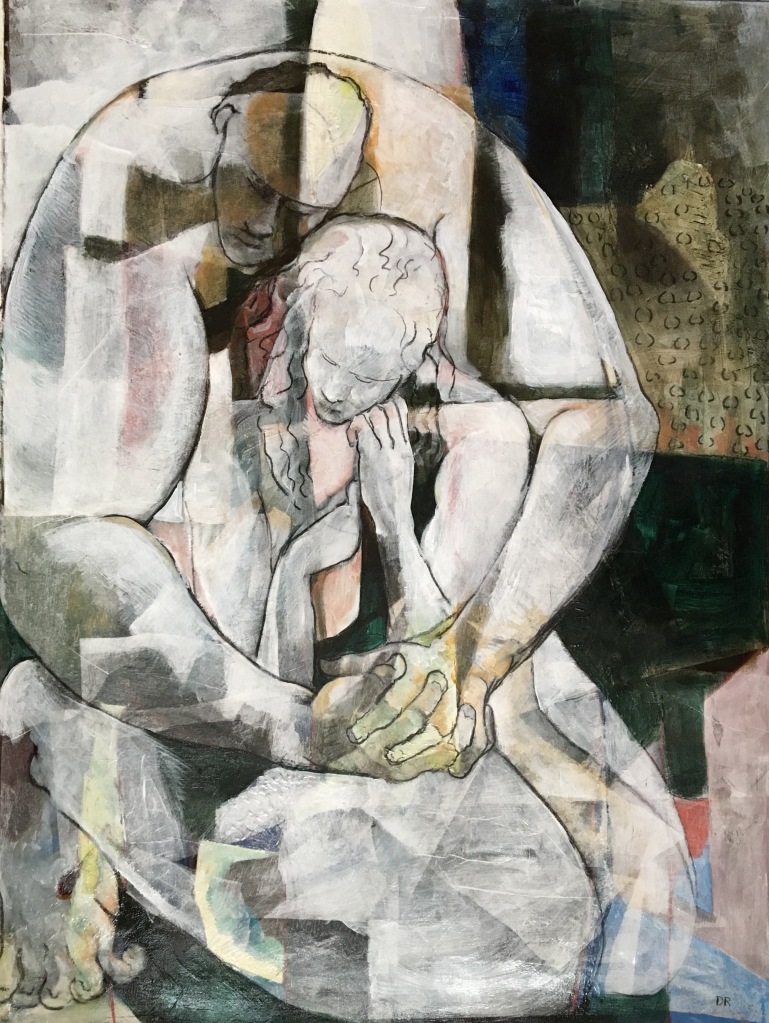
Embrace Now, 36x48IN, mixed media

read Kerri’s blogpost about BRECK’S BUDS

Embrace Now © 2016 david robinson

If you appreciate our too-many-words, buymeacoffee.com or share our posts with your friends. Ex-Oh-Ex-Oh!

Turn Around And Look [on DR Thursday]

One little line gives reference to the whole. The horizon line. It is how we naturally – visually – orient in space. It is a baseline of perception. It’s the beginning of discernment.

It is a line that disappeared.

Among other things, art is a reflection of its time. In the past century, art leapt into the abstract. We are “post-modern”. Expressions of personal fantasy rule over community truth, a breaking apart of shared ideals, instant doubt of objective theories…we are mirrored in post-modern art. What is art? What is it not? There’s not a whit of agreement to be found.

General distrust is the beating heart of the post-modern ideal. Division, aggression, tribalism, conspiracy…are its blossoms. Our children perform active-shooter-drills in school; a performance we shudder to attend while our leaders smile and look the other way. Post-modernism at its finest. The absence of a baseline.

Shared truth, group trust, community…requires an undeniable horizon line.

What is up? What is down? What has value? What does not? What has merit? What is undeserving? There is a line. Where is it?

Walking through the antique mall, Brad and I discussed chatGPT. I’m playing with it; he’s using it in his work. It’s raising some very big questions. The questions are not new. They are the next step in a series of questions people have been asking for the past 30 years: what is true? A photograph was once proof that something happened. That hasn’t been true for a few decades. A video was once proof an experience occurred. That is no longer true. News – a word that once implied the accurate reporting of an event. No more. No horizon line.

Brad and I turned our discussion to a sorely missing quality in our times: discernment. In the absence of a horizon line, people will – and do – believe anything. We speculated that, with the introduction of chatGPT into our world, perhaps discernment will once again become important. Perhaps the complete absence of a truth-anchor will turn us toward a common center and require us to look at each other, to seek and restore general trust. The post-modern tide will someday turn and we will draw an old/new line in the sand: we’re-all-in-this-together.

I know, I know. Pie-in-the-sky. However, I’d like to point out that shared dreaming brought us here. Shared dreaming is how we stood on the moon. It is how we can talk to someone across the planet using a small device that fits in our pockets. When a dream becomes shared it becomes powerful. Manifest. A shared dream is a form of a horizon line.

If a shared dream isn’t powerful enough to establish trust, try remembering the other one; the original line of discernment. The line that invites curiosity. It need not be debated. Turn around and look. The horizon line is everywhere.

Four-by-Four, 48x48IN, acrylic, (sold)

read Kerri’s blogpost about THE HORIZON

4×4 © 2007 david robinson

Unroll And Renew [on DR Thursday]

During the past weeks I have rectified a wrong that I did to myself. A few years ago, after several water disruptions in my basement studio, with the space in disarray and too full of stuff, I had a fit of “what-am-I-going-to-do-with-all-of-these-paintings. With no thought to the future, I rolled several of my canvases. There are many, many paintings so I made multiple heavy rolls. And then I stacked them. The stacking was my crime. The weight of the top rolls pressed those on the bottom. Left too long and the canvas warps; the paint cracks.

I feel as if I am emerging from a dream. The past. Dried flowers in springtime.

At breakfast on Monday, Liam asked if I had been painting. I blinked, not ashamed of my reply but mostly shocked at the truth of it. “I just finished a painting,” I said, “the first I’ve completed in three years.” Three years ago I rolled my paintings to keep them out of the water – to get them out of the way. Broken wrists, lost jobs, pandemic, an uncanny series of water issues…A pause. Or, I feared, a finish?

I carefully unrolled the paintings. Flattened the waves in the first canvas roll with books. I built successive layers of flat paintings, using the weight that caused the problem to my advantage. Opening the rolls was like taking a walk back through my life. Two of the rolls were paintings from the early 1990’s. A self portrait in orange on an Oregon beach. I recognized the paintings but had to reach to find the painter. Dried flowers. A dream. The past.

Kerri wrangled carpet tubes from a big box store. We cut them and carefully rerolled the paintings, now with a solid center so they cannot be smashed. We devised a strategy to stand the tubes, protected from any future water problem.

Emerging from the dream. Perfect timing. It is the season of renewal. Spring.

read Kerri’s blogpost about DRIED DAISIES

Learn A New Word [on DR Thursday]

Call it a “happy accident.” Call it an unintended consequence. “I like this photo!” she exclaimed. “It reminds me of a Rothko.” A wrinkled brow and then, “I wonder when I took this?”

Last night we learned a new word that I love: Coddiwomple: to travel in a purposeful manner toward a vague destination. I’ve never heard a more appropriate definition for the life of an artist! My pursuit could not be more clear and the destination could not be any less attainable. It’s impossible to explain. Recently I tried – again – to clarify for a colleague that I know exactly what I want, I do not need career counseling or advice. I’ve always known what is mine to do. I’ve never been able to wrap words around it so it might make sense to others. An artist’s life is hyper intentional. From the outside it makes no sense at all. There is no 401k. There is no safety net. There is no certainty. Sometimes there is no shape. Always, there is no adequate answer to the question, “Why?”

There is a clear calling, an underground river running beneath how it is expressed – whether through paint or musical notes or pirouettes. My career, on paper, looks like a random romp through the woods. Galleries and symphonies and stages and boardrooms and classrooms and consultancy and facilitation and coaching (a word that still makes me wince). DEI and intercultural. Start-ups and SaaS. Canvas, all. Some of the best plays I’ve ever developed happened in cafeterias or a conference room. I knew exactly what I was doing. I was not “using improvisation” in a business setting. I wasn’t using anything. The work of my life has not been about translation or utilizing “the tools of art” in other settings.

Artistry is akin to stepping into a rocket headed into deep space for a journey of discovery. The only honest answer to the those who ask, “What are you doing?” is “I’m journeying.” Creating. Inventing. Innovating. Stepping purposefully toward a vague destination. Coddiwompling.

May You, 55x36In, mixed media

read Kerri’s blogpost about ROTHKO PHOTO

may you © 2015 david robinson

Ask The Same Questions [on DR Thursday]

Their call is ancient and beautiful. I imagine their unique voice reaches back to the pterodactyl. Sandhill cranes. We live on their migration path. Each spring they stop for a rest, passing through, heading north. The Des Plaines river, surrounded by abundant farm fields, provide ample road snacks and safe places for respite.

Last fall, during the southern migration, a crane couple took up residence in a cornfield we pass en route to our trail. They stayed so long that they became a fixture. We expected to see them. Statuesque, always together, I wondered if they were as excited to see us as we were of seeing them. “There they are!” the cranes point to our little black toaster car. “Those two are always together,” they observe. “I wonder where they are headed?”

We make the same observations and ask the same questions of them.

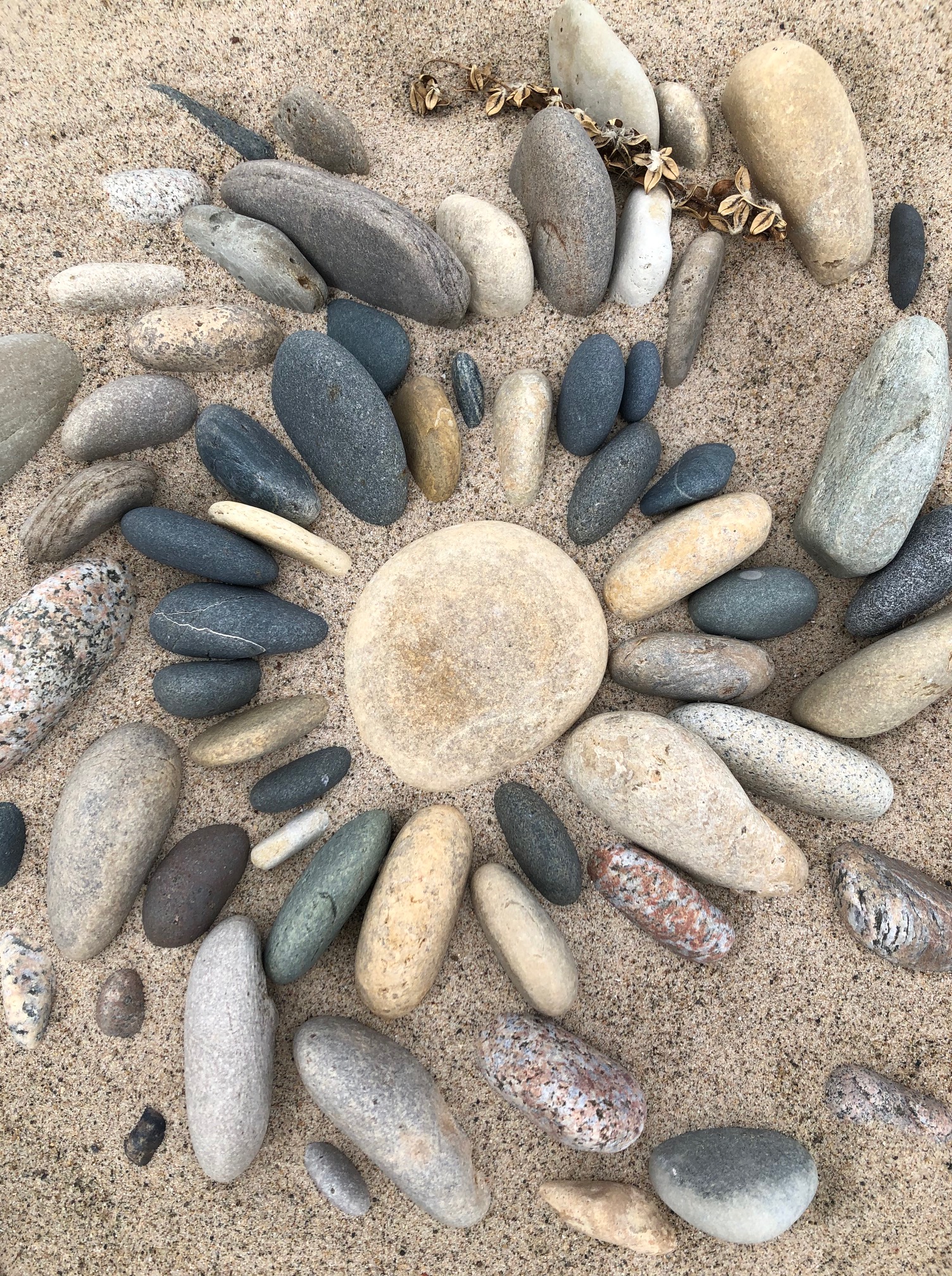
When we first saw their tracks in the snow it felt like a gift, like seeing two hawks circling or several deer peeking from the willows. Their prints were huge, almost too big to be real. They were so distinct that they reminded me of something Andy Goldsworthy might create. Patterns in the snow. Marks mysteriously etched across the landscape.

Were it stone instead of snow, white quartzite, these amazing marks would be petroglyphs. Abraded to leave us a message, a symbol whose meaning was lost in time but inspire speculation none-the-less. “Where did they come from,” we ask, knowing there is no answer but we have to ask anyway.

Our footprints cross theirs on the path. Brad does a masterful crane-walk-imitation. We laugh as man becomes bird, eyes intense. The original theatrical impulse. I look back at the our prints crossing the crane’s and marvel at the image. This startling canvas will certainly melt. Another reminder of Andy Goldsworthy. The power of impermanence, like a sacred sand painting, a spirit captured for a brief moment, witnessed, evoking power, and then disappearing into sun and wind and time.

Canopy, 48x48IN, acrylic

read Kerri’s blogpost about CRANES

Canopy © 2008 David Robinson

Sense The Air [on DR Thursday]

In the summer, it is a place of frogs and turtles perched on rocks, drinking in the sun. We stop and watch until the wary turtles slip into the murky water, the frogs halt their croak-symphony. Respectfully, we move on. Behind us, the symphony resumes.

In winter, it is a different scene. Sienna and ochre rather than a million shades of green. Silent, the musicians are on hiatus. The turtles sleep, having disappeared beneath the earth some months ago. They will return in several weeks without fanfare. Without formal announcement we will spy them on a log. Kerri always marks the first sighting in her calendar. “Turtles!” Some winter days we cross the long bridge and look into the river at their usual spot. We know it is too soon but such is the way with hope.

I’m getting a taste of the life my grandfather lived. One place. He lived in one town his whole life. My dad’s dad. I was with him one bright sunny day in the park when he stopped, sensed the air, and said, “We’d better get in. A storm is coming.” I thought he’d lost his mind. There wasn’t a cloud in the sky.

The clouds rolled in. Thirty minutes later, safe inside, we watched the heavens open and dump buckets of rain. Somedays on this trail we love, I sense the air. I know what’s coming. Having lived so many places, until now, I never understood the power of place, the relationship with the reeds, yearning for the symphony, knowing in my bones that the sun is not quite right for the turtle’s return.

read Kerri’s blogpost about THE MARSH

Feel The Rain, 24x24IN, mixed media

feel the rain © 2020 david robinson

Study The Studier [on DR Thursday]

I study the studier. She kneels, excited to capture the winter face of plants along the trail. It’s as if they call to her.

Where does it start? An idea. Broad and generic. Spontaneous. Studied.

For months I watched her take photos of the train through the trees. “Here it comes!” she’d laugh and pull her phone from her pocket, running to get the best spot on the trail. Each time as excited as the first. I took photos of her taking photos of the train snaking just beyond the trees.

Mostly she shoots close-up photographs. Spontaneous. She has an eye for detail. She helps me see what I overlook. I have an eye for the big picture, the metaphoric. I study. Pie-in-the-sky.

I think she would have been great pals with Georgia O’Keeffe. They’d have compared notes on the magic world of minutia. The dried flowers, the pattern in the petal. The amazing textures and vibrant winter colors. Some people see only brown. Kerri sees subtle changes, ochre, cream and an array of umber. A universe full of color. Just like Georgia.

This is where my studied painting started:

underpainting: train through trees.

Originally I intended to use a long canvas. The composition-in-my-mind was different, more spatially accommodating of the train. I was going to paint over something I didn’t like but she flung herself between me and the doomed painting, like the angel rescuing Isaac from Abraham’s knife. Needless to say, I shifted my composition. I had another canvas. Large and almost square.

It had been awhile since I attempted a larger painting so I made one rule: I had to have fun. Master Miller sent some cool tools for me to try. They are like large rubber scrappers and brushes. After a hiatus I have a tendency to go to detail too soon so I used his gifts to keep my strokes broad and light hearted.

Okay, I made two rules: I painted in 45 minute sessions. I generally have a 3 hour necessity but the realities of our circumstance make that dedication of time difficult. I start Dan Fogelberg’s album, Captured Angel, and when the last note is sung, I stop. I clean my brushes. It was a great way to stir my process-pot. It was frustrating and liberating at the same time.

This is where it may end. This painting has traveled a long way. Soon, I’ll turn it to the wall. I need to forget about it and will someday see it with fresh eyes. Right now, in a festival of irony, all I can see is the detail so I asked Kerri to come into the studio. Blinded by minutia I needed her wise eyes to tell me what she sees. Globally. The studier becomes the study. A perfect circle.

Train Through Trees, 48x49IN, mixed media

I’m slow-stepping into my new site. The construction continues…

read Kerri’s blogpost about DETAIL

train through trees © 2023 david robinson

Ask A Simple Question [on DR Thursday]

It’s existential. What you see changes depending upon where you stand. That’s true when engaging any piece of sculpture. It’s true when engaging anything in life. Point-of-view is fluid and relational. This sculptural reminder is Olafur Eliasson’s Rainbow Bridge.

In another era of my life facilitating diversity and inclusion workshops, the same surprisingly simple concept was usually a revelation to people. What you call “normal” is merely a point-of-view. Most importantly, it’s not everyone’s point-of-view. Your “normal” is unique to you, not universal. Most hopeful: it’s not fixed in stone. It’s changeable. Relational. Capable of growth. A mature point-of-view recognizes that it need not, it cannot, be the center of the universe. A mature point-of-view necessarily asks an all important question: “What do you see?”

It’s not only possible to look at the same sculpture and see a myriad of differences, it’s necessary. It’s human. Sharing what we see is how we, together, create community. A common center is created by a circle of differing points of view. A common experience is borne of sharing disparate points-of-view of the same event. A common center is made functional when everyone in the circle is capable of asking with sincerity a simple question: What do you see? It is made vibrant when everyone in the circle expects the answers to be different than their answer.

Art is one way of responding to the simple question.

Instrument of Peace, 48x91IN, mixed media

read Kerri’s blogpost about RAINBOW BRIDGE

instrument of peace © 2017 david robinson

See The Frame [on DR Thursday]

The lake was angry. Had you dropped me in from outer space I’d have sworn I was standing on a beach of the stormy Atlantic Ocean. “I just can’t capture it,” she said, after snapping several photographs. The roiling waves hit the shore with thunderous power and intensity. I felt it in my chest. Distilling the energy within the frame of a photo sublimated the dramatic waves to an everyday image. The frame successfully abolished the fear and eliminated the awe.

On the trail this past Sunday, he quipped that the world as we knew it began its decline when CNN invented the 24 hour news cycle. It’s a lot of time to fill and, to keep people hooked (ratings), the importance has to be exaggerated. When everything becomes ‘Breaking News,’ the really important stories are lost amidst the manufactured dross. Scrolling through our news app this morning I felt as I once did while waiting in line at the grocery store check-out surrounded by the screaming headlines from The National Enquirer. Sorting to the grotesque. Manufactured awe has successfully amped up our fear. A very strange frame, indeed.

The real power of a frame-of-reference is that it is mostly invisible yet it determines the potency of the composition. Focus is largely a function of frame. I’m in the habit of taking “snippet” shots of my paintings. Altering the frame of what I see helps me…see. It promotes inquiry.

A fluid frame is like an open question. It facilitates engagement. A fixed frame does the opposite. It closes the question options: yes or no. A 24 hour news cycle necessarily defaults to a fixed frame. It pretends to be inquiry while promoting dogma. If you wonder why we are at each other’s throats, why we’ve reduced ourselves so severely to a community defined by two primary colors instead of the full palette available in our color-full nation, do an experiment: pay attention to the story-frame you are being fed.

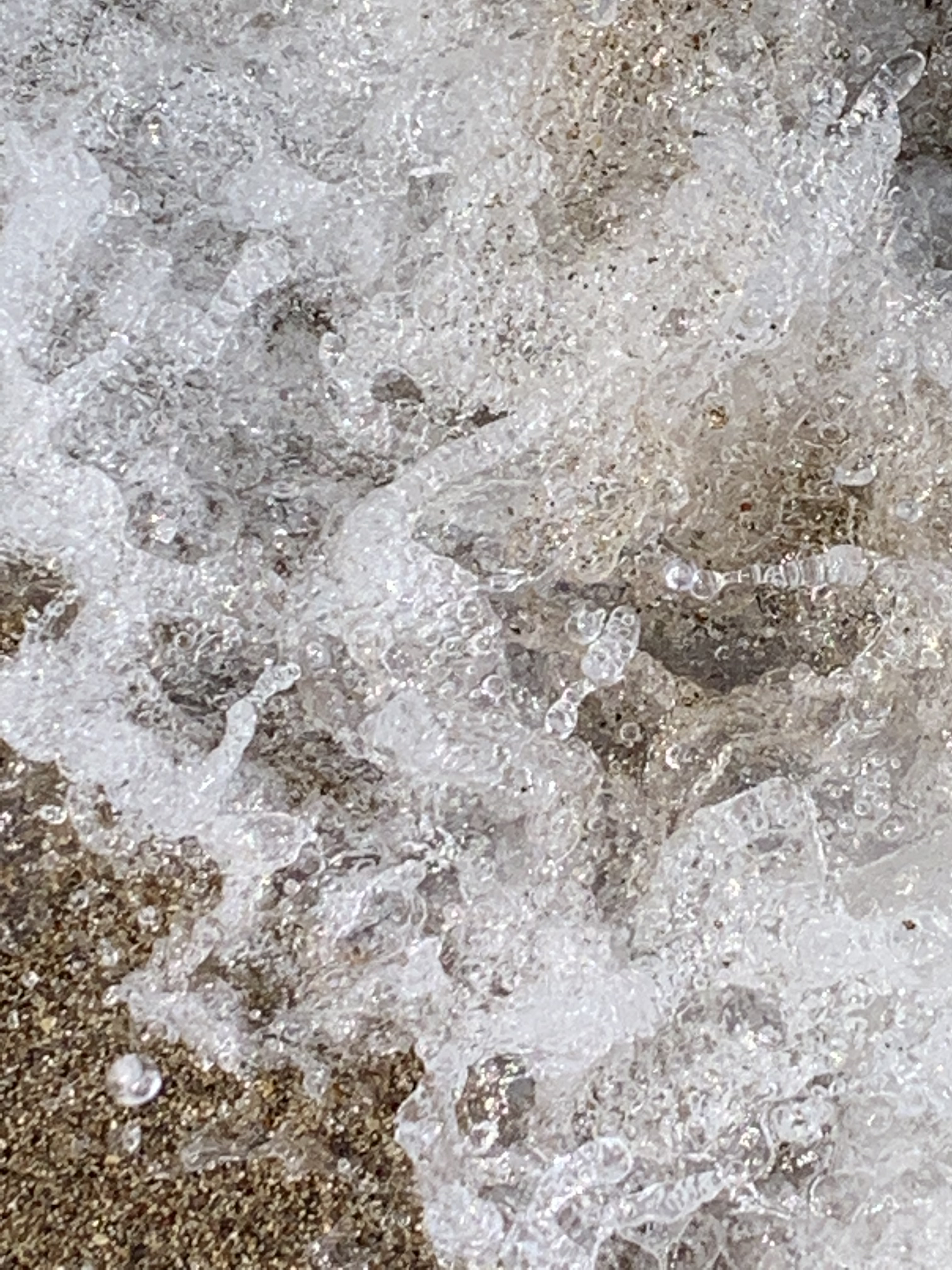
Ice crystals formed on our kitchen window during the latest storm. Kerri rarely takes a single close-up. She takes many shots of the same subject. In a digital age, she is also able to pull a single photo into several different focuses and takes screenshots of the possibilities. A fluid focus. She composes. She questions. She asks. It’s a pure artist’s action. Turning to me she never asks, “Which is better?” Instead, knowing the power of a frame and with full respect for the difference that I might perceive, she asks, “Which do you like and why?”

joy. 50x56IN mixed media

Two frames. Can you see them? [the new site is like a good wine…taking its time to mature]

read Kerri’s blogpost about ICE

joy © 2014 david robinson

Protect The Seed [on DR Thursday]

Lately I’ve been applying for many jobs so I’m configuring and reconfiguring resumes and writing cover letters. They essentially serve as a surface-layer life review. This is who I am. This is what I’ve done. Of course, for me, that means I am thinking about art and artistry.

When I write the words “art” and “artistry”, I am aware that they mean something to me that I will never be able to convey through language. They are not “things” that I do or have done, they are not welcome career paths or positive attributes that potential employers desire to see on a resume. I wish I could count the times someone has said to me, “Yes, but what are you really going to do?”

“No, no, no!” I think. “You don’t get it! It’s not something I do.” I’ve learned over time to keep that thought to myself. There’s no point debating the worth of a way-of-life in a world that measures value in dollars and cents. Against this calculus, artistry makes no sense.

What am I really going to do? Paint. Write. Perform. And bring my artist’s sensibility to an organization. The people who hire me will fully realize the benefit of someone who sees through my eyes, someone whose artistry permeates everything they do. At this stage in my life, I’ve run companies, I’ve saved companies, I’ve held people’s hands and led them into and through impossible conversations, I’ve stood in organizational fires and, sometimes, taken Tom’s advice and let the place close-down. “Make space for something new to enter.”

As I write my resumes, I am daily reminded that we are embroiled in a culture war. We are standing in a historical teachable moment: we will either tell our full story and grow or we will do what we’ve done in the past and ignore our addiction to fantasy and opt for history-censorship. There’s never been a better or more necessary time to be an artist. Artists hold, express, and reflect the identity of their community. Nihilism has brought us here and that empty “anti-woke” sun is setting.

What we say matters. That’s an artist’s thought. How we say what we say matters. That, too, is an artist’s thought. Mattering is a word of relationship. Consideration of others is the province of mattering. That, too, is an artist’s thought. It’s an artist’s imperative: tell all sides of the story.

Kerri and I walk the trails to clear our minds and our walks have provided me with a perfect metaphor; artists are pine cones. The pine cone holds the seeds. It’s a protective, nurturing organism . It’s “…the female reproductive structure of the tree.” It’s the keeper of the essence and promise of the next generation.

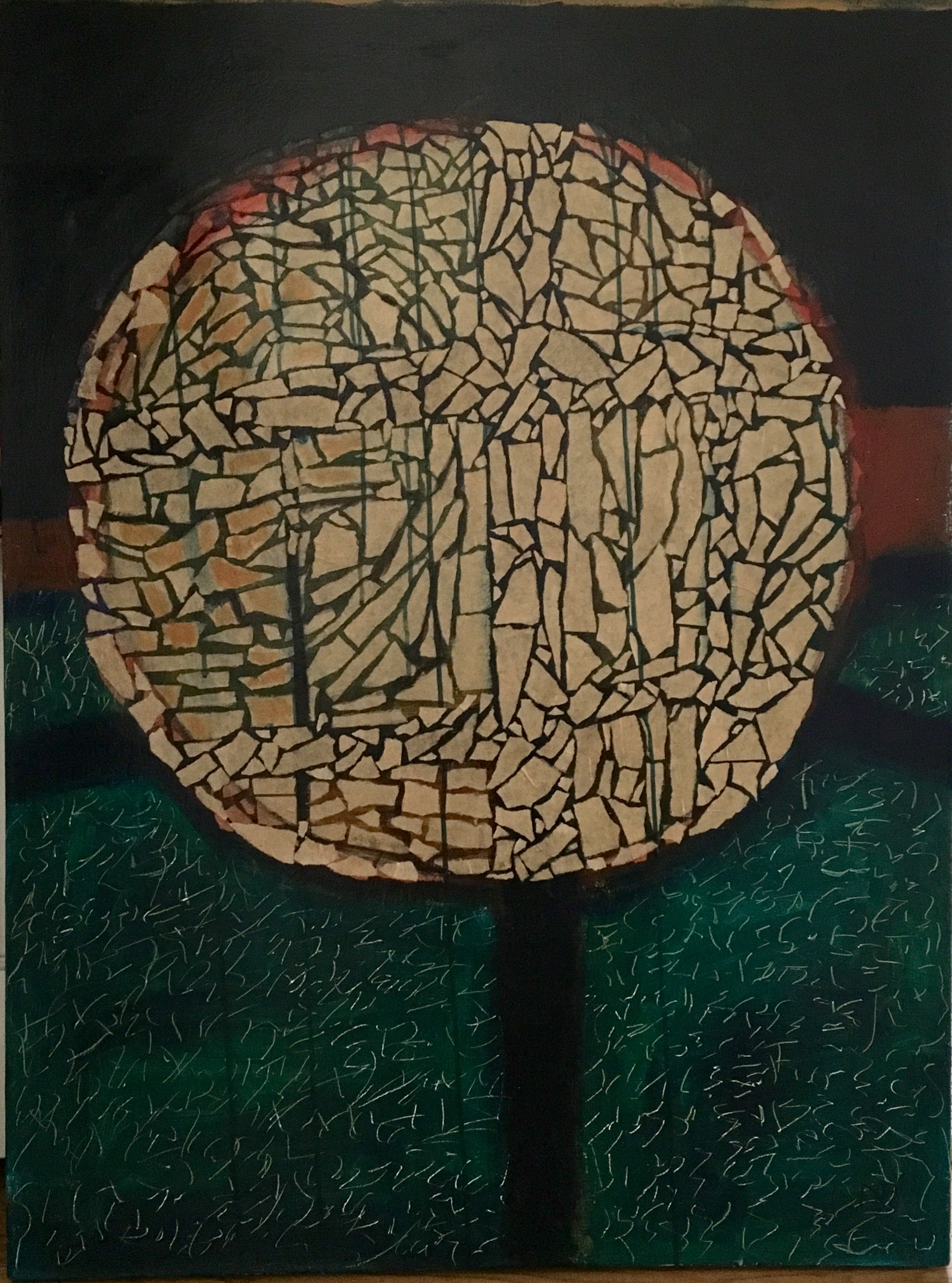
From the deep archive. A painting from another century. From the estate of Marian Jacobs

read Kerri’s blogpost about PINE CONES

painting from another century (I can’t recall the title) © 1990, 2023 david robinson