Sun Dry [on DR Thursday]

“…people find what they are looking for. If you’re looking for beauty, you’ll find beauty. If you’re looking for conspiracies, you’ll find conspiracies. It’s all a matter of setting your mental channel.” ~ Roger von Oech, A Whack On The Side Of The Head

Our time on Washington Island was multi-layered. Half of the people on the island saw us as invaders. The other half saw us as welcome progress. We were hired to manage the performing arts center which, out of the chute, served as a divisive symbol for the local community. We were the first “non-islanders” to manage the TPAC. Division upon division. And, although we were the focal point of the contention, none of it had to do with us, not really. Our status as invader or progress originated in the eye of the beholder.

Because the actual job was a festival of landmines, I especially appreciated the simplicity – and sanctuary -of our little house, a home provided to us for the summer-on-island-months. Our refuge sat on the shore of Lake Michigan. It was as peaceful as the job was contentious.

My favorite symbolic act at the little house was hanging the clothes to dry. When we arrived the clothesline was in disrepair. We re-strung the poles with new line purchased at the local hardware store. We quickly grew accustomed to carrying the wet clothes outside. We learned that the wind off the lake sometimes required strategy to what-is-pinned-in-front-of-what. Double clothespins on sheets and shirts was always a good idea. Mostly, I appreciated how the clothesline slowed our pace. It brought us into the sun and in relationship with the wind. The real stuff.

It helped set our mental channel. Hands on, tactile, slow-paced, generous, the power and presence of the lake filled us with awe. So, to our work, we brought awe. Literally. We were in awe of these people that cared so much for their community. Like most communities, they had more than one idea of how to protect it. Progress or conservation.

We understood that these two paths-to-the-same-goal need not be oppositional.

We learned that our job was to build bridges where they had fallen. We understood that, in this divided community, we had to pay attention to what-is-pinned-in-front-of-what. We learned that double pins on big ideas was sometimes a good idea because ideas often generated big wind. Listening was the best idea of all. We understood that if we brought our awe to both sides of the coin, we might one day build a single bridge that could not be burned.

We learned that there was no rushing the process, just as there is no way to rush the clothes drying on the line.

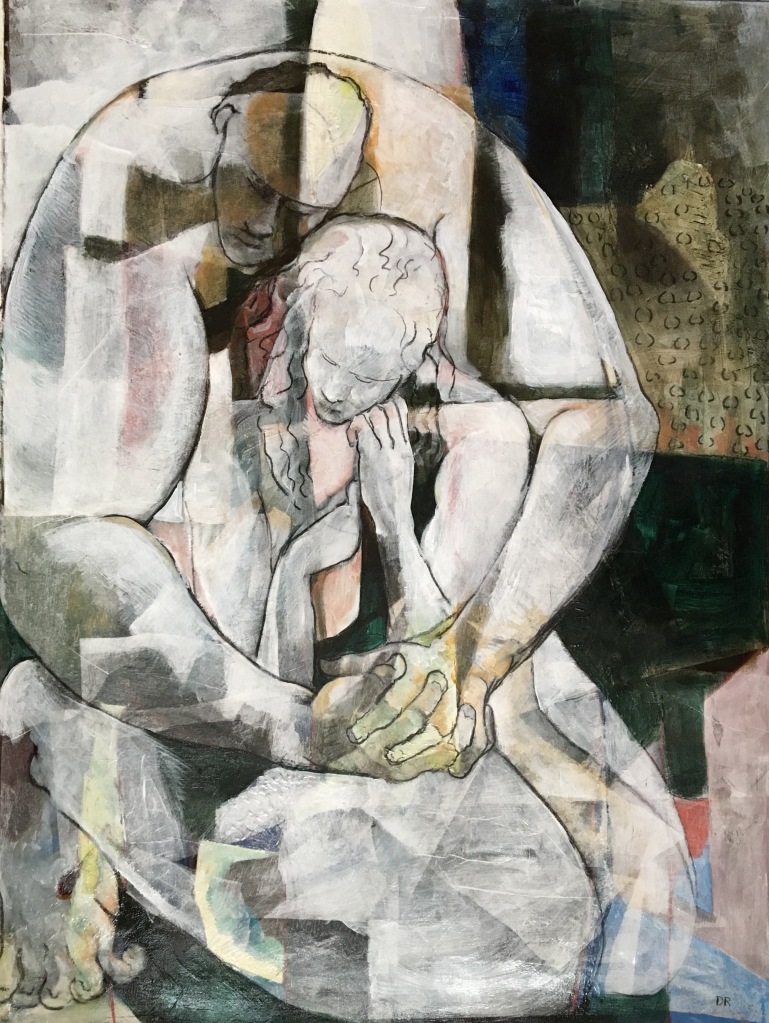
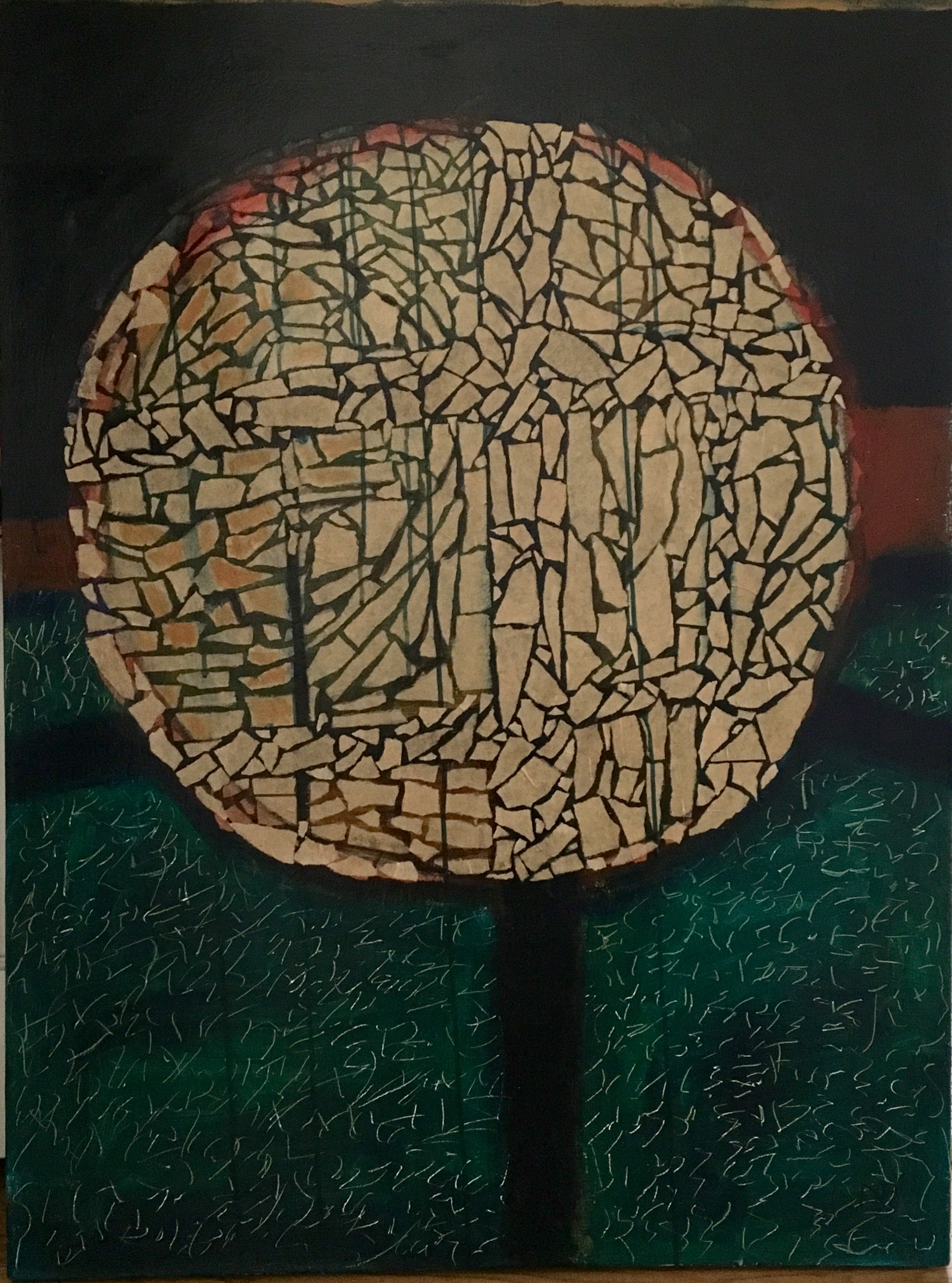
a day at the beach, mixed media, 38x52IN © 2017

my site. yes. as yet incomplete. a testament of continued indecision of my purpose and intention.

read Kerri’s blogpost about the CLOTHESLINE

like. share. comment. support. many thanks for all.

Labor For Surprise [on DR Thursday]

I designed the set using a David-Hockey color palette. Rich and vibrant. A gifted scenic artist brought my renderings to life. I was concerned. Sometimes what looks good on paper does not scale well. Sometimes scaling up fulfills the promise. Dreams are that way, too. You can’t possibly know a good idea is genuinely good until you give it a try.

I moved from California to Seattle. When I first arrived in Seattle I took my paintings to many, many galleries hoping to find representation. I was excited to be in a city with a mature art scene. I was ready to scale up my career. The response was unanimous: my paintings were too vibrant. Too much color. As a kindness, one gallery owner suggested that my paintings were appropriate for a California audience but would never sell in Seattle. Apparently the cloudy skies and reputation for rain dampened en masse the local appreciation of color.

I was deflated but undeterred.

After a season or two in Seattle my color palette was noticeably different, toned down. The ubiquitous rain naturally muted my spectrum of color. There’s no telling what will happen when lofty dreams hit the hard work of reality. It’s unpredictable. The labor of surprise. Once I was sufficiently color-muted, everyday, every-single-day for 15 years, I showed paintings in galleries, in coffeehouses, in theatre lobbies, in studios, in pop-up shows…

I left Seattle when I met Kerri. I knew immediately that she was The One. Early on, before I actually moved, as we were driving around town, I wondered if my art-life would survive in this new place. I wondered if it was time for me to scale down. The same rule that applies to scaling up also applies to the opposite direction. It was new territory. My dream had never included the idea of trimming. From this vantage point I can safely say that I had no idea how hard it would be and no idea of the abundant changes – that brought simple abundance – this move would bring.

Yesterday Jen asked, if we had life to live over again, and money wasn’t an option, would we make the same choices. Kerri and I laughed heartily at the money-part. This path has been hard – so far, money hasn’t been an option – but we were unanimous and immediate in our response: I wouldn’t – we wouldn’t – change a thing. This dream was and continues to be a genuinely good idea, regardless of scale, filled to the brim with vibrant color and the hard labor of surprise.

cloud watchers, acrylic on canvas, 20×49.5IN, © circa 2002

My still-as-yet-unfinished-because-I’m debating-the-how-what-and-why-of-my-life-website

read Kerri’s blogpost about PEONY RAIN

if you like it, like it. share it. comment, or buyusacoffee. we love writing it and appreciate that you read it.

Learn The Language of Color [on DR Thursday]

Earlier this week I wrote of DeMarcus’ notes on color made when he was a first year art student. I flipped through the fading pages before placing the notebook back on my shelf and lingered on these gems:

“If we wish to create we must learn the Language of Color.”

“Color stands for JOY in this world of seeing.”

“Through the language of COLOR, we add JOY to the world of seeing.”

His notes are from a lecture. In my mind I see some fantastic art teacher, a life teacher, standing before a class of enthusiastic hearts that included the young DeMarcus, infusing them with a purpose that demanded they pay attention to others, to their reason for creating. Bring joy. Through the language of color, speak to a world that doesn’t know how to see. Speak to a world desperately in need of Joy. Color theory as community tending. Igniting the idea in the students, the teacher then set them free to explore how, through color, to bring joy to the world. The lesson was simultaneously both practical and existential.

I wish I knew the name of DeMarcus’ instructor. I’d send a deep debt of gratitude into the universe.

It is profoundly easy to diminish the role of artists in our culture. Note the dearth of art programs in schools. The emaciated National Endowment for the Arts relative to other budget lines. What might be more important in our times than artists striving to weave togetherness through the language of color? What might be more necessary than opening eyes to see beyond grey assumptions? We diminish ourselves when we devalue our art.

I knew DeMarcus when he was in his 90’s. Those early lessons still twinkled in his eyes. Or, perhaps, a lifetime of speaking the language of color, a lifetime of offering the joy of seeing, brought a permanent twinkle to his eye . He understood artistry as more than indulgent self-expression. He understood – and helped me understand – that artistry came with a responsibility to others as well as to the self. Service. See, in order to help others see, through the language of color, joy.

prayer of opposites, 48x48IN, acrylic on panel © 2006

my-as-yet-still-unfinished-site [I hope you’re not holding your breath]

read Kerri’s blogpost on COLOR

like it. share it. comment. buyusacoffee. thank you for reading our work.

Illustrate The Energy [on DR Thursday]

This afternoon I received a lovely email from John. He asked permission to use an image from my website, “…to illustrate what angel energy might look like.” I was delighted. The image he wanted to use was of my palette, a fantastic mess of swirling, colliding color.

It occurred to me that my palette is perhaps where I do my most honest painting (the action as opposed to a finished piece). I mix color on top of color. It’s a terrible habit and, if it becomes public knowledge, I’ll be banished from the art league: I never clean my palette because I love the paint build-up. It’s a history of the dance. It also grinds down my brushes. I love working with rough worn brushes. Don’t tell anyone.

“Don’t you love that he called your palette ‘Energy!'” Kerri said. I do. It brought to mind Jakorda Rai, a healer, a Balian that is significant in my life. He was a painter, too. His paintings were visual captures of the movement of energy in the body. A mix between solid structure and whirling flow. Color streams that resembled photos of distant galaxies. His pieces were unceremoniously tacked to the walls of the hut where he saw his patients. Spiritual healing; the art of moving energy stuck in an eddy. The art of regaining natural flow. Natural pace.

We walked through the city as night fell. Dinner was done and we had a train to catch. Kerri snapped photos along the way. The river. Reflections in the buildings. The ceiling of the train station. As she focused her camera, I watched the people hustling to the rhythm of the city. The pace is fast. The gestures emphatic. Aggressive. People racing to “get there”. Never here. It’s easy to get caught in the undercurrent. Hyped up. Swept away. I thought of Georgia O’Keeffe’s city paintings. Towering buildings reaching to the heavens. Hard linear thrusts obstructing the sky. “That’s why New Mexico was so appealing to her,” I thought. A different energy. Softer. Deeper. Ancient. Less eddy. Human scale and slower. A place to be still and meditate.

As we boarded the train Kerri said, “I like visiting the city but I like it better because we can leave it.”

I thought of a phrase I’d read earlier in the day in The Marginalian: “…our golden age of compulsive productivity at the expense of presence…” [William James]. “Sometimes it’s too much energy through the wire,” I quipped, suddenly yearning to move to New Mexico and walk the arroyos where Georgia painted. “Nothing between the artist and the stars,” I whispered, “…angel energy.”

angels at the well, 24x48IN, acrylic on hardboard (2 panels) © circa 2004

read Kerri’s blogpost about ENERGY AND STRUCTURE

like? share? comment? buyusacoffee? all are greatly appreciated.

Allow Good Things [on DR Thursday]

Pre-Covid we regularly had dinner parties or hosted gatherings of Kerri’s choirs and ukulele band. Each week the big dining room table was piled high with food and drink. People crowded into the kitchen and living room. People spilled out onto the deck.

Now, we use the dining room table when we have large projects that require space for organization. We use it as a staging ground when we’re preparing for a trip. Covid ushered in an era of reclusion and the necessity for space and quiet.

Last weekend we had a surprise large project to assemble. Tons of paper to sort. As Kerri prepared the plan I headed to the dining room to clear the table. I stopped in my tracks with what I found there. The table was covered with rocks. There were several gallon size ziplock bags with painted rocks and rocks ready to be painted. Mostly, there were paper towels spread like islands across the table surface, each populated by dozens of hagstones. Odin Stones. Adder stones. Magical stones of many names, all sizes, from tiny bead-size to fist-size rocks, each with a naturally eroded hole. The power of water working on earth.

I hadn’t realized that we’d collected so many. We’d inadvertently converted our dining room into a hagstone sanctuary, an epicenter of ancient folk magic: nature’s talisman of healing, protection and wisdom. I laughed. Apparently we could use a bit of ancient protection. I certainly could use a healthy dose of wisdom. I considered laying on the table, body across the bumpy stones and saying, “I’m ready! Do your stuff!”

We bumbled onto the secluded beach a few months ago. The power of the lake is palpable. The beach is a festival of wave-polished rocks and treasured hagstones. The gulls circle and chase. The portal to the beach requires crawling through trees recently burned. Fire. Air. Water. Earth. People have created whimsical structures, crude altars and twisted sculpture from the driftwood.

We’ve returned a few times to comb the beach for the miracle stones with holes made from years and years of their dance with water. A feather on the stone. Time disappears as we slowly walk the beach, heads down, sensing as much as looking for the rare hagstones.

According to tradition, only good things can pass through the hole in the stone, made magic by the watercarver. Our growing collection, a prayer-pile or incantation cairn. Good things.

I will, someday soon, lay on the beach after dipping into the cold Lake Michigan water, warm myself in the sun, and feel the large hole that life has worn through me, myself now a magic hagstone. Grateful, I will think, “Only good things. I’m ready. Let’s do it.”

read Kerri’s blogpost about HAGSTONES

winged, 26x20IN, acrylic, nfs

visit my perpetually unfinished new site

like it. share it. tip it. comment.

Keep The Connection [on DR Thursday]

A Haiku: Sun bathes the hilltop/Green grass, stones etched, dates with names/Here, we meet again.

Carvings in stone. I’ve read that among the first evidence of human-made-art is associated with funerary rituals. Send the soul on their journey with the proper talismans. There are petroglyphs, too. Scratches in stone. A message? A journal? A reach to the “beyond”? A handprint on the wall of a cave.

The earliest Greek theatre was a religious ceremony. A portal for the gods to come through and speak. Can you imagine the role and responsibility of the playwright?

I watched a Rangda ritual in Bali that shook my world. Priests with knives ran at the Rangda, stabbing and stabbing. The knives bent, the Rangda taunted. One of the priests fell into a trance and began channeling a voice from beyond. The entire community leapt to surround the priest and hear the ancestor’s message. As introduction to the ritual, the only English speaker in the village told us something akin to: “What we have of value to share is our art.”

Can you imagine? An entire community that held their art and artists as sacred. Valuable. As the means to connect to their ancestors. It was so profoundly moving that I couldn’t sleep that night. What I had known and experienced personally was, in this place, alive in the public heart. I mourned the art-poverty of my nation and community. We tape bananas to the wall and lose ourselves in a made-up-maze of the conceptual.

I was taken aback in the pioneer cemetery. Most of the headstones were homemade, a red-brown sandy-cement with shells or rocks pressed in; a name scratched in the surface with a stick. Families doing their best not to lose their kin. Moving forward in time, we found a few stones made of marble and decorated by a stone carver. More substantial, perhaps, but the purpose remained the same. Keeping connected to what has come and gone. Attending to the ancestors. The story of us etched in stone.

shaman. 36x48IN. Oil on canvas. nfs.

read Kerri’s blogpost about THE CARVING

like. share. tip jar if you want to support our creating. pass it on. all are greatly appreciated.

Watch Your Fingers [on DR Thursday]

After several weeks with its face to the wall, I turned the painting around to see it with fresh eyes. “OMG!” I thought. “This needs some serious work!” It’s too tight in some places, not finished in others, and it’s missing an all important element. The florals are rock hard and the dog – part of the original composition – is nowhere to be found. What was I thinking!

I’m a bit too famous for painting over paintings. It’s a habit that evokes finger-wagging from friends. Kerri has been known to fling herself between me and a painting that I put on the easel-chopping-block. “I hate it!” I cry.

“Touch it and I’ll break your fingers,” she quietly threatens. I like my fingers so I relent.

Actually, she’s provided me with the perfect response to gallery-goers when they ask the ubiquitous question, “How do you know when a painting is done?”

In the past I’d say something amorphous like, “It’s not something you know; it’s something you feel.” Intuition. Gut feeling. Artistic argle-bargle.

Now, my perfect reply is definitive and goes like this: “Oh, it’s easy! I know it’s complete when my wife threatens to break my fingers.” She might look like a delicate columbine-flower but watch out.

It’s a conversation stopper but the real fun comes when I add, “She’ll break the fingers of anyone who doesn’t appreciate my work.”

I turn and walk away as they debate asking the obvious next question: Is she here?

read Kerri’s blogpost about COLUMBINE FLOWERS

The offending painting. It needs work and Kerri has yet to threaten my fingers.

My site-placeholder.

“like” my argle-bargle. or share it. or comment (but watch your fingers!). or buyusacoffee.com. all are great ways to support our work.

train through trees – in this state of development © 2023 david robinson

Swim Upstream [on DR Thursday]

Today we travel. Family, like salmon swimming upstream to a place of origin. We’ll meet at the farmhouse. We’ll eat dinner. We’ll discuss what to do tomorrow at the inurnment. I think he mostly would have enjoyed our gathering together. Food and laughter. That is the ritual he would have appreciated.

The Great White Trillium produces “a single showy white flower atop a whorl of three leaves.” The flower opens late spring to early summer. Right now. They are abundant on our trail.

Whorl: a pattern of spirals or concentric circles.

Five years ago we strolled with him through the cemetery. He told stories of his friends. We will, I am certain, tell stories about him.

Kerri and I walked our trail on the ten-year-anniversary of our first meeting. We talked about how we’ve changed in the decade since I stepped off the plane. “I’m more connected to the impermanence,” she said. I nodded my head. Me, too.

Impermanence. A short season. Generations, a whorl. Patterns. Concentric circles. We tell stories and then we join the story.

Today we travel, like salmon swimming upstream.

rest now, 24×24″, mixed media (sold)

read Kerri’s blogpost about GREAT WHITE TRILLIUM

like it. share it. buy us a coffee (qr or link). tell us what you think. all are greatly appreciated

rest now © circa 2016 david robinson

Juxtapose [on DR Thursday]

Our meeting seemed destined. I’d just moved into my apartment in Seattle on Queen Anne hill. It was a beautiful sunny morning and I decided to explore the neighborhood so I walked down the hill to The Seattle Center. I laughed when I saw a sign for a theatre conference so I went in the Intiman Theatre to check it out. There was an open seat. I sat down next to David. He was the first person I met in my new town. We’ve been fast friends ever since.

Although we’ve had few shared projects, he is among my most prized artistic wise-eyes. If I want an honest opinion about one of my pieces, he’s among the top of my go-to list. If I need some fresh air blown into my muddled brain, some playfulness infused in my too-serious-process, there is no one better to call.

One night, early in our friendship, we did a painting together. We tossed three pieces of masonite onto the floor; we started painting on opposite sides and worked to meet in the center. It was a riot of fun. It was an exercise in juxtaposition. My-action-inspires-your-action. Artistic call-and-response.

I’ve kept those three pieces of masonite these many years. Occasionally over the years, I remove the protective wrap and reassemble the pieces on the floor. I snap a photo and send it to David. “Do you remember this?”

Juxtaposition. Proximity of color-to-color, image-to-image. Comparison and contrast. It is how color works. Ask Seurat. It is the essence of painting. How purple illuminates green. It is the essence of artist community. Artists elevate the work of their peers. Inspiration is a blossom of proximity. Collaboration. How does my work inflect upon the story of yours?

Diversity of color. Diversity of approach. Diversity of perspective. It is how healthy community works – artistic or otherwise. Uniformity spells the death of progress, the end of invention and creativity.

The cold rainy weather broke and the sun emerged. Finally. We walked our trail. We soaked up the sun. She gasped, let go of my hand and raced away. I know that means a photo op has been spied. “Don’t you love this!” she exclaimed, pointing to the budding crimson flower against the coarse wood. “They are so beautiful together!”

david & david, acrylic on masonite. fun on board

read Kerri’s blogpost about TRILLIUM

Like it. Share it. Coffee-life-support. All are greatly appreciated.

Return To The Nest [on DR Thursday]

In a few weeks we will travel to a small town in Iowa for my dad’s inurnment. It is the town of his birth. Although he never lived there during his adult life, it is the place he called home. It is somehow appropriate that we will take him home in spring.

I’ve had plenty of time to think about the coming ritual. It’s now associated for me with the birth of the bunnies in our backyard. We watched the momma-rabbit dig the nest but thought she’d rejected the spot once she’d experienced our enthusiastic dog who regularly terrorizes critters in the backyard. She knew what she was doing. We discovered the truth the day we caught Dogga proudly carrying a baby bunny around in his mouth. He dropped the bunny, unharmed. We went on a 24/7 backyard bunny watch.

Once, sitting on the deck watching the terrorist Dogga run circles, I decided to check out the nest. I stopped in my tracks when I realized two babies were gnawing on grass just inches from my feet. They hopped back to their nest. I watched as they disappeared into the safety of the dark void.

The dark void. The safety of the nest.

Years ago I started a painting. My dad emerging from a field of corn. Or returning to the field of corn. I’m not sure why I painted it. He often talked of his desire to return to his hometown but he could never find a way to make a living there. His yearning seemed profound. I suppose my painting was an attempt to understand the anchor of “home”; I have been a wanderer so his longing seemed incomprehensible.

Watching the bunnies race for their nest and disappear into the comfort of darkness sent a shock of recognition through me. It helped me understand. Away from his nest, he felt like an alien in a confusing frenetic world. In that place, he felt safe. Known. He understood the rules. He knew the stories. He was attuned to the pace.

It is somehow appropriate. We will take him home, return him to his nest, in spring.

I’m still working on my site...go here to see my continued indecision

read Kerri’s blogpost about BUNNIES

If you appreciate this post, like it or share it. Or, buymeacoffee.com. Or, let us know your thoughts. All are appreciated. Thank you.