Ask, “What Now?” [on DR Thursday]

weeping man copy 2

“Although each of us is fashioned in careful incompletion, we were created to long for each other. The secret of our completion can only be found in the other. Huge differences may separate us, yet they are exactly what draw us to each other. It is as though forged together we form one presence, for each of us has half of a language that the other seeks.” ~ John O’Donohue, Beauty

My favorite definition of “story” comes from Robert Olen Butler: a story happens when a yearning meets an obstacle. It is, of course, also a great definition of the experience of being alive. In our “careful incompletion” we yearn for other things and other places, other ideas of ourselves. And, so, we set sail. We seek.

Without yearning there would be no story. Without obstacles there would be no story.

Like you, I have spent my time on the kitchen floor, Kerri’s code-phrase for weeping.  When my obstacle was insurmountable, when my yearning required leaving. Loss. Weeping invited surrender. Surrender required weeping. Letting go.

And, after the weeping, emptied of what was, I, like you, stood, took a deep breath and asked myself, “What now?”


read Kerri’s blog post about WEEPING MAN


cropped head kiss website copy


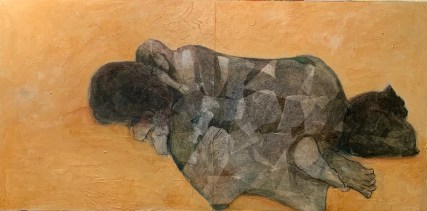
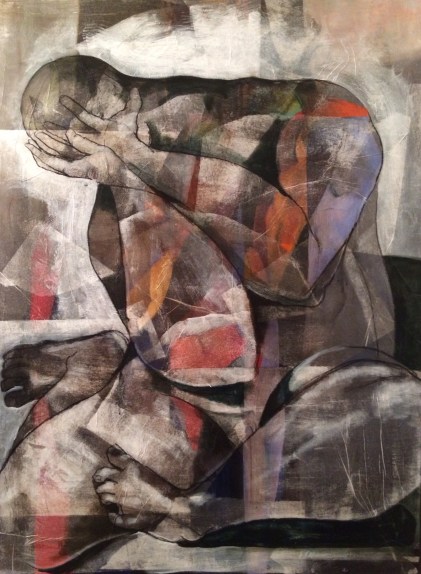
weeping man ©️ 2015 david robinson

Keep Playing [on Two Artists Tuesday]

tendonitis copy

As I reported several weeks ago, if you where standing on the far side of the piano, you’d never know Kerri was playing with casts on both of her wrists. You’d never know that she was playing with two broken wrists, her right thumb completely out of the line-up. Nine fingers doing the job of ten.

As a composer, singer-songwriter, a person whose entire career, her livelihood, has been about playing the piano, she was at the keyboard four days after her fall. She had to know if she could play. I couldn’t believe my eyes or my ears. In my best mother hen voice, I suggested, “Maybe you should wait a bit.”

“I have to know,” she said with THAT tone in her voice.

When I first met her, I took note that she stands when she plays the piano. She is not a bench sitter. Rather, she is a full-body player. She is a full body composer. Sometimes the piano literally hops with the force of her playing. She is little but grows exponentially in energy and presence when she steps up to the keys. The first time she played for me I had to step back from the power that came through her.

Now, several weeks into her mending time, the casts are off and the splints are on. I tell her that they make her look all Mad Max. Michael Jackson’s glove is bush-league compared to her performer-fashion-statement: double black splints.  She looks like a pugilist getting into the ring with her piano. The disparity between her bruiser-piano-vogue and the beautiful music she creates makes my head swirl.

Of course, all of that piano punching has brought a new hurdle in the wrist recovery saga: tendonitis. She went on a Google frenzy when the hard nodules began forming in her palm. They hurt. “My palm is on fire!” she said, “What do you think they are?” Google inflamed her already wild imagination with horror diagnoses and none of the scenarios were good. In fact, they were downright dire.

Doctors were called. Photos of palms sent. A scary foray into the medical facility mid-pandemic was arranged. She emerged from the facility, pulled off her protective mask and climbed into the truck. “Well?” I prompted.

“I didn’t touch anything,” she announced.

“I’m asking about your hands,” I huffed. “What did they say about the nodules growing in your hands?”

“My tendons don’t like that I’m playing with casts,” she said. “Probably tendonitis.”

“That’s good news!” I said and she hit me with THAT look. “Okay, so. Well. Not great news. What are you supposed to do?”

“Keep playing,” she said, looking out the front window. “They gave me some exercises. Advil. But, I keep playing. What else can I do?” she asked, a question not to me.

“Good then. You’ll keep playing.” My mother hen suggestion went unvoiced: maybe some rest? I didn’t want to be hit with THAT look two times in a row. Instead, knowing full well that she is not a bench sitter, knowing that she is a full-body artist and that, for her, to play is to heal, I said, “Okay. Let’s do it. Let’s keep playing.”


read Kerri’s blog post about THE SAGA CONTINUED


their palettes website box copy

See Anew [on Merely A Thought Monday]

baconwrapped pears copy

It seems that everything during the pandemic is a study of circumstance-driven-change. For instance, I am a painter of people. I’ve never been interested in still life studies. Even in school, I cringed at the bowls of fruit placed before us by the instructor. Shape, shade, blah-blah-blah. Give me figure drawing any day! Suddenly, to my great surprise, I am photographing big bowls of fruit. They are gorgeous. I’m thinking about a painting featuring fruit.  What’s happening to me?

The devil is in the pandemic detail. We used to go to the store everyday. We used to buy what we needed for the next 24-48 hours. There were no big piles of fruit, no explosions of color in the fruit bowl or waves of color rolling across the counter. Now, in the time of pandemic, we stock up. We are – like you – buying massive amounts of bananas and oranges and apples and pears. They are, to an artist’s eye, when assembled, simply beautiful. They are, I suspect to an accountant’s eye, also beautiful, but my thoughts stray beyond merely eating.

Beautiful.

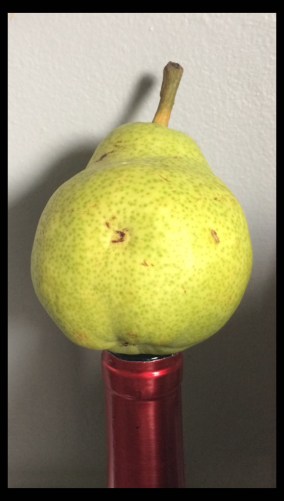
We are also in a fit of food experimentation. To delay our need to go into the wild COVID world and shop, we comb the empty larder, asking “What do we have? What can we make with what we have?” We throw our random ingredient list into the Google pool and voila! Yummy options emerge. Bacon wrapped pears. Oh. My. God. It never would have occurred to my bear-brain to wrap a pear in bacon. I savored it. I moaned. My eyes rolled back in my head.

Beautiful. Delicious.

When you study change processes, you bumble across something akin to a rule. It goes like this: if you know where you are going, then it is not really change; it is controlled reordering of what already exists. It may look new but is really the same old wolf in new sheep’s clothing.

Change is what happens when you step into unknown and strange lands, when all of the old points-of-orientation are gone. Only then will you step into something new and surprising. Only then will you see without the old dulling filter. For me, apparently, change looks like a big bowl of beautiful fruit.


read Kerri’s blog post about BACON WRAPPED PEARS


banana copy

Look Again [on DR Thursday]

EARTHInterrupted7.THIS ONEJPG copy 3

It’s all a matter of context. As it stands, this is the seventh painting in a series I call Earth Interrupted. This piece would not exist today except Kerri stopped me from painting over it. She likes it. I find it dark. Foreboding. Of the seven paintings, it is the darkest piece in the series. When I painted it, I didn’t know how to place it – I didn’t know its reference point. It wasn’t and isn’t comfortable.

I pulled it out of the stacks last week. Now, in this time of pandemic, I know exactly what it represents. Everyday in the news I see a graphic of the virus. It is dark and foreboding.  Earth interrupted.

In an earlier version of myself I spent a great deal of time trying to educate educators to this simple truth: art is not supposed to be entertainment. It can’t always be comfortable. In fact, it holds diminished value if it doesn’t sometimes challenge, sometimes upset, sometimes confront, sometimes incite. Art is powerful because it confronts us, asks us to question what we see and think and believe.

And now, looking at this painting that makes me uncomfortable, I find it necessary to listen to that earlier version of me. This painting is beautiful, not because it makes me feel good or takes me away, it is vital because it upsets me. It lands me squarely into this inescapable moment in time.


read Kerri’s blog post about E.I. 7


k&dbw backs website box_ copy


earth interrupted vii ©️ 2018 david robinson

Add A Stone [on Not So Flawed Wednesday]

southport cairn copy

I am fond of a labyrinth tucked into the woods at The Whidbey Institute. I’ve spent many a sunrise and sunset walking the meditation path to its center and back again. After each trip into the labyrinth, I’d add a small stone to the cairn that stood adjacent to the entry point. A ritual to mark my passage. A location stone.

I hadn’t thought of the labyrinth for years.

Last week, on a stormy day, we took a long walk through our neighborhood and emerged on to the beach at Southport.  We were stopped in our tracks by what we found there. A field of cairns. Someone – or many someones – had created dozens of stacked stones. Each unique. Some playful. Some sorrowful giants. Markers of the way home? Funeral stones? Sculpture merely? The intention didn’t really matter. They brought us peace.

We approached silently just as I used to approach the labyrinth at Whidbey. We entered the field with a reverence that surprised me. We wandered through them, spent time with them. Some were massive, towering over us. Some very small, a few stones stacked at our feet.

Pebble and red brick trails ran like crazy lines connecting the cairns, a mixed up maze that begged us to follow, to make sense of the impossible. This labyrinth had no center. This meditation maze led nowhere specific, looping back, a dead end here, a path to the water, and over there, a line that stopped at a heart made of rock, a spiral. A wish. A message. An inspiration.

I could imagine no better monument to this pandemic. A shattered labyrinth. Burial monuments. A field of markers standing ready for the day when we might find our way out. A quiet reverent place where we are called to add a stone, a simple gesture to remember our passage through.


read Kerri’s blog post about CAIRNS


cairns website box copy


Look For The Manatee [on DR Thursday]

canopy copy

This has never been Kerri’s favorite painting. When I chose it for this week’s melange I asked her why she didn’t like it. She said, “Because there’s a manatee in it.”

“A manatee?”

“Keep in mind,” she said, “that I’m inkblot challenged.”

Wait. What?

Responding to the blank look in my eyes, she added, “I could never see Jesus in the pancake. Stuff like that.”

“The pancake?” My synapse fell short of the hoop. She Googled inkblots to demonstrate her disability.

“See (she pointed to an inkblot on the screen)! There’s Florida and I’m supposed to see Jesus. Wait. Oh. There he is. Wait! There’s a lot of stuff in there!” she marveled, squinting at the blot.

Blink. Blink.

“Oh! Maybe it’s that I see too much stuff in the inkblot!

I pulled up the image of the painting. “It’s called Canopy,” I said. I enlarged the image.

She looked close. “Wait. That’s not a manatee!” she exclaimed. “That’s a person’s leg!” She looked closer. “Hmmm.”

It is, after all, what I love about art: It is never complete. It emerges anew with each new look, each new performance. What I intend has very little to do with what is perceived and in that space between artist and audience, a new creation, a new conversation arises. Imagination is like that. It opens worlds of surprising possibilities. It projects itself into the known, into the painting, and magically transforms it.

“So, you don’t like manatees?” I tease.

“I love manatees!” she huffs. “Just not in your paintings.”


read Kerri’s blog post on CANOPY


not our best morning minturn website box copy


canopy ©️ 2009 david robinson

Let It Spin [on Two Artists Tuesday]

perspective copy

The answer to “Who Am I?” is mostly a matter of perspective [or concoction, depending upon your perspective ;-)]. As much as we might want it to be, who-am-I is not a fixed state of affairs. Thankfully, we are not as narrowly defined as we want to believe.

We constellate together some identity-fixed points (son, father, banker, artist, gardener…) that give general shape to the who-am-I inquiry.  Mix in a few subsets: competitive, passive, rich, poor, successful, homeless, handy, all-thumbs… and there’s some nice variation giving color to the primary fixed points.

For some real fun, factor in the changes of identity that happen over the course of a lifetime. Who did you understand yourself to be at 10? At 20? At 30? Dear friends just became grandparents; their entire universe is spinning. Who are they now?

I have had moments of triumph that turned to dust in my mouth. What looked like fulfillment was, in fact, an empty sack. Once, thinking I was looking good, I walked headlong into a glass door. Instant fool. Identity is much more fluid than fixed.

In the Buddhist tradition there is a “Big Dipper” exercise. From our perspective on the earth, there is a constellation of stars that form a big dipper in the sky. But, travel toward that constellation, the image of ‘big dipper’ starts to warp and then falls apart altogether. The position of the stars does not change. Our perspective does. The constellation is nothing more than an illusion. Mostly, my constellation of fixed identity points is nothing more than an illusion.

These days I’m thinking much about my illusion and attachment to my fixed points. My move to Wisconsin came with career death and I spent more than a few years grasping for the lost stars in my constellation. New stars appeared. I became a husband. I have two ‘given’ children. My beard has become grey. Yesterday, to my utter amusement, I found myself concerned with fallen leaves staining the patio and had thoughts of immediate raking. What has become of me? In the past week, I’ve awakened more than once with this thought: What if the painting on my easel is to be my last. It’s not finished and it’s an utter mess! I want to leave a better last impression! I have more work to do!

And then, I wondered, what if, as I travel out beyond the constellation, this image of myself, this part of me that I call ‘artist,’ matters not at all? Fluid, not fixed.

And so, my perspective spins, more anchor points fall away and the entire universe opens.


read Kerri’s blog post about PERSPECTIVE


handshadowstones website box copy

Hope [on KS Friday]

hope (spring) copy

Chris wrote, “So this is what a pandemic feels like.” He is a brilliant actor, the artistic force behind Sea Dog Theater, living with his wife and two children in New York City. I was worried about him and his family. “Overall, we are okay and grateful. It’s scary. And when we aren’t thinking of just our family, we are trying to help artists who’ve lost everything; creative gigs and day job wise.” Artists generally live on a thinner margin than most people.

It is what I most love about the people who populate my world: they think of the needs of others. They seek meaningful ways to help, to support their community. It is, when all is reduced to the essence, what makes an artist an artist. It is what makes a human being a human being.

We were on the raft choosing the images and music for this week’s melange. Kerri asked, “What about HOPE?” I laughed at the double entendre. Yes. What is most needed in these times of pandemic?

Kerri’s HOPE – like the yearning it reflects – enters the world quietly. It is a sturdy force that warms the heart but does not call attention to itself.  It will lift your eyes beyond the scary and refocus them on possibilities. Ways to help. Hope.

Chris added, “We are healthy and together, which is most important.”

From our seclusion, healthy and together, to yours, Kerri offers her HOPE.


HOPE from the album THIS SEASON is available in iTunes


read Kerri’s blog post about HOPE


tpacwebsitebox copy


hope/this season ©️ 2005 kerri sherwood

Answer The Call [on DR Thursday]

Eve copy 2This painting makes me laugh. It is an inside joke [in my exclusive club of one], a mash-up between Newton’s apple and the variety enjoyed by Eve. The apple, in both stories, is a symbol for knowledge – or, better, that most human of characteristics: curiosity.

Curiosity is piqued when forbidden. Isn’t that the point of Pandora’s box or Eve’s apple? That piece of symbolic fruit is better understood in a greater illustrative context (making it, therefore, useful): in the story, there are two trees in the allegorical garden, 1) a tree of knowledge and 2) a tree of everlasting life. To “know” requires separation. Eat of this apple and you will forever discern between this and that. With this apple comes self-knowledge. You will “know” rather than simply “be.” You will, in your separation from your Self, spend the rest of your days attempting to get back into the garden to eat from the other tree (unity, wholeness, no-separation,…purpose, meaning, etc.). It’s a parabolic life cycle. Don’t bite that apple, I dare you.

The other apple-of-legend knocked some insight into Newton. “And, why did that apple fall straight to the ground?” Newton asked himself. His answer: universal gravitation! Every body in the universe is attracted to every other body with a force that is directly proportional to the product of their masses and inversely proportional to the square of the distance between them [my comprehension and advanced math stopped at the word “force” so the rest of the law is yours to sense-make]. This apple was most welcome!

In both cases, I imagined, seated in front of my easel, that both the symbolic Eve and the actual Sir Isaac, in their respective apple moments, looked to the sky and uttered, “You have got to be kidding me!” And, so, curiosity calls.


read Kerri’s blog post about EVE


sunsetonisland website box copy

eve ©️ 2004ish david robinson


Plant What You Love [on DR Thursday]

K.Dot Dogga Close Up copy

“All that we are arises with our thoughts. Speak or act with a pure mind and heart and happiness will follow you as your shadow, unshakable.” ~The Buddha

What is it to speak or act with a pure mind and heart? I’ve often thought about Don Miguel Ruiz’s 4th Agreement: be impeccable to your word. He writes that being impeccable to your word is the most self-loving thing you can do. Mean what you say. Say what you mean.  And, beyond that, say nothing. How often have I said something I didn’t mean? How often have I done something out of anger or spite or fear that I knew I would later regret?

Pure (adjective): free of contamination.

Wayne Muller wrote a book I admire, How Then Shall We Live. In it, he asks four questions. The second question is, “What do I love?” He writes that “we must plant what we love in the garden of our lives.” Plant anger and you will grow anger. Plant generosity and you will grow generosity. Nurture reactivity and your garden will run amok with weedy reactivity. So, self love: say what you mean and only that. Mean what you say and only that. Jay made me laugh out loud when she told us what she used to say to her young students: “You can think it in your mind but don’t let it out of your mouth.”

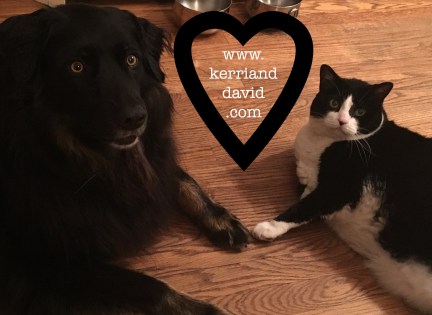
Horatio told me that I needed to get back into the studio, even if it was only to sit and sip a glass of wine. I took his advice. On the easel was a canvas with the trace of an image that I had sketched and then wiped clean. On a cold autumn day, DogDog and BabyCat asleep on the bed, Kerri (pre-broken wrists) crawled between them and cuddled with DogDog.

An image of what I love. In this time of high anxiety, anger, division and fear, in the quiet of my studio (which induces quiet in my mind), perhaps my entry back into painting should be attention to my garden. In this first image, I will plant what I most love.


k.Dot Dogga BCat copy


read Kerri’s blog post about SKETCHES


cropped head kiss website copy