Laugh At Yourself [on DR Thursday]

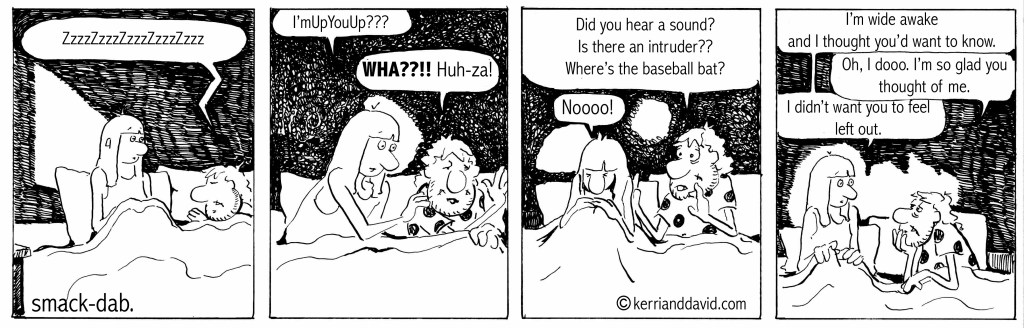
Had you come across our website during the era of The Roadtrip, a play that Kerri and I wrote from the several-months-email-conversation we had before we first met face-to-face, you’d have read this phrase: smack-dab in the middle of middle age…a true story of quiet hope and the arrival of life’s second chances.

Smack-dab. In the middle of middle age. We met. We married. We walk the neighborhood arm-in-arm. We write these blog posts each day. She brings her wise-eyes into my studio and I tell her what her music makes me feel and think.

For an intense year or so, we tried-like-crazy to syndicate a cartoon strip called Chicken Marsala, the imaginary child of two people who met smack-dab in the middle of middle age. In the course of writing and drawing Chicken, we also pitched a single-panel cartoon, Flawed, and another called At The Door. Chicken Marsala had several iterations because the syndicate liked it…almost. They asked for improvements though never specified what those improvements might be – in the writing? The art work? In this age of too much information, no answer ever came back to us.

In the face of unspecified and uncertain improvements, this ONE thing is certain: we generated a mountain of material in the hunt for the elusive improvement. Oh, and this, too: we laughed heartily at ourselves. The mountain of material was about us. We were poking fun at the things we do and say each day.

This morning I found Kerri furiously working at her computer guffawing. She’d pulled up the old Chicken file. There was an iteration of the strip that was pre-Chicken, the middle-aged couple prior to the appearance of their imaginary son. We sat this morning and laughed again at ourselves. These things actually happen and how joyful is it to chronicle yourself in-and-as a cartoon?

I suspect we are going back to the drawing board. This time, we’ll not hide behind our imaginary son. This time, we’ll pull the blankets on the source. Smack-dab. In the middle of middle age. Two artists met and got married. What could be a better set-up for ridiculousness?

read Kerri’s blog post introducing SMACK-DAB

*don’t believe a word she writes, she guffaws all of the time.

smack-dab ©️ 2021 david robinson & kerri sherwood

Consider The Intention [on Merely A Thought Monday]

My least favorite character in Romeo and Juliet is Capulet, Juliet’s father. A few years back I thought it would be a good exercise to tell the story from his point of view. In his world of privilege and order, he has an out of control daughter, a teenager no less, ignoring the rules of the house and society, having sex with the son of a sworn enemy. He imagines a better future for her (and himself) and has worked hard to protect her and match her with royalty. Like every parent I know, he just wants his daughter to behave and thrive.

Every story has an agenda. That’s true of the stories we tell of ourselves at parties, it’s true of the stories we shout at each other when we are having fights, it’s true of the stories we tell when we are falling in love, it’s true of the stories we tell when breaking up. Every story has at least two sides and each side has an intention.

Stories are never neutral or passive. It’s precisely why Blind Justice is so important to the health and well being of a society: between two opposing/competing stories there is a point of equilibrium that we call “fact” or “truth.” Blind Justice carries a scale to symbolize that place of story-equilibrium, ideally free of status, privilege, sway…weighing the stories to arrive at fairness and equity.

Health is the capacity to consider the other side of the story.

It is the truly despicable character that steps with intention into the gap between competing narratives solely to create discord. To lie for gain. Iago is just such a character. He creates an illusion with no greater intention than to hurt, to destroy. Desdemona dies. Othello murders because he cannot see through the lie Iago is telling. Othello’s love turns to hate. He cannot or will not hear the other side, the love story, the truth of Desdemona.

Hatred is a territorial flag planted in a one-sided story.

The modern GOP is Iago. Othello is a cautionary tale relevant in our times. What or who will be murdered before the lie is laid bare?

I have always been a lover of myth and parable, stories that reach with intention to deeper truths. It is why I stepped into the theatre in the first place. Art, like Blind Justice, uses story to reach deeper truths, truths that can rarely be captured in words. It’s the paradox of art and truth is always found there.

No story has a single point of view. No truth is singular – that is the hallmark of the truly important challenges that every society faces. It is why successful governments tell their story with truth as their intention. It is why successful relationships sail through stormy seas. The intention is pure. The desire to stand in the shoes of the other-side-of-the-story is genuine and necessary in order for the relationship, the community, the country to thrive.

Capulet is not a bad man. He has good intention. The play ends when he becomes capable of standing in and considering the other side of the story. Hope and equity is the promise rising from the pain.

Iago, on the other hand, is a wholly different story. His play ends in a cage with a nasty celebration of the pain, death and havoc he’s wreaked, gloating about his capacity to snare others in his big lie. All are made fools.

read Kerri’s blog post about THE OTHER SIDE OF THE STORY

Appreciate The Marks [on DR Thursday]

Life leaves marks. When I look in the mirror these days, I see my grandfather staring back at me. Or, to be more accurate, I see aspects of both of them, all akimbo in a variation that I now recognize as “me.” The topography of DNA, crafted by my unique life, now sketched into my mask.

Quinn left marks in me. So did Tom. And Doug. And Kathy. I could go on. The list of amazing humans who had a hand in shaping my perception, molding my thinking, in informing my walk through this world, is lengthy. They are my fortune, the gold in my pocket. Their marks serve as my credo, define my intentions. Their marks have become the scale upon which I weigh value and importance. Laughter, according to their marks, carries enormous weight.

As we carried boxes out of the house, I couldn’t help but notice marks on the walls, scuffs on the floor. Each marked a memory. When the movers lifted the couch, its impression in the carpet was deep. It had sat in the same spot for years. In its absence, the entire space reeled. Soon it would find a new equilibrium as another family sculpted the now empty space. They will, no doubt, remove the carpet. The impression is too deep, the placement and accompanying memories are not theirs. Erasure is the necessary first act of new inhabitants. Eliminate the marks. Paint. Sand. Demo. And freshen. Clean the palette.

Leigh is an authority on rock art. Cave painting. The marks left by humans. Prophesy and map. Ritual and graffiti. Not all cultures are obsessed with leaving marks. Many try not to. My relationship to my marks, my paintings, changed the day I helped carry Duke’s brilliant paintings out of his basement. He’d passed and now the question was, “What do we do with all of his paintings?” I knew, someday, someone would ask the same question of my paintings. Carrying his paintings up the stairs and stacking them in the truck, I became less invested in the notion that my paintings, my marks, need matter. They no longer need to transcend me. They are immediate, fulfilling for me and perhaps me alone. That is enough. Bits of ego easily fall off when the perspective of age comes calling, when the marks are undeniable.

Marks fade. Life is what is happening now. A cliche’ that could not be more relevant. The couch, seemingly so permanent, will someday be hauled out. The marks will remain for a while. Only a while. And new life will move in and fill the old space, as it should.

read Kerri’s beautiful blog post on IMPRESSIONS

Touch The Walls [on DR Thursday]

A Haiku

I wander the house

touching boyhood memories.

Stories pour from walls.

read Kerri’s DR Thursday Haiku

Come Look! [on Two Artists Tuesday]

“The artist finds, rather than creates and controls.” ~ Declan Donnellan

I’m not sure when I began including floral shapes in my paintings. I’ve always appreciated the shape of symbols and shapes as symbols. One day in my Seattle studio, I lined the walls with my most recent paintings and was surprised to discover leaves and plants and stems etched into figures and the spaces. My charcoal and paint flora was generic; they were not studies of plants nor in any way representational. They were shapes. They were accidental.

Even when my plant-shapes became intentional they remained generic, improvisational. I didn’t go outside and study the shapes of leaves. It never occurred to me to step into the field next to my studio and look at the plant life. I’m slow that way.

And then I met Kerri. We walk almost every day. While my mind wanders into the ethers and gets lost in the sky, she is busy looking at life’s minutiae. She stops often and takes photographs, usually of a tiny treasure. A forest flower. The bud about to burst on a limb. A butterfly nestled into the leaves. “Look!” she exclaims and kneels on the path, camera in hand. She navigates thorns, wades into tall grasses, climbs over rocks, all to get close enough to see, really see the miniature miracle.

Because she sees, I see. She is single-handedly responsible for my ongoing Georgia O’Keeffe revival. And what I’ve re-learned as Kerri beckons me to, “Come Look!” is that my vast imagination is not capable of creating the amazing shapes and colors and delights that surround me. I’ve been walking through this intense world of marvels my whole life and noticed only the smallest slice. The best I can do is pay attention and dance with what I find.

It’s humbling – as it should be. I’ll never be a better creator than nature because I am a creation of nature. In fact, I realize again and again that my job as an artist is not to create, it is to discover what is already right in front of my face. To open eyes – my eyes and others’ eyes – to the enormity of what already exists. The wild shapes, the dancing colors, the glow of life that I’ll never be able to capture, no matter how great my technique or pure my intention. The best I can do is point to the mystery, with symbol, shape and color, and say, as Kerri does for me each and every day, “Look! Come Look!”

read Kerri’s blog post about SUCCULENTS

Add Another Layer [on DR Thursday]

Were you to meet my easel in a dark alley it would, no doubt, frighten you. It’s big. Substantial. Rough. Weathered from hard life. Knobby, bent and encrusted.

I see it with different eyes. It is one of my most sacred possessions. It was given to me, a gift of celebration, following the opening of my very first solo show. Prior to its arrival in my life I propped my canvas on chairs or tables, I leaned them against walls, kneeling to paint. My easel allowed me to stand.

Caked in charcoal and layer upon layer of paint, artifacts of the hundreds of paintings that it has held for me, I find it beautiful. It has traveled with me through many states and life stages. Its main support is bent. It creaks when I adjust the angle or drop the arm. It occurred to me this morning, as I rebuild my studio following the great flood, that I also creak when my angles adjust, when my arms drop. We’ve aged together.

In a life with very few constants, my easel has served as my single steadfast companion through every move, every triumph, every tragedy. It has stood with me when I was artistically productive and a barren wasteland. It’s listened to me rant, ramble, and recite. It’s been witness to my laughter and my fears. It has been the silent sentinel during my mini-deaths and slow rebirths.

This morning, as I carried my easel back into the studio, I realized how out-of-order my world has felt. If my studio is in disarray, as it has been since the flood, I am also in disarray. Returning my easel to its proper spot in the studio I felt a flood of relief. All of my pieces are nearly put back together again. My trusty companion, my reliable easel and I will soon stand together, paint will spatter, charcoal and matte medium will crust another coating onto our already layered archaeology.

Art hollers. Possibility beckons.

read Kerri’s blog post about the EASEL

Complete The Ritual [on KS Friday]

One of the strangest rituals in directing plays comes in the closing hours of tech rehearsal. It is the final button, the cherry on the sundae; the last detail before the addition of the audience: choreographing the bow. The mechanics of gratitude. The curtain falls. The audience claps. The actors return to the stage to accept the appreciation. It’s important, in that moment, to know what to do and where to go. It’s important to know when to bow and when to vacate the stage.

It’s a mechanical moment made generous – made real – when the audience arrives. After having been led through a story or gifted with a performance, the curtain falls, the audience claps in appreciation. The actors, relieved and filled with gratitude, return to the stage and bow in thanks. Appreciation meets appreciation. The strange ritual of the previous day becomes the point of the whole exercise. Without the other, audience and performer, the storytelling is empty. We complete each other. We acknowledge in appreciation this absolute truth. My story is nothing without your witness. Your story is incomplete without my story. You applaud for me. I bow to you.

A major purpose of the artist is to remind the community of this truth. We are nothing without each other. We are capable of walking into impossible questions, when, together, we gather to share and complete a story.

Artistry is a service industry. It is humbling. It is meant to be humbling.

I sit staring at the screen. I am rewriting a script, a piece I performed with a symphony in 2008. I was terrified until the conductor lifted his baton. I remember very little after the first note was played. I came back into my body the moment the music concluded, my story told. The applause. I’ve never felt so small. I’ve never felt so full. Both.

The conductor wants to perform the piece again in 2022, only he asked that I revise the story, something that will speak directly to the issues of our times. The mechanics of writing. A strange ritual, this staring at the screen. I know the story I want to write. I wonder if I am up to this task. And then, I remind myself that this question, “Am I up for it?,” is the wrong question. It leads me to believe that I am alone in this creation. Of course I am not up for it! But, together, with the musicians, the conductor, the audience… Someday, after the mechanics, the rehearsal, the revision, the final button of preparation, we will gather and together, we will walk into impossible places, ask questions too big to be answered. Together, we will join hands and share the experience of a story. The curtain will fall. The audience will clap. The performers will bow. We will remind ourselves, as this strange ritual completes itself, that we are nothing without each other.

[I love this sculpture. Kerri keeps it close by her piano. The Bow by Duke Kruse.]

kerri’s albums are available on iTunes

See The Invisible [on Merely A Thought Monday]

“Oh my gosh!” She whispered. “These remind me of my mother!” She quickly pulled her camera from her purse and, to the amazement and amused curiosity of our fellow grocery shoppers, we had a straw-plate-holder photo shoot at the end cap of aisle 9.

It is, of course, among my favorite aspects of going through life with an artist wife. Everything is a story-thread. Everything is a possible composition, an opportunity for beauty. Everything is immediate. It is utterly unpredictable when the muse will strike. And, the immediacy of capturing the moment usually draws a crowd and she is blissfully unaware of the ruckus her immediate-story-composition creates. She is a rolling storm of performance art. I am the lucky one who gets to watch both the artist and the audience.

Augusto Boal, one of the developers of the Invisible Theatre, would be most proud of the unintentional performances Kerri creates. In an everyday setting, everyday life, a performance snaps an audience into awareness, shocks them out of their dulled sensibility, an audience that has no idea that it is functioning as an audience. Many stop to watch the crazed lady snap photos of straw-plate-holders as she tells sweet stories of her mother. Many scurry for the safety of anonymity. Either way, either response, a pure theatrical event takes place.

The performer scrutinizes her many photos, completely unaware of her performance. As she places her camera back in her purse, the audience immediately disperses, hopeful not to catch the attention of the performer and somehow be called into the play. They fold themselves back into the normalcy of their day.

But, something has changed. They have a story to tell, an unusual event happened in their day. The performer has touched back to her deep story and through her photographs, plucked her heart-threads.

And I have been the happy witness to art and artistry. All are fed by these lovely, oh so common, straw plate holders displayed at the end cap of aisle 9.

read Kerri’s blog post about STRAW PLATE HOLDERS

Walk In Sync [on Merely A Thought Monday]

My Seattle studio was on the 4th floor. It was a corner space so I had windows on two sides. On one side, across the railroad tracks, were the stadiums. Out of the other set of windows I could see the streets that bordered the International district. People scurrying to and fro.

Many afternoons, working on a painting, I’d hear the roar of the crowds, touchdowns or home runs. The light rail pulling into the station. The Amtrak train pulling out of the station heading north. Sirens, car horns honking. I loved my studio because, although I was surrounded by the hustle and bustle of city life, I felt somehow removed from it, a witness.

Sometimes, when I was too much in my head or I could no longer ‘see’ my painting, I’d walk the streets. I’d wander to clear my mind or refresh my vision. I’d walk slowly, people rushing, rushing by. People trying to get somewhere. Trying-to-get-out-of-a-too-active-mind requires a much different pace than trying-to-get-somewhere. They are opposite actions. In my slow walk I’d feel the wind of impatience as people dodged around me. I was an irritant. I was a slow moving rock in a rushing river of humanity.

The wind of impatience.

I’ve always understood the artist’s role to be a witness, to live on the edges looking in. Master Marsh recently sent Wendell Castle’s “My 10 Adopted Rules of Thumb.” Rule # 2 is “It’s difficult to see the whole picture when you are inside the frame.” An artist’s job is to sit on the frame, to see and share what those inside the frame cannot see. Pattern. Movement. Illusion.

One of the first things I noted the day I met Kerri is that we had exactly the same stride. We were walking and our steps were weirdly identical. We strolled in sync. It made us laugh.

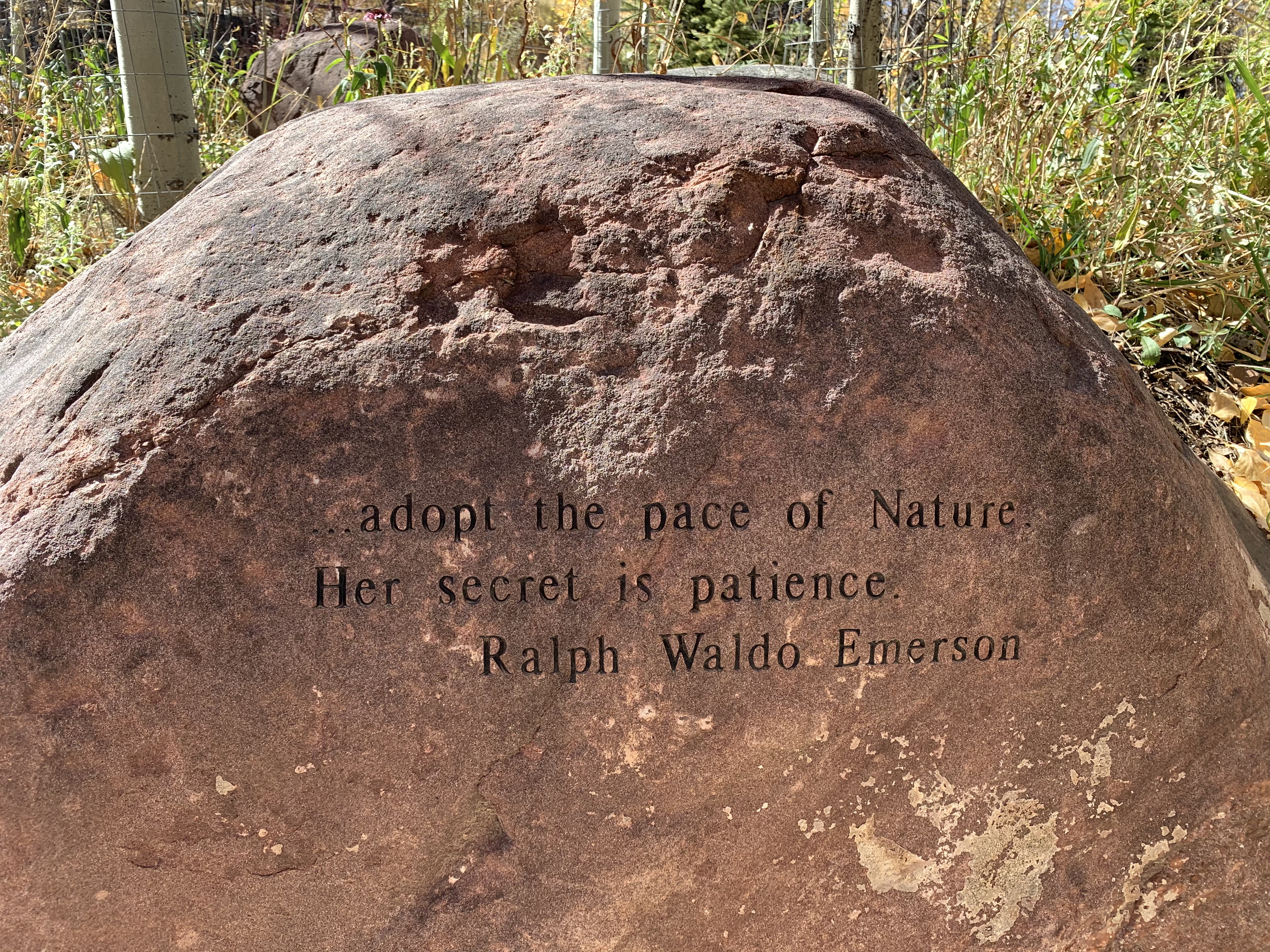
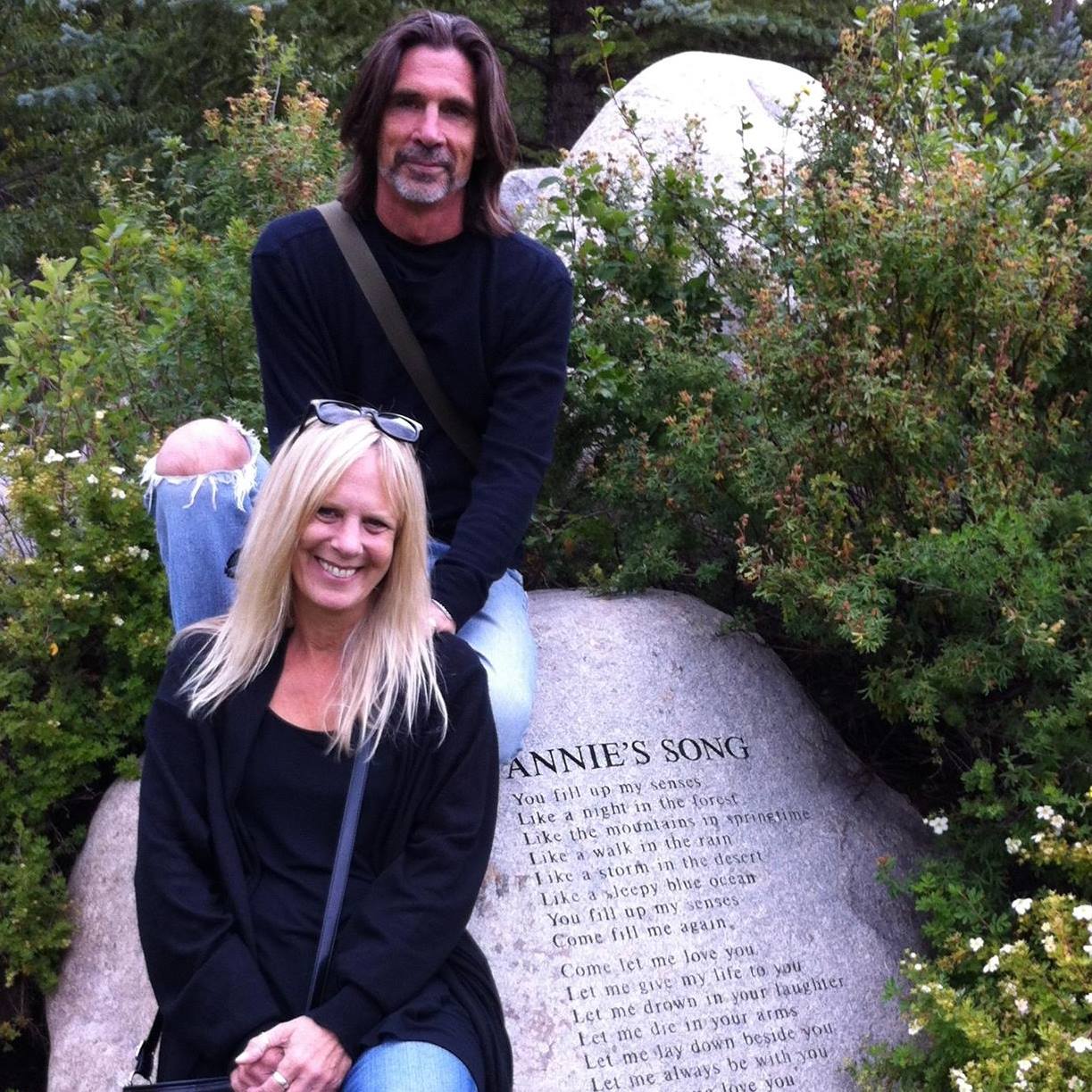
There is a special place in Aspen, Colorado. The John Denver Sanctuary. We make a pilgrimage to the Sanctuary when we travel to visit Kirsten. It is a place designed to make people slow down. Babbling brooks. Aspen leaves. Monolithic stones carved with the lyrics of John Denver’s songs, stones that carry the words of writers and artists and thinkers who appeal to the heart. It asks the visitor to sit for a spell. To listen. To breathe and see. To be, as nature teaches, no where other than here. It offers the gift of the artist: to fill-up with quiet before jumping back into the life-of-hurry-up-and-get-it-done. To remember what is natural and walk with exactly the same stride as nature.

read Kerri’s blog post about PATIENCE

Evolve And Laugh Heartily [on Merely A Thought Monday]

I find the notion of evolution to be hopeful. Evolution of species. Evolution of consciousness. I assume in my wild idealism that the evolution is toward betterment. Reading Ken Wilber’s thoughts on our chaotic and troubled post-truth times, we are, he suggests, in the throes of an evolutionary step. Evolution is not a smooth stepping dance. It’s more a stumbling forward drunkard.

Last week I posted about the lake in my studio and how the clean up facilitated a life-work review. I was surprised by how many notes I received from life-long friends asking me not to burn my paintings this time. I’d forgotten that, after my move to Seattle, I took most of my paintings and drawings to a fire pit on a beach and burned them. I had so much work that it took three days to complete the purge. That life-work-review ended in fire. This latest life-work-review began with water. I actually loved, post flood, going through my paintings. The paintings that went to the fire felt like a burden, a weight. From heavy burden to love; not a bad progression in my personal stutter-stepping evolution.

We drove to Colorado last October to see my parents. In his dementia, my dad cast me in the role of his college roommate and took me on a tour of the basement. We stopped in front of a large photograph taken at his parents 50th wedding anniversary celebration, a photo of the whole clan. He pointed to my twenty year old face in the photograph and said, “Now, I don’t believe you ever met this one.” It was true. As I listened to his description, I had the overwhelming feeling that he was right. Later, I returned to the photograph and visited that version of myself. I thought, “I think dad’s right. I don’t believe I ever met this one.”

The months that followed set the stage for my flood-inspired-work-review. I’ve discovered that I am more apt to be kind, more given to the positives, than I was a decade ago. Evolution has softened me. Or, opened me.

I’m not alone in reaching back, in sifting through the evolutionary drunken stumble to the present. This pandemic era serves as a marker-in-time as well as a great disrupter of pattern and path. It has inspired many a life review among those in my circle. Together, we ask the questions that have no answers, Quinn’s big three: Who am I? Where am I going? What is mine to do?

There are no answers but from time-to-time it’s necessary to ask.

There’s a fourth question that kept Quinn in stitches every time I asked it. What’s it all about? He’d howl and snicker and snort whenever the question came up. I am now the age he was when that younger version of me sat in his study and wrinkled my brow, disconcerted at his hearty laugh. Now, I know without doubt what’s so funny. I find myself laughing to tears when I hear the un-answerable-fourth-question. It’s about what you make of it as your illusion drops away in the course of your own personal evolution.

What else?

read Kerri’s blog post about EVER EVOLVING