Scratches On The Wall [David’s blog on Two Artists Tuesday]

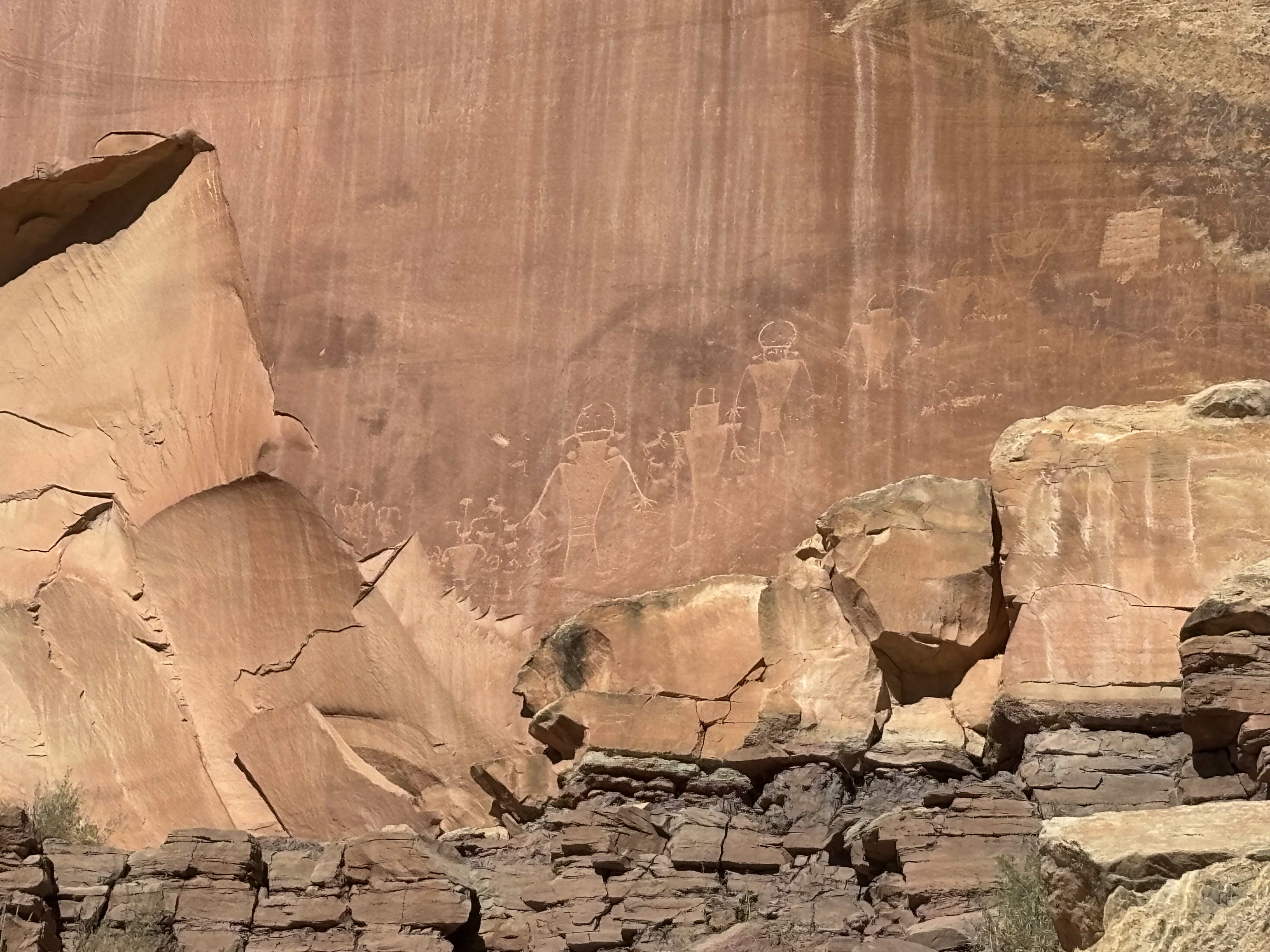
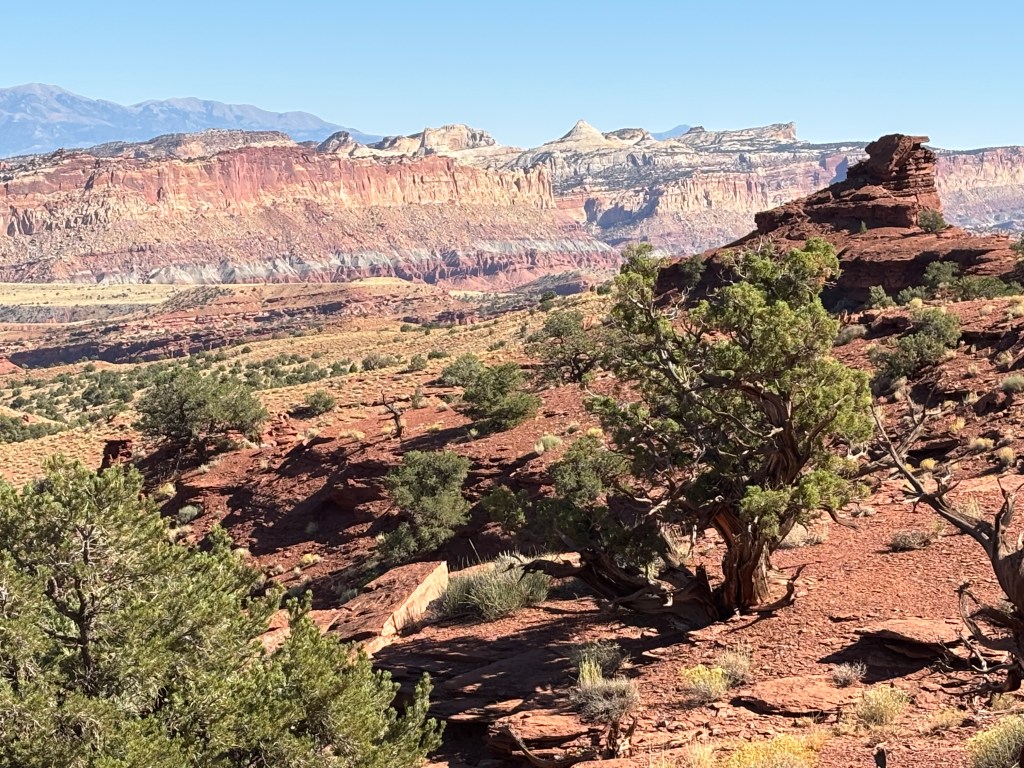
Scratches on the wall. Petroglyphs, the only evidence that remains of a people who once lived in these canyons, who lived by the river we’ve named Fremont. We do not know if they had a name for the river. We do not know if they had a name for themselves. We call them the Fremont, after the river. A location name.

The Fremont River is named for an American explorer, John Charles Fremont, so the people who scratched pictures into the rock over 1,000 years ago also carry his name. As is the nature of history, we locate them from our point of view. We build an identity-structure and civilization-story about them based upon our story of them. We’ve placed them in our narrative timeline, 1 – 1300 CE. We have no idea how they thought of or marked their time.

We have no idea what became of them. They disappeared into time. We have no idea what the petroglyphs mean or why they scratched them into the canyon walls. We wonder at the semiotics, the inner symbolic life that produced such strange (to us) images that remain on the red rock walls.

This morning, through my COVID aches and chills, I watched the news. I would like to say that I am mystified by the civilization-story currently being spun and supported by half of my nation but I am not. I would like to say that the hatred and fear-mongering of the red hat tribe is as much a mystery to me as the way of the Fremont, but it is not. The concurrent xenophobia and wild-eyed-creation of an internal enemy (anyone not in a red hat) has roots that are all too easy to see. It’s a fascist popcorn trail, a page from Hitler’s handbook. The language is identical. The images, scratched into the red-fox-walls of our time are all too easy to interpret. A frightened and misinformed populace is easily manipulated. Fooled.

What is a mystery to me is the inner symbolic life of my nation’s conservatives that seem so ready to trade our sacred democracy for a populist authoritarian. What scratches on the walls of their minds are so easily storied into hatred. What has so hardened their hearts that they embrace with cheers the repulsive bile spewed by their candidate? It is as incomprehensible to me as the petroglyphs of the Fremont.

All societies disappear into time. Ours, relative to the Fremont, is still in its infancy. We can only hope that an explorer in some distant future finds our petroglyphs – and although a mystery to them, we will have known that we transcended the authoritarian threat and overcame the fox-fear-fantasy, manufactured hatred and dark lies. And, over the next thousand years, our scratches on the wall tell the tale of how we matured to fulfill the promise of our sacred ideals. Out of many, one.

read Kerri’s blogpost about PETROGLYPHS

like. share. support. comment. subscribe…thank you.

Upside Down [David’s blog on Merely A Thought Monday]

We saw the sticker on the back of a traffic sign. “What’s the definition of hippy?” she asked.

Since she is a detail-girl, I Googled the definition. I am famous for making up definitions and she’s on to my game. I read aloud: “usually a young person who rejects the mores of established society (as by dressing unconventionally or favoring communal living) and advocated a non-violent ethic.” Or, “having very large hips.”

She frowned. “Do you have to be a young person to reject the mores of established society?”

“Are we young people?” I responded and she smiled. Always the rebel.

As we strolled away from the sticker I wondered about the mores of our society that so assumes violence as conventional that non-violence is considered – by definition – unconventional.

Sometimes this world seems upside-down.

The moment was made more ironic because, just moments before, every phone on the busy street rang with an alarm: there was an active shooter just six minutes drive away, a fifteen minute walk, and the police were locking down the area. Everyone stared at their phones and continued with their business.

What was the most unnerving? That there was an active shooter close-by or that no one was surprised?Everyone continued shopping. Violence as a convention.

“I think I want to be a hippy,” she said. Me, too.

read Kerri’s blog about HIPPIES

like. share. subscribe. support. comment. many thanks.

Find Hope [David’s blog on Two Artists Tuesday]

To say our weather has been weird is an understatement. It is February in Wisconsin and I’ve not yet used my snow shovel. I know that a mile or so inland there has been some substantial snow – some – but here, by the lake, not so much. We’re having rain and fog. Seattle in Wisconsin. The world just recorded the warmest January on record.

We just finished watching a three-part National Geographic series, Arctic Ascent with Alex Honnold. A scientific expedition across remote Greenland with two objectives: to gather data on climate change from arctic glaciers, and for Alex and his climbing team to make a first ascent of Ingmikortilaq, a wall 1000ft taller than El Capitan in Yosemite. Beautiful, extreme, unimaginable. Breathtaking. The lead scientist on the team, Heidi Sevestre, much to her surprise, finds hope in her research. Although the glaciers all around are melting at an rapid rate, the Daurgaard-Jensen glacier remains stable. “This glacier is holding on,” she said.

Holding on. Across time, human being have been brilliant at spoiling their nests. Societies disappear when they either pollute or exhaust their resources. Historically, we’ve rarely demonstrated the wisdom to change our behavior before losing it all. We are on track for a repeat performance, this time on a global scale, so it was curious that this single glacier, to date, was somehow impervious. Hopeful. “All is not lost,” Heidi Sevestre suggested.

Resilience. Tom used to tell me that he was often stunned by the resilience of some children. They were capable of transcending unimaginable odds, emerging from their fire with humor and balance and wisdom. “They give me hope for all of us,” he said.

Alex Honnold and Hazel Findlay, against all odds, climb an impossible wall. Heidi Sevestre finds impossible hope in the movement of a single glacier. “These are the people I want to emulate,” I tell Kerri. They are upbeat. Positive. Generous with each other. Generous because of each other. “These are the people who give me hope.”

read Kerri’s blogpost on FOG

comment. share. like. support. thank you.

buymeacoffee is a bit of hope in a steep upward climb.

Keep Your Nickel [on Merely A Thought Monday]

The second part of the quotes reads like this: “The ability to observe without evaluating is the highest form of intelligence.” It’s another way of saying, “Be in the moment.”

Being in your moment is harder that it sounds. Lately I’ve been pondering two Buddhist practices that came by way of Quadzilla. First, develop the capacity to discern between the fear raging inside and what’s actually happening outside. Unless there’s a tiger chasing you, the fear is most-likely manufactured. Second, learn to discern between what-you-feel and the story you layer on top of what you feel. Feel the feeling, chuck the story. Develop these two practices of discernment and arrive at equanimity: “mental calmness”, the ability to observe without evaluating.

The first part of the quote reads: “It is no measure of health to be well-adjusted to a profoundly sick society.”

Each time I scroll through the news-of-the-day I hear Tom’s voice in my head: “When I was a kid and the circus came to town I paid a nickel to go into the tent to see the ‘freak show.’ Cows with two heads, etc. Now, all I need to do is watch what’s on tv.” In his final years, Tom retreated to his ranch and spent his time cutting the grass and tending the land. He watched baseball games. For a time I was concerned with his isolation but now I understand it completely. He was a deeply sensitive man, a gifted theatre artist, and rather than grow numb to the “freak show,” to try and make sense of the sense-less, he put his hands in the soil. He watched the sunrise and sunset. He found his health in the quiet place beyond the sickness of the society.

Pasting the quote back together in proper order: “It’s no measure of health to be well-adjusted to a profoundly sick society. The ability to observe without evaluating is the highest form of intelligence.” ~ Krishnamurti

The lessons keep coming. Late in life Tom made the choice to keep his nickel and stay clear of the world concocted inside the tent. The world inside the tent is manipulated. It’s meant to rile, to confuse. He discerned between where to place his focus and where not to place his focus. Stay out of the tent. Focus on the soil. The movement of the sun. Family. Ancestry. Helping. Chopping wood. Carrying water. The real stuff.

Outside the tent, outside the made-up-horror-story, there’s no reason to evaluate [to judge]. It’s another way of saying “Appreciate your moment.”

read Kerri’s blogpost about KEEP YOUR HEAD UP

like it. share it. support it. comment on it. we appreciate it.

Find The Universe [on DR Thursday]


“There is nothing more truly artistic than to love people.” ~ Vincent Van Gogh

I don’t know why but Van Gogh is lately on my mind. He died at age 37. Most of his paintings came through him in the last few years of his life.

He wrote letters to his brother. That’s why we have so many of his words. His contemporaries thought he was mad. They had plenty of evidence of his mania so that was what they saw. Crazy Vincent making crazy paintings. Nothing serious. Swirls of color in an age of dreary.

Only a crazy man would assert that artistry is to love other people, right?

As a young man he was an art dealer and his experiences in the market drove him to become a missionary in Belgium. The art market drove him to religion and he found religion so depressing that he started to paint. This, of course, is my telling of the tale.

Like Vincent, run to the edge of society. Run to the very margins, turn around and look. What do you see?It’s enough to make anyone turn away from sane society and start painting swirls of color. You’re certainly crazy if you consider society and its politics sane. Right?

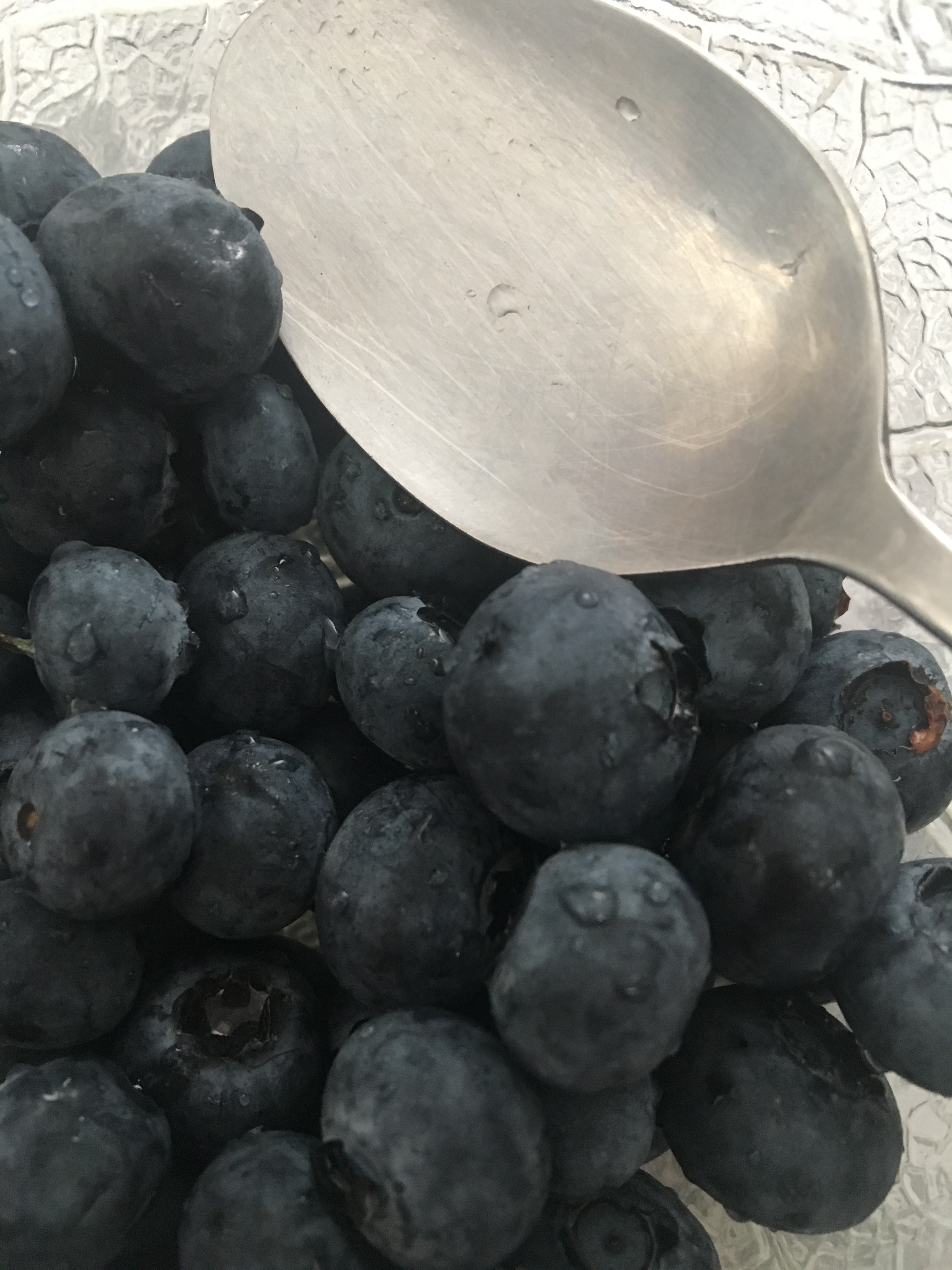
Vincent painted and moved further out, beyond the margins. Beyond the power games and posturing. The pretending-to-be. He left behind the Joneses. He found entire universes in simple things: sunflowers, the night sky. Bowls of blueberries.

He must, at the very end, have turned and looked back, again. This time seeing through the eyes of a painter. Was it wishful thinking that he saw artistry as love? Was it a prayer for humanity?

Oscar Wilde, Vincent’s contemporary, a man brutalized by the society that once adored him, wrote, “Art is the only serious thing in the world. And the artist is the only person who is never serious.” Oscar tried to live on the margin and in the center, all at the same time.

Love makes us giddy. It helps us drop our pretense and gaming. I think Vincent saw, not through the lens of madman, but life without a lens., into pure life, pure love. Swirls of color. Entire universes in bowls of blueberries and in other people. Artistry.

read Kerri’s blogpost about BLUEBERRIES

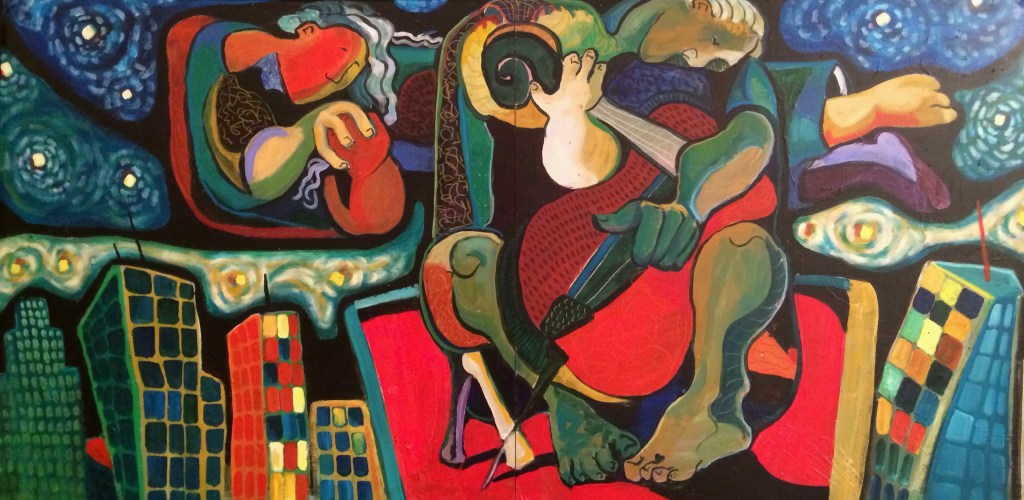
bass player © 2002 david robinson

Imagine It [on Flawed Wednesday]

Malidoma Somé wrote that a society with locks on its doors is a sick society. Something has broken down when a home needs protection from the other members of the community. Acquiring stuff takes precedence over honoring your neighbor. Can you imagine living in a community built upon mutual respect and trust, that valued and protected its members over its acquisition of stuff? Pie-in-the-sky? That might be the problem: we can’t imagine it.

Societies betray themselves. Despite the values inscribed in library cornices, despite the commandments we hold up as sacred ideals, we lock our houses against each other. We turn away when we see a person in need, their cardboard sign an appeal for help. The gap between the espoused and lived value-set is wide. In a society that claims greatness but practices mediocrity, is it no wonder that so much energy is dedicated to perpetuating a big lie? The lie is not the exception, it is the norm. The lock on the door.

Apparently, there is so much road rage on a particularly beautiful stretch of road rolling into Aspen, Colorado, that signs are posted giving travelers the number to call when the need for help is dire. Societies betray themselves. Why would a road through so much beauty, a road that dead ends in to some of the world’s great ski areas, a place where the elite retreat for some peace and quiet, why would there be so much rage on the road to such a place?

It must be a metaphor.

We tell a good story, that all are created equal, but we fight like hell to keep the full story untold. It’s happening now. Again. Still. Why are we so afraid to tell the whole story of a nation touting equality but built upon slavery and a rolling metamorphic racism? Like an individual, a society can’t address its problem until it admits it has one.

Gaps between espoused and lived values usually fill up with rage. Our gap is textbook. So many guns, so many locks on the door, so many patterns of violence and suppression that repeat over and over again.

Can you imagine living in a society that was proud of its story and need not dunk it in a lie? Or feast on an orgy of guns in order to feel potent and protected? Or post signs warning of the ubiquity of rage? That just might be the problem: we either can’t or won’t imagine it.

read Kerri’s blog post on ROAD RAGE

Call Her Anguish [on DR Thursday]

morsel copy

It was a long night. We’ve spent the last few evenings listening to a police scanner and watching live-stream reporting of the violence in our streets. We sit on our back deck and follow the swirl of helicopters, listen to the explosions, the angry voices in the street. We have a “go” bag packed by the door. We sleep with one eye open.

The Jekyll-and-Hyde pattern of our national protests has come to roost in our city, the epicenter a few blocks from our home. Peaceful protests by day; violent destruction by night. And, each night it gets worse. Each day I scan the heart-sickening savage call-and-response of an ugly divided citizenry, a crumbling society incapable of civil discourse.

I am haunted by an article written by Wade Davis. I’ve reread it a dozen times. I will read it a dozen more. Each day new quotes arise. After watching an armed militia strut up and down the boulevards of Kenosha under the pretense/delusion of protecting the city, stand cock-guard over a dry cleaning shop, and ultimately, one young militia member [too young to drink a beer in Wisconsin but not too young to sport an automatic weapon] murdered two and maimed one of the unarmed citizens they proclaimed to protect. Alice’s wonderland makes more sense than America’s implosion. This young man was not a citizen of our town or of our state. He brought his big gun across state lines to feed his white nationalist fantasy and ended the evening a murderer who will spend the days of his life in prison. What did he imagine might happen? Waste upon waste. These are the quotes from the article that today bobbed to the top:

“The measure of wealth in a civilized nation is not the currency accumulated by the lucky few, but rather the strength and resonance of social relations and the bonds of reciprocity that connect all people in common purpose.”

“The American cult of the individual denies not just community but the very idea of society. No one owes anything to anyone. All must be prepared to fight for everything: education, shelter, food, medical care. What every prosperous and successful democracy deems to be fundamental rights — universal health care, equal access to quality public education, a social safety net for the weak, elderly, and infirmed — America dismisses as socialist indulgences, as if so many signs of weakness.”

By his measure, we are a very poor nation indeed. Violent to the core because we eschew shared responsibility, shun a common center and refuse to deal with our issues.

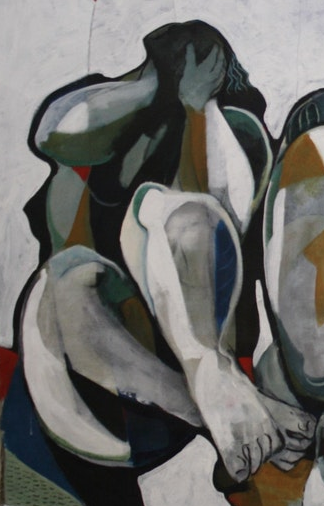
I asked Kerri to choose a piece for the Melange today. I was surprised because she selected a snippet from my painting, Three Graces. She’s not fond of this painting. Traditionally the Graces represent Muses: Brightness, Joyfulness, Bloom. Beauty, Charm, Creativity. It’s ironic.

Were I to name this fragment, this lonely Muse culled from her sisters, I think I’d call her Anguish. What else?


read Kerri’s blog post about ANGUISH


Three Graces


stick people website box copy


three graces ©️ 2012 david robinson

Make Better Assumptions [on Two Artists Tuesday]

go away 1 copy

As a kid, riding up the mountain to Central City (long before it morphed into a casino town) to visit my great aunt Dorothy and uncle Del, I’d always look for the hermit. With my face pressed to the window I’d scan for him.

Perched precariously high above the creek, his shack seemed in constant danger of sliding down the mountain. The only thing holding it in place was the cascade of rusting bean cans that he’d tossed over the edge after each meal. Decades of cans. And, every once in while, I’d catch a glimpse of him.

He was uniquely grey; his clothes, his long miner-forty-niner beard, his pallor. He was always standing still, looking over the canyon. I don’t think in all of my rare glimpses that I ever saw him move. I wondered if he’d just thrown a can over the edge. I wondered if in his moments of standing-stillness he pondered how he came to be the hermit in the canyon. If life forged him into a hermit or if he came into the world wanting to be alone. I wondered where he got his cans of beans. It was a great mystery that I spent long hours considering. Hermits are not known for shopping trips into town and it was long before the age of home delivery. Where did he get his money to buy all of those cans? Was he a wealthy miner, a Howard Hughes type who retreated into a paranoid seclusion? Who facilitated his solitude?

I am mostly an introvert so his retreat from society fascinated me. I’d try ‘hermit’ on like a costume. He wasn’t a monk though I wondered what he did all day; contemplation had to be on the list of things to do. I wondered if his shack was filled with paintings or wire sculpture, a reclusive Alexander Calder? A disenfranchised artist (now, there’s an oxymoron!) I wondered if his shack walls were lined with good books.

I wondered, if I climbed up the mountain to his shack, would he meet me with a shotgun and tell me to go away? Or would he welcome me and tell me that he’s waited a lifetime for someone to come for a visit? I liked the second scenario but the realist in me knew it would be the first. He was grey because he didn’t want to be bothered. He was alone because it was not safe to be in relationship. It’s always easier to close the door and growl than it is to open it and ask, “Can I help you?”

We see this sign often. It marks the door of a house on the road to one of our walking trails. In the absence of a canyon I suppose the only thing to do is paste your anger on your door. Every time I see this sign I wonder what would happen if love came knocking?


read Kerri’s blog post about GO AWAY


blackwalnut website box copy


Unify

a watercolor from 2003, House On Fire

a watercolor from 2003, House On Fire

Stay with me. I actually have a point.

If ever I teach actors again, or coach people in any endeavor, or communities/businesses seeking betterment, I will only have two things to teach: 1) Grounded-ness and 2) Focus placement on the unifiers. These two concepts are really  one looping concept but for ease and the sake of being understood, I will offer them independent of one another.

As focus placement goes, an actor on the stage has two options and depending on the focus placement they choose, they will either create the play or destroy it. A focus on how they look or sound or feel destroys the play. It is a self-focus in an art form of relationship (all art forms are made vital in relationship). A self-focus breaks the relationships and effectively locks the audience out of participating in the story. It makes the actor giddy with fear, easily distracted, alone. Conversely, the actor can focus outside of themselves, on the other actors on the stage, on the energy between, on their pursuit. An outer-focus creates relationships and serves as a magnet that pulls audiences into the story. It facilitates participation, creates relationship, and shared experiences. It unifies. Literally.

The actor who listens to him/herself pulls up their root. They unground themselves. The actor whose focus is outward, who is actively pursuing relationship, creates grounding. In fact, they must be grounded to create vital relationships. It is a first principle. Grounded-ness begets grounded-ness; it unifies. It strengthens. It invites. It clarifies truth.

The same principles apply off the stage or out of the studio. It is, however, more complex off the stage. It is much, much, more sticky.

And here’s the point: It has been said that nothing is better at uniting a community than having an enemy. It’s true. A common enemy provides an outer focus. It provides another team to defeat. It works so well that leaders across the ages, leaders who would otherwise look insipid, leaders who, like a bad actor, have a self-focus, a control need, have concocted all manner of enemies. It is a deflection. It works for a short while but what starts as false unity strips a community of its true binder. It separates and splits. It diminishes. It destroys.

Here’s the sticky part. One of the oldest tricks in the book for controlling a community is to split them, to locate the enemy within the community. And then, for good measure, magnify the split. In the early colonies – that ultimately became The United States of America – it was a strategy known as The Giddy Masses (see Ronald Takaki’s excellent book A Different Mirror). Make the people giddy with a false enemy. Uproot them. Deflect them so they cannot join in relationship and be strong as a community. Self-focused leaders cannot survive a unified, healthy populace. It is a strategy: separate the people so they cannot see the movement of power.

Today I started to read the news but stopped after only a minute. Building walls. Expelling Muslims. Enemy creation everywhere! Fox news and MSNBC are great giddy creators. It’s a bad story poorly told. It weakens all players. The primary actors do harm to their audience. Grounded-ness, a first principle, can only come to all when the actors choose to focus on the relationships, see the unifiers, to create rather than destroy. Groundedness comes when the audience engages, questions what they are being told and open (rather than close) their minds.

Grounded-ness. Focus placement on the unity. The principles that make great art also make great society. Fear, the province of the bad actor, the lot of a passive audience, although temporarily effective, can only destroy the play.

Save

Save

Look To Each Other

my latest work-in-progress

my latest work-in-progress

Josh laughed from the back seat of the car. He read aloud the text that made him laugh: I’m in MoMA (the museum of modern art) and someone dropped a glove. Now, people are walking around it because they don’t know whether it is art or not!

I’ve spent a goodly amount of my time on the planet in museums of contemporary art and know that most folks passing through the museum have the same confusion about the pieces on the walls. What makes something art and something else not-art?

Almost a century ago Marcel Duchamp entered a urinal in an exhibition and gave it the title, “Fountain.” At the time it was scandalous and now represents a major milestone in art history. Today, a urinal in a museum exhibition would get the same treatment as the glove on the floor: confused consideration. Is it or is it not art? The beauty of the glove moment, the thing that binds it to the urinal moment, is that, in both cases, the gallery goers looked to others, perfect strangers, to ascertain a proper response: it is art if they say it is. Art, in this case, is an agreement.

This agreement, looking for approval about how to behave when confronted with the art-or-not-art question may seem superficial until you consider that recently people in Paris lost their lives over a disagreement of what was art and what was not. In recent history (2001), the Taliban destroyed centuries old giant statues of the Buddha in the Bamiyan Valley. They considered the statues idols (not art) and dynamited them off of the face of the earth (I will leave you to discover and ponder the irony between my Paris and Bamiyan Valley examples).

the words written into my work-in-progress

a close-up: the words written into my work-in-progress

Art is meant to open our perspective, to make us question, to help us see. A society that is capable of seeing is also a society that is capable of questioning; they go hand-in-hand. Questioning is always present when people are growing – so is art. Questioning also begets tolerance – it requires us to doubt our perspective and consider the view from someone else’s shoes. In these times when I hear someone bemoan the end of civility and the horrors in the world, I wonder if they’ve argued to cut art from the schools or  recently attended a concert to hear music to move their soul. Art is dangerous to leaders who like their people blind. Art is offensive to people who want their community thought-less. I delighted that somewhere in the world, in a museum of modern art, a group of people walked around a lost glove and looked to each other for guidance.

title_pageGo here to buy hard copies (and Kindle) of my latest book: The Seer: The Mind of the Entrepreneur, Artist, Visionary, Innovator, Seeker, Learner, Leader, Creator,…You.

For all manner of digital SEER copies, go here

Yoga.ForwardFoldFor posters and prints of my paintings, go here.