Paint The Sun [on DR Thursday]

white sun primary image BOX copy

white sun PRODUCT BAR copy

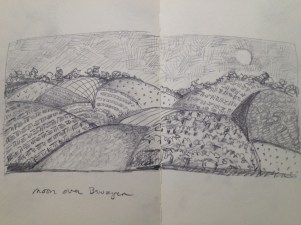
My sketchbooks are peppered with landscapes. I call them my meditation drawings because I do them as a form of meditation – to quiet my mind. I am kinesthetic so quiet comes to me through movement. Drawing is one of my favorite forms of dance.

One day, a few years ago, I decided to experiment and paint one of my meditation drawings. I like it but have no idea what to do with it. I’m not a landscape painter so it exists as the ‘something-different’ in my studio archive. Someday, maybe, I’ll do a few more of them and mount a show of meditation-drawing-inspired-paintings.  Until then, it lives as a morsel for this weeks melange. Kerri calls it White Sun.

photo

The moon over Benziger Winery

White Sun full copy

White Sun. 18 x 48 IN. mixed media on two panels. It’s not listed on the gallery site so contact us if you are interested in purchasing it.


WHITE SUN [morsel] gifts and products

read Kerri’s blog post about WHITE SUN

www.kerrianddavid.com

white sun painting and products ©️ 2016/18 david robinson & kerri sherwood

Find The Doorway In [It’s DR Thursday]

A Doorway In for your Thursday from studio melange.

THISthedoorwayin FRAMED jpeg copy

You learn a lot about yourself combing through old sketchbooks. For instance, I am not a religious person but was gobsmacked to discover that in my life I’ve done hundreds of drawings on the theme of Jacob wrestling with the angel. Why? I had to research the story to have context for the images I’d drawn.

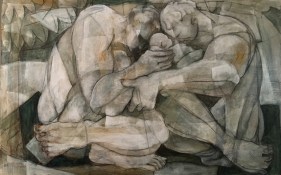
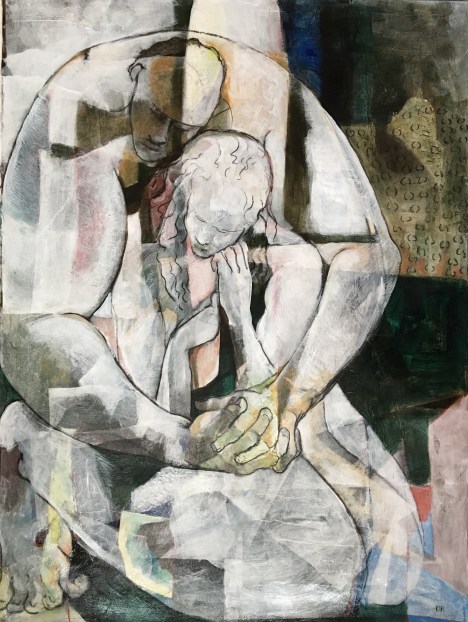
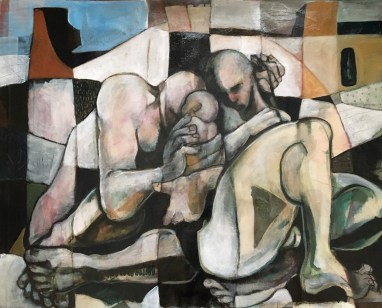
the doorway FRAMED ART copyThe other theme that populates my sketchbooks is much more conscious. It is… (wait for it…) Polynices and Eteocles. In Greek mythology they are the sons of Oedipus who, rather than share power, kill each other. It is my visual rumination on contemporary politics in America. Here’s the catch. Every time I attempt to translate my drawings of combat into a painting, the process leads me to a loving statement, Shared Fatherhood. I’ve made two runs at it. There are now two versions of my warring brothers turned to adoring parents. What!?

Kerri loves my Shared Fatherhood paintings. She has no idea of their sketchy origin. So, when she chose this week’s morsel from the first Shared Fatherhood painting, exclaiming, “I love this image! I think we should call it The Doorway In!” It jarred me a bit. The Doorway In. She is ever positive.

Shared Fatherhood

the first version of Shared Fatherhood, 39.5 x 51IN

I delight in the notion that in my visual meditation, through my hundreds of drawings on warring brothers, I am so incapable of arriving at a painting of mutual annihilation. It is a tired, old story. Rather, my muses, my sketchbooks, lead me to stories of hope for the future and images of quiet adoration. A doorway in.

SharedFatherhood2

a second version,  Shared Fatherhood, 25.5 x 40.5 IN

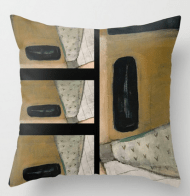
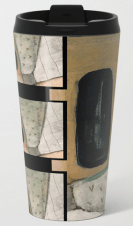
THE DOORWAY IN reminders/merchandise

society 6 info jpeg copy

the doorway in SQ PILLOW copy   the doorway in FLOOR PILLOW copy

the doorway in LEGGINGS copy

leggings

the doorway CARDS copy

gift cards

read Kerri’s blog post about THE DOORWAY IN

purchase the original painting

melange button jpeg copy

kerrianddavid.com


the doorway in/shared fatherhood 1 & 2 ©️ 2017, 2018 david robinson & kerri sherwood

DR Thursday

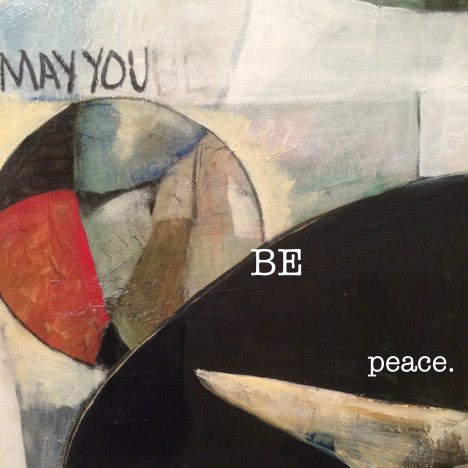
2mayyouBEpeace jpeg copy

Kerri calls them “morsels”: snapshots of a portion of one of my paintings. May You Be Peace is a morsel. I love watching her take the shots. I delight in how she helps me see my work anew. I appreciate how each morsel is a complete work of art in itself.

Shift the focus. Pull in the frame of reference. We live in a world of cameras and microscopes and telescopes and compartments; what we see and believe is very much determined by where we place our focus. Georgia O’Keeffe knew it; she was a master of the close-up.

A few years ago I began taking photographs of my paintings-in-process. The camera helps me sees aspects of the painting that would otherwise remain invisible. It’s odd. I stand before a canvas stapled to the wall and see one thing. I aim a camera at the canvas stapled to the wall and see a wholly different painting. Just imagine the infinite perceptions and perspectives at play in our world!

My photo-painting-practice is a constant reminder that my perspective, my perception is mine alone. You are most certainly looking through a different set of lenses.

Peace, I think, has nothing to do with sameness and everything to do with the celebration of  difference, the capacity to help each other see our lives anew.

MAY YOU BE PEACE merchandise

iphone  framed print  greeting card  MayYouBeToteBag

read Kerri’s thoughts on MAY YOU BE PEACE

photo

May You, 55″ x 36″

kerrianddavid.com

may you be peace and may you ©️ 2016, 2015 david robinson & kerri sherwood


DR Thursday

EmbraceNow

[Held In Grace: Embraced Now, mixed media on canvas, 48″ x 36″]

Beaky showed me a photograph taken of Kerri and me early in our relationship. She said, “I like this one because your strong arms are holding my daughter.” I took her comment as a kind of blessing. It was her way of telling me, ‘This is right and good. In this embrace you two have found all that you will ever need.’

In the studio melange, Thursdays are for my paintings. I chose this painting as the first in our melange offerings because it came from Beaky’s sentiment. During this Valentine’s week, let this painting, Embraced Now, from my Held In Grace series, remind you, as it does me, that all is right and good. In this embrace you will find all that you will ever need. It’s not a shabby thought to help navigate through a Thursday!

HELD IN GRACE: EMBRACED NOW [art prints]

HELD IN GRACE: EMBRACED NOW [purchase the original]

kerrianddavid.com


held in grace: embraced now ©️ 2017 david robinson


Don’t Ask Why

DR 002

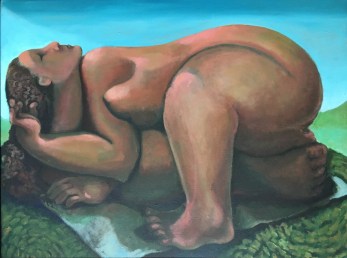
From my archives. I call this painting Alki Beach.

When I woke up this morning, researching the color blue was not on my to-do list. Did you know that in Belgium blue is the color associated with baby girls? Pink is for boys. To be blue in the German-speaking world means to be drunk rather than the English assignment of depression. Color associations are cultural.

I jumped down the rabbit hole of color symbolism and meanings because I’ve been building a new catalogue for my paintings. I’ve been revisiting the eras of my work, looking at every painting I’ve done (those that I documented…). A few days into my cataloguing Linda asked me why I never paint with the color blue. Linda loves the color blue. She is a veritable celebration of blue in earth, air, and water. “You never use blue!” she exclaimed. “Why?”

BlanketOfBlueSky

A Blanket Of Blue Sky

“I always use blue,” I sputtered, convincing no one. Since my move from Seattle to Kenosha my paintings have been more earth tones, umbers and sienna. The blues are there but certainly not dominant. Linda has never seen the work from my blue period.

“Why don’t you use more blue?” she laughed.

‘Why’ is one of those words that can either bring you to clarity or will drive you crazy. Knowing ‘why’ is useful in a Simon Sinek seminar or valuable in the pursuit of a purpose driven life but is near-to-impossible when attempting to articulate an artistic choice. The top two responses are conversation stoppers: 1) I don’t know, and 2) It feels right. I suppose there is a third response, the anti-why: 3) why not? It, too, leaves no room for discourse and is generally a lousy explanation.

IslandDreaming

This one is called Island Dreaming

“Why don’t I use more blue?” I asked Kerri. Without looking up or missing a beat she responded, “Why don’t I use seventh chords?” Leave it to my wife to hit me with a musical-zen-koan.

Horatio often reminds me that to enter the studio is to also enter stillness. Working in and from stillness precludes all questions of why and how.

Did you know that blue is the most commonly used color in corporate identity and that it is a color rarely found in fruits and vegetables? It has more complex and contradictory meanings than any other color. Among the seven billion people on earth, roughly 4 billion of them prefer blue to any other color.

This morning while entering images into my catalogue – most were predominantly blue – I heard the echo of Linda’s question. “What’s up with blue?” I asked myself. Abdicating all responsibility for internal answers, I did what we all do at such moments: I turned to Google.

Did you know that blue is generally embraced as the color of heaven?

Why?


Shared Fatherhood

My latest: Shared Fatherhood.


Honor All Perspectives

my latest painting. Hope asks, “What do you see?”

Hope Hughes, Kerri’s longtime assistant and voice of reason in all-things-business, passed through my studio and flung herself in front of the painting I was working on. “Stop!” she cried. “Don’t touch it! It’s finished!”

“Finished? I just started,” I whined. She laughed at the perplexed look on my face.

“Put down your brushes,” she smiled, “and listen for a minute.”

Over time I’ve learned to listen to Hope. She makes sense of the world through her feelings which comes in handy to an over-cerebral artist like me. She has no inner-editor in the early stages of communication so I’ve learned her heroics are pure. She sees something that I do not. This is not the first time Hope has thrust herself between me and the painting I am about to destroy, so when she asks me to ‘look’ there is usually a good reason. I set down my brushes, cross my arms, and huff as if to say, “I’m listening but make it fast.”

Each time she begs me to stop work on a painting, a great debate rages in the household. This time was no exception. I sit in my chair and listen to what she sees. It is always diametrically opposed to what I see so I pretend to pout (I secretly love this process because it is EXACTLY what I adore about art in general and painting in particular). She tries to get me to tell her what I intended to paint, coaxing me to talk about what I see but I refuse. As Joseph Campbell once said, “If an artist respects you, s/he will not tell you what a painting means. ” Art is always about a relationship between the piece and the viewer and the artist needs to stay out of the way. If the artist has no respect for you (or themself), s/he will tell you what the painting means to them. I respect Hope so I stay out of the way.

In this painting, Hope sees deep humility in dual fatherhood.

My refusal drags other people into the fray. She snaps a photo of the painting and then shares it with others, asking what they see in the painting, what descriptors they would use. As is always the case, the replies sometimes align with her perception and sometimes not which further fuels the debate. 20 had the misfortune of coming over for dinner and he was subjected to the photograph test.

In this painting, 20 sees grief and loss. In this aspect he agreed with Hope: the painting is finished.

When I first started showing paintings I would follow patrons through the gallery (they did not know I was the artist) and listen to their perceptions. They rarely saw what I intended but what they saw was marvelous – almost miraculous to me. It was an advanced course in understanding the futility of trying to determine what another person perceives. Art, I learned in those days, is a living relationship. Perception is personal. No one is a blank slate. Paintings evoke. The meaning is made between the patron and the painting.

I enter into the studio to drop out of my many descriptors and over-cerebral tendencies. I go to the studio to engage in a pure relationship with…my muse(?) I am never more alive than when I am painting. I am never more quiet than when I am painting. The images that emerge from my quiet are sometimes incidental, always surprising, and are sometimes just a map of a moment in the greater relationship of my life. Only a moment. I feel that I have never finished a painting because the paintings themselves are not distinct, separate from each other. They are living things. They change over time. They are moments, marks in the sand in a greater ongoing relationship in the long-body of my life.

What do I see in this painting? It is not important to know. Is it finished? For me, never. And, and for Hope, yes.

Every artist needs a Hope Hughes. Someone they trust, someone they respect to step in front of their work and without editor, tell them what they see. Hope reminds me that the true value/purpose of art is to create a commons capable of affording multiple perspectives and the rich opportunity to discuss the differences in what we perceive.

Be Held In Grace

Grace (noun): 1. Simple elegance or refinement of movement. 2. Unmerited divine assistance given humans for their regeneration or sanctification.

The first time it happened Kathleen, my landlady, stepped between me and the canvas shouting, “You can’t do it!” I was about to wipe off the image and start anew. “I love this one!” she said. “I love it.” Baffled by Kathleen’s wild-eyed heroics I granted the painting a stay of execution. I let it live. I faced the canvas to the wall so I couldn’t see it. After a few days I put it back on the easel. I saw it anew. I saw what Kathleen saw. It was a good painting and ultimately birthed an entire series of paintings.

One of the great paradoxes of being a visual artist is to lose sight en route to seeing. Becoming mired in the thoughts of the painting blinds an artist to the painting. Stare at anything long enough and you will stop seeing it (you will only see what you think about it). The only antidote is to turn it around. Forget about it so you can see it anew.

A few weeks ago it happened again. Kerri was coming down the stairs to the studio just as I was about the wipe an image off the canvas. It wasn’t working for me. Like Kathleen a decade earlier, Kerri threw herself over the painting and pleaded for its life. This time I asked her to tell me what she saw that I clearly was not seeing. I asked her to make a case for clemency. She saw something new. She saw Grace. And, she convinced me that I was blind to the painting. I took it off the easel and turned it to face the wall.

I’m learning again lessons that were pounded into me when I was younger but am now finding deeper levels. Step away. Forget. Clear your vision by looking away. Tom called this “closing the building for a spell.” Understand that seeing and thinking are intertwined. It is a sword with two edges that can illuminate or limit. The skill is never found in the thinking, the interpretation. The great skill is to see beyond the thinking. To see. Artistry happens when thought serves sight and not the other way around. The mastery of art and the mastery of life are, after all, one and the same thing.

When I turned the painting around I saw it anew. And, like the reprieved painting of a decade ago, this one, too, is inspiring a series. In a fit of intentional spontaneity (one of my new favorite descriptions of artistry), the second in the series jumped off my brush. I’m preparing surfaces for the third, fourth, and fifth. They are asking me to follow them – no thought required. They are asking me to take a walk with Grace.


Wait For The Flow

The Weeping Man

The Weeping Man

The Weeping Man is finished.

Sometimes the process of painting feels like wrestling with an angel: It will not release me. I will not let it go. We wrangle and discover the truth in each other. It is, as Quinn used to say of all relationships: “corrections as refinements”.

Sometimes a painting follows you for years and chooses its day. It chooses its time and simply steps into the light. It announces itself: “I am here now.” The Weeping Man was like that.

In my life I have painted hundreds of paintings and I can count a handful that are like The Weeping Man. Pure. In laying it out, I corrected one line. I added another. There are relatively few unnecessary brush strokes.

Flow is like that.

Open Your Eyes

a detail from the painting on the chopping block. It's called "The Stillness Must Be Immense."

a detail from the painting on the chopping block. It’s called “The Stillness Must Be Immense.”

There is a debate raging in my house. Yesterday I was about to wipe a painting off my canvas and begin anew when Kerri intervened. “I love it!” she declared. “I hate it,” I replied. “Truly,” she said, “I love it.” When I wrinkled my brow she restated, “I love it.”

Many years ago I was stepping toward a canvas to wipe it clean. The painting wasn’t working for me and I’d given up. I wanted to start anew. My landlady, Kathleen, came into the studio at just that moment and hurled herself in front of the canvas. “You can’t erase it!” she declared! “This is one of my favorites!” She had the look of a desperate woman begging for the life of her child. I relented. I couldn’t wipe it clean. She confessed to coming into the studio the previous evening and admiring the painting. “I spent a long time with it!” I made a deal with her. I promised to show the painting – to include it in one show – and let the public decide. If it was roundly reviled, as I KNEW it would be (as I was actively roundly reviling it), I’d paint over it without drama or interference. If it was appreciated by anyone, by a single person, Kathleen could say, “I told you so,” and I’d never paint over it.

the painting Kathleen saved

the painting Kathleen saved.

A few months later I hung the painting in my solo show at Rock/Dement studio gallery in

Seattle. At the opening a woman came into the gallery, stood before the painting, and burst into tears. She looked at me with tears rolling down her face and said, “I love it.” Kathleen waited a few days before allowing words to break through her smug smile, “Well,” she sighed, “I told you so.”

That painting is the reason I made the same deal with Kerri yesterday. I will let it remain long enough to show one time. If it is roundly reviled and ignored, then I will paint over the canvas without protest. If a single person likes it or expresses appreciation for it, she can bury me in a mountain of, “I told you so,” and the painting will live on long after I’m gone.

The Stillness Must Be Immense.

The Stillness Must Be Immense.

This morning I posted an image, a print that reads, “CROSS THE BOUNDARY OF ELEMENTS.” In the short blurb associated with the image I wrote that sometimes we have to stand in other people’s shoes. We have to see what they see. I am an artist and am convinced that artistry is all about opening new visions for others. It is about helping people see what is there, not what they think is there – and I’m certain that I fall into a thought eddy while painting. It is, perhaps impossible for me to see what others see in my paintings. What I judge to be worthless has often proven to be magnetic to others. And so, I am willing to make this bet, I delight in the moments when my understanding of life turns back on me, flings itself in front of me and screams, “Open your eyes!”

another detail of the painting.

another detail of the painting.

Dance Without Effort

my mud-slog

my mud-slog

Last night I painted badly and I did it intentionally. I went down into the cool of the basement studio to escape the heat and humidity. A new canvas was stapled to the wall, gessoed and ready to go. I picked up my brushes, squeezed paint onto the palette and began working.

Many years ago I made the switch from oils to acrylics because the fumes were making me ill. It was a happy accident. Acrylics required me to work fast and fast meant I had no time to think. I learned by default that I am a much better artist when I’m not laboring over the details. Sometimes the process feels like an invocation. Sometimes the process feels like a rolling mess that morphs and morphs until the final moment when, like focusing a telescope, the image becomes crystal clear.

My paintings are generally big. They demand a full-body engagement, painting-as-dance. I know I am working well when I lose track of time, when the dance overtakes me, and the line between painting and painter disappears. It is pure magic: a place free of thought-obstacles.

Last night there was no magic. When I was younger the slog sessions would depress me. I believed I had to have magic all of the time and felt despair when, instead of magic, I danced knee-deep in mud. It took a long time for me to appreciate the necessity of the mud dances. Painting badly is, of course, necessary to paint well. In fact, I now know that there is no such thing as painting badly just as there is no such thing as perfection. Saying more with less is a life-long learning process for all artists. Freedom of expression is a yoga, a practice. It has as much to do with muscles as it does with minds. It is a yoga of brevity. It is as efficient as breath. It is a paradox of stepping out of the way so that you can fully step forward.

I once saw an exhibit of the hundreds of sketches and studies John Singer Sergeant did before painting El Jaleo. I loved it. He drew the same thing over and over again. He painted again and again the smallest detail. He was putting the image into his body. He was teaching his muscles to flow without tension. The finished painting (the last thing in the exhibit) was thrilling. It is a celebration of brevity, free motion without mental intervention. It made me dizzy. It made me cry because I knew how devoted he was to his practice to say so much with so little. I knew how many hours of effort it took for him to dance so effortlessly.