Shape The Vessel [on Two Artists Tuesday]

George Ohr was one of the great ceramic artists of the late 19th and early 20th century. Like Van Gogh, he died unknown, never experiencing the success of his work. Robert reminded me of George Ohr’s story and I reminded Robert that Ohr would be a terrific story for him to tell through a one-man play.

What is it to follow your art-call with heart and dedication with nary a hint of financial reward or success on the horizon? Vincent Van Gogh would have been called an amateur during his life since the making-of-money is the flag we plant in the sand marking the line between being a professional and a dilettante. Those lines do not exist for artists with a deeper call. The money does not the artist make.

The Ohr-O’Keefe Museum of Art was designed by renowned architect Frank Gehry, quite a journey for the unseen work of George Ohr’s life to find so much vibrant admiration after his passing. Had he known it would have changed nothing. He’d have spent his days at the potter’s wheel either way.

“Shape clay into a vessel; It is the space within that makes it useful. Cut out doors and windows from a room; It is the holes that make it useful. Therefore, profit comes from what is there; Usefulness from what is not there.” ~Lao-tzu

Profit and usefulness. Shape and space. Mary Oliver asked the question: What will you do with your one wild and precious life? It hits the nail squarely on the head. It was not the pots that George Ohr made or the paintings that Van Gogh painted, it was the space they entered while throwing pots and painting paintings. It was the world they entered through their artistry, more expansive than financial success, more necessary than renown. A wild and precious life lived wildly and with avid appreciation.

Standing amidst the brilliant orchids, some of the flowers were in their last days. Their beauty fading, they cared not a wit. It is not in their nature to stretch their faces and pretend that the cycle of life is more valuable in the early bloom than it is in the late retreat. All is treasured, beguiling. Every last moment, not to be stalled or held onto. The root as necessary as the bloom, the winter as indispensable as the spring.

read Kerri’s blogpost about FIREWORKS

Wander In Wonderland [on Two Artists Tuesday]

I’ve re-read his email several times. Skip’s explanation of the development of the computer. Subject/Object. Noun/Verb. Items/Action. It’s a story of cause and effect. This causes that. I’ve learned more from this single email than from my very expensive graduate degree. And, it’s sent me down the rabbit hole and I am currently in a world easily as miraculous as Alice’s Wonderland.

Does the moon cause the tides? It does if you are an English-speaker. Causation is the foundation structure of the English language. An action needs an initiator. The noun is king. He kicked. The sea rocked the boat. The moon causes tides. If you speak Mandarin, the moon and the tides are inseparable, not perceived or described as separate events but as interconnected. The same dance, differentiated forms.

Where does an action begin? A consequence end? I warned you. A rabbit hole.

Our perception of the world has everything to do with the language we use to describe it. Our creating of the world has everything to do with the language we use to imagine it. In a world where actions are separate from items, verbs from nouns, this causes that, it’s easy to believe that order is separate from disorder, cosmos is separate from earth, humans are separate from nature. Death is separate from life. Is it?

Each year that passes I’ve noticed the world of written communication includes more emojis and fewer words. Attention spans are shorter – mine, too. Tweet and text. Images carries the bulk of the message. If you could see the analytics on my blog you’d note that if I use more than 600 words, you are less likely to read what I write. We are slowly moving toward ideograms and slowly away from alphabets. Whatever will we do, what might we see, when nouns and verbs blend into image? When the eyes of dedicated separation begin to see through the eyes of interconnectivity – or, as Skip says, “When actions become central.”

It’s called a Wolf Moon, I read, because wolves are particularly loud and vocal during the first months of the year. One questioner asked if the moon causes the wolves to howl. Noun/Verb. Subject/Object.

read Kerri’s blogpost about THE WOLF MOON

Reboot [on Flawed Wednesday]

I’m not going to lie. Yesterday was textured and difficult. Because our internet connection was spotty – and because our work depends upon a reliable connection – we called our provider to upgrade our service. And, rather than an easy upgrade, we lost our service altogether. And, as I write, almost a full day later, in a world brimming with messages of fast-and-easy, we are still in the internet no-fly zone. After eleven hours, a full five hours on the phone, a trip to the store to get new equipment, ethernet tests on everything but my heart, after a series of pleasant but not-very-helpful service representatives, after the fifteenth (not a joke) suggestion that we “reboot one more time just to see,”we gave up for the night. 

Giving up looked like this: “The problem is on our end,” a pleasant tech offered when there was still light in the sky. “There’s a ticket and our engineers are working on it.” Later, much later, after being passed to two of the engineers-that-were-working-on-it, we heard that they had no idea what the problem was. “We could try to reboot one more time,” he said. “Just to see.”

Kerri looked at me, exhausted, and said, “I can’t do it. Not again.” A battle to be waged another day.

Surrender. I’ve learned this lesson again and again in my life. Sometimes it is best to give over. It is best to stop pushing. Sometimes, there is no solution. Time and a bit of sleep, a new day, will bring another point of view. What was impossible yesterday will resolve today.

In surrender, we sat in the quiet night and talked of our day. The quiet. Nothing dinging or binging or pulling at our attention, nothing notifying us of another message. Nothing trying to keep us hooked for the sake of being hooked. The static was gone. The incessant, “Look at me,” of news apps and Facebook and Instagram and… Life as perpetual “Breaking News.” Within the constant pull, the only thing breaking is our focus. We sat and enjoyed a moment when nothing was breaking.

For a moment during the madness, I looked out the window of my office. The day before yesterday the leaves on our tree were still green. It’s late in the season. Yesterday, in a seeming flash, they were vibrant color. They changed overnight. I was taken, as I always am, by the recognition that the best way to learn color is to go outside, take a walk in nature. See. If there is ever a question about, “Does this color work with that color?” – go outside. Look around. The answer is right there. Crimson and dusty grey. A bit of sage green. Charcoal. Polka dots are not a human invention. The patterns are there, too. Texture. See it.

This morning, while we await the visit from our tech who-will-fix-everything, we’ll go outside. We might play in the leaves. We’ll certainly enjoy the moment without the bings and pings and tech-sounds of made-up-importance. We’ll kneel and coo over the polka dots and salmon pink, the electric yellow and revel in the rare simple moments that a good surrender brings.

[*a hefty thank you to Matt the technician who just spent hours sorting out and fixing what ailed our internet. This post is proof positive that we are, at long last, out of the internet-no-fly zone]

read Kerri’s blogpost about POLKA DOTS

Reach Purely [on Two Artists Tuesday]

“Art, as best practiced and understood over the centuries, is a spiritual as much as technical pursuit.” ~ Kent Nerburn, Dancing With The Gods

It was disconcerting. It still is. The illusion was so distinct that I had to show the book to Kerri and ask if she saw it, too. Each morning I read a few pages from Kent Nerburn’s book. This morning, in a chapter entitled The Divine Thread, I turned the page and a single paragraph, just a few sentences, was printed in a font twice the size as anything else on the page. I read it a few times since the author had given the section such obvious emphasis. After the I finished the chapter, I looked back to reread the oversized section – and it was printed in the same size font as everything else. It wasn’t emphasized at all. The shock of it made me dizzy.

“Art, however, does create this touch. It speaks in different voices, different rhythms, different languages. There is no place in the human heart it cannot reach.”

Paul taught his student-actors that they had an obligation to something greater. “When you choose to get on the stage, you have the power to impact other people’s lives. Do not take that responsibility lightly.” Your art, your creation, if purely intended, will reach the heart of another – purely. Even the loneliest painter knows the transcendence of the expansive energy that comes through in the moment of creation. Transcendence is all inclusive.

I have been humbled by the great artists I’ve known. Teachers, mentors, and others. I’ve been humbled by their humility. Tom, a brilliant director of plays and believer of possibility, influenced more artists than any person I know. He was tortured by the size and scope of his gift. At the end of his life, sitting before a fire in his cabin, he was, for a moment lost in thought. I watched his revelation come to the surface. He looked into his wine and said, “I think I did my best work when I was a just starting, when I was second grade teacher. It was pure imagination. I had no idea what I was doing. I just knew that we could have fun telling stories and going on adventures where our imaginations led us. It was pure.”

I met a few teachers who’d been second grade students in that classroom of long ago. They told me that year changed their lives. They touched his heart and he touched theirs. Shrunken heads and planning expeditions to the Amazon. Maps and budgets and “What do we need to bring to survive?” They spent weeks preparing for “blind day,” an exploration of the world through the full scope of senses. “What could we learn if we didn’t rely on our sight? What would we need to prepare to help each other?” he asked. Pure.

For our wedding, Julia made for us a small box with a Klimt’sThe Kiss” decoupaged on the lid. Inside, she placed a few Euros. A metaphor. Great love as a container for great adventure. We placed the box in our sitting room in a spot where we see it everyday.

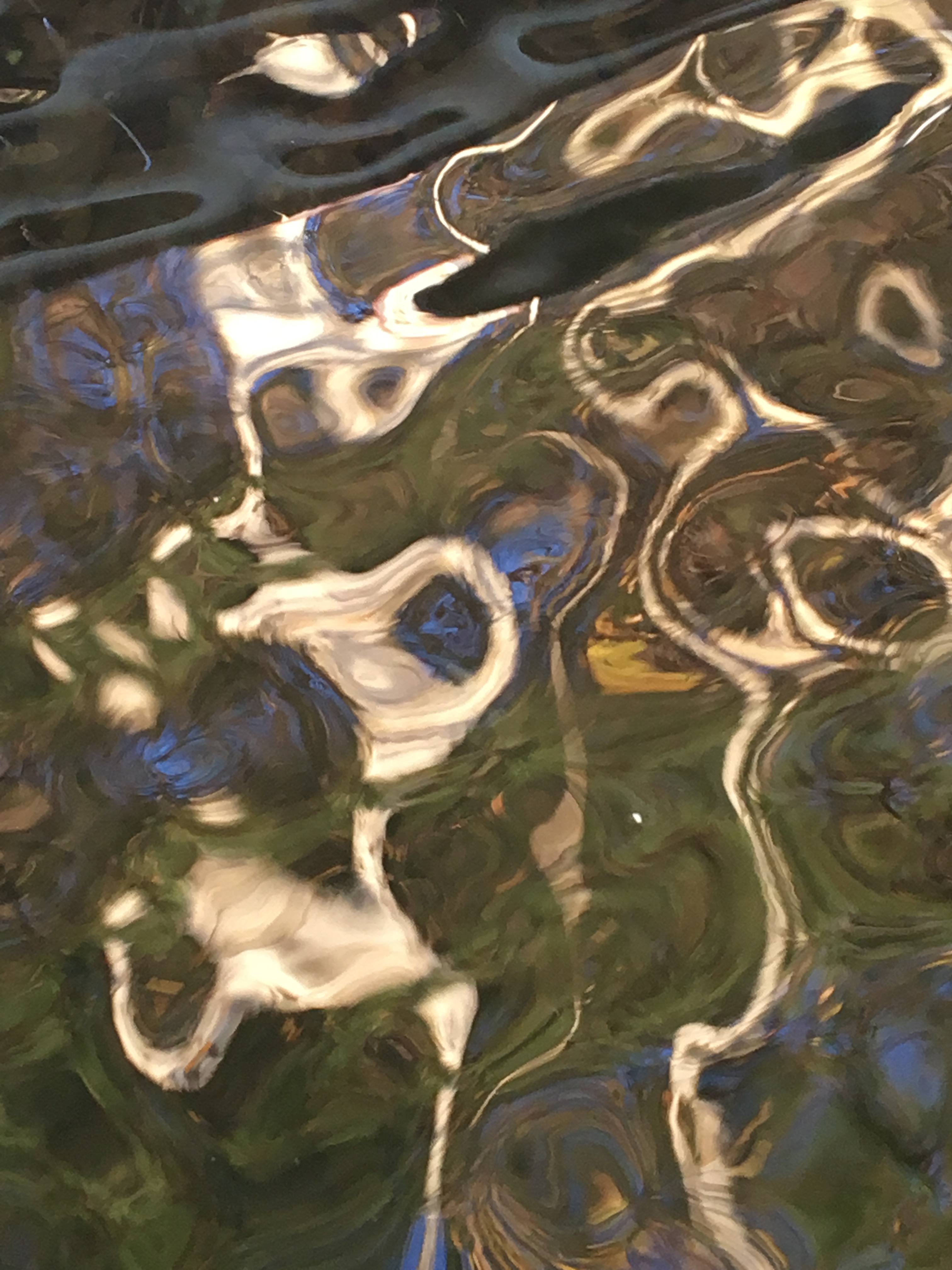
Kerri knelt on the dock to get this photograph of the water. “The color!” she gasped. Pull up an image of “The Kiss” – or any of Klimt’s paintings for a closer inspection and you’ll see this water pattern. Klimt might have painted it. He studied swirls in water, swimming color on the reflection of the surface. I’m certain of it.

Great love. Great adventure. Tom. Julia. Paul. Art that is pure. My head spins. There is no place in the human heart that art cannot reach.

read Kerri’s blog post about WATER

images of water © kerri sherwood 2021

Glance Sideways [on Not So Flawed Wednesday]

It came as quite a shock. Our beloved plant, Snake-In-The-Grass, was hosting a community of Gnomes and Faeries. We haven’t actually seen the Gnomes and Faeries – they are notoriously hard to spot. They are not fond of human beings since we are famously territorial and also so easily eschew our imaginations. Fearing all things “wild,” we generally erect fences and street lights, build dams and make management plans for “nature.” If we could see them, I suspect we’d notice how often they roll their eyes at us.

When I was playing the role of consultant in public school systems, I took note of a central mandate of the adults, playing the role of teacher or administrator: clamp the imagination of the young people, those imaginers playing the role of students. The students would enter the system with wide-open imaginations, free from limitation, and the oldsters found it necessary to kibosh or contain that wide-open meadow. This is not meant to disparage those actors playing the role of adults; when young, they’d been recipients of the imagination whammy, too. They were simply carrying on the tradition. The imagination is apparently considered a wild-thing so necessary of damming.

Dammed imaginations do not die, they distort. Imagination, as a wild thing, will run in circles when put in a cage. It will gnaw its leg off when caught in a snare. It will invent monsters and madness as it paces to-and-fro. It will get angry as it descends into madness. You might say that millions of Americans are gnawing their legs off, angry at the swirl of dark imagining run amok in their caged craniums, seeking reasons and someone-to-blame for their dark imagining. The caged imagination will lead all the lemmings over the cliff with the shout, “Where we go one, we go all!” It seems that we are awash in imprisoned imaginations howling to be freed.

I took it as a positive sign that the Gnomes and the Faeries took up residence in our house under the good protection of Snake-In-The-Grass. While the world outside our doors goes deeper and deeper into the cage-of-its-own-creation, the world inside our house seems to have become a refuge, a safe haven, for those beings still alive in their imaginations.

David recently wrote that he was dedicating himself to being a better artist. He’s been making art with his son again, a wild imaginer that has pulled his daddy (and me, too) out of our cages and into the open meadow. I can’t wait to see what David will do next. Who he will now become. What role he will shed. He’s already a great artist so the possibilities are…wild.

I confess that I regularly wander into the sunroom and glance sideways at Snake-In-The-Grass. Sideways – so they say- is the only way we humans can catch a glimpse of the Gnomes and Faeries. I want them to know that I’m looking.

read Kerri’s blog post about TINY MUSHROOMS

Honor Yourself [on Two Artists Tuesday]

“There’s a trailhead,” Loida said, “It’s just up the road.” She could see that we needed some quiet time. Some space. Some nature. We dropped our other plans. All errands went out the window. More importantly, all obligations, made-up and otherwise, fell to the wayside. Or, said another way, we honored ourselves, our needs. We ran to the hills like thirsty people running for an oasis.

“Why is that so hard?” Kerri asked. “Why should I feel guilty for taking a few moments for myself?” Later, deep in the night, we’d express intense – not an overstatement – gratitude for having given ourselves a short hike into the foothills. The sun. The deer. The hawk. The cyclist who cried, “Snake!” There were signs warning of rattlesnakes so we walked with caution. We laughed at our imagined-snake-paranoia.

Those few moments allowed us to be present with family when we needed to be present with family. Our short hike refilled our people-gas-tank. Kerri’s question was spot-on. Why is it so hard to do the thing you most need to do? Why is it so hard to put your needs above the demands of others – especially when attending to your needs is the single action that ultimately enables you to attend to the needs of others. To be present with and for others.

We are both introverts. Quiet, not cacophony, recharges the battery.

Kerri gasped, “Look at this!” she knelt and carefully took a photograph of the autumn blossom beside the trail. “This is exactly what I needed,” she sighed. Face to the sun. Awash with an awe-some blossom discovery, we took a moment, a necessary moment, to drink in the beauty and the sage mountain air.

read Kerri’s blog post about AUTUMN BLOSSOM

Remember The Single Story [on KS Friday]

If you truly love Nature, you will find beauty everywhere.” ~ Vincent Van Gogh

When Kerri took this photograph I thought Van Gogh would have loved to paint it. I read that most of his 860 paintings date from the last two years of his life. The romantic in me wants to believe that he knew his time was short and he let all of that imperative spill out onto canvas. He died never knowing success or imagining that his work would in any way impact the world. I doubt he cared. His frenzy was not driven by success or status. He painted because he had to.

Waning time brings retirement to some. To others it brings fire and fuel. The need to bring what is inside to the outside. To compose, to write, to dance, to paint, to build, to design. Michelangelo was driven by his waning time. Some of his final sculpture was 500 years ahead of its time. At the end of his life, his work would have shown well with Picasso.

There simply isn’t enough time to say it all, explore it all. Last night, sitting in a circle with my family, multiple conversations resonating throughout the activity hall, my conversation pod began talking about regrets. When we were younger, we made vows to live lives without regret and now, at this end of the road, we see how foolish was our vow. Life is a series of choices and choices always leave unexplored paths. We laughed at our folly and relished the beauty of a life full of regrets. Paths not taken seed gratitude for the paths we ultimately chose. There is intense beauty in regret.

The morning dawned cold. Autumn has arrived in Colorado. The energy abandons the leaves and goes to the root. Columbus’ passing has brought energy to the root. He would be pleased. There are members of my family that I have not seen for years. In gathering, we bring together our separate stories and for a few days remember that we are also a single story.

A single story. The beauty of regret. The gift in loss. The waning of one season affirms the promise of the new.

All of Kerr’s albums are available on iTunes & streaming on Pandora

read Kerri’s blog post about WANING SEASONS

part of the wind/blueprint for my soul ©️ 1997 kerri sherwood

Feel The Rhythm [on Not So Flawed Wednesday]

We lay awake in the night listening to the waves pound the shore. Boom. Rest. Boom. Rest. This lake that is sometimes glassy-in-stillness can rival the Atlantic Ocean in restlessness. It has many moods. It can turn on a dime. I have found great peace walking the shores. I have stood in awe as it blasted those very same shores, hurling boulders with ease.

When we were fortunate to live for a summer in the littlehouse, right on the lake. Kerri had to adjust to the constant sound. Her musician’s ears were caught in the rhythm of sound lapping the shores. Nature’s metronome. We teased about parking a piano on the back deck so she might compose an album of pieces set to the lake’s pulse.

The most striking visceral-revelation that I brought back from Bali is that we function together. Just as I am impacted by the lake, my pace and rhythm are impacted by the people around me. No one is an island. David Abram wrote in The Spell of the Sensuous that it is nearly impossible to meditate in the un-united states. We are an angry frenetic lake, fast moving wave. Changeable. I will always remember pausing at the custom’s gate re-entering the country. It was too much. Finally, I stepped through the doors and felt sucked into a chaotic turbulent whitewater river. It was months before I adjusted, before a walk down the street didn’t feel like a fist fight.

Columbus (my dad) would sit for hours each morning, on the porch. Listening. When I was younger I wondered what he was listening to – or for. He grew up in Iowa and came into adulthood moving to the rhythm of the corn. He lived his adult life in Colorado. It was a different rhythm, the metronome of the mountains. For many years he yearned to live where he understood the rhythm. He was, I think, listening for the corn.

When I return to Colorado I feel an immediate recognition. The mountains are the rhythm I was born into. Alignment. My original dance was a mountain dance.

Kerri and I are both transplants to the lake. Perhaps that is why we hear it so clearly. Jim E. told me that people go to the shore to stare into the infinite. We listen to the lake with the same awareness. The lake was here before me. The lake will be here after I am gone. The mountains, too. We are, of course, delusional to entertain the idea that we control it – nature. That we are somehow separate. Sometimes I think it is the artist’s job to bring proper perspective to the community, to pop the separation-notions – even for a moment – out of ego-brains.

This lake could hurl me like a pebble. It also brings peace to my soul. Stillness. We are not as distinct as we want to believe. That recognition is the single greatest blessing of artistry. It’s a circle dance. Just as my dad is disappearing back into the corn, I, too, will someday rejoin my original rhythm and fold back into the mountain.

read Kerri’s blog post about THE LAKE

Smile With Pete [on Two Artists Tuesday]

It is a hot and humid morning as we sit to write. The sky is dark and rumbling. A storm is moving in. Dogga doesn’t like the thunder. He stays close. He studies our responses. Kerri jumped up to close the windows against the rain.

News of Pete’s passing came yesterday. And, although I have not seen him in a few years, it sucked the air from my lungs. His path through life was not easy. He was the first truly free spirit I met in my youth. I’d met lots of pretenders, cape-wearing artists that fancied themselves to be free. Angry activists. Pete was different. His protest against the Vietnam war meant that he simply refused to fight. Peace made him a criminal so he went where he could live as he believed, a hippie, living off the land and off the grid. He understood that his actions mattered. He understood that his choices impacted everyone so he was dedicated to making sustainable, non-violent life-choices. Pete was way ahead of his time.

He was a beekeeper and, occasionally, when he needed help, I rode in his old truck and helped him lift the heavy hives, moving them to the next field. He collected the honey for sale and made beeswax candles. If a puritan work ethic smashed into a Buddhist mindset, Pete was the result. He worked hard. He relaxed hard.

He believed in the illumination of human consciousness. He meditated and practiced presence. We talked endlessly about the nature of…nature and what it was to be of the earth and not on the earth.

One night, after a long drive and a long day of moving hives to a farmer’s field, too late to drive home over the passes, the farmer gave him permission to camp overnight. Pete rolled out his sleeping bag and fell asleep under the stars. Two county ditch riders, seeing a hippie in a farmer’s field, decided it would be great fun to run their truck over the hippie. Pete’s hair got caught in the bumper. He was drug behind the truck for a long, long way before his hair finally released from his head.

No one can explain how he survived. His body was broken, his brain was damaged, but his spirit was unharmed. I’ve never seen another human being go through so much, lose so much, and come out smiling. In my middle age, years after the “accident,” sitting with Pete at family picnics, I’d ask him how he was doing. “Greeeeaaaaat!” he’d say, smiling his famous smile, closing his eyes again, turning his face to feel the sun.

No one I’ve ever known had more reason to be bitter yet had less capacity for self-pity. A peace-lover who became a survivor of horrific violence, an independent spirit who became impossibly dependent, a man of nature who was rendered incapable of doing any more than looking at the mountains and the fields, and his response was to smile.

Pete was rendered present. He embraced a simple gratitude for every day of life. He was capable of being no where else and inhabited his limitation with appreciation.

Even in his wreckage he managed to live fully his convictions. Isn’t that the mark of a great person?

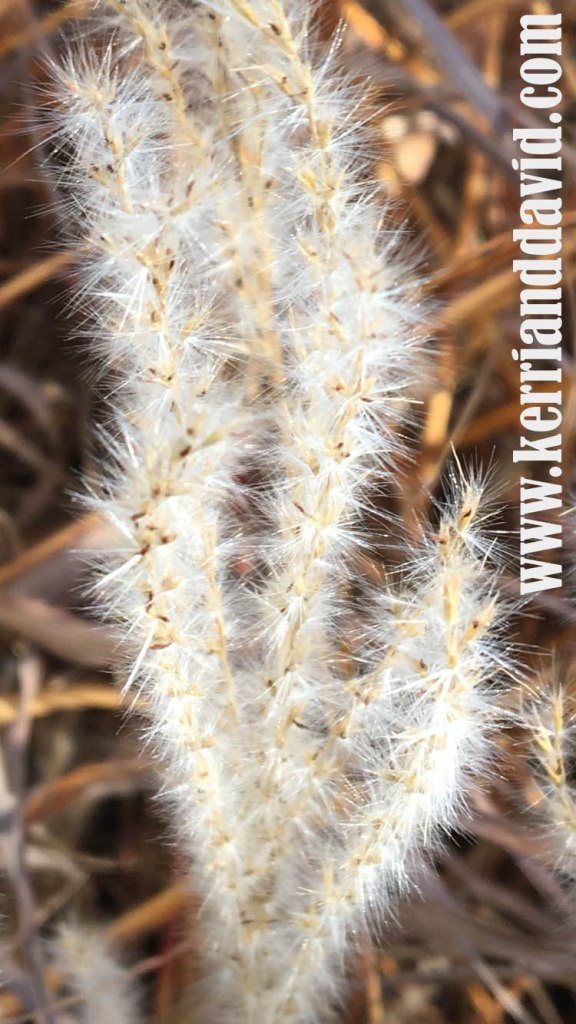
read Kerri’s blog post about GRASSES

Consider The Revelation Necessary [on KS Friday]

An exercise that is designed for generic failure is also designed for specific success. And, so it is with the bridge. The instruction is simple: get everyone safely across the space. If anyone touches the floor, all must go back. Invariably, the first attempt is an abject failure. The group ignores the word “everyone” and, instead, opts to try and get themselves safely across the space. They believe the game is about them, that “winning” is a singular affair.

After being sent back to the beginning more than once, they come to a spectacular yet inevitable innovation: if they work together, crossing the space will be easy. It is only a matter of moments after their revelation that they, together, construct a secure bridge and are all safely standing on the other side of the room. Specific success wrought from generic failure. And, once they have their realization, they cling to it. They own it. They must, the stakes are raised, the rules are tipped against them during the ensuing phases of the exercise.

I’ve led this exercise hundreds of times. Every single time the group has the necessary revelation. They are not in the game alone. They can only “win” if they join together. If they build it together, everyone will safely cross the space. It gives me hope.

Last night, during the town hall, President Biden said something that ought to slap us from our divisive stupor. Xi Jinping and Vladimir Putin believe the 21st century belongs to the autocrats. The pace of change is moving too fast and democracies, in their divisiveness, move too slow. So far, we are proving them right.

Once, as an experiment, rather than set the challenge of the bridge, I forced the answer. The group did as I said but collapsed in the ensuing rounds. When I raised the stakes, the people gave up. The harder it got, the less they tried. They coalesced in apathy. They never made it across the bridge again, even though they knew how to build it.

This is what the autocrats do not understand. There is no ownership, no game, in a forced answer [educators could pay attention to this simple rule, too].

We are being divided through titanic campaigns of misinformation. And so, no one will make it safely across this time-space. Generic failure. Wade Davis wrote that we now live in a failed state and, so far, we are proving him right. But I have hope. The necessary revelation, the specific success, bubbles in the frustration. Those stoking the division, feeding fear, will have their day but, in the long run, the lie collapses, people join together and, like a prayer flag, build a bridge to ensure that all make it safely across. They recognize that they are not in this game alone. Winning is hollow if half the team is lost in the process.

This game, the bridge. The necessary revelation is in our nature; nature’s prayer flag. It gives me hope.

Kerri’s albums are available on iTunes or streaming on Pandora

read Kerri’s blog post about NATURE’S PRAYER FLAG

hope/this season ©️ 1998 kerri sherwood