On The Mystery Trail [David’s blog on Not So Flawed Wednesday]

It’s no secret that we watch hiking videos before turning out the light for the night. There’s something comforting about people unplugging from the national nonsense and thru-hiking The Pacific Crest Trail. There’s something reassuring about people reducing their needs to the simple basics only to discover that the real essential – as important as food – is companionship. Giving and receiving support. There’s genuine kindness to be found on the trail that is not found in our current national story.

Last night we veered off trail and clicked on a story about Bigfoot encounters. Beyond the curious tales, a few of which sounded more extraterrestrial than large-furry-creature, I was struck by the process each person went through to make sense of their encounter. In the absence of a sense-socket-to-plug-into, they defaulted to something recognizable: a religious explanation or contact with an other-world-alien, Hollywood style. One man has spent years searching for others who had a similar experience or for someone who might help him understand what he saw. He admitted that his story sounded insane – and, previous to his encounter, he said, “Had I heard someone tell a similar tale, I’d have rolled my eyes. Not anymore,” adding, “It opened me,” he said.

People do not easily stand alone in the unknown. It is not comfortable. Not-knowing is more doable with company.

Listening to their stories I recognized that the unknown, like life on the trail, has a way of stripping us back to basics. When all of the layers of our mind-armor – our “knowing” – are peeled away, we do the most human thing possible: we reach for others. Even if slamming the door on the encounter is the initial response, the second action is to reach. To corroborate or to find comfort. To have companionship on the mystery trail.

This morning we sat in bed sipping coffee and told the unexplainable stories from our lives. Our coming-together-story is full of the impossible-to-understand. Sometimes we ascribe it to chance and sometimes to kismet. Good guiding angels or happenstance, either way, for us, it is a kind of miracle.

Hamlet always jumps to my mind when I dance on the edge of these delicious questions of guidance or fate or coincidence: “There are more things in heaven and earth, Horatio, than are dreamt of in your philosophy.” Hamlet sees the ghost of his father and asks: “Be thou a spirit of health or a goblin damned?” Is this ghost from heaven or sent from hell? The rest of the play is a detective story, a young Hamlet trying to answer his question, trying to make sense of his ghost encounter. He pretends madness in order to investigate, to find the truth of what he has seen.

Ultimately, like all of us, Hamlet finds peace, not because he finds an answer, but because he makes peace with life as an unanswerable question. “There is special providence in the fall of a sparrow…”

read Kerri’s blogpost about THE SUN AND CLOUD

likesupportsharecommentsubscribe…thankyou.

A Dream Itself [David’s blog on KS Friday]

I awoke this morning with a line from Hamlet running through my mind: “There are more things on heaven and earth, Horatio, than are dreamt of in your philosophy.” What dream, what night-wander was I following that made me bob to the surface with a line from Hamlet as my first thought of the day?

Sometimes I use Google like I use the i-Ching. A divining tool. I called up the phrase from the mighty Google and read two opposing opinions of the meaning of the line. Of course. Divining tools generally cast a broad net. The first writer interpreted the line to mean that the human imagination has limits; there is so much that we don’t know and cannot yet imagined. The second interpretation was stated with absolute authority. This is what Shakespeare meant! “One must believe what he or she sees. Even if they previously did not think so, the real evidence should change their mind.”

Evidence or the limits of imagination? Evidence as the limiter of imagination? I was no closer to answering my dreamtime question but I was affirmed in the dynamic nature of perception and interpretation. What a great play!

Living as we now are, in the advent of A-I, one must not believe what he or she sees. I have no idea what Shakespeare meant – we never discussed it – but I am certain that what one sees is no longer evidence of anything. What one hears requires vetting. There are more things on heaven and earth than Shakespeare could have possibly imagined. Our world is beyond his dreaming or he might have suggested to Horatio that he must question everything he hears and challenge everything he sees.

And, about my dreamtime question? I’ll leave that, too, to Hamlet: “A dream itself is but a shadow.”

Kerri’s albums are available on iTunes and streaming on Pandora and iHeart Radio

read Kerri’s blogpost about THE NIGHT

like. comment. share. subscribe. support. thank you!

Open The Tiny Measure [David’s blog on KS Friday]

My first question: when did UFO (unidentified flying object) become UAP (unidentified anomalous phenomenon)? I know I am late to the party on this one. Like you, I’ve been reading the UAP headlines for a few years and, each time, ask myself the same question: Why the moniker change?

I did a little research this morning and came upon this phrase from Bill Nelson at NASA: “We want to shift the conversation about UAP’s from sentimentalism to science.” Apparently, George Lucas and Steven Spielberg have our space-alien-sentimentalism dialed to an all-time high. Human imagination runs amok with unidentified flying objects and not so much with unidentified anomalous phenomenon.

Language matters. Since our reference point is…us…a flying object, like an airplane or a spaceship implies a pilot, a “being” at the controls. An anomalous phenomenon? It’s another way of saying unusual occurrence and what, exactly, is an occurrence? If it’s unusually amorphous, there is nothing to hang your hat on. The only thing to do is call a scientist or artist since the imagination needs a few parameters to light its fire.

There was another sad-ancient-yet-contemporary-cautionary-tale that popped up in my reading: “NASA recently appointed a director for UFO research, but is not divulging the identity to protect them from the kind of threats and harassment faced by the panel members during the study.” Science and art are -and always have been – dangerous business. Galileo spent his last years on earth under house arrest for publishing his science; it contradicted the firmly-held belief of the day. He was forced to recant his findings or face the fate of heretics.

Belief does not appreciate being contradicted, especially when there is evidence involved – or as is true in the current example – no evidence at all. Belief has a wonky relationship with evidence. We are witness to that all-too-human phenomenon in our times, just as was Galileo. Protecting poll workers and UAP scientists from the violence of those who are unshakable in their faith and/or “news” source (their reference point).

We do not need science (or maybe we do) to see our absurdity.

We have the capacity to exercise our imaginations in this vast universe of possibilities. We have the ability to question if we desire to use it. We have the gift of unbridled curiosity and need not go off the rails into rootless belief if we allow that, “There are more things in heaven and earth than are dreamt of in [our] philosophy”. We can be afraid of ideas, run from progress, or threaten the artists and scientists that force us to open our smallish belief and tiny measure of “normal”. Growth is always preceded by an uncomfortable step into the unknown. A challenge to what we think we “know”.

And then, after the upset, we need to find language to describe the new world that we discover there.

Time Together/This Part of the Journey © 1997 & 2000 Kerri Sherwood

Kerri’s albums are available on iTunes and streaming on Pandora and iHeart Radio

read Kerri’s blogpost about UFO and UAP

like. share. support. subscribe. comment. thank you.

Find Out [David’s blog on Two Artists Tuesday]

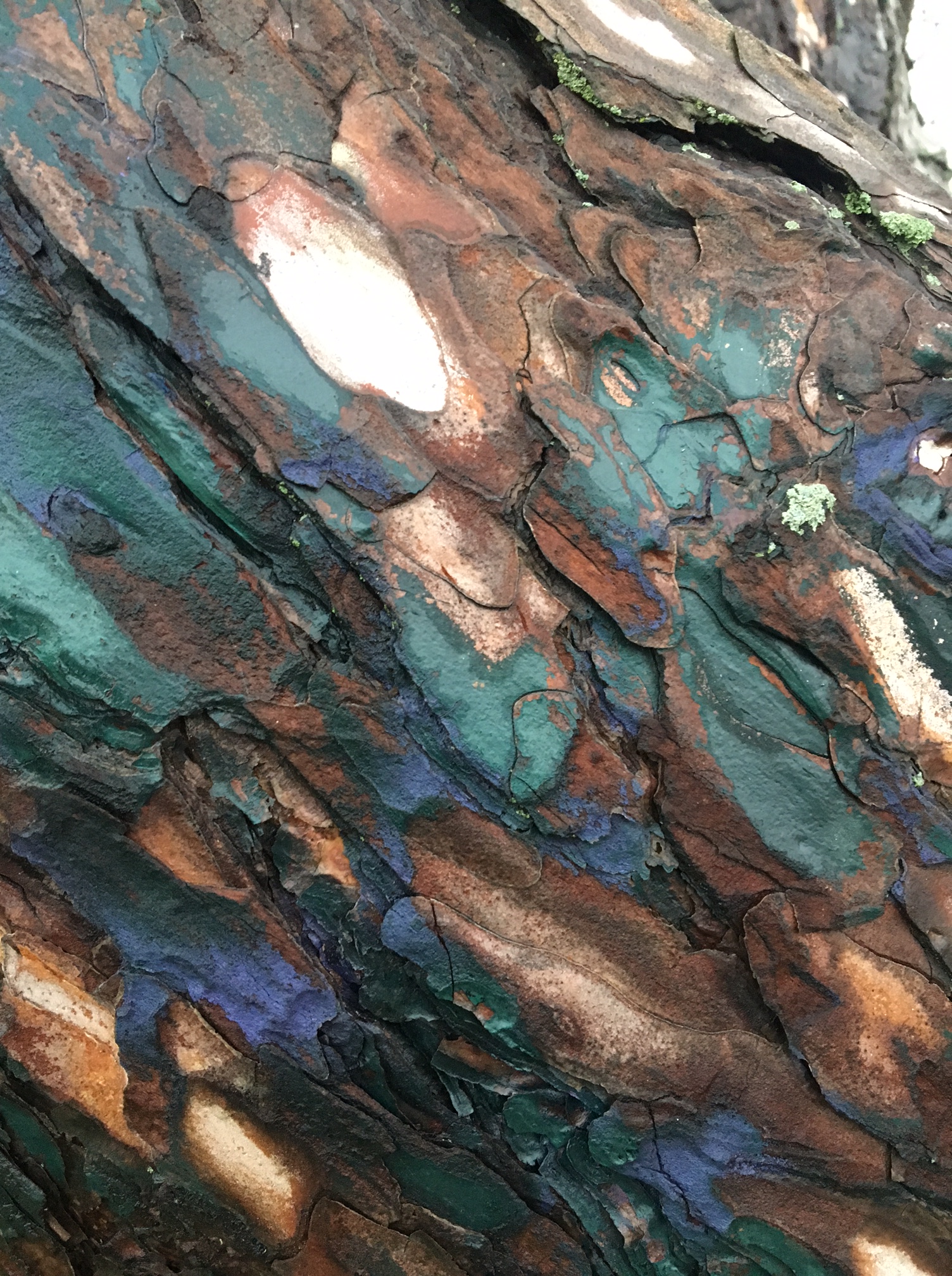
Google “iridescent tree bark” – or any question variation – and the top hits will be Marigold Carnival Tree Bark Glass. Second place on the list will be rainbow eucalyptus. Both are interesting but neither is helpful in our pursuit. This mystery tree is in a park on the shore of Lake Michigan. The bark on the east facing side is moist and shimmers with green, blue and purple. Why?

Google can be a very strict although paradoxical schoolmarm, often requiring exact language for inquiries yet always returning ranked probabilities. Web crawling in the blink of an eye. The art of the question meets a never ending popularity contest. It works most of the time. Sometimes it produces an amazing clown car of results. Today I learned a smidge about Marigold Carnival Tree Bark Glass. And who knew a eucalyptus tree could produce such vibrant color! I’ll be more mindful the next time I’m tempted to say, “That color does not occur in nature.” It turns out that all colors occur in nature. Even puce, the hands-down-winner for worst name of a color.

I gave up the search but Kerri is a dog-with-a-bone when she has a question. After lengthy sleuthing (“lengthy” in 2023 terms. In 1980, her search would have taken weeks but in 2023 she scored a find in less than 30 minutes) she found (drumroll…): blue-green crust fungus! Amaurodon (I’m tempted to insert crack social commentary into this scintillating post about the ease of information-finding in the age of dedicated information-denying but I’ll exercise extreme restraint and stay on my subject). Now, what exactly was my point?

More than once the glistening color has stopped our walks. We stand close and squint our eyes. We stand back and ponder. We take photographs and discuss outrageous possibilities for the surprising color shimmering on the lake side of the tree. We hold hands and I thank the stars for walking through life with someone who entertains as many unanswered questions as I do. I believe it is why we feel young even though our joints sometimes ache. Unbridled curiosity. Delight at running our fingers through paint. The utterance of a common phrase: I don’t know but let’s find out.

In case you’re wondering: I value the clown car of results almost as much as I do an instant-on-the-spot Google return. “There are more things in heaven and earth, Horatio, than are dreamt of in [my] philosophy” (Hamlet. Act 1, scene 5). It invites the second-most-common-curiosity-utterance in our household: now what the heck is this?

read Kerri’s blog post about AMAURODON

share if you dare. like if you like. support if you support. comment if you have something to add.

buymeacoffee is an alien life form attempting to hypnotize you into the outrageous assertion that artists have an insatiable thirst for coffee and it is your life mission to quench their thirst.

Protect The Heartwood [on DR Thursday]

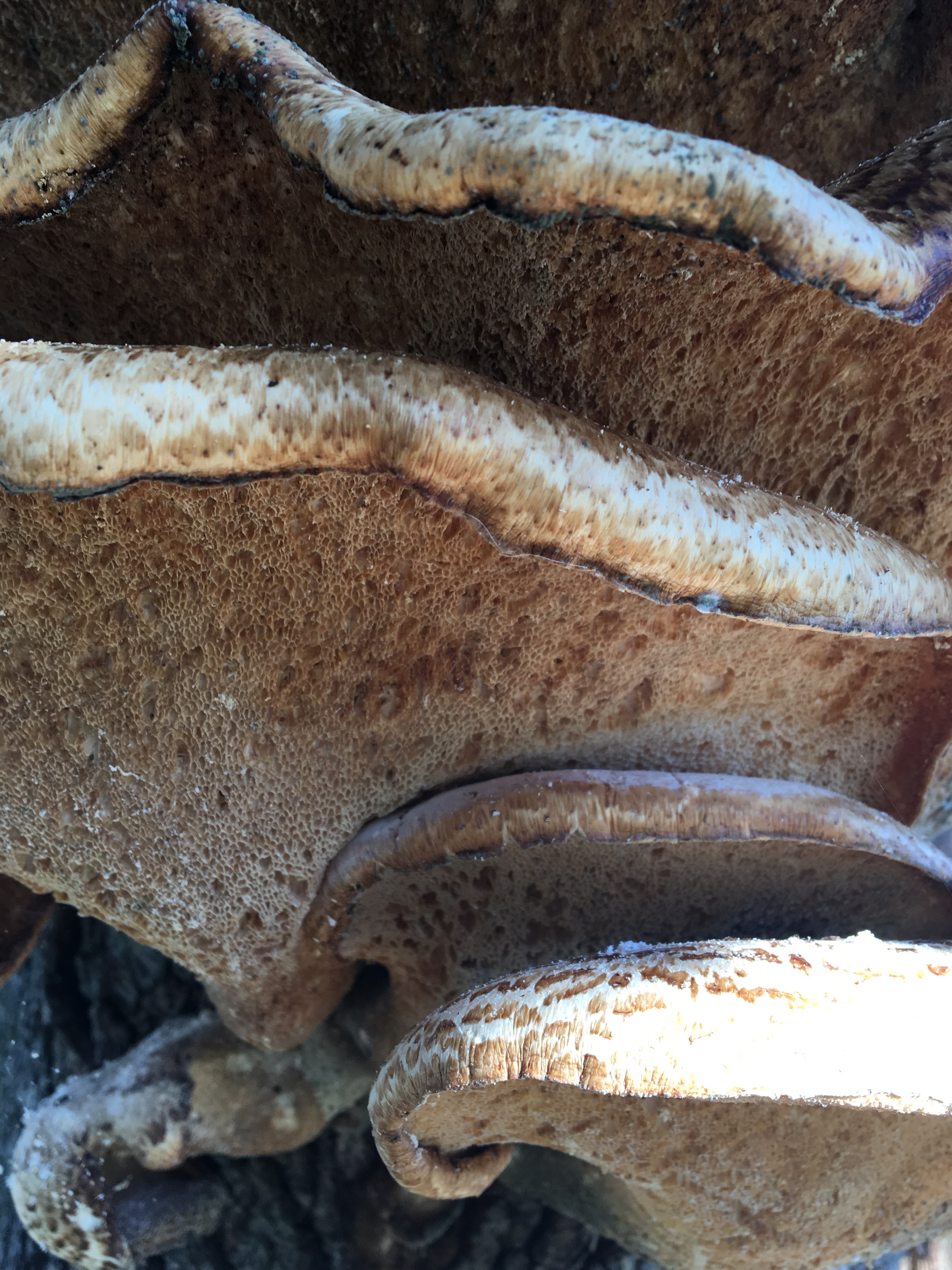
Conk!

No, that is not cartoon-speak for being hit on the noggin. It’s a formal name, the body-shape of the shelf-fungi that grows on local trees. Not having grown up here, the first time I saw them, I thought they were aliens. Trees with tongues. A Little Shop of Horrors; Audrey II. Get too close and tree-Audrey would feed on me. Conk! Chomp! (burp).

Polypores. Now, there’s a word that rolls trippingly off the tongue – and is made more fun because polypores actually look like a tongue. Shelf-fungi (a polypore) is not a good thing if you are a tree. In fact, it has no interest in feeding on me but consumes the heartwood of its host.

Heartwood.

I’m not kidding when I admit that, in passing this shelf-fungi, I imagined the conks to be visible stories. Each conk represented a story of insecurity or fear. The stories that feed on our heartwood. What would we look like if our conk-stories where visible on our trunks?

If the rot-story was visible, what might we do to tell a self-tale intended to protect our heartwood and eliminate the conks? How might we help our children tell life stories of self-love, knowing they’d wear their conk-stories? How might we address our neighbors? What would we do to protect the heartwood of the forest from wearing rot-stories?

I think I’ll stop there. Conk!

read Kerri’s blogpost about SHELF FUNGI

shared fatherhood © 2018 david robinson

Dance The Future [on DR Thursday]

“There are more things in heaven and earth, Horatio, than are dreamt of in you philosophy.” William Shakespeare, Hamlet

We opened the oat milk ice cream container and read the message printed on the protective cover. It made me laugh. I appreciate marketing messages with a sense of humor. The best news, beyond the giggle-inducing package, is that the ice cream was delicious. Coffee. The woman in the store recommended Salted Caramel but we were on a mission to find some coffee ice cream.

We watched some of the events at the recent winter Olympics. I always appreciate watching the athletes, prior to their competition, imagine their path down the mountain or performing on the ice. They quietly dance the future they envision. They “see” themselves perform. Actors do it, too. Jim taught me, rather than push my voice so I might be heard by the people sitting in the back of the hall, to walk to the edge of the stage and imagine that every person in every seat is included in the embrace of my voice. Not push or reach. Include. Draw in.

Have you ever said, “I just knew it was going to happen!” Or, “My gut told me…” Or, “I knew in my heart.” Even the most hardened scientist follows their intuition. Happy accident, good luck, serendipity, right-place-right-time. Where preparation meets opportunity. Luck of the draw.

Hamlet saw a ghost. His pal from the university had doubts. Reason draws a wide circle but, despite what it thinks of itself, does not encompass all things. Accidents happen. “It’s as if it was meant to be.” Kismet. Follow your heart.

Kerri and I talk of our meeting as destiny. “What are the odds?” we ask. I’m filled with stories of “knowing.” Aren’t we all? And, isn’t it also true, the most oft used phrase following, “I knew it,” is “I can’t explain it.”

And, isn’t that where the wonder lives? In the land beyond explanation?

read Kerri’s blog post about SEEING THE FUTURE

Receive The Message [on Two Artists Tuesday]

“Progress is impossible without change, and those who cannot change their minds cannot change anything.” ~ George Bernard Shaw

We just made a pact to lighten up. It’s not the first time we’ve made this pact and it probably won’t be the last. What’s important in this particular version of our pact is that we are growing more capable of keeping it.

The week before Columbus died, my sister-in-law sent some pictures of him. He was at the very beginning of what would become a rapid decline. She sent the photos to reassure us but they had the opposite impact on me: I was shocked.

Those photos threw me into a pendulum: some days, nothing seems worth getting riled up about. This ride is short and it ends. I know my mind can whip up a fruit-smoothie of drama in a nano-second but that doesn’t mean I need to drink it. And, on the other end of the pendulum, everything seems worth getting riled up about. This ride is short and it ends. Both/And.

I know the pendulum will settle. I know equilibrium is merely a matter of not indulging in the swing but stepping back and watching. The thoughts will sway to-and-fro and I need not sway with them. To lighten up, as Don Miguel Ruiz advises, “Doubt everything that you think.” Or, as someone once told me, “What we think is the mother-lode of comedy.” Changing a mind begins with realizing that a mind, although it will tell you otherwise, is not the keeper of truth.

We hit the trail for many reasons but first and foremost a good walk serves to restore our balance. Someone has been leaving good spirits along our favorite trail and we delight in discovering them. We leave them for others to find. We’ve encountered happy messages, halloween goblins, and folks just like the red and orange googly-eyed fellow that made us laugh. He was sitting with his back to us in the middle of the path. Kerri did a photo shoot with him; he was a willing subject.

I’ve decided that he crossed our path to affirm our pact: he is the spirit of lighten-up. He is the messenger of you-are-not-all-that so enjoy the day. A trail jester to remind us that nothing we imagine or create compares or is more real or important than the step we are currently taking. “Alas, poor Yorick…” he had his time and so do we. What we decide to do with it, how we decide to live it, is not happenstance; it is completely up to us.

read Kerri’s blog post about GOOGLY EYES

Defy Augury [on Two Artists Tuesday]

It lifted my spirits. David sent a short video, a snippet of a play. He called it “Sofa Shakespeare.” Using small toys from his son’s collection, he performed – and filmed – a puppet version – of Act 5, Scene 2 of Hamlet. “…we defy augury. There is special providence in the fall of a sparrow….” He’s a professor of theatre, a director and playwright, a major member of my inspiration-tribe. He is a bubbling wellspring of the creative.

We have a periodic-ongoing-for-years-conversation about Hamlet. The play is special to both of us. I’ve had two runs at Hamlet. Both were significant. Both productions popped open new doors of understanding for me. Both productions also came to me just before the floor-of-my-life collapsed. I’ve come to think of Hamlet as an omen. If today I was approached to direct it, I’d say “Yes,” but, inwardly, I’d think, “Uh-oh.” I would defy augury. Like Hamlet, I’ve come to realize that I have little or no control over my fate.

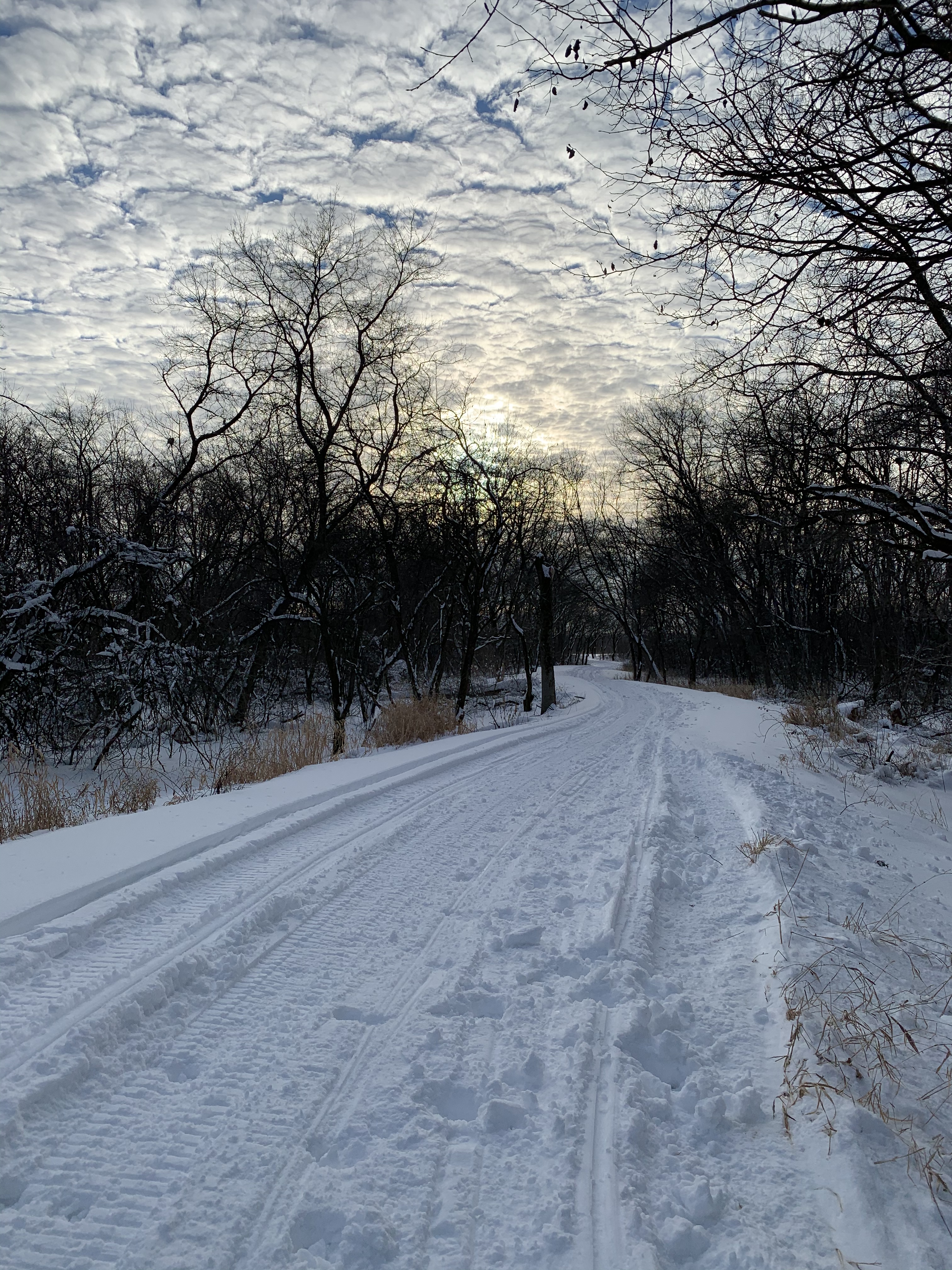
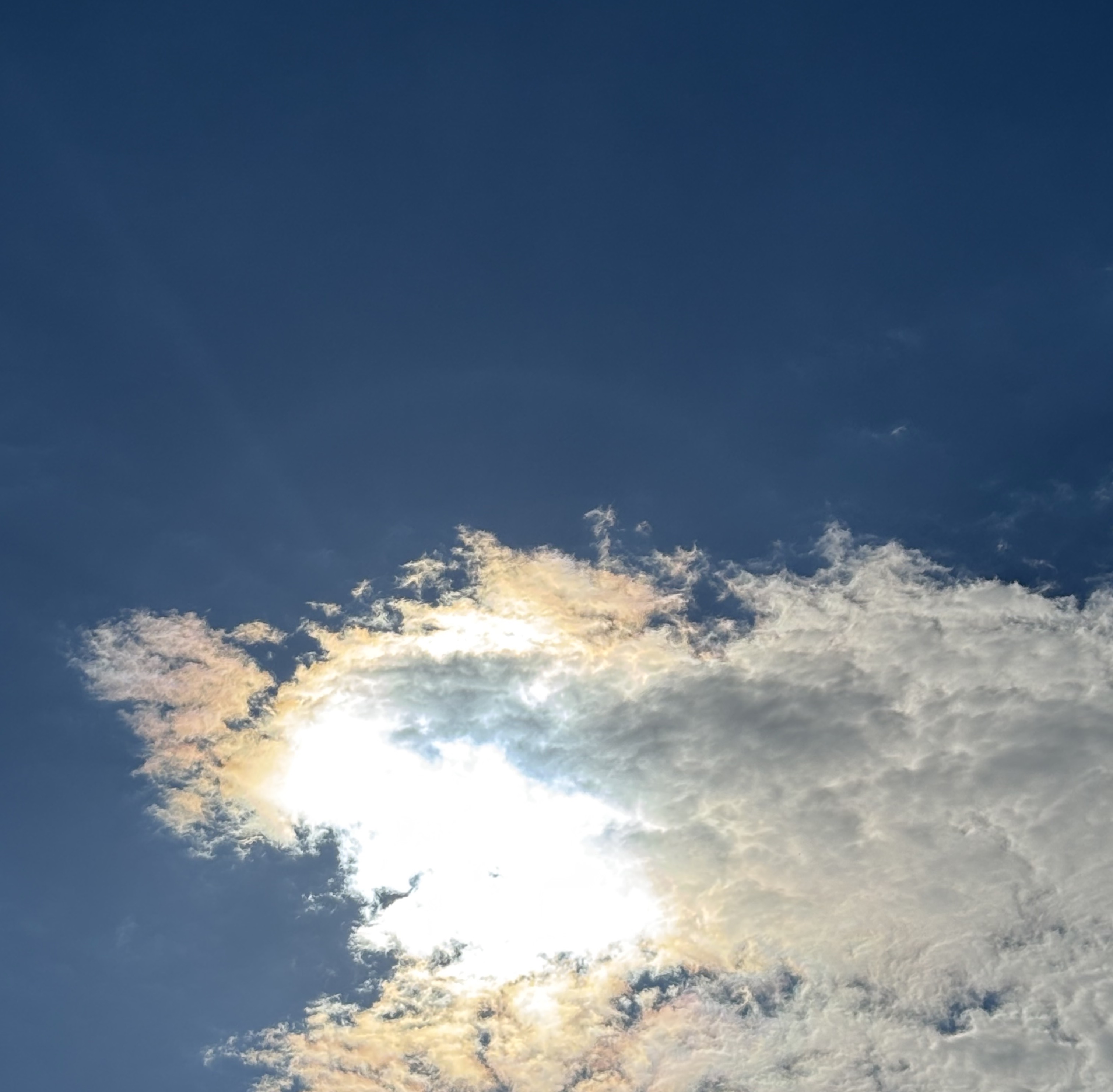
Later in the day, after Sofa Shakespeare, Kerri and I hit the trail. The sky stopped me in my tracks. It was winter-radiant. I felt as if I was standing between heaven and earth. Staring at this magical sky, Kerri asked, “What do you think is going to happen?” Our lives, like so many others during this pandemic, have been blasted into utter uncertainty. We ask this question daily, “What do you think will happen?”

“I don’t know. Something will happen. That’s for certain,” I respond. She punches my arm.

“Not helpful!” she grimaces.

Making choices. Making peace with your choices and your fate. Chasing ghosts. Asking the ethers for more information. “What does it mean?” Trying to decipher whether the ghost you chase is “a spirit of health or goblin damned.” Whether your ghost brings “airs from Heaven or blasts from hell…” What will happen?

Continuing down our snowy trail, more words from Hamlet rolled to the front of my brain. These words come at the beginning of the play: “There are more things in heaven and Earth, Horatio/Than are dreamt of in your philosophy.” At the end, “We defy augury.” This great magical world is beyond our capacity to grasp. Still, we must try. And, like Hamlet, the best we can do is arrive at peace with our uncertain fate.

“If it be now, ’tis not to come; if it be not to come, it will be now; if it be not now, yet it will come – the readiness is all.” Hamlet. Act V, ii

read Kerri’s blog post about HEAVEN AND EARTH

Go Spelunking [on KS Friday]

Arnie is among my team of wise-eyes. In response to a recent post, he wrote that he was relieved that I was stepping back into the light. “Darkness,” he wrote, “has never been the place from which I observed you to start.”

I am also relieved to be stepping back into the light. And, I am most grateful for my foray into darkness. It was necessary. It was useful. “The anger burned off a resistant layer of the onion.” I wrote in reply. “It burned away many of the resentments I was carrying, opened a channel to the voice I was withholding. Nature is not balanced in a world that makes room for light alone.” I was out of balance and needed to walk into that dark cave. Again. There is great power to be found at the dark center of the earth. After defeating the monster Grendel, Beowulf had to go into the dark forest and dive into the dark bottomless swamp to confront a more dark and terrifying monster, Grendel’s mother. He emerged victorious and forever changed.

“This above all: to thine own self be true, And it must follow, as the night the day, Thou canst not then be false to any man.” ~ William Shakespeare, Hamlet.

As the night the day. The day the night. Darkness is necessary to perceive the light. It is not possible to thy self be true without a good grasp of the whole truth, including the bits we ignore and deny. I’m only now understanding that this dance in the dark has been central to my lessons and my non-stop-pondering these many months. It is neigh-on-impossible to be true to yourself, to be whole, without embracing the full spectrum of your self. Without both sides of the moon. Self love, it seems, requires a love of ALL parts of your self. Dark and light. There’s plenty of room at the table.

Nature, your nature, is not corrupt or bad. It is nature. There is no judgment in nature, just interrelationship. Cycles and dances. Seasons of growth and rejuvenation. Birth and death. Rather than applying a scalpel it is more useful to go spelunking.

There is no denying we are living through a very dark time. It is the understatement of this young century to suggest that we are finding – again – a host of monsters in our very dark cave. We can, as we have in the past, run from the truth that we find, or, we can at long last pull up a chair, sit with our monsters, and have a chat. Monsters tend to transform when given some time and attention. When light is brought into darkness and darkness is led into light.

It is symbolically perfect and appropriate – deeply human – that the darkest night of the year is the time when many traditions celebrate the return of the light. It is natural, this progression into darkness. It is natural, this journey into light. Roots gather energy during the cold dark months. We rest, knowing that, with the return of the light, there will be much work to do. New crops to plant. New thoughts to harvest and share.

read Kerri’s blog post about NATURE SETTING THE STAGE

find all three of Kerri’s HOLIDAY ALBUMS on iTunes.

Love Your Words [on Not So Flawed Wednesday]

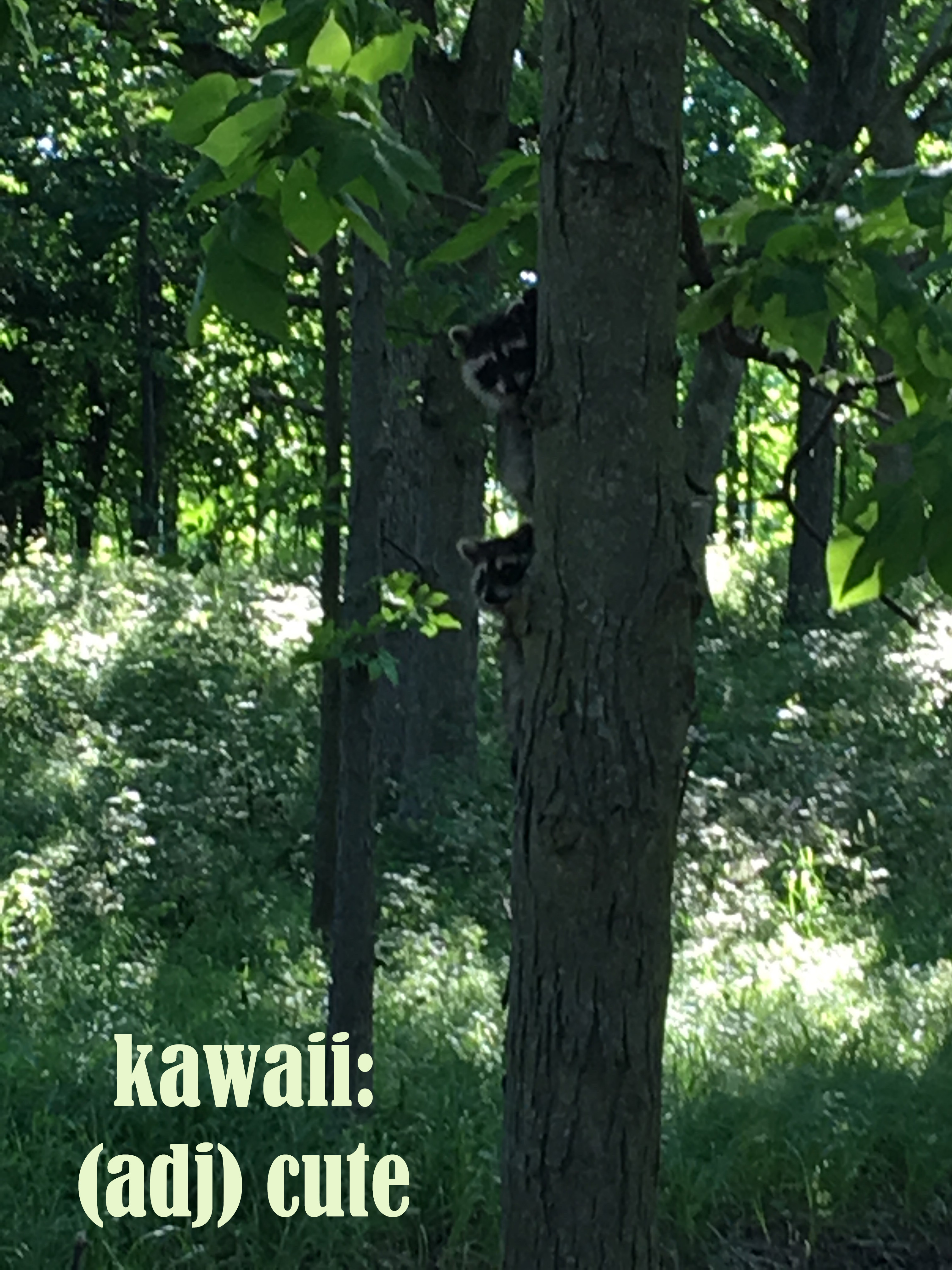
kawaii raccoons copy

I have grown fond of words. No one is more surprised by this statement than me.

A decade ago I did not consider myself a writer. Nowhere in my limited identity structure did I harbor thoughts of writing. This is an admission of my utter unconsciousness since I was writing and performing stories at conferences, with symphonies, and during facilitation. Tell a good story and even the most disparate-and-divided group will inhabit a common metaphor. Tell a good story in cliffhanger segments and even the most resistant conference-goer will greedily return to the general assembly to gobble up the next bit of story.  Stories are powerful magic and I loved telling them. At the time, it never occurred to me that I first had to write them.

The Buddha said, “The mind is everything. What you think is what you become.” I’ve also found the quote modified to read, “What you think is what you are.”  We think in words. We think in stories. Mostly, we are unconscious to the stories we tell ourselves and, more to the point, we rarely recognize that the river of words running through our mind is not truth. It is not fact. It is interpretation. It is story. We are storytellers all and the stories we tell define the moments we live. The stories we tell determine what we see or do not see, how we see or do not see.

That recognition brought me to my love of words. I started paying attention to the stories that I tell myself. I have a Hall-of-Grievances. I have a Complete-Book-Of-Rules for how I ought to live. I have a Jukebox-Of-Greatest-Hits, a entire collection of  stories and conversations that I replay again and again and again. I’m fond of the debate records I play because I win every time! There’s even a special long play set of recordings of things I SHOULD have said and, guess what? In my mind I say the SHOULD-HAVE-SAID words every time! I especially enjoy being witty and quick (in my mind).  It is a wonder that I have any space for new thought given the story-grooves I play over and over ad infinitum.

Words matter. The words I choose matter. I learned in school that William Shakespeare had a working vocabulary of approximately 26,000 words. If we are average, you and I top out at around 1,800 words. William either made up or was the first to put on paper roughly 10,000 of his 26,000 word vocabulary. We tell shorter, less articulate stories. Less poetry and more “get-to-the-point!” He didn’t have commercial breaks shaping his attention span.

I story other people as much or more than I story myself. The annoying little secret about the-story-I-tell-myself-about-others is this: it is not a story about them at all. It’s my story about them which makes the story I tell not about them, but about myself. “Words, words, words,” Hamlet replies to Polonius.

My world can be beautiful. My world can be ugly. My world can be safe. My world can be violent. My world can be kawaii. My world can be fugly. My world can be fearful. My world can be love-full. My world can be. I can be my brother’s/sister’s keeper. I can be concerned only for myself. Yes. No. Just words. Not just words.


read Kerri’s blog post about KAWAII

We are still in the Facebook annihilation zone. It is possible that Kerri’s posts may never reappear so, if you enjoy reading Kerri’s blog, consider subscribing to her blog. I know we publish waaay too much but, with the minor exception of us, no one reads everything that we write – except Horatio and for his dedicated perseverance, we are grateful.


chicken and perseverance website box copy*look at this website box on Kerri’s post. She added pupils to the eyes. Originally, I drew Chicken Marsala without pupils and that creeps Kerri out. She always adds pupils to Chicken!