Laugh More

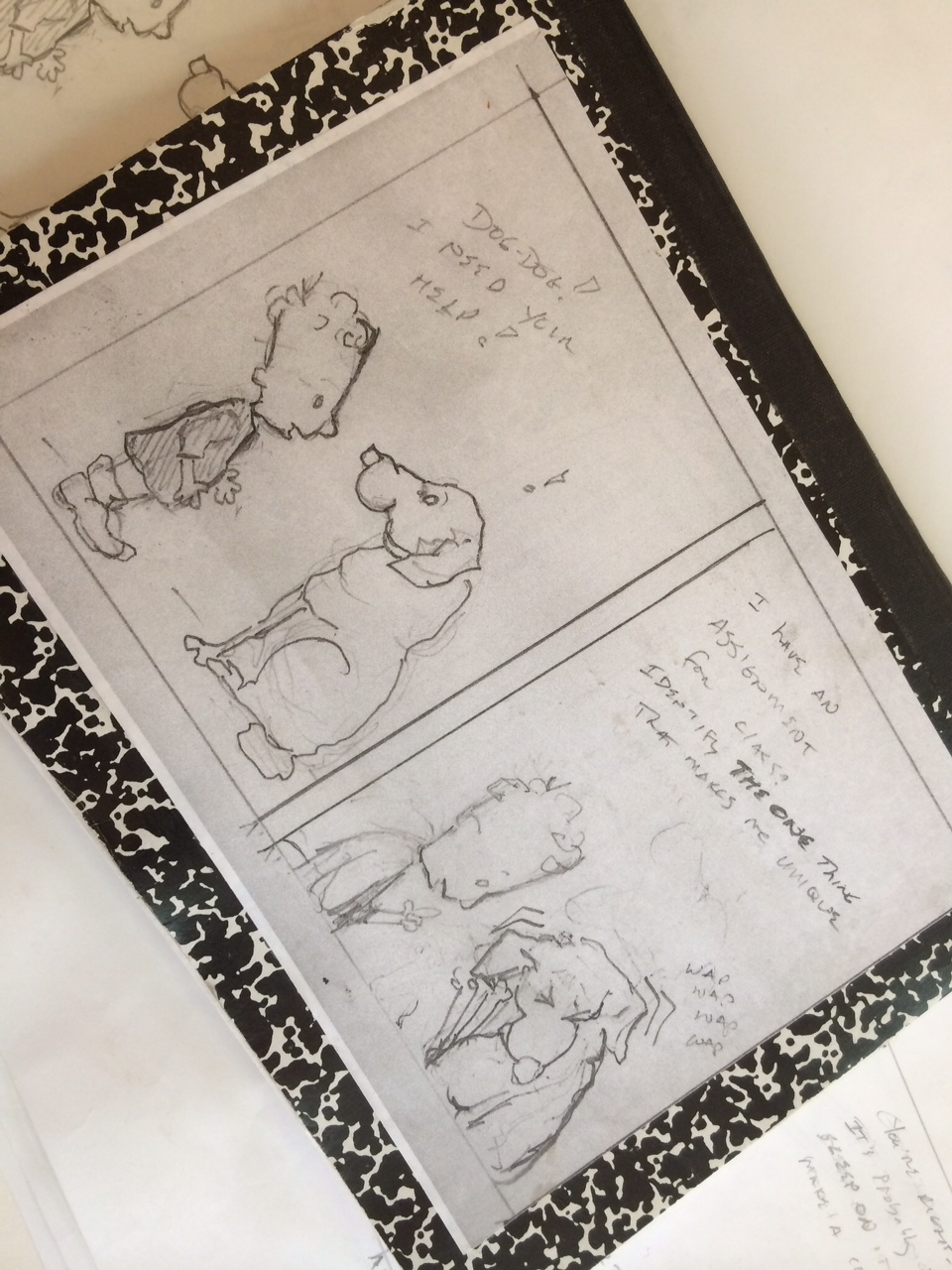
my idea book for our coming-soon cartoon, Chicken Marsala

my idea book for our coming-soon cartoon, Chicken Marsala

There is laughter coming from the next room. Across the way, a woman bursts into tears and a man with a ponytail leads her away from a group. They whisper. He tries to calm her. He makes her laugh. She wipes her eyes and they walk back to the group and all act as if nothing had happened. And, maybe nothing did happen. I am too far away to know the circumstances of her tears. I know the circumstances of her laughter.

Today it rained. I sat at my drafting table and worked on a cartoon strip. Tripper Dog-Dog-Dog sat at my feet. For the first time in over two years I streamed NPR and listened to the day’s news and some other stories. There was a story of a hunger strike in Chicago over the closure of a school. There was a story on public figures and apologies. There was an age-old story of the division in congress. I felt the same way listening to the news as I just felt watching the woman in tears. I am too far away to know the circumstances. I am too far away to know with certainty the truth of any of it. I’ve developed a healthy distrust of news reports. All I know with certainty is that truth is relative, truth is a point of view. I inked my drawings and listened as I might listen to a book-on-tape.

There is more laughter. It is coming from a meeting. I find comfort knowing that a committee in charge of anything can laugh. I hope that they are laughing at themselves.

Ann once told me that they key to success was to find a need and fill it. This world seems to have no shortage of needs. It does seem to have a shortage of laughter.

Recently, David shared with me his thoughts of Plato’s analogy of the cave. Perception as projection. It’s all shadows. Once I watched a Balinese shadow puppet master perform. The performances always take place in the outer ring of the temple and are meant to remind people that what they see in this life is a shadow, a projection merely. One of the messages: we are too far away to know Truth. Another message: our projections are worthy of our laughter and not much else. The puppet master had us rolling on the ground. His characters were mostly tricksters, stooges, and in their over-serious pursuits they were hysterical in their folly. Another message, perhaps the most important: the quickest route to the divine, to the connective tissue, is through laughter.


Focus On The Important Stuff

an offer from TwoArtistMakingStuffForHumans

an offer from TwoArtistMakingStuffForHumans

A note from the temporary site of TwoArtistsMakingStuffForHumans:

The waxing moon was muted with fog. It made the air shimmer. Avalon was near. Although it seemed too soon, there was a hint of autumn in the air. We sat next to a chiminea talking to friends. Monica told us of her daughter working in villages in South America. She told Monica that, by our standards, the people there have nothing. They are possession poor. But, they were happy, genuinely happy. They didn’t have much money or stuff but they had the essential thing that many of us lack: peace of mind. They focus on different, more important stuff.

It brought to mind my experiences in Bali. When I arrived all I could see was the poverty. By the time I left several weeks later, I’d have given everything I own or will ever own to have what they have: presence. Ease of mind. They weren’t looking for fulfillment, status, or living for retirement. They were living. Life was fulfillment. In a world where all things are sacred, status is gained by the quality of your giving and not by the size of your piece of the limited pie. It is a different focus.

There is a hidden cost to what dominates our focus, the things that take our attention…as opposed to the things we pay attention to.

As artists, both Kerri and I believe the work of our lives has been, one way or another, to help people focus on the important stuff, to see the extraordinary in the ordinary moment, to find inside what people seek outside. We’ve both worked across the boundaries of business, art, and the fine art of living everyday, there is no lack of necessity to refocus the eye, mind, and heart.

In a few weeks we will be launching our business (details to follow). All the many aspects of our work – if you can call art a product and performing a service – are intended to support, exercise and pay forward a focus on the important stuff, the important moments…sometimes the teeniest things that in the chaos pass unnoticed.

We want to do for others what we do for each other. Check out our pre-launch coaching offer. Take us up on it! Or, if you know someone who might benefit from working with us, pass it on, pay it forward.

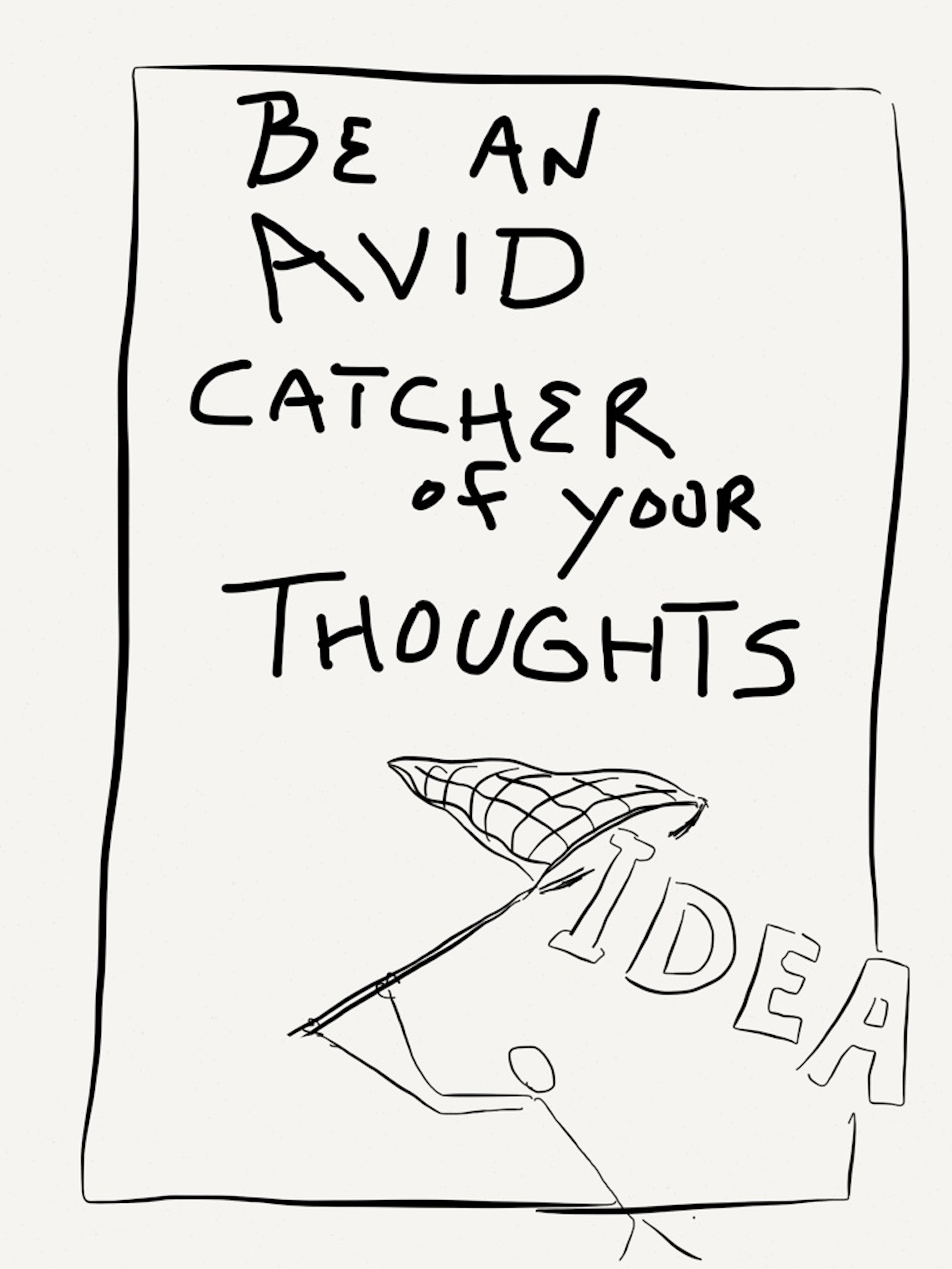
Be An Avid Catcher Of Your Thoughts

TODAY’S FEATURED IDEA FOR HUMANS

Be an avid catcher of your thoughts

This notion is the heart of change. It is the practice of self-awareness. Listen to the story you tell yourself about your self.  It is ripe with ideas, dreams, and yearnings. It is also ripe with fears, doubts, and comparisons. Capture the ideas. Listen to the dreams. Follow the yearnings. It’s a muscle. Develop a focus for the creative. Capture what’s useful and let the other jabber go.

Screen Shot Avid Catcher

TO GET TODAY’S FEATURED IDEA FOR HUMANS, GO HERE

Say More With Less

TODAY’S FEATURED THOUGHT FOR HUMANS

say more with less

One of my favorite humans is Master Jim Marsh. He told me a story of a dilemma. Something in his world was bugging him. He complained about it a lot. One day he realized that complaining was not helping. He said, “I decided I had 3 choices: to stop complaining, to move, or to do something about it.” He stopped complaining and began acting to change on what was bugging him. Sometimes talking about something makes us feel like we’re doing something. It’s a deflection. Actions, as we are told, speak louder than words. 

TO GET TODAY’S FEATURED THOUGHT FOR HUMANS, GO HERE.

Screen Shot Say More

Unroll The Generosity Perspective

from the archives: EmbraceI’m eavesdropping. Kerri and Pastor Tom are in the next room having a planning session. I just heard P-Tom say, “The generosity perspective fell down. Woody rolled it up and put it under the table.” I laughed out loud. They are talking about a banner but, taken out of context, it is a terrific and ominous phrase!

If you take a gander at the daily news, follow the political circus, count the people trampled in the crush to buy stuff the day after Thanksgiving, you would be hard-pressed to find a better phrase for our times. The generosity perspective fell down. And, to add icing on the metaphoric cake: Woody easily rolled it up. He put under a table.

This land is your land. This land is my land. This land was made for you and me.

I’m convinced that there is another side of the coin. There is no denying that meanness exists in our world. Humiliation is a game played everyday through social media and beyond. Yet, I still believe that there is a disconnection between the rhetoric and the lived experience. I see and experience terrific acts of generosity every day. Some are small acts, some are vast – unfathomable, some are spontaneous, some are planned but all are generous. In fact, when I really pay attention, I find that the incidences of generosity far outpace the acts of cruelty.

Cruelty makes for good gossip and good gossip is cruel. And so, meanness sells. It is good for advertisers so those are the stories we broadcast. Generosity, on the other hand, erases victim stories and so is rarely yummy-fun to talk about. Acts of generosity are less potent as a selling tool.

Cruelty is easy to see. Generosity requires an intentional focus.

This morning I bumbled into a TED talk by Patti Dobrowolski. I learned that the odds are 9-to-1 against making change even if the change needed is life saving. Her message is great: draw the story you want to tell. Literally, draw it. And then tell it. If we want a different story we have to imagine a different story. If we want a different story we need to tell a different story. If we want a different story we need to act a different story.

If Woody easily rolled up and stashed the generosity perspective under the table it should be equally as easy for Woody to reach under the table, unroll the generosity perspective and hang it for all to see.


Change Your Mind

I used this quote by Friedrich Nietzche in The SEER:

“The snake which cannot cast its skin has to die. As well as the minds which are prevented from changing their opinions; they cease to be a mind.”

A few days ago I asked myself this question: What if I never painted another painting or wrote another word? What would happen? Who would I be?

title_pageThe first question, what would happen, is much less interesting to me than the second question: who would I be if I simply put down my brushes forever? When I was younger, I felt driven, as if I had to paint. I needed it. In asking the question I recognize that now I choose it. I don’t have to paint; I want to and consequently I am a much better artist. It’s a paradox: I am a better artist because I don’t need to be an artist. In other words, I don’t need to be, I am.

I’ve been revisiting The SEER. My initial team of wise-eyes unanimously voted the first draft to be “too much.” The book that I published is comprised of the first three chapters of the original draft. I deconstructed them and broke the steps into smaller bites. There were six more chapters outlined and, in my latest revisit, I recognize that I have a trilogy if I want it. So, book two is in process. I’m going to release the first draft in daily snippets as I write it. Everyone gets to be my wise-eyes this time around.

Here’s the launching pad section for book two from The SEER. It’s from the second cycle (story):

You can change your story. That is the sixth recognition. Doesn’t it sound simple? Say it this way: changing your story is the equivalent of changing who you know yourself to be. Changing your story often requires the loss of your illusion, a lot less armor and nothing left to lose. Who are you when you don’t know who you are or where you are going? This was the heart of Virgil’s question to me. Who are you distinct from your circumstance? Who are you when the mask comes off? More importantly, what are you capable of seeing when you are not looking through a [knight’s] visor? No one is immune to the stuff of life. Everyone lives a unique version of the story cycle. It too is a pattern, a natural process.

Go here to buy hard copies (and Kindle) of my latest book: The Seer: The Mind of the Entrepreneur, Artist, Visionary, Innovator, Seeker, Learner, Leader, Creator,…You.

Go here (to Leanpub) for all digital forms of The SEER

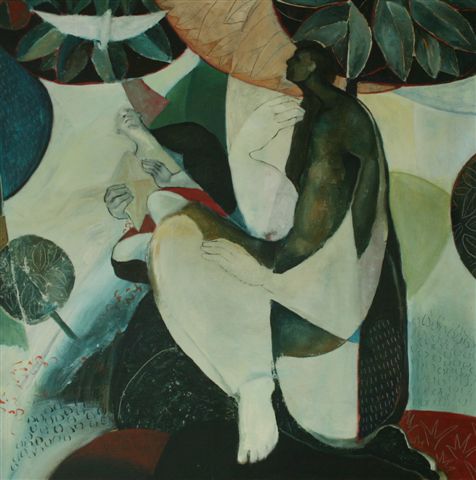
Canopy by David Robinson

Canopy by David Robinson

And, for fine art prints of my paintings, go here.


See It. Feel It.

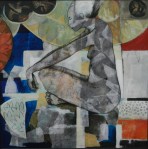
I call this painting "Sleepers"

I call this painting “Sleepers”

Tom spoke of small actions, the gift of peanut butter to a food kitchen for the poor. He asked, “Will it change the world?” and answered his own question, “I don’t know. In some small way, bringing a bit of hope to anther person, or providing food for a day, maybe it will.” Tom has been meditating on the many ways we enact love but perhaps do not see. He has been wondering if small acts of generosity serve as small acts love. Are not these small acts of generosity capable of changing the world.

For the past year, since moving from Seattle and leaving my work with entrepreneurs, I’ve been pondering this impulse toward change and the ubiquitous desire to change the world. I learned last year that, in business start-ups, the intention to change people is the great sign of folly. Changing people is impossible. If the central intention of the new business is to change people, don’t invest. It’s good rule of thumb.

People pray for a world without violence, a world free of disease and poverty. People read the paper and wonder what has become of the world. Someone recently said to me, “It’s overwhelming. What can I do?”

Tom’s meditation has brought him to this: it is not the doing that ultimately matters. It is quality of the being that matters. If your doing changes your being, you have changed the world. If some small act of generosity or compassion opens you, it changes the world. In the year prior to my move, I walked across the city of Seattle twice each day. I made it a game to count the small acts of kindness I saw each day during my crossing. There were always too many to count. People opening doors for others, making space in line, helping someone who dropped their packages, blocking traffic for an elderly person to cross the street. My walks were steeped in otherwise small invisible generosities.

The mistake we make when desiring change in the world is to think of change as a bottom line, change as an outcome or end result. Change as a forced march or dose of castor oil. Changing the world is not an arrival platform. It is within every act of kindness. It is every generous thought. It is fluid, on going, never ending.

One thing I learned from my walk with entrepreneurs is that every single start-up came about because someone saw a way to make life easier for others. What makes an idea good is how effectively it helps others. And so, in pursuing their idea, in every small action, they change themselves. They play in the field of possibilities. In changing themselves, they cannot help but change the world.

Will a donation of a jar of peanut butter to a food bank change the world? Perhaps. If it feels good. If it changes you. Small acts do not exist in isolation. To change the world you need only change yourself. People do not exist in isolation. The river flows. Each act impacts others in small ways and large.

title_pageGo here for my latest book, The Seer

Go here for fine art prints of my paintingsYoga.ForwardFold

Bring Your Boon

This painting is called Icarus.

This painting is called Icarus.

During my call with Skip I used the word, “boon.” He scribbled a note saying, “You’ve not used that word before.” The word came up because he’s been overrun by well meaning advice-givers that think he needs to know about the hero’s cycle. Skip said, (and it’s true) that he’s forgotten more about the hero’s cycle than most people will ever know. “I’m a business guy so they think I can’t possibly know about it!” he exclaimed. “If another person tells me about the hero’s cycle I’m going to explode.”

My thought for him was to pay attention to why so many people are coming up with the same response when they hear about his work. What’s evoking the common response: have you heard about the hero’s cycle? I always pay attention when a book title repeatedly drops into my world (I get the book) or when a place or a metaphor seems to pop up everywhere. What’s there that I may be overlooking? What is hammering Skip that he may not see? That’s what sparked the word, “boon.”

When the hero (and we are all heroes in our personal story) emerges from the ordeal of change, when they escape the belly of the whale, they are transformed. They know something that they didn’t before understand. This is the boon. They have a new gift or insight that will, in turn transform the community. Personal change is communal change. They are one and the same thing.

There is a small catch when dealing with boons: communities (like individuals) talk a lot about the need for change but mostly resist it. When you are the bringer of the gift, the carrier of the insight, often you are not welcome when you share it. New insights are dangerous to the status quo. History is resplendent with visionaries banished for sharing the boon of their transformation or bringing to the community the gold that they need but are incapable of recognizing.

Skip has arrived back to the world with a boon. He sailed to the edge and has returned with strange knowledge and a unique perspective. His insight contradicts common models of business. His boon describes motion, a flow, which is hard to see when the landscape is dominated by bottom lines and outcomes. His community mistakenly thinks he needs to go on a hero’s journey when, in fact, he is just returning. His hands are full of gold that they cannot see.

The best we can do is share what we hold. How it is received is out of our hands. If it is received at all is not in our control. Vincent Van Gogh died having sold one single painting – and that to his brother. The glory of his life – and the lives of all visionaries – is that he kept painting regardless of whether the world might someday see the boon, or not. It didn’t (and doesn’t) matter. Bringing the boon home is all that is required.

title_pageGo here for my latest book, The Seer

Go here for Fine Art prints of my paintingsYoga.Meditation

Welcome The Bump

With Kerri on the top of a mountain

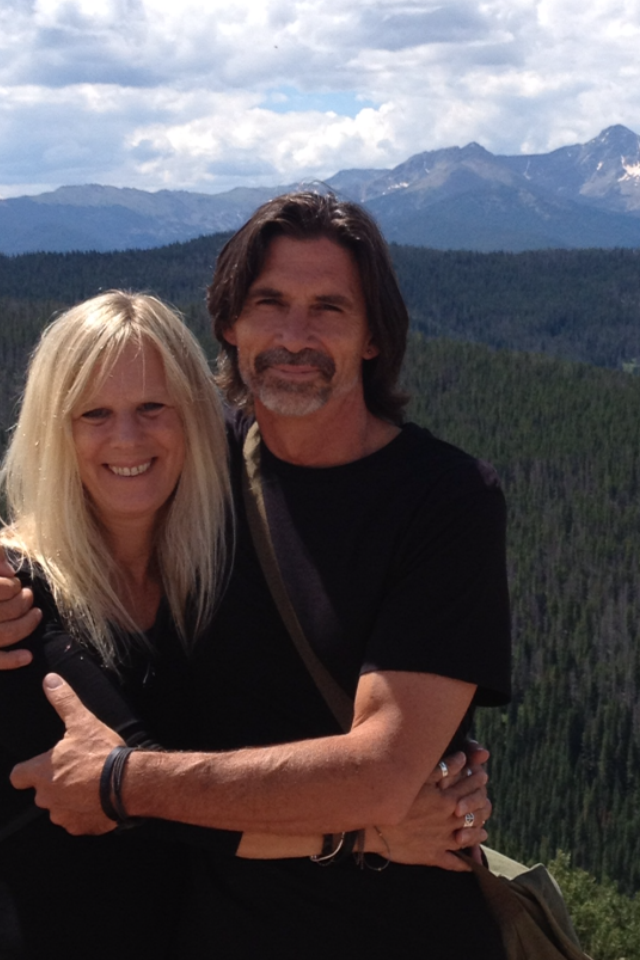
With Kerri on the top of a mountain in Colorado.

Just beyond Vail, Colorado there is a tiny two street town called Minturn. It began as a mining town when people were rushing for gold but these days it survives as a place for tourists. It is radically different than its founding fathers intended. We stayed there for a few days of rest and recuperation after our two-week double loop through Middle America.

The double loop through America was nowhere in the plan a month ago. Things just seemed to pop up. A death. Kerri’s daughter stumbled into a new job that necessitated an immediate move. Plans changed. Our intentions for the month went out the window. All of the artistry went on hold. We quickly packed the car and hit the road.

Just as plans change it is also true that change is rarely planned. I’ve yet to meet a person who doesn’t resist change (despite their rhetoric). Change requires a step into the unknown and that’s precisely the point: real change comes when we simply don’t know. Most of us like to know where we are going before we step. Change finds its way through the cracks that happen when patterns are disrupted, when things just seem to pop up, when we have no idea what the next step is. Change happens when we are making it up as we go. Change is a creative act, a tap dance on the event horizon.

Last week we drove to Colorado from Wisconsin through Iowa and Nebraska to attend my grandfather’s funeral. After the service we drove to Columbia, Missouri, crossing the full expanse of Kansas, to deliver some treasures from Beaky (Kerri’s mom) to Wendy (Kerri’s niece). Since we were driving to Denver, why not go home via Missouri? We returned home long enough to wash our clothes, pet the dog, and repack the car and head to Minneapolis. We packed up Kerri’s daughter and moved her to Vail via South Dakota with a sharp turn through Nebraska before arriving again in Colorado. After a rest in Minturn, a few hikes, some time with wine sitting on a porch, and a few precious nights with my parents, yesterday we returned to Wisconsin through Wyoming, South Dakota, and Minnesota.

It was a tap dance. Change found its way in as our patterns disappeared in the spontaneity of the double loop. We arrived home exhausted and exhilarated, with renewed eyes, a riches of profound and varied experiences, and much clearer intentions. What seemed initially like an interruption in our path was, in fact, a crack in the pattern, a necessary bump into the unknown.

title_pageGo here for my latest book

Embrace The Mess

circa 2011

circa 2011

I did not intend for this post to be a continuation of yesterday’s but when Amy climbed the stairs into the choir loft and said, “I don’t do change very well,” I laughed. It was word-for-word the same phrase that Kerri had just spoken.

For some reason, we’ve come to expect change to be comfortable and breezy. We expect ourselves to be paragons of reason in the face of imbalance. I find this ridiculous expectation of centered-off-centeredness to be suspiciously corporate. Apparently all change needs management and if it is not managed smoothly and without feeling or emotion then it is not well done.

Emotion is messy. Change is hard. The seed cracks before the tender shoot finds its way to the sun. The seed needs to crack in order for the new form to emerge. Hearts are broken, like seeds, to allow new forms to emerge. Even the “right” relationship is dynamic, messy, surprising, joyful, disappointing, filled with fear, the heights of elation, tenderness, quiet, and at the core is this volatile thing called love. Love burns hot during transformation; love is snuffed when excessively managed. Love is transformative when not unduly controlled.

Everyone does change well because change is the nature of our existence. Energy is always in motion. If humans are expert at anything it is change. We do change well because we can’t avoid it. What we do not do well is afford ourselves the grace of feeling the grief, the insecurity, the frustration, the anger, the joy, the exhilaration, and the dizziness that comes with change. We limit our emotional color palate when we confuse change with control. We do not allow ourselves the mess, the unpredictability, and the loss of balance that necessarily comes with this rolling vibrant transformation called life.

Amy would have been more accurate had she said, “I don’t do control very well.” I didn’t tell her the secret: no one who experiences the fullness of life does control well. In the face of her messy, volatile, change process, she wouldn’t have appreciated my counterpoint. When someone is standing in the middle of the muck it is cold comfort to tell them that they are in the right spot. So, I simply laughed, nodded my head, and said, ‘I know….”

Go here to get my latest book, The Seer: The Mind of the Entrepreneur, Artist, Visionary, title_pageSeeker, Learner, Leader, Creator…You.

 

Go here for fine art prints of my paintings.