Make No Sense

these hands will change

these hands will change

The woodpecker hammered high atop the ancient television antenna. He seemed not to be bothered by his lack of progress, beak on metal. At first I thought it made no sense and then it occurred to me that progress was not the goal. Perhaps the woodpecker hammered for the pure pleasure of the sound of it. It need not make sense. This woodpecker was an artist to his or her core!

Yesterday was a “no-power-tools” day. No sharp objects were allowed. No walking near ledges permitted. I was distracted; tired to the core. Late in the day we drove 45 minutes to a bakery called ‘Simple’ in Lake Geneva. They make the world’s best flourless chocolate cake. “This makes no sense,” Kerri said as we stepped out of the bakery with our cake. We laughed and ate a slice in the car; pure pleasure before driving home.

Every time the neighbors let their dogs out, Tripper Dog-Dog-Dog runs a frenetic figure eight in the backyard, over and over and over. He exhausts himself. He is having some exotic shepherd fantasy or perhaps he cannot contain his delight. It makes no sense for him to run a trench in our backyard for dogs he’s never even seen. He runs for the pleasure of it.

We sat in the sun this morning drinking coffee. The sky was cloudless, the air was cold but the sun was warm. We leaned against the house, saying little, feeling the warmth seep into our bones. We both knew that on this day we would do nothing. There would be no visible progress toward any defined goal. The wheels of society would have to grind on without us. We needed most to stop, to sit, to stare, to laugh at the Dog-Dog.

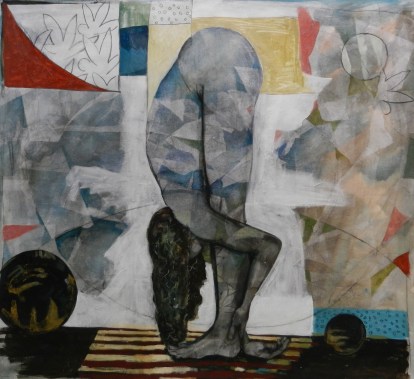
photo-2I started a painting a few weeks ago. It is a figure falling through space. Something has been wrong all along and sitting in the sun I figured it out. The hands are all wrong. Rather than reaching for something to grasp they ought to be letting go.


Walk Through The Firewall

from my narrative series: Sleepers

from my narrative series: Sleepers

The text read something like this: There are some things in life you cannot circumnavigate. You can only move through them.

Carol told me that each year there is a growing change in her students. There is a gap between their generation and ours – and it is alarming. She teaches young actors at a college for the arts.

“What’s the difference? “ I asked, “what’s the change?”

“They are increasingly more and more medicated,” she said. “Through their whole lives, since they were small children, they’ve been reinforced through medication that their emotions, what they feel and how they express it, are bad. To teach them to be actors, to be authentic on the stage, to allow that what they feel is necessary and good, is nearly impossible when they are drugged to prevent them from feeling anything.”

She paused for a moment and added, “I can’t ask them to get off their drugs. I can only help them consider that their feelings, their emotions, are not the enemy but the route to truth.”

I offered that the drugs serve as a firewall that keeps them from themselves. It dulls them from the full range of life experiences. Years ago, when I was working in the schools, I experienced the first wave of kids drugged into compliance. It seemed that the solution for almost everything was medication. Their attention was either in deficit or their behavior obsessive and, either way, meds were the answer.

We talked of the other firewalls, the drugs that numb us or distract us from a full range of life experiences. Television in excess is the most obvious. And then there is the downside of social media; disconnection in the guise of connection.

I shared that, on my move to Wisconsin, I decided to unplug from the daily news. For me, it was serving as a firewall against the essentials of life. Too much adrenaline and fear numbs us. It makes us close, shut down. I felt that the noise was doing the opposite of what it pretended. I suspected that I was less informed by listening to the onslaught of opinion-masked-as-news. I realized that I was agitated all the time by the battling correspondents and felt infected by the us-and-them picture they were painting of the world. When minor events are elevated to disaster status the real disasters pass unnoticed. Everything evens out. All colors of life reduce to bland gray.

Now that I’m through the firewall the events of real importance are evident beyond the chatter. If I really need to know it, I hear about it. In unplugging, I am actually more informed. And then there is this: without the incessant chatter, my artistry is coming through with clarity and potency. In seeing more clearly I can see my self more clearly. When not dulled or distracted by the noise, the full range of sound and color has re-emerged. The lesson: this world does not need fixing or changing or improvement. Neither do I.  It is gorgeous and profound when we are able to live unafraid of what we feel.


Reach

photo-6In these few weeks post Lost Boy I’ve been writing thank you letters and sending Kickstarter rewards to the many people who donated to the campaign. I am humbled by the number of people who stepped forward to lend a hand, offer resources (financial and otherwise), and/or heap us with the moral support necessary to produce the play.

The Reminder: no one does anything alone. All creative acts, all things that are useful in this world, all triumphs that seem on the surface to be an individual achievement, are, in truth, a group effort. Life is a team sport. Quarterbacks are nothing without a front line, a coaching staff, a back office, a marketing machine spinning the tale. They also had mothers that for years drove them to practice, families that stood in the cold to watch them play little league, and a host of friends who told them that they could do it if the only kept going. Artists are no different. Even the loneliest painter has a rolling lifetime team whether they recognize it or not. Consider this simple basic: a painting is never complete until someone other than the artist engages with it. A play is never complete until an audience arrives. The whole point is to make or accept an offer to/from an other.

We, the people of these United States, place the accent of our existence on the achievement of the individual and that sometimes makes us blind to the obvious truth of our existence. We do nothing of worth on this earth without the support and participation of others; relationship is at the core of anything worth doing.

from the 2015 Racine snow carving contest. I'm sorry I did not capture the artists names!

from the 2015 Racine snow carving contest. I’m sorry I did not capture the artists names!

Once, many years ago, I lived in Los Angeles. I did not know my neighbors. I had no idea or desire to know who was living in the houses next to me. One night the earthquake came and our illusion of independence was stripped bare. With no power, no water, no heat, and compromised housing, the first thing we did was to reach to each other. When the illusions of comfort and security are stripped, our real need (each other) becomes glaringly apparent.

I wrote this play, The Lost Boy, because someone dear to me, over a decade ago, asked me for help. I was grateful that he asked – it meant I got to spend time with him and return some of the attention and love that he had invested in me. When the metaphoric earthquake hit – when Tom died – I had no recourse but to reach out to others; I produced this play when I realized that I was not alone and all I need do was ask for help. Legacy, like story or life, is an infinite loop of relationships.

Move Your Words

My friend, Mark, made this Wordle of my blog

My friend, Mark, made this Wordle of my blog

I am working with words again today but in another aspect entirely. Now that The Lost Boy has the minimum funding necessary for a production I am working on the play in earnest. Tripper Dog-Dog-Dog cocks his head and wrinkles his brow in wonderment as I talk to myself or dance the words. Sometimes he confuses my work method as an invitation to play and he leaps, catching the cuff of my shirt and pulls me to the ground. “Not now!” I cry out as Dog-Dog stretches my sleeve so that it might fit a giant (a side note: Dog-Dog has altered all of my shirts – he regularly mistakes my work for play. If I do not roll them, my shirt sleeves look as if I am small child wearing an adult extra-large).

I am a kinesthetic learner and realized years ago that working on a script was easier and more productive if I moved or danced the words as I worked with them. To borrow a phrase from a lost friend, my years at school were “fresh hell” because sitting in a desk was painful, it hampered my learning. If I want to have an insight or gain an understanding of something, the best thing for me to do is take a walk. If I move it, I can break down a script in no time. I can memorize anything if I can physicalize the intentions. For me, language, word use, and sense-making are a physical affair.

It is a physical affair for everyone. Try to speak without breathing (an impossibility); breath is movement. Speech is physical. For a real laugh, try to communicate without gesturing. Limit your movements and you will inhibit your capacity to communicate. For more fun, Google the latest statistic about how much of our communication is really non-verbal (we primarily read body language; listening to what is being said is a distant second). The deep mastery of a storyteller is found, not in the words, but the punctuation of a moment: the turn of the head, the intake of breath, the smallest of gesture, the connection made through the eyes; the fire of imagination is fanned when the storyteller, no matter how subtle, dances the story.

Last night I was reminded again of the power of language – the real kinesthetic of it. B is disturbed by the violence and darkness she sees in the world and asked, “How do we push back on it.” I challenged her verb. When we choose our language we also choose a “metaphor path”. Language choices come with images and images are not passive. They define what we see. They define the available options. They are a root for movement. To push back is a verb of resistance. It is counter force, a choice of aggression. “Why push against what you don’t want?” I asked. “Why not put your energy, effort, and imagination into creating what you actually want?”

To push. To create. Which verb will move you?

title_pageGo here to buy hard copies (and Kindle) of my latest book: The Seer: The Mind of the Entrepreneur, Artist, Visionary, Innovator, Seeker, Learner, Leader, Creator,…You.

The PoetFor fine art prints of my paintings, go here.

Expose The Value

photo-3We debated our costumes for Brad and Jen’s Halloween extravaganza for months prior to the party. The letter for this year’s costume theme was “T” (with extra credit for using a “Q”). During the long hours of our summer road trips, our conversation sounded something like this:

“We could be Trollops.”

“Trollop is good. We could be Tin men.”

“I like that. What about Tootsie Pops!”

“Someone will come as a Tootsie Pop. How about Tramps.”

“No. I did that when I was twelve. What about tsunami! We could be a tsunami!”

And on and on we’d go. We finally settled on this bit of whimsy: Too-many-ideas & Too-many-questions. Kerri was going to be Too-many-ideas and I was intended to be Too-many-questions – but we changed our minds in the final hours.

At the party you might have asked, as many people asked us, “What is a Tarving Artist?” We wore paint-spattered clothes and artist aprons filled with paint and brushes. On the aprons we wrote: Dying Of Exposure. Between us we carried a donation bucket with a sign that read: Our “S” was repossessed. Please help us buy it back.

In the week prior to the party, Kerri was asked to play for an event. Every artist in the nation is used to hearing the words she hears weekly: “We have no money to pay you but it will be great exposure for you.” She is a consummate, career musician with 15 albums, (going on 16) and needs no help with her exposure. I loved her response: “Let me call my accountant and ask if she accepts exposure for payment.” Her latest encounter with empty exposure started a long hysterical conversation and note-comparison session of all the amazing ways people have asked us to work for anything and everything but money (Yes, it is true. When artists make art they are working as surely as a plumber who plumbs or a doctor who diagnoses. When was the last time you asked your dentist to work for exposure?).

The common mistake at the center of every work-for-exposure offer: it will be good for the artist. It’s never good for the artist. For two reasons it’s a notion that is good for everyone but the artist. First, no artist wants the kind of exposure that reinforces that their work is without real value. Second, no creative artist wants to be defined as a player of background music or drawer of dog portraits (unless, of course, their dream in life is to draw dog portraits). The act of drawing or playing a musical instrument is not what defines the artist or their art. It is a mistake to assume that because I can draw and paint that the act of drawing and painting is what constitutes the art. A carpenter uses a hammer but the hammer does not define their work. It is a tool. The keyboard, the paint and brushes are tools.

People who pay artists with exposure see the tool but not the artist. That is why Kerri and I opted to change our costume. Certainly dressing as a Tarving Artist was a statement but more than that, we realized that only a starving artist would agree to play for exposure; only a starving artist would agree to hammer incessantly to get the attention of people who can’t see them to begin with. It’s never good for the artist and is always a costume or role they assume for the empty promise of exposure. The cost for the artist is always greater than the exposure and at the end of the day, after trading a bit of their integrity, they still aren’t able to pay the bills.

title_pageGo here to buy hard copies (and Kindle) of my latest book: The Seer: The Mind of the Entrepreneur, Artist, Visionary, Innovator, Seeker, Learner, Leader, Creator,…You.

Yoga.ForwardFoldGo here for fine art prints of my paintings


Be The Detail

I took photo and used this image in The Seer.

I took photo and used this image in The Seer.

When I shared the early chapters of The Seer with friends, their feedback was universal: I was trying to say too much. They asked me to break it down into smaller bites. At first I resisted because I couldn’t see the path to smaller bites! In time I was able to step back and see what they were telling me. All of the necessary connective tissue was in my mind; I was filling in the thought-gaps. My wise-eyed readers had no access to my mental filler and saw a story riddled with gaps.

It was a valuable lesson for me. What I see is never what others see. Even when we share an experience, it is false to suppose that we had the same experience. We share. That is a much different thing than assuming sameness. When I think I am being clear, when I think that my point of view is right, I remember the gaps. I am projecting content and context filler onto every experience and so are all the other people in the room.

Perception is at best a moving target. This simple principle is what makes art so necessary and science so exciting. Newton thought he was dealing in absolutes. He was describing a universe based on uncontestable fixed principles. And then came Einstein. We see from and through a context that we like to call “truth” but, it is at best relative. Is it a particle or a wave? Well, it depends…

I used to facilitate an exercise called Mask Mingle. It is a powerful way to open eyes and hearts to the grace that we grant ourselves but rarely grant to others: specificity of story. We cannot walk through our days without carrying the specificity of our experiences and the rolling, roiling interpretations and re-interpretations of those experiences that we call ‘memory.’ No one can see what we’ve done and where we’ve been. No one sees the joy, the hurt, the dreams, the losses, the fears, the perseverance. They cannot see the detail. The best they can do is interpret us through their lens. We will always be a generality in the eyes of others.

I find that central to much of what I write about and coach about is the surrender of what other people might think. It is a fallacy to think that you can determine what others think of you. You will never see through their eyes. You will never know their lens. It is a powerful moment when an artist (or anyone) realizes that they have no control over the perception of others. The best they can do is offer their gift from their unique, unknowable, rich, point of view. That moment is called artistic freedom.

title_pageGo here to buy hard copies (and Kindle) of my latest book: The Seer: The Mind of the Entrepreneur, Artist, Visionary, Innovator, Seeker, Learner, Leader, Creator,…You.


Explore The Human

photo-2

my latest work-in-progress. No name yet, approximately 5ft x 9ft.

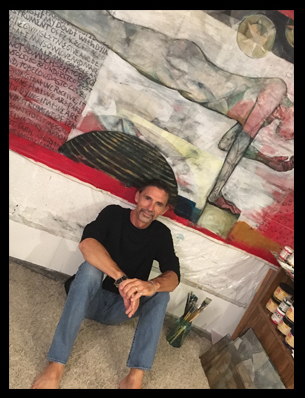
Standing on the stair to her studio, Pam said, “I’m not sure where my work is going. I’ve pulled out all of the old paintings so I can see where I’ve been, what I’ve been doing, and maybe that will help me live into what’s next.” Like me, Pam has been a painter most of her life. She’s been through this transition many times before and recognizes the necessity of fallow artistic fields. Rather than push or panic, she’s matured as an artist and knows enough to value the emptiness.

With maturity comes faith. The muse never leaves. She rests. Artistic cycles are no different than seasons. Like a farmer living through the winter months on the harvest of the fall, Pam will spend hours sitting with her old work, thinking nothing, drinking in the nutrient of her artistic yield, allowing her inspiration fields to recharge and rejuvenate. She will allow herself to go empty, creating ample space for the new work when the muse reawakens. And then, one day, she will pick up a brush and be surprised by what comes through her.

Hans said, “An artist matures when he or she ceases working from their pain and begins exploring the human condition.” Working from the wound is necessary as adolescence is necessary. Most artists in our western tradition begin in rebellion, pushing against, making statements. We celebrate the outsider, the margin-sitter and so the wound can be difficult to escape: artistic pain becomes a role, an expectation. In practice it is akin to a developmental stall. The only place to go when pain is the norm is into the intellect: to produce, to make statements. Pain isolates and ultimately, an isolated artist is ineffective. Artistry, like all things vital, must occupy a shared space. It is communal or it is impotent.

Potency comes when the eyes turn out, when the question of “we” becomes more vital and interesting than the question of “I.” Artists mature when they reorient, when instead of the art expressing their pain, they serve the art and, make no mistake, art is another word for “human condition.” Art is bubbling life in all its forms: visual, kinesthetic, aural. As Hans said, “I want to fall deeper and deeper into the music. I want to find the edges and follow where it takes me, give myself over to it.”

title_pageGo here to buy hard copies (and Kindle) of my latest book: The Seer: The Mind of the Entrepreneur, Artist, Visionary, Innovator, Seeker, Learner, Leader, Creator,…You.

DSC_1196 copyGo here to support the kickstarter campaign for my play, The Lost Boy.

Welcome The Bump

With Kerri on the top of a mountain

With Kerri on the top of a mountain in Colorado.

Just beyond Vail, Colorado there is a tiny two street town called Minturn. It began as a mining town when people were rushing for gold but these days it survives as a place for tourists. It is radically different than its founding fathers intended. We stayed there for a few days of rest and recuperation after our two-week double loop through Middle America.

The double loop through America was nowhere in the plan a month ago. Things just seemed to pop up. A death. Kerri’s daughter stumbled into a new job that necessitated an immediate move. Plans changed. Our intentions for the month went out the window. All of the artistry went on hold. We quickly packed the car and hit the road.

Just as plans change it is also true that change is rarely planned. I’ve yet to meet a person who doesn’t resist change (despite their rhetoric). Change requires a step into the unknown and that’s precisely the point: real change comes when we simply don’t know. Most of us like to know where we are going before we step. Change finds its way through the cracks that happen when patterns are disrupted, when things just seem to pop up, when we have no idea what the next step is. Change happens when we are making it up as we go. Change is a creative act, a tap dance on the event horizon.

Last week we drove to Colorado from Wisconsin through Iowa and Nebraska to attend my grandfather’s funeral. After the service we drove to Columbia, Missouri, crossing the full expanse of Kansas, to deliver some treasures from Beaky (Kerri’s mom) to Wendy (Kerri’s niece). Since we were driving to Denver, why not go home via Missouri? We returned home long enough to wash our clothes, pet the dog, and repack the car and head to Minneapolis. We packed up Kerri’s daughter and moved her to Vail via South Dakota with a sharp turn through Nebraska before arriving again in Colorado. After a rest in Minturn, a few hikes, some time with wine sitting on a porch, and a few precious nights with my parents, yesterday we returned to Wisconsin through Wyoming, South Dakota, and Minnesota.

It was a tap dance. Change found its way in as our patterns disappeared in the spontaneity of the double loop. We arrived home exhausted and exhilarated, with renewed eyes, a riches of profound and varied experiences, and much clearer intentions. What seemed initially like an interruption in our path was, in fact, a crack in the pattern, a necessary bump into the unknown.

title_pageGo here for my latest book

Give As Love

The stack of paintings sitting in my basement waiting for me to show them.

The stack of paintings sitting in my basement waiting for me to show them.

Sitting in the choir loft this morning I was at first disappointed that the stained glass window was silent. I was so full of questions – and have lately been so full of questions – and have come to look forward to hanging out in the loft, conversing with the window, while Kerri plays a service.

When I bring my questions the window always has something to say. The window offers a better set of questions or a startling reflection or a slap of insight. The window’s responses always come in the form of a message of return (return to heart, return to forgiveness, etc.). If I get quiet and ask my question, out of the peace, a conversation always ensues. Today, from my quiet, I asked my question about artistry, about my artistry, and I was met with an unusual silence. I wrinkled my brow. I wondered if my conversation with the window had come to an end or if perhaps my question was out of the scope of topics for a stained glass window.

There was a visiting pastor, an elder who’d been preaching for over 50 years. I sat up and paid attention when he began his sermon this way:

“Artists have a special gift. They help others see in a new way….”

His message was about love. Love, he told us, takes many forms and the form that love takes depends upon the unique gifts of the lover: a symphony is a gift of love, a painting is a gift of love. A plumber fixing a broken water main late into the evening is a gift of love. “What is your gift? he asked. Do you recognize it as love?

A few years ago, on New Year’s Eve, I visited a tarot woman at a bookstore in Denver. During our session she asked me a question that felt like a cold slap in the face. “You know god’s voice,” she said. “Why do you not use it?” I mumbled a lame excuse that dribbled into silence. “Why do you not use it?” she asked again.

Sitting across the table from the tarot woman, I knew without doubt that I have, my whole life, been a great servant to other people’s artistry but a lousy servant to my own. In my life I’ve been the midwife to many people’s gifts while mine have remained mostly unrealized.

The window whispered, “A painting is a gift of love. So is a play. So is a book. These are your forms of love. Your gift is a gift of love. Love is god’s voice and you know god’s voice.”

“I do know it,” I said, timid to admit it. “Don’t we all?” I asked the window.

“Access is open to all. Few actually listen,” the window replied. “Few know how to listen. Most fear their gift and plug their ears.”

To offer my gift without inhibition is how I best express love to the world? That was old and new for me at the same time. I asked the window, “How many artists need to hear that message? How many people need to hear that message?”

“You are deflecting. You deflect your gift by serving other people’s purposes before your own. These questions you ask are the wrong questions,” said the window. “Yes, of course, all people need to hear the message. But, is it your purpose to deliver the message or is it your purpose to fulfill your gift? Helping others hear their message is not yours to do. Yours is to fulfill your gift and, in that way, help others to see their gift in a new way. You need do nothing but give your gift. They will see or not without your intervention. Love by giving your gift. It is simple. Give your gift, give your love, without reservation or doubt.”

“Love can be how you listen to a friend in need,” the pastor said. Love is not about the rules or the restrictions. Even when you try to alienate love, it will always find its way back to you. It will find its way back through you.

“You know god’s voice,” the window continued. “And you know it. Return to the truth; return to your truth. The question, ‘Why do you not use it,’ no longer matters. It, too, is a deflection. Asking ‘why’ merely delays the giving. Use it. Give it. Give as love.”

Go here to get my latest book, The Seer: The Mind of the Entrepreneur, Artist, Visionary, title_pageSeeker, Learner, Leader, Creator…You.

Or, go here for hard copies.

Clear The Static

'John's Secret' by David Robinson

‘John’s Secret’ by David Robinson. I’ve used this image before but this painting came to mind while writing so I’m using it again.

So many of my conversations with the stained glass window have to do with returns. For instance, the first conversation was about the return to silence. Over the year, we’ve had lengthy chats about the return to the sacred, a return to light, gratitude, alignment, unity, presence and love. Today our conversation was about the return to voice.

When people talk about voice they generally associate the verb “to give.” Give voice to your thoughts. Give voice to your ideas. Giving voice implies that you have something inside that is unexpressed. It implies that your inner editor has run amok and has a choke hold on your communication. Release the grip and give rein to your voice.

Free expression is all well and good but giving voice also comes with a caveat. Someone I once knew told a great story of a woman who grew tired of hearing her associates complain about not having a voice. This woman, in a fit of frustration, asked, “If you had a voice, what would you say?” It is a potent caveat: it is not enough to have a voice. In addition to the capacity to give voice you also need something meaningful to say. The 24-hour news cycle is rife with great examples of voice sans content.

My conversation with the window had nothing to do with giving voice to the unexpressed or to the necessity of useful content. The window surprised me. The window reminded me of a favorite quote by Vincent Van Gogh: If you hear a voice within you say, “you cannot paint,” then by all means paint, and that voice will be silenced. Oddly, my discussion with the window about the return to voice had to do more with with silence than with sound. It had to do with the quieting the static. In other words, full expression is available when the inner radio station is properly tuned. Clear the noise and the channel opens. Clear the noise and act: paint the paintings, write the next book, create the Be-A-Ray performances, give life to my play, The Lost Boy. The return to voice is a path that leads through quiet. It is a paradox and to my great delight it is a paradox that loops back to my very first conversation with the window. Silence and voice, voice and silence: they are dynamic and intimately connected.

Go here to get my latest book, The Seer: The Mind of the Entrepreneur, Artist, Visionary, title_pageSeeker, Learner, Leader, Creator…You.

Or, go here for hard copies.