Cut A New Path

ComfortNow

The latest in my Held In Grace series. This is Comfort Now

It seems to me that most of our days on this earth are spent moving through patterns, conscious or unconscious. These patterns are the rituals of our lives. Some of the rituals are easy to see. For instance, what is the sequence of actions you perform before going to bed each night? What about your ritual of rising each day? The care and feeding of Tripper Dog-Dog-Dog and Babycat are central to my rising and retreating rituals each day. We move through the same actions every morning and evening and I delight in the warmth of the ritual.

Some of the rituals are not so easy to see. Researchers tell us that most of the thoughts we think every day are the same thoughts we had yesterday. We mostly think in patterns (it makes sense once you recognize that language is constructed of category and pattern). We talk to ourselves, cutting paths through the forest of our minds and, once we’ve established a trail, we like to stay on it. Easy is often unconscious. There’s nothing wrong with staying on the easy trail if the path you’ve cut, your repetitious thought-ritual, is self-loving. The rub: ritual paths of self-loathing and self-limitation are also easy, well-worn paths and that makes them both unconscious and hard to leave.

Cutting a new path through the mind forest begins with recognizing that new paths are always available. They just aren’t easy to establish. They require new practices. They require surrender and the first bit of surrender necessary for cutting a new path is the ritual giving-over of needing-to-know-anything; new paths, by definition are unknown.

New paths are not comfortable precisely because they require attention, consciousness.

My teachers taught me that all stories worth telling are stories of transformation. The main character or characters will know something at the end of the story that they did not know at the beginning and the new knowledge will be hard-won. That’s what makes the story worth engaging. Hamlet is a much different character in Act 5 than he was in Act 1. His peace was difficult to come by. He had to learn to surrender. To cut a new path he had to make a practice of peace.

The same ideal applies to the stories we live off the stage.


Heed The Call

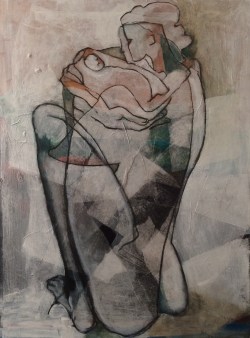
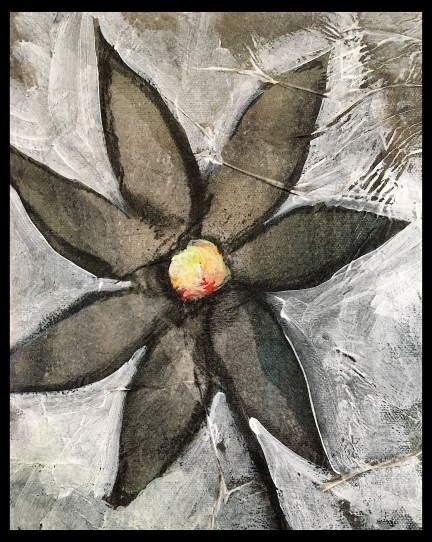
A detail from my painting, Will Is Belief

A detail from my painting, Will Is Belief

“It’s hard to explain to people,” said Chris. “I’m answering a calling. I know in my bones that I’m doing with my life exactly what I’m supposed to be doing. There is nothing else that gives me life. There is only this that I can give my life to. I don’t have a choice and that makes no sense to my family and friends.”

Chris is an artist, a brilliant actor. He acts because he needs to act and that is impossible to understand to those who’ve never had a soul-deep calling. It makes no sense to those witnessing the hardship his life path requires. His family and friends want him to have a better life. They want him to have a big home and two cars. They want him to have a back yard and a barbecue. What they can’t grasp is that Chris, like all artists with a calling, is acting from a selfless imperative. They aren’t doing it for themselves. They are not indulging an ego-need. They are, as Chris said, “creating to translate experiences for others.” Artists are meaning makers in a world that often makes no sense.

It is simple. Artists serve the force of unity in a world dedicated to the forces of division. And, that makes no sense.

Pastor Tom has a calling. He left a big salary career for the meager salary of a pastor because he could no longer ignore the inner voice demanding that he answer his call. It need not make sense because Pastor Tom can say that he answered God’s call. Chris’ calling is coming from the same source though, in our world, the connective tissue of his claim is not as easy to grasp.

Many people can draw, write, dance, act, sculpt, trumpet, and paint. A very few actually need to do it. They can do nothing else. Just as many people are capable of sermonizing and leading a church, it is the rare person who has to do it, who can do nothing else. Chris would wither if he did, as his elders suggest, leave his crazy pursuit and get a real job that pays real money and provides real stability. They do not know what Chris knows: stability has nothing to do with money or jobs that make sense.

Sense-making is a matter of the head. Chris is a servant of the heart.

There is a very powerful Hungarian film, called White God (though if you are a dog lover as I am you should probably steer clear). It is film about violence and suppression begetting nothing but more violence and suppression. It makes sense. In the final scene of the movie, when faced with a tide of horrific violence, a young girl pulls her trumpet from her backpack and begins to play. The beauty of her playing stops the unstoppable. It breaks the cycle of violence. It makes no sense: beauty has the power to extinguish violence.

Beauty has the capacity to unify a world dedicated to division and violence. This is what Chris’ call is all about. This is what he knows in his bones. It is the reason he gets on the stage for meager pay. It is the reason he spends his days going to endless auditions and producing plays on subway platforms and other places where few will ever stop and take notice. It is the reason a big backyard and sensible job make no sense. He is a servant to the power of beauty, the wonders of art, the necessity of illuminating unity amidst the madness of division. With this calling, all other paths are closed. They simply make no sense.

Be Held In Grace

Grace (noun): 1. Simple elegance or refinement of movement. 2. Unmerited divine assistance given humans for their regeneration or sanctification.

The first time it happened Kathleen, my landlady, stepped between me and the canvas shouting, “You can’t do it!” I was about to wipe off the image and start anew. “I love this one!” she said. “I love it.” Baffled by Kathleen’s wild-eyed heroics I granted the painting a stay of execution. I let it live. I faced the canvas to the wall so I couldn’t see it. After a few days I put it back on the easel. I saw it anew. I saw what Kathleen saw. It was a good painting and ultimately birthed an entire series of paintings.

One of the great paradoxes of being a visual artist is to lose sight en route to seeing. Becoming mired in the thoughts of the painting blinds an artist to the painting. Stare at anything long enough and you will stop seeing it (you will only see what you think about it). The only antidote is to turn it around. Forget about it so you can see it anew.

A few weeks ago it happened again. Kerri was coming down the stairs to the studio just as I was about the wipe an image off the canvas. It wasn’t working for me. Like Kathleen a decade earlier, Kerri threw herself over the painting and pleaded for its life. This time I asked her to tell me what she saw that I clearly was not seeing. I asked her to make a case for clemency. She saw something new. She saw Grace. And, she convinced me that I was blind to the painting. I took it off the easel and turned it to face the wall.

I’m learning again lessons that were pounded into me when I was younger but am now finding deeper levels. Step away. Forget. Clear your vision by looking away. Tom called this “closing the building for a spell.” Understand that seeing and thinking are intertwined. It is a sword with two edges that can illuminate or limit. The skill is never found in the thinking, the interpretation. The great skill is to see beyond the thinking. To see. Artistry happens when thought serves sight and not the other way around. The mastery of art and the mastery of life are, after all, one and the same thing.

When I turned the painting around I saw it anew. And, like the reprieved painting of a decade ago, this one, too, is inspiring a series. In a fit of intentional spontaneity (one of my new favorite descriptions of artistry), the second in the series jumped off my brush. I’m preparing surfaces for the third, fourth, and fifth. They are asking me to follow them – no thought required. They are asking me to take a walk with Grace.


Dance!

A painting called JOY

A painting called JOY

“A dancer’s body breaks down,” she said, “Painters can paint all their lives. Musicians can play until they are old, but a dancer’s instrument, her body, gives out.”

To be a contrarian I responded, “And then there is Martha Graham. She danced into her 80’s, didn’t she?”

She wrinkled her nose and said, “Not very well.”

The lights dimmed, the movie started, and our conversation ended.

She was, in her youth, a dancer, classically trained. She’d spent the bulk of her adult life teaching and choreographing. And, as she told me, “Those things are all you can do when you can no longer dance. They are what’s left.” Had our exchange not bothered me so much I might have felt sadness for her.

Like an art-mantra, Tom used to say, “A writer writes and a painter paints.” I wanted to say to my seatmate, “A dancer dances.” I thought immediately of Linda who dances even when she is not dancing. She is a riot of movement, joy-in-motion; her need to dance is infectious. Even non-dancers find themselves jigging across the floor when Linda is dancing at the party. I once told her that she is my secret weapon for throwing a successful party.

I imagined my seatmate as a young girl. Before all the training, before the technique and expectations, there was enthusiasm. There must have been joy. There must have been lots of joy. She must have known the world by moving, twirling, spinning in it. Artists – before they call themselves artists – make sense through sound, through scribbles, through spinning. They only way forward in life, the only way to make meaning and to learn, is to scribble more, to engage and translate through movement. Lazy educators write off this imperative as self-expression.

The great artist deathtrap is called technique. It is a paradox. It is necessary. It is a kind of language mastery. It is, at first, a struggle of control. How do you say what you need to say when your language is visual, aural, or kinesthetic? Training is necessary. The path to full expression is always paradoxically through constraints, control of breath or brush. Yet, too often, as is the case with my seatmate, technique replaces the enthusiasm. It can turn joy into judgment. It can make an artist forget their WHY and replace it with a too rigid HOW. It is how artists limit themselves with their artistry. It made my seatmate, a healthy ambulatory woman, believe that she is not capable of dancing.

Later, I told Kerri about my conversation at the movies. She said, “That’s why fewer and fewer people are going to symphonies or galleries. People draw lines. Artists not only limit themselves with their artistry but they also limit access to their artistry.” Joy is infectious. Artistry without it is not very interesting (and, arguably, not artistry).

Wait For The Flow

The Weeping Man

The Weeping Man

The Weeping Man is finished.

Sometimes the process of painting feels like wrestling with an angel: It will not release me. I will not let it go. We wrangle and discover the truth in each other. It is, as Quinn used to say of all relationships: “corrections as refinements”.

Sometimes a painting follows you for years and chooses its day. It chooses its time and simply steps into the light. It announces itself: “I am here now.” The Weeping Man was like that.

In my life I have painted hundreds of paintings and I can count a handful that are like The Weeping Man. Pure. In laying it out, I corrected one line. I added another. There are relatively few unnecessary brush strokes.

Flow is like that.

Focus On The Important Stuff

an offer from TwoArtistMakingStuffForHumans

an offer from TwoArtistMakingStuffForHumans

A note from the temporary site of TwoArtistsMakingStuffForHumans:

The waxing moon was muted with fog. It made the air shimmer. Avalon was near. Although it seemed too soon, there was a hint of autumn in the air. We sat next to a chiminea talking to friends. Monica told us of her daughter working in villages in South America. She told Monica that, by our standards, the people there have nothing. They are possession poor. But, they were happy, genuinely happy. They didn’t have much money or stuff but they had the essential thing that many of us lack: peace of mind. They focus on different, more important stuff.

It brought to mind my experiences in Bali. When I arrived all I could see was the poverty. By the time I left several weeks later, I’d have given everything I own or will ever own to have what they have: presence. Ease of mind. They weren’t looking for fulfillment, status, or living for retirement. They were living. Life was fulfillment. In a world where all things are sacred, status is gained by the quality of your giving and not by the size of your piece of the limited pie. It is a different focus.

There is a hidden cost to what dominates our focus, the things that take our attention…as opposed to the things we pay attention to.

As artists, both Kerri and I believe the work of our lives has been, one way or another, to help people focus on the important stuff, to see the extraordinary in the ordinary moment, to find inside what people seek outside. We’ve both worked across the boundaries of business, art, and the fine art of living everyday, there is no lack of necessity to refocus the eye, mind, and heart.

In a few weeks we will be launching our business (details to follow). All the many aspects of our work – if you can call art a product and performing a service – are intended to support, exercise and pay forward a focus on the important stuff, the important moments…sometimes the teeniest things that in the chaos pass unnoticed.

We want to do for others what we do for each other. Check out our pre-launch coaching offer. Take us up on it! Or, if you know someone who might benefit from working with us, pass it on, pay it forward.

Walk The Line Where Sky Meets Earth

TODAY’S FEATURED THOUGHT FOR HUMANS

Walk the line where earth meets sky

There is a concept that shows up in one form or another in all spiritual traditions: find the middle way. Finding the middle way is simply another way of saying ‘presence.’ Be present. Be where you are, not in the past, not in the future, here, in the middle place. Move out of the distant poles of right and wrong, us and them, red and blue, and walk in the actual, the present, instead of the conceptual. Deal with what’s in front of you instead of what you think is there. It’s a sound business practice, too. Guiding people to the middle way, to the line where sky meets earth, IS the artist’s job.

FOR TODAY’S FEATURED PRINT FOR HUMANS, GO HERE.

Fall Into It

lingering

lingering

Scott said, “In today’s world, if you can’t say it succinctly, you might as well not say it.”

Guitar Jim teases me each Sunday, saying, “Hey, I read the first 80 words of your blog!” I always laugh and he adds, “No, seriously. I didn’t have time to read the rest of it.”

I am like everyone else. I give only 3-to-5 seconds to any website that I visit. If it doesn’t capture me in that vast span of time, I move on to the next and the next and the next….

Click. Click. Click.

We are slaves to brevity.

In The Art of Living, Wilferd Peterson wrote: Travel with curiosity. It is not how far you go, but how deeply you go that mines the gold of experience. Thoreau wrote a big book about a tiny Walden Pond.

Going deeply takes time. My grandfather lived his entire life within a 10-mile patch of earth. He could smell a storm on the wind when all I – a visitor – could see was blue sky.

When I go to a museum, when I need to recharge my artist battery, I find the paintings that demand my attention, the pieces that want a relationship with me. Relationship takes time, too. Like Thoreau, I need to stare into the pond deeply, to spend time with it, to know it beyond mere thinking. Then I can breathe it in, feel the impact that only comes available with an engagement beyond the cursory. When I fall into it, it falls into me.

This is the challenge of our time, the artistic challenge of our time, the expectation that depth can be found by skipping a stone across the surface.

A good poem will not fully open without lingering in it.


Dance Without Effort

my mud-slog

my mud-slog

Last night I painted badly and I did it intentionally. I went down into the cool of the basement studio to escape the heat and humidity. A new canvas was stapled to the wall, gessoed and ready to go. I picked up my brushes, squeezed paint onto the palette and began working.

Many years ago I made the switch from oils to acrylics because the fumes were making me ill. It was a happy accident. Acrylics required me to work fast and fast meant I had no time to think. I learned by default that I am a much better artist when I’m not laboring over the details. Sometimes the process feels like an invocation. Sometimes the process feels like a rolling mess that morphs and morphs until the final moment when, like focusing a telescope, the image becomes crystal clear.

My paintings are generally big. They demand a full-body engagement, painting-as-dance. I know I am working well when I lose track of time, when the dance overtakes me, and the line between painting and painter disappears. It is pure magic: a place free of thought-obstacles.

Last night there was no magic. When I was younger the slog sessions would depress me. I believed I had to have magic all of the time and felt despair when, instead of magic, I danced knee-deep in mud. It took a long time for me to appreciate the necessity of the mud dances. Painting badly is, of course, necessary to paint well. In fact, I now know that there is no such thing as painting badly just as there is no such thing as perfection. Saying more with less is a life-long learning process for all artists. Freedom of expression is a yoga, a practice. It has as much to do with muscles as it does with minds. It is a yoga of brevity. It is as efficient as breath. It is a paradox of stepping out of the way so that you can fully step forward.

I once saw an exhibit of the hundreds of sketches and studies John Singer Sergeant did before painting El Jaleo. I loved it. He drew the same thing over and over again. He painted again and again the smallest detail. He was putting the image into his body. He was teaching his muscles to flow without tension. The finished painting (the last thing in the exhibit) was thrilling. It is a celebration of brevity, free motion without mental intervention. It made me dizzy. It made me cry because I knew how devoted he was to his practice to say so much with so little. I knew how many hours of effort it took for him to dance so effortlessly.


Paddle On

photo-3We’d been out in the canoe for more than an hour. The morning was warm and the water was still. We hugged the shore, cruising the lily pads. Dan told us some of the lily pads were over 150 years old. I was amazed at their capacity to reach through time but also reach through long stems to the water’s surface to drink the sun.

The turtle emerged from nowhere. It appeared from the depths, through the lily pad stem forest, and rose to within inches of the surface. It was big for a lake turtle, perhaps the size of a dinner plate. I let my paddle trail in the water. It was so close I could have reached into the water and touched it. We glided forward and turned the canoe so Kerri might see it but the turtle had already disappeared.

the view from the canoe

the view from the canoe

Turtle is perhaps the oldest known symbol for the earth. In many traditions, turtle carries the world on her back; the earth is her shell. She is a great reminder to go slow and persevere, to live grounded amidst the chaos of life. She symbolizes patience and ease. I was struck by how similar are the symbols of turtle and lily pad. Peace. Ease. Both are extraordinary symbols of grounding or rooting. Both cross the boundary of elements: the turtle lives in water and land. The lily pad reaches through the water to find air and sun. Both inhabit the depths and reach to the surface.

It feels as if I came into this world with art already in me. From an early age I drew pictures, not because I wanted to but because I had to. Like the lily pad, I was reaching for something unknown. I drew the same images over and over again: a cabin in the woods, eyes, clowns. I wasn’t drawing to master the image, I was drawing and painting in order to reach beyond the image. There was something there, beyond, deep in the depths, a root, rich soil, the void. There was a force behind the image that pulled me. My artistry felt like a descent into the caves of the ancients, a search for sources mythological.

Sometime during these past few years, the direction of the pull reversed itself. Like Orpheus in the underworld, I turned around. I walked toward the surface. In essence, the pull to the depths became a reach to the light. The sun called. Balance, in this life, at long last necessitated light and warmth.

Tom once told me that inheriting his family’s ranch and subsequently finding a trunk hidden in the wall of the house containing his ancestors possessions served as an affirmation that he had finally come home. Sitting in the canoe, the turtle rising by my side, I felt the affirmation. I am now only inches from breaking the surface. I drink the light because I know the depths and am adept at walking in the dark unknown.

the first layer of  under-painting for the next piece

the first layer of under-painting for my next piece

I am working much slower now. I am in no hurry to get anywhere. And my art, my life, is the better for it.