Beautiful. Perhaps.[David’s blog on Flawed Wednesday]

“Everyone thinks of changing the world, but no one thinks of changing himself.” ~ Leo Tolstoy

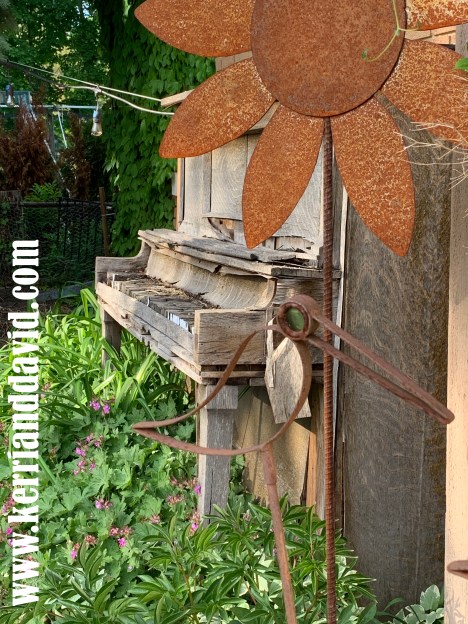
We have watched Barney-the-piano change over these many years. As he ages and falls apart we discuss how he has become more beautiful. It is a sentiment that we do not allow for ourselves as we have also aged and changed over these many years.

“Not everything that is faced can be changed, but nothing can be changed until it is faced.” ~ James Baldwin

There are days that I do not recognize myself. I look in the mirror and see my grandfather. I look in my heart and am surprised by what I see. In these past months I have discovered my intolerance and I am proud of my intolerance. I have discovered my hard lines of belief. I do not believe that masked men should be plucking people off the streets. I do not believe we should scrub history to make white supremacy palatable. Now, when I look in my heart, I know exactly what I believe. And I like what I see.

“Education is the most powerful weapon which you can use to change the world.” ~ Nelson Mandela

I recently wrote a play about this nation’s resistance to education. Educated people ask questions. Educated people are not easily drowned in propaganda. Educated people do not fear learning that they are wrong because the point of education has nothing to do with right or wrong answers and everything to do with expanding hearts and minds. Minds that expand reach toward the unknown. Minds that close stagnate in the safety of what is known. Entropy, the gradual decline to disorder.

“Change is the only constant.” ~ Heraclitus

Barney is beautiful. He has been home to chipmunks. He is a resting spot for squirrels. Birds revel where he once sported keys. He has dropped all illusions of grandeur and each day reveals his true nature. He makes progress toward earth. He does not resist his natural path. That is the secret of his beauty.

“Make every effort to change things you do not like. If you cannot make a change, change the way you have been thinking. You might find a new solution.” ~ Maya Angelou

Master Marsh once told me that when caught himself complaining about something that he had three choices. Shut up (stop complaining). Do something about it. Or leave. In the current reality of our nation I am not able shut up. In fact, I feel it is necessary to raise the volume. That is what I am doing. We write and write and write. We ask ourselves every day, “What more can we do?”

“The world as we have created it is a process of our thinking. It cannot be changed without changing our thinking.” ~ Albert Einstein

In their advanced age both Maya Angelou and Albert Einstein arrived at the same conclusion. They agree with Leo Tolstoy: to be better on this earth, we need to change our thinking. We need to think about changing ourselves. Looking at our nation (ourselves) doesn’t it beg the obvious questions: What are we thinking? Are we capable of changing our thinking?

Perhaps, as we dissolve, as we crumble like Barney, we will discover at the core of our national story the rot of exclusion. Then, perhaps, we can face our dysfunction, root it out, and change our thinking. Perhaps we can become the inclusive home that our nature – and our founding ideals – intended us to be. Beautiful. Perhaps.

read Kerri’s blogpost about BARNEY
likesharesupportcommentthankyou

Look In [on Not So Flawed Wednesday]

“I want to stand as close to the edge as I can without going over. Out on the edge you can see all kinds of things you can’t see from the center.” ~Kurt Vonnegut

Yesterday I applied for a job that is all about narratives told from the edges of society. I’m not sure why it surprised me to find such a cool-to-me job; our community seems addicted to shattering so there are plenty of small edges to be found. Small edges are fallacious and serve a myriad of false centers. Our survival will depend upon whether or not we can awaken from the shatter-narrative and make the decision to direct our broken focus toward a common center. No small feat.

It is the role of the shaman, the explorer, the artist, the researcher to stand on the edge and report back to the community what is seen and unseen. The voice from the edge is rarely welcome since the report is capable of popping delusions or pulling the sheep’s clothing from the wolf. Page one of the autocrats’ handbook instructs the elimination of artists and educators. Making an enemy of the eyes-that-see, demonizing educators and thinkers – the people who recognize pattern and metaphor. The game of Us-and-Them necessitates silencing the voices capable of calling out the wolf. Autocrats require blind sheep that follow without question.

Some famous edge sitters: Galileo. Cesar Chavez. Rosa Parks. Nelson Mandela. Susan B. Anthony. Albert Einstein. Frederick Douglass, a former slave and leader of the abolitionist movement, wrote extensively about what we call Critical Race Theory; it was clear in his view from the edge. It’s not a new theory. It’s an old pattern with a new name. I think he might denounce his Republican party affiliation were he alive today; they would certainly silence his voice. He would be fired were he a professor in Florida today. As would Martin Luther King, another famous voice from the edge.

Voices of reason are often voices from the edges. Voices of the future are always voices from the edges. Galileo was silenced for suggesting that the earth circled the sun and not the other way around. Over time, the voices from the edge, when authentic, always make the center better, the community stronger. Susan B. Anthony spent her life on the edge, lobbying the center, to secure for women the right to vote.

Progress. Growth. They are rarely inspired from the tight grip at the center. Silence the edges and the community atrophies. Stop the movement and the body dies. That page was left out of the autocrats’ handbook for obvious reasons.

read Kerri’s blogpost about EDGES

Look Both Ways [on Not So Flawed Wednesday]

“We are an impossibility in an impossible universe.” ~ Ray Bradbury

This is, perhaps, a quote sandwich.

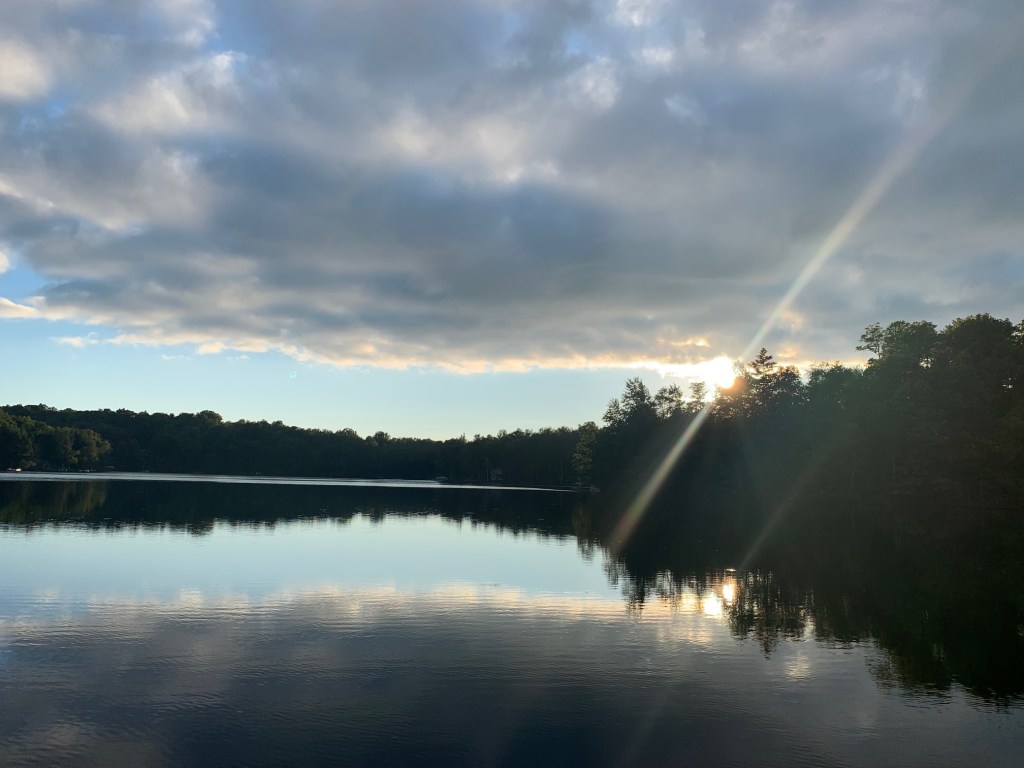
Standing at the edge of the lake at sunset, the breezes calm, the quiet stills the water. Who hasn’t felt the beautiful impermanence, the last rays of sun on their face? The truth of life captured in a single moment. It is passing. Precious. Impossible.

Climbing back up the stairs, joining the group on the deck. Red wine. The conversation turns to the news: the state of the world. Politics.

“Two things are infinite: the universe and human stupidity; and I’m not sure about the universe.” ~ Albert Einstein.

We are, after all, capable of the impossible. Full spectrum impossibility. We write symphonies that open hearts. We tell stories that touch the soul. We witness sunsets and desire for a better world for our children. We create telescopes to help us see deeper and deeper into space. To reach to alien worlds. All the while we divide. We lie and propagandize to feed false fire. We plant our heads deeply into the sand while we soil our nest. We reduce the impossible miracle to a book of man-made rules. Worshipping money and pretending otherwise.

Both/And. Impossibly capable. Impossibly inept. Impossibly hopeful and impossibly pessimistic.

We stand at the water’s edge.

read Kerri’s blogpost about THE LAKE

Melt And Hammer [on Merely A Thought Monday]

We are easily entertained. Once, we nearly crashed the car laughing-so-hard at the names we gave to our alter-egos. Who drives around naming their alternative selves? We do. Sit us in a corner and we’re pretty good at finding something to do.

Art enables us to find ourselves and lose ourselves at the same time.” ~ Thomas Merton

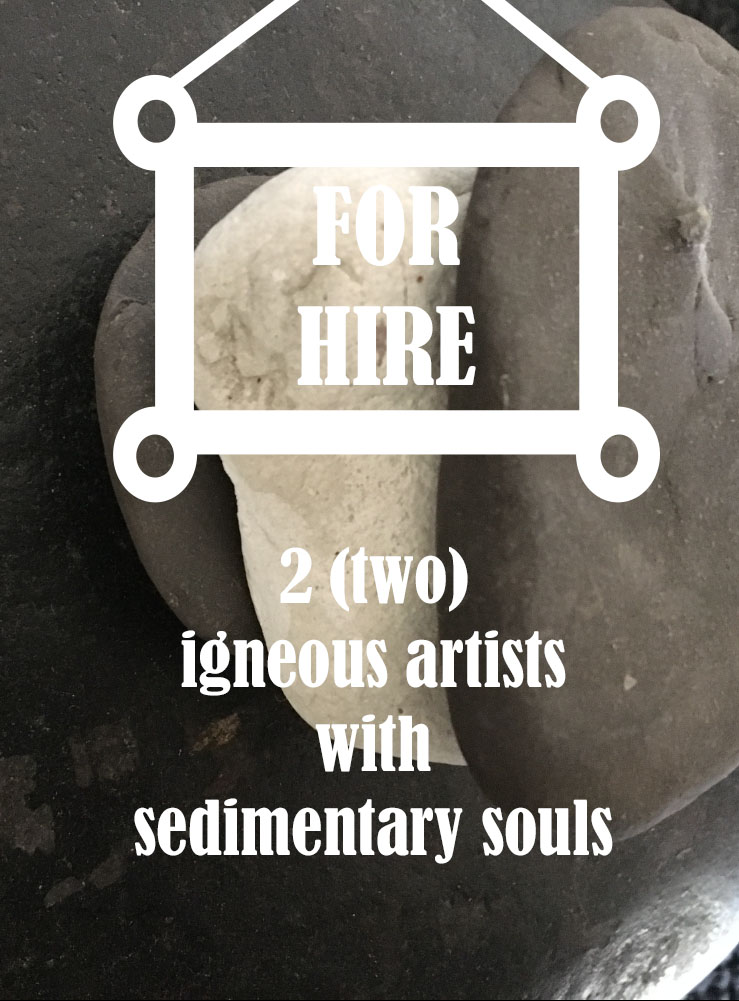
Igneous is volcanic. Fiery. A few weeks ago we painted rocks to put on the trail. Since we’re both cycling through an artistic-growth-crisis, we painted and fantasized about our new career intentions. When Kerri suggested we call ourselves “igneous artists” I howled. The layers of meaning are too vast to count. Plus, I thought it sounded suspiciously close to “ignorant artists” and I liked that, too. “We should hang out a shingle,” she said, “For Hire!”

Igneous artists.

Art is standing with one hand extended into the universe and one hand extended into the world, and letting ourselves be a conduit for passing energy.” ~ Albert Einstein

Because we tend to riff on everything, while painting rocks, we rolled around our new art-moniker until we had an appropriate clever (to us) sub-phrase. “It sounds like a lyric,” I announced, mostly as enticement for my lyricist wife to spin out a theme song. She did not take the bait.

Igneous artists with sedimentary souls.

‘Layers of soul’ is a yummy image. Especially if the layers are born of elements like fire. Like all artists, we’ve been forged, melted in a hot furnace and hammered into shape. The smith hammers out the impurities. “People don’t change,” Kerri often quips, “They become more of who they already are.”

I could stand to lose a few impurities. I look forward to becoming what I am already.

“To draw you must close your eyes and sing.” ~ Pablo Picasso

read Kerri’s blogpost about IGNEOUS ARTISTS

Step Out Of Line [on Merely A Thought Monday]

“…the fountain of creative work is an intelligent questioning of the rules.” ~Alan Watts, Tao: The Watercourse Way

“If someone tells you they know, they most certainly do not.” It’s not a direct quote from Quinn but it’s close enough. Art school almost snuffed the art in me; there were so many rules and nary a hint of curiosity allowed in the studio. I fled into the theatre after a single year for fear of losing my heart to a book of rules. My theatre professors were explorers of nature. Their refreshing mantra was, “Well, let’s find out!”

What if…? What happens if…?

Nature is boundless expression. Boundless expression is human nature, too, until it is taught otherwise. Boys don’t cry. Be a good girl. Sit in your desk. Follow the rules. There’s a right way. My way or the highway…So much effort to force nature – your nature, your curiosity, to stand on a line.

Einstein revolutionized our world because he dared to posit that Newton had it upside-down. Thank goodness, as Alan Watts observed, “The scientist and the mystic both make experiments in which what has been written is subordinate to the observation of what is.” In other words, they look beyond established belief, expectation and entrenched norms into what is.

What is? Curiosity. A desire to know what’s over that hill. No child begins their life-walk by desiring to color within the lines. Lines are a learned thing. The word “wild” was invented by people whose ancestors emerged from the woods and who have forgotten that they, too, are part of nature – so have become afraid of stepping into the woods. What might they – we – find there?

“It’s not an idea problem,” David Burkus wrote in the HBR, “It’s a recognition problem.” Stepping beyond the known – a great definition of curiosity – is too often seen as an aberration or an assault upon authority. Nip it in the bud. Forcing flow into a fixed state invariably causes idea-blindness and the imperative to think-outside-of-the-box. Innovations are too often smothered in the crib by “What we know,” or “We don’t do it that way.” Coloring in the lines, once ingrained, is a life-long-book-to-follow.

I wish I had a nickel for every time I’ve been invited into an organization or hired by a client to help them “see what they cannot see,” and then subtly or not-so-subtly, been rebuked for opening their eyes to what is in plain sight…or the availability of alternative paths. “We want a vital arts program but we only want art that entertains,” said the school board after the student play asked a serious question of their audience. “…the scholastic theologians would not look through Galileo’s telescope because they considered that they already knew, from Scripture, the order of the heavens.” (Alan Watts)

Think outside the box – as long as you stay within the model or the expectation or the rules. So many models. So many lines. So in love with the struggle and afraid of the simple, natural joy of curiosity. Bend your will to the line. See what you are supposed to see and look no further. What, exactly, are we trying to control?

read Kerri’s blog post about CURIOSITY

Get Lost [on DR Thursday]

“A person who never made a mistake never tried something new.” ~ Albert Einstein

Recently, I revisited Sir Ken Robinson’s TED talk about schools killing creativity. Among his many points, the central idea was simple and clear: we reinforce knowing answers instead of the pursuit of the question. We reinforce “being right” when the beating heart of learning, the vibrant center of creativity, the foundation of scientific process, is to try-and-see-what-happens. To be “prepared to fail,” as he said, is to remove failure from the equation. A curious mind seeks discovery, not “rightness.” An experiment is meant to test a hypothesis not immediately arrive at the answer.

When Kerri and I stepped onto the trail, new to us, the signage was more than confusing. “It’s a loop,” I said, “What’s the worst that could happen?” We chose the orange trail and started walking. We followed the blazes rather than the signs. A storm or drunken ranger must have erected the signs because they were often out of alignment with the blazes. “If we followed that sign, we’d be in the creek,” Kerri said.

Early on in our hike, a man came crashing out of the woods. “Is this the trail?” he asked. “I think I’m bushwhacking,” he said. This man, I suspect, followed the signs. He was having a great time but was somewhat relieved to be back on the beaten path. He was the first of many. A woman stopped us. She and her husband were having a disagreement about which trail they were taking. “Is this the long or short loop?” she asked. We shrugged, a shadow of concern creeping up in the back of our minds.

There was supposed to be a waterfall somewhere on the trail. We asked more than a few people as we passed and received a marvel of contradictory instructions. “There’s a side path on the left.” “Somewhere ahead you’ll see a side trail on the right.” We took option B and had a lovely trek up the mountain but turned back when it became apparent that our choice did not include the waterfall. “Next time,” we said. It was late in the afternoon and we wanted to be back at the car before sunset.

With tired legs and lack of trust in the signage, we came to a trail crossroads. Orange went in three different directions. The sign that pointed the way to the parking lot did not inspire confidence but we followed it anyway. We passed an older couple, local hikers, that assured us we were on the right path. A couple crashed out of the woods, having lost the trail but were equipped with a GPS app: we were definitely headed in the right direction but had more than a mile to go to get back to the car.

“It does not feel good to feel lost,” we agreed. “Especially when the light is waning.”

Arriving back at the car, breathing a sigh of relief. “That was fun!” we laughed. “And stressful at the end.” We were never actually lost but we were successful at filling ourselves with doubt. We were grateful for the older couple that reassured us, the lost couple with the GPS that broke out of the woods exactly when we needed them.

And, we learned a lesson. Next time we’ll take the time to study the map. And, we’ll be equipped with a better app. Our lostness was always in our minds, in our doubt. The next time we lose ourselves in second guessing – and it is certain to happen – we’ll be better equipped to handle our self-imposed-disorientation.

In the meantime, we’re already whipping it up into a great survival story. I didn’t mention the bears or starting fire with flint and steel. Building a survival shelter from twigs. That version, the real story of our heroic adventure, is certain to come soon. Lostness, it seems, stimulates fabulous creativity.

read Kerri’s blog post about THE MOUNTAIN

Make Noise [on Merely A Thought Monday]

I am conflicted. I wrote a version of this post and then tossed it away. I’m trying to be less argumentative in my daily writing. And then, Toni Morrison collided with Albert Einstein:

“In times of dread, artists must never choose to remain silent… This is precisely the time when artists go to work. There is no time for despair, no place for self-pity, no need for silence, no room for fear. We speak, we write, we do language. That is how civilizations heal.” ~ Toni Morrison, No Place for Self-Pity, No Room for Fear

I am an artist. Is it argumentative, is it confrontational, to write what I see? Yes. Sometimes. Once, I saw a park service truck, on a trail, quickly backing up. The driver did not see the man in the wheelchair right behind his truck. I screamed and ran and banged on the side of truck until the driver stopped, a few inches from hitting the man in the wheelchair. Sometimes it is necessary to shout and make noise.

All of my life I’ve understood the first rule of being educated, namely, to check your sources, as simple sage advice. It’s a good idea, if you are going to anchor your identity in a narrative, to make sure that your narrative-of-choice is solidly anchored in verifiable substance. Doubt and questioning, used properly, are necessary tools of an engaged mind.

Years ago, Robert Cialdini wrote, “The world abounds with cults populated by dependent people who are led by a charismatic figure.” In other words, people are easily led and – as we have recently witnessed – with disastrous results. All that people ever need do to avoid a nasty drink of purple Kool-Aid is to check their sources. In our day and age it is almost easier to check the veracity of the story-we-are-being-fed than it is to be misled. Almost. One must first desire to be fed the truth, even if the truth challenges rabidly-held belief.

Checking takes less than a minute.

Just ask the now-jailed-and-soon-to-be-tried capitol insurrectionists claiming that they were led astray by a flimflam-president-man. The Big Lie was easy to check. It remains easy to check. Yet, none cared to check it or perhaps refused to believe what they found. Checking the lie, listening to the data, would undermine the tightly held power-narrative of an entire political party. A pathological lies requires more and more effort, more and more outrageous lies, to sustain itself. It should have been easier to check the story than it was to storm the capitol.

Now I see the first rule of being educated, the necessity of checking sources to verify fact, as a dire necessity. It is the flashing red warning signal to these de-united-united-states that there is a cliff ahead. It is no longer a sweet bit of sage advice; it is a survival imperative. Respect for the line – truth or fiction – will determine whether we as a nation unite and grow or divide and collapse.

Many years ago, Robert Cialdini also wrote,“Audiences have been successfully manipulated by those who use social evidence, even when that evidence has been openly falsified.” Openly falsified. He wrote those words decades before tweets, Fox News, and the mega-amplification of all the openly falsified big lies. His words might now serve as the sad single credo of the Republican party.

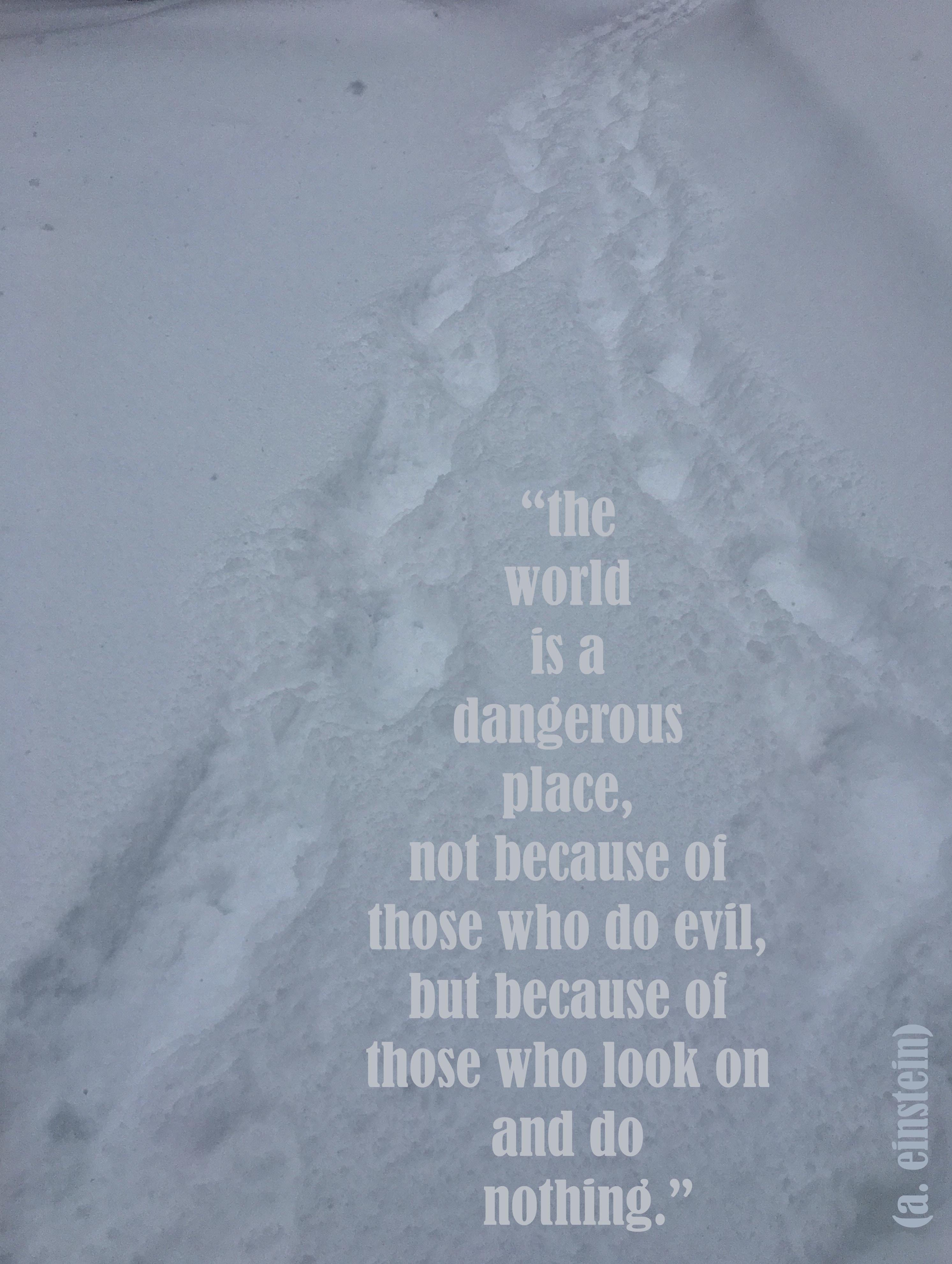
It is not shocking that a political party lies. It is most shocking how little the followers of the party care to check the sources of the enraged hype it daily swallows like so much anger-candy. Dependent people. Easily led. Believe wholeheartedly. Ever expanding lie. No facts necessary. It is far beyond Einstein’s observation of people doing nothing in the face of evil; our nation is in peril because the evil we face is an openly falsified narrative. So many of our people, so many of our leaders, know it is a lie, feed the division, and actively look the other way.

read Kerri’s blog post about DOING NOTHING