De-Compress [on Two Artists Tuesday]

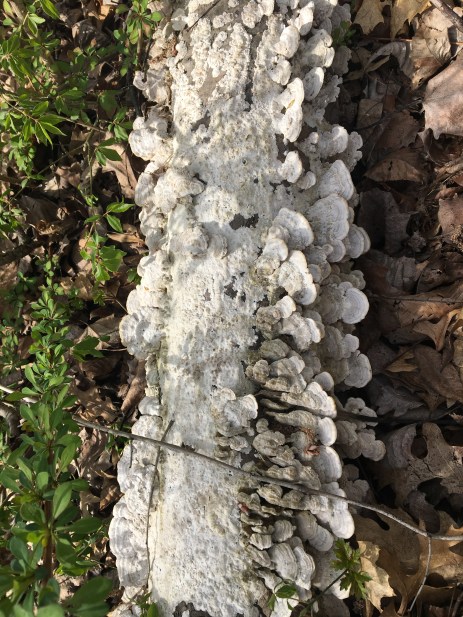
nature's stripes copy

I had no intention of writing about white rot fungi. I never imagined myself in the course of my lifetime writing or even being interested in white rot fungi. In fact, in scholarly terms, I have no business writing about it. But, here I am. White. Rot. Fungi.

I live in the age of the internet and Google. I remember the moment in the mid 1990’s that I realized the world had changed! I was doing research for a play about Joan of Arc and, instead of using the card catalogue and spending days in the library scouring the stacks, I was trying this new thing called ‘the internet.’ In a matter of moments, I found the complete transcript of Joan’s trial. The actual notes from the actual scribe that sat in the room in the 15th century during that very political/religious trial! The scribe’s notes were typed for my consumption, digitized, and available for my 20th century eyes. Information-gathering was suddenly so easy! Then, I discovered the notes for the 2nd trial! Ten years after burning Joan at the stake they reconsidered their decision and admitted a mistake. It was also, no doubt, a very political/religious trial; the making of a saint! Days of dedicated research compressed into a few hours of poking around. It was a kind of miracle. I reached through time and a scribe handed me his meticulous notes. “Do not judge us,” he whispered.

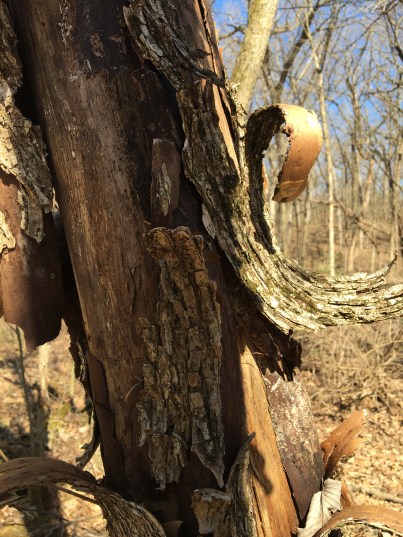
And, so, white rot fungi. Kerri shot this gorgeous photograph (she calls it ‘nature’s stripes’) and we chose it as a prompt for our studio melange. This morning, wondering what to write about nature’s stripes, I asked myself, “What’s all over that nurse log?” In less time than it took to find Joan’s second trial I had my answer. It digests dead wood.

The name, white rot fungi, a collection of words, does not do poetic justice to this species. It is the vital middle stage in a snapshot of the life cycle. On the left, the vibrant green shoots of new life, spring. The middle: a nurse log, a fallen tree, providing food for the fungi. And on the right, the brittle brown leaves returning to the soil, nutrient for the next new growth. A hundred year cycle captured in a single image.

This photograph is also a compression, making it possible for me to easily see an unimaginable life cycle. Yet another miracle. Yet another way to reach through time and see.

I forgot how difficult it once was. Finding facts. Blowing dust from pages made it somehow more important to check the data. Reaching through time to a reader in the 25th century, I whisper, “Don’t judge us. It happened so fast, this enamoring of the easy, this nonchalance of meaning, this indifference to information”.


read Kerri’s blog post about NATURE’S STRIPES

read Kerri’s blog post about White Rot Fungi
 

megaphones website box copy


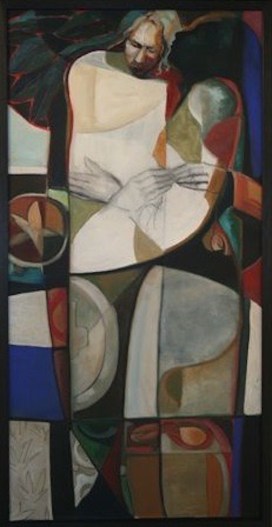
pray now/john’s secret ©️ 2010 david robinson

Let It Peel [on Two Artists Tuesday]

peel back the layers copy

Jonathan told us that a tree must split its bark in order to grow.

It’s a theme. A snake must shed its skin. A bird molts its old feathers making room for new growth. A caterpillar sheds its identity entirely. Out with the old and in with the new. The forest burns and rejuvenation begins.

It is so easy to say, this bit of sage advice. Let go of that old skin! Make room for the new! Change is not supposed to be easy!

Robert tells me that many of his peers, actors becoming older actors, are no longer getting cast. There are fewer parts for aging actors. “They are angry,” he said, “They are having a hard time reinventing themselves.”

Holding tight to the old skin. It’s necessary for a while. It’s important to embrace the security of the known before stepping out the door. But clutching the old skin too long brews a sour path.

Dwight tells me that to try and recreate and/or wear the old skin is a fool’s path. He reminded me of the many times, walking down the streets of Los Angeles, I’d pass an old body squeezed and painted into the trappings of youth. There was nothing to do but look away. “Let go,” I’d whisper.

One of the few rules of systems change is that if you know where you are going you will merely recreate what already exists. Growth, like learning, is always in the direction of the unknown. Always.

Lately, Kerri and I ask each other many times each day, “What do you think will happen?” We discuss the options, spin the variations, play out the scenarios, and, in the end, we arrive at the same conclusion. We don’t know.

Bark is peeling everywhere. We must be growing.


read Kerri’s blog post about PEELING BARK


SurrenderNow framed copy

surrender now. a good name for a painting and even better advice when your bark is flying off.


closeup at jonathans website box copy

surrender now ©️ 2015 david robinson


Make Better Assumptions [on Two Artists Tuesday]

go away 1 copy

As a kid, riding up the mountain to Central City (long before it morphed into a casino town) to visit my great aunt Dorothy and uncle Del, I’d always look for the hermit. With my face pressed to the window I’d scan for him.

Perched precariously high above the creek, his shack seemed in constant danger of sliding down the mountain. The only thing holding it in place was the cascade of rusting bean cans that he’d tossed over the edge after each meal. Decades of cans. And, every once in while, I’d catch a glimpse of him.

He was uniquely grey; his clothes, his long miner-forty-niner beard, his pallor. He was always standing still, looking over the canyon. I don’t think in all of my rare glimpses that I ever saw him move. I wondered if he’d just thrown a can over the edge. I wondered if in his moments of standing-stillness he pondered how he came to be the hermit in the canyon. If life forged him into a hermit or if he came into the world wanting to be alone. I wondered where he got his cans of beans. It was a great mystery that I spent long hours considering. Hermits are not known for shopping trips into town and it was long before the age of home delivery. Where did he get his money to buy all of those cans? Was he a wealthy miner, a Howard Hughes type who retreated into a paranoid seclusion? Who facilitated his solitude?

I am mostly an introvert so his retreat from society fascinated me. I’d try ‘hermit’ on like a costume. He wasn’t a monk though I wondered what he did all day; contemplation had to be on the list of things to do. I wondered if his shack was filled with paintings or wire sculpture, a reclusive Alexander Calder? A disenfranchised artist (now, there’s an oxymoron!) I wondered if his shack walls were lined with good books.

I wondered, if I climbed up the mountain to his shack, would he meet me with a shotgun and tell me to go away? Or would he welcome me and tell me that he’s waited a lifetime for someone to come for a visit? I liked the second scenario but the realist in me knew it would be the first. He was grey because he didn’t want to be bothered. He was alone because it was not safe to be in relationship. It’s always easier to close the door and growl than it is to open it and ask, “Can I help you?”

We see this sign often. It marks the door of a house on the road to one of our walking trails. In the absence of a canyon I suppose the only thing to do is paste your anger on your door. Every time I see this sign I wonder what would happen if love came knocking?


read Kerri’s blog post about GO AWAY


blackwalnut website box copy


Step In The Box [on Two Artists Tuesday]

bcat tape box copy

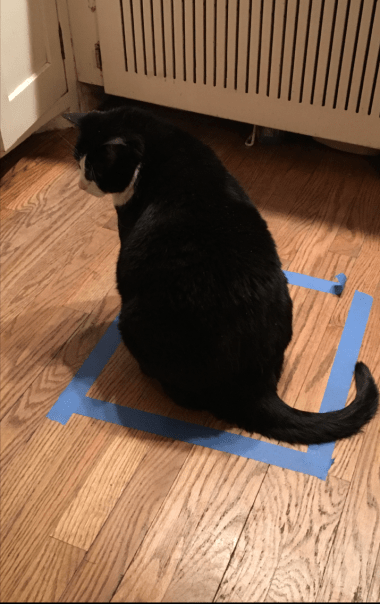
Jen told Kerri about it. Make a square on the floor with blue tape. It will act like a siren call to your cat who will NEED to sit inside the square. I was a doubter. Worse, I was a loud doubter.

During one of our famous Sunday night dinners, Kerri told 20 about the blue tape square and its kitty magnetism. I remained a stalwart disbeliever. After a glass of wine we retrieved the blue tape from the studio and slapped down a rough square on the kitchen floor. We poured more wine and waited. I scoffed.

In a few minutes BabyCat (lovingly known to me as Sumo) thump-thumped into the kitchen, went directly to the tape, circumnavigated the square (counterclockwise) and like a kitty in a current, was  pulled as if by a force into the square. He sat down. Kerri roared with triumph and took a picture for proof. She knows I am capable of denying the undeniable so she was quick to get photographic proof. 20 shook his head at me and said, “I thought you’d have learned by now that she is always right.” I am, as previously reported, a slow study. Very slow.

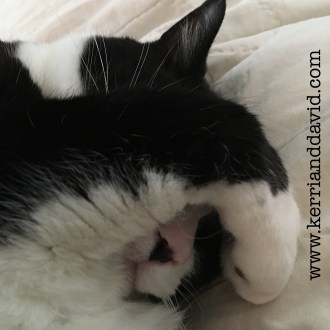
BabyCat sat tight in his blue tape square throughout our turmoil. He seemed oblivious to our antics, He was content. And, to add further insult to my injury, he laid down. He closed his eyes. He purred. He fell asleep, safe and sound in his blue tape box.

DogDog runs in circles. Circles are in his DNA. I suppose box attraction, real or imagined, must be encoded into BabyCat. It was true. He couldn’t stop himself from stepping into the box. I imagine the defined space made him comfortable. It made him feel safe.

I found myself wishing that somewhere in my DNA was the coding for box attraction. Or, at least a balance to the chain-of -command written into my coding: box avoidance. I wondered what it must feel like to see a defined space and not want to stir it up or redefine it. To open it up. I wondered what it must feel like to see a box, step inside, and give in to contentment. To purr with confinement.

20, watching me move through my troubled thought process, laughed. He sipped his wine and said, “You’ll never learn.”

True. Too true.


read Kerri’s blog post about the BLUE TAPE SQUARE


babycatContemplating website copy


Circle Back To Change [on Two Artists Tuesday]

wheels of change copy

A long time ago, in addition to naming my posts, I used to number them, too. Today, as I considered what to write, I realized that I had an old post sitting on my desk top because I’m slowly (very slowly) working on a maybe-someday-book called For Art Sake. I opened the old post and laughed aloud when I read it. It is  from a younger version of me writing about the wheels of change [I’ve made a few edits]:

1174. MEET THE FIRE

In order for the phoenix to rise it must first burst into flames and be reduced to ash. Every rebirth requires a death. I imagine the phoenix does not relish the flame but after a few cycles it recognizes the necessity of the fire.

The same image (metaphor) is everywhere: the caterpillar must first cocoon and then be reduced to mush before the impossible happens. The leaves must fall from the tree before the root can replenish, revitalize, and do the impossible: bring forth new life.

The healers in Bali assured me that a wound is necessary to open the door to the gift – each of them had suffered a devastating wound or loss en route to fulfilling their healing power. The journey through the wound was necessary to realize and fulfill their gift. The heroes cycle, the belly of the whale, the quest through the wasteland, finding joyful participation in the sorrows of the world; change is a fiery, difficult business.

In my life I’ve worked with many, many people in all manner of change and transformation processes. It is surprisingly common for people to want their phoenix without experiencing the flame. It took me a while to realize that people (organizations and otherwise) were hiring me under the guise of helping them transform but in truth they really wanted me to help them circumvent the fire.

People go to great lengths to avoid the flame. No one willingly seeks the wound and no one transforms without it. No one in their right mind jumps out of bed in the morning ready to jump into the abyss and yet the adventure is impossible without it. If a full rich experience of living is the aim of our limited time on this earth, then the fire is necessary. The fire is part of the ride.

Fire avoidance is what dulls an otherwise vital life. Comfort is certainly a worthy aspiration but as the only aspiration it deadens, it limits the life-color-palette to taupe. The trick, as all the stories teach us, is never to avoid the fire (you can’t) but, once there, to be alive in it.

After ashes comes honesty. With ashes comes a deeper knowing, call it faith, that  somewhere deep inside, the phoenix-in-you will someday rise just as spring will always return.

[Kerri took these photos. They are the treads of the massive tires on the enormous earth moving equipment that is transforming our beloved Bristol Wood into a high ropes course. We grieve it daily, watching the woods reduced to ashes]


read Kerri’s blog post about THE WHEELS OF CHANGE


archeswebsitead copy

Slog And Smile [on Two Artists Tuesday]

ice castle 1 copy

the melting ice castle

It is the mud season. The time of thaw. When snow and ice like magic return to their elemental form and flow according to the rules of least resistance. Downhill. Always.

It is the season that we wear our black boots, the pair that is good for slogging through the mire. On a recent squish through our beloved Bristol Woods we laughed at the sucking sounds our black boots made when we tried to lift our feet from the bog. The water gurgled around us. The sun warmed our faces even though the day was cold. We were glad that we left DogDog home. He’d have been a mucky mess.

It is the in-between time. Not winter. Not spring. This morning there wasn’t a cloud in the sky and still it snowed. The winter took a toll and everyone groused, “I thought we were done with that!” These same growlers only a few short months ago celebrated the return of the white stuff. “It’s the first snow!” they laughed and ran out to touch it. How fickle we are.

Or, perhaps, how ritualistic we are. Persephone must return to the underworld for a season. Demeter grieves and so the cold snows come. Months later, when the daughter returns to the light, the mother, over-joyed, allows the plants to grow again. Life returns. Tell the story any way you want. It is the same. A cycle of life. Equinox. Solstice. A time to sow. A time to reap. The root, rejuvenated, now pushes little green tendrils upward the sun. Rituals and celebrations.

Our ritual? Eager to get outside and walk, Kerri asks, “What boots shall we wear?” I respond, “I don’t know. Do you think it will be muddy?”


read Kerri’s blog post about THE ICE FALL


icefall website box copy


Love The Mud [on Two Artists Tuesday]

maturity with background copy

“It took me four years to paint like Raphael, but a lifetime to paint like a child.” ~ Picasso

It would seem to be a no-brainer. Mastery comes from a lifetime of doing. Trial and error. Malcolm Gladwell’s 10,000 hours rule: success is nothing more than practicing the task for many hours over many years. As the old joke goes, it’s how you get to Carnegie Hall.

Efficiency. Ease. Body knowledge. Body of Knowledge. Flow. Wisdom. The blossoms of a long-body of experiences. The farmer, over a lifetime of living and working the same plot of land, knows the signs that no one else can see. They sense the storm coming. They smell the time for planting. They waste no time; their 10,000 hours having developed a solid relationship, a kinship with their environment and work.

An artist, over a lifetime of living and working the same plot of music or paint or dance, knows the signs that no one else can see. Artistry is efficiency, a single line saying more than 20. A musical phrase capable of reaching deeper into hearts than was once possible. Like the farmer, their 10,000 hours becomes 20,000 and then 30,000. Their worth, their work, after so many hours of hands in the soil or fingers on the keys, is incalculable.

Awash in abstractions, organizations play by a different set of understandings. Bottom lines are blind to mastery. You’d be amazed (or not) at how many people I know who’ve been “let go” because a younger, less expensive person, might “fill the role” and “cost less.” Mastery as deficit. You’d  be astounded (or not) at how many people I’ve coached who were punished because they became highly efficient. Their life-of-experience made their work look too easy. They were either squeezed for more or released as unnecessary.

What happens when all of the organizational knowledge, the ease and efficiency that comes via experience, becomes a liability? Wearing my consulting hat I’d routinely shake my head at the standard folly of leadership – people in power suits and ties a hundred miles from the dust and grit of the boots-on-the-ground – determining with pencil and paper the time and worth of a task. Abstracting the worth of a life. Budgetary efficiency driving the carefully calculated undervaluation of experience. Actual efficiency red-lined by abstract efficiency. As John would say, “Penny wise and pound foolish.”

Maturity in season of life. It comes from a job description that came across Kerri’s desk. Maturity as a job requirement! A search for someone with the experience necessary to paint like a child. Seeking the mastery that results from years and years of plowing the same fields.

I wonder if the hiring committee merely tossed out flowery language or actually understood that their ideal candidate would come through the door with boots made muddy from a lifetime of walking the fields?


read Kerri’s blog post about MATURITY IN SEASON OF LIFE


buffalo adirondack chair website box copy


Release The Peace [on Two Artists Tuesday]

prayer flags copy

Peace. Compassion. Strength. Wisdom. The idea is that prayers and mantras symbolized on the flags are blown by the wind, spreading their peace, compassion, strength and wisdom into the world. It’s not a bad idea. It’s not a bad reminder.

We pass beneath our prayer flags everyday. It is our version of the Balinese split gate. A symbol of bigger things. Coming or going we pass through a moment of meditation, a fluttering reminder of the path that threads through time’s center. The place of presence. It is the place where divisions fade – even for a moment. The place where the drama-of-the-day and turmoil – all expressions of separation – fall away.

The flags quiver and dance. We stop and listen to the quiet flapping, the release of peace into the wind. The basic elements of compassion, strength, and wisdom. Water, fire, earth and sky. A renewed focus.


read Kerri’s blog post about PRAYER FLAGS


archeswebsitead copy


Mess With It [on Two Artists Tuesday]

skewed -framed copy

A simple image skewed. It becomes something else. The original was beautiful, simple stark contrasts. Iron grey corrugated metal meeting untouched snow.  Textures. Man made meeting nature made. It looked like an abstract painting.

When Kerri is restless she plays with images. My composer wife has a better visual eye than her painter husband. She can play for hours with a single image, designing from an inner imperative that words cannot reach. “What are you messing with?” I ask, already knowing the answer. Silence. She shakes her head, my question a horsefly to her concentration.

A curator might tell you that this photo represents a dream gone awry. A door that opened. A possibility that whispered. And then, like the iron grey metal meeting the snow, the dream met the realities of the moment and tilted. The door, the possibility was a mirage, a vanishing oasis.

Of course, a curator might say it represents any number of things and we’d affix their meaning to the image, even if we didn’t want to.  Words are powerful. Sticky.

A simple image. Another day. Another step. Skewed. What are you messing with? I already know the answer. Tell me what it means.


read Kerri’s blog post about SKEWED


bong trail, wisconsin website box copy


Put It In Context [on Two Artists Tuesday]

THIS from the ferry copy

Context (noun): the circumstances that form the setting for an event, statement, idea, and in terms of which it can be fully understood and assessed.

I love this photograph. It could be of the salt flats. It could be desert landscape. It could be the arctic snows. Absent of context, how can we know?

The headstone of the 21st century will read ‘Taken out of context.’ I was a teacher when the internet first washed over the land and the question on every educator’s desk was this: how do we teach students to discern what information is valid and what is not? Education is, at least partially, the pursuit and discernment of what is true and what is not.

Discernment (noun): the ability to judge well.

In a world in which any one can post anything about any topic in service to any agenda, void of context and with an astounding expectation of 280 characters or less, how do we judge well? No attention span available. No context necessary. Discernment is out of reach. As W.B. Yeats wrote, “The center cannot hold.” 

“The best lack all conviction, while the worst are full of passionate intensity.”  (Yeats, The Second Coming)

Context avoidance and manipulation is not unique to the 21st century. It’s been around since the invention of preachers and politicians. We simply have the tools to amplify it and glut ourselves on the fat that remains.

‘Taken out of context’ comes with a cold surgical sister phrase: after the fact. They knew after the fact. He was an accessory after the fact. It was only after the fact that they saw what was there all along.

fact (noun): a thing that is known or proved to be true.

How do you know or prove something to be true? It is the same question educators faced so long ago: how do we discern what information is valid and what is not? Well, begin by slowing down enough, care enough to place the thought, idea, opinion, data, in its full context. Conviction, ideals, truths…all of these lofty words, have meaning and value, become grounded, solid, and meaning-full – in the presence of context.

(The photograph was taken from a ferry cutting through the surface ice at Death’s Door).

lake ice copy

pull the camera down and this is what you see


read Kerri’s blog post on ICE LANDSCAPE


zigzag through ice website box copy