Find Your Way [on Two Artists Tuesday]

I will never forget the day I followed the stream, watching the life-ending struggle of the salmon as they fought the current the final mile to return to their place of origin, their spawning ground. To the local people, the people who tended the hatchery, the salmon were gods. Gods or not, watching their struggle to return was sacred. The utter necessity to continue life through the next generation – as the final act of life. Cathedral building.

We brought home a Selenite crystal. It is raw, translucent, gorgeous. A Google search of its properties reveals that it promotes calm and provides clarity. I’ve never actually been invested in the debate about whether or not a crystal has powers. I’ve made the association so, when I look at it or hold it, I have in my mind that we brought this beautiful crystal home to elevate our spirits. And, so it does.

I live in the golden age of marketing. I’m told that a new truck will make me sexy, the latest medication will make my life a snap, that a pizza delivery will bring my family together like never before. Status and power are available through the purchase of machines and clothes. One year, no interest. We buy these messages, filling our closets with passing satisfaction. Is the fulfillment of a new pair of shoes imagined, less-than-genuine? We are consumers so doesn’t it make sense that contentment lasts no more than a spin through the washing cycle? Momentarily satisfied. What’s next?

I suppose the question is whether or not the crystal brings peace to me or do I bring more calm to my day because I’ve surrounded myself with messages – and, therefore, intentions – of serenity?

I know without doubt that a new truck will not imbue me with sex appeal. Yet, I have a pair of jeans that I save for the days that I want “to look good.”

Skip drove two days to find the sun so that he might stand in it and rejuvenate. I go to the basement and stand amidst the boxes that currently fill my studio and stare at a large blank canvas. Like the sun, it rejuvenates me. Yesterday, the nurse at the community health clinic said she loved her job because she felt that she was really helping the people who need her the most, “There are better rewards than money,” she said. Imagine the necessity – the hope – she brings to her life and work. Rejuvenation.

I do not know whether we are gods or not, but our struggle to find our way home is no less beautiful or fraught than the salmon. It is breathtaking, this swim upstream. Confusing. Sacred.

read Kerri’s blogpost about CRYSTALS

Skip Again And Again [on Two Artists Tuesday]

On this day* nine years ago I exited an airplane, walked down the concourse, a little nervous to finally meet the woman with whom I’d been corresponding – an email every day – for the past 6 months. She’d written the previous evening that “she’d be the one holding a daisy” so I’d recognize her. I laughed since it hadn’t occurred to her that I’d studied her album covers and would recognize her with or without the daisy. She was at a distinct disadvantage since my face was nowhere to be found in the Google-sphere.

I exited the concourse, saw the woman holding the daisy, and knew I was meeting the woman who would someday be my wife. I knew it. I’d seen this moment before…

We stared at each other and laughed: black shirts, blue jeans, and boots. Both. We were dressed like twins. A hug amidst the laughter, we turned, holding hands, and spontaneously skipped out of the airport.

Two years later, after saying, “I do,” we held hands and, without a second thought, skipped out of the church.

Nine years ago, either my life changed or my life finally arrived. Either way, today (like every day in my lucky, lucky life) is a day to celebrate holding hands and skipping.

[We’ve decide this is our new song. You & Me by Eldar Kedem. It’s good for skipping]

*May 14

read Kerri’s blogpost about SKIPPING

Say The Word [on Two Artists Tuesday]

“In the realm of ideas, everything depends upon enthusiasm…in the real world all rests on perseverance.” ~ Goethe

To outside eyes it looks like a small stack of plastic Adirondack chairs. To our eyes, it is a marker of something almost unimaginable to us during these past few years: stable ground.

If you want to know what these semi-cheap plastic chairs represent to us, look no further than the movie Gravity. Sandra Bullock in space in a story of “if it can go wrong, it will go wrong.” Through a rolling series of disasters peppered with just-in-the-knick-of-time hand-holds, against all odds, she splashes down to earth, safe. She stands on a beach, shaky legs. For the first time in a seeming eternity: stable ground.

Perseverance is a word used after the fact. During the free fall to earth, nothing feels even remotely like tenacity. Survival-mode does not allow for meaningful reflection or personal congratulations. Look for anything to grab to stop the fall. Believe that the ghost of George Clooney will crawl into the space capsule with a kick-in-the-butt speech at the very moment when giving up seems like the only option.

“There’s always another option,” we told ourselves. There’s always another step to take. Any step. There must be…

During our free fall we sat on our back deck in our broken white, cracking-and-en-route-to-collapsing plastic Adirondack chairs. We felt the sun on our faces. We talked of appreciating our moments. We encouraged and affirmed each other when “hope” was a word that made us roll our eyes and laugh-out-loud.

Last week, in a daring gesture of new times, we bought (on sale!) six black Adirondack chairs. Six! For friends to sit in when they come to visit. A statement of “hope” during a season of pandemic.

Yesterday we sat for the first time in two of our new chairs, faces in the sun, appreciating our moment. And, for the first time in three years, we dared utter the word “perseverance.” Shaky legs. Stable ground.

read Kerri’s blogpost about NEW CHAIRS

Marvel The Resilience [on Two Artists Tuesday]

The guys at the water utility told us not to bother replacing our yard until the fall. “The dirt needs to settle,” they said. After trenching from the street to the house, tearing up great chunks of the sidewalk and curb, blowing a hole in the foundation, throwing dirt into the moat and covering it with straw, ripping up the street and quickly tossing temporary asphalt over the hole, our front yard is a hot mess of destruction.

Our neighbor owns a landscape design business; he scowls every time he looks our way. It pains him that his pristine yard sits next to our ruin. “The dirt needs to settle,” I say and shrug as he looks in horror at his worst nightmare. To add insult to injury, I’ve threatened to park the truck on our ruin but Kerri gives me THAT look. If I want to stay above ground, the truck stays in the driveway.

Standing on the front porch, amazed at the hardy green shoots reaching up through the devastation, straw and lawn netting, I thought of Tom. He marveled at the resilience of young people, students in the schools that he stewarded. Some of the children lived in extreme circumstances or had suffered terrific injury, and yet, they consistently transcended their situation. Pushing through the wreckage and reaching for the sun. “The human spirit,” he’d say and shake his head in amazement. “Marvelous.”

Despite being trenched, torn, mixed with concrete and rock, thrown about, turned over and over again, covered with straw and netting, the Day Lilies have not only survived, they are thriving. Just as a fire brings renewal to the forest, it seems the destruction served to energize the plants. More than a comeback, this is a riot of Lily return. A reunion.

“The impulse to life,” I whispered to Tom. “Unbelievable.”

“Yep,” he smiled.

read Kerri’s blog post about RESILIENCE

See The Exact Center [on Two Artists Tuesday]

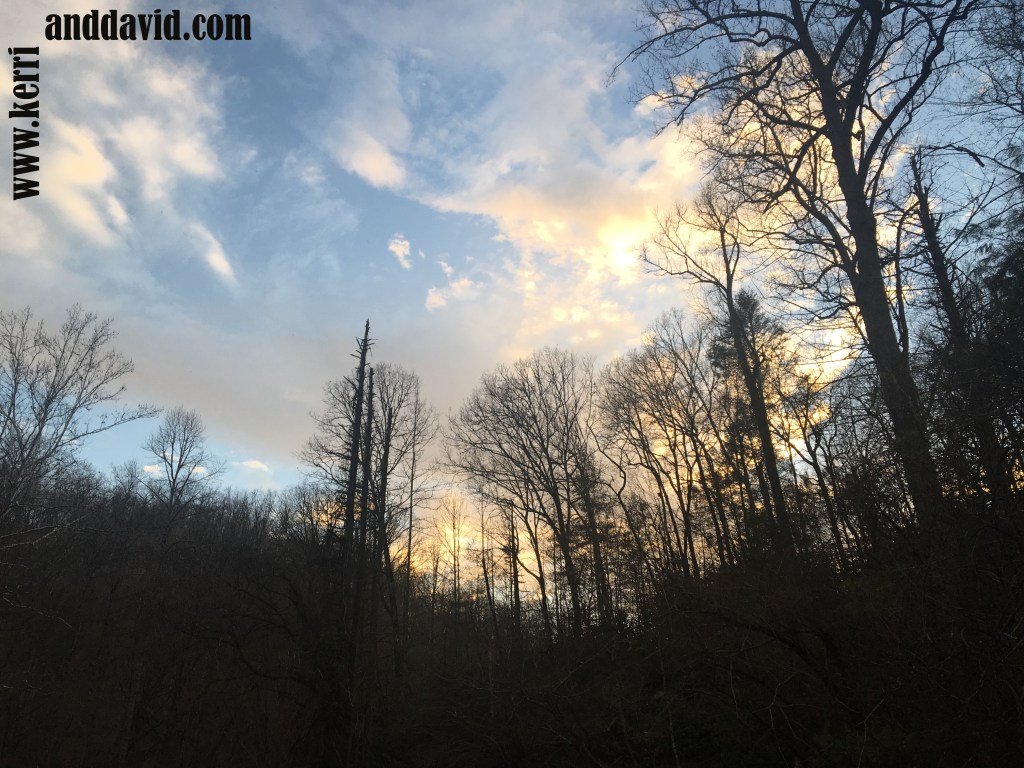
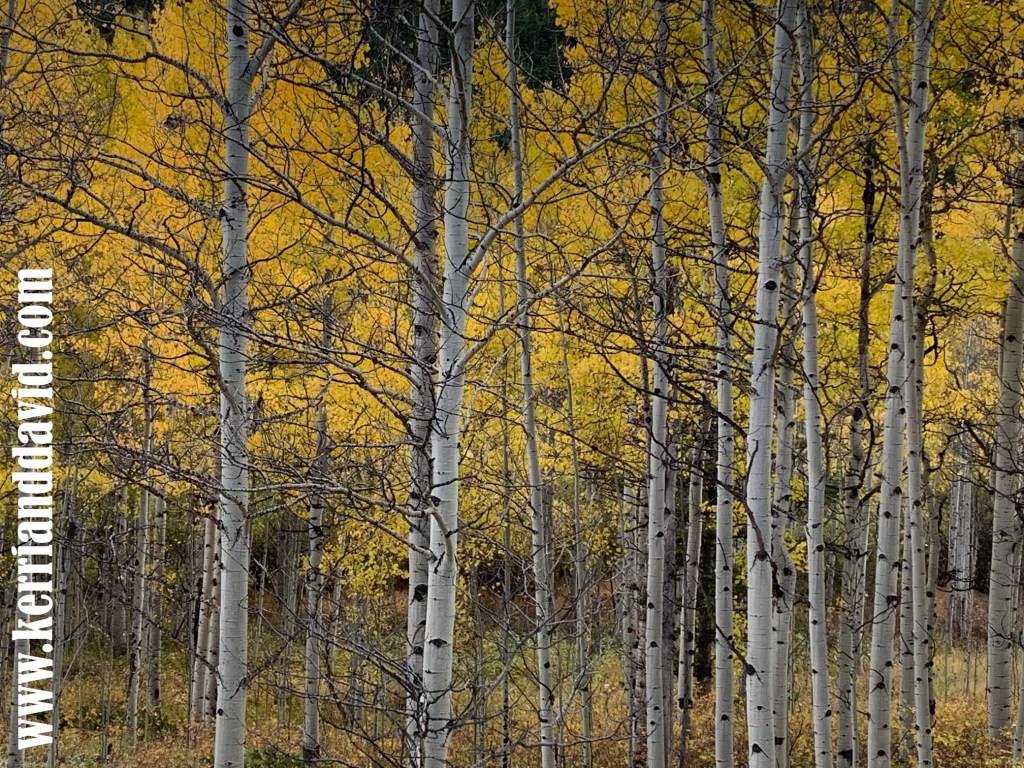
Kerri took this photograph a week ago. We’d set up our pop-up table in the middle of the woods. We had a small cooler with cheese and crackers, tabouli and chips and wine. It was cold. We needed to take off our gloves to eat a bit of our snack and then put them on again, fingertips stinging. Since she is a photography maven, I knew to stand back after setting up so she might take shots of our snack-laden table. She finished, sat, and then pointed her camera to the sky.

Despite what you see in the photo, the trees did not reach to a common center. That is an illusion. Perspective as taught in art school. The point of view of a lens. “Lookit!” she said, red fingertips holding the camera so I could see the image. “We must have found the exact center of the forest,” I thought and smiled.

I often feel like that these days. We must have found the center.

Last night, on an all-too-rare warm evening, we sat with friends on their deck. The Up North Gang. We ate dinner. We laughed. I had my first ever sip of salted caramel whiskey. Dessert as a drink. Time stood still for me and I studied the moment. I wondered if anyone on earth was as fortunate as Kerri and me.

Perspective as taught in art school. Points converge creating the illusion of distance. At one time in history, a crossroads of art and mathematics, this simple recognition was a revolution. Linear perspective. A unique point of view. The accurate portrayal of three dimensions on a two-dimensional surface was powerful – the creation of illusion, shape and distance, produced new intentions and mathematical rules.

It also changed forever the viewer. To see the illusion one must occupy the illusion of a unique center. A new psychology. It’s possible to draw a direct line of descendancy from the hard perspective of the Renaissance to our abstract expressionism. The artist’s point of view, unconscious expression without limit or rule, is all that matters. Two ends of the same pole.

I told Horatio that I am, at long last, learning to keep quiet. To share what I see when asked, and not before (he says as he writes a blogpost about what he sees). I have made a career out of too adamantly trying to get people to see what I see. My adamancy might be traced to the Renaissance and the notion that I occupy a unique center, a specific point of view that makes my illusion of shape and distance somehow privileged and necessary.

Age is helping me challenge and release my investments. It is also a grand teacher of movement and moments. Nothing stands still, especially time. The best we can do is savor the spaces between, always shifting and moving. Children become parents become grandparents. A warm night. A cold day on the trail. It matters less and less what I see and sense-make with my unique hard lines and more and more that I taste the tastes and see the colors, my lens aimed at a common center, sharing the passing moments with others.

read Kerri’s blogpost about THE WOODS

Imagine The Possibilities! [on Two Artists Tuesday]

Mastering others is strength. Mastering yourself is true power.” ~ Lao Tzu

I’ve had this quote sitting on my desktop for months. I’ve been on a Lao Tzu kick, a Kurt Vonnegut kick, a Rainier Maria Rilke kick…all at the same time. They are, not surprisingly, in alignment on many topics, among them self-mastery. “The secret?” they whisper. “Stop trying to control what other people think or see or feel and, instead, take care of what you think and see and feel.” Their metaphoric trains may approach the self-mastery station from different directions but the arrival platform is the same.

It’s a universal recognition: take the log out of your own eye.

Sometimes a penny drops more than once and so it is with Saul’s advice to me. “Look beyond the opponent to the field of possibilities.” “And, just what does that mean?” you may shout at your screen. It sounds like new-age hoo-haw.

Ghandi said, “Nonviolence is the weapon of the strong.” It is the height of self-mastery to bring ideas to the table rather than a gun. It is the height of self-mastery to bring to the commons good intention and an honest desire to work with others to make life better for all. Power is never self-generated but is something created between people. Power is distinctly different than control. Power endures since it does not reside within a single individual. Power lives, as Saul reminded me again and again, not in throwing an opponent but in helping the opponent throw themself. “Focus on the possibilities,” he said again and again. Throw yourself to the ground often enough and, one day, it occurs that there may be another way.

Work with and not against. It seems so simple. The bulb hovering over my cartoon head lights-up. Work with yourself, too, and not against. Place your eyes in the field of all possibilities. Obstacles are great makers of resistance, energy eddies and division. Possibilities are expansive, dissolvers of divisiveness.

I am writing this on the Sunday that Christians celebrate their resurrection. The day that “every man/woman for him/herself” might possibly and-at-last-transform into “I am my brothers/sisters keeper.” All that is required for this rebirth is a simple change of focus; a decision to master one’s self instead of the never ending violent attempt to exercise control over others.

It’s the single message, the popcorn trail left for us by all the great teachers. Instead of fighting with others, master yourself. Imagine the possibilities!

read Kerri’s blogpost about THE CEILING LIGHT

Look Out [on Two Artists Tuesday]

Perhaps the most useful and profound lesson I’ve learned happened under the water. I was doing my first night dive. I was scared. I was not yet a confident diver. As we descended the world became inky black. All I could see was where I pointed my light.

It was that simple. I can see where I point my light. That’s it. And, more to the point, I choose where I point my light. I have the capacity to choose what I see. I can…and have…chosen to focus on hardship and lack. I can…and have…chosen to focus on what I love. On any given day my focus bounces full spectrum between complaint and appreciation. And then I remember: it’s my light, where do I want to aim it?

There’s a second aspect of the lesson. My focus is a beam. My light is not all encompassing. Each of us looks at life through a soda straw. None of us has the big picture. That’s why the commons is so important. In order to know what to do, we need to bring our many perspectives together to approximate something close to a full picture. Rather than fight about disparate points of view – who is right – it’s more useful to try and assemble all of those differing views, like the pieces of a jigsaw puzzle, into a bigger picture. No one wins when the pieces refuse to interlink.

With two broken wrists the cello became impossible to play. It has sat in her studio, the case unopened, since her fall over two years ago. I remember the day we bought it. We were early in our relationship, not yet married. I knew she was having cello dreams. We went to the music store for some other purpose, I can’t remember. The cello was sitting in the corner. She sat. She began to play. It was a perfect fit. And, although we could not afford it, we also could not leave it behind. It was a perfect fit.

Our lives these past two years have been a descent into dark water. We’ve worked hard to shine our light at our good fortune in a dark and inky landscape. As we make our way back to the surface, we are cleaning out. Taking stock. “The cello needs to be played,” she said, deciding to sell it. “I’ll never be able to play it, now.” She took photographs of her cello. Sent out a message through the network.

At the end of the day she showed me the photo. Edges. The view from inside the empty cello case, looking out. A slice of the world visible outside the case.

What’s “out there” is rarely clear. We see a small slice. It tickles our curiosity. The cello dream moves on making space for…? Who knows? We can’t see that far. In the meantime, we keep our eyes and hearts uplifted as we slowly kick our way back to the surface.

read Kerri’s blogpost about EDGES

Look Out The Window [on Two Artists Tuesday]

I came down the stairs, having just finished work for the day, and found her staring out of the bedroom window. “You have to come see this!” she said.

Atop John and Michele’s house, hundreds of birds, starlings, jockeying on the roof, taking turns diving into the gutters. And then, in heartbeat, the entire murmuration whirled as one into the sky. The visual impact of their singular launch nearly knocked us over.

And then, they were in the trees and swooping down to the pond. We ran to the sunroom where we could see the backyard. Dozens and dozens of birds and, we realized, not just starlings, great-tailed grackles were in the mix. The starlings, apparently late for a date or not willing to wrestle the grackles, swirled into the sky and disappeared, leaving the great-tails to enjoy the pond.

For a few moments it was like watching a bird ballet. The pulse of bird dancers, rising and falling in groups to the water, according to a symphony that we could not hear but could see in their choreography. And then, like the starlings, in a heartbeat, they were gone.

We looked at each other to confirm that we actually saw what we just saw. No dream or hallucination. It happened and we were lucky enough to look in the right direction at the right moment.

It’s not that it’s rare. This ballet happens all day, everyday. It’s rare that we are privy to the performance or are captured by the play happening around us.

“What if I hadn’t looked out the window?” Kerri asked.

read Kerri’s blogpost about STARLINGS AND GRACKLES

Step Off [on Two Artists Tuesday]

“A tree is not made of wood, it is wood.” ~ Alan Watts, The Watercourse Way

Language is powerful. It’s a drum I have beat for a long time, the notion that we insist that the narratives we wrap around ourselves are somehow “reality.” We are told that 50% of Russians believe the hell wrought on the Ukraine is merely propaganda. A made-up story. Not true. It is the narrative they are fed and, in order to eat it, they must ignore any evidence to the contrary. Their economy crumbles. The ruble falls. How could they not see it? Don’t laugh. 40% of USAmericans still believe the last presidential election was stolen, a plausible story only if wearing blinders with fingers placed firmly in ears. Burying your head in the sand is not a Russian or American trait, it’s uniquely human. We see what we believe, not the other way around. Our language makes it so.

Years ago I read that the word “wild” could only come from a people who believe all things must be tamed. Wild makes no sense without the concept of tame. Wild, bad. Tamed, good. So, a people afraid of their own “nature” must become tamers. A people who think “nature” not only can be but must be managed. To be “above” it all, in charge and atop the pyramid, giver of names. It is the necessary narrative for such tamers of the wild, those who story their very nature as corrupt. Tamed, good. Above it all. Separate. Is it any wonder the intrinsically conflicted human world rarely embraces peace? Our narrative leads us to believe, amidst so much inner and, therefore, outer conflict, peace is something to be created because we are naturally conflicted. What else?

Where, exactly, does wild end and tame begin? Where’s the line that delineates nature from civilization? What if nature is neither good nor bad? What if your nature was neither good nor bad? Perhaps self-love would be within reach and, as a natural extension, the love of others, too. It’s an alternative narrative though not possible in a belief-story that fears the wild. Wholeness begins with a step off the pedestal.

It’s in the language. Somehow separate from the world in which we live, not “in” nature or “of” nature , we are deluded to believe we are made of different stuff. Above it. Divinely manufactured. Made.

Manufactured. Made. Trees made of wood.

And, just what are we made of? I guess it depends on the story we decide to tell. Wild stuff.

read Kerri’s blogpost about TREES

Let Fly [on Two Artists Tuesday]

“We have to continually be jumping off cliffs and developing our wings on the way down.” ~ Kurt Vonnegut, If This Isn’t Nice, What Is?: Advice For The Young

It is now my opinion, based on life’s experience, that it you don’t find the cliff, the cliff will find you. Wing development is the name of this game. Hide in the closet, bury your head in the sand, drink yourself to oblivion, pretend the monster is not at the door, and you’ll discover in your last moments that looking the other way was, in fact, your cliff.

Master Marsh once asked me why I had the need to run and jump off every cliff. At the time I said, “I don’t know!” My latent response comes straight from Vonnegut: wing development. Apparently my wings took their sweet time developing and needed some extra cliff-age. And, as we all know but are too polite or arrogant to admit, wing development never ceases. There’s always another cliff until there’s not.

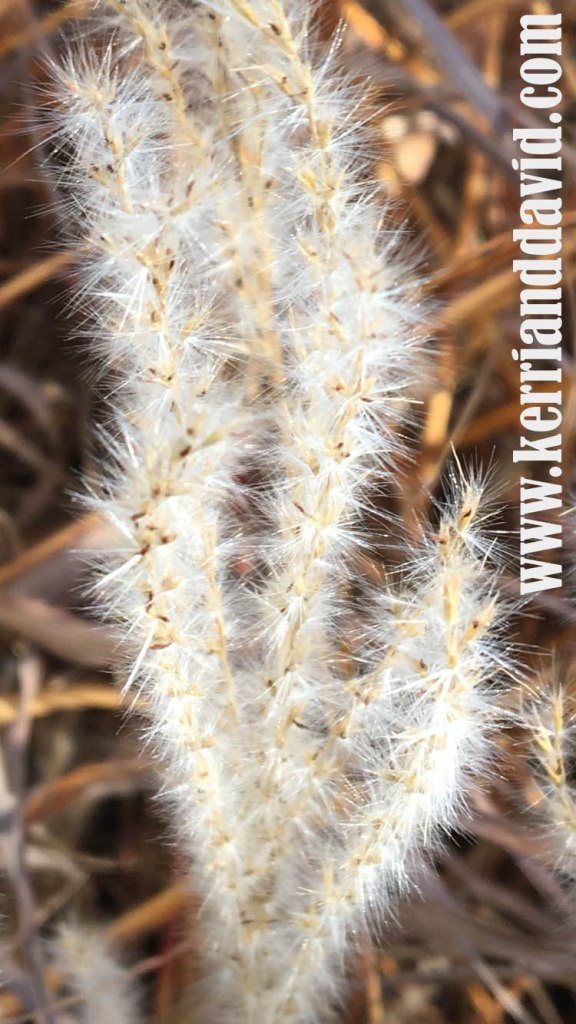
We had a rare warm day so took a walk on our favorite trail. The brilliant raw sienna of the empty pod caught Kerri’s eye. While she took photos of the pod I thought about the thousands of seeds it once held that took flight on the wind. A few certainly found fertile soil. Most did not. That’s the idea behind Kurt Vonnegut’s advice. Don’t hoard your idea seeds. Put them out. Audition for the play. Submit your story. Offer your idea. There’s great truth to the advice: your job is to put it out there, not to decide whether or not it is good enough. Explode the pod rather than protect the seed.

Greg recently told me said, “it doesn’t have meaning until it’s published.” He wasn’t speaking about publishing in a newspaper or by Random House. Sending an email is an act of publishing. To text is to publish. Greg was referring to sharing. It has no meaning until it is shared. And, sharing your creations can be -and often is – vulnerable and scary. Giving a speech is terrifying to most people. Dancing, painting, composing a song, playing a solo, offering your idea in a meeting…all are acts of publishing. All are potential cliffs to jump off.

Explode the pod. Let the seeds fly. The wind will carry them. Some will find fertile soil. Most will not. Wing development is easier when you realize that you are a pod of ideas and not a judge of worth or value.

read Kerri’s blog post about THE POD