


Filed under: Art, Gratitude, The Direction of Intention, Uncategorized | Tagged: david robinson, davidrobinsoncreative.com, Gratitude, kerrianddavid.com, painting sale, society6.com/davidrobinson, studio melange, the melange | Leave a comment »
50% OFF ALL PAINTINGS THROUGH MIDNIGHT APRIL 22nd
“I paint the way some people write their autobiography. The paintings, finished or not, are the pages of my journal, and as such are valid. The future will choose the pages it prefers. It is not up to me to make the choice.” ~ Pablo Picasso
The further I walk down this life path, the more I identify with this quote. A younger version of me would have thought it interesting but not much more. A younger version of me wouldn’t have admitted to trying to pre-determine the choice for the future; trying to determine what others see. A forgivable fool’s-errand as I am certain I am not alone in my folly.
There is a flip side to my fool’s-errand. There are things I see in the paintings that no one on earth will ever see. I am the channel. It is the privilege of being an artist to express from personal experience what cannot be fully expressed, only approximated. And, in the attempt to fully express the personal (another fool’s-errand!), a common ground is created – art is a universal meeting place, a crossroads. It’s a paradox. It is also a truth: individuals create common ground through the experiences they share and the stories they tell about those experiences. Society is a creation just as a painting is a creation. Society is an expression just as a painting is an expression.
The future will choose the pages it prefers because it will choose the pages it relates to, the pages it understands, the pages that inspire, remind, or give pause.
For me, at this point in my autobiography, it is enough to paint without regard to validity or investment in value of my paintings. It is enough to discover yet another facet of my life as an art-fool on errands .
Filed under: Art, The Direction of Intention, Uncategorized | Tagged: #50%Off, acrylic paintings, autobiography, david robinson, davidrobinsoncreative.com, figurative paintings, fool's errand, Iconic, kerrianddavid.com, pablo picasso, painting sale, paintings, society6.com/davidrobinson, studio melange, Surrender Now, the melange, Weeping Man | Leave a comment »
50% OFF ALL PAINTINGS THROUGH APRIL 22nd
Together we read the local paper every morning. Yesterday there was an essay from the executive director of a new ‘creative space’ making a case, financial and otherwise, for why the community should value and support the arts. Everything he wrote was true. Everything he wrote has already, as Kerri likes to say, fallen into the moat.
Fifteen years ago I might have written that essay. I am an artist and need no case made for the necessity and essential nature of “the arts.” However…. In a past life I consulted with schools and many times found myself in the position of lobbying the school board to support arts programs. I jumped up and down making a case for the arts and rarely achieved my desired result. Until, one day, a word-angel grabbed my tongue and instead of using that mystical word “arts,” I replaced it with the phrase “experiential learning.” Doors blew opened. Angels sang. Kids made movies, painted paintings, held poetry slams, wrote musicals, made plays…came alive. And learned.
Our mistake is “to make a case” for the arts. Our mistake is to define it narrowly, relegate it to museums. It is not a separate thing. It is everything. It is everywhere. The design of our cars and blenders is an aesthetic as well as an engineering process. The apps on our phones (the very design of our phones) requires artistic as well as technical skill. Every piece of marketing that clogs our streams requires an artistic sensibility. We live in age of narrative, of artificial intelligence, of imagination run rampant. We story ourselves on Facebook and Instagram and share our pins on Pinterest. Step back and listen to the competing narratives we call The News. Listen not to the content of the question but how it is asked; these things are not accidental, they are designed, targeted to influence and move our imaginations. The “arts” are not lofty nor dusty, they are throbbing, vibrant, and central to every nuance of our lives. Why do we insist on keeping them in such a tiny little box?
Stephen asked me more than once, “Why don’t people value the arts?” He is a prolific painter, brilliant, and exhausted from living on the margins. “They do,” I’d say, “they just don’t know it.”
Kerri and I said goodbye to a few more paintings yesterday. They found their right home and that is more than gratifying. It is the moment of completion of the painting (or the play or the composition…or the car, couch, and coffee mug) when it finds an audience or its home. It’s a life cycle, deeply connected. It is everything. It is everywhere.
Filed under: Art, The Direction of Intention, Uncategorized | Tagged: a case for the arts, art, david robinson, davidrobinsoncreative.com, design, imagination, Kerri Sherwood, kerrianddavid.com, kerrisherwood.com, life cycle, margins, painting sale, paintings, society6.com/davidrobinson, society6.com/kerrisherwood, studio melange, technology, the arts, the melange, value | Leave a comment »
50% OFF ALL PAINTINGS THROUGH MIDNIGHT APRIL 22nd
I always loved gallery openings of my work because they served to remind me how deeply personal a relationship with a painting really is. And, isn’t that the point? For instance, when I first showed my painting, Canopy [featured in a post yesterday], it literally stopped a woman in her tracks. She burst into tears and spent the next hour communing with the painting. Literally communing. I love this story because a few moments before the communing woman entered the gallery, a young couple stood before Canopy and said, “Ooh. I don’t like this one.”
As John once said, “Your job is to paint the paintings, not to determine what people see in them.” True enough.
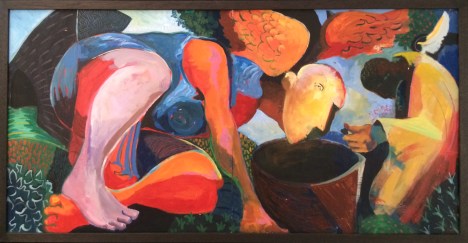
There are two paintings in my stable that have drawn more attention than any others. By far. They were painted at roughly the same time. They are the same size. Both are acrylic on two panels. Both have shown often, always have multiple inquiries, and always return to the stable. They are favorites to be courted but are always left standing alone at the altar.
Once, when taking them down after a showing, a gallery rep. told me she thought they were abandoned yet again because they were too colorful. “Too Colorful?” I questioned. And she said, “You’re right. That’s not possible.”
Filed under: Art, The Direction of Intention, Uncategorized | Tagged: #50%Off, acrylic, angels, angels at the well, art, art sale, bass player, color, david robinson, davidrobinsoncreative.com, kerrianddavid.com, paintings | Leave a comment »
50% OFF ALL ORIGINAL PAINTINGS THROUGH MIDNIGHT APRIL 22nd
Horatio and I just finished one of our famous calls. He, too, is an artist [and film maker] and so I look forward to our all too rare and epic conversations. They are pot-stirring and life-giving. Today, among a host of other things, we talked about the necessity of letting go of the old story in order to move forward into the new.
Non-attachment. It is an artistic imperative (and spiritual practice). It is one of the reasons I love and appreciate Kerri’s total attachment to my paintings; I know my work is loved and in good hands so it frees me to continue stepping forward. I no longer walk this path alone. I have the same attachment to her compositions and trust my embrace of her work opens safe space for her artistic voyage to the edge.
Kerri treats the sale of my paintings more as a placement, a matching of hearts, than as a transaction. She’s helping me tell a new story even in the selling of my work. ” I hope you sell a lot of 50% off paintings,” Horatio said.
“Me, too,” I thought. In my new story that would mean a meeting of many, many hearts.
Filed under: Art, The Direction of Intention, Uncategorized | Tagged: artistry, david robinson, davidrobinsoncreative.com, non attachment, painting sale | Leave a comment »
50% OFF ALL PAINTINGS through MIDNIGHT APRIL 22
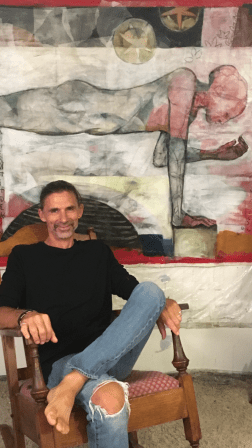 It is my favorite rituals. Just as I put the last stroke on a new painting I hear Kerri say, “I love it. You can’t sell that one.” I smile because I know she means it. Generally it takes a few days of convincing her before she acquiesces to the inevitable destiny of my paintings and we list it on the site. Letting them go, placing them in the world, is personal.
We take great delight when my paintings find homes with people who love them.
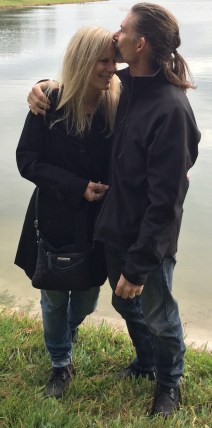
Soon, Kerri and I will celebrate 5 years together. A wish come true. This morning in the studio, sorting through paintings to select new morsels for the melange, we discussed how fortunate we are, how prolific we’ve been, how fast we are filling up space, how many people have said to us, “I wish I could afford that painting.” We decided that part of our celebration of the first 5 years should be a clearing of space, a nod to wish-giving (or as close as we can come to it), an invitation and welcome to the new.
It’s easy. Go to my site before midnight on April 22nd. Choose your painting – old or recent. Take 50% off the listed price (of course, there’s tax and shipping if we need to ship it to you). Send us an email through the contact page (or text or call us) claiming your painting. If it’s still available, it’s yours (our space-clearing is necessarily first come first served). We’ll contact you with the details.
Oh. And, don’t be surprised if Kerri tries to talk you out of it. She is persistent!
Filed under: Art, The Direction of Intention, Uncategorized | Tagged: #50%Off, david robinson, davidrobinsoncreative.com, erom yub, Kerri Sherwood, kerrianddavid.com, kerrisherwood.com, painting sale, potlatch | Leave a comment »
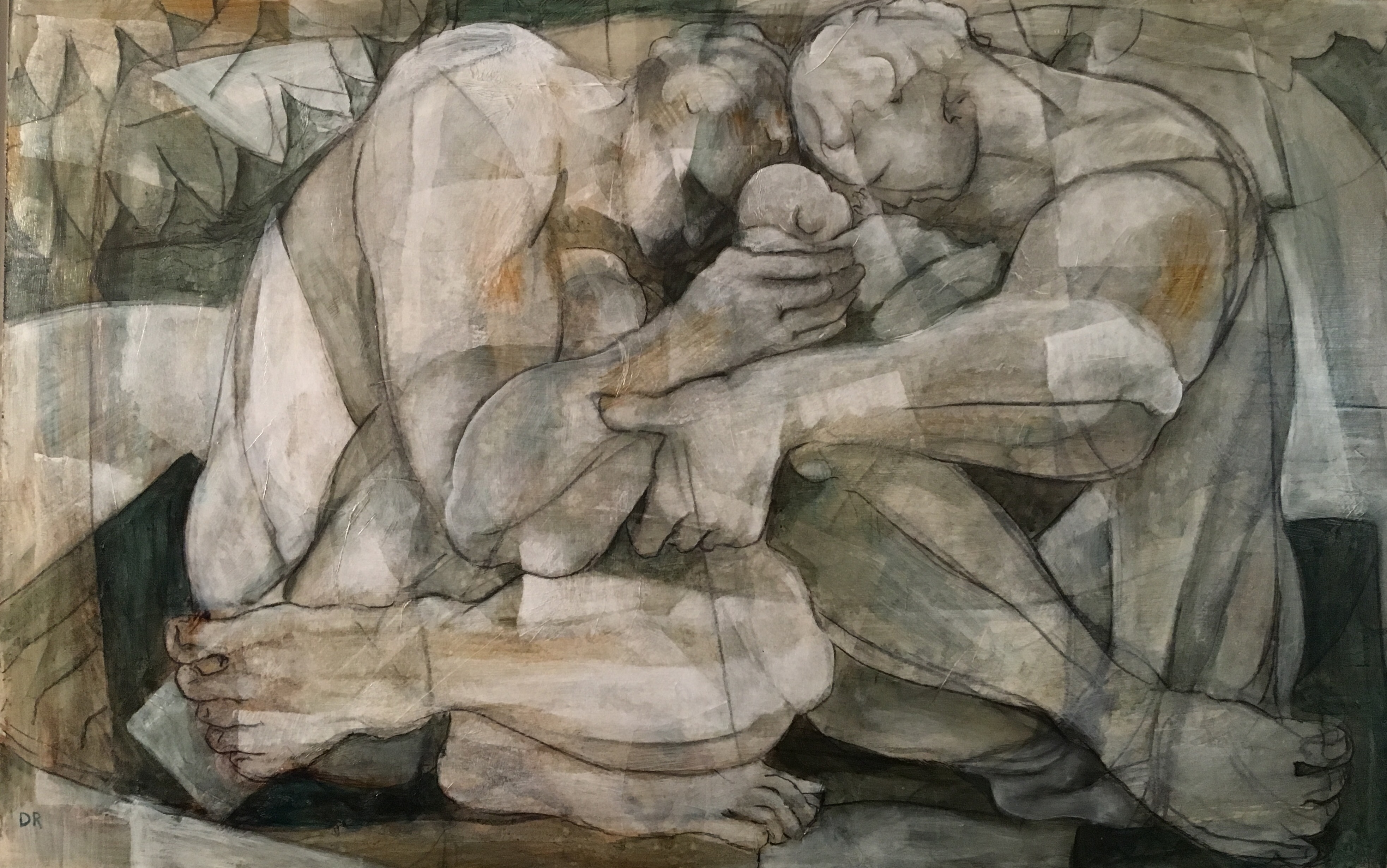
a second version, a second point of view of my painting Shared Fatherhood
I suppose it is the great trap in human nature to define life through oppositions. Was your experience good or bad? Are you liberal or conservative? Are you your brother’s keeper or is it every man for himself? Oppositions provide the illusion that there is a right way or a wrong way, that any issue can be reduced to a simplicity, a singular path. One way. Oppositions are great language devices for dictators and the righteous. They remove the grey tones and blunt the grey matter. With an opposition, us or them, “god” can be exclusively on your side (a small god, indeed) which self-grants permission for all manner of abuses enacted by “us” on “them.” The problematic word when employing oppositions is “or.”
“And” is a much more useful (and honest) term to employ when dancing with oppositions. Can you be your brother’s keeper AND take care of yourself? Certainly. Can you survive entirely by yourself without the participation of your brothers and sisters? Certainly not. No one lives in a vacuum; “or” is the great creator of illusory vacuums. “And” guarantees a conversation and perhaps a host of useful, challenging and robust perspectives. Both/And is always more functional than Either/Or.

AND the first version of Shared Fatherhood
The snag in “Or” is that there is very little truth in any reduction that ultimately lands on just One. This or that. All life is movement and all movement stops in One. Creative tension requires at least two points and a desire for someplace place to go. There is no single arrival station in real life. There is no achievement that stops all the presses. Every answer inspires new questions. Each question opens doors to multiple possibilities. Agreement is a fluid target at best and must be nurtured. Compromise is never an end state; it is a relationship imperative. Life is never found in the static “or.”
Do an experiment: go to the grocery store, choose any item and ask yourself how many people it took to bring your chosen item to the shelf at that moment. If you are not astounded by the complexity of participation, how dependent we are on actions of others, your imagination has most certainly failed you. Skip, entrepreneur extraordinaire and mentor to entrepreneurs taught me that a business cannot succeed until it serves its customer’s customer. Note the word “serves.” Businesses serve. Not simply a customer but the complexity of a customer’s customer. Entrepreneurism is a service to the creative genius of a community and multitudes of communities beyond.
Entrepreneurism, like artistry, ….even, yes, like governance…like all things vital, moving, complex and growing, live in service according to the good graces of AND. Anything else is a mirage.
Filed under: Art, entrepreneur, Language, Perspective, Seeing, The Direction of Intention, Truly Powerful People | Tagged: Agreement, And, artist, artistry, Black and White Thinking, Both/And, collaboration, community, complexity, Compromise, davidrobinsoncreative.com, duality, Either/Or, entrepreneur, fluid, illusions, movement, moving, Opposition, Or, participation, Reduction, service, simplicity, society6.com/davidrobinson | Leave a comment »

my new tree;-)
Wide awake in the middle of the night, we snacked on handfuls of Chex cereal and indulged in my favorite kind of conversation: “Isn’t it weird that…?” Little did we understand that our late-night conversation would set the theme for the week.
The next night high winds toppled our neighbor’s ENORMOUS aging maple tree into our backyard. The insurance company called it “an act of God.” It is a phrase implying no fault, no responsibility. It just happened. I laughed aloud when, immediately following the “act of God” designation, the insurance adjuster heaped on us a load of legal cautions, new responsibilities (the tree now ‘belonged’ to us), property line designations, and small print reminders meant to minimize financial risk and responsibility to the insurance company. The layers of irony are too many to count though I suppose if wacky preachers can assign responsibility for hurricanes and other natural disasters to the wrath of God, then it is no less ridiculous for insurance companies to invoke the fickleness of God to absolve themselves of liability.
Isn’t it weird that…?
P-Tom reminded us that the “act of God” was that no one was hurt in the tree fall. For P-Tom the act of God was a kind of intervention. A few degrees to the right, a slightly different wind direction, and the tree would have landed on our bedroom. Life does seem fragile by the slightest of degrees. We told people that we were lucky. Intervention? Fortunate? Fate? Design?
Isn’t it weird that…?
We cut a branch from the fallen tree and brought it in the house. It is now our Christmas tree.
Had you asked that branch a week ago if it would ever become a Christmas tree it might have laughed at you.
As a maple branch it had no aspirations or intentions of being wrapped in lights or decorated with silver baubles. In truth, it probably cares little if it makes us laugh or invokes a smile each time we enter the room. But it does. Or, better, we make sense of it that way. Sense making? Story telling? Either way.
Isn’t life weird?
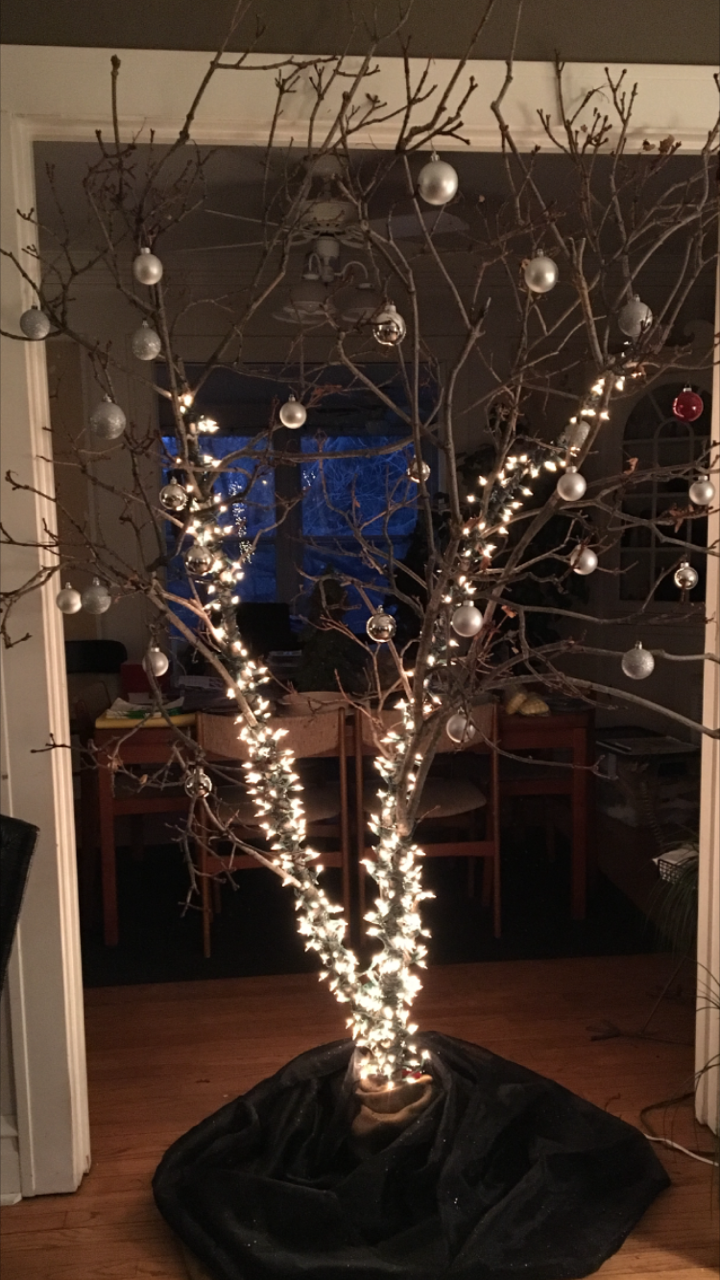
Our work-in-progress
Filed under: Random, Seeing, Story, The Direction of Intention, Truly Powerful People | Tagged: christmas, christmas tree, davidrobinsoncreative.com, design, fate, God, insurance, insurance companies, luck, sense, sense making, society6.com/davidrobinson, story, story telling, tree | 1 Comment »
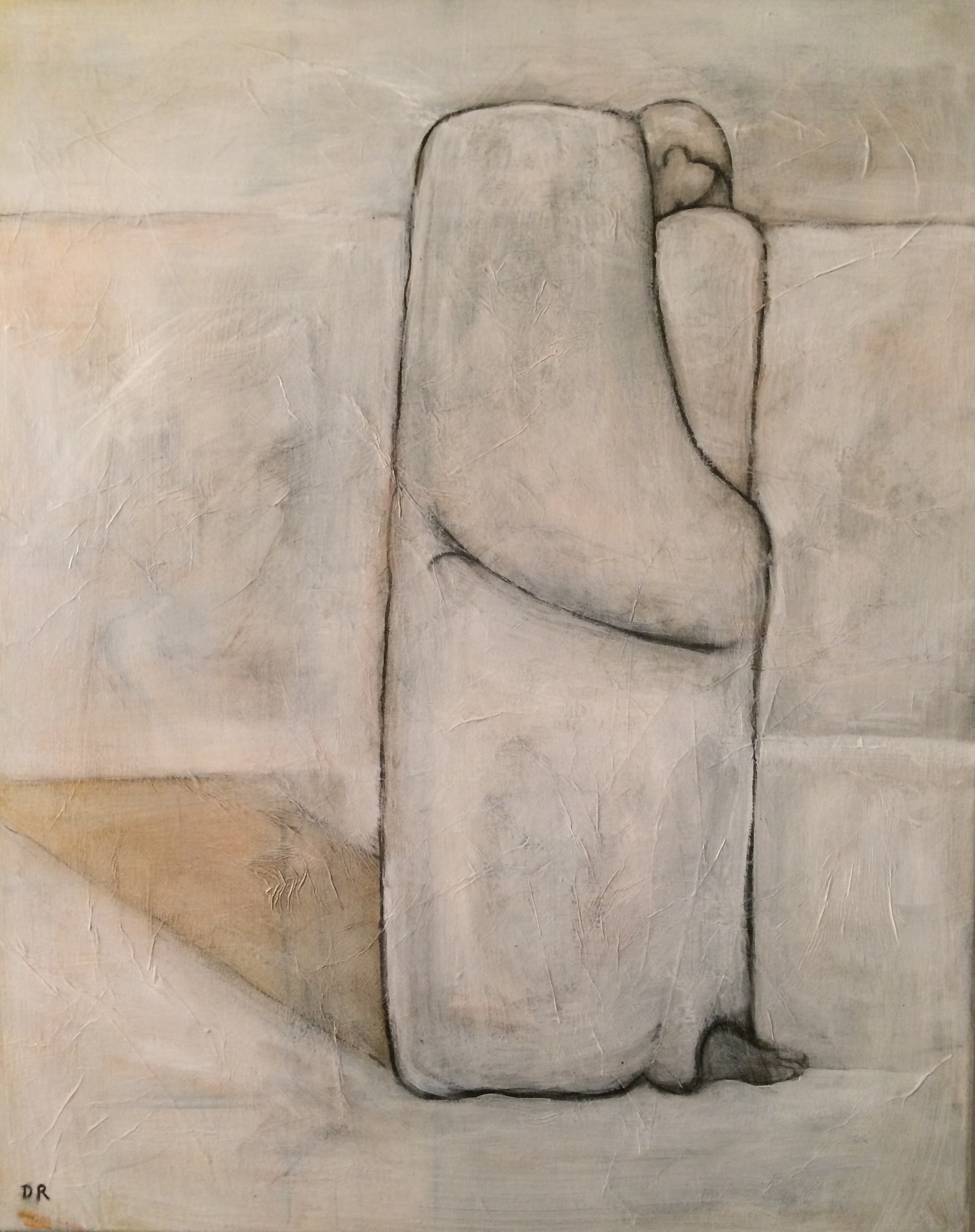
a new painting perfect for winter and inward looking. it’s part of a set in my sacred series.
“The doctor may explain why the patient is dead, but never why the patient is alive.” ~Declan Donnellan
Once, tromping through a biodynamic vineyard, Barney explained to me that winter is the time for the energy of the vine to go to the root. The vine that appears dormant above ground is, in fact, actively recharging below the surface. The energy goes inward. The root rejuvenates, drinking in the minerals necessary for the new growth of the coming spring. The fruit of the summer is impossible without the rejuvenation of winter.
We are not so different from the vines though language can trick us into compartmentalizing, perceiving winter as distinct and separate from summer, the inhale as a separate action from the exhale, tides that ebb and then flow. Cycles of life have compartments in study but never in real life. The compartments are made up for the convenience of categorization and conversation.
These past few weeks we’ve been cleaning out our house, going through old boxes and files, shredding old bills, carrying furniture and computer carcasses to the curb. Old clothes are going away. Closets and bins are emptied. The house is beginning to breathe. There is space. Spaciousness. We are laughing at old pictures, sometimes cringing. This day’s new-found spaciousness inspires the next day’s cleaning rampage. It is invigorating. Rejuvenating.

and this is the other half of the set. winter has me looking inward and exploring simplicity in line and space.
Our cleaning tsunami wasn’t planned. Our computer crashed. Our work was interrupted. Our expression was limited. We complained and resisted and then turned our energies elsewhere. Inward. Going through and releasing old stuff, past lives, creating space, is rejuvenating. We are taking our time. We are going slowly. It is oddly restful.
Driving home from our walk in the woods, we laughed at ourselves. Mock-praising our virtuous cleaning, exaggerating and inflating our new found spaciousness to full spiritual illumination, we pretended we’d achieved life beyond wanting, living without yearning. Consciousness beyond compartments. Wiping laughter-tears from her eyes, Kerri said, “Wait! This could be boring! What is life without desiring some red wine while cooking dinner? What about the pleasure of yearning for morning coffee? With all this new found space….”
Filed under: Art, Creativity, Energy, The Direction of Intention | Tagged: cleaning, clearing, comparmentalization, cycles, davidrobinsoncreative.com, desire, energy, illumination, inner peace, inward looking, life cycles, recharging, rejuvenation, root, society6.com/davidrobinson, spaciousness, winter, yearning | 1 Comment »

My latest. As yet untitled. It’s about dreams and angels.
It is the time of thanks giving in these United States and this week when I say my quiet thanks I will include Horatio in my list. Our conversations are life-giving and art-inspiring. And, best of all, tracking Horatio’s thought path is an utter delight. He is an expansive thinker! Here’s an example from our recent call:
“I’m the last person to really see my work,” I said. “Kerri routinely stops me from ruining paintings. She forces me to leave them alone until I can actually see what I’ve painted.”
Horatio said, “You have a parallax problem.”
I thought to myself (who else would I think to?): Parallax is a great word! The last time he flung that word at me I looked it up. In essence, divergent perspectives when looking at the same thing from two different points of view. You might say our political parties have a parallax problem.
Horatio continued, “All religions say, ‘Love your neighbor.’ All religions say it. Love your neighbor.”
What!? I thought. How did we get to neighbor-love from parallax? Grab the reins and hold on!
“The fundamental human problem is to know yourself.” Horatio said. “And artists confront that problem every moment that they stand in front of the canvas or sit down at the piano. Every moment is an exploration of the self, what you see, what you believe.”
From parallax to loving your neighbor to knowing yourself.
“Self. Other. That’s it!” Horatio continued: “That’s all there is! Isaac Bashevis Singer said that the purpose of literature [he was a writer but you can insert any art form] is to 1) entertain and 2) to educate. IN THAT ORDER! You cannot educate first! Playing matters! Fun matters! You must engage the heart first. It opens the path to the other thing.” [take note all ye test makers and proponents of head-driven education].
Parallax: differing points of view. Love your neighbor: a universal aspiration amidst the raging parallax. Know yourself: the fundamental human problem and the singular pursuit necessary to approach the universal aspiration. Heart first: the only route to all of the above.
“An artist has to play. Experiment. Step across the knowns into the unknowns. Question all of those assumptions. Doubt what they see,” he said.
It’s a beautiful paradox, isn’t it? The route to knowing yourself, the route to loving your neighbor, is to doubt what you think. In fact, it is to realize that the river of nonsense incessantly running through your mind is nothing more than a deflection from actually coming to know your self. It is not to be believed. It is the ultimate fake news. It is a great day when you recognize that your inner monologue is entertainment and not education! It’s a great day when you recognize that you need another person’s perspective in order to know your self. You need it precisely because it differs from what you see. Clear vision requires two points of view. It’s called perspective. Having two points of view opens the door to questioning. It makes probable the birth of a possibility.
“It’s all about relationship.” Horatio concluded, “Now, the only real question surrounding the artist is, in the midst of all of this navel gazing, in the thick of all of this dedicated pursuit of the self, boundary-crossing-questioning, will your neighbors want anything to do with you? Will they want to have you around at all?!”
Oh, yes. Parallax.
Filed under: Art, Creativity, Perspective, Seeing, The Direction of Intention, Truly Powerful People | Tagged: art, artistry, creativity, davidrobinsoncreative.com, divergent thinking, education, entertainment, Isaac Bashevis Singer, Love your neighbor, paintings, parallax, perspective, play, religion, seeing, society6.com/davidrobinson, Thanksgiving | Leave a comment »









 The Direction of Intention