Start Thinking [on DR Thursday]

“As Huxley remarked in Brave New World Revisited, the civil libertarians and rationalists, who are ever on the alert to oppose tyranny, ‘failed to take into account man’s almost infinite appetite for distractions.”‘ ~ Neil Postman, Amusing Ourselves To Death

Any day now I’m going to watch the 1976 movie, Network. It’s the film equivalent of a crystal ball to our current predicament. A veteran news anchorman loses it on air, threatens to kill himself, but instead goes on a full-blown rant. The network’s ratings skyrocket. An ambitious producer recognizes and exploits the opportunity by creating more and more outrageous programming. Fact falls prey to profitable fiction sold as truth. Ratings imperatives eclipse the north star of accuracy-in-reporting. Roger Ailes created his Fox News Network on the same premise; no veracity necessary. People like a good train wreck, just ask Jerry Springer. It is why the nation is so divided. The blues use news to sort out the lies; the reds use lies to siphon off the truth.

“Contrary to common belief even among the educated, Huxley [Brave New World] and Orwell [1984] did not prophesy the same thing. Orwell warns that we will be overcome by an externally imposed oppression. But in Huxley‘s vision, no Big Brother is required to deprive people of their autonomy, maturity and history. As he saw it, people will come to love their oppression, to adore the technologies that undo their capacities to think.” ~Neil Postman, Amusing Ourselves To Death

Neil Postman wrote Amusing Ourselves To Death before Facebook and Twitter were glimmers in their inventors’ eyes, before the internet hit the personal computer, before multiple channels on cable networks. We have, as Postman wrote, an infinite appetite for distraction with nary a need for honesty. And, as we are witnessing, distraction has arrived in the halls of Congress. We’ve now a party in government that actively shuns verity and raises funds on peddling fallacy.

“When a population becomes distracted by trivia, when cultural life is redefined as a perpetual round of entertainments, when serious public conversation becomes a form of baby-talk, when, in short, a people become an audience, and their public business a vaudeville act, then a nation finds itself at risk; culture-death is a clear possibility.” Neil Postman, Amusing Ourselves To Death.

We are a nation that finds itself at risk. In my post yesterday I wrote that I no longer wonder how a society can willingly and knowingly take itself down. We have front row seats. And yet, the road to our recovery is as simple (and as difficult) as a collective valuing of the truth over ratings or poll numbers or bubbles. We worship at the wrong altar. We are inundated with info-dross. We would be better off if ratings plummeted every time a pundit ranted, a politician bullied, or a commentator lied. We’d be better off if thinking, if fact-checking, was a prerequisite to posting or tweeting or speaking. We’d find ourselves in a shared center, a place of possibility built on a generous commitment to probity.

“For in the end, he [Huxley] was trying to tell us what afflicted the people in ‘Brave New World’ was not that they were laughing instead of thinking, but that they did not know what they were laughing about and why they had stopped thinking.” ~ Neil Postman, Amusing Ourselves To Death

read Kerri’s much more positive post on LEARNING FROM TV

Plan And Reconsider [on Not So Flawed Wednesday]

Last night it snowed. I had to pry open the back door and shovel so I could let Dogga out. It is snowing now. We are lying low, appreciating the quiet that comes with winter.

Societies have seasons, too, though their winters look more like forest fires than bears sleeping.

I remember standing atop a Mayan pyramid in Belize, having just read Jared Diamond’s book, Collapse, and wondering how it was possible that such an advanced society didn’t see their demise coming. As NASA Science aptly wrote, “They Did It To Themselves.” It’s hard to see the mountain when you are sitting on it, I suppose.

I no longer wonder how societies do-it-to-themselves as I feel I have a historical front row seat of our unwavering commitment to collapse. We are following a well-known pattern, a rat trail of self-destruction. We are not the first society to impact our temperatures, to influence our rainfall. We are, however, the first to do it on a global scale.

There are so many people ringing the alarm of climate change, the science is incontrovertible, yet overpowering evidence is no match for dedicated human denial. Ignorance is, in this case, to ignore. Action will hurt the markets. Non-action, of course, could destroy life as we know it. We will not be the first society to sacrifice the greater for the lesser, to throw away the essential by protecting the luxury. We will not be the first to ask, “How did that happen?”

I revisited Jared Diamond’s, Collapse. He identifies “two crucial choices distinguishing the past societies that failed and those that survived:” 1) Long term planning – the courage to make difficult choices when problems become perceptible and before they reach crisis proportions. 2) Willingness to reconsider core values – the courage to make painful decisions about values (which treasured values must be jettisoned and replaced with different approaches).

Courage. The-courage-to-make-choices-and-decisions.

The Maya did not cope well when their problems emerged. They doubled down in hearty denial until all resources were exhausted. They waited until their crisis was full blown before attempting to deal with it. The survival odds are better by planning for the hurricane before it hits.

And us? We are on the Mayan path. It seems that we are, like they were, penny wise and pound foolish.

Despite evidence to the contrary, I am not nihilistic or hopeless. In fact, quite the opposite. As Rich used to say, when the pain of change is greater than the pain of staying the same, people get moving. The levels of pain are rising on all fronts. The problems are more than perceptible and it’s debatable about whether or not the crisis has fully arrived. What we’re experiencing could be the very beginning of movement, the willingness to face ourselves and take a good hard look at what we value. It might be the leading edge of courage.

read Kerri’s blog post about POW

find out more about POW

Conceal To Reveal [on Two Artists Tuesday]

When I was tilting at windmills, one of my favorite things to facilitate was mask work. I brought masks to lawyers, to CEOs, to teacher’s, government workers, elementary school students, corporate trainers, business coaches and sometimes to actors. There’s nothing better than a mask to pop open possibilities and challenge petrified thinking.

Masks conceal and reveal. They serve the paradox and, therefore, are tapped into the root of truth.

It’s impossible to work with masks for long before realizing that the faces we wear everyday are also masks. We “put on” a smile. We attempt to hide what we feel by the mask we manufacture. Some faces freeze in masks of indifference or masks of disdain. We perform ourselves, and craft our masks accordingly.

Many cultures around this world believe the mask opens a communication with the gods. Don a mask and something bigger-than-you speaks through you. When I paint I often have that feeling. Artistry sometimes means getting out of the way so the creation can flow.

It’s why I brought masks to lawyers and CEOs and corporate folks and teachers. To introduce them to the fields that bloom beyond their need to control. So much of their lives, so many of their problems and challenges were wrestling matches of control. They were actively creating the obstacles that they desired to remove.

What do we actually control when we harden our faces over what we feel? What do we gain by attempting to control what others see or think or feel? We are makers of our own prisons. We are deluded by our fantasy that we have the capacity to determine what others see. The only control we exert is upon ourselves.

The mask work makes abundantly clear that control is not power. Power – creativity – flows. It is the dance of the artist to master technique, to learn control, and then transcend it. To get out of the way.

My favorite moment, with every group, in every circumstance, came when the masks released the people and they slowly, respectfully said goodbye and removed them. Their faces was also mask-less. It was like seeing infant’s faces. Bright. Open. They would, for a few brief moments, look at each other, unmasked and unprotected. Simply astonished at being alive, together, in the world.

read Kerri’s blog post about MASK

Welcome A New Day [on Not So Flawed Wednesday]

An old dream. A new day. Enough said.

Look Beyond The Wish [on DR Thursday]

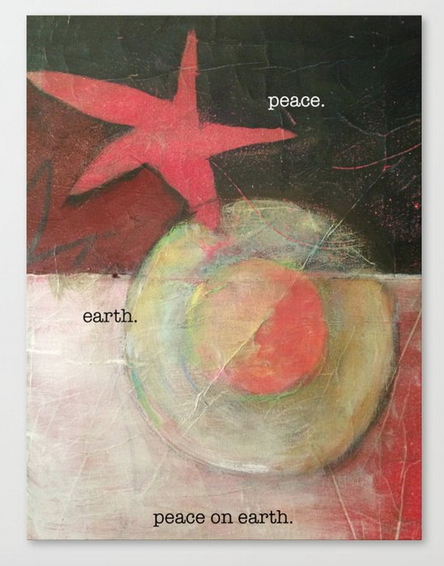
Peace on earth. It is something to be wished for, and, in fact, it is something we wish for every winter solstice. We sing. We hold hands. We light candles. We wish.

Wish [verb]: a strong desire or hope for something that is not easily attainable; want something that cannot or probably will not happen.

For months I’ve been taking notes and doing research for a play that I want to write. One of the themes of my someday-play is control-by-division and I find myself constantly tripping over stories and mythology with control-by-division as the central tenet. It’s everywhere. For instance, The Tower of Babel features a unified humanity – speaking a single language – who attempt to build a tower to reach heaven. The god’s response was to blast their language, split them linguistically so they were incapable of understanding each other. Plato’s Symposium tells a similar tale. Humans united are too powerful so fearful gods go to great lengths to keep humanity divided. It’s the history of these intentionally-divided-united-states as understood through the lens of Bacon’s rebellion. It’s a repetitive pattern, a living system.

Peace is something the gods, the 17th century aristocrats, and the current republican party do not want us to have. A united populace is capable of peace and a prerequisite of peace is equity. Good will toward men and women and neighbors and speakers of languages other than ones own. The desire for everyone to prosper, for everyone to be safe. Everyone.

When I was young and perhaps more naive than I am now [if that is possible], I explained to rival gang members that they were essentially puppets doing exactly what the powerful expected them to do: fighting and killing each other. Division serves as a useful preoccupation. It keeps eyes and minds off those who were controlling them, keeping them poor. As you might imagine my blather fell on deaf ears and those beautiful young people were back on the streets killing each other before the sun went down.

This is what I read in all of the myths, in all of the stories of intentional-division: peace is our natural state. It takes extraordinary effort and manipulation to divide us.

Peace. Reaching across division. Division that is often – as we have lately seen all too clearly – trumped up to keep us from coming together, from building our too-tall-tower and approaching heaven. United, we might turn our eyes toward the powerful few and ask, “So what are you really doing?”

United, we might ask of ourselves to do something more than our annual-ritual-of-wishing.

read Kerri’s blog post about PEACE

Intend And Stop Wishing [on KS Friday]

We walk. Each day we stop all work, bundle up, and find a trail. That is how we create peace.

We create peace.

It might seem that peace is hard to come by in our angry divided nation, pandemic raging, deniers denying, propaganda smearing,… It’s not so hard if you look for it.

We say to the departed, “Rest in peace.” It is a wish. It’s always seemed to me a bit late to wish peace on others only after they die. Why not wish peace for the living?

Actually, we do – as a seasonal ritual. This is the time of year we hear the hopeful proclamation, “Peace on Earth!” It is sung and inscribed on holiday cards, it is printed on banners hanging in malls and city centers. A wish. Good will toward men and women.

Good will. Peace – like anything else – will always remain a wish, a holiday bromide, until it becomes an action. An intention with effort. A priority. Until we decide it is more important to create peace than it is to wish it. To wish for it.

Good will. To will good.

Will [verb]: expressing a strong intention or assertion for the future.

We walk. We create peace for ourselves. Every day. It is a practice. We know that peace cannot ripple out if the center is turbulent chaos. We know that peace will remain a wish unless we stop work, bundle up, and act on our desire to experience it. To spread it.

Peace. Good will. They are choices. They are actions. They will only be hard to come by until we decide, with strong intention, that it is what we desire for our future. Until we decide peace is more important than division, until we decide to create it. And create it. And create it. Peace isn’t an achievement. It is a relationship.

Pie-in-the-sky? Here’s a thought from my inner cynic: If peace made a profit we’d be doing more than singing about it.

Here’s a thought from my inner idealist: Look around you. We are capable of creating anything. Most likely there’s a little miracle called a “cell phone” within your reach. Peace is no more difficult to create than that little device of connectivity. It is no more difficult than walking. A simple practice. A pursuit. An intention. One step at a time.

All of Kerri’s albums are available on iTunes

read Kerri’s blog post about PEACE

Try, Try Again [on DR Thursday]

shared fatherhood

This morning, as I looked through my stacks, I could find no more relevant painting for this day, for our times.

Ironically, I made two runs at this painting. Both times it evolved into something else. It started in violence and ended in shared fatherhood. In the final paintings, you cannot see is the inception, the original impulse, the story that made me pick up my brushes. Polynices and Eteocles. Brothers fighting for the control of the kingdom. Both die. They kill each other rather than share.

The story is ancient. Like all Greek stories, it’s a cautionary tale. It’s a story of fate. Oedipus’ children. An original sin playing to its inevitable conclusion. It’s been one of my metaphors for these now-ridiculous-united-states. Brothers fighting for control, forgetting that they are brothers. It’s a lose/lose story. Hubris kills all.

The mystery to me is why – in both attempts – did my if-wishes-were-fishes subconscious kick-in and transform this horror story into something positive? Out of the fire, I argue in the naive recesses of my being, we will forge a union.

I’ve always known that I am an idealist but, this morning, listening to the trickster fox whip its gullible crowd into an election fruit-smoothie, amplifying the bloviated rants of a shyster, creating fraud-fantasies from thin air, I recognize that I am perhaps the most foolish of all, the blue ribbon winner of witless. Perhaps not.

I will make a third go of this painting. I have the drawings. This time, my realist might punch through the wall of hopeful idealism. The tale is cautionary. It is ancient. It is worth telling. To look with clear eyes at “what is” does service to “what might be.”

Kerri just reminded me that, on our walk yesterday, I waxed poetic about how what we focus on matters. It’s true. Possibility needs to be firmly rooted in reality.

Bubbles always burst.

The brothers kill each other rather than share a kingdom. Is it their fate [our fate]? Is it inevitable – human nature – to be so blinded by the lust for control that we plug our ears to possibility, that we refuse to see the promise we lose in our petty penny struggle? Do people always need to sacrifice the greater for the lesser en route to waking up?

The pandemic rages. The Fox feeds lies to hungry-angry listeners. The brothers fight over something as silly as a mask. The map sprouts virus-red. The populace dies in the struggle.

Is this merely a chapter in the story of becoming? I guess we’ll see.

read Kerri’s blog post about SHARED FATHERHOOD. With any luck, her thoughts will be more hopeful.

this is my second run at my subject. Shared Fatherhood 2

shared fatherhood 1 & 2 ©️ 2017 david robinson

Take A Peek [on Two Artists Tuesday]

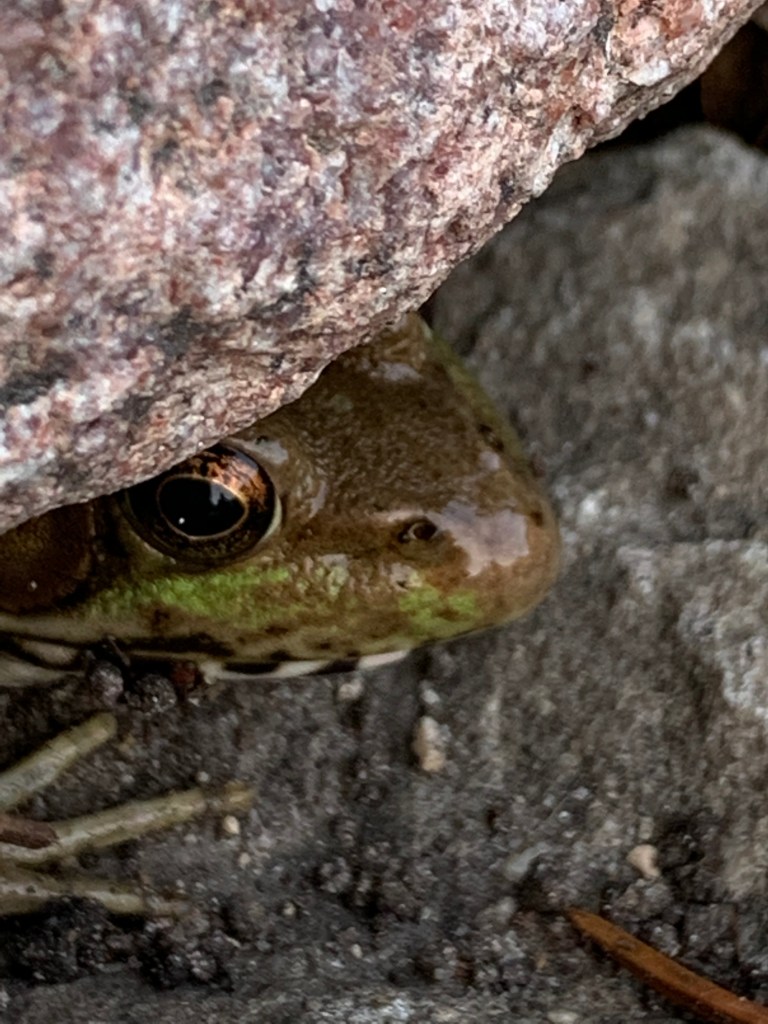
We have two frogs in our pond this summer. Their names are Epic and Tiny. This is a photograph of Epic. He’s in his safe place. When Kerri took this picture she said, “This is how I feel most of the time.”

Each day, in writing this blog, I face a dilemma. I named my blog The Direction of Intention because I desire my writing and artistry (and life) to be conscious steps toward positive creation rather than pushing against and complaining about what I don’t want. Lately, that is a tight rope to walk. I no longer feel it is possible to peek out from my safe place because I doubt in these-once-united-states that there is a safe place. Lately, each day, it seems that pushing back, peeking from my rock and croaking, “Open your eyes,” IS taking conscious steps toward the creation of a healthy spirit, nation-body and world.

I’ve long been a believer that the deep imbalances in our system, like systemic racism, cannot change by focusing on the word “racism.” The change we seek, the safety we desire, will only come when we address this completely broken and ugly system that is composed upon layers of inequity. BLM is a pressure valve. It is an opportunity to look with clear and honest eyes at the favoritism designed into our system.

At the epicenter of our dysfunction is an apparatus that pretends to be a democracy but, in fact, throws its weight behind minority rule. For instance, if the popular vote of citizens actually elected the president, Ronald Reagan would have been the last Republican to occupy the White House [George W. Bush won the popular vote in his second term but initially gained the presidency after losing the popular vote to Al Gore]. Or, consider this: even though, since 1920, more Americans are urban dwellers, the electoral system throws its weight to rural (more conservative) voters. The electoral college ensures democracy will not prevail. It goes on and on. If you want a hysterical look at the hysterical gerrymandering of the American system, visit John Oliver here.

Why would a system that purports to be a democracy knowingly allow and continually enable unfair political advantage to a minority elite? Why would a political party work so hard to gerrymander electoral maps, prevent black and brown voters from voting, whip up with no evidence the notion that, if they lose, the election will be rigged? The advantage is blatantly apparent in our tax codes, in how we fund schools and fill prisons, an on and on and on.

The gap between who we are and who we pretend to be is vast.

The game is rigged. A thriving democracy is impossible when one team, the conservative elite, do not believe in nor support democratic processes. Winning at all cost, regardless of the cost, is a tool from the fascist toolbox. it is the opposite of the democratic ideal. What we are experiencing is not an accident. It is not a mistake. It is a design. A thriving democracy is impossible when the system is designed to be undemocratic [when you are done laughing with John Oliver, weep at Umberto Eco’s list of 14 common features of fascism].

In other news, upheaval makes systems change, real change, possible. Peeking out from my rock I can only hope that we-the-people, in this turbulent time, have both the will to show up at the polls AND the courage, resolve, and clarity to stick with it until we align our words with our actions, until we pull down the institutions that keep inequity and minority-rule the name of the game – until we expect our system and our elected leaders to actually believe in democracy.

It’s epic.

read Kerri’s blog post about EPIC

See The Pattern [on Two Artists Tuesday]

guarding the sidewalk copy

“The United States, virtually a demilitarized nation on the eve of the Second World War, never stood down in the wake of victory. To this day, American troops are deployed in 150 countries. Since the 1970s, China has not once gone to war; the U.S. has not spent a day at peace. President Jimmy Carter recently noted that in its 242-year history, America has enjoyed only 16 years of peace, making it, as he wrote, “the most warlike nation in the history of the world.”’ ~ Wade Davis, The Unraveling of America

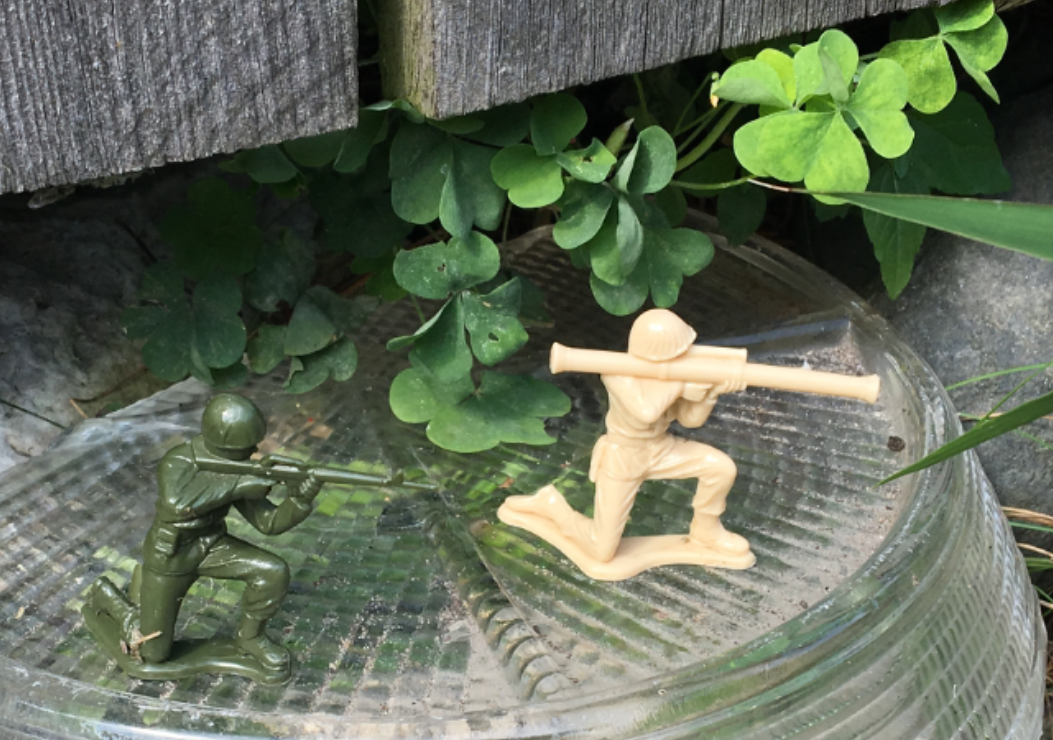
The most remarkable thing about these toy soldiers on a dish, is that a child did not place them in the garden. The adults did. People regularly place statues in their gardens, a Buddha or the Virgin Mary or gnomes or fairies. They are statements of value. They are statements of identity. Little guardians with powers no bigger than their guns.

In the words of Captain Obvious, the United States is rife with contradictions. In our sacred founding documents we wrote that “All men are created equal,” while simultaneously legislating that black men (and women) were less than human. It’s the crevasse we fall into again and again, our metaphoric original sin. The people currently protesting on the streets across this land simply want the rhetoric of the nation to align with the actions of the nation. Nothing more. Nothing less.

Today in Kenosha we await the unwelcome arrival of the commander-in-chief, a leader whose has only one note to pluck: division. The white nationalists are taking to the streets, waving their flags and chanting, “Four more years.”  For a nation comprised of immigrants from all over the planet, the world’s greatest crossroads, it seems more-than-absurd that anyone in this nation could or would revel in xenophobia. It’s astounding that the leader of a nation so rich in diversity would throw gasoline on the fires of racism. Contradiction upon contradiction. It’s farcical.

Or, perhaps it’s not contradiction at all. As Shakespeare wrote, “The truth will out.”

It shouldn’t be surprising that “the most warlike nation in the history of the world” is habitually at war with itself. The battle lines are as clear as the vast difference in the photographs comparing the Republican and Democrat members of the 116th Congress Members-Elect [scroll the article to see the photographs]. Ours is a war of identity and the dividing line runs along the color line. More Captain Obvious, I know [my apologies].

We do not have a problem, we have a pattern. And, to change our pattern of division and internal war, we need only take an honest look at the story we tell ourselves. The story we continue to tell ourselves about ourselves. We need to take a good honest look at who fits into the definition of “ourselves.” Right now we have two working definitions. And, that is our pattern. A pattern of conflicting definitions (inclusion vs. exclusion) works for some but is misery for most. Division by design.

Taking an honest look at ourselves is easily said. Even Captain Obvious is rolling his eyes!

The truth will out. It’s in our gardens. It’s in our statues. It’s in our streets. It’s on the images of brutality we capture on our iPhones. It’s in our tax codes and how we fund our schools and the children killed by guns while at school. It’s in our COVID-19 morbidity data and the populations of our prisons. The truth will out again and again and again until we decide to look at it with honesty, until we learn that our words matter, until we resolve to tell a different story, a story that lines up with our professed ideals. Until we decide that perpetual war is not a pattern that leads to social harmony and peace.

And, it’s a choice. Nothing more, Nothing less. Obviously.


read Kerri’s blog post about TOYS IN THE GARDEN


please vote website box copy


Face In [on KS Friday]

figure it out copy

“…gentleness can be a greater force for transfiguration than any political, economic, or media power,…” ~ John O’Donohue

Here is my utopian fantasy: The protesters put down their signs, the police put down their shields, the militia drops their weapons, the citizens of all races, creeds, colors, political identities and economic stripes come out of their houses and hold hands facing into a circle of their creation. Nothing need be said. What are we protesting FOR if not this?

We are excellent at pushing against what we do not want. We are practiced at screaming in rabid reactivity. Finger pointing and blame is among our most popular Facebook pass times.  We like to make noise and bluster about the violation of our rights and ignite fearmongering fires warning of imagined assaults on our amendments. Propaganda and lie make for good reality television ratings. They provide permission to smash glass, loot, denigrate “others” and give cover to murder in all its forms, but are lousy foundations for a civil and civilized society.

Truth is intentional, not reactive. It steps toward an ideal. It provides a national focal point, a guide-star that will not cotton with lie and propaganda.

We seem utterly inept, absolutely incapable at walking toward what we profess. Our ideal is printed on our dollar bills and chiseled into the facades of our buildings: e pluribus unum: out of many, one.  Our division is chiseled into our history.

My utopian fantasy is not so hard to realize but notice it requires a common first step: a putting down of weapon and rhetoric and dedicated division. The  second step is also not difficult: reach out, take the hand that is closest. Circle up with those who you most disagree. The third step may be the hardest: say nothing. Defend and justify nothing. Prove or claim nothing. Face in, not face off.  The greatest intentions, like the most profound truths, are often silent. Step four: live the circle.

We can figure it out. It’s no greater matter than walking toward what we want, what we espouse, instead of forever pushing against what we do not want. Perhaps our first truth is to admit that there is a lie built into what we chisel in walls and what we actually live. We need to intend oneness if we are to realize our central ideal.

Doc Rivers, a black man and coach of the LA Clippers said this yesterday: “It’s amazing why we keep loving this country, and this country does not love us back.” Love. Love back. There is no better or simpler statement of intention. Walk toward it.

He also famously said, “Average players want to be left alone. Good players want to be coached. Great players want to be told the truth.” His dictum applies to nations as well as players: great nations want to be told the truth. Average nations want to be left alone.


FIGURE IT OUT on the album RIGHT NOW is available on iTunes


read Kerri’s blog post about FIGURE IT OUT


hands website box copy


figure it out/right now ©️ 2010 kerri sherwood