Make It Someday [on DR Thursday]

More than a few times, we’ve stood at the display of wind chimes in a store. We sound them. We compare the tones. We close our eyes and feel the vibration. Some we like immediately. Others we shrug, not-so-much. We give them a second try, ringing a few together to make mixed tones. We never buy the chimes but we always try them on for size. It’s a form of dreaming. We leave the display with the magic phrase, “Someday.” Yes, someday we’ll have to get those.

Someday. What a double-edged sword is this word!

A few years ago, when Kerri’s digestive system went awry, we dedicated ourselves to the Whole 30 diet so she might regain balance. There’s no sugar allowed in the Whole 30. We learned a valuable strategy for coping with the intense I-must-have-that desire. Walk past the plate of brownies and count to 5. In five seconds, without fail, the desire dissipated. We learned that what-we-must-have is a healthy system. The road to “someday” meant not biting the illusion of sugar-fulfillment.

Delayed gratification. Accelerated health.

Today we learned of Jonathan’s passing. The news floated by on the Facebook stream. We were stunned. In addition to being a very bright light in the world, a peer, he was one of the hardest working people I’ve ever known. He was stockpiling money for his retirement. He had vision. He had plans. “Someday,” he’d say, a twinkle-of-delight in his eye. We lost touch during the pandemic. This morning Kerri said, “I always thought we see him again. Someday…”

Delayed gratification. Accelerated health. Missed opportunities.

I’m given to looking up the words I’m batting around. The antonyms of “someday” are “immediately” and “never.” Two choices, polar opposites, both unforgiving.

Today we will celebrate the life of a friend. We’ll lift a glass in his honor. We’ll share a brownie bite. We might just go to the store and sound the chimes. And, who knows, maybe today will be someday. “Why wait?” I’ll ask.

surrender now, 24x24IN, mixed media © 2016 david robinson

my perpetual placeholder site

read Kerri’s blogpost about CHIMES

[dinner at Jonathan’s house]

like. share. support. comment. thanks.

Keep Your Nickel [on Merely A Thought Monday]

The second part of the quotes reads like this: “The ability to observe without evaluating is the highest form of intelligence.” It’s another way of saying, “Be in the moment.”

Being in your moment is harder that it sounds. Lately I’ve been pondering two Buddhist practices that came by way of Quadzilla. First, develop the capacity to discern between the fear raging inside and what’s actually happening outside. Unless there’s a tiger chasing you, the fear is most-likely manufactured. Second, learn to discern between what-you-feel and the story you layer on top of what you feel. Feel the feeling, chuck the story. Develop these two practices of discernment and arrive at equanimity: “mental calmness”, the ability to observe without evaluating.

The first part of the quote reads: “It is no measure of health to be well-adjusted to a profoundly sick society.”

Each time I scroll through the news-of-the-day I hear Tom’s voice in my head: “When I was a kid and the circus came to town I paid a nickel to go into the tent to see the ‘freak show.’ Cows with two heads, etc. Now, all I need to do is watch what’s on tv.” In his final years, Tom retreated to his ranch and spent his time cutting the grass and tending the land. He watched baseball games. For a time I was concerned with his isolation but now I understand it completely. He was a deeply sensitive man, a gifted theatre artist, and rather than grow numb to the “freak show,” to try and make sense of the sense-less, he put his hands in the soil. He watched the sunrise and sunset. He found his health in the quiet place beyond the sickness of the society.

Pasting the quote back together in proper order: “It’s no measure of health to be well-adjusted to a profoundly sick society. The ability to observe without evaluating is the highest form of intelligence.” ~ Krishnamurti

The lessons keep coming. Late in life Tom made the choice to keep his nickel and stay clear of the world concocted inside the tent. The world inside the tent is manipulated. It’s meant to rile, to confuse. He discerned between where to place his focus and where not to place his focus. Stay out of the tent. Focus on the soil. The movement of the sun. Family. Ancestry. Helping. Chopping wood. Carrying water. The real stuff.

Outside the tent, outside the made-up-horror-story, there’s no reason to evaluate [to judge]. It’s another way of saying “Appreciate your moment.”

read Kerri’s blogpost about KEEP YOUR HEAD UP

like it. share it. support it. comment on it. we appreciate it.

Act For The Benefit [on KS Friday]

We are hunkering down today. The smoke from the Canadian fires has arrived and the air-quality-index reads “Poor” to “Dangerous.” My head hurts. I feel as if I can’t catch my breath. A glaring example of interconnectivity. Airspace knows no nation. Not really. All for one and one for all.

I Googled the phrase “All for one and one for all” wondering if it was yet another clever Shakespearean quote. It is but the good poet didn’t originate it. He borrowed it from the Latin or from Aesop. I read that now-a-days it is the unofficial motto of Switzerland. “Each individual should act for the benefit of the group, and the group should act for the benefit of the individual.”

Aesop was born circa 620 BCE so the idea that we should – and could – act for the benefit of all is not a new idea. It may be the most basic of human survival necessities. Aesop popped it into a fable since storytelling is the original-and-best form of adult learning theory. On a side note, someone who composes and/or tells fables is called a “fabulist.” Had I known sooner I’d have spattered that on every business card, used it at every social gathering: “What do you do for a living, Mr. Robinson?”

(humble chuckle) “Oh, you know, I’m a fabulist. Here’s my card…”

Kerri snapped this photo of Meadow Hawkweed. It’s important to our story of Canadian smoke in American airspace because its healing properties include the treatment of asthma and other respiratory ailments. All for one and one for all includes the world of flora and fauna, too. The whole knows no parts just as the airspace knows no nation.

In my dystopian fantasy, when we warm the globe sufficiently enough that systems collapse and smoky air is the new norm, I’ll corner the market on Hawkweed. Just-kidding. I’ll share what I know with whomever needs help breathing. And, while waiting for the healing to kick-in, I’ll tell some stories of people helping people. Like Aesop, I’ll try and plant the seed for a better world. Once a fabulist, always a fabulist.

in a split second/as sure as the sun © 2002 kerri sherwood

Kerri’s albums are available on iTunes and streaming on Pandora and iHeart Radio

read Kerri’s blogpost on HAWKWEED

Like it? Like it. Or share it. Or comment. Or buyusacoffee. All are greatly appreciated.

Steward The Radical [on Merely A Thought Monday]

I’m reading Gordon MacKenzie’s brilliant book, Orbiting The Giant Hairball: A Corporate Fool’s Guide To Surviving With Grace. There’s plenty to love in this little book that extrapolates beyond the corporate cubicle. This morning I laughed heartily when he compared two organizational systems, the pyramid and the plum tree. Traditional versus Holistic. Mechanistic versus Organic.

For me, the point of his Fool’s argument, sketched on yellow-pad-paper, comes down to this: the traditional pyramid, a hoosegow of compartmentalization, kills collaboration and snuffs the creative. It is purposeful division. The holistic plum tree, an integrated dynamic continuum, enhances collaboration and stimulates the creative. He draws an arrow pointing to the words “Enhancement of collaboration,” and writes, “This is radical.” [his underline]

It might seem radical to suggest that a system that intends collaboration is radical until you consider our current state of affairs. The latest attack on “the woke” by “the traditional” is, in essence, a pyramid that fears a plum tree. Pyramid people have an investment in exclusion, in standing on the top. Supremacy, white or otherwise. Keeping the cubicles intact, keeping the hierarchy in place.

Plum tree people, the proudly “woke,” reach across and eliminate division because they recognize the truth and power of the continuum, “integrated in a single creative ecology” otherwise known as a “community.” It is the opposite of supremacy. Float all boats.

There’s a race to the bottom in these un-united united states: the recent scrubbing of diversity, equity, and inclusion initiatives, the banning of books, red-legislators knocking themselves out trying to bleach our history, bury our past, snuff a questioner’s right to question (i.e. to learn), eliminate a woman’s right to choose; to squeeze gender-identity into a too-tight-airless-box…

In this environment, to suggest a system that intends collaboration, a system that enhances collaboration, is radical. Of course, democracy, by definition, is a system that intends collaboration. It is a system that needs collaboration to survive. It is a plum tree. The real and present danger of the pyramid, as Gordon MacKenzie points out: a pyramid is a tomb.

Democracy is radical. That people of diverse backgrounds and orientations might come to the table together with full respect for their differences – in fact a celebration of their differences, and intend to create “a more perfect union” is-as-has-always-been, a bright star to follow. It is a radical dream that demands open eyes, the capacity to ask questions of ourselves and each other, to tell our full history, to consider the perspective of all the human-beings sitting across the shared table. A radical dream, an ongoing creation stewarded into the future by the radical collaborators, keepers of the dream, the proudly woke.

read Kerri’s blogpost about PROUD BUTTONS

if you like it, like it, share it, comment or buyusacoffee. As always, thank you for reading what we write.

Sail Anew [on KS Friday]

It’s hard to know what to believe. For instance, each day I cross paths with an advertisement showing me what to do if I experience tinnitus. The ad is muted so what I see is a smiling woman yanking repeatedly on her earlobes. And, each day, I think the same thing: this has to be some trickster-ish plot to get masses of people to pull on their ears. Invisible theatre worthy of the great Augusto Boal. I’m considering jumping on the city bus, taking a center seat, and without comment, begin tugging my lobes. I’ll either clear the bus, make friends or, in these United States, most likely be shot by an armed citizen whose only answer to the unknown is to shoot it. I suppose that sounds cynical but we citizens of the U.S.A. are living proof of the adage, “If a hammer is the only tool in your toolbox, then everything looks like a nail.” If a gun is your only solution, you’ll kill a teenager who accidentally pulled in your driveway or shoot someone who mistakenly knocked on your door. We read about it everyday. Every single day.

There’s another ad I appreciate appealing to people to check-the-facts before forwarding or liking what they read. “We are awash in misinformation…” it warns. “Amen, advertisement!” I cheer, “What took you so long?” With so much mis-info-noise ringing in our ears, we either need to regularly check what we hear or smile and yank our earlobes. My theory is that yanking our lobes will occupy our fingers so we can’t like or forward info-dreck. By-the-way, the statistics on gun deaths are easy to check. No one is making up the story of neighbors killing neighbors rather than talking to them. Of course, in one horrific case, a neighbor killed his neighbors because they talked to him. Sometimes the factual stuff is so disturbing it’s better to yank on your ears than consider how out of control it’s all become. Our elected officials are certainly yanking on their ears to make our noise go away.

My hope? My fantasy? We are trying to bust out of our cocoon. A caterpillar transformed can’t know it has become a different critter until it breaks out of its hard protective shell. Escape from a cocoon is not an easy process. It looks ugly. It’s not meant to be easy. The difficult cocoon-exit is essential for the next stage of butterfly survival and thriving. An arduous rebirth is necessary for the caterpillar to fulfill its transformation. Flight, an utter impossibility prior to the protective cocoon, the next part of the story. The fulfillment of possibility beyond imagining. Maturity. Wings dry while the butterfly catches its breath following the struggle. And then, the newly-minted butterfly takes its first step off the branch, releasing the old story, and sails anew into the world. Or, sails into a new world.

A new world. People protecting each other as civilized people are meant to do. All grown up. Listening. A bag full of tools for every situation. No guns needed. No longer a necessity to yank on its ears.

taking stock/right now © 2010 kerri sherwood

Kerri’s albums can be found at iTunes or streaming on Pandora or iHeart Radio

read kerri’s blogpost about BUTTERFLIES

like.share.comment. or buyusacoffee. all are appreciated

Choose A Better Story [on Two Artists Tuesday]

Watching an early episode of the Millennial Farmer I was astounded to learn how computerized farming has become. Driving the tractor was far more digital-than-donkey. Even the word “driving” is mostly misplaced, just as the word “telephone” is loosely applied to the magic box in our pockets that searches the internet, takes photographs, measures our step, our heart rate, acts as a calendar, a compass, a flashlight, a newspaper…

Farmers can do more, faster, with greater precision. The seeds are planted to exact depths and meticulously spaced. The temperature of the earth and the minerals in the soil are collected and measured as data points. The farmer monitors the technology and engages the steering only when making a turn. Keeping the machinery in good running order requires an entirely different set of skills than it did twenty – even ten years ago. I wonder what farming will mean to the grandchildren of the people I watched mowing their fields. Like a modern car mechanic, in addition to wrenches and oil, farming demands computer diagnostic skills and a continuous upgrade of software. While the process is different, the basics remain the same. Plant. Nurture. Grow. Harvest. Feed.

To feed. Hands in the soil. Eyes to the horizon gauging the weather. Eyes on the advanced weather forecast technology. Praying for rain. But not too much.

There’s an old black-and-white photograph on the wall of the farmhouse we rented for our family gathering. People assembled on the porch, wearing high collars and long prairie dresses. Horses and wagons populate the foreground. I marveled, standing on the same porch in the old photograph, how close-in-time I am to the people in that picture. Two headstones away. Tom once told a story, when he was a boy, of sitting in the lap of an elderly woman who, as a small child, sat in the lap of Abraham Lincoln. That makes me a mere three headstones from the 16th President. “He smelled of saddle soap and lavender,” she reported.

I hear abundant chatter about rural America being all red and urban America mostly blue. Both colors have to eat. Both are made better by technology. The food is grown in the red while the computers are imagined and made manifest in the blue. A single step back from the chatter reveals how truly interdependent we really are. I am grateful for the easy availability of food at my local grocery store. I imagine the farmer is grateful for the advanced technology that takes some of the guesswork and toil from their lives.

We are, all of us, a single headstone away from passing on a better or lesser world. Both are possible. The choice is ours. Where do we desire to place our focus? What world do we desire to create?

Farmer’s take great pride in feeding the world. Entrepreneurs and software engineers take great pride in making tasks easier for others. Generally, gratitude is not only a much better story than division, it’s also more productive. It’s also more honest. I find that people are highly motivated when helping others. The question is, “Why can’t we see how we are helping and being helped?” Our interdependence is right in front of our faces.

The noisy trappings of our time may seem complicated but the basics remain the same: Plant. Nurture. Grow. Harvest. Feed. We eat what we sow. We choose the thought-seed that we plant. Technology can help us be more effective and efficient. It cannot help us gain wisdom or sort what we lose in our dedicated color-crayon-divide. It cannot help us choose or pass on a better story. Only we can do that.

read Kerri’s blogpost about HAY RAKES IN THE SKY

like it. share it. online tip jar (link or qr). talk to us. all are appreciated.

Embrace The Accident [on Two Artists Tuesday]

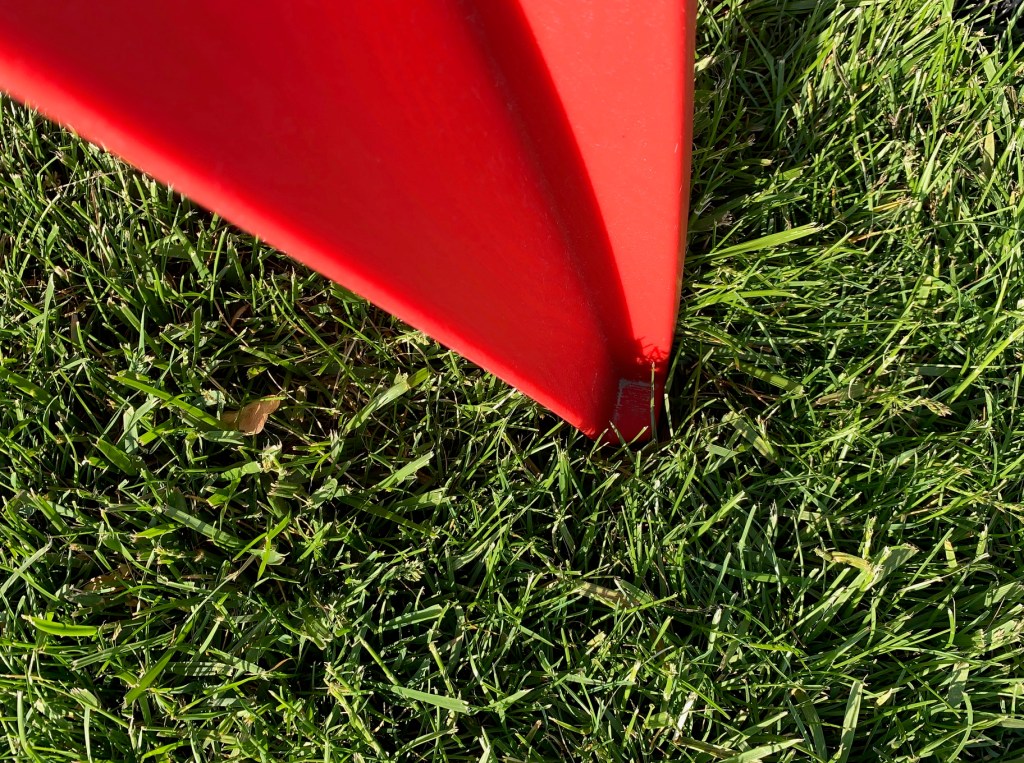
I am a big believer in happy accidents. Kerri didn’t intend to take this photo. A vibrant shock of red thrust into a field of green. I’m tempted to slap a title on it and enter it into a contemporary photography exhibition.

I’ve read that serendipity, an “unplanned fortunate discovery,…is a common occurrence throughout the history of product invention and scientific discovery.” It’s also a common occurrence throughout the history of art. It’s also a common occurrence throughout the history of…history. We have experiences and then we make meaning of them. Not the other way around.

I suppose we pride ourselves on our capacity “to know” so we forget that all knowledge is the result of a stumble, a discovery found at the far end of curiosity, exploration or an outright mistake. The point of a hypothesis (to borrow a term from Quinn) is to cultivate serendipity. Try it and see what happens.

I’ve been following the conversation in the tech-o-sphere about the sudden blossom of the very lucrative job “phrase engineer.” Human beings attempting through trial and error to learn how best to converse with the technology we’ve created. AI. ChatGpt. The unspoken goals are (not surprisingly) efficient and effective communication. There are now several sites with useful phrases, conversational hints, Youtubes abound with guidance for best ways to ask better questions, quickly eliciting the best result: an answer. It’s glorious and reminds me of old 3rd grade language primers or my high school foreign language class – only more enthusiastic.

I am among the millions who hope beyond hope that someone-out-there bumbles into the secret of effective communication. Perhaps if we discover how to communicate with artificial intelligence there will be a profound blowback and we will, serendipitously, discover the secret of easy communication with each other. Generosity. Empathy. Kindness. How-you-say-what-you-say matters.

“AI, tell me what you see and I will listen with an open mind and heart.” I know, I know. More pie-in-the-sky. But as a dedicated believer in happy accidents, I’m given to think that anything is possible.

read Kerri’s blogpost about RED ON GREEN

like it. share it. buyusacoffee. tell us your thoughts. all are appreciated.

Creative Think [on Merely A Thought Monday]

The truth is that I could talk with MM all day. Our calls are few and far between but it always feels as if we’re picking up a conversation from yesterday. His perspective on life is vast, deeply rooted like an oak tree, yet simple enough to play on a banjo. As per usual, he left me with a head-full-of-thoughts-to-think.

One of the thought-rocks he dropped on my head was this: we’ve lost touch with our connection to the humanities. And, we’ve lost that connection, not by accident, but through reckless intention. Years ago I was wide-eyed with disbelief when the local school system stripped history and the humanities from their course offerings to make more room for STEM; science, technology, engineering and math. “Short-sighted and fundamentally stupid,” I said to no one listening. Art was long gone. Music was nowhere to be found.

It’s hard to measure the real worth of the humanities on a test so it was sailed off the edge-of-the-curriculum-world. What , exactly, is the value of kindness, the worth of considering others, the merit of empathy and understanding interconnectivity? How important is it to know where you come from? The origin and cycles of knowledge and the grand mistakes of the past? What might be your intellectual lineage, your moral ancestry? How important is it to consider opposing ideas, to recognize there are many ways of seeing a single event? What happened the last time an out-of-control authoritarian impulse attempted to quash a diversity of opinion? How worthwhile might it be to understand that democracy is nothing more or less than an idea about how humans might create community together? It is not a given. It is not a fact. It is an ongoing relationship. The province of the humanities.

The operative word is “together.”

I laughed aloud the day after my call with MM. Two articles crossed my screen. Because I’m searching for jobs I’m paying attention to articles like The Ten Most Important Skills For Workers. You’ll not be surprised to learn that analytical thinking currently tops the chart but the king is about to be unseated by a new/old champion: creative thinking. Also rising in the top ten are “curiosity and lifelong learning” and “motivation and self-awareness” Of course, “unmotivated and unconscious” have probably never topped the list of desirable skills…though most factory work – and varieties of corporate work – generally produce those qualities in previously motivated human beings.

[I take a moment of silence to recount the multiple times I have, in my life, been told I was un-hire-able because I was too creative. “You’ll see how to improve things and want to make changes,” a manager famously told me. “My job,” he said, “is to keep that from happening. To maintain the status quo.” In another famous jaw-dropping moment, a potential employer told me I was not an attractive hire because I was educated so, “I would want things.”]. A cautionary tale to all those who currently fear exposure to ideas and the other purported horrors of the humanities and a fully educated mind.

Educated = curious = questioning. It’s simple.

Listen to Sir Ken Robinson ask a still-relevant question about whether or not our schools kill creativity. Killing creativity is the same as killing the humanities. Killing our humanity.

Ultimately the horse race between the analytical and the creative is itself symptom of the schooled ignorance. They are not really separate things. The right brain and left brain are only detached for the sake of study and discourse. They are ends of a spectrum and one cannot exist without the other. Like science and art: both are concerned with dancing to the beating heart and movement of the universe. They are two ways of walking at the yet-unknown. They are not oppositional.

Another quote from MM roared into my mind: if you ignore 100,000 years of human evolution, you might-could just miss the fundamentals.

It’s consilience. The unity of knowledge. The whole system. Heart and brain and gut. That’s the loop that MM and I regularly travel. We circle out and return once again to E.O. Wilson.

“One day we’ll figure it out,” posits MM. It’s another reason I adore our conversations: with his tongue firmly planted in his cheek, he is, all the same, infinitely hope-full.

read Kerri’s blogpost about CREATIVE THINKING

like? share? comment? coffee? (QR or link) all are greatly appreciated.

Utter Life [on Not So Flawed Wednesday]

The theme of the mural is “humanity represented through different stages of life through song.” Past, present, future. The song of Sorrow. The song of Joy. The song of Hope. It’s painted above the proscenium arch of Chicago’s Auditorium Theatre, designed by artist Charles Holloway, the words at the apex are “The utterance of life is a song, the symphony of nature.” The symbols of his time.

Even as I write this, the birds this morning are in full-song. The utterance of life. The symphony of nature. Dogga barks to round out the bass section. Yesterday, standing on the bridge over the Des Plaines river, as we watched two deer amble across the trail, the ancient sound of Sandhill cranes croaked from above and two gawky-yet-glorious birds careened in for a landing on the sandbar just to our right. “We’re smack-dab in the middle of a National Geographic special,” Kerri whispered.

Sitting in the auditorium I wondered why the song of the past is Sorrow. Hope, Joy…Sorrow? It seemed a mismatch or, perhaps, a wrong assignment. Most of the people I know are suffering in the present moment. They sand off the rough edges of their memories so they remember their life-walk fondly. The song of warmth.

Honestly, the mural reminded me of another painting, a piece by a master-painter that lived during the same period as Charles Holloway. Gassed by John Singer Sargent. It was not something that sprung from his imagination. He witnessed this moment. A man who’d spent his entire life painting portraits of the elite. A genius artist. He painted his composition from what he sketched that day and it has become a symbol. The suffering of his present moment. The sorrows of the past in a world that had lost its mind. As testaments of the horrors of war, it lives up there with Picasso’s Guernica.

I just took a peek out of the window at the bird feeder. In addition to birds eating the seed, at the base are chipmunks, a squirrel, and the adolescent bunny. The song of Joy is also available in the present moment. I wonder, if I was commissioned to paint a mural over the proscenium arch of an enormous theatre, what would I paint to represent the human condition? The songs of past, present, and future?

It was a National Geographic Live event that brought us to the Auditorium Theatre: Coral Kingdom and Empires of Ice. The brilliant underwater photography and the lifetime exploration of a husband and wife team: David Doubilet and Jennifer Hayes. Among other things they’ve documented the impacts of climate change in the oceans. Even amidst the loss of reefs and disappearing ice that sustains life, theirs was a message of Hope. They infused us with their rich hope, drawn directly from their duet with nature. The utterance of life. Interconnected. The song of the future.

read Kerri’s blogpost about THE MURAL

coffee or like it or forward it or talk to us. All are appreciated!

Meditate On It [on Merely A Thought Monday]

I was struck by how important it felt. How could something so routine seem like such a big deal! We used to do it all the time. Without thought. Nothing special. Now, it felt like a significant passage. A step toward “normal”: we took the train to Chicago.

Covid was the great disrupter. Daily patterns exploded. Social norms obliterated. It changed us in ways that we are only now beginning to comprehend. To this day – without thinking – if someone stands too close to me in the grocery store I adjust, creating distance. A dance of protection. That small adjustment away from someone is a titanic statement about how I approach social situations, about how I feel about being with others. Keep-them-at-arms-length.

In other words, I’m meditating on safety all of the time.

I don’t think I’m alone in my meditation. I believe the central meditation in my nation is safety – rather, our lack of safety. We wouldn’t be arming ourselves to the teeth if we felt safe. We wouldn’t be ripping at the seams or tolerating corrupt bullies or gobbling up conspiracies if we felt secure. People do not willingly plant their heads in the sand when times are good. In good times, people look up, people reach toward each other. Generosity of spirit engenders generosity toward others. A poverty of spirit engenders animosity toward others.

In other words, no one meditates alone. The big meditations are shared.

Of course, it is also true that people rarely make significant change when times are good. The gift of disruption is progress though the first phase is often nasty and necessarily looks precarious. I suppose we are in the nasty stage of change.

It was not so long ago that a gathering with friends began with testing to make sure no one was carrying the virus. Testing became the norm. It was routine. Am I safe? Are you? Do you remember washing your groceries or isolating your mail for 24 hours when we did not yet understand how the virus was passed? It fundamentally reoriented our experience of being with others.

I think about my safety when I enter a crowd. I look for exit routes when I enter the grocery store. And, last weekend, we stepped onto a train for the first time since the great disruption. It felt momentous. A marker in time. Rather than taking a step away, we took an intentional step toward.

The journey of a thousand miles begins with a single step and ours was a step onto a train. Each small step toward others, each reach, each moment of listening…matters. It creates the progress borne of the disruption. I look forward to taking many more small steps.

I don’t know about you but I’m more than ready for a different meditation.

read Kerri’s blogpost on THE TRAIN

coffee or share it, like it or talk to us.