Look In [on Not So Flawed Wednesday]

“I want to stand as close to the edge as I can without going over. Out on the edge you can see all kinds of things you can’t see from the center.” ~Kurt Vonnegut

Yesterday I applied for a job that is all about narratives told from the edges of society. I’m not sure why it surprised me to find such a cool-to-me job; our community seems addicted to shattering so there are plenty of small edges to be found. Small edges are fallacious and serve a myriad of false centers. Our survival will depend upon whether or not we can awaken from the shatter-narrative and make the decision to direct our broken focus toward a common center. No small feat.

It is the role of the shaman, the explorer, the artist, the researcher to stand on the edge and report back to the community what is seen and unseen. The voice from the edge is rarely welcome since the report is capable of popping delusions or pulling the sheep’s clothing from the wolf. Page one of the autocrats’ handbook instructs the elimination of artists and educators. Making an enemy of the eyes-that-see, demonizing educators and thinkers – the people who recognize pattern and metaphor. The game of Us-and-Them necessitates silencing the voices capable of calling out the wolf. Autocrats require blind sheep that follow without question.

Some famous edge sitters: Galileo. Cesar Chavez. Rosa Parks. Nelson Mandela. Susan B. Anthony. Albert Einstein. Frederick Douglass, a former slave and leader of the abolitionist movement, wrote extensively about what we call Critical Race Theory; it was clear in his view from the edge. It’s not a new theory. It’s an old pattern with a new name. I think he might denounce his Republican party affiliation were he alive today; they would certainly silence his voice. He would be fired were he a professor in Florida today. As would Martin Luther King, another famous voice from the edge.

Voices of reason are often voices from the edges. Voices of the future are always voices from the edges. Galileo was silenced for suggesting that the earth circled the sun and not the other way around. Over time, the voices from the edge, when authentic, always make the center better, the community stronger. Susan B. Anthony spent her life on the edge, lobbying the center, to secure for women the right to vote.

Progress. Growth. They are rarely inspired from the tight grip at the center. Silence the edges and the community atrophies. Stop the movement and the body dies. That page was left out of the autocrats’ handbook for obvious reasons.

read Kerri’s blogpost about EDGES
Hold Space [on Not So Flawed Wednesday]

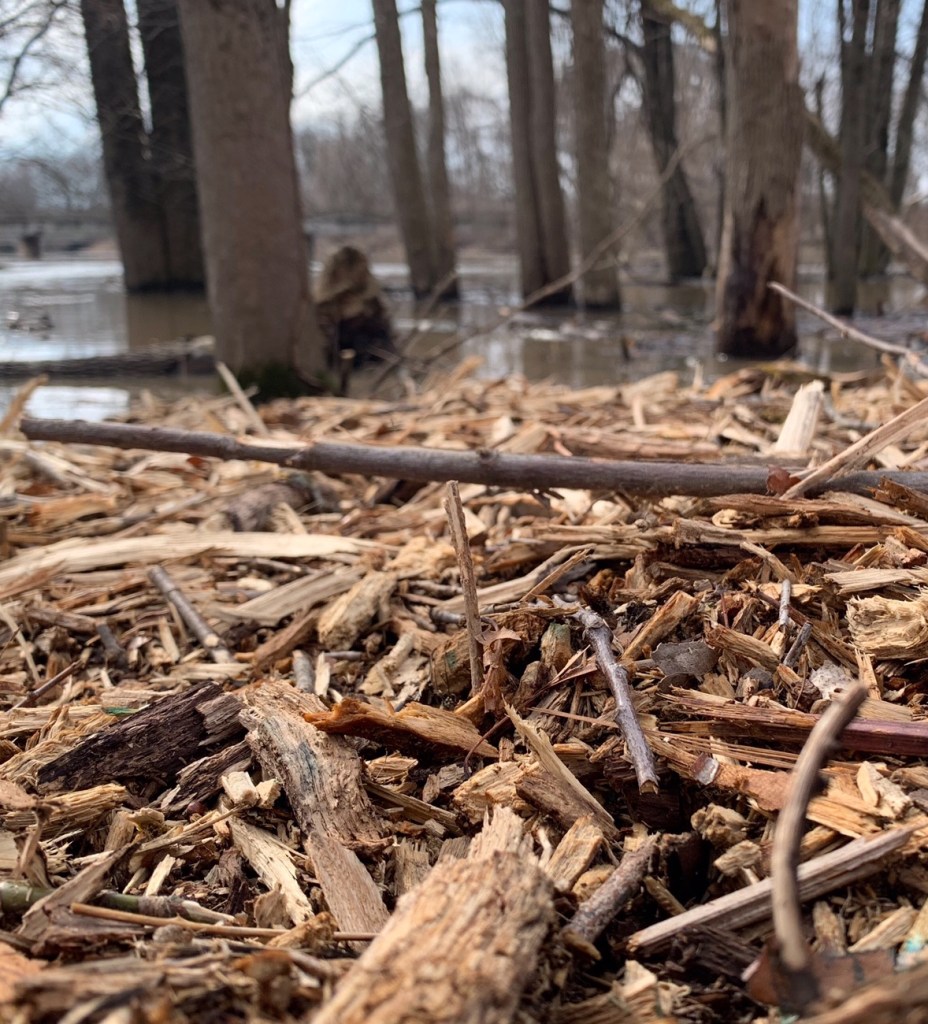
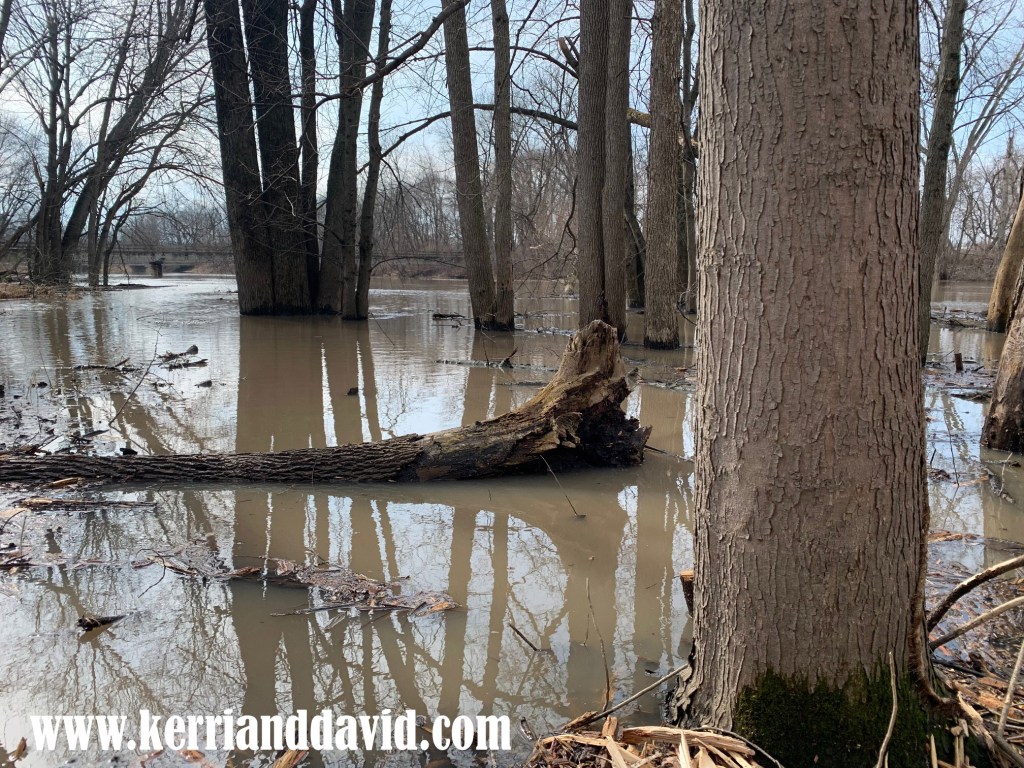
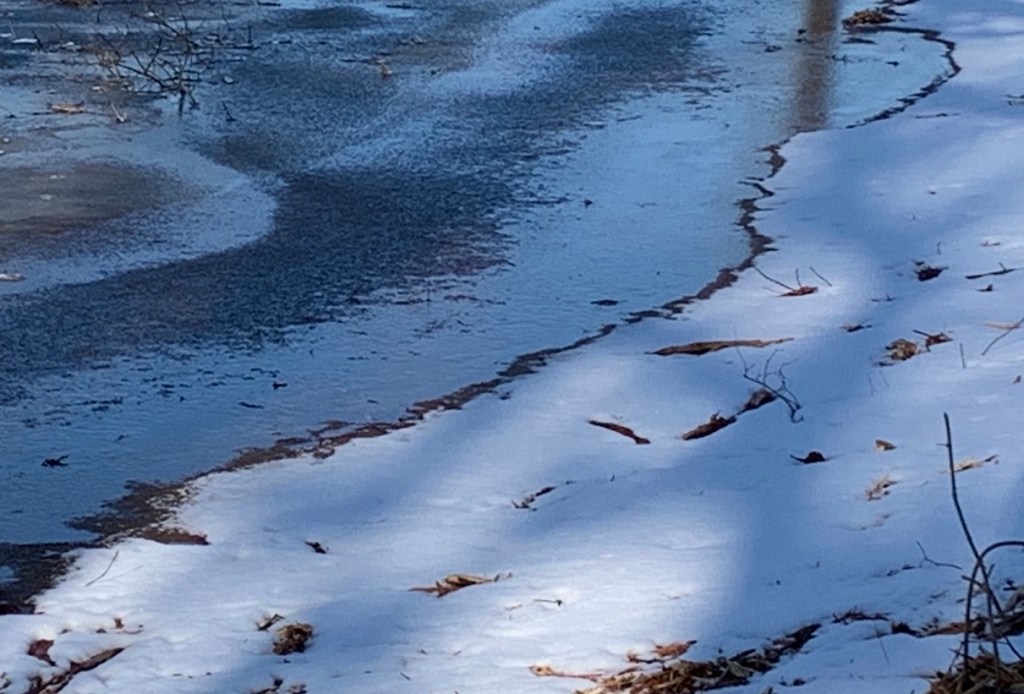
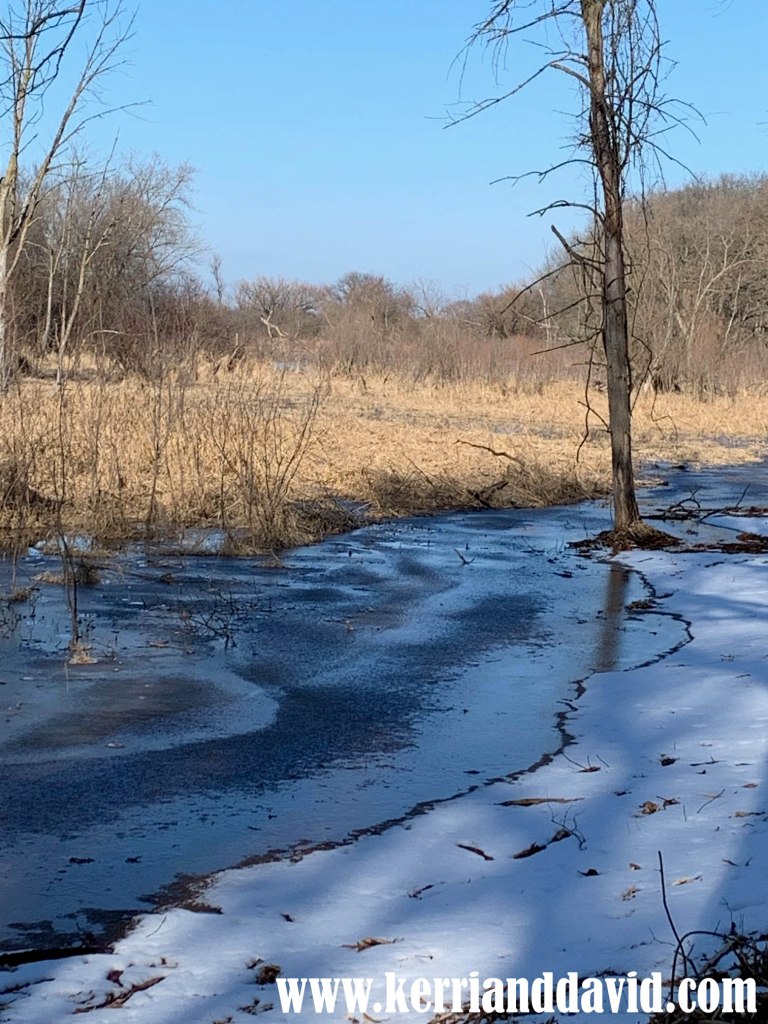
I just realized why the stripped forest is having such an impact on me. While opening the back door to let Dogga out, my dials spun and it slapped me in the face. I am like the forest.

For several minutes, staring at the photograph, writing then rejecting, then writing and again rejecting what I’d written, I decided to get up and let Dogga out. This picture was making me anxious. Moving around has always been good for me when I’m thought-wrestling.

I am like this forest. Exposed. Chips and debris are everywhere. Water is overtaking the trees.

I was writing about a question Justin asked one night at dinner. “What’s your stance about secular Calvinism?” he asked.

“I don’t think I have one,” I replied. Justin’s eyebrows hit the ceiling and I made a snap decision not to follow my reply with an explanation. He was sorting his belief and searching his heart. Empty space was more useful than cramming my erudite-and-empty justification into the moment.

Insight requires space. Lots of space.

I wish I could express how rare it is for me to keep my mouth closed when I have a thought on a topic. Kerri will laugh aloud when I read this to her. “No joke!” she’ll say. I wanted to say to Justin, “I don’t have a stance because I think it’s a given.” His question was akin to asking about my stance on the existence of the moon. No culture sees itself clearly.

No person (me) sees himself clearly.

Chips and debris. The river has overrun its banks. One half of the photo is the result of natural forces. The other half is man-made. Choices. Circumstance and intention. This landscape, once so familiar, will never be the same.

I’ve spent my life cultivating my capacity to see pattern and metaphor. It’s an artist’s prerogative to make the strange familiar and the familiar strange. I am the forest. Familiar, yet completely unknown. Stripped for rejuvenation.

Insight requires space. Perspective requires distance. Perhaps the reason I left open space in my conversation with Justin is something I need do for myself, too. Searching my heart, I am the forest. Stripped of invasive plants I can see all the way to the river. So much space.

What is my stance? Right now, thankfully, I don’t think I have one. I’m holding the space for insight to come.

read Kerri’s blogpost THE FOREST

Greet The Snow [on Two Artists Tuesday]

Like the return of an old friend, the snow finally came. It’s funny. Most winters we yearn for warm summer days. This winter our conversation has been about the absence of any real snowfall. We’ve had dustings but nothing worthy of a snowman. It made me realize that cold weather is no fun unless there’s something to stomp through or ski on. Walking in the cold is just…cold. Walking in the snow is an event.

The snow also brings an aesthetic magic. It paints the trees. Since the return of our old friend snow, we regularly stand in the kitchen and stare in awe at the striking lines tracing the path of the limbs. The lines change color throughout the day, morphing from purple through white to vibrant orange. It re-animates the forest left barren by fallen leaves. What was brown and sad a few short weeks ago is made remarkable, proud in its frosty adornment.

The day the snow came home we strapped on our heavy boots, slipped into our thick coats, pulled our hats onto our heads, and stepped into the muted world, a quiet that is only made possible by fluffy falling flakes. We pulled up our hoods and walked a loop around the neighborhood taking the trail that leads behind the Kemper Center and along the lake. Turning our pink faces toward crazy flakes made us giggle.

The snow beckons. It calls us out. Cold toes and layered clothes, we’ll appreciate the change until that fateful day when we think the snow has overstayed its welcome. We’ll turn our conversation back to warmth and the deck, and yearn for sunny days. Fickle people, never content for very long.

read Kerri’s blogpost about SNOW

See Beyond [on Two Artists Tuesday]

Breck, the small aspen tree in our backyard, is beginning to change its colors for the season. Although we have yet in our neighborhood to smell autumn in the air, Breck is giving us a heads-up.

A decade ago I wrote that, in order to see beyond preconception (thought), artists and entrepreneurs need to master two skills: pattern recognition and metaphor. Look for patterns and you will eventually see beyond them. See beyond the pattern and, as Ash Bhoopathy said, “The familiar will become strange and the strange will become familiar.” What an amazing definition of metaphor.

In this pattern cycle, the green becomes brilliant golden yellow as Breck turns her summer attention from the sun and sends her focus into the root for winter nourishment.

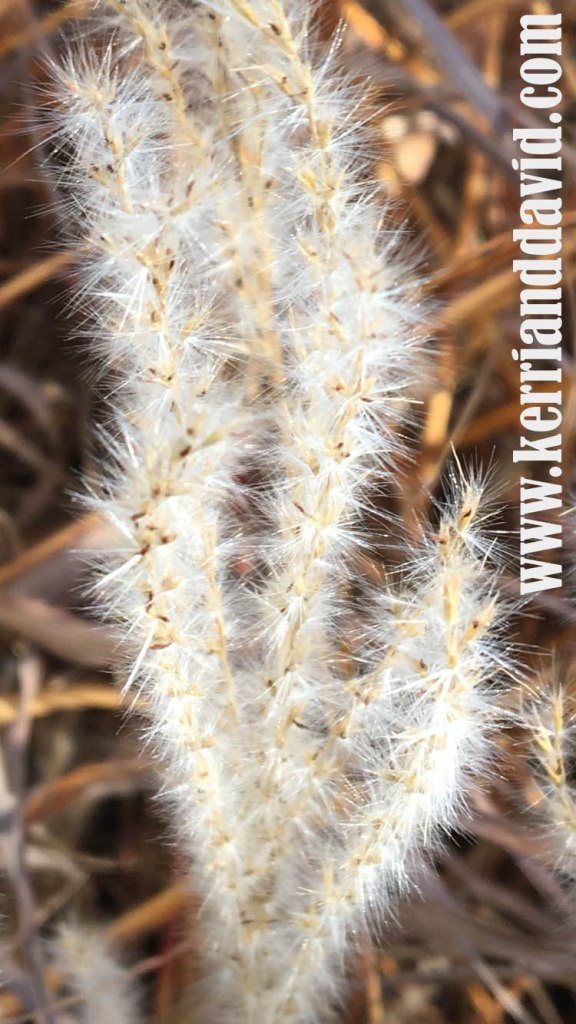
Kerri’s photographs are often extreme close-ups. She has a bit of Georgie O’Keeffe in her artist’s eye. Often, when showing me the latest photo, she pulls the-already-close-up-image into a detail. I am always amazed at the pattern beneath the pattern beneath the pattern. The plumes of the grasses are a festival of pattern. The many feet of the caterpillar, perfect suction cups.

Despite our dedication to our perceived differences, we, too are a festival of pattern. The operative word is “perceived.” Pull the lens close-in and our divisions disappear as rapidly as our skin color. Pull the focus farther out and we move together in a sweet-and-sour ballet. Koyannisqatsi. History repeats, a pattern, like the cycle of the seasons. Order moves to chaos to order to chaos…mainly in our minds. Order is what we crave, so purblind are we to seeing the ubiquity of pattern.

The plumes explode pink and red on the grasses The chipmunks have picked up their foraging pace. The geese have reappeared. The miracles are in the familiar, strange and surprising when seen again for the first time. The feel of the hand of the one you love. The moon on a clear cold night. The yellow rim reaching through the green quaking leaves.

read Kerri’s blogpost about BRECK’S LEAVES

See The Pattern [on Two Artists Tuesday]

“To live on a day-to-day basis is insufficient for human beings; we need to transcend, transport, escape; we need meaning, understanding, and explanation; we need to see over-all patterns in our lives.” ~ Oliver Sacks

Entrepreneur Ash Bhoopathy said, “The more you see, the more you see patterns.” It’s true. Take some time and sit on a busy street corner and watch. If your eyes are open, you’ll notice that you are surrounded by patterns. Not only the bricks in the buildings but the patterns of travel. The space between a red light and green light. The beeping of the crosswalk. The suits and ties. The paths walked by busy commuters.

“Comfort” and “home” are defined by patterns. What do you do to get comfortable? How do you signal the end your busy workday? Is it the same as you did yesterday?

Expectations are patterns, too.

Study “story” long enough and you’ll discover, as Kurt Vonnegut did, that there are patterns beneath every plot. We tell ourselves the same storyline over and over. Hallmark has its story pattern defined to the minute. It’s the secret to their appeal: the comfort of knowing the pattern. The comfort of asking, not “What” will happen, but “How” will it happen.

It’s a great paradox. The more you see, the more you see pattern. Yes. Yet, in order to see, often it’s necessary to disturb your patterns. That’s the beauty of patterns. When you are inside them, living a day of your life, you rarely see your patterns. It’s the reason Julia Cameron built artists dates into her Artist’s Way. Do something different. Break your routine. Challenge your expectation. Get out of your pattern rut. Only then will you be capable of seeing the pattern.

If you desire to change anything about your world, about this world, the change you seek will ultimately be a change in pattern. It’s a good practice to begin seeing them.

read Kerri’s blogpost about PATTERN

[the pattern image is the mat at our backdoor]

Dowse Your Data [on Merely A Thought Monday]

My favorite question of the week: What is the science behind divining?

I admit to laughing out loud when I read the question. In a world run amok with science-deniers and rabid propagandists, we might as well answer the question with a qualifier: it depends on what you decide to believe. Or, answer a question with a question: do you really want to know what the science says?

Since belief-divining is all the rage these days, the best available advice for adherents of critical thought is, “Don’t waste your breath.”

I took a peek at ‘dowsing’ in wikipedia. Divining is generally attributed to “ideomotor phenomena.” A psychological response. An accidental movement. Science reports dowsing is projection.

What is the science behind love? What is the love behind science? A moment ago Kerri frowned when I told her she was the sole-object of my ideometric phenomena. She’s learned not to ask and has developed a keen ability to move on from my thoughts to thoughts with more substance.

Science doesn’t prove. Science hypothesizes, gathers data, and then reports findings. Science is objective. It is both rooted in data and is open-minded. New data always come in. It takes an open mind to successfully roll with the theory of relativity. It takes an open mind to open to the data. Excessive carbon in the air is heating the planet. We are simultaneously cutting down the earth’s lungs to make room for more cattle production.

What’s your hypothesis of our recent spate of 1000 year storms year after year? Science is offering a fairly clear picture.

What’s the science behind divination? The science of seeing into the future? Projection?

I was delighted when I stumbled on an NPR story about U.K. Water Companies Sometimes Use Dowsing Rods. The companies admitted to the use of divination but were quick to add, that it’s not a company-wide policy. And then reinforced their disclaimer with the only disclaimer that we universally and wholeheartedly accept: it doesn’t cost money. If it cost money, we’d take it seriously. Like pet rocks. Or reality tv.

Deloitte (using scientific methods) reports the cost of climate change to the U.S.A. economy will be 14.5 trillion dollars over the next 50 years. We can expect to lose 900,000 jobs each year. Ideometric phenomena? Scientific divination? Data-dowsing?

For adherents of critical thought, it occurs to me to update the best available advice with another question: How much time do we have to waste?

read Kerri’s blog post on Y

Discern [on Not So Flawed Wednesday]

It’s a little over two miles to Steve’s garage. When we drop the car for a repair, especially in the early morning, we like to walk home. The route takes us by the lake. We take our time, more stroll than stride, and breathe in the early morning quiet.

We are dedicated walkers. We’ve become dedicated seekers and creators of quiet. It’s as if we are counterbalancing the crazy-noise-of-the-news with a stalwart sanctuary that we take with us wherever we go. We walk slow enough to notice. We walk slow enough to appreciate.

There is, of course, a direct correlation between pace-of-movement and paying attention. It’s hard to smell the roses when racing through the day. Lately, much of my work-in-the-world involves addressing information overload. The pace-of-movement need not be physical, it also applies to the river of information rushing across our screens. It’s no wonder we’re angry and anxious and aggressive. I’ve adopted a phrase from my colleague, Greg; he calls the info-torrent More/Faster. We live in the age of info-gluttony and have difficulty discerning between what has nutritional value and what is dross.

Until we slow down. There is a correlation between the pace of movement and peace-of-mind. There is a correlation between pace and the capacity to determine relevance.

It’s why we walk to or from Steve’s Garage. It’s why we end the work day holding hands and walking the neighborhood. It’s why we begin each day sitting side-by-side writing. To slow it down. To discern relevance in a fast moving info-river of dedicated draff. To see what matters in a More/Faster world racing too fast to see anything at all.

We smell flowers. Feel the dew on leaves. Turn our faces to the sun as it reaches through the morning clouds. Real stuff. Stuff of the moment. The small discoveries available when racing to the next thing is the last thing you want to do.

read Kerri’s blogpost about MORNING SKY

Be Different [on Merely A Thought Monday]

Inadvertently, 20 did me a great favor. On the day Kerri and I married, he carried a concealed camera and captured conversations and special moments of our ceremony. In his footage is a short exchange he had with my dad. My dad said of me, “He’s his own man.”

To that point in my life I’d wondered what he thought of me, my winding career path, my free-form seeming-feral existence. “He’s his own man,” brought me peace.

Once, during a conference that we led, Alan told me I should dress differently. “People would have more respect for you,” he said. Once, trying to fit in, I wore a suit to a facilitation and Rich told me I should dump the suit and dress as myself. I’ve awarded him the blue ribbon for best advice.

In my consulting life I wore clogs. I hated shoes with strings. The first thing I did at every job was kick off my clogs. You’d be surprised how invested people in power suits are in their footwear. You’d be heartened how human they become when they unlace and kick off their shoes. It’s like removing a mask.

People hire me because I am different. Because I see differently. My difference is my gift, the epicenter of what I bring to the world – and that is true of all people.

In a culture that prides itself on its individualism, it’s always been amusing to me how invested we are to “fit in.” Shopping at the right store, wearing the right clothes, we gush about our wild nature while synching tight the corporate tie. To “dress for success” means to fit a prescription, to NOT stand out. Business casual. The real real. All houses must look the same. Revealing behavior betrays the swaggering rhetoric.

Our individualism is at best a thin veneer. In truth, we fear difference. I dare the court of Supremes to uphold a coach’s right to pray before the big game on the 50 yard line if he’s Sikh. Or Muslim. Or Hindu. Or Buddhist. My son is gay. He lives a constant, never-ending battle to defend his difference. Why?

“But the truth is, I am different,” I said to Kerri who was red-faced with anger at the email from the concrete sub-contractor. He turned down the job to replace our bit of sidewalk, broken out during the waterline repair. Among his reasons, “…and he seems a little different.” He was referring to me.

“I’ve dealt with that my whole life,” I said as she furiously typed a reply. “It’s not a big deal. I’m an artist.”

“It is a big deal,” she snarled, typing harder, faster.

Listening to her ferocious key-pounding, I had a sweet wave of appreciation for her. In a lifetime of “different”, it is a rare and precious moment that someone vigorously defends your difference. Rather than hammer you into creased dockers, lace-up shoes or the right haircut, a furious defender was unfamiliar. She, too, is different and knows the bruise of the shame-hammer. I suspect we’ve all experienced its sting.

In my head, I heard my dad say, “He’s his own man.” Peace. I am what I am and the people who love me wouldn’t have me any other way. That makes a difference. All the difference.

This I know: it’s nice – so nice – not to be alone in my difference.

read Kerri’s blogpost about DIFFERENCE

Find Your Way [on Two Artists Tuesday]

I will never forget the day I followed the stream, watching the life-ending struggle of the salmon as they fought the current the final mile to return to their place of origin, their spawning ground. To the local people, the people who tended the hatchery, the salmon were gods. Gods or not, watching their struggle to return was sacred. The utter necessity to continue life through the next generation – as the final act of life. Cathedral building.

We brought home a Selenite crystal. It is raw, translucent, gorgeous. A Google search of its properties reveals that it promotes calm and provides clarity. I’ve never actually been invested in the debate about whether or not a crystal has powers. I’ve made the association so, when I look at it or hold it, I have in my mind that we brought this beautiful crystal home to elevate our spirits. And, so it does.

I live in the golden age of marketing. I’m told that a new truck will make me sexy, the latest medication will make my life a snap, that a pizza delivery will bring my family together like never before. Status and power are available through the purchase of machines and clothes. One year, no interest. We buy these messages, filling our closets with passing satisfaction. Is the fulfillment of a new pair of shoes imagined, less-than-genuine? We are consumers so doesn’t it make sense that contentment lasts no more than a spin through the washing cycle? Momentarily satisfied. What’s next?

I suppose the question is whether or not the crystal brings peace to me or do I bring more calm to my day because I’ve surrounded myself with messages – and, therefore, intentions – of serenity?

I know without doubt that a new truck will not imbue me with sex appeal. Yet, I have a pair of jeans that I save for the days that I want “to look good.”

Skip drove two days to find the sun so that he might stand in it and rejuvenate. I go to the basement and stand amidst the boxes that currently fill my studio and stare at a large blank canvas. Like the sun, it rejuvenates me. Yesterday, the nurse at the community health clinic said she loved her job because she felt that she was really helping the people who need her the most, “There are better rewards than money,” she said. Imagine the necessity – the hope – she brings to her life and work. Rejuvenation.

I do not know whether we are gods or not, but our struggle to find our way home is no less beautiful or fraught than the salmon. It is breathtaking, this swim upstream. Confusing. Sacred.

read Kerri’s blogpost about CRYSTALS

Call It Realism [on Not So Flawed Wednesday]

This garlic could have been painted by Jan Vermeer. To my eye it looks like the work of a Dutch master, an artist more concerned with realism than the ideal.

Art that reveals the beauty in the ordinary. For a few weeks in my surly youth I studied with a realist painter. I was wowed by his technique but could not yet grasp his dedication to capturing the everyday. Only later did I come to understand that his art was not about the technique but about bringing attention to the experience of the everyday. He rejected the aloof and desired to pull art down from the pedestal so it might reflect the lives of the “common people.” He believed that people needed to literally see themselves in the paintings to have access to the painting. They needed to see their hardship and toil as well as the objects that surrounded them.

Bertolt Brecht believed the opposite. In order for people to have access to the deeper messages of a play, they needed to be removed from their circumstance. So, in his way of thinking, people are more capable of seeing themselves in a piece of science fiction than in a reality-mirror.

David is working on a re-imagining of Pirandello’s play, Six Characters In Search of an Author. One of the questions of the play is, “Who is telling your story?” And, how are they telling it. I reread the play and was struck by how relevant it is to our times.

The beauty in the ordinary. The turmoils and struggles of the everyday. Ours is a time of tumultuous story tug-of-war. I wonder, in a hundred years, what historians will write about our time. I wonder what aspect of artistry – if any – will be considered “realism.” As defined by Vermeer and Pirandello, it’s to reach across a social line, from the privileged to the working class. For Brecht it is spatial: step out to look in.

One thing is constant, while reaching across time and artificial boundary, it is always the role of the artist to help their community ask the questions: Who is telling my story? Whose story am I telling? What is the story that we are telling?

I imagine those someday-historians will write tomes on our messy struggle to sort out what is “real” and what is not.

read Kerri’s blogpost about GARLIC