Meditate On It [on Merely A Thought Monday]

I was struck by how important it felt. How could something so routine seem like such a big deal! We used to do it all the time. Without thought. Nothing special. Now, it felt like a significant passage. A step toward “normal”: we took the train to Chicago.

Covid was the great disrupter. Daily patterns exploded. Social norms obliterated. It changed us in ways that we are only now beginning to comprehend. To this day – without thinking – if someone stands too close to me in the grocery store I adjust, creating distance. A dance of protection. That small adjustment away from someone is a titanic statement about how I approach social situations, about how I feel about being with others. Keep-them-at-arms-length.

In other words, I’m meditating on safety all of the time.

I don’t think I’m alone in my meditation. I believe the central meditation in my nation is safety – rather, our lack of safety. We wouldn’t be arming ourselves to the teeth if we felt safe. We wouldn’t be ripping at the seams or tolerating corrupt bullies or gobbling up conspiracies if we felt secure. People do not willingly plant their heads in the sand when times are good. In good times, people look up, people reach toward each other. Generosity of spirit engenders generosity toward others. A poverty of spirit engenders animosity toward others.

In other words, no one meditates alone. The big meditations are shared.

Of course, it is also true that people rarely make significant change when times are good. The gift of disruption is progress though the first phase is often nasty and necessarily looks precarious. I suppose we are in the nasty stage of change.

It was not so long ago that a gathering with friends began with testing to make sure no one was carrying the virus. Testing became the norm. It was routine. Am I safe? Are you? Do you remember washing your groceries or isolating your mail for 24 hours when we did not yet understand how the virus was passed? It fundamentally reoriented our experience of being with others.

I think about my safety when I enter a crowd. I look for exit routes when I enter the grocery store. And, last weekend, we stepped onto a train for the first time since the great disruption. It felt momentous. A marker in time. Rather than taking a step away, we took an intentional step toward.

The journey of a thousand miles begins with a single step and ours was a step onto a train. Each small step toward others, each reach, each moment of listening…matters. It creates the progress borne of the disruption. I look forward to taking many more small steps.

I don’t know about you but I’m more than ready for a different meditation.

read Kerri’s blogpost on THE TRAIN

coffee or share it, like it or talk to us.

Together Thrive [on Merely A Thought Monday]

“Art is an illusion that can convey the truth.” ~ Alex Grey

The little boy who was obsessed with drawing eyes – for hours on end – was not attempting to perfect the drawing; he was trying to reach beyond the visual and touch what was inside. Beyond. To the place of joining.

That motive has never wavered. I have always been at-service. For Kerri and me, art-as-service is the impulse behind our blogs. It’s at the center of our many cartoons. It’s the driving impulse in the plays I have yet to write and the few books that haunt me at night. It’s in the music Kerri amasses in her mind and hums when she’s walking down the trail.

We understand art is essential. That’s not an abstraction. Look into the abyss of your death and tell me where you go to wrap your mind around it? Politics? Business publications? Software? My bet is you read the poets. You listen to Arvo Pärt. You stare at The Sistine Chapel. You walk a labyrinth. You read the words of Anne Frank or ponder a psalm. How do you reach beyond what you can see and touch the essence of what is inside? Infinite? How do you make sense of the big questions? If we do good in the world, what does it inspire you to see? If you do good in the world, what does it help us to see?

It’s hard to put a price on it. It’s impossible to put words around it. And it is our reason for being.

Without you, we cannot thrive.

read Kerri’s blogpost about THRIVE

If you like this post, pass it on. Or, buymeacoffee.com. Or share your thoughts with us. All are appreciated. Thank you.

The Heart Of The Matter [on Merely A Thought Monday]

“Well, there goes wine and coffee…” I thought when I read the headline. At 100 Years Old, I’m ‘The Oldest Living Doctor’ – 5 Things I Never Do To Live A Long, Happy Life. I couldn’t have been more wrong. The good doctor’s advice is sound, simple, and sans finger-wagging.

Several months ago, Dwight started an important ongoing conversation: how do we live well this chapter of our lives? I recently read a quote (that I can’t re-find) that suggests we grow old-in-our-minds because we stop being curious about life and living. The quote speaks to the good doctor’s first Never Do: I don’t spend my days retired. His fifth Never Do is an extension of the first: I don’t let my knowledge go to waste. Bookends, encouraging us to stoke the fires of curiosity and to share abundantly our gifts.

Ann used to say, “Find a need and fill it,” and I suspect her good advice knows no age limit. Margaret, one of my great unconfessed inspirations in this world, makes quilts, makes meals, makes smiles.

Since our dinner with Dwight I’ve been paying attention to the many guides that populate my path. I am surrounded by people either approaching or older than the ‘age of retirement” who are younger at heart than most of the 30-somethings I know. They are fully following their star. Horatio is writing scripts and books and making movies, making art, and has an “ever-growing ” idea pile I call his “mountain of amazing things to explore”. Judy is painting and writing more beautifully now than ever, Rebecca is boldly leading people to simplicity, Master Marsh tends a section of the Calaveras River, plays music, and makes trouble. To be clear: they are not “striving to achieve” – a concept-distinction that Dwight has me pondering – they are engaged with life. They are rooting around on their heart path. Each is finding a need in others and filling it. My list of “those-who-inspire” could go on and on.

A moment ago my thoughts turned to H. He visited me in a dream last night. If ever there was a model for how to thrive in the last chapter, it is H. He sang with his barbershop quartet, was a lively presence in Kerri’s choir and famously rapped a song, encrusted in bling, at age 89. His enormous car filled two parking spaces and after expertly landing his machine between the lines, he’d pop the trunk and retrieve his walker. I learned early on not to ask if he needed any help. The answer is “no.” He died in his middle-90’s, boldly making a mess of new technology, stomping around in this strange new world.

All are embracing the good doctor’s 4th Never Do: I don’t restrict myself. It seems to me that all of the good doctor’s rules are encapsulated in #4: it is the heart of the matter.

read Kerri’s blogpost about 5 THINGS

If you’d like to support our writing and our work-in-the-world, BuyMeACoffee. Use the QR code or follow this link. And, thank you!

Listen To The River [on Merely A Thought Monday]

“Have you learned that secret from the river; that there is no such thing as time?” Hermann Hesse, Siddhartha

I’m not sure why I didn’t recognize it before now but Siddhartha and the Parcival grail epic are the same story. A ferryman. A hermit in the woods. A second teacher that appears and teaches presence – by example.

“The river knows everything; one can learn everything from it. You have already learned from the river that it is good to strive downwards, to sink, to seek the depths. The rich and distinguished Siddhartha will become a rower…” Parcival removes his armor. The great and powerful knight loses himself; he chops wood and carries water.

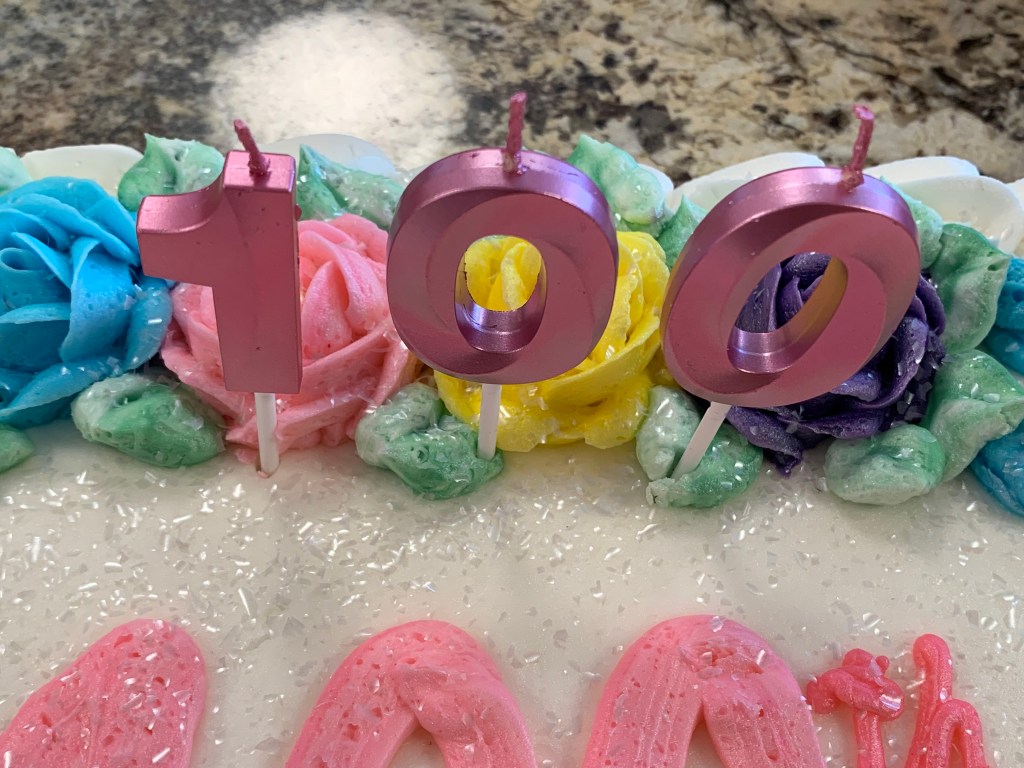
Eileen, 20’s mom, turns 100 today. Her party was last week. 20 made a beautiful photo board of her long life. The child. The sassy teenager. A vibrant young woman. A mother. A keeper-of-the-books. A grandmother. An aged woman. The full cycle of life. Her granddaughters attended the party. Her great-granddaughters, too.

“Age-and-stage,” 20 often says. Age and stage.

“Is this what you mean? That the river is everywhere at the same time, at the source and at the mouth, at the waterfall, at the ferry, at the current, in the ocean, and in the mountains, everywhere, and that the present only exists for it, not the shadow of the past, nor the shadow of the future?”

That is it,” said Siddhartha, “and when I learned that, I reviewed my life and it was also a river…”

Parcival turned and was shocked to see the grail castle standing in the meadow behind him. The hermit smiled and said, “Boy, it’s been there all along.”

Happy Birthday, Eileen. 100 years. A moment.

read Kerri’s blogpost about 100 YEARS

Open And Share [on Merely A Thought Monday]

We have “go” bags packed. One contains our important papers. The other has a change of clothes and the dog’s leash. It’s not that we’re paranoid. During the civil unrest a few years ago – buildings ablaze and murder on the streets just a block or two from our house – the local authorities advised people to be ready to leave on a moment’s notice. We prepared our “go” bags and thought it such a good idea that we’ve never unpacked them. Now, when the tornado sirens wail, we simply grab our bags and the dog and descend into the basement. Easy-peasy in times of scramble.

Each night we watch Youtube videos of people hiking long distance trails. Often the hikers talk about the moment that they “leave” the mindset of the city and enter the freedom of the trail. Everything they need they carry on their backs. They cease dealing with what is supposed-to-be and fully enter life with what is right in front of them. There is a plan and the plan is constantly in flux. There is little to no consistency. What they can and cannot control becomes readily apparent.

What is most important, what is consistent to all of their stories on the trail, is how important other people become to their experience. Leaving the mindset of the city brings them back to the basic tenet of their humanity. They are totally dependent upon the kindness of others. They enter an ecosystem of mutual support. The illusion of “every-man-for-himself” falls away. They open. They share. They fill themselves with gratitude for others. The people who try to go-it-alone don’t make it very far.

I think that is why, at the end of each day, we watch these people on the trail, with their “go” bags on their backs and their hearts bursting with appreciation for their lives and for those who walk with them, if only for a day. They remind us of what’s most important. They cut through the noisy abstraction of news and ratings and likes. They don’t expect their walk to be easy or comfortable or pretty. They remind us to fill our days with gratitude for others, to turn toward our fellow travelers rather than turn away. They offer a hand and accept assistance. They share. They remind us, in our scramble to find safety in the storm, that life in an ecosystem of support is what it’s all about.

read Kerri’s blogpost about STORMS

Choose A Double [on Merely A Thought Monday]

The storm that blew through last night was ominous. The thunder shook the house. I lay awake, marveling at the force of nature. And, while I lay awake, counting the seconds between flash and boom, I also counted myself lucky. I rolled gratitudes through my mind, enumerating all the things I was thankful for in the previous 24 hours. There were more than I could count.

It is very easy to get lost in despair. It’s very easy to count all the things that don’t work, go wrong, hurt a lot, and didn’t-go-my-way. It takes a bit more intention and effort to turn the eye toward the good stuff. Counting gratitudes requires aiming focus.

It reminds me of an exercise I used to do with groups, revealing to them how easy and fun it is to blame-the-universe or other people for our woes. Blame is like sugar. It’s addictive. The groups would tell outrageous blame stories and laugh. Blame lightens the load. It’s an easy answer to the mysterious question, “Why?”

It’s much harder to see and embrace participation and choice in a life path. Ownership comes with responsibility. There is circumstance – that which I can’t control. There is what I do within my circumstance – that which I can control. The moment I suggested to the groups that they transform their blame-story into a story-of-choice, they fell silent. Every group. Every time.

Blame requires allies and layers of story; it happened to me. Choice needs no audience. It is the story. I made this happen.

On any other night, between flash and boom, I might have tossed and turned and counted my woes. I am more than capable of diving into dark holes and indulging my blame story. I have and will again drown my sorrows in pity and it’s-not-my-fault denial. But, on this night, during this storm, I was filled with awe for the power of nature, for the abundant good that boomed through my life, for the chance to live another abundant day. A double double of appreciation.

read Kerri’s blog post about A DOUBLE

Lean Into The Questions [on Merely A Thought Monday]

A theme that surfaces in my conversations with Rebecca is how unsafe people feel – especially women – to ask questions. At work. At school. Asking a question is too often misunderstood as a challenge to authority. It’s dangerous. Smile. Be silent.

I suppose authority has always been thin-skinned though the idealist in me wants to believe that we’re all in this together. I know without doubt – as we all know – that the way forward is through the field of questions. The best answers open doors to better and better questions. Anyone afraid to be questioned and insisting that their answers are absolute – full stop – should inspire dread.

After eight years on the job, Kerri was handed a contract with the mandate to sign it. She asked a few questions. The description in the contract didn’t align with the reality of the job she was performing or the previous agreements made with her supervisors. Authority did not respond well to her questions. The ensuing assault was incessant. Bullying. Dangerous. For awhile she tried to comply with the only advice offered her: smile sweetly. I wondered, if a man was being similarly pummeled, would he be offered the same advice? When Kerri finally stopped smiling and stood solidly with her questions, she was branded “belligerent” and “uncooperative.”

I doubt a man would be similarly pummeled. To this day, I wonder at all the men and women in the community who watched the pummeling and said nothing. As witnesses to the danger in asking a question, they held-their-tongues. I suppose they learned their lesson. Ask no questions. See no evil. Hear no evil. Look away. Speak no truth.

And, while they weren’t looking, their community fractured and fell apart. All were diminished. Thugs count on division; it’s their secret sauce for establishing control. They engender silence. It’s how they maintain their authority.

And, isn’t that the true danger. We don’t want to bring the the wrath of the gorilla upon ourselves so we “get on board” or “toe the party line.” Smile sweetly. Pretend the bully isn’t beating the woman into submission. Make the assault her fault. She brought it on herself.

Kerri’s experience is a microcosm. The bullies have the microphone. World-wide, authoritarianism is on the rise.

If ever there was a time to lean into the questions, it is now. If ever there was a time to ask aloud, “What are we doing?” and “Why are we doing it?”, it is now. Together, asking questions capable of leading to answers that open doors to better and better questions. We have no shortage of persecutors beating down questioners while screaming that they have all the answers and their answers are absolute.

Perhaps the questions we need to ask together are simple: Is this who we are? Is this who we want to be?

read Kerri’s blogpost about SMILING

Stop and Turn [on Merely A Thought Monday]

“We have no reason to mistrust our world, for it is not against us. Has it terrors, they are our terrors; has it abysses, those abysses belong to us; are dangers at hand, we must try to love them.” Rainier Maria Rilke, Letters To A Young Poet

Open the door to the monster in the closet. Walk into the wound. Throw light onto the dark. Nothing is broken, nothing needs to be fixed. All stories of resistance released into flow. Deliverance of fear.

How many times have you heard or said, “I don’t know what to do with what I feel?” Or, the partner statement, “I don’t know where to put what I feel.” Feelings as spatial.

In an earlier chapter I dreamed that I was being chased by giant monsters. I quickly ducked into a warehouse thinking I could easily find a place to hide but, much to my horror, the warehouse was vast and empty. Open space. Nowhere to hide. No other door. There was only one thing to do: turn and face the monsters. Surrendering to my fate, I stopped and watched them come at me, certain they would gobble me. But, as they approached, they shrank. The closer they came the smaller they became. By the time they reached me, they were smaller than my toe. They dissipated the moment they touched me. When I looked up I saw an older version of me standing across the room, transformed.

It was a Rilke moment.

“How should we be able to forget those ancient myths that are at the beginning of all peoples, the myths about dragons that at the last moment turn into princesses; perhaps all the dragons of our lives are princesses who are only waiting to see us once beautiful and brave. Perhaps everything terrible is in its deepest being something helpless that wants help from us.” Letter Eight, Letters To A Young Poet

A shorthand phrase from my coaching era that I’m certain Rainier would particularly appreciate; a phrase well known to the older version of me now standing across the room looking back: Invite your dragon to tea.

read Kerri’s blogpost about FEELINGS

Ask The Bird [on Merely A Thought Monday]

“I think we consider too much the good luck of the early bird and not enough the bad luck of the early worm.” FDR

I laughed aloud when I read this quote. Luck certainly comes from a point of view. The good luck of the early bird is not great for the worm. I’ll add that tasty tidbit to my book of low-bar-wisdom: It’s never good news when you are on the breakfast menu.

Luck, good or bad, is never an incident isolated in time. That’s the point of the famous Chinese fable. Is it good luck or bad? Who knows. It’s all dominoes. I met Kerri because my career (and life) was collapsing. Was my career collapse good luck or bad? Ask Kerri if meeting me was good luck or bad and her answer will probably waver given the events of the day.

These past few months, after the software start-up went away and we tumbled into our latest reinvention, I’ve been pondering the Chinese fable more than usual. It felt like great luck when the opportunity appeared. If feels like bad luck in its disappearance. Both/And. I was certainly prepared when the opportunity came along. No amount of preparation-meeting-opportunity kept the company from vanishing. Bird or worm? We’ll see.

I love the notion that luck, the good side, is out there, looking for us. I imagine Luck standing on the horizon each day, shielding her eyes and whispering, “Where are they?” With us standing on our horizon looking for Luck and Luck standing on her horizon looking for us, it’s only a matter of time before we spot each other.

And, maybe we already have. That’s the tricky thing I’ve learned about Luck. She sometimes comes in disguises. That wily Luck is a trickster and has a wicked sense of humor.

This is all I know: if I was writing the children’s-book-for-adults-about-luck, the worm would have just crawled out of a tequila bottle and the newly intoxicated early bird would be left with an important question: was that worm good luck or bad?

read Kerri’s blogpost about LUCK

Trace The Line [on Merely A Thought Monday]

Love has a lineage. Without Piet Mondrian there would be no Ellsworth Kelly. Without Ellsworth Kelly there would be no Robert Indiana. For that matter, without Georges Seurat or Henri Matisse there would be no Piet Mondrian. Without the invention of the camera and the science of optics there would be no Georges Seurat. Of course, I’m referring to Robert Indiana’s sculpture, Love. We are rarely aware of how many lives influence our thoughts and give shape to our passing moments.

Love, the non-sculpted variety, follows the same principle in every life. It has a lineage. Chose any moment – any emotion – and follow the thread. An amazing web of interconnectivity emerges that stretches beyond…beyond. Sometimes I stop on a trail and wonder how I came to be walking through the woods in Wisconsin holding this woman’s hand. A tumble of choices. An immensity of influences and circumstances that quickly become impossible to comprehend. It’s no wonder destiny is such an attractive notion! Phew!

Four simple letters. Stacked symbols designed into another symbol. An aspiration? A graphic design? History placed Love in the box called Pop Art, thereby giving it a location-in-time. A starting point. A relative nod to lineage.

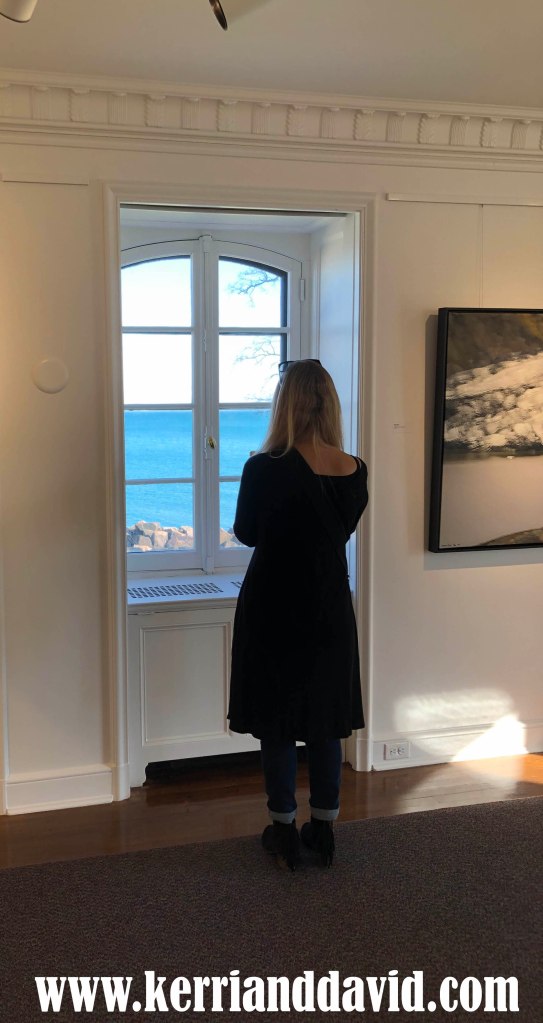
Standing in the museum, gazing out the window at Love, Dale Chihuly’s color explosion to my right, Kerri taking a photograph of the sculpture over the shoulder of a biker seated at a cafe table, the guard lost in his thoughts, a school tour echoing in the next gallery, a mural behind me that I’ve not yet taken in though it’s tapping me on the shoulder…meaning being made and shared and expressed all around me! How is it possible that we ever think we originate on our own? How is it possible that we ever think we walk this path alone?

read Kerri’s blogpost about LOVE