Stop and Turn [on Merely A Thought Monday]

“We have no reason to mistrust our world, for it is not against us. Has it terrors, they are our terrors; has it abysses, those abysses belong to us; are dangers at hand, we must try to love them.” Rainier Maria Rilke, Letters To A Young Poet

Open the door to the monster in the closet. Walk into the wound. Throw light onto the dark. Nothing is broken, nothing needs to be fixed. All stories of resistance released into flow. Deliverance of fear.

How many times have you heard or said, “I don’t know what to do with what I feel?” Or, the partner statement, “I don’t know where to put what I feel.” Feelings as spatial.

In an earlier chapter I dreamed that I was being chased by giant monsters. I quickly ducked into a warehouse thinking I could easily find a place to hide but, much to my horror, the warehouse was vast and empty. Open space. Nowhere to hide. No other door. There was only one thing to do: turn and face the monsters. Surrendering to my fate, I stopped and watched them come at me, certain they would gobble me. But, as they approached, they shrank. The closer they came the smaller they became. By the time they reached me, they were smaller than my toe. They dissipated the moment they touched me. When I looked up I saw an older version of me standing across the room, transformed.

It was a Rilke moment.

“How should we be able to forget those ancient myths that are at the beginning of all peoples, the myths about dragons that at the last moment turn into princesses; perhaps all the dragons of our lives are princesses who are only waiting to see us once beautiful and brave. Perhaps everything terrible is in its deepest being something helpless that wants help from us.” Letter Eight, Letters To A Young Poet

A shorthand phrase from my coaching era that I’m certain Rainier would particularly appreciate; a phrase well known to the older version of me now standing across the room looking back: Invite your dragon to tea.

read Kerri’s blogpost about FEELINGS

Step Off The Path [on DR Thursday]

At first we were horrified. The forest filled with machinery. Trees down and the underbrush annihilated. Our beloved trail decimated. We read that the seeming destruction was part of a woody invasive species clearing project. The clearing would allow the native species to rejuvenate.

Later, after the machinery was removed and the air cleared of diesel fumes, we returned to walk the obliterated forest trail. And, on our walk, I learned – or re-learned – a very valuable lesson. The change pulled us from our well-worn path and invited us to explore. Because we could now see all the way to the river, we left the trail. We stepped into the unknown. What had been comforting and known now beckoned us to see anew. To wake up.

We walked in places where previously we could not because the brush was too dense. We followed an animal trail through the snow into a part of the forest we’d never been. It was a place we’d never before considered investigating. We deviated and hiked all the way to the train tracks. We took photos. We felt the thrill of stepping into new territory. Our eyes wide open, our ears attuned to every nuance of sound, we took nothing for granted. Everything was pristine and unknown.

Change is like that. It makes you pay attention.

Returning to the trail so we could make our way back to the car, enlivened by our off-trail adventure, we wondered aloud about the wildlife. We worried for the deer. And, just as the words left our mouths, Kerri stopped and motioned to the forest’s edge. A deer was watching us. And then there were two. Three. Five. After determining that we were not a threat, they nibbled on branches. We stood very still; quiet appreciation.

It felt like a reward for taking the step off the beaten path. It felt like reassurance that the devastation was akin to a forest fire; necessary for renewal.

From a cue invisible to us, the deer leapt in unison, white tails flashing, and disappeared into the forest. It broke the spell. We returned to the car, eyes scanning the forest in case the deer returned. Our senses keen, I felt fully alive.

Change is like that. A clearing project, disrupting comfortable complacency, nothing can be taken for granted, making way for new seeing and discovery. Anything becomes possible.

a work in progress: train through trees, 48x48IN

read Kerri’s blogpost about RIVER BEND

train through trees (in progress) © 2023 david robinson

Scribble With Purpose [on DR Thursday]

Henri Matisse said, “Creativity takes courage.” I suppose that is true when considering the enormous pressures to conform to a style or standard. To create what is acceptable or expected. To suss-out what will be rewarded with approval and/or profit. In this context, it takes enormous courage to deviate. To explore. To surprise yourself by breaking form and risking ridicule and rejection and poverty. In this context, it takes courage to show up. It takes courage to punch through.

On the other hand, creativity is the most natural thing in the world. Ask any child. On second thought, please don’t ask any child since it will only confuse them. They have no idea that creativity – to an adult – is a separate thing. What’s scary and vulnerable to the tall people is commonplace to the little critters. There’s help for the older folks: allow the child-inside to scribble with abandon. Recognize that the story of, “I’m not creative,” is a creative act. The story of “It’s scary to create,” is also a creative act. It’s a story.

Creativity runs like wild horses through every day of our lives. Our perceptions and interpretations and fears are pure storytelling. The real challenge is not the absence of creativity but the conscious appreciation of our rampant creativity. The squeeze to conform serves as a heavy curtain obscuring our vibrant expressiveness.

The courage that Henri Matisse references is borne of the tension between the desire to be appreciated (to fit in, to succeed) and the yearning to break new trail or sail into undiscovered lands. To risk. To intentionally and publicly scribble outside the lines. To say aloud what needs saying.

Creativity is the most natural thing in the world. As it turns out, so is conformity. We are, after all, like wolves: animals that run in a pack. Humans die in isolation so serving the will of the group is a high priority. The wrestling match between creativity and conformity is necessary.

The progressive impulse. The conservative impulse. A bowstring drawn taut between these two poles provides the necessary tension to send the arrow of our ideas and dreams sailing toward the distant target. Children scribble with abandon. Grown up children, those telling themselves the story of “I’m a creator,” learn to scribble with purpose.

read Kerri’s blogpost about PUNCHING THROUGH

shared fatherhood, 25.5X40.5IN, mixed media on panel

shared fatherhood 2 © 2017 david robinson

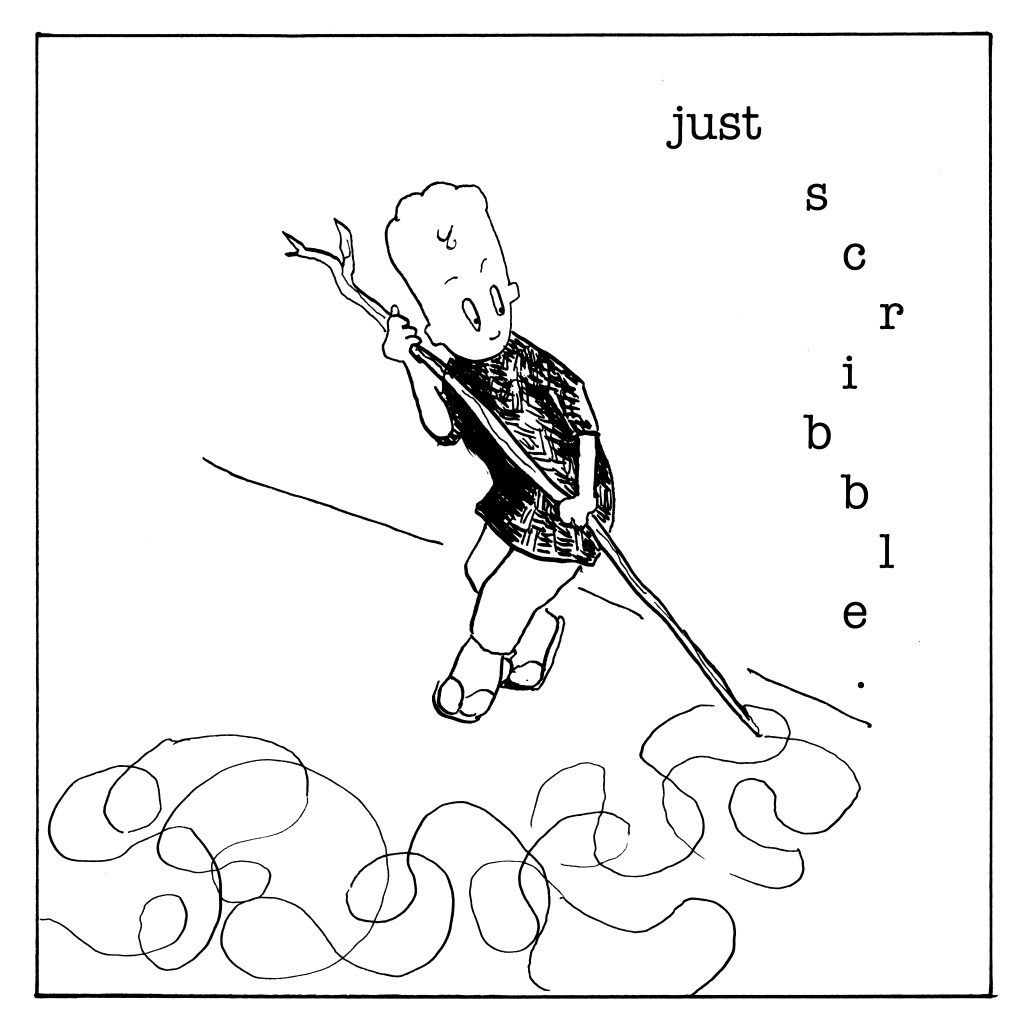
chicken marsala/just scribble © 2016 kerri sherwood & david robinson

Feel The Dope Slap [on Not So Flawed Wednesday]

This morning I awoke agitated. Restless. I’m blaming my dreams. I know I had tons of dreams last night but I can’t remember a single one. I find it useful to blame my restlessness on something as slippery as an unremembered dream. It prevents any significant self-reflection or responsibility for my unease.

I just popped Rob on the head for diminishing his own work. He’s a prolific and gifted playwright and referred to his latest piece as “…another corpse being thrown on a mass grave of scripts.” After I sent the email-head-pop I admitted to myself that I was actually ALSO popping myself on the head. I used his head as a proxy. Popping other people on the head is also useful for avoiding any significant self-reflection. Although I admitted to myself that my head deserved a good slap, I successfully transferred the impact to Rob. No further self-reflection needed! I’ll wait for Rob to write me back with a return dope-slap. He’s a great friend and I deserve nothing less. Really, I deserve a good slap but I refuse to slap myself. That would require taking responsibility for my actions and my indulgent restlessness is getting in the way.

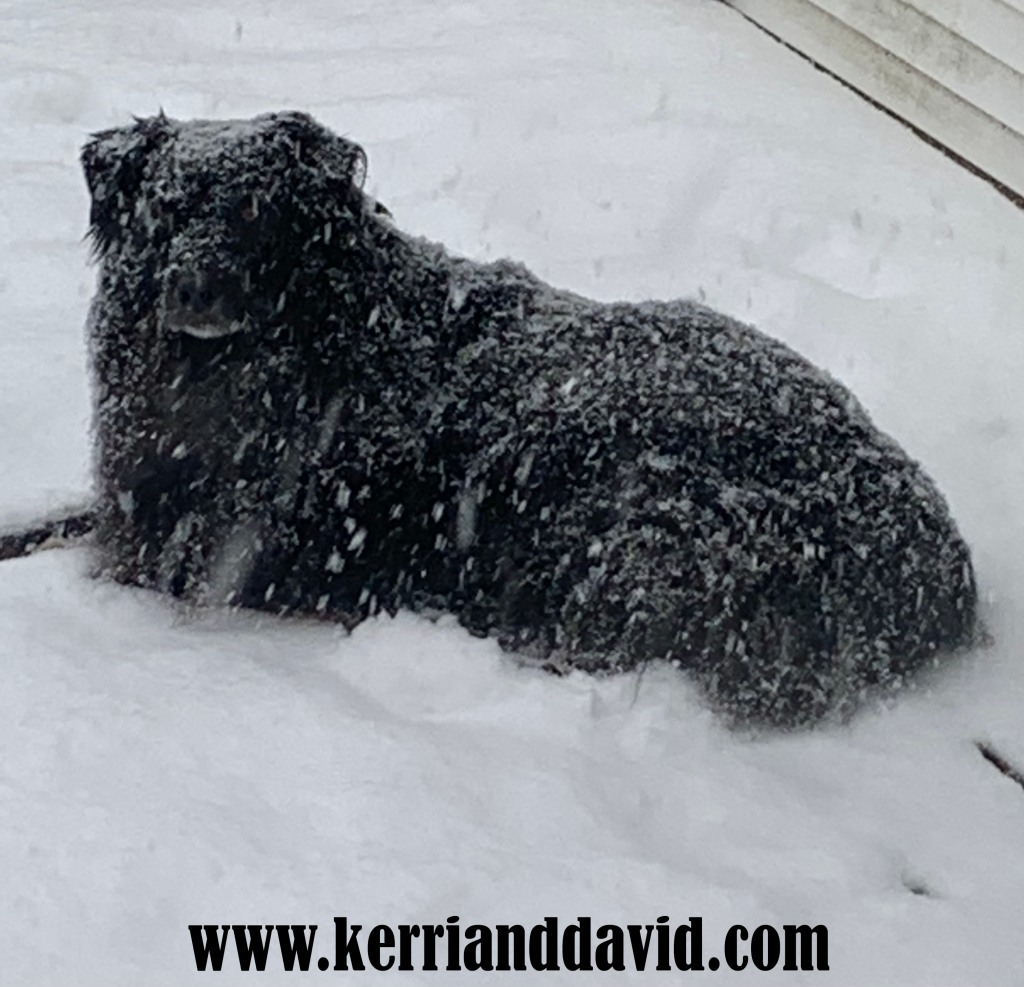
I’ve known for years that Dogga is a master teacher. Among his many lessons is contentment. And, what constitutes contentment is unique to each individual. For instance, most folks want to find a nice beach to lay on. Not Dogga! His nirvana is found in a deep pile of snow. He’s never happier than when the temperature plummets and the white stuff falls. He can linger for hours on the snowy deck in blissful satisfaction, doing nothing more than appreciating his moment. His teaching method is gentle. Unlike me, he eschews head slaps. He lives his peace, affording me the opportunity to emulate it or not.

The other thing I appreciate about Dogga’s lessons: he has absolutely no investment in how long it might take for me to learn. He is not concerned about whether or not I ever learn his lesson of contentment. His job is to make the offer. He is not concerned at all with the reception.

Perhaps the cure to what currently ails me is a few moments sitting with Dogga in the snow. I think I’ll invite Rob. It’s the least I could do after using his head to slap mine.

read Kerri’s blogpost about SNOWDOG

Remember This Vivid Moment [on Merely A Thought Monday]

When we first met, we sat on the living room carpet staring into the fire, and talked the night away. The sound of the birds at dawn surprised us. I remember the coming light and sweet birdsong like it was yesterday.

A few days ago we sat on the living room carpet in the sun, and talked the afternoon away. Our quiet conversation reminded me of that very first night. Our topic in the winter sun: letting go of too-tightly-held-ideals. “Truth will out,” wrote Master Shakespeare in his Merchant of Venice. Our truth was out in quiet voices that brought affirmations of better days.

A story I once loved to tell was The Crescent Moon Bear. The heroine, a young wife, must go on a journey. She must leave all that she knows in pursuit of her purpose. Leaving all that you know is easier said than done. It doesn’t happen in a moment; it requires some sweet visitation of the past. “What was” as launching pad to “What will be.”

Before I left my studio in Seattle, I had to touch the walls, run my fingers along the sill. I knew I would never be back. Even in that moment, all I could remember was the goodness I experienced in that space. The refuge. The sanctuary. The creative fulfillment. The hard times I’d known there dissipated like mist.

What was. Krishnamurti wrote, “You can only be afraid of what you think you know.” I marvel that the hardships of my past soften into pastel remembrance, translated into useful lessons, while my future fears are as sharp as broken glass, monsters around the corner. Acute imagination.

I marvel that the generosities heaped upon my life are vivid and bring tears to my eyes just as they did the day that I first experienced them. Keen remembrances.

Sitting on the carpet, the low afternoon sun warming us, I realize that I will always remember this vivid moment. The day we opened our hands and let fly illusions. We both took a deep breath. New air rushed into the open space, Not knowing where we might now go or what we might now do, we sat in the waning light, surprised that the sun was setting so soon.

read Kerri’s blogpost about REMEMBERING

Move The Eye [on Two Artists Tuesday]

“If you think good work is somehow synonymous with perfect work, you are headed for big trouble. Art is human; error is human; ergo, art is error.” ~ Art & Fear, David Bayles & Ted Orland

The winterberries came as a shock. Vibrant red pops in a bleak landscape of brown and grey. “They look like maraschino cherries!” Kerri laughed as she waded into the brush to get a photograph. In Wisconsin, the mere mention of maraschino cherries invokes immediate and widespread mixing of brandy old-fashioneds. Even though it was early in the day, I imagine people for miles around sensed the invocation and sprang toward their liquor cabinets.

“Sour or sweet?’ I asked, trying to be clever, but she was too engrossed in her photograph to hear my quip.

Watching her crouch to capture the shot, I thought, “Red makes the eye move.” It’s a lesson I learned beyond the abstract and used in my narrative paintings – a series that I’ve had on the back burner for ages. Limit the palette, move the eye with winterberry red. It’s a director’s thought. Guide the eye. It’s a playwright’s plot; tell the story through the anomaly. Create movement through curiosity rather than control.

Explode the idea. Run toward the edge. Extol the sore thumb!

I let my eye roam across the fields. Winterberry shock to Winterberry shock, electric reds pulling my eye across muted purple and drab green. The wind rattling branches, antlers clacking in the sky. I breathed it all in as she waded through the grasses back to the path. “Make big mistakes,” I heard Quinn whisper.

“The bigger the better,” I whispered in reply.

read Kerri’s blogpost about WINTERBERRIES

Witness [on DR Thursday]

It’s almost impossible for us to keep walking when the sun sets. We stop wherever we are. In quiet, we watch it descend. It’s as if we are full participants in the day’s end. Holy moments. Holding sacred space. It’s the role of the witness.

I feel the same is true now, at this year’s end. It’s not always true in December but this year is different, It’s almost impossible for us to keep walking. In quiet, holding hands, we are watching the year descend into the past.

I wonder what we are, in fact, witnessing? We stepped off the known path and are once again traveling the unknown trail. That is not new in our experience. It is actually more common in our lives to be stepping into new territory. To not know where we are going. This time feels different.

A few years ago I painted a picture that I like very much. It is simple. Kerri calls it Pax. Peace. The figure in the painting is satisfied. Present. At peace. I’ve not thought about this painting for a long time but it’s walking with me right now. It’s asking to be pulled from the stacks.

Witnessing is not passive. This painting will be our witness during the setting of the year. We will witness it as it daily reminds us to be at peace. Holding hands in sacred space. Not rushing to get out of the woods even as the light wanes.

I have sometimes wondered why I paint. Today I know without doubt the reason.

Pax, 24x24IN, mixed media

read Kerri’s blogpost about SUNSET

pax © 2015 david robinson

Retrace Your Steps [on KS Friday]

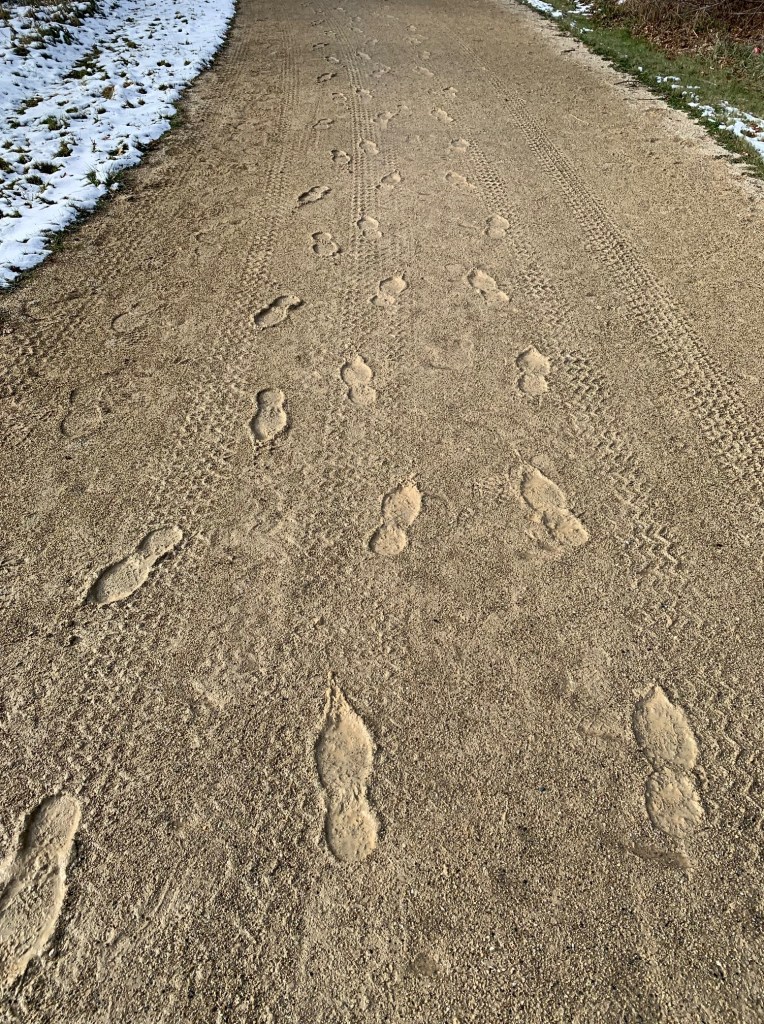
We completed the first loop and, rather than continue in the same direction as we usually do, we turned and walked the other way, retracing our steps. It was remarkable. Walking in the opposite direction seemed like a different trail altogether.

It is the way of memory. Take a walk backward in life through places you’ve already been. It is a different trail. Often unrecognizable. In fact, with each backward stroll, the path is surprisingly different depending on the reason for retracing your steps.

This is the season for retracing steps. Remembering people and places, tastes and smells. Kerri asked how we celebrated Thanksgiving when I was a boy. We spent the next several hours roaming through our forgotten lands. Some were delicious. Some painful. Some made us laugh.

I’ve been talking with Horatio and emailing with Rob about next steps. Where to go from here. This seems like a well-worn path: sudden job loss. Their advice is clear: do not walk the same path. Do not do the same old thing in the same old way. “My advice is mundane,” said Horatio.

As we set our eyes on a new trail, we also walk old paths in our minds. In order to avoid doing the same old thing -again – we must first see the loop that we’re on. Turning around and walking in the opposite direction seems prudent.

Kerri’s albums are available on iTunes and streaming on Pandora

read Kerri’s blogpost about STEPS

figure it out/right now © 2010 kerri sherwood

Take A Closer Look [on Two Artists Tuesday]

“Knowledge is rarely completely divorced from power, and interpretation is too often an expression of convenience.” ~ Wade Davis, The Wayfinders

Discussing our project, Yaki and I agreed that we needed to step lightly. “We wouldn’t be allowed to perform this piece in Florida,” I quipped. Yet, sadly, it’s true. The piece is Beethoven. Nothing controversial there! I’ve written and will perform the narrative, an update of the piece from 2008. Yaki asked me to rewrite the narrative to speak to the issues of 2022.

It’s odd. Were we to perform the new script in the world of 2008, it would be benign. No one would deny or take issue with the fact that slavery is part of the history of the United States. It would have been laughable to challenge the era of Jim Crow or that the struggle for Civil Rights was and is a part of our story. Our division is not new. It’s institutional, systemic. Yet, in 2022, in red states, the dark side of colonialism is being scrubbed from curricula. They’re attempting to rewrite our nation’s history as a Hallmark movie.

Things are rarely what they appear. It’s one of the reasons why art is so powerful and necessary in a healthy society. When a community goes off the rails, claiming truth is fiction while aggressively promoting fiction as truth, the truth deniers always attempt to shut down and/or shout down all conversation. The theatre, the arts, during turbulent times, can reach into dark fiction, and resurrect the soul of truth.

Things are rarely what they appear. Staring out the kitchen window I was amazed that the bird perched on the wire fence was so still. It was so uncanny that I walked out back to get a closer look.

It’s the only way for people, for ideas, for communities, for nations, to grow. To question. To be curious enough to have a closer look. To laugh at themselves when the bird is discovered to be a leaf. To not be afraid to have their illusions popped, their history unpacked, or to welcome another point of view.

read Kerri’s blogpost about THE BIRD

Make Some Sense [on Merely A Thought Monday]

When standing at life’s crossroads, there is a choice to be made. Take the right-hand path or the left-hand path? Or, turn around and go back. Turning around is never an option since it’s akin to going back in time. So, right or left?

Symbolically, the right hand path represents the safe path. The conservative choice. The path that “makes sense.”

The “road less travelled” is to the left. Destination unknown!

It’s never made sense to me (ahem) that choosing the path to the right is considered the sensible choice. We’re a culture that celebrates the cowboy! We’re a nation that prides itself on its rugged individualism. We stomp across the wilderness, aim for the moon, yet the clear message to our children is “know where you’re going.” Choose the sensible path, “Go to the right.”

Sometimes I wonder why these two paths are set in opposition to each other. There can be no further-left-hand-path than the one free-solo climber Alex Honnold has taken, yet he is studied, methodical in his passion. Some of our greatest historians are actors and dramaturges; it takes precise study to be the mirror of a culture.

To act like you “got some sense” does not mean to ignore your heart. Every high wire artist begins with a net. Michelangelo and Leonardo were intense studiers on their left-hand-path, scientists both. Going to the left does not mean recklessness but it does imply vulnerability to new experiences. Curiosity. Sailing toward the horizon. Opening to the awe of being alive. Taking chances; try, try again. Following an impulse.

Knowing the value of a mistake as the vital necessity of learning.

What could make more sense than that?

read Kerri’s blogpost about GOT SOME SENSE