Notice The World

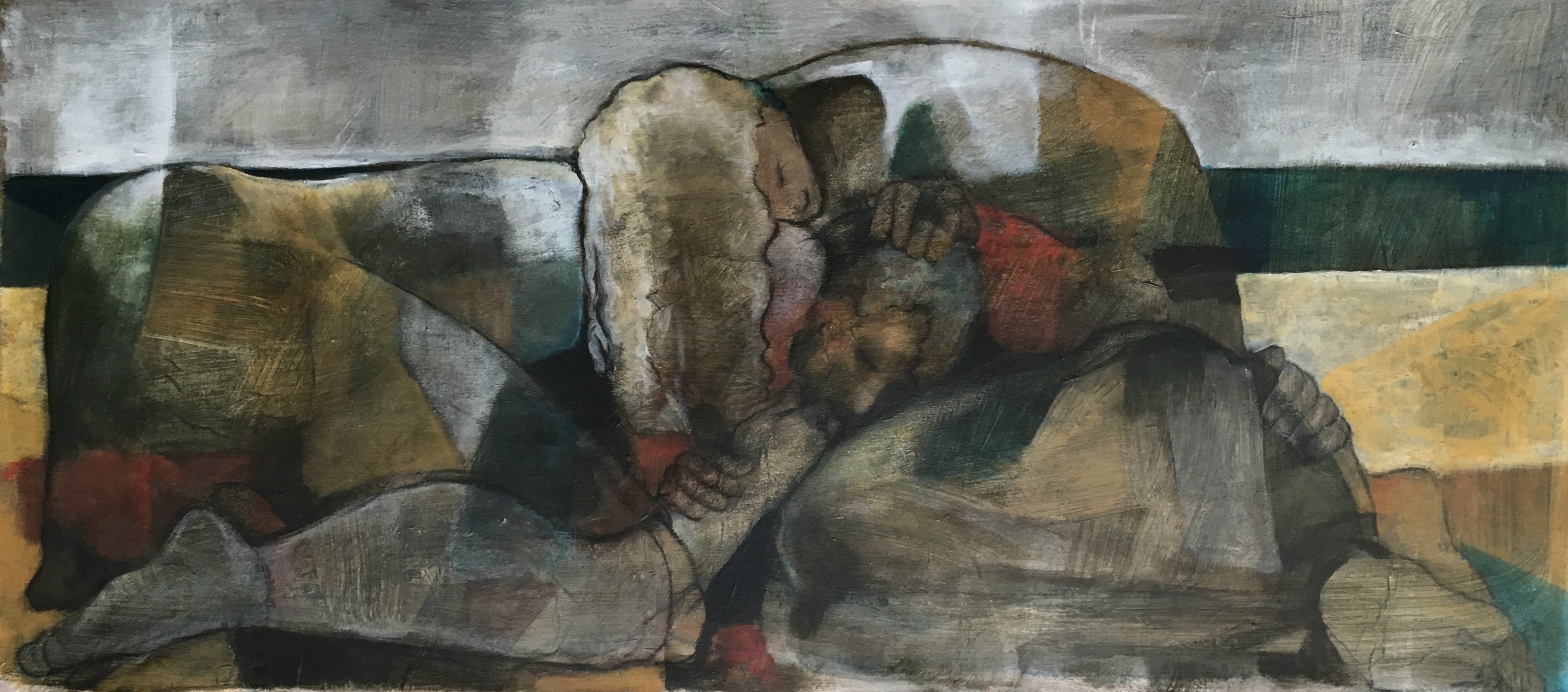
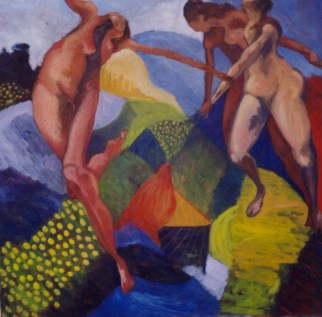
my latest painting. another addition to The Beach Series.

It’s a constant source of the giggles for me now. So many things that used to seem so complex and unknowable, so serious and weighty, have morphed into utter simplicities. And, I’ve unwittingly accumulated or created shorthand phrases, adages, that encapsulate the simplicities.

Stephen used to ask me, “Why don’t people see how important art is? Why don’t people value the arts?” He is a prolific and gifted painter and, like most artists, was struggling financially. I used to sit around with other artists and actors asking the same type of questions. Why don’t they value us. Our conversations made us into a frustration-club, so certain were we that we carried in our art pouch the cure for the worlds’ ills. But the world, they, were not noticing us. No matter how great our play or heartfelt our paintings or how loudly we proclaimed and marketed our work or trumpeted our capacity to help people to think or feel more deeply – to change the world! – the community (they) seemed mostly inattentive (to us).

Art as castor oil. Non-profit non-prophet.

Wearing my corporate consulting hat, I taught this core principle for years: you can never determine what other people think or feel or see. And, it took years for this simple adage to penetrated my life – especially my artist life (we do, in fact, teach what we most need to learn…).

I still believe in the importance and great power of the arts but not in the same way I did all those many years ago. I actually believe in it more than I once did only now it seems so simple: ‘Do what you love…,’ so the saying goes. Do what you love because you love to do it. That’s all. The world (how’s that for a sweeping generality!) does not need to be saved or changed. Mostly, it needs less frustrated artists waving to be noticed while perpetuating the narrative that they are undervalued. The world could do with a wee bit less of ‘us and them.’

The simplicity: I would much rather root my energies, my focus, my creative powers in the love of it all. Frustration makes the well run dry. There is no us and them when standing solidly in the love of creating. The real power of the arts – the only real power of the arts – is to open access to the commons, the shared space beyond separations (real or imagined). At best, artists reach across boundaries, not create them. In the end, artists (I believe) are mirrors, not medics.

Kerri gave me this new adage for my collection (and I giggled): It’s not about the world noticing you. It’s about you noticing the world.

Skip The Handbook

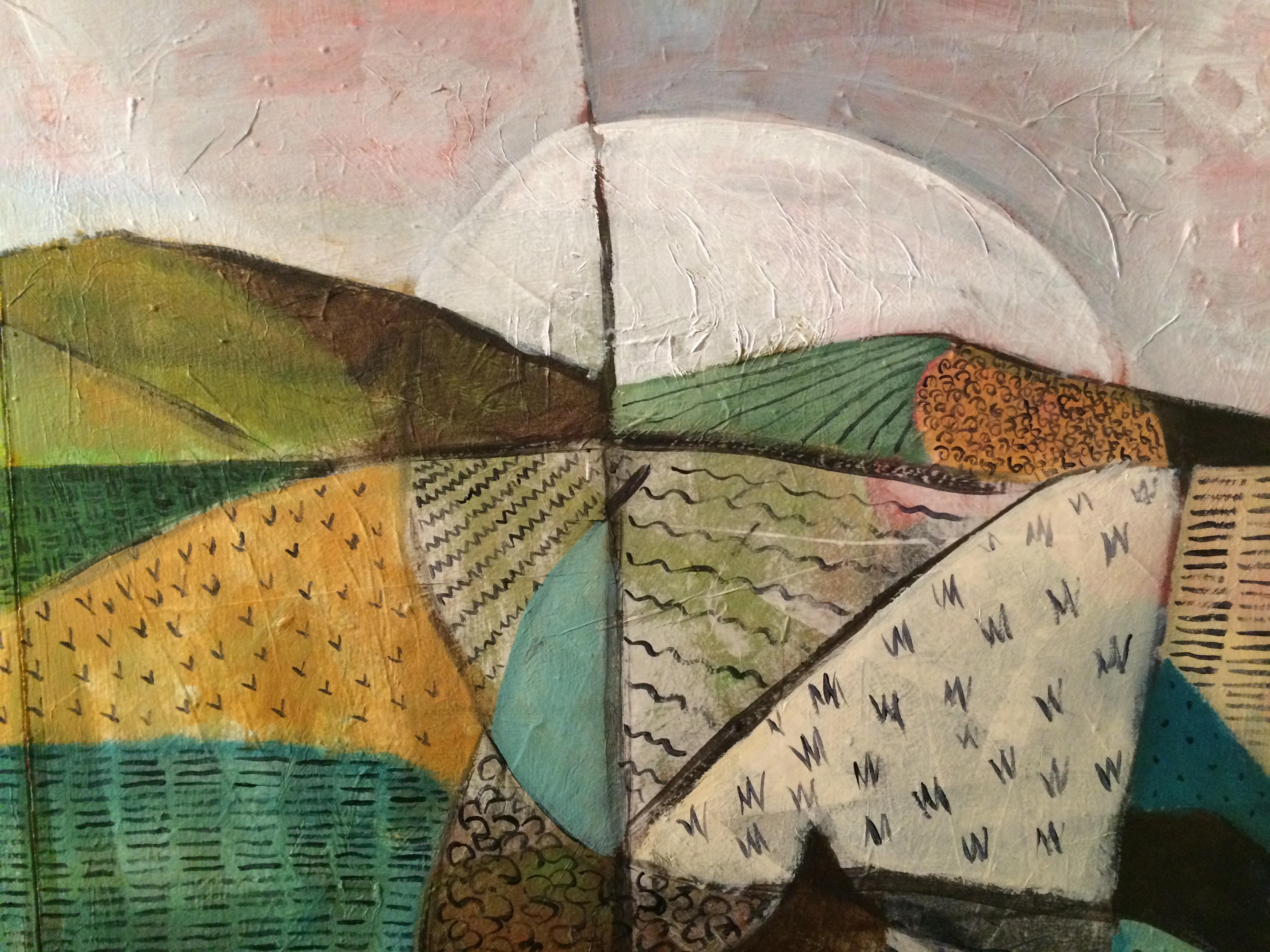
We walked some great beaches this summer. In this post are my three most recent paintings. Kerri calls them the start of my Beach Series. This one is called, They Draw The Sunset In The Sand

I just made myself laugh out loud. “Lol!” I’d have texted to myself had I not been breathless from my guffaw. No one can accuse me of needing to be entertained.

I was writing about my history with curators, galleries and their consistent criticism of my work: I am stylistically all over the map. And, it’s a valid criticism! I am stylistically schizophrenic. I was overcome with laughter by what I wrote after using the words ‘stylistically schizophrenic:’ If I didn’t know myself (and, most of the time I am the last person to see in myself what is obvious to all – so it is a solid argument to make that I do not know myself)…. Wow. I might have made a good lawyer had I not been so dedicated to seeing things from multiple points of view. My paintings reflect my dedication (as it should be).

When I was younger I tried repeatedly to squeeze myself into a stylistic box. I thought that the advice and feedback I was receiving from gallery representatives meant that I was somehow lacking or out of control. In the handbook of real artists it must say in bold print something about possessing a consistent style. The youthful me looked all over creation for a copy of the handbook but could find it nowhere. How could I call myself an artist if I had not first read the handbook?

This one is titled, A Day At The Beach

My attempts ‘to fit’ into the single style rule made me miserable and, worse, made my work stale. In my mind, achieving real-artist-status meant I must learn to contort myself yet the price of contortion was very high. Twice in my life I took a year long hiatus because my attempt to fit into a single-style-box left me with deep aches and no creative fire. Once, so burdened was I by the pain of my contortion, I burned most of my paintings.

Fire is cleansing. Creative fire is clarifying. I have learned through my fire that the real handbook is internal and uniquely personal. As John once said to me, “Your job is to paint the paintings not to determine how or where they fit.” The painters I admire and feel a kinship with are stylistic pantheists. They are more visual explorers than technical geniuses.

There is a bridge that every artist must cross. It comes in the moment when the inner compass is no longer at odds with the necessities of learning technique, when the well-meaning comments of teachers and mentors and agents and representatives are just that: well-meaning comments. The compass, your internal rulebook, will let you know without doubt whether the comment needs to be considered or discarded. Growth happens either way.

This one is untitled at the moment…

visit www.davidrobinsoncreative.com to see the full extent of my stylistic pantheism.


Meet Your Obligation

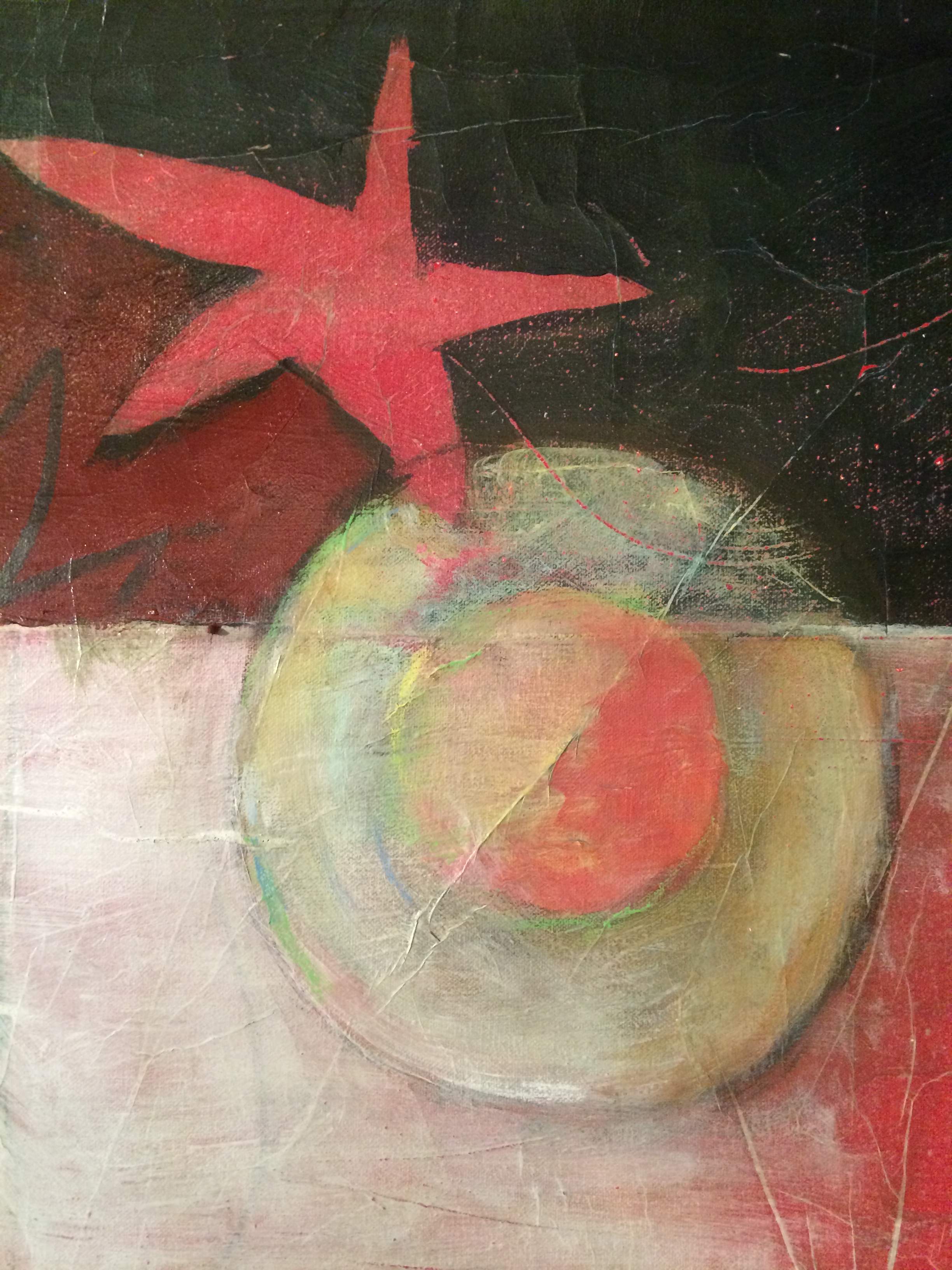
a detail of my latest – and yet unnamed – painting

“I feel like I have an obligation to live,” she said, in response to the question from the audience.

Joyce Maynard was reading from her latest book, The Best Of Us, at The Book Stall, an independent bookstore in little downtown Winnetka. Kerri has been a huge fan for many years but had never been able to attend a reading so we jumped at the opportunity. The Best Of Us is a memoir. In 2011, in her late fifties, Joyce met her “first true partner.” A year into their marriage he was diagnosed with pancreatic cancer and died 19 months later. Her book is the story of their all-to-brief time together.

“It’s not a book about death,” she said, “It’s a book about learning what love really is. What is truly important in life.” She added, “I don’t think people should have to pay 20 bucks for my catharsis.”

An obligation to live. I loved the phrase and all that it implied. Sometimes life collapses. This week, we remembered 9/11. We watched Irma wreak havoc on the heels of the devastation of Harvey. Fires burn homes and lives in the west. Listening to Joyce Maynard read from her book, I felt as if Viktor Frankl was sitting beside me whispering, “See! She is not looking for meaning where none can be found. She is making meaning. She is giving meaning to her path. That is the ultimate creative act!”

It is the fire that burns beneath an obligation to live. To not waste another moment of this amazing life seeking for that which cannot be found; but it can be given.

Save

Be A Nart

My latest: A Day At The Beach

John inadvertently coined my favorite word of the week. We were sipping wine, watching the fire burn in the chiminea, and he was telling us about a recent trip to the Milwaukee Art Museum. It was his first visit and he was thrilled by it. In a moment of brilliant thought collision, he said, “I’m a Nart.” His eyebrows knit and eyes crossed at the force of the collision. “What I meant to say,” he said, shaking his head, “is that I am not very well versed in the arts.” We laughed heartily. A new word was born.

Nart (noun) – a person not well versed in the arts.

When people talk with me and Kerri about their encounters with the arts they often include a disclaimer as if we are, as artists, universal experts (and critics) of all artistic experiences. I told John that, even as an artist, I feel that I, too, am a Nart. I’ve studied it, experienced it, practiced it, rejected it, claimed it, been lost in it, found in it, baffled by it, thrilled by it, transported, disappointed, confused, bored, energized, fed and starved by it. The longer I do it, the deeper into it I walk, the less I am able to put my arms around it.

It is impossible to contain. It is impossible to plumb the depths of it.

In my younger years I was intimidated by this vastness. I thought my job was to grasp it. It was – and is – a calling and I felt inadequate to the call. Now, I understand that my job is not to grasp or contain or to know. My job is to experience it. And, to relate what I experience. I will never be able to express all that is living within me. I will never have enough life to find its (my) edges.

Art is intimate and public, deeply person and intrinsically communal. It can heal or destroy. I have never been more lonely than when standing empty in front of a canvas. I have never been more fulfilled that standing before a finished canvas wondering where the past few days went.

Roger once told me that, where the arts are concerned, there are levels of sophistication. Shakespeare, like fine wine, is not immediately accessible. It takes time for black-and-white thinkers to develop a socket for metaphor to plug into. Art, after all, is not a thing. It is a relationship. The more time you give it, the more experiences you have with it, the more rich and complex it becomes. It opens. You open. If you are lucky, it is a yoga (a practice) that is necessarily personal in a never ending pursuit of greater range and flexibility.

Greater range and flexibility can only be found when you are a Nart. Relationships are made vital in not-knowing. Those who think they know have stopped seeking. They have stopped relating. To believe you know, is to stagnate.

Although I didn’t say it, it would have made John re-knit his brow, but he is lucky to be a Nart. I hope that will always be so.

Dance With Parallax

My favorite word of the week is ‘parallax.’ Horatio pulled it out of the word bin during our latest conversation about art and artistry. We were discussing the difference between what an artist sees in their work and what others see – and how artistic “sight” changes over time. I scribbled the word along with the phrase, “the difference in what you see and what others see. Perspective over time.” After our call I looked up the word in my dictionary:

paral-lax (noun) 1. Apparent change of position. 2. Angle measuring star’s distance from Earth.

Many years ago in a fit of vulnerability I showed my mentor, a great theatre and visual artist, my paintings. I lined them all up for him to see. I followed him around the room as he quietly studied each piece. Finally, after taking in all of my work, he asked, “What’s the meaning of the spheres?” I was dumbfounded and had no idea what he was asking. “Spheres? What spheres?” So he led me back around the room, revisiting each painting, showing me the three spheres that appeared in EVERY single painting.

“What’s with the spheres?” he repeated, knowing that there wasn’t an answer but there was certainly a vast new question. My universe spun a bit that day so astounded was I at my inability to see the unifying principle in my own paintings.

I needed his eyes to see my work. Isn’t that the point?

When I think back on that day, on that younger version of my self, I revisit the fear, the raging vulnerability I felt in sharing my paintings. I feel again the deep doubt I held against myself. I recall the nausea of inviting someone I admired into my house of doubt. I somehow believed that, to be an artist, I had “to know” what I was doing – yet knew with certainty that I had no idea what I was doing. I knew with certainty that he would see through me to my lack of knowing.

And, he did. Thank goodness. “What’s with the spheres?” Such a simple question yet it spun my universe and pitched me through the portal of a new perspective.

I learned that day that artistry has nothing to do with knowing. Life has nothing to do with knowing. Knowing is an illusion, temporary at best. Knowing has everything to do with hiding.

Making a life, as Master Marsh just reminded me, is an engagement with the unknown. It is to have experiences. It is to make meaning of the experiences. If you are lucky, you learn to have the experiences first, and make the meaning second. It is to understand that, in this dance of knowing and not-knowing, sight and blindness, chaos and order, consciousness and unconsciousness, there are no fixed points. There is dance:

dance (noun) 1. An act of stepping or moving through a series of movements.


fine art prints available at society6.com

my original work on zatista.com

Save

Honor All Perspectives

my latest painting. Hope asks, “What do you see?”

Hope Hughes, Kerri’s longtime assistant and voice of reason in all-things-business, passed through my studio and flung herself in front of the painting I was working on. “Stop!” she cried. “Don’t touch it! It’s finished!”

“Finished? I just started,” I whined. She laughed at the perplexed look on my face.

“Put down your brushes,” she smiled, “and listen for a minute.”

Over time I’ve learned to listen to Hope. She makes sense of the world through her feelings which comes in handy to an over-cerebral artist like me. She has no inner-editor in the early stages of communication so I’ve learned her heroics are pure. She sees something that I do not. This is not the first time Hope has thrust herself between me and the painting I am about to destroy, so when she asks me to ‘look’ there is usually a good reason. I set down my brushes, cross my arms, and huff as if to say, “I’m listening but make it fast.”

Each time she begs me to stop work on a painting, a great debate rages in the household. This time was no exception. I sit in my chair and listen to what she sees. It is always diametrically opposed to what I see so I pretend to pout (I secretly love this process because it is EXACTLY what I adore about art in general and painting in particular). She tries to get me to tell her what I intended to paint, coaxing me to talk about what I see but I refuse. As Joseph Campbell once said, “If an artist respects you, s/he will not tell you what a painting means. ” Art is always about a relationship between the piece and the viewer and the artist needs to stay out of the way. If the artist has no respect for you (or themself), s/he will tell you what the painting means to them. I respect Hope so I stay out of the way.

In this painting, Hope sees deep humility in dual fatherhood.

My refusal drags other people into the fray. She snaps a photo of the painting and then shares it with others, asking what they see in the painting, what descriptors they would use. As is always the case, the replies sometimes align with her perception and sometimes not which further fuels the debate. 20 had the misfortune of coming over for dinner and he was subjected to the photograph test.

In this painting, 20 sees grief and loss. In this aspect he agreed with Hope: the painting is finished.

When I first started showing paintings I would follow patrons through the gallery (they did not know I was the artist) and listen to their perceptions. They rarely saw what I intended but what they saw was marvelous – almost miraculous to me. It was an advanced course in understanding the futility of trying to determine what another person perceives. Art, I learned in those days, is a living relationship. Perception is personal. No one is a blank slate. Paintings evoke. The meaning is made between the patron and the painting.

I enter into the studio to drop out of my many descriptors and over-cerebral tendencies. I go to the studio to engage in a pure relationship with…my muse(?) I am never more alive than when I am painting. I am never more quiet than when I am painting. The images that emerge from my quiet are sometimes incidental, always surprising, and are sometimes just a map of a moment in the greater relationship of my life. Only a moment. I feel that I have never finished a painting because the paintings themselves are not distinct, separate from each other. They are living things. They change over time. They are moments, marks in the sand in a greater ongoing relationship in the long-body of my life.

What do I see in this painting? It is not important to know. Is it finished? For me, never. And, and for Hope, yes.

Every artist needs a Hope Hughes. Someone they trust, someone they respect to step in front of their work and without editor, tell them what they see. Hope reminds me that the true value/purpose of art is to create a commons capable of affording multiple perspectives and the rich opportunity to discuss the differences in what we perceive.

Attempt What Is Not Certain

Revelry

A painting from the archives. This one goes way back…

“Attempt what is not certain. Certainty may or may not come later. It may then be a valuable delusion.” Richard Diebenkorn, Notes To Myself On Beginning A Painting

Yesterday we went to Linda and Jim’s house to do some Irish dancing. They are terrific and dedicated dancers – with a dance floor in their basement – and thought it would be fun to teach their pals a waltz cotillon. It was, as they suspected, a riot of laughter, wrong-direction, toe-stepping and left-footed-entanglements. We drank wine, ate snacks, and found ourselves boldly waltz-stepping into the great unknown. 20 called it “an afternoon of happy insanity.”

All my life I’ve been fascinated at what happens to (and for) people when they open themselves to new experiences. Generosity rises. When people allow themselves to step outside of their safe-place, challenge their need to control and open to the new, they come alive. I mean that literally. They come into the present moment, out of their obsession with replaying the past and fearing/manipulating the future, and into the place where life actually happens. Now. It is the artist’s job to open the door to the place where life happens. It is the door Linda and Jim opened for us yesterday.

Krishnamurti wrote, “Have you ever noticed that when you respond to something totally, with all your heart, there is very little memory?” Horatio and I have an ongoing conversation about art and artistry. Lately, we’ve been discussing how completely we disappear when working on a canvas. Hours go by and it feels like minutes. And, more to the point, we don’t disappear, we become present. We show up. We experience the fullness of life at the burning point. Time, that grand master of illusion, disappears.

After our dancing, standing in the kitchen with a glass of wine, I heard, “Where did the time go?” We were revitalized and giddy, compatriots and survivors of a journey into the surprises of the unknown. I smiled when there rose a rowdy chorus of, “When can we do it again?” Life had burst through – as it wants to do – and left its charge.

Begin

my studio and all of my current messes-in-progress

“Where I create I am true, and I want to find the strength to build my life wholly upon this truth, this infinite simplicity and joy that is sometimes given me… But how shall I begin…?” Rainier Maria Rilke

But how shall I begin? It is a great and ubiquitous question. I have, in my life, worked with many, many people who passionately and at last created beautiful studios for themselves and then, in horror, sat frozen in their dream creative space blankly staring at a canvas. Or a blank sheet of paper. Or an incessant cursor on an all-white screen. Or an instrument. Their first question for me (for themselves): but how shall I begin?

A friend once told me that artists’ studios can sometimes be terrifying places. “You have to show up,” he said. “And what if, when I show up, I find I have nothing of value in me? What if I have nothing to say?” Ah. There’s the rub. Inner judges delight in confusing creative spaces with torture chambers. No one, in their right mind, will willingly step into a torture chamber. Even the hardiest creative impulse goes into hiding when judgment is on the menu.

In the category of things you can say to friends but not to clients: What if you have lots to say but are simply too afraid to say it? What if within you lives an entire universe of unique perspectives and you have created a monster at the door to ensure your silence? Who’s this judge that you fear?

Rilke wrote, “Where I create I am true….” Truth is not a frozen, fixed thing. It is alive and dynamic. Artistry is an exploration into truth (personal truth), not an answer. It is a living dynamic process, not a finished product. This same sentiment applies to all of life.

my favorite recent spontaneous art installation by 20

Tom had a mantra: a writer writes and a painter paints. He might have answered the question this way: begin. Simply show up. Begin. Make messes. Make offers. Make strong offers. See what happens. Learn. Choose. Make mistakes. Make big mistakes. Decide. Fall down. Go too far. Rip it up. Stop too soon. Use the torn pages. Learn. Play. Surprise yourself. Bore yourself. Learn. Play. Choose. No judge, inner or outer, can survive in such a vibrant creative truth-space.

An actual studio is nothing more than an expression of an artist’s internal life. How do you begin? Value your truth. Allow it to live. Knowing how to begin requires an understanding of why you stopped in the first place.

And then, as someone wise once said to me: make all the world your studio.


Live According To Your Necessity

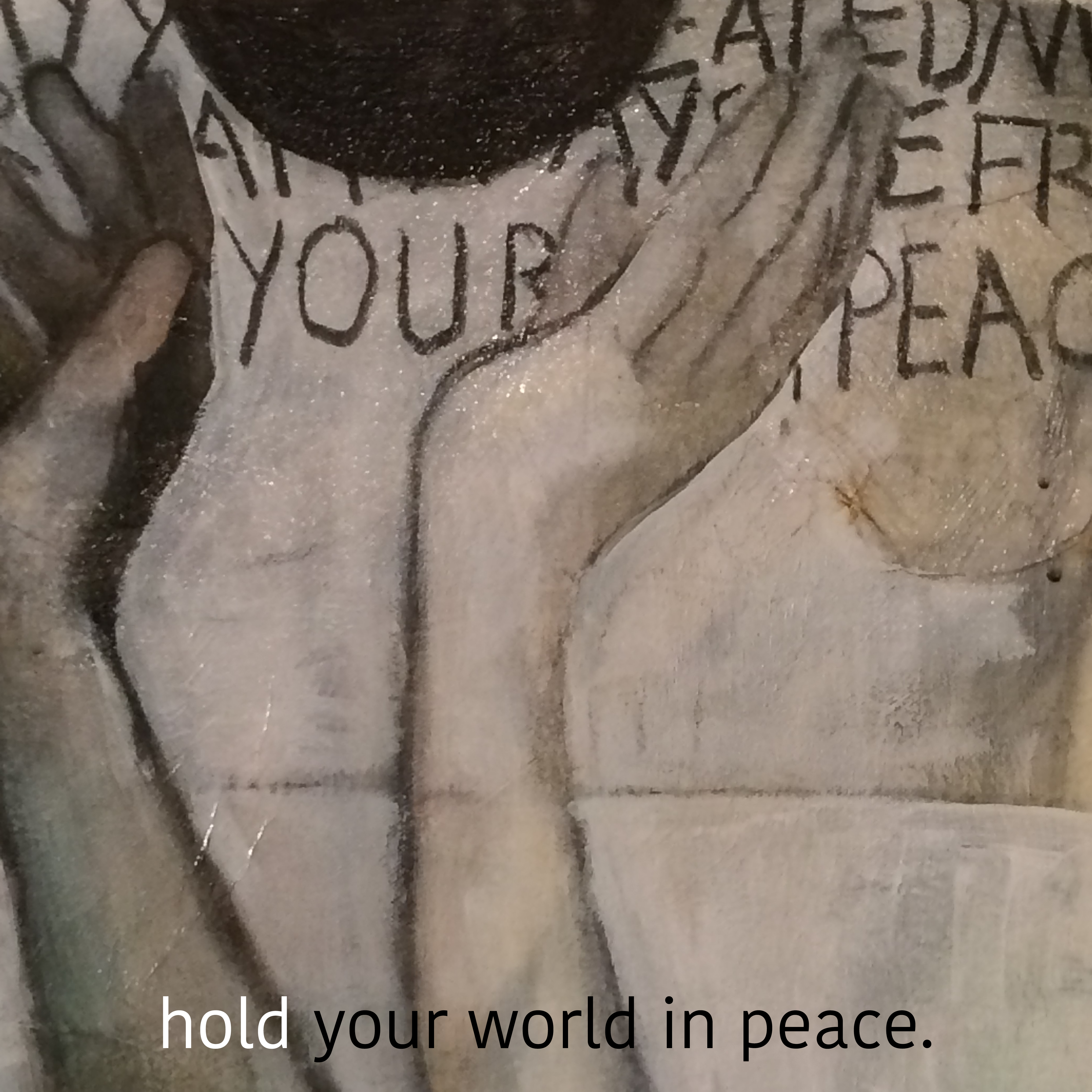
a detail of a painting I did in honor of Dawson's arrival on earth

a detail of a painting I did in honor of Dawson’s arrival on earth

“Depending upon the lens you look through, I have been a miserable failure at everything I’ve ever done,” I said. Arnie protested but we both knew it was, to a certain extent, true. And, since our conversation I have been gazing through that certain lens and feeling my failure acutely.

This lens is not new to me. I visit it each year as my birthday rolls around. It is a lens that most artists visit from time to time. To their peril. Recently, Chris, one of the most talented and hardworking actors I know, told me that now that he is far down the road of his career, no longer a beginner, he has surrendered the idea, imperative or illusion of economic success. “I work because I have to,” he said. It makes no sense and is impossible to explain to someone who does not have “that” impossible intrinsic driver. The incentives are internal. The rewards are internal. The achievements are mastery landmarks and not monetary rewards. It looks like insanity through the lens of a profit/loss, money=morality society.

When I look through the failure lens I’ve learned I need to visit Rainier Maria Rilke. I need to seek the advice of a master. “Nobody can counsel you or help you. There is only one single way. Go into yourself. Search for the reason that bids you write; find out whether it is spreading out its roots in the deepest places of your heart, acknowledge to yourself whether you would die if it were denied you to write. This above all – ask yourself in the stillest hour of your night: must I write? Delve into yourself for a deep answer. And, if this should be affirmative, if you may meet this earnest question with a strong and simple “I must,” then build your life according to this necessity;….”

...closer in

…closer in

My life is built upon this necessity. No amount of comparing it to others is useful. No other lens is healthy. Since moving to Kenosha from Seattle, I am fond of telling people that in my move I committed economic suicide. That is a statement made looking through the wrong lens. Here is the truth: Since my move I have published my book, The Seer. I produced and performed in what I thought was the greatest heart-project of my life, The Lost Boy. It played to sold out houses and fulfilled a decade long journey and commitment to Tom. Two months later I did what I now think was the the greatest heart-project of my life when I illustrated and Kerri and I published Beaky’s books, The Shayne Trilogy. Beaky had an author’s reading a mere two weeks before her passing. Last year I authored drew and submitted with Kerri over 25 cartoon proposals to syndicates. We are completing work on our next play, The Road Trip. And, in the middle of it all, I’ve done arguably the best paintings of my life. I am meeting my question with a simple and strong “I must.”

What is failure? What is success? They are lenses and they matter not.

I am living and building my life “according to this necessity.”

The whole painting.

The whole painting.


FIND ENDURING TRUTHS

a detail of an unnamed painting

a detail of an unnamed painting

Skip is in NYC and spent some time at MOMA and The Guggenheim. He sent a cascade of photographs of the great paintings he encountered. I thanked him for the uplift, the reminder of what is enduring and true in this time of post-truth-politics. He wrote, “Trying to fill my head with art and beauty and not full of fears and lies.”

My dear friend came to visit. We have generally stood on opposite sides of the political aisle though have always been able to discuss our differing points of view. We’ve always been capable, at least for a moment, to stand in each other’s shoes and identify common ground. During this latest visit, the other’s shoes were nowhere to be found. I told him that our conversations were like the particle-wave duality: he is looking at the political world and seeing a particle and I am looking at the same world but can only see a wave. Common ground was nowhere to be found. We learned that our friendship is much greater and more enduring than our politics. We went to a play, filled our heads with art that inspired intense conversation. It turns out that there was plenty of common ground available when peering at our world through a rich art-lens. Perhaps our leaders need a better grasp of the power and purpose of art.

I'm experimenting with my meditation drawings. A detail from a work-in-progress

I’m experimenting with my meditation drawings. A detail from a work-in-progress

Kerri asked me if I wanted to see something beautiful and I said, “YES!” She was standing in the kitchen looking out the window through binoculars. “It’s the fox,” she said, handing me the binoculars. About a hundred yards away, nestled into a pile of leaves, the fox was soaking in the sun. While this world seems so out of joint, teeming with discord, I found great solace on this cold winter day watching a fox curl up for a nap in a rare sliver of sun. It filled my heart with beauty and the comfort of an enduring cycle.

I’ve always appreciated the work of Neil Postman. His writing was a North Star for me when I was sailing the choppy waters of education and corporate dysfunction. Today I think he was a prophet. A few months ago I reread portions of his book, Amusing Ourselves To Death, published in 1984. This morning, after reading the news, I shook my head and read again the Forward of his book:

“…Orwell warns that we will be overcome by an externally imposed oppression. But in Huxley’s vision, no Big Brother is required to deprive people of their autonomy, maturity and history. As he saw it, people will come to love their oppression, to adore the technologies that undo their capacities to think.

What Orwell feared were those who would ban books. What Huxley feared was that there would be no reason to ban a book, for there would be no one who wanted to read one. Orwell feared those who would deprive us of information. Huxley feared those who would give us so much that we would be reduced to passivity and egoism. Orwell feared that the truth would be concealed from us. Huxley feared that the truth would be drowned in a sea of irrelevance.”

another detail

another detail

As I find myself drowning in a sea of irrelevance (post truth, alternative fact, crowd size infatuations), I am, like Skip, reaching into the one place where I have always found unshakable truth. When so many are working so hard to fill our minds with fear and fable, a walk through a museum can be salve for the soul. Time in the studio can be a re-grounding in truth, reorienting to the solid realities beyond those smoky deceptions fed to us as fact. It seems to me that intentionally filling our heads and hearts with beauty (not to escape but to feed on substance rather than ingesting so much sugar) is healthy and necessary in an effort not to become like the thing we resist.

Skip and I are not the only ones. George Orwell’s 1984 is selling like hot cakes. Aldous Huxley’s A Brave New World deserves a serious look. When truth is hard to find amidst the ranting fiction, sometimes we must turn to fiction (art) to find the enduring truths.

art prints/bags/cards/pillows/cool stuff

Kerri told me that the orchestration in this piece, Bridge, is perfect for this post: Orwellian, a bridge between truth and untruth.

BRIDGE on ITunes: Kerri Sherwood track 15 on AS IT IS

BRIDGEBRBRBSave

Save

Save

Save

Save