Draw [on DR Thursday]

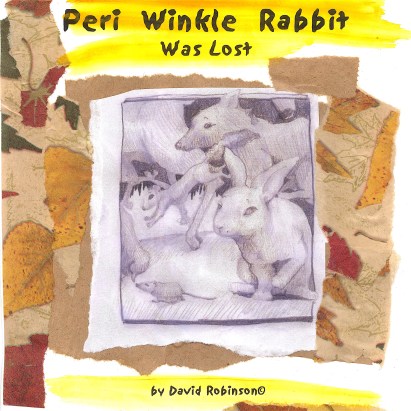
Peri Winkle Square copy

Sue’s request was clear: write a story that is hopeful but does not pretend that everything will be easy or rosy in the end.

In 2005, while Sue Eskridge was teaching a course on children’s literature at The University of the Pacific, Hurricane Katrina devastated the Gulf Coast of America. Sue had an idea. She refocused her class to help children who were displaced or had lost their parents in the storm. Her class approached several artists and children’s book authors and asked them to write and illustrate a story, to make single-copy-books. The books would be bundled with other supplies and through service organizations would go to children that needed them. “We want to give them hope but not false hope,” she said when she asked if I would “quick do a book.”

What do you do when the forest fire comes? The hurricane? The pandemic? Run. Hide. But then what? People pull together. People pull apart. The disaster invokes the best in us. The disaster invokes the worst in us. Ultimately, we realize that we are in it together and our togetherness can be defined through selflessness or through selfishness.

What defines us? I lived in Los Angeles during the riots and martial law. People turned on each other. I also saw the same community, just two years later during the Northridge earthquake, pull together. 9/11. AIDS. Our rhetoric does not define us. Our actions do.

I did as Sue asked. I quick did a book, Peri Winkle Rabbit Was Lost. I only had a few days and managed to write the story and smack out 16 illustrations. A story of personal gifts brought to communal need in the aftermath of a fire. When I bundled the original and sent it off to Sue I promised myself that I would someday go back into the story and draw all the pictures, fill in the 10 or so illustrations that I did not have time to realize.

This week, we retreated into our home, this pandemic hot and frightening and eerily invisible, except for the growing and incomprehensible numbers on the screen. The unreal reality. The hurricane that cannot yet be grasped.  I asked myself what might be a worthwhile project to do while isolating?  And then I remembered my promise to Peri Winkle Rabbit.

Draw. And perhaps a new story? One that deals with the hot fire now raging through our divided world? Two narratives. One pandemic. What are the odds that this crisis will burn off our national division and clear our eyes so that we are capable of stepping into a single story. I will ask Peri Winkle Rabbit.


read Kerri’s blog post on PERI WINKLE RABBIT


their palettes website box copy


Step Into The Ripple [on DR Thursday]

sometimesfaith WITH EYES jpeg copy 2

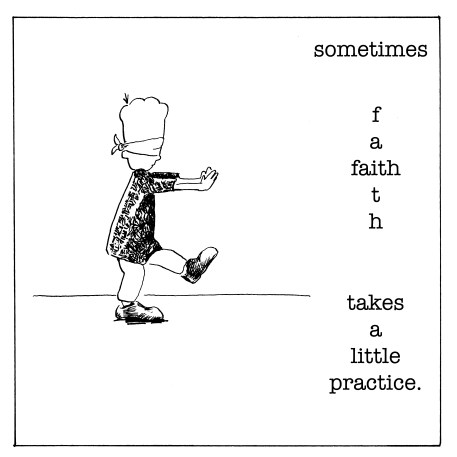
I’ve never understood faith as a religious term. Look up the word in the dictionary and you’ll come across trust, belief, and conviction. Rather than a lofty word reserved for worship day, it has always struck me as an everyday something – that becomes extraordinary when you realize how ever-present-and-ordinary it actually is. Stepping blindly. Blindly stepping. Each and everyday.

We surround ourselves with calendars and lists and routines and rituals and patterns – all necessary mechanisms to plan our days but they also serve to protect us from the truth of our walk on this earth: there is not a moment, an hour, or day that is actually known before it is lived. Every moment of every day is a step into the unknown.

The real practice of faith is not about an abstraction.  It is a recognition that walking in faith is an essential part of the human condition. The real practice is in realizing it. Being right where you are, open to the reality and empty of the illusion of certainty that you know what is coming. You do not. The true spiritual practice is to empty yourself of the need for the illusion of control.

Fully inhabiting the moment. Standing at the crossroad of past and future without the map of ‘I-know-what’s-going-to-happen’ dulling the experience.

Spiritual practices are not meant to be other worldly. They are, at their best, concrete relationships found at the intersection of past and future, in that tiny slice of infinity called “the moment.” It is a miracle of unknowns and surprises.

The practice of faith is the practice of putting down what you think you know – dropping the notion that you know what will happen- and stepping fully and with intention into the rippling unknown.


read Kerri’s blog post about FAITH


frozen lake website box copy

chasing bubbles ©️ 2019 david robinson

chicken marsala ©️ 2016 david robinson & kerri sherwood

Listen To Chicken [on DR Thursday]

putyourfingersonthekeys WITH EYES jpeg copy 2

The original conceit behind Chicken Marsala came during a road trip. Kerri and I started talking about what life might have been like had we met when we were younger. Our conversation wandered into the question of mutual children and then became utterly hysterical when we started tossing possible names back and forth. Chicken Marsala, the imaginary child of two people who met late in life, was born.

ifpapahasOCD copy 3

Chicken had friends. Chicken went to school. Chicken had a full blown imaginary life. Chicken terrified his parents, making them do and say things that they would not have otherwise done. Chicken became the inner and outer voice of two artists trying to make their way in a world where they do not necessarily fit.

All of my life people who have cut themselves off from their inner artist have asked me, “Where do I begin?” They build studios for themselves, buy supplies, and then sit, frozen. Tom McK used to tell me that there was only one answer to that question: a writer writes and a painter paints. There is no magic. The muse can’t help unless you pick up the clay and throw the pot. Write many, many bad pages and soon you will discover that you are following an impulse rather than grinding “it” out or making “it” up.

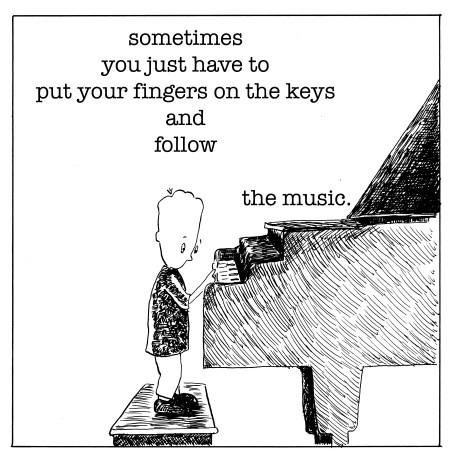
One day, someone asked Chicken’s mom a question about composing. “How do you do it? What’s your secret?” It was a question from someone desperate to uncover their long buried inner artist. What’s the secret charm, the divine key? Chicken leaned into his mom and whispered: Sometimes you just have to put your fingers on the keys and follow the music.

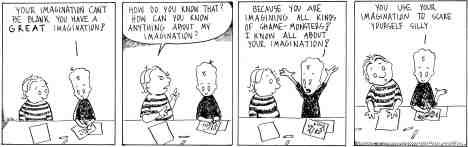
It is no mystery, after a few years banished in the drawer, that Chicken is suddenly pulling on my sleeve. I haven’t been active in the studio for months. ‘A dry spell,’ I tell myself. ‘All of my creative energy is going to other things.’ ‘I’m bored with my work!’ ‘I’m blank…’ Yada Yada. Chicken shakes his head. ‘Not again!’ He giggles.

REDOyourimaginationcan'tbe copy 3

Put your fingers on the keys. Pick up your brush. Use that great imagination to play rather than plague yourself. Follow the music. It will always lead you home.


read Kerri’s blog post about FINGERS ON THE KEYS


wideopenmouths website box copy

chicken marsala ©️ 2016 david robinson & kerri sherwood

play 2 play illustration ©️ godknowswhenprobablybeforeyouwereborn david robinson


Knit A Better Structure [on Not So Flawed Wednesday]

impact 2 copy

“…the test of a civilization is how it cares for its helpless members.” ~ Pearl Buck

As a nation, we are currently enamored with tests, and it is not a stretch to say that we’d receive a failing grade on this test of civilization. The helpless members do not fare well.

As Horatio pointed out, much is lost between the cracks of the quintessential conundrum built into the DNA of these United States: the dueling philosophies of every-man-for himself versus I-am-my-brother’s-keeper. Republicans versus Democrats. Corporate greed versus social need. Black and white thinking that leaves gaping voids into which the helpless members disappear. There is no both/and to be found. Division has been a useful tool of control since the inception of the American experiment. The ideological cleaver is sharper than ever these days.

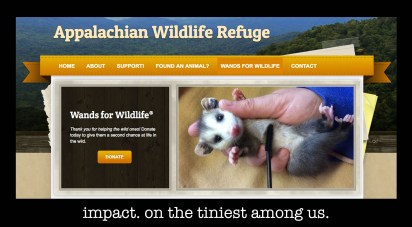
Yet, there is hope that reveals another side to our character.  Kerri said, “Look at this!” The Appalachian Wildlife Refuge put out a call for used mascara brushes. They are a useful tool in saving small critters and returning them to health. They received so many brushes, the response was so great, that they had to put limits on when they would accept new brush donations. It’s my bet that people of all political stripes and social strata sent their used mascara brushes to the Refuge. It’s my bet that the critters and the caregivers were grateful in every case.

When tragedy strikes, we rush to meet the need. When a photo moves us, we respond. Something pierces the superficial divide and reaches into our communal heart.

Robert Fritz teaches that behavior is like water, it follows the path of least resistance. If you want to change behavior, you must first change the underlying structure of the land. What might it take for us to challenge this superficial concocted divide, to reach deep  into our DNA and knit a better structure of the land – something more useful and more profound than perpetually dueling philosophies? What might it take for us to put down our cleaver and pick up our mascara brushes? What might we imagine and create together that would help history give us a better grade on our test?


read Kerri’s blog post about IMPACT


bonfire website box copy

Leave It At The Door [on DR Thursday]

assumeawe WITH EYES jpeg copy 2

There is a simple exercise that I am particularly fond of but less than terrific at practicing. It goes like this: don’t drag yesterday’s trash into today. See this day as it is: new. Live this day without the control fantasy of believing that you know what will happen, that you know or can control what other people think. Recognize that the burden you carry is exactly that – something you carry. Put it down for a spell. It will be there when you are ready to pick it up.

It’s not an exercise in denial. It’s actually the opposite. It’s an exercise in dealing with the real moment rather than the imagined monster. You’ll be amazed at the world of light, color, and possibility that opens when yesterday’s trash stays in yesterday, when the weighty story wrapped around the past-moment drops away.

I used to tell my actors, when entering the rehearsal hall, to leave their day at the door. Rehearsal halls, like artist studios, are sacred places. The art of the theatre is the mastery of presence and it’s a necessary skill to tuck the story-of-the-day into a safe keeping box before stepping onto the stage. And, what if, as master Will wrote, all the world is a stage? It seems to me that the art of living is the mastery of presence.

I call it the “garbage layer,” those moments when I am first coming out of sleep. Coming up from the bottom of the slumber-ocean there is a surface layer where all the trash floats. It is coming through the garbage layer that I have the option of leaving behind or picking up yesterday’s flotsam. The nagging to-do list, the contention, the worries, the fears and fights can all be scooped up and hauled into the new day or the story-of-yesterday can be left at the door.

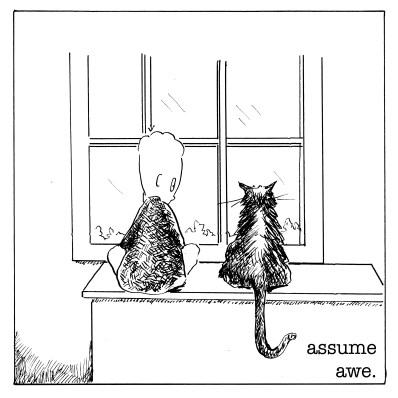
And when I leave yesterday’s garbage in yesterday? An entirely different set of experiences and assumptions become available. Awe at the light in the trees. Awe at the smell of coffee brewing. Awe at the sun and the enormous cat that purrs when I sit close.

[Chicken Marsala was one of our cartoon creations. He tickled the syndicates but never got picked up. We love him still. We designed all manner of cool prints, cards, cups and other stuff that you can find here]


read Kerri’s blog post about ASSUME AWE


chicken and dogga roadtrip website box copy

chicken marsala ©️ 2016 david robinson & kerri sherwood


FaceTheSun copy

face the sun, mixed media, 18 x 24IN


chicken marsala ©️ 2016 david robinson & kerri sherwood

face the sun ©️ 2019 david robinson


Tickle Open The Closed [on Merely A Thought Monday]

eleanor roosevelt copy

It used to be one of my favorite exercises to facilitate. Ask one person in a small group to tell a story of blame. Ask the rest of the group to invest in the story. In no time the small groups would be indignant, talking over each other in disgruntlement. A klatch of agitated victims, howling.  They’d laugh in their aggravated frenzy. They’d devise clever revenge or ways to torment the object of their blame story. They’d grow a monster.

Blame stories are like sugar. They are easy to eat and highly addictive. There’s rarely any real substance, so much gossip-cotton-candy, but there is an odd pleasure in playing the role of  “the injured party.” The groups would always reflect that the exercise was fun. So much so that they’d often forget it was an exercise. Commiseration and validation, after all, are the point of a blame story. That, and making someone else responsible for how we feel.

Ask the same groups to tell a story of choice or opportunity and most times, after only a minute or two, they’d sit in silence. Their, “Great. That’s really great,” support would dwindle. Feeding an idea is not nearly as easy as feeding a story of blame.

Quinn used to tell me that creativity is not for the faint of heart.

The groups were always shocked to discover how much of their lives were spent chewing the gristle of discontent, of feeding the notion that someone else was to blame for their choices or their circumstance. They’d generally comment on how easy it was to commiserate and how difficult it is to question, challenge or stop the blame-game. Mostly, they were shocked to discover how little of their time they dedicated to feeding ideas, theirs or another persons.

Blame stories are easy because they are reductive. They engender tight little balls of closed minds and closed circles. They close hearts. They take almost no energy at all to spark but, once burning, like a wildfire, they are capable of consuming entire forests.

Idea exploration is expansive. Seeing possibilities requires eyes that look up and out.  It takes much more energy to imagine, to question, to ponder. To try. To experiment. To ask. To challenge what you think you know. Opening minds, opening circles and hearts requires a deep sense of self-responsibility. It requires an even deeper sense of responsibility to others.

One of the purposes of the artist is to open closed circles, to tickle open closed minds. To help their community see anew and entertain never-before-imagined possibilities.

It takes more effort and courage to sail to the edges of the known world than it does to hang out around the water cooler and complain about others. Great minds do not have more capacity than any other mind, but they do require a very different focus.


read Kerri’s blog post about GREAT MINDS & IDEAS


k&dbw backs website box_ copy


FaceTheRain

feel the rain, mixed media, 2019

Find The Quiet [on DR Thursday]


I paint figures. I’ve never been a landscape painter or a painter of abstracts. I want to touch the spirit within the body.  I want to wander through the inner landscape.  I want to find the quiet-power places.

I didn’t know what to call this painting so Kerri named it A Little Modesty. I liked the name. Synonyms of modesty: unassuming, humility, simplicity. These are quiet-power words.


read Kerri’s blog post about A LITTLE MODESTY


drc website header copy


laughing website box copy

a little modesty copyright 2012 david robinson

Value It [on DR Thursday]

DawsonDetail copy 2

“Creativity is a dance where the flow of the eternal gleams through the brittleness of time and the distance of space.” ~ John O’Donohue, Beauty

The arts are so often seen as unnecessary. They don’t pencil out. Hard to make money, yada yada. The budget just submitted by the current administration once again is attempting to cut the funding for and kill the National Endowment for the Arts. “A waste of money,” they say.

No way to measure it. Can’t be reduced to a spreadsheet.

Kerri was recently asked by her employer to calculate how many hours per week she spent working on her music. “What constitutes working on it?” she asked, “I think about it all the time. I’m constantly listening for and searching out good music. Does it qualify as working on it when I sit to play, to compose, to noodle on an idea?” She sighed the sigh that all artists sigh when asked to reduce their artistry to a number. “Maybe 125 hours a week? Does a lifetime playing, composing, conceptualizing, conducting, rehearsing and leading choirs count in my working on it” she quipped. They didn’t smile. The committee got together and determined her value based on their spreadsheet.

We know that when a society disappears from earth it leaves behind art and artifact. We discover what was important to the society by the arts they produced.  The architecture, the pottery, the scribbles on a cave wall. Their values expressed. Their arts – like ours – are the eternal gleam pressed into specific forms.

The arts are nothing less than the glue that keeps a society together. The common story is, after all, a story, and it is told through literature and theatre and dance and music and painting.

One of the necessary first acts of every dictator, after identifying a scapegoat, is to eliminate the artists, the thinkers, and the educators. It is a control strategy: rend the common story. Split the people. Then, make questioning and expressing a crime. Diminish reason. Eliminate the voice of imagination and reflection. Vilify the voice of dissension. Appeal to the reptile brain [that part of your brain that deals with the basic functions but has no reach into higher order thought].

Asking the question “why” and challenging the group-think is the artist’s and academic’s job. To discern between truth and lie. To open eyes. To open hearts. To open minds. Value beyond measure in a free society if the society values its freedom.

Yada yada.


read Kerri’s blog post about NEW MOTHER


bonfire website box copy


new mother ©️ 2017 david robinson


Do Like Duchamp [on Two Artists Tuesday]

doorknobs copy

Roger used to say that Picasso’s paintings determine the shape of our cars. He meant that “seeing” is not passive. Just as audiences in a play wiggle in their seats at seven minutes into the play, the usual time for a commercial break on television, our visual sensibility is also patterned and mostly culturally uniform. Beauty is in the eye of the beholder and that eye has been conditioned.

One of the great moments of visual conditioning came in 1917 when Marcel Duchamp entered his “readymade” sculpture, FOUNTAIN, in an art exhibit. FOUNTAIN is a urinal. He signed his readymade scultpture R. Mutt. It is possible to spend many days of your life reading about FOUNTAIN, the symbolic meaning of a toilet, the then-new art term “readymade” and the challenges readymade-as-art posed to the art world, how Duchamp came to enter a urinal in an art exhibit. In that moment of time, a whole new genre was born: conceptual art. The idea behind the work is more important than the finished piece.

You can draw a straight line from Duchamp’s toilet to the recent banana duct taped to the wall by Maurizzio Cattelan. And, you might ask, just what was the idea behind the banana?

You can draw a straight line from Duchamp’s FOUNTAIN to Kerri’s out-door-voice-exclamations in a gallery, “ARE YOU KIDDING ME?” The idea behind the conceptual work generally needs a curator’s explanation. “I WANT TO EXPERIENCE IT, NOT HAVE IT EXPLAINED!” she gestures wildly, sending other patrons fleeing. In that moment, my wife becomes exquisite performance art.

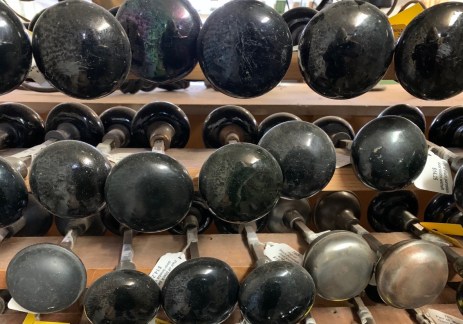
You can draw a straight line from Duchamp’s urinal to my inability to walk through an antique store and not see elegant design worthy of Louise Nevelson. Racks of door knobs. Stacks of suitcases. A wall of bric-a-brac, the wall composition more meaningful and beautiful than any of the individual pieces displayed.

A statement from Captain Obvious: artists live in a time and the art they produce is an expression of that time. Duchamp put his toilet on a pedestal in 1917, the year the world was nearing the end of the first war to end all wars. It was a horror story. The manufacture of stuff was hitting its stride.  The Royal Academy had a lock on determining what was considered art and what was not. The rules of polite society felt dangerous and suppressive. Duchamp, like all change agents, pushed against the norm.

There is composition and design in the everyday. There is human-created beauty all around us. We learn in school that form follows function and form is design. We learn in school that one of the purposes of art is to create beauty. Another purpose is to shock people out of complacency, to see what is in front of them and not what they think is there. Beauty usually lives beyond what we think.

We live in very confusing times. We are asking fundamental questions about truth, about social norms and what is acceptable. We are asking questions about who we are and what we believe. You can draw a straight line from Duchamp’s FOUNTAIN to our current confusion. Is it art? Is it not? If the idea is more important than the final expression then what happens when all that is left to see and touch is absent of the idea? What happens when the curator is gone and only the urinal remains? Sense breaks down.

What happens to  the eye and ear that is shocked open but refuses to see what is right in front of them and, instead, retreat behind the fortress of what they think?  What happens when form no longer follows function but things flip the other way around? What happens when form IS function? Propaganda, mostly. A naked emperor and plenty of people passionately swearing that they see clothes. Readymade thought.

We live in those times. Sense breaks down. We tape bananas to walls and issue a certificate of authenticity.


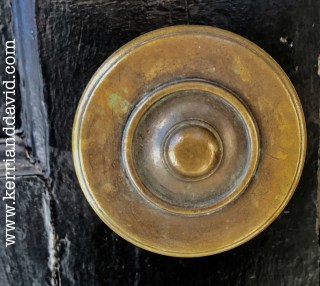
read Kerri’s much-less random blog post about DOOR KNOBS


frontdoorknob website box copy


Thank The Muse [on KS Friday]

two wrists copy

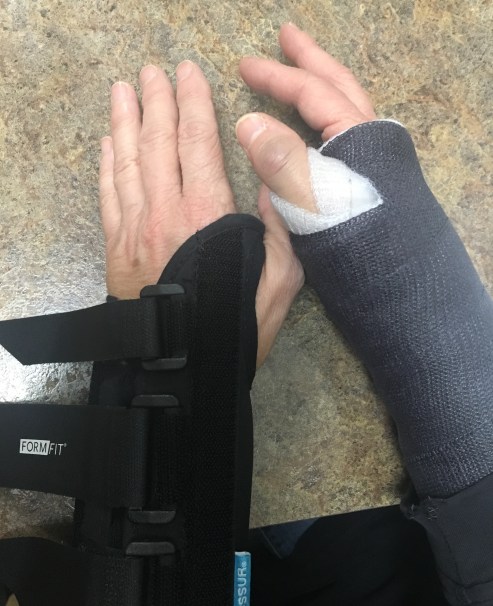
She said in jest, “I should take the next two weeks and record an album. I’ll call it Two Broken Wrist!” I would have laughed except she was playing the piano when she said it. Four days after the fall. The day after the cast. Were I blindfolded I would not be able to tell that she has no use of her right thumb and limited use of her right fingers. The fingers on her left will spread as far as the sprain will allow. I muttered in my new role as mother hen, “Don’t hurt yourself.” And then I closed my eyes.

Her playing left me slack-jawed. She has her doctor’s permission to play (“It’ll be good to move your fingers but don’t expect too much and don’t push it.”). I wish her doctor was standing beside me. She’d have laughed at the absurdity of the image. The disjoint of sound and image. I’d ask the doctor if this was what “pushing it” looked like?

It is, of course, what most people do not grok. Artists need to do-the-thing-they-do. If they don’t, they implode. It makes no sense but very few life-callings make sense. There is a deeper imperative at play. A muse must have satisfaction. Monet painted when blind. Was he pushing it?

Kerri played the piano. She had to. Her greatest fear, the largest monster in her closet, is the loss of her hands. She had to approach the keys, to visit the abyss, to see if the monster had her by the wrists or if she could push it back into the dark. Her words, ” “I should take the next two weeks and record an album…” was a celebration. It was a moment of soul-sighing-relief. The monster whined and vanished. I closed my eyes, not to spare myself the image of her possible pain, but to whisper a thank you to the muse. In my estimation, there has never been a more beautiful piece of music played.

There is a long road ahead.

I hope she records that album. The clucking you hear in the background will be me, reminding her to go slow, to take it easy. You won’t be able to hear her eye-rolling reply, but it’s there, too. Trust me.


read Kerri’s blog post about TWO BROKEN WRISTS


ks website header copy


their palettes website box copy