I am ever so slowly working on a painting. In my mind it is a political statement which is why my movement is glacial. I sit in my rocking chair staring at the work-in-progress and wonder if what I want to say needs to be said. I wonder why I need to say it. I wonder if paintings that “say it” are worth painting at all. My teachers and mentors, all of them, taught me that great art happens when you “say it without saying it”.
Dogga stands in the middle of the snowy yard and barks. These are test-barks. Nothing is happening in the neighborhood and he wants something to bark about. In the absence of a meaningful bark objective, in the absence of other dogs barking in the neighborhood or the neighbor starting his car, he barks, “Is anyone out there?” Is my painting akin to Dogga barking?
Tom told me that when my beard was grey I would have a crisis of relevance. My age-peers would read my rough drafts and consider my work viable but the younger artist in my life would not. I have found that to be true. When Tom was in his middle 60’s he was arguably at the peak of his abilities yet the many, many artists whose careers he’d informed and shaped simply stopped responding to his calls. So he simply stopped trying. That was his last and perhaps greatest lesson to me: do not place your relevance in the hands of others. Follow the muse until your legs will no longer carry you. Bark and see what comes back at you.
Michelangelo sculpted his most prescient work in the last chapter of his 88 year life though he kept them under wraps since his patrons would have thought them to be irrelevant. It took the world 450 years to catch up to his Mannerist pieces.
And then there is this timeless bit of advice from a younger version of Tom: A writer writes. A painter paints. The rest is not really relevant. It’s always at this re-membrance that I stand up from my chair, put down my incessant musing, and grab my brush. A painter paints.
Posted on October 29, 2025 by davidrobinsoncreative
In every great story there are trials to be faced, especially at the thresholds. A Sphynx with a riddle. An ogre with an attitude. St. Peter with a book. Boulders that smash. Forests that come alive. Guardians of the great beyond. I thought about the trials as we crawled for hours through traffic toward the George Washington Bridge. New York did not grant us easy passage home.
The riddle must be solved. The ogre defeated. A reckoning must be made. The trials on the journey provide valuable lessons and useful tools necessary to fulfill the hero or heroine’s destiny. She plucks a single hair from the breast of the Crescent Moon Bear. It is the secret ingredient necessary to cure her husband. He enters the Grail Castle for the second time, this time with no need to pretend. They are both transformed.
The two people who drove into the city, straight into winds and sheets of rain from a tropical storm, were not the same two people who left the city. They met this trial but the story is far from over. The destiny is not yet met.
Surrounded by giant metal monsters, trapped on all sides as we followed the asphalt trail, there was no escape. There was only one way and that was through it. Ours was a lesson in patience. Ours was a lesson in presence. We-are-here-so-enjoy-this-moment. The metal monster box reinforced tools that we already possessed but too often ignore.
Enjoy this day. Appreciate this moment. Faster forward movement cannot be forced. There’s nothing gained in the metal monster box of frustration. I know patience will come in handy in the next section of our journey.
The Balinese have a phrase I’ve long appreciated: Jom Karet: it will happen when it happens.
Posted on September 5, 2025 by davidrobinsoncreative
“Your pain is the breaking of the shell that encloses your understanding.” ~ Kahlil Gibran, The Prophet
Lately we’ve been walking an out-and-back that takes us south along the water. The turn around point is the Southport Beach House. It is a sacred place for us; ten years ago, on a beautiful October day, we held our wedding reception there.
Although not consciously intentional, there is something essential about our near-daily walks to the beach house. As we approach our tenth anniversary, we find that we are reaching back. In reminiscing, we make contact with our origin story. We are appreciating the distance we’ve traveled, the hardships we’ve endured, the support we’ve enjoyed, and the profound changes we’ve realized.
In our time together, life has taken a hard rock to our shell and we are better for it. We are more capable of standing in fire. Try as it might, circumstance cannot pull us from center. We know how to discern substance from nonsense. We are no longer in a hurry “to get there” and are more than content “to be where we are”.
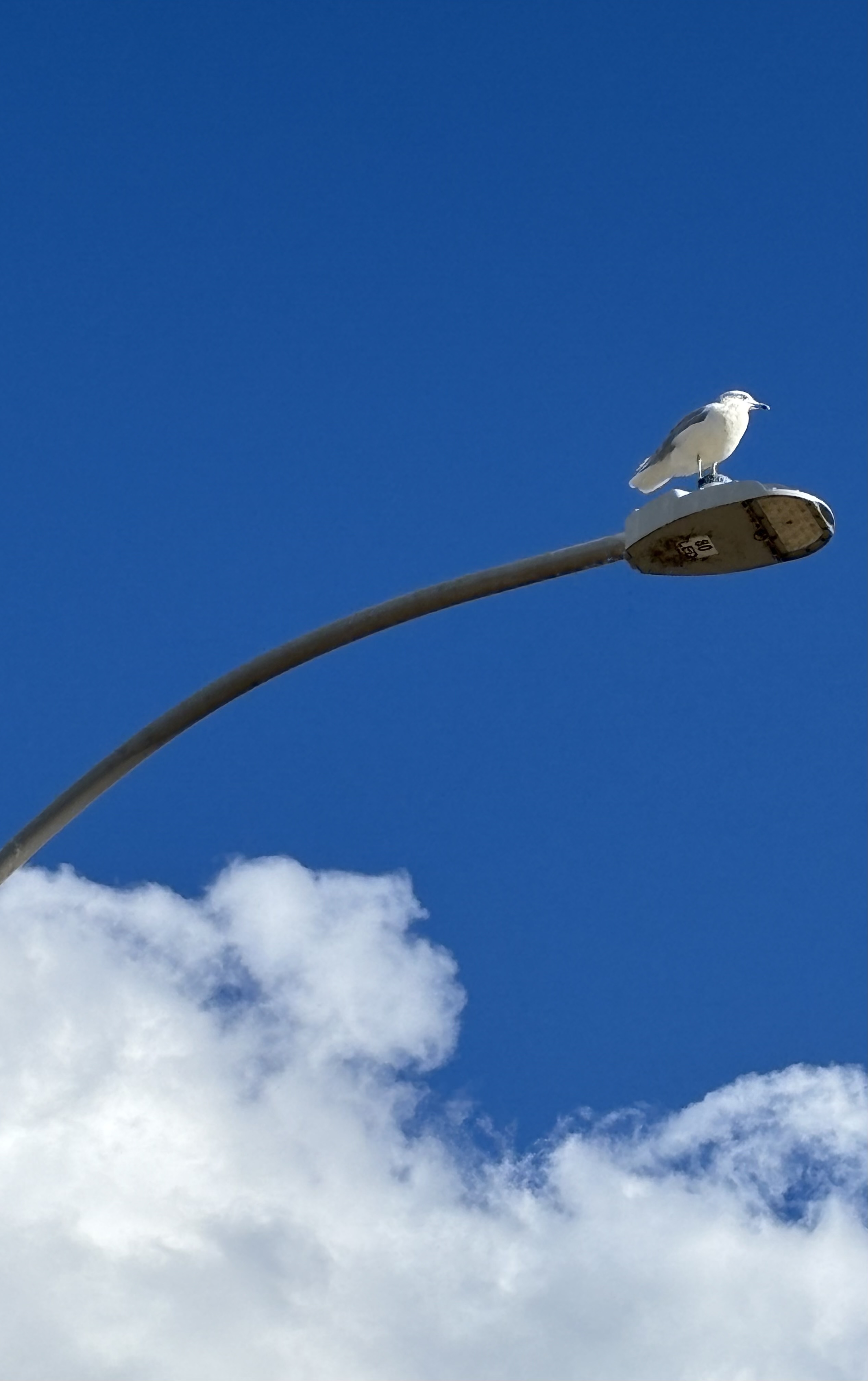
A seagull stands watch on the light post. It’s greeted us each time we’ve take the steps down to the beach on the path circumnavigating the beach house. In symbol, a seagull represents “the spirit of exploration and boundless freedom”. I like what that bodes. I have come to expect to meet this messenger on our path and why not?
I’ve had plenty of experience focusing on the hardship and bemoaning the pain. Why not now expect to meet each day the spirit of exploration? Why not assume boundless freedom? Isn’t this the very realization that now pours forth, the understanding that was once imprisoned in the hard armor that our life-pain has opened?
Posted on November 15, 2024 by davidrobinsoncreative
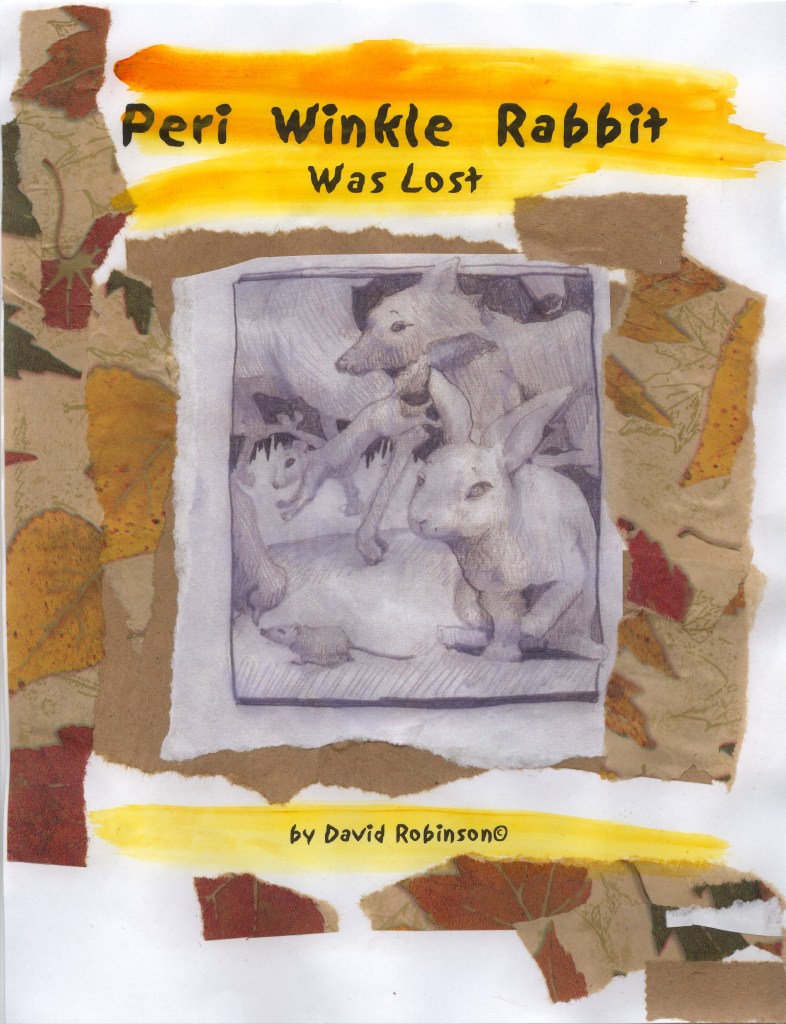
The birds on a wire brought my Periwinkle book to mind. Context is everything. It is now as relevant as the day I wrote it:
Peri Winkle Rabbit was lost.
All the other animals were lost, too!
There had been a fire. Peri Winkle was asleep when grandpa Harry Winkle Rabbit shook her awake and said, “RUN!”
Peri ran. At first, Peri ran with her mom and dad, her sisters and brothers and grandpa Harry Winkle, too.
All the other animals were running, too, the deer and the bears and the foxes and the squirrels. Some were running in circles but most just ran away from the fire.
It was confusing. There were so many legs and paws running this way and that. Peri could no longer see her parents. She couldn’t see her brothers or sisters. Even grandpa Harry Winkle Rabbit was nowhere to be found.
Peri stopped and got knocked down. She hopped back up and called out for her mother. She called for her father. She couldn’t see them anywhere.
A great paw scooped her up and she was suddenly eye to eye with a bear!
“This is no time for still standing, little ears!” said the bear.
“I can’t find my family,” squeaked Peri Winkle Rabbit. The bear was holding her very tight.
“We’ll find your family, little ears,” puffed the running bear, “But first we have to find a place safe and beyond the fire.”
The bear held Peri Winkle Rabbit close to his chest. Peri could hear the boom-Boom of the bear’s big heart as he ran swiftly away from the flames. Peri Winkle Rabbit felt so sad and so tired, she couldn’t help it when she fell fast asleep.
“Good morning, little ears!” The bear smiled as Peri blinked open her eyes.
“Where am I?” asked Peri.
“I don’t rightly know, “ said the bear, “but we’re now safe and far from the fire.”
That’s how Peri Winkle Rabbit came to be lost. She looked around and saw that the forest was gone! The other animals looked and they saw it too. All the green was now black and the mighty trees were charcoal twigs twisted in ruins on the ground.
The animals started to cry. Even the big bear cried. Peri cried, too. Together, they made lots of loud crying sounds and it felt good to wail the loss of their forest home.
And then, they each told their stories of escape from the fire. They told of their lost homes and missing family and friends. They told the stories of their cuts and their bruises, their fears and their worries. They told of how they came to be together, in that place at that time. Peri Winkle Rabbit told her story, too.
“What do we do now?” a red fox asked, which was exactly the question that Peri Winkle Rabbit was thinking!
No one said a word for a very long time. They looked at each other, all covered in soot, dirty and singed and ruffled and tired.
“Well,” a great ram began, “I am sure footed, I can help carry what’s needed.”
A hawk landed on the ram and said, “I can see far away and can help find your missing families and friends.”
The great bear said, “Yes, and I have a nose that can smell good smells for many miles, I will help supply all of my new friends with food!”
“I can gather nuts!” cried the squirrel, rubbing his nose with his hands.
“I have great ears!” cried Peri Winkle Rabbit! “I can hear what is needed and help find who can do it!”
And all the animals offered their great gifts in service to their new friends. They slowly began to do what was needed with whatever they could find. They found water and food. They found shelter from the rain. They looked for their families. They made new friends.
“Remember, a forest must grow back slowly, one day at a time,” said the bear when Peri felt impatient.” Our job is to help it grow.”
“It is all different than before,” said Peri, suddenly missing her old home.
“Yes,” said the bear. “We are all different now, little ears. The fire has changed us forever.”
Peri Winkle Rabbit wrinkled her nose.
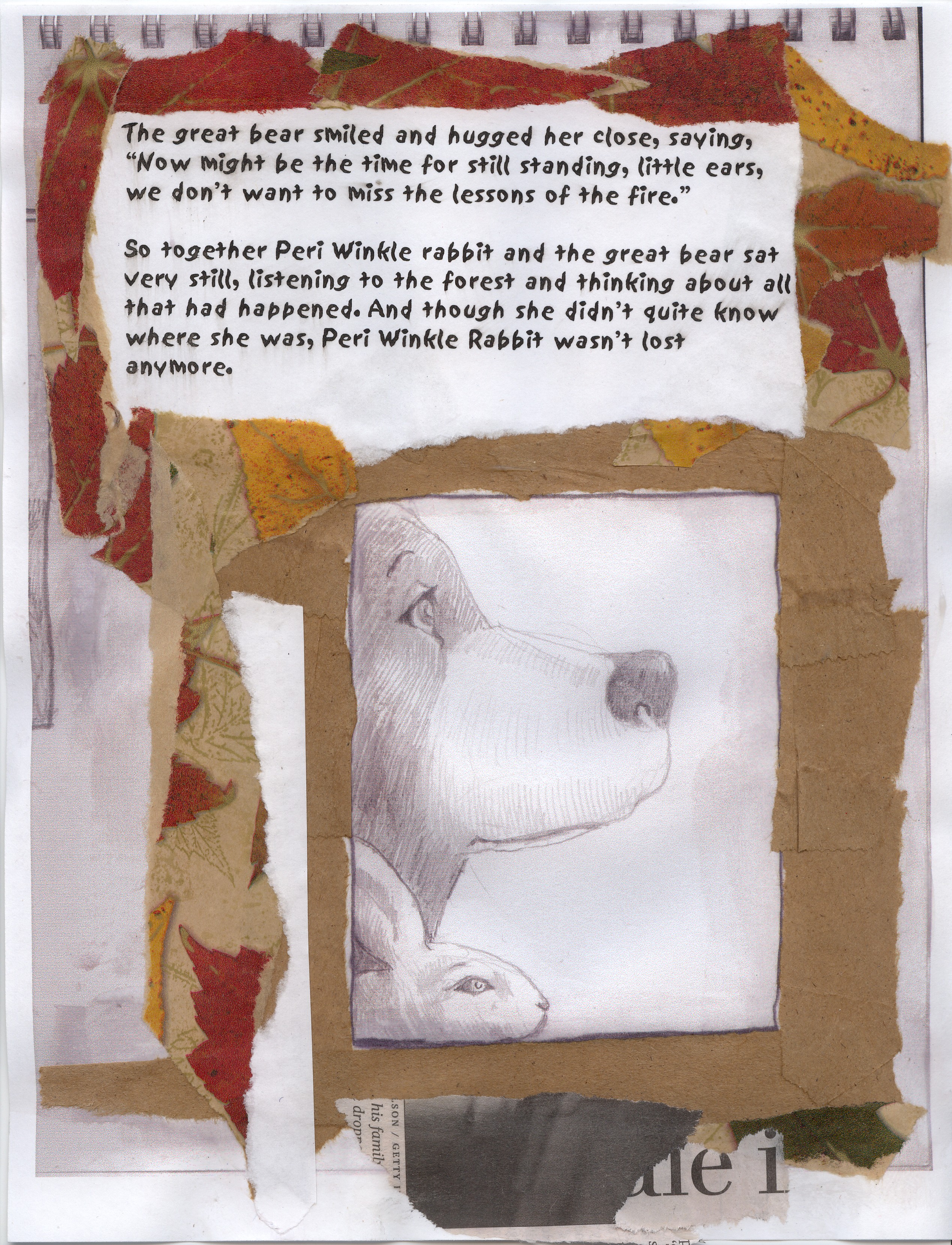
The great bear smiled and hugged her close, saying, “Now might be the time for still standing, little ears, we don’t want to miss the lessons of the fire.”
So together Peri Winkle rabbit and the great bear sat very still, listening to the forest and thinking about all that had happened. And though she didn’t quite know where she was, Peri Winkle Rabbit wasn’t lost anymore.
A one-copy book made for a child who lost their family during Hurricane Katrina. I’ve never published the full text but thought it was time. I included photos of a few of the pages.
Kerri’s albums are available on iTunes and streaming on Pandora
Posted on September 26, 2024 by davidrobinsoncreative
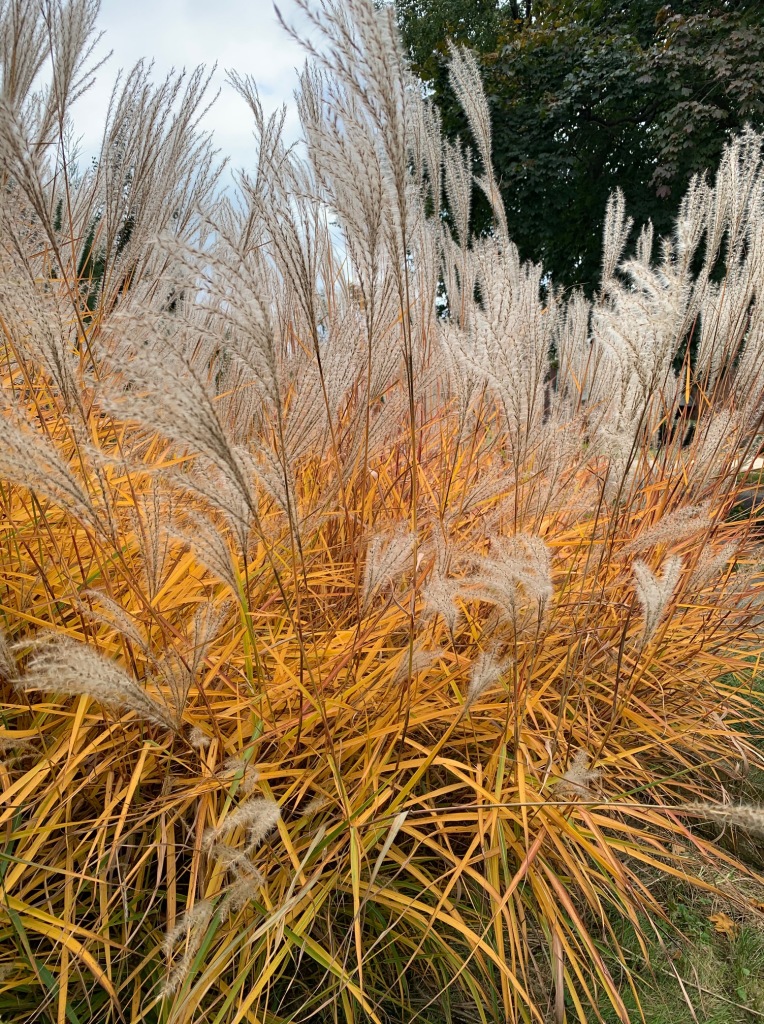
Living so close to the lake our soil is sandy so ornamental grasses thrive in our yard. Each year, rounding the corner into fall, the grasses produce gorgeous plumes. The plumes catch the light. Amber and gold, purple and crimson. The plumes catch the wind, waving and dancing. The plumes capture my attention. I am each day mesmerized by the color and sway of the grasses.
Beyond their enthrall, I have another, perhaps more important appreciation for the ornamental grasses. They have become teachers of patience. They are reminders of right process.
Several years ago we transplanted grasses from our front yard to the back. The sandy soil and constant sun made it difficult for flowers and other plants to grow along our eastern fence line so we decided to give the grasses a try. We didn’t have the resources to buy new varieties so we split the grasses in our front yard.
The result was not good. I thought I’d stunted the grasses in the front. The first year after splitting, their usual exuberance was gone. To personify them, they seemed disheartened. The newly planted grasses in the backyard were gasping. The second year was not much better. I thought, rather than watch their slow demise, it would be better to pull them and start anew. I was mortified. I didn’t know what I was doing and it seemed I’d made everything worse.
Kerri told me to wait, to give them one more season.
In the third year, both front and back, the grasses exploded into life. Ebullient. Buoyant. Each day I’d stand in the middle of the yard and mutter, “I can’t believe it.”
Kerri watched my daily mystification and asked, “Aren’t you glad that you didn’t pull them?
Now, many years later, they are huge, thriving. Little volunteers have sprouted and prosper around the pond. In fact, I now work to keep the ornamental-grass-colonies from taking over the yard.
The grasses have fostered an environment of abundance: they have become safe haven for rabbits, DeeNCee Lullabaloo (the frog-in-residence) spends more time in the grass kingdom than in the pond. The chippies have established a protected highway running through and behind the grass-cover.
And I sit and marvel at their luminance and wind-choreography. Each year I await the coming of the plumes. They fill me with life. They remind me to allow for natural growth rather than push for a result. I hope that I’ve learned their humble lesson. No matter; they fill me with awe, the reward of slow walking, the gift of patience.
Although he is mostly black, our Australian Shepherd, like most Aussie’s, is tricolor. In addition to black, he sports rich copper and white fur patches. His eyes are auburn, lively and penetrating. Again, like most Aussies, he makes great eye contact because is always on the look-out to be one-step-ahead of our next move.
One step ahead.
I grew frustrated when he was a puppy and we were attempting to train him to walk with us. He could not, would not, walk by our side. Instead, he pulled-like-a-sled-dog to be in front of us. He seemed impossible to train. And then, one day, on a walk in a forest preserve, we let him off the leash and he raced ten paces ahead of us. He was delighted and kept exactly ten paces ahead of us. The penny dropped in my slow-on-the-uptake-mind. His job, his very reason for being, is to clear our way. To keep us safe. It’s not something he thinks about or intends, it’s in his DNA.
It has become a source of great joy to open the backdoor and watch his delight, racing out in front of me to clear the yard of potential marauders. Taking out the trash has become one of my favorite things. My Dogga has my back. He has our backs. Being one step ahead of us is his job, his purpose, his reason for being. Our well-being is his well-spring of joy.
It’s funny to me now, how he has become one of my great teachers in the art of non-resistance. I thought I was trying to teach him to walk-on-a-leash and, in truth, he was trying to teach me how to better walk in life. How to get off my leash and out of my tug-of-war. How much better is life once I ceased trying to bend him to my will and learned to listen to and lean into his gifts!
This is what I’ve learned from Dogga’s teaching: there is joy all the way around.
Yesterday was a hard day for me. It sometimes happens that the smallest thing – a comment, a slight – rubs, becomes a hotspot, and blisters. The rub became the focus-of-the-day and I made myself miserable. Obsessing. I blistered.
Until the sunset.
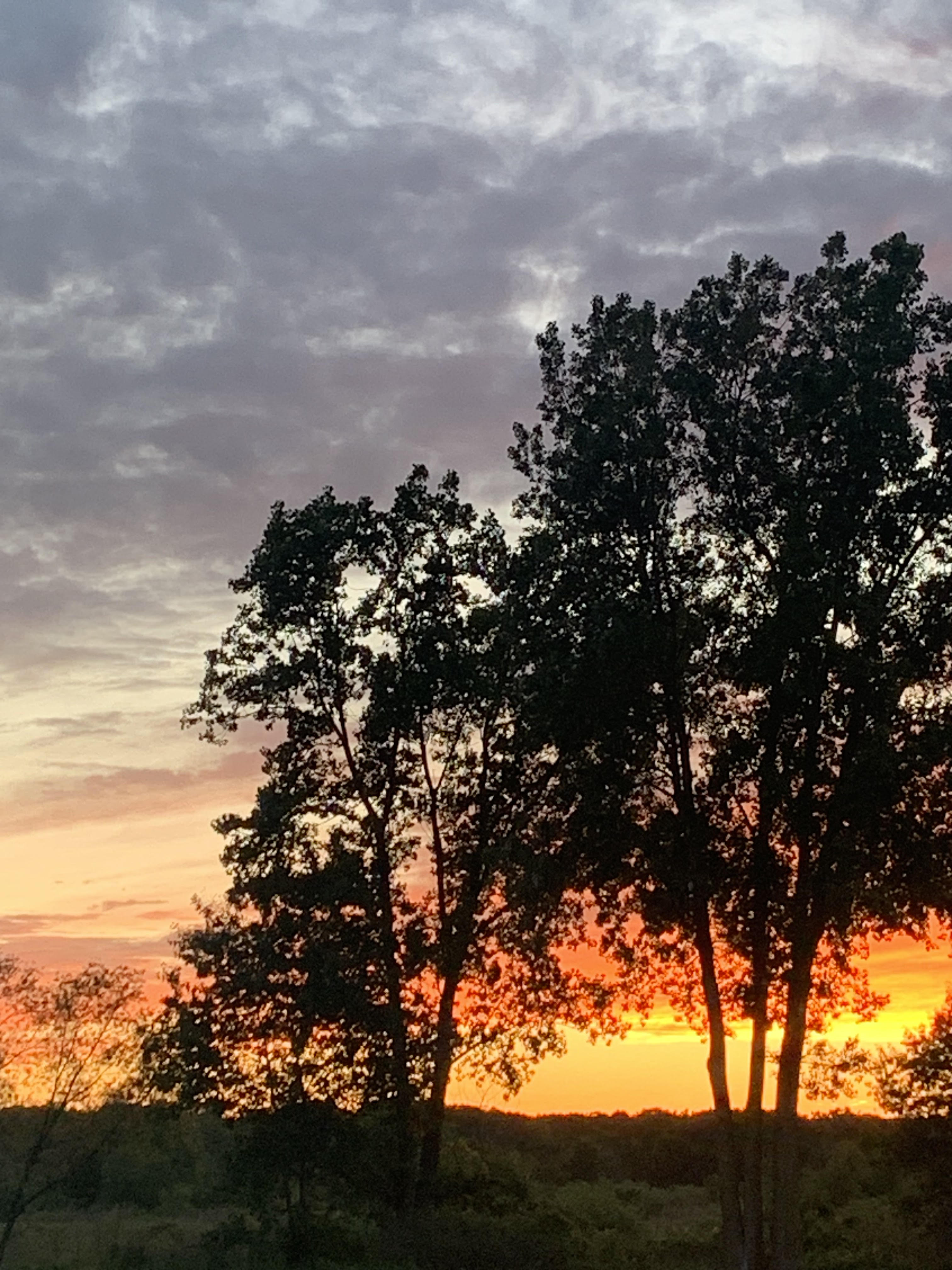
Sunset came like a soothing balm. Towering storm clouds passed through earlier in the evening. We heard the thunder and saw flashes of lightning (emblematic of my inner state of mind) but the system moved to the north so we had nary a sprinkle. And, just before sunset, the clouds parted. Suddenly vibrant yellow and orange clouds danced on a field of light cobalt blue. By the time the purples appeared, I was back in-my-right-mind. The rub vanished with the waning sun. The blister began to heal. I sighed and was careful not to ponder why I gave away the day to the smallest thing.
The smallest thing. What other people think. What happened yesterday. What I fear will happen tomorrow. What I think (ask Kerri, I have more than my share of opinions and perspectives and I sometimes lack an internal editor. If you are a compassionate human being you will immediately send to her your condolences).
What I think. The sunset dissolved my roiling inner monologue. And, again, I learned that what I think is… just that. No more, no less. I heard this phrase a hundred years ago and again last week: where your thoughts go, so too will your energy. Yesterday my thoughts went into a very dark place. So, too, went my energy. A day of my life.
The sunset brought me to a lesson I learned a hundred years ago and apparently needed to learn again yesterday: I have choice. My thoughts need not be reactive. I can aim my focus anywhere I choose. I can attach my thought like a barnacle to any-old-whale-of-an-idea-stream that I desire. And, the deep dark secret to making the thought-choice-of-the-day easy? Recognize that what I think is just that – what I think – no more and no less. Lose the import. Drop the judgment. Let go the valuation. Recognize it for what it is.
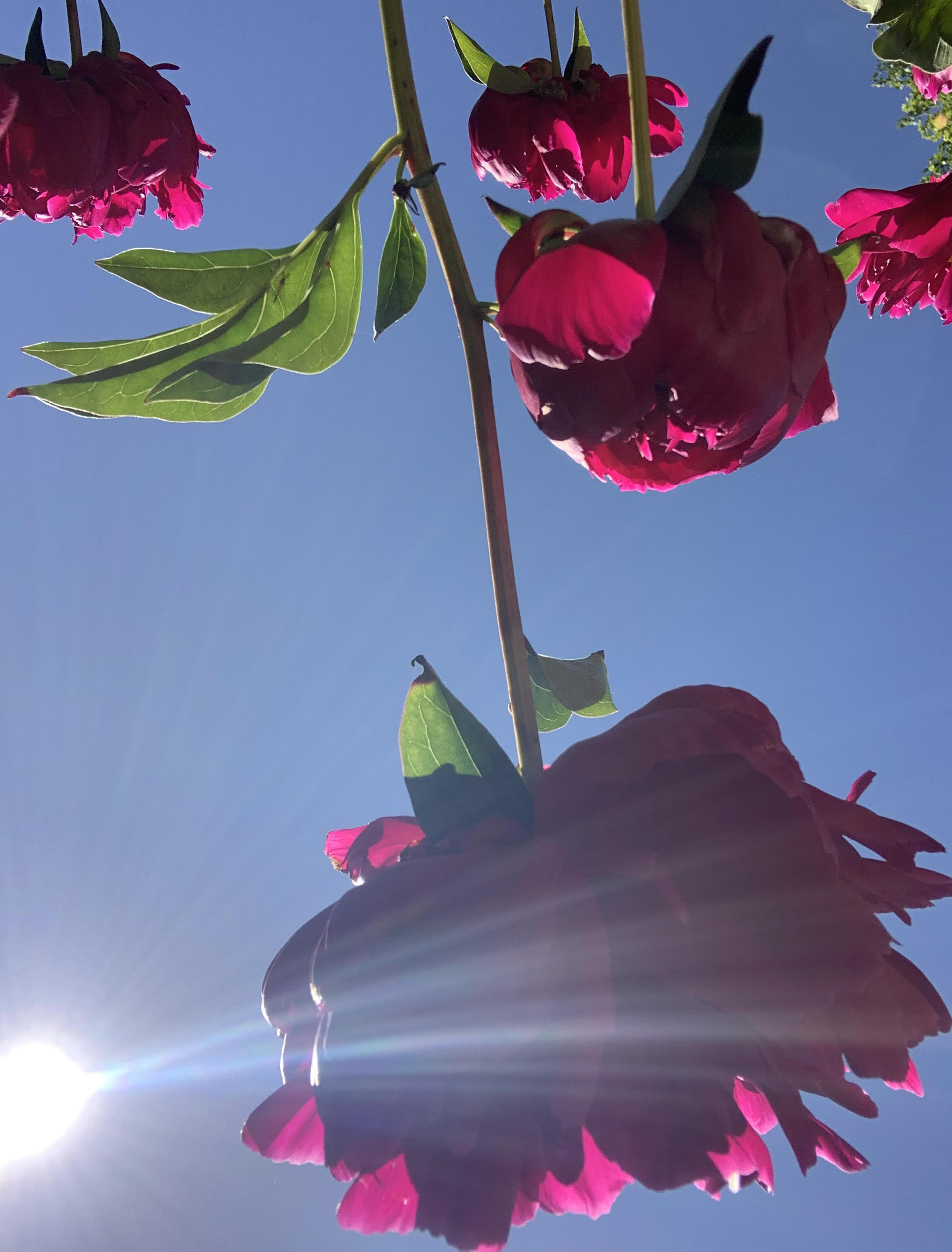
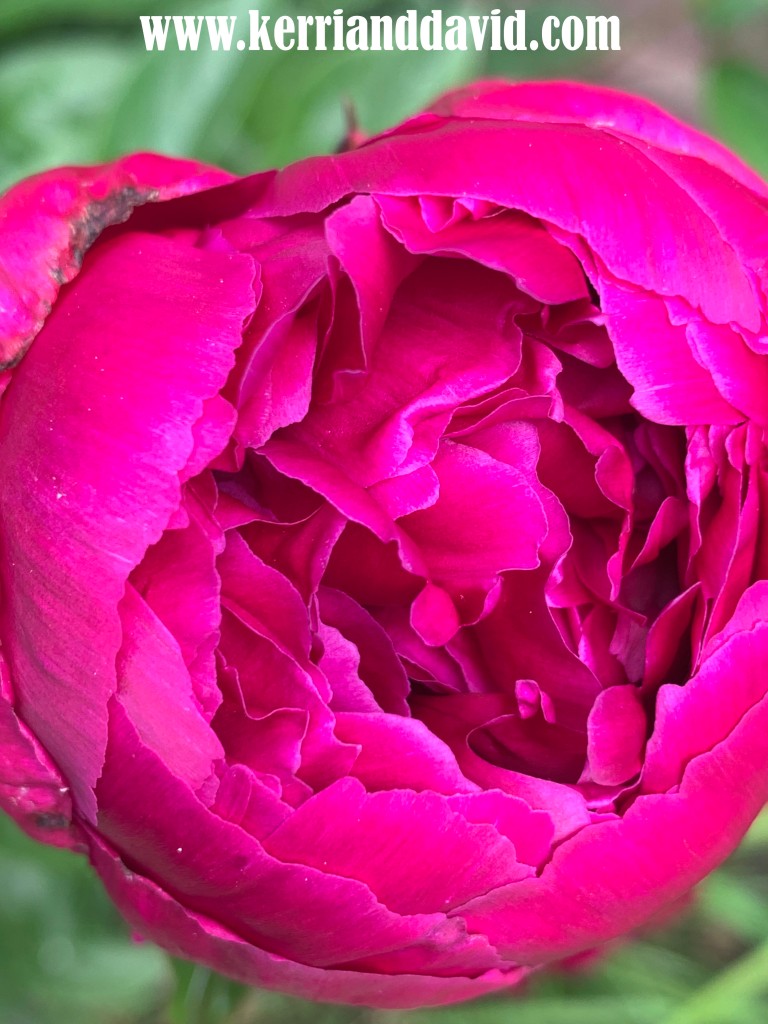
This peony-perspective begs to be the inciting image of a children’s book. I imagine the main character comes from a world where people are smaller than flowers. Where bumblebees are happy Ubers delivering their small human riders to distant neighborhoods when they need a lift. Where nature is magical, playful and esteemed.
Not all ideas make it to the final draft so it’s important to stack up the ideas and have fun with the images. The main character sleeps inside the peony. The Uber bees are chaotic fliers and one never knows where they land; in this world, destination is always a surprise. Spontaneity is the norm.
In this world where people look up to flowers, “Home” is everywhere for everyone – so people, unacquainted with ownership or territory, have evolved as intrinsically helpful. Generosity of spirit is a highly prized character trait. Survival is not of the fittest but of the kindest.
Hummingbirds know the secret of finding sweet treats, caterpillars know the secret of patience.
Since this storybook is evolving as a sweet utopia, it begs the question, “What’s the conflict?” Stories do not work without obstacles. The bigger the better. What is the lesson our main character must learn? What gets lost that must be found? Maybe our little person, like Adam and Eve, falls out of their garden? Perhaps an Uber bee unwittingly flies our hero/heroine through a magic portal, to a place where people are bigger than flowers? In a world that seems sad and upside-down, the question becomes, how does our little person, lost in the land of big, find their way home?
Posted on January 1, 2024 by davidrobinsoncreative
“I would love to live like the river flows, carried by the surprise of its own unfolding.” ~ John O’Donohue
Day one. A mimosa. A special breakfast. A question: what will this year bring? In truth, it’s the umbrella question to the question we ask each morning. What will today bring?
Kerri keeps a calendar. Each day of the year she records special events, bills paid, meals made, important phone calls. She records the sacred and mundane. On the last night of the year or the first morning of the new year, we read her calendar. Each review is chock-a-block with surprises. “I forgot about that!” we exclaim.
And, with each calendar review, comes a ritual final summation: the year past was nothing like we anticipated. What was thought to be solid exploded. What was thought to be predictable was volatile. It was a rolling ball of surprises. It was defined by the unforeseeable.
It is always a rolling ball of surprises. Births and deaths. The losses leaving holes in our hearts yet making new space for love’s expansion. New trails discovered and old friends found. New friends, too. The obstacles that jumped in front of our path. The obstacles that suddenly and without warning disappeared. Old fears roaring to be heard. New fears sending us running in one particular direction: away. Then, the deep well of laughter that bubbles to the surface when we realize (as we always do) that our fears are mostly made-up. Tiny monsters. Shadow puppets.
As we read the calendar we are surprised by our courage in some moments and our cowardice in others. We are particularly amused – or not – when our cowardice appeared to be courage and vice-versa. There are days when the only notation in the calendar is an unhappy face, a dark day when together we completely lost our sense of humor. Gratefully, those days are few and far between.
The river flows with no regard of our notation. The trick, we learn again and again, is to welcome the surprise of its unfolding. Rather than try to swim upstream against the current-of-time in an always fruitless attempt to control, to reach for the imagined safety of the known, the lesson learned on every day-one is to give over to the mystery of the unfolding. To relax and choose to be in the flow. To welcome the surprises in all their iterations, the rapids, the rocks, the waterfalls and those rare and cherished stretches of calm.
When it’s humid our refrigerator has an incontinence problem. Upon entering the kitchen and stepping into the latest puddle, we call out as if it was normal, “The fridge tinkled again!” Sometimes I wonder if the neighbors can hear us. And, if they can, do they double-lock their front doors against our madness? Do they pull down their shades as we pass by?
We think we know the problem with the fridge’s urinary tract. We ordered a part months ago that arrived magically through the mail and now sits within view of the tinkling-fridge. It’s like knowing you’re going to need a hip replacement, ordering the part, and setting the titanium hip on the kitchen counter for months until you have the courage to schedule the surgery. “Yep. There’s my hip. Someday I’m going to install that thing…” Our new part has been in view for so long that I no longer see it. I’ve incorporated it into my visual expectations. We’re still working up the courage.
The refrigerator’s incontinence began when the ice-maker went on strike and refused to make ice. We met and negotiated but the ice-maker negotiating team is difficult. We’re having a hard time discerning their demands and are clueless about the original issue. We know the ice-strike and the fridge-tinkle are connected but are somewhat mystified by the humidity-trigger. So, in the meantime, thoroughly mystified but incredibly adaptive to our circumstance, we bring in ice from our beloved the corner market, Morelli’s Deli. We place towels on the kitchen floor.
And what might this have to do with living the good life? “Deferred maintenance is a fact of life!” Kerri insists and she is right. As I’ve learned from our sweet old house, there is always something to fix and that’s what gives our beautiful home its character. And, in the face of the obvious-never-ending-list, the best plan of action is to relax. Do what you can do when you can do it.
This may come as a surprise but, in the face of a long to-do-list, I had to learn to relax. I had to practice the skill of letting go. I’ve had to exercise the muscle of realistic expectations. I was not a willing student at first – I had to recognize that I had lessons to learn! …so many lessons…
How fortunate am I that our house is a master teacher? When you visit, I’ll show you how to jiggle the door. And don’t ask me about the cabinet handles in the kitchen! The first lesson from our house: explain nothing. Smile, relax, and say, “Yes. I know. It appears that needs fixing.”



















 The Direction of Intention