Blur The I [on Not So Flawed Wednesday]

We capture quotes all week. Some we see. Some we hear. Some find their way into the Melange. Most do not. We usually note where we heard or found the quote so we remember the context. It’s a practice. It’s not as if we are perpetually eavesdropping on conversations. We’ve simply tuned ourselves to immediately write the amazing words and phrases that catch our attention.

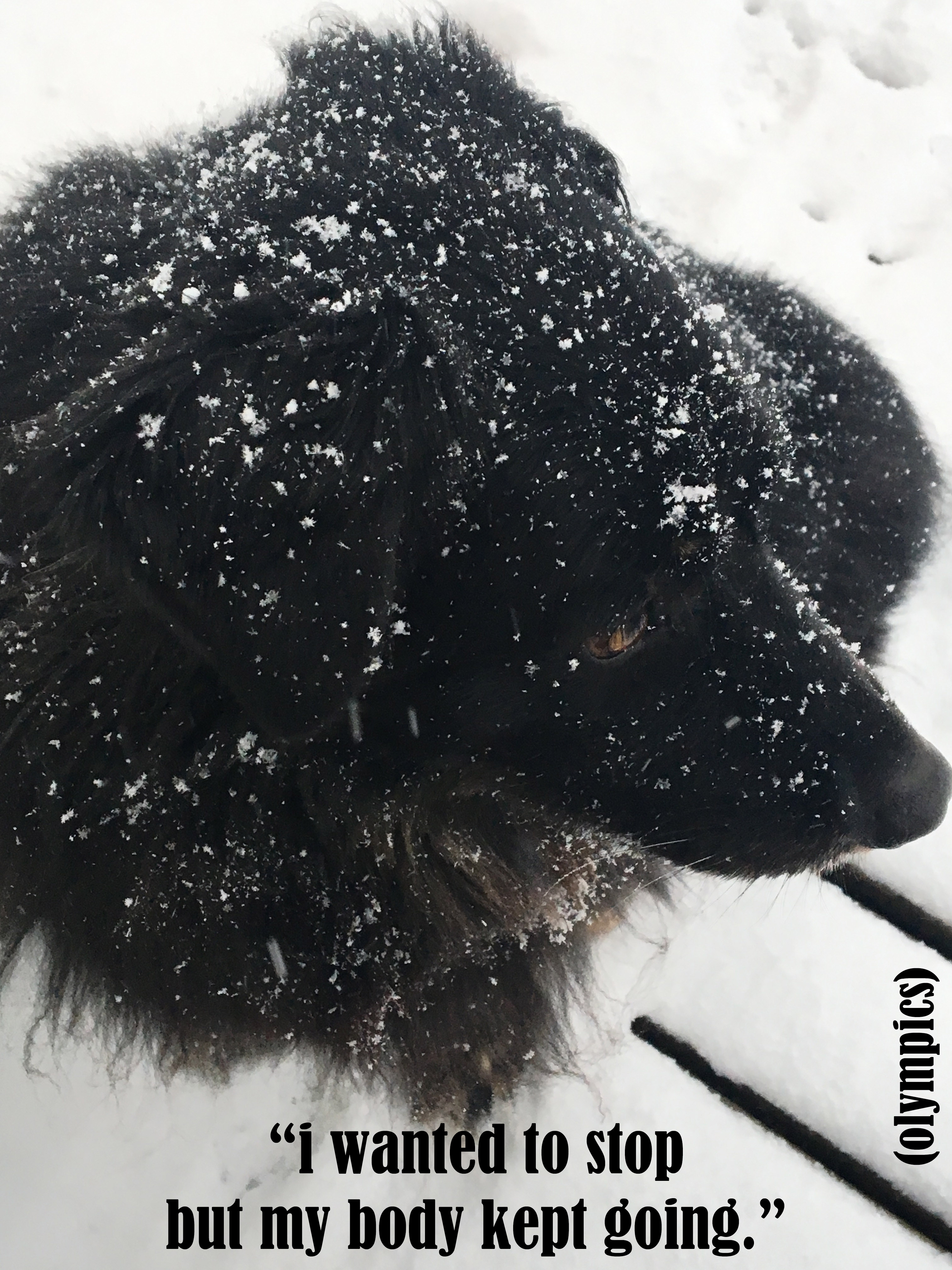
A common phrase is mind-over-matter. Athletes and actors and dancers are conditioned to ignore the limits of their bodies. To keep going. The mind as master over body. I loved this quote because it is the flip side. The mind, the “I”, wanted to stop but the body did not listen. It kept going.

Lately I’ve been reading about – so, paying attention to – the false separations that language necessitates: Mind and body are spoken of, thought of, as separate things. And, the question is this: where does one begin and the other end? Mind over matter. Body did not listen. I made myself do it. Once you start listening for it, it is ubiquitous. Exactly where is the line between “I” and “myself”? When your toe is in pain, isn’t your whole body is in pain? Follow your gut. What does your heart say?

When Dogga gets excited, his little body bounces. He runs in circles. He has to work hard to sit still. Say, “Do you want to go…” and he’s bouncing before the words “on errands?” reach his ears. He knows he won’t actually go on errands until he first sits on the rug. Eventually, he bounces his way into compliance. Control follows unbridled enthusiasm. Control is a means to an end. Rug before errands. Sit before snack.

Dogga might say, while bouncing enthusiastically, “I wanted to stop but my body kept going!”but I doubt it. Given his unified happy spirit, I’m certain the phrase would come out of his muzzle this way: I wanted to stop but I kept going. Watching him is like reading the I-Ching: no separation.

read Kerri’s blogpost about I AND BODY

Wander In Wonderland [on Two Artists Tuesday]

I’ve re-read his email several times. Skip’s explanation of the development of the computer. Subject/Object. Noun/Verb. Items/Action. It’s a story of cause and effect. This causes that. I’ve learned more from this single email than from my very expensive graduate degree. And, it’s sent me down the rabbit hole and I am currently in a world easily as miraculous as Alice’s Wonderland.

Does the moon cause the tides? It does if you are an English-speaker. Causation is the foundation structure of the English language. An action needs an initiator. The noun is king. He kicked. The sea rocked the boat. The moon causes tides. If you speak Mandarin, the moon and the tides are inseparable, not perceived or described as separate events but as interconnected. The same dance, differentiated forms.

Where does an action begin? A consequence end? I warned you. A rabbit hole.

Our perception of the world has everything to do with the language we use to describe it. Our creating of the world has everything to do with the language we use to imagine it. In a world where actions are separate from items, verbs from nouns, this causes that, it’s easy to believe that order is separate from disorder, cosmos is separate from earth, humans are separate from nature. Death is separate from life. Is it?

Each year that passes I’ve noticed the world of written communication includes more emojis and fewer words. Attention spans are shorter – mine, too. Tweet and text. Images carries the bulk of the message. If you could see the analytics on my blog you’d note that if I use more than 600 words, you are less likely to read what I write. We are slowly moving toward ideograms and slowly away from alphabets. Whatever will we do, what might we see, when nouns and verbs blend into image? When the eyes of dedicated separation begin to see through the eyes of interconnectivity – or, as Skip says, “When actions become central.”

It’s called a Wolf Moon, I read, because wolves are particularly loud and vocal during the first months of the year. One questioner asked if the moon causes the wolves to howl. Noun/Verb. Subject/Object.

read Kerri’s blogpost about THE WOLF MOON

Point The Way [on Merely A Thought Monday]

“You can accomplish with kindness what you cannot by force.” ~ Publilius Syrus

It’s one of the most interesting Wikipedia pages I’ve come across. Publilius Syrus. A life described in two sentences that conclude with this: “…but by his wit and talent he won the favor of his master, who freed and educated him. The rest of the page are maxims attributed to him. A Syrian. A Roman slave. An observer of human-kind.

We live in a world of ubiquitous maxims. They are posted everywhere, in stores, billboards, and elementary school signboards. Appeals to our better nature. Choose kindness. There are, of course, plenty of appeals to our worse nature, too. It’s as if our maxims are in a tug-of-war. I imagine that Publilius Syrus experienced in his short life both ends of the rope, the cruel and the kind, which is why he wrote so many maxims.

This quote came across my screen so I wrote it on a lilac colored post-it note and stuck it to my monitor. It may or may not be from Christina Wodtke: “When you make complex things, words eventually fail.” Life is a complex thing that words will always fail to describe or contain. The best a word can do is point to something, or the way to something. A maxim, an ideal, is, after all, a signpost, a direction. A choice of path. A point-of-view is created during those moments of choosing.

Kindness is not a thing. It’s not a word – not the word. The word simply points the way to something so complex, so boundless, that the word will always fail. But, we know it when we see it. We know it when we offer it. We know it when we receive it. We know with certainty when we choose it and when we do not.

read Kerri’s blog post about CHOOSE KINDNESS

Color The Language [on saturday morning smack-dab.]

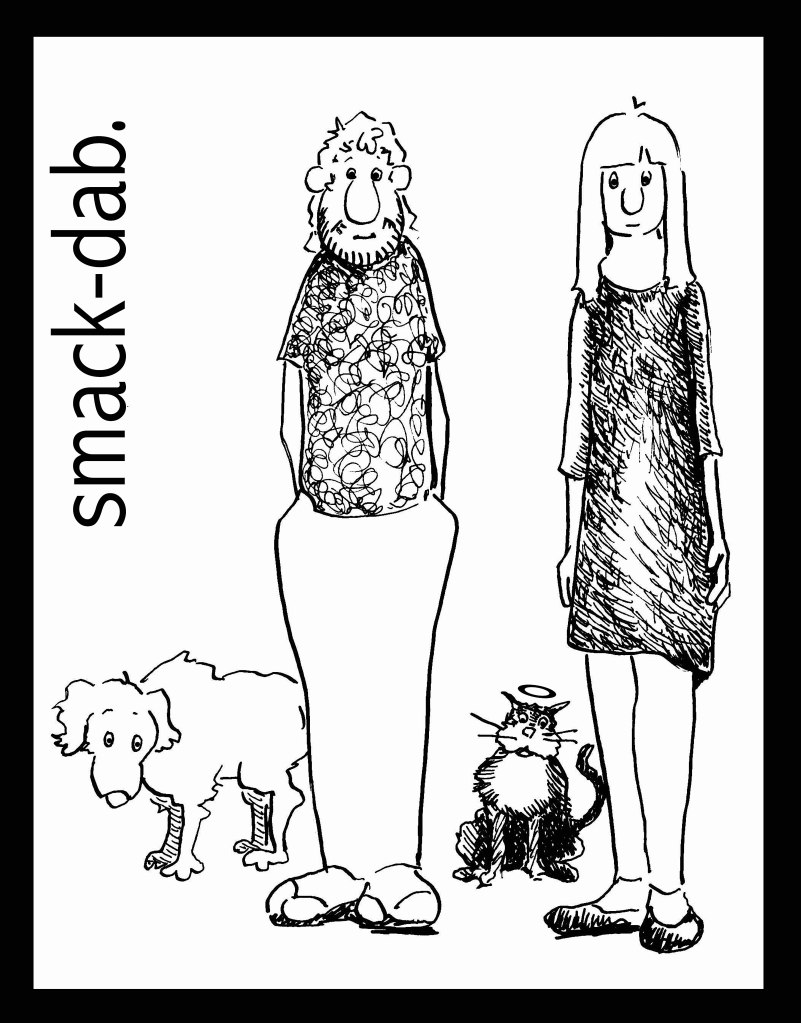
In the cartoon version of our life, Kerri cleans up my language. I never use the word “beeswax” when there are more colorful options available. I’m an artist. Color is my thing.

It’s hard to explain the inner imperative that drives an artist to spend their precious life composing or painting or dancing, even amidst the knowledge that heeding their inner call might never pay the bills. I know many, many people who’ve snuffed their artistry because it simply doesn’t make financial sense. They are now like boiled fish. The ‘”good living” that they make doesn’t replace the vitality-in-life that they ignore. Source is source.

I also understand that the answer, “Because I have to…” must sound childish to someone who has never operated out of an inner necessity or something more meaningful than making-money. I actually understand their eye-roll and less-than-subtle-but-always-predictable response about the need to “take responsibility…” They’re really saying, “Grow up.”

What I’ll never understand is the gap. For instance, Kerri’s music is all over the world. She is regularly stopped on the street or contacted by people who reach to tell her that her music moves them, touches their souls, makes their day, opens their hearts, calms their fears… And, then, she’s asked what’s she’s really going to do (for a living). Or, better, if she’ll play for free. Or why it bugs her that Pandora or Spotify make money – lots of money – on her music – and that is the reason why she is not. The gap between those two poles is…mind boggling. And, into the gap, the question is always dropped: What are you really going to do?

So, I paint the question with vivid colorful language because it makes my love laugh but definitely needs scrubbing before publication.

read Kerri’s blog post about BEAUTY

smack-dab. © 2021-2 kerrianddavid.com

Move Toward Wholeness [on Two Artists Tuesday]

When I look at the bowl of green tomatoes, each plucked from the vine before we pulled the plants from their pots, still moving toward red ripeness, I think of Joe. He was fond of saying, “Life moves in the direction of wholeness.” It’s important to note that his fond phrase included nothing about outcomes. Joe was particular and knew that life is movement and not arrival.

I am revisiting the word ‘rehearsal’ these days only this version of rehearsal is not on the stage with creative minds. It is over Zoom with decidedly analytical minds. Actors in rehearsal halls move through a process of exploration that leads to specific choices. The goal, if there is one, is to embody a state of moving presence within a story. The analytic mind comes with a template overlay that is placed atop the experience before it actually occurs. The language reveals all: content items. Telemetry. The mathematics of movement. Rehearsal is predicated on precision.

As I’ve probably written ad nauseam, these minds are not in opposition. They are complimentary. Freedom of artistic expression comes from years of study of technique. The path to mastery winds through repetition and constraint. Saying more with less comes after a lifetime of saying less with more. The creative mind is one step closer to the senses. The analytic mind applies language, gives voice, to the experience.

Many years ago I participated in a workshop with an actor/director of Noh Theatre. The process was strict, exacting. The movements precise. There was no room for error. We, the participants in the workshop, knew we’d never achieve proficiency since it takes years and years of rehearsal to perform even the simplest of symbolic gestures. No one sings opera in a day. We did our best and failed and failed and failed. That was the point. That is always the point. Each failure is actually an exercise of muscle memory. The body learns. The mind is impatient. Rehearsal is rarely about the mind, despite what the mind insists. At the end of the day, our workshop leader gave a short demonstration of his art form. His ease of movement, born from years of repetition within constraint, was breathtaking. He was free.

Many years later I was helping John in his wood shop. He was a master wood worker. I watched him look over his lumber, preparing to build a cabinet. He ran his hand over the wood, feeling his way into his project. “Ah,” he said, laying his hand on a piece of cherry wood. “This is it.” John was like the Noh actor.

“How did you know?” I asked.

“I don’t know,” he said, “it just feels right.” Then he smiled and added, “Plus, I’ve built a lot of crap.”

Life, moving toward wholeness.

read Kerri’s blog post about TOMATOES

Decide To See [on Merely A Thought Monday]

My thoughts while watching the wedding:

Oprah asked Gary Zukav this question: Where is soul? His response: Where is it not?

Exchange the word ‘love’ for the word ‘soul.’ Where is love? Where is it not?

In the English language, words like ‘love’ and ‘soul’ are nouns. Things. And, things must have limits. It is a remarkable misunderstanding, a miracle of minimization. Love, the single hardest ‘thing’ to define, in fact, impossible to define, is undefinable because it is without limit. The best we can do is point toward love-made-visible. A newborn in the arms of its mother. The moment the couple, standing before their community, stares into each other’s eyes and promises, “I do.” Watching a sunrise on an anniversary. A mother dancing with her son, the groom.

Love is. Where is it not? That means, of course, that it is “in” everything, everywhere. The air we breathe. The thoughts we think. The actions we take, big and small. It is in how we treat our neighbors. In how we see ourselves. In how we report our news. In how we tell our lies and our truths. Love is.

It is the province of no-single-religion. In fact, it is where every religion on earth goes off the rails. To claim to be “the way” or “the one true…” is to attempt dominion over love. To place rules and boundaries on the boundless.

The question Oprah didn’t ask: if it is everywhere, in everything, in war and in peace, hate and acceptance, does it have any meaning at all? If it is ubiquitous, unchangeable and indescribable, why bother? Gary’s answer, I imagine, would be something like this: we choose the form we give to our love, do we not? We can choose to put the accent on unity. We can choose to put the accent on separation. Love is. We can choose to put the accent on division or we can choose to offer our support.

There is never more or less love. Isn’t that the point? Love is beyond definition. What changes is not the love or the amount of love. What changes is what we decide to see. What changes is how we decide to see, especially how we decide to see ourselves in this world with so many “others.”

read Kerri’s blog post about JUST LOVE

Run Through Norway [on Not So Flawed Wednesday]

DogDog is a very vocal pooch. He sings his body electric, he gives full voice to his soul. There are times that I, with great delight, watch him run fence to fence, barking for the simple pleasure of making sound. He is a vocal hedonist.

Sometimes he barks and listens. He wants some dog out there to bark back, a pooch call-and-response. There is no better gift for DogDog than when one of his neighborhood pals barks in response. Pure pleasure, he runs circles around the yard. When his call does not evoke a response, he waits a few minutes and tries again. He is an eternal optimist.

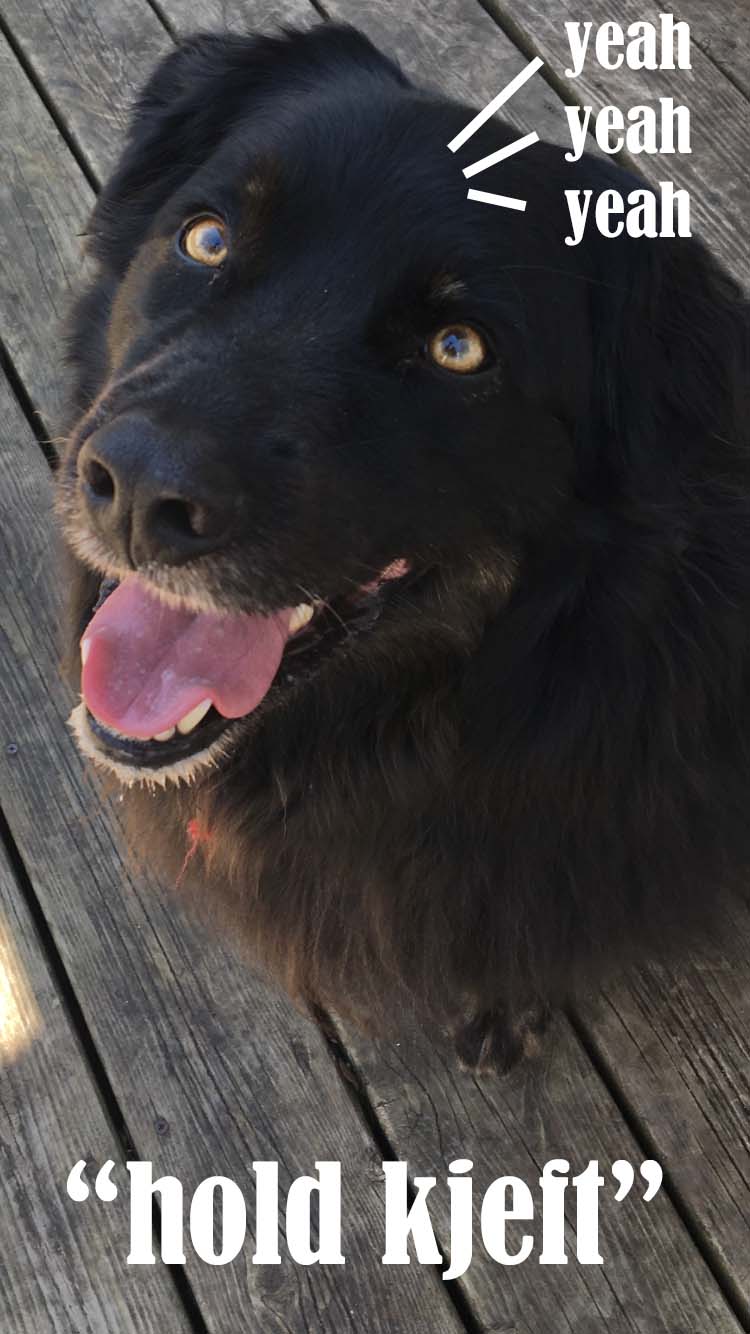
DogDog knows when he’s NOT supposed to bark. Inside the house is a no-bark-zone. When Tim, the neighbor gets in and out of his car. When Lucky, the dog that recently showed up in the yard behind ours, comes to the fence. When we are in the car, going on errands, and he sees another dog; his body quakes with full-bark-desire but he knows better. Kerri taught DogDog a bit of Norwegian. “Hold Kjeft,” she says, when we he winds up for a good bark-in-the-car. DogDog hears Hold Kjeft and he moans and whines and complains. He performs a melodramatic Medea until something else captures his attention.

Initially, she didn’t use the phrase in any other situation. Norwegian was reserved for the car. Hold kjeft, in translation, means shut-up but for us it has become a preemptive command, “no bark.” Norwegian was so successful in the car that it has now spilled out into all other situations. She never has to raise her voice. She simply opens the back door, says, “Hold Kjeft,” and all barking turns to enthusiastic circle-running. It’s magic. It’s Norwegian.

It doesn’t work when I use it. For some reason that I can’t explain, my “Hold Kjeft” elicits howls of laughter from DogDog. He looks at me and, as if to make a point, “Your Norwegian is no good!” he barks in reply. And then, to sear in his criticism, he barks again. I revert to my Frankenstein English “No Bark!” DogDog immediately complies. “That’s more like it,” he wags and runs for the back door.

Language is a mysterious and magic beast. Lately, I’ve noticed, that when I am whining and complaining and feeling like performing my version of melodramatic Medea, a tiny voice in the back of my mind whispers, “Hold Kjeft!” So taken aback by the sudden whoosh of Norwegian, my performance is short-circuited. My mind shuts up.

I look to Kerri to suss out whether that tiny voice is hers or coming from some other mysterious source. She always appears to be innocent and asks, “What?” to my inquisitive stare. “Nothing,” I reply and look to DogDog, who wags and rolls for a belly-belly.

I suspect that, rather than DogDog, it is I who am being trained. Belly-belly. Hold Kjeft. I am suddenly suspicious about my overwhelming desire to wash the dishes. What is going on here?

There is only one thing of which I am certain: my path to inner quiet runs through Norway. Hold Kjeft! On me, Norwegian works.

read Kerri’s blog post about HOLD KJEFT!

Live A Sockdolager [on Two Artists Tuesday]

Word genius sends me a word everyday. Some I know. Most I do not. Yesterday, my word-of-the-day was sockdolager. Sockdolager is a word that, when typed, is unrecognizable to the vocabulary in my spellcheck and is adorned with a screaming-dotted-red-line meant to notify me that either I spelled the word incorrectly or it’s not a word at all. Language is a fickle companion.

In Seattle, when the rains clear, people are fond of saying, “The mountain is out.” Mount Rainier, hidden in the clouds, makes a grand – almost impossible – appearance when the weather clears. Where there was no mountain, suddenly a Titan appears. It is a sockdolager, an exceptional occurrence. A forceful blow. The first time I saw it I almost crashed my car.

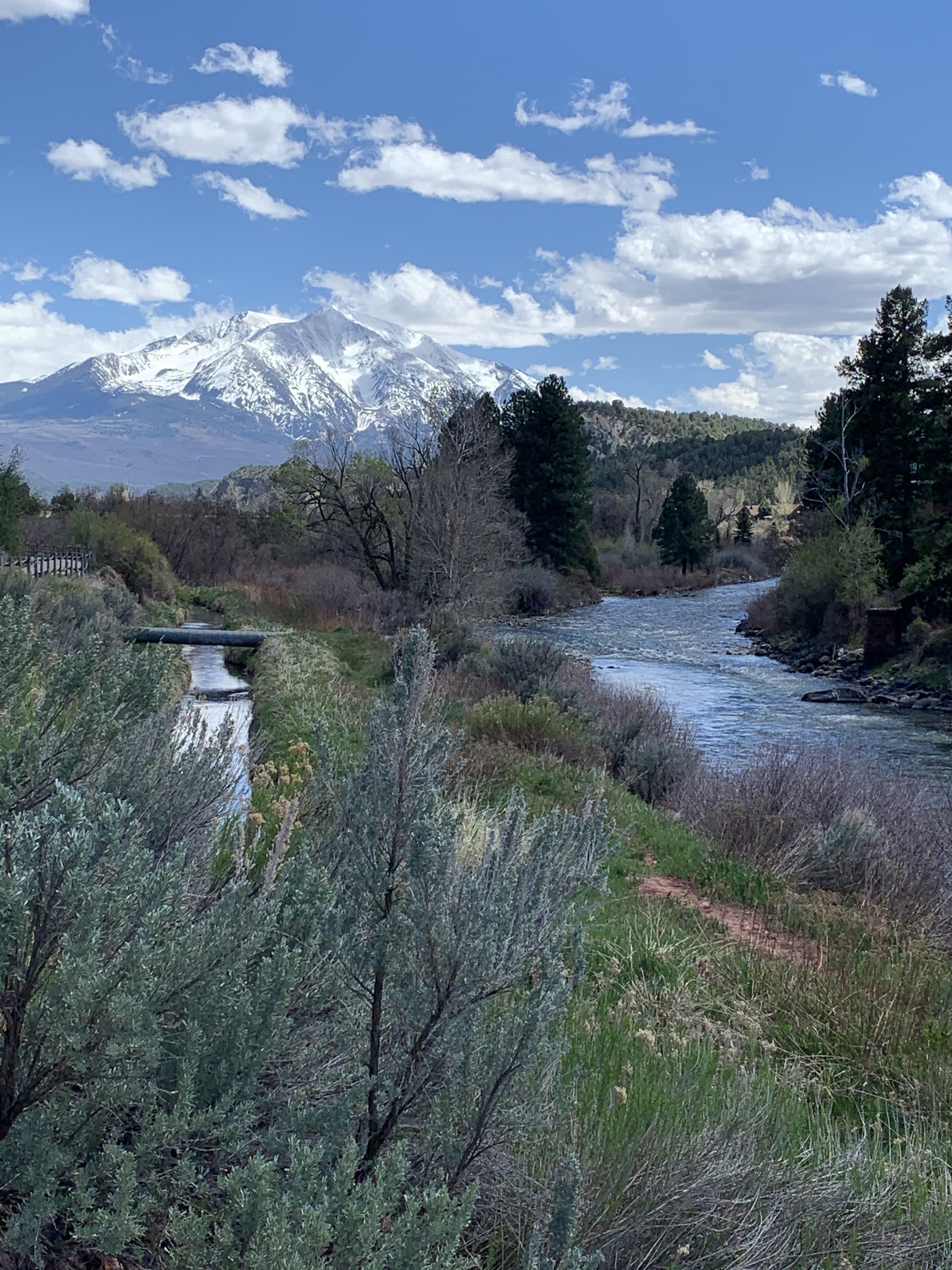
Mount Sopris hit us with a similar wallop. We arrived in Carbondale “in weather.” A day later, making a run to Main Street to meet Kirsten, we rounded a corner and nearly crashed the truck. There was a mountain towering over us where, previously, there was none. Clouds swirled around the summit. The late afternoon light made it glow. Sockdolager! Sockdolager!

I very much appreciate that my snotty spellcheck does not recognize or appreciate my use of sockdolager. No word can adequately capture the experience of being hit by a mountain. “Awe” is a word. So is “amazement.” They fall short, too. Language can reach toward but never quite touch that which it hopes to describe.

The day after the wallop we took a stroll on the Rio Grande Trail. We intentionally walked away from Mount Sopris, knowing that, at some point, to get back to our airbnb, we’d need to turn around and walk toward it. Like Orpheus leading Eurydice, we tried not to turn and peek but the majesty was too much. We’d giggle and turn and gasp. “My god!” we whispered.

We go to the mountains to remind us, to refresh our eyes and hearts and minds. This life. An exceptional event. A forceful blow. Grander than words can describe. Sometimes the mountain is hidden. Sometimes it shows its face. Either way, it never ceases to surprise you, to take your breath away. Sockdolager.

read Kerri’s blog post about THE MOUNTAIN

See The Verb [on Not So Flawed Wednesday]

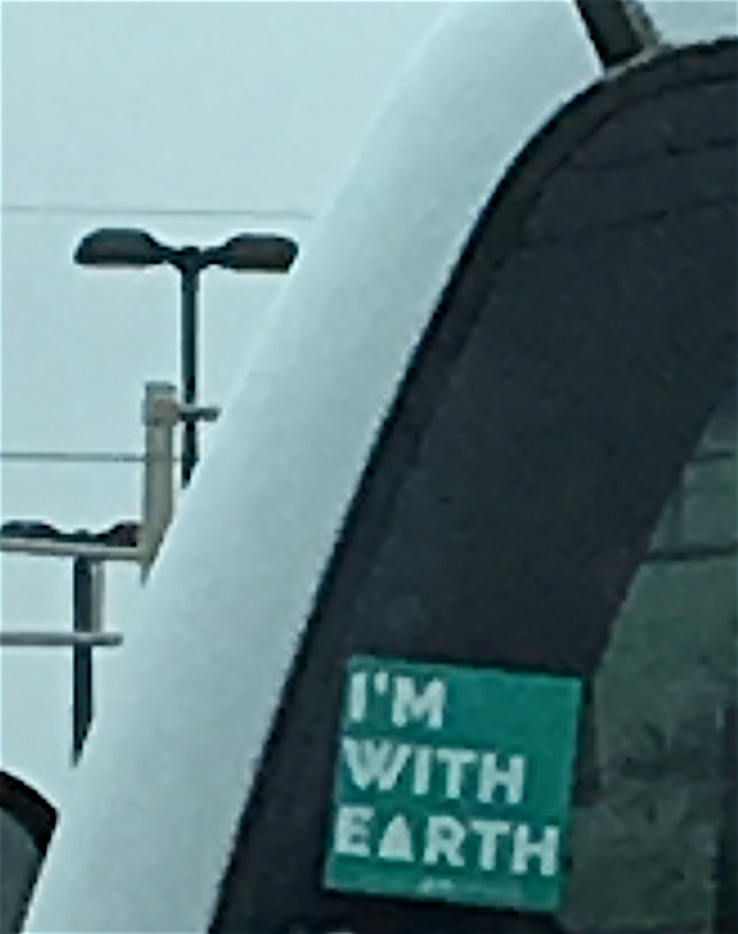
Random fact of the day: my waking thought this morning was about The Geography of Thought. No kidding. It’s a terrific book by Richard Nisbett. The subtitle is “How Asians and Westerners Think Differently…And Why.” Somewhere in the recesses of my brain I must have been pondering the bumper sticker we recently saw: I’m With Earth.*

One of the points made in the book, the one that permeated my dream state, is that different languages place different emphasis on different parts of speech. For instance, many Asian languages place emphasis on the verb. English speakers place the emphasis on the noun. In listening to mothers talk to their infant children, an English speaker will say, “Look at the red truck! Do you see the red truck?” An Asian mother will say, “Look at the red truck go!” Do you see the red truck go?”

Why does it matter where the emphasis lands in a language structure? Noun or verb?

The language we use shapes our thinking and seeing. It shapes basic worldviews. Earth as a noun or earth as a verb. Earth as a stand-alone-thing or earth as a moving interrelationship. These are vastly different worldviews.

This was my thought/image coming out of sleep: earth and sky. In a noun world, earth and sky are two distinctly different things. In a verb world, earth and sky are not separate things, they are verbs, actions, interplay of a dynamic relationship. In a noun world, I am also a distinctly different thing. In a verb world, earth, sky and I are not separate things, we are a dynamic inseparable relationship. We.

The bumper sticker is a declaration: I am with earth. It makes perfect sense in a noun world because it is also possible, in a perceptual world of separate things, to be against earth. Nature needs to be conquered, tamed. In a noun world, earth, once tamed, is a resource and resources are meant to be used. In a noun world, we are capable of believing that our actions have no impact on our environment. Action and environment are nouns, separate things.

In a verb world, what you do to the earth is what you do to yourself. No separation. In a perceptual world of relationship, of verbs, it is understood that your actions not only have impacts, your actions are impacts.

We woke to the news of yet another mass shooting. This one in Colorado. As usual, we know that our community and leadership will offer thoughts and prayers but nothing really – not really- will be done to address it. In a noun world, we protect the rights of the individual, the separate thing. In a verb world, there are no mass shootings. None. Violence done to one is violence done to all. In fact, more people are gunned down in the United States in a day than are killed by gun violence in Japan in a decade. The differing linguistic emphasis extends to differing understanding of rights and responsibilities.

Language matters. Where we focus matters. What we emphasize matters. The story we tell is determined by the language we use to tell it. I am with earth. Or, I am earth. I go to worship. I am worship. I seek purpose. I am purpose. Separation. Relationship. A whole philosophy of living reduced to a simple bumper sticker.

So, when we ask complex questions like, “Why can’t we do anything about gun violence?” or, “How is it possible that people in a pandemic refuse to wear masks to protect each other,” our answer is really very simple: our language makes it so.

Perhaps in a world of nouns a declaration is the best we can do. It is a step toward the middle way, a declaration of responsibility to the commons. Black Lives Matter. #MeToo. Stop Asian Hate. I’m With Earth.

*The “I’m with Earth” sticker is from the very cool company Gurus

read Kerri’s blog post about I’M WITH EARTH

Say “Look” [on Merely A Thought Monday]

“Look” is the new “um.” It now lives among the tribe of words used as placeholders, thought-launching-pads, or mental-composition-vocables.

I had a professor that cleared his throat when composing his thoughts. That semester nearly killed me. I lost all contact with the content of his lectures in the cacophony of throat-clearing. I spent entire lectures either writhing in my seat or wondering what happened in his life to develop such an odd vocal tick. I’m certain Sarah Jessica Parker based her throat-clearing-character in The Family Stone on my professor. Each week I sat in the lecture hall and wondered if he was terrified when speaking in public or perhaps he was fearful of not expressing thoughts clearly. That odd-socks-thought-train sent me down a rabbit hole of pondering weird karma. It’s a wonder I passed his class (or any class, for that matter).

“Look” is significantly different than “um” or throat clearing. There’s a very important nuance to note: it assumes authority. It’s a directive. “Take note!” “Consider this!” It’s a placeholder with a purpose. It’s as if everyone on the public stage secretly doubts their credibility or must demonstrate their sway.

Perhaps it’s the cabin fever that comes with believing in the pandemic, perhaps it is the state of politics and pundits in these media-cleaved-united-states, but we’ve become fascinated by the ubiquitous “Look.” It regularly launches politician replies and reporters’ reports. At first we merely glanced at each other, “Did you hear it, too?” Then we counted. We passed through the cheering phase. We even considered making it a drinking game – take a sip every time we hear “Look” – but decided against it for obvious reasons.

Instead of a drinking game we’ve lapsed into mimicry. “What do you want for dinner?” Kerri might ask. My reply, “Look, I’ve surveyed my belly and 85% of tummy-grumbling prefers pasta over all other candidates.”

Without missing a beat, she counters, “Look, your data is clearly partisan since the people are voting for chicken soup.”

“Look,” I say, gathering my thought for a response, “I’m willing to work with you here. My caucus will support your chicken soup if you’ll guarantee chocolate sometime before bedtime.”

She stares her best stare of thoughtful consideration. “Well, look,” she replies, extending her pause, “I think we can make that happen.”

read Kerri’s blog post about LOOK