Joyfully Jump [David’s blog on DR Thursday]

“The true work of art is but a shadow of the divine perfection.”Michelangelo

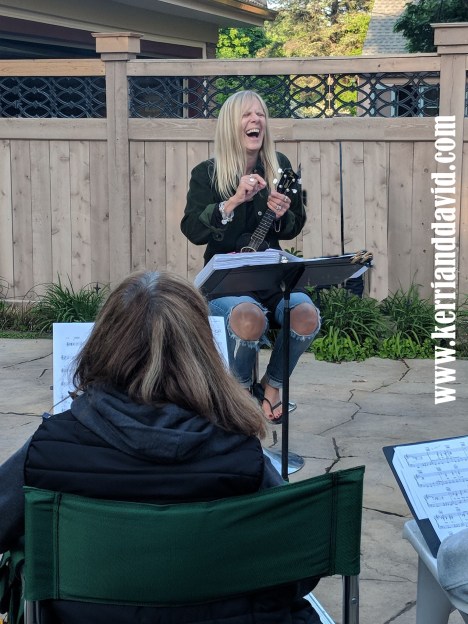
I still marvel even though I’ve grown used to it. Without warning she suddenly jumps up and races to capture an image. Walking on the trail, mid-conversation, she suddenly disappears; I turn and find her kneeling in the dirt, her camera aimed at a new bud or the methodical march of a caterpillar. Her muse is not gentle. Her muse demands immediate action.

At first her sudden bursts of energy frightened me. I thought she saw a snake or was leaping to dodge a tarantula. I jumped, too, usually crying out, “WHAT? WHAT?” After the hundredth scare I learned to temper my response to her bursts of inspiration. I’m painfully aware that with my new conditioning it’s likely that she will someday leap to avoid a rattlesnake while I step on it, thinking she’s having a muse-call. I am certain that she will get an excellent photograph of the snake biting my ankle.

In The Artist’s Way, Julia Cameron wrote, “Creativity is God’s gift to us. Using our creativity is our gift back to God” She continued with a more tangible sentiment, one that every human being experiences: “The refusal to be creative is self-will and is counter to our true nature.”

Blunting ourselves is not natural. It is what KDOT is teaching me. Do not doubt or delay the muse. Jump with both feet into the beauty when it beckons. Play with the moment. Share what you find there.

We forget that we, too, are works of art. We’re not finished pieces but ongoing shadows of divine perfection. We express. We are most alive when we are uninhibited in our participation and celebration of what we experience. It’s called “connected”. Plugged in. Present. Flow.

The muse will open the door and like Kerri, we could all learn to joyfully jump through it. Anything less is unnatural.
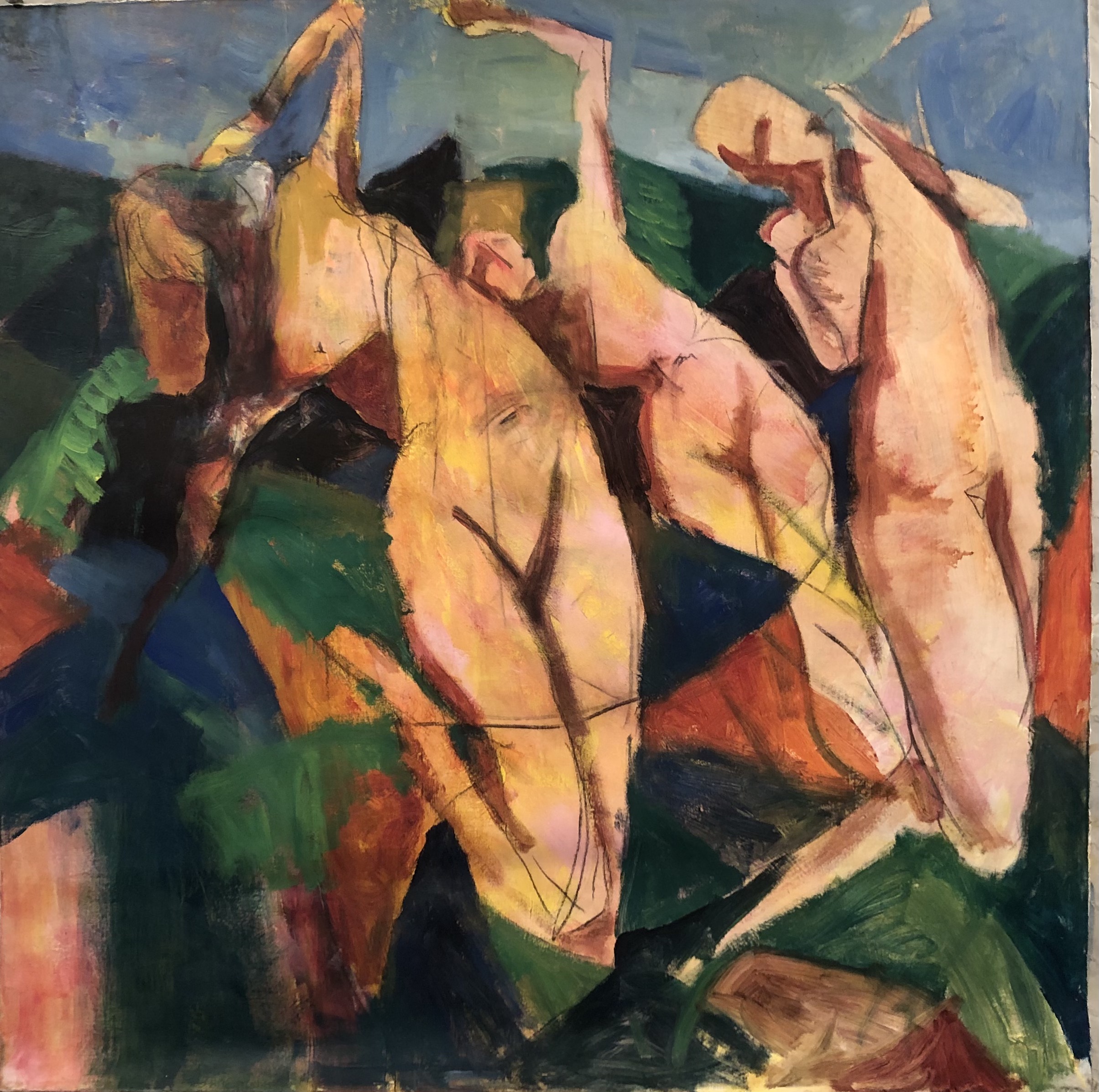
from the archives: Maenads

Go here to visit my gallery site

read Kerri’s blogpost about THE MUSE
likesharecommentsubscribesupport…thankyou.

See The Pattern [on Two Artists Tuesday]

“To live on a day-to-day basis is insufficient for human beings; we need to transcend, transport, escape; we need meaning, understanding, and explanation; we need to see over-all patterns in our lives.” ~ Oliver Sacks

Entrepreneur Ash Bhoopathy said, “The more you see, the more you see patterns.” It’s true. Take some time and sit on a busy street corner and watch. If your eyes are open, you’ll notice that you are surrounded by patterns. Not only the bricks in the buildings but the patterns of travel. The space between a red light and green light. The beeping of the crosswalk. The suits and ties. The paths walked by busy commuters.

“Comfort” and “home” are defined by patterns. What do you do to get comfortable? How do you signal the end your busy workday? Is it the same as you did yesterday?

Expectations are patterns, too.

Study “story” long enough and you’ll discover, as Kurt Vonnegut did, that there are patterns beneath every plot. We tell ourselves the same storyline over and over. Hallmark has its story pattern defined to the minute. It’s the secret to their appeal: the comfort of knowing the pattern. The comfort of asking, not “What” will happen, but “How” will it happen.

It’s a great paradox. The more you see, the more you see pattern. Yes. Yet, in order to see, often it’s necessary to disturb your patterns. That’s the beauty of patterns. When you are inside them, living a day of your life, you rarely see your patterns. It’s the reason Julia Cameron built artists dates into her Artist’s Way. Do something different. Break your routine. Challenge your expectation. Get out of your pattern rut. Only then will you be capable of seeing the pattern.

If you desire to change anything about your world, about this world, the change you seek will ultimately be a change in pattern. It’s a good practice to begin seeing them.

read Kerri’s blogpost about PATTERN

[the pattern image is the mat at our backdoor]

Compose [on DR Thursday]

Many years ago I attended a workshop facilitated by Sam, a brilliant landscape painter. I was delighted and amused when he demonstrated his technique. Rather than paint what he observed, he took great pleasure in rearranging the elements. He moved the trees, altered the hills, relocated the barn. He laughed while mixing up his elements. His eyes sparkled with mischief. Rather than a workshop on painting, the day became an exercise in joy-in-art. Seeing and playing with what we see.

This morning I read that the word ‘composition’ means “putting together.” Definers-of-art-terms associate composition with freedom. “The artist has freedom when choosing the composition of their artwork.” It is a mistake to believe that compositional freedom is the sole province of an artist. If the mind is a canvas then thought is a composition. It is patterned and composed. Arranged and rearranged. We choose where we place our focus. Point-of-view is cultivated, it is not a default setting. We design the story-we-tell-ourselves-about-ourselves. And, then we project it onto the world.

The trick in both art and thought composition is not to wear ruts in the road. Sam was joyful in his art because he was constantly challenging and engaging with what he saw. Art was fun, not morbid tradition. Art was delight-full, not rule-bound or laden with the pressure to capture. Recall that stepping out of the rut was the first lesson in Julia Cameron’s The Artist’s Way. Morning pages and artist’s dates are meant to both see the ruts and open new paths. The same process applies to the thought-canvas. See the rut. Step out of it.

As Sam taught me so many years ago, seeing and playing with what we see begins with letting go of what we think we see. It begins with a blank canvas, an unfettered mind, and the freedom to choose the composition.

read Kerri’s blog post about COMPOSITION

Unfettered ©️ 2018 david robinson

Unlock The Lock [on DR Thursday]

“The confidence of creativity knows that deep conflict often yields the most interesting harmony and order.” ~John O’Donohue, Beauty

To me, the most interesting moment of the story happens when Sisyphus has managed to chain Death to a post. No one could die. And, although suffering continued, famine raged, people begged Sisyphus to keep Death locked to the post. They’d rather have certainty than experience change. They’d rather suffer with what they knew than face the scary unknown.

Krishnamurti once wrote that people fear death because they are afraid to live.

Over and over we hear stories of soldiers or mountaineers or extreme athletes who felt the full force of living when they understood that they had little or no control over their life.  On the battlefield. Leaping off the mountaintop. Climbing without ropes.

There is an equation between releasing the illusion of control (locking Death to the post) and experiencing fully this crackling unpredictable life. Brad said it best, “Bored people are boring people.” Break the pattern. Step out. Go do something new. Julia Cameron called it an artist’s date. Get out of your comfort zone. Heed the call. Live a little.

Sisyphus did what we all must finally come to do: even though he knew it would mean the end of his life as he knew it. He walked over to the post, unlocked the lock, and set Death free.


read Kerri’s blog post about PRAY NOW


k&dbw backs website box_ copy

held in grace series: pray now* ©️ 2010 david robinson


*Originally titled “John’s Secret. John was my framer and I gave him the wrong measurement for this painting; I was a quarter of an inch short. We had to release one end of the canvas and add a small spacer so the painting would fit the frame. Now you know John’s Secret. Don’t tell!