Follow The Lines [David’s blog on Not So Flawed Wednesday]

There was a time when humans didn’t know how to translate three dimensional space into a two dimensional rendering. We either had no capacity for understanding visual perspective or no reason to pursue it. Art was symbolic, purely. And then came Brunelleschi. An architect. Linear perspective, a mathematical construct, became all the artistic rage. The wilds of symbol met the dictates of the representational. Horizon lines and vanishing points, the one-two step of perspective danced into the arts in a crazy time we know as the Renaissance. A painting could pull us into its world. The ghost of the ancient Greeks whispered 15 centuries into the future.

With perspective came a wholly new set of questions. The magic of math. The study of nature. How close can we come to understanding how things work? What are the secrets driving the universe and what we see? What lurks behind and beyond the symbol? What do we not see?

The trees in Kerri’s photo are roughly the same size. The trees retreat into the distance so the furthest tree appears to be smaller, the closest tree taller. It’s an illusion that we take for granted, so steeped are we in the necessities of perspective. The smallest child with a crayon wouldn’t care or perhaps even see the distance. They’d happily scribble the symbol: tree. An older child would put down their crayon and insist that they couldn’t draw because the magic of perspective is intimidating. Trying to “capture” reality in two or three dimensions is a tall order. Trying to place yourself and others inside it is overwhelming.

On this foggy day on the coast of Lake Michigan, I admire the perfect lesson in perspective taught by the trees stretching out in front of me. The fog brings to mind string-theory and the mathematics of multiple realities existing in a single space or Stephen Hawking’s bubble theory, many many universes brushing each other as they pass. What would Brunelleschi think of that? Follow the lines of perspective far enough and it becomes necessary to sail beyond the known horizon. Expressionistic. Conceptual.

Both Picasso and Einstein broke apart our understanding of space and invited an entirely new form of perspective into our conversation. The mystic and the mathematical. Multiverse and many dimensions.

Standing in the park, fingers cold, swallowed by the dense fog, I am a lucky child with a crayon knowing that all I can manage to do is scribble.

read Kerri’s blogpost on PERSPECTIVE
like. share. support. comment. many thanks.

buymeacoffee is a an impression left by a crayon meant to let others know that someone is out there and paying attention to the lines of perspective.

View The World [on DR Thursday]

Dogga is a wrecker of backyards. He’s a destroyer of pristine spaces. His joyful enthusiasm propels him in rapid circles and his circles have become etchings in our smallish yard. Initially, we tried to cover his etching path in stone. Were you to visit you’d find flat stones covering a wide spiral around the pond, his first velodrome. To no avail. He is a living Spirograph, a dervish of delightful circles. Viewed from the air, I’m certain our backyard smacks of alien visitation, mysterious crop circles.

We’ve learned. Rather than resist nature, attempt to control it or cover it up, it’s a much better plan to work with it. I knew we’d crossed a thought-bridge the day Kerri suggested we install a round-about sign. We had to be direction-correct so we bought one for right-sided drivers. The details matter. If Dogga was to suddenly switch and run in the opposite direction we’d have to issue a citation or get a new sign.

If there is a devil in the details there must also be an angel. As I’ve previously noted, I am not naturally a detail-guy; my head is at home in the clouds. I’m conceptual and can see great distances. It’s why metaphors are my currency, movement and pattern my friends. Please do not ask me to write a grant or make sense of the world through a spreadsheet. I can. I have, mostly out of necessity. But the cost to my soul is mighty. Luckily, as this great world spins, and the draw to a comfortable center is the force-at-play, I’m currently surrounded by teachers-of-detail, Kerri and Dogga are my favorite two but there are many in my circle. Angels, all.

Kerri runs to show me the photo she’s just taken. A close-in shot. A texture. A bud. An entire world in minutiae. See the beauty in the detail. For me, that’s the passage to the center. There’s entire universes to be found in the smallest detail. The up-in-the-clouds and close-in are relative terms. There’s a whole other worldview available from the grasses.

Lay on the ground and the Dogga will run circles of joy around you, his center point. There’s nothing better and that’s the kind of detail that’s not to be missed.

read Kerri’s blogpost about FROM THE GROUND UP

face the rain © 2019 david robinson

Follow The Twine [on DR Thursday]

[Day #2 of no image upload capacity so, for the melange image, see Kerri’s post or visit the Melange]

Follow the thick neon pink twine, winding through the park, and you’ll eventually come to a giant ball of string. I delighted in the thought that an enormous barn-sized Kitty, had recently been at play. Across the park giant flowers towered into the blue sky. Strolling beneath the stems and petals gave us an ant’s perspective.

Imagination. It’s working all of the time. And, sometimes it takes a giant ball of pink neon twine to make it visible. When we look forward to an event or dread a meeting, we are in full imagination. What else? When we desire a certain future or run fast from an opportunity, we are deep in our imagination. Kerri’s toes curl every time she drives under the train trestle while a train passes overhead: she imagines disaster.

I wish I had a nickel for every time I’ve heard in my life, from students or clients or friends, who’ve said, “I don’t have a good imagination.” The greatest figment of imagination is the notion that there are greater or lesser degrees of imagination. Sense making, personal story, idea generation, brainstorming, hypothesis checking, retirement planning…are all processes of imagination. We sense the world and then story it and the story always begins with the generation of an image. To be human is to be a wild. imaginer.

I’m privy these days to many thought models and process maps. I’ve spent the past 48 hours in a deep conceptual exercise. Emerging from my office at night I squint at Kerri and say, “My brain is tired.” The lovely paradox about the models and maps and conceptual paths is that they are not real. A map of the city is not the city. A model for product development is not product development, it is a map at best, a place to locate the imagination. The imagination uses itself to discover itself.

And, therein lives the paradox: imagination is as much about “discover” as it is about “invent.” We imagine our future so we can walk toward what we already see. As every artist knows, the canvas tells you where to go, the character tells the writer where the story turns. We discover ourselves in our imagination. Follow the pink twine far enough and you’ll eventually come to a giant ball of string.

read Kerri’s blog post about PINK NEON

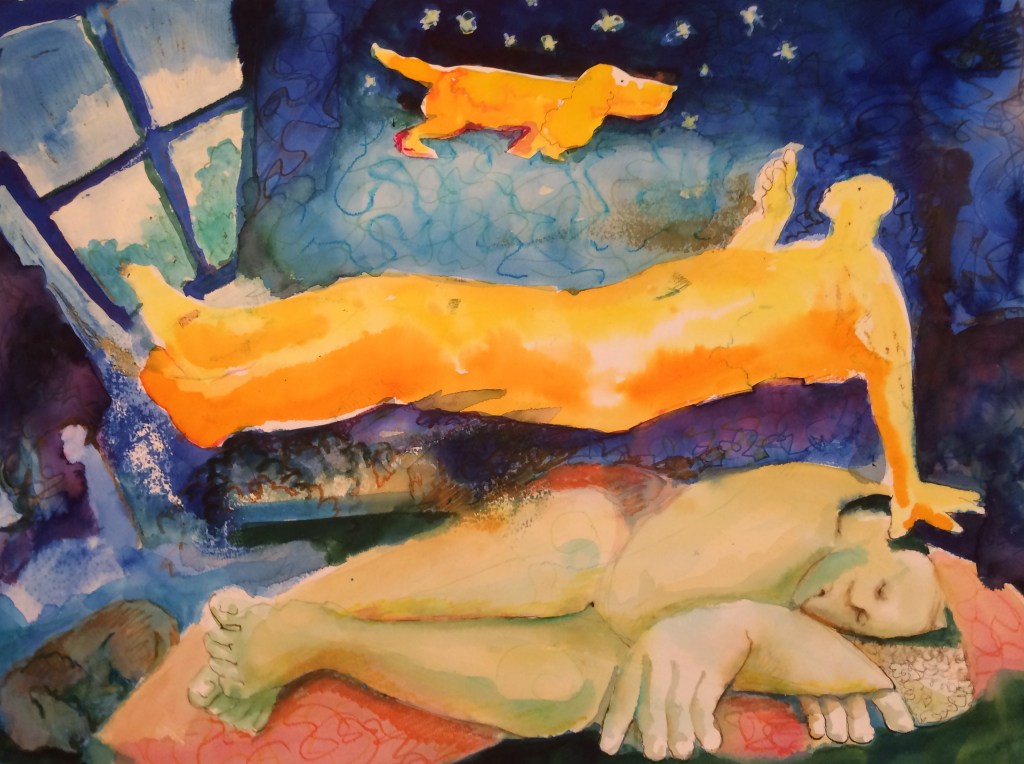
watercolor fun: dog dreaming © 2010 david robinson

Recognize The Art [on Flawed Wednesday]

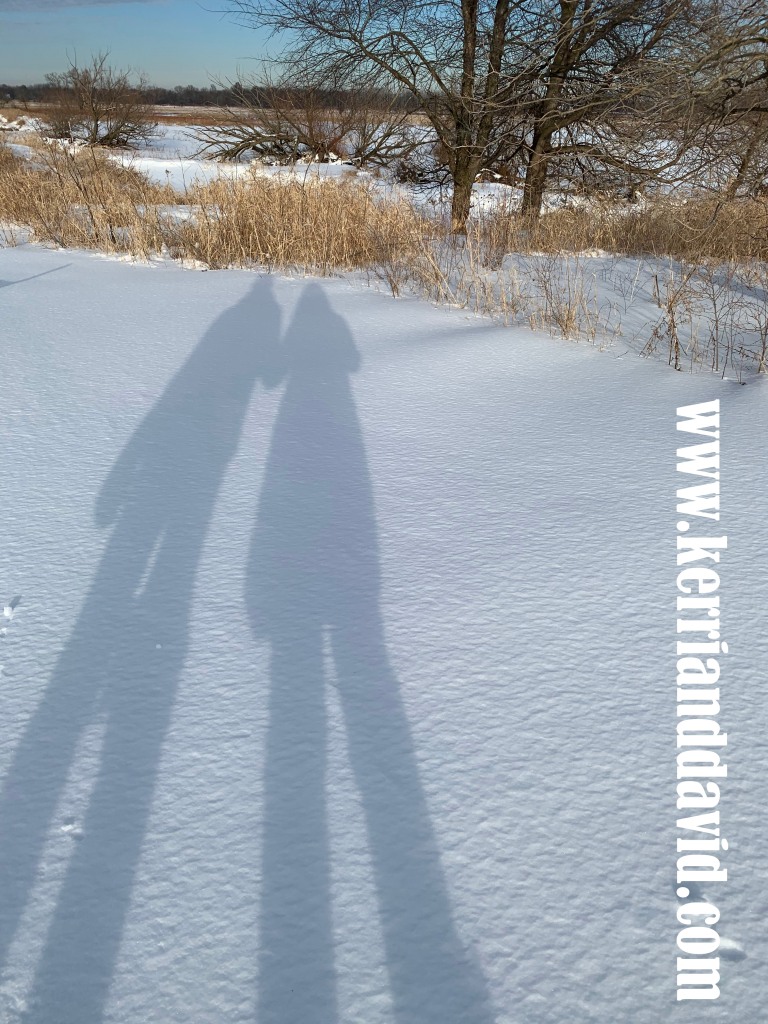
The snow was too dry. My snowman fell apart when I put the head on. “It doesn’t have to look like a snowman to be a snowman,” Kerri said to cheer me up.

“Maybe it’s modern art!” I quipped, using my if-it’s-a-mess-call-it-art default statement. As I walked down the trail, away from my unsuccessful snowman, I wondered when incoherence had become included in my definition of art.

I am and have been these many months doing some soul searching and life review. Walking down our snowy trail I remembered working with a dying theatre company. The first step in restoring their health and vitality was to help them face a simple truth: that they made the “art” did not necessarily make the “art” good. In fact, the “art” could not be good until their criteria for “good” wasn’t about them.

The challenge with “art” in the modern era is that it is nearly impossible to define. For purely masochistic reasons I looked up the word ‘art’ in the dictionary and nearly fell asleep before I finished reading the definition. “A diverse range of human activities involving the creation of visual, auditory, or performing artifacts…” Artifacts? The last lap of the definition reads, “…intended to be appreciated primarily for their beauty or emotional power.”

Beauty. Emotional power.

Of course, the contemporary world is awash in conceptual art and I read in my dictionary that this form of art, dating back to Duchamp in 1917, “…abandoned beauty, rarity and skill as measures.” Bananas taped to the wall. Statements.

Beauty abandoned. No emotional power necessary. But still “art.”

Art is, I’m told by historians and other scholars, a mirror of society. It is reflective of the era in which the artist lived. What a society values is made apparent in their art. It’s true.

Art, I believe, has a power and purpose far beyond mere appreciation. It is more than a mirror. It generates identity. It pulls disparate individuals to a common center. It affirms connectivity. It awakens us – and provides access to – that which is greater than any single individual. It bonds. It affirms. It transforms.

I wonder if our art, often so unrecognizable, sometimes incomprehensible, dependent upon curatorial interpretation, not concerned with beauty or rarity or skill or any other discernible measure, is not the perfect reflection of us. Narcissistic. Statements. Each day I am, like you, met by a tsunami of stories in the daily news revealing our collective confusion, our collapse of values, a commons at war with itself fueled by leaders stoking division for personal gain. Bananas taped to the wall. It is – we are – in our daily tales – so conceptual – so void of beauty or rarity or recognizable skill or measure – that it requires an anchor/curator to tell us why it – or we – might have meaning.

And then, just when I wonder if we are hopelessly lost, Amanda Gorman stepped up to the mic. The one true test of artistry is that we know it when we see it. No curator necessary. We are, we were, for a moment, bonded together in a way that no politician, no historian, no concept will ever understand or achieve.

I see it alive in Mike, and David, and Mark, and Chris. It glistens every time Kerri sits at the piano or composes a poem. It is not a mess though sometimes skill meets a happy-accident and, like penicillin, something healing emerges.

When we are washed away into the annals of time, what will be our art-love-letter to the future? What legacy – and art is a legacy – will we leave behind? What will I leave behind?

read Kerri’s blog post about SNOWMAN

for kicks, Kerri made a Snowman mug. Go here to get it

Gear Down, Baby!

a detail from my painting, John's Secret

a detail from my painting, John’s Secret

When writing The Seer I showed the early chapters to some pals and the response was unanimous: break it down into smaller bites. The conceptual steps were too big for readers to connect the dots.”What!” I exclaimed. “Are you kidding me!” I protested. “Are you telling me that people need me to spell it out for them? Am I supposed to hit them on the head with a hammer?” I cried in disbelief to my bemused pals. Their response to my inner adolescent was, again, unanimous: yes. You need to go slower, take smaller steps, and come a bit closer to earth. The details matter. The job is not to be understood. The job is to create understanding.

After gnashing my teeth and tearing my clothes I took their sage advice. And, it was sage advice. The book that I published was comprised of only the first three chapters from the original manuscript broken into smaller thought-bites. Breaking it down was one of the hardest and best things I’ve ever done. Like Horton the-hearer-of-a-Who, I discovered complete new universes in the details, in the things I’d deemed too insignificant to mention or simply didn’t see with my head so firmly in the clouds. Ironically, while writing a book entitled The Seer, I learned a lesson in seeing.

Skip laughed when we first met. He’s a very-big-thinker and, like me, sees the world from 30,000 feet. He exclaimed, “Oh, No! You have the curse, too!” From 30,000 feet, small steps and details are almost invisible or easy to ignore. From 30,000 feet, everything is inter-related, one great big dynamic flowing motion. From 30,000 feet, the ubiquitous question is, “Don’t they see?” The runner-up question is, “What’s the problem?”

As we learned in school, the devil is in the details so, with my head in the clouds I have often been surprised by the detail-devil. People on the ground plant flags and guard territory. People on the ground choose sides and assume a defensive posture before thinking to ask a single question. Fear drives swifter action than does lofty reason. People are much more complex than they seem from the conceptual heights.

And, the only way of working with a complexity is through a simplicity. Connect the dots. Do not assume that “they” will “know” or “understand.” Do not assume that “they” see what I see or believe what I believe – or that what I see or believe is better or more valid than what they see. Opening a heart is a slow affair. Listening is best done when leaning in. Asking questions before making statements is good artistic process. Be a dot that connects to the other dots. Art, in all of its forms, is meant to serve as the great dot connector.

John's Secret by David Robinson

John’s Secret by David Robinson

Kerri, no stranger to my 30,000 foot rants, has developed a short-hand phrase for those too-many-moments when I need to move slower and pay attention to the details. She is helping me with this life lesson by applying a simplicity to my complexity. Now, when I have assumed that the dots are already connected and am perplexed by the breakdown, she simply says, “gear down, baby.” Move to a lower gear and open your eyes. Connection always happens in a lower gear. What is really there is infinitely more important (and often more beautiful) than what we want to be there. Releasing the “shoulds” opens eyes and hearts for shared experiences. So, gear down, baby.