Diamonds In The Cold [David’s blog on KS Friday]

The already cold temperatures are dropping like a stone. The weather app described tonight and tomorrow with a single word: frigid.

Kerri and I have a dilemma: as we age she is getting more sensitive to the heat. I am getting more sensitive to the cold. “What are we going to do?” I asked. She gave me “the look.”

Do you ever marvel, as I do, how much can be communicated in a single look?

For now, we are staying put. We will dream dreams of mountain homes in temperate zones. Places where horses roam, where trails are aplenty, where both hot-flashes and cold-shivers are nowhere to be found. We will practice the art of compromise.

I suppose it is easier for me to pile on more clothes than it is for her to find more layers to take off. I won’t get arrested if I move through the public looking like the Michelin Man but she will certainly raise eyebrows if she strips to the original layer. “I’ll get my sweater,” I say, as she dials down the thermostat.

Henrik Ibsen wrote, “The devil is compromise,” but I am learning that compromise – healthy compromise – doesn’t live in an either/or world. It is not populated by devils or angels. That is a strategy of loss, a begrudging middle-ground arrived at by settling. I’m discovering that it is possible for compromise to paint from a broader palette. Middle ground is just as easily arrived at by giving. Generosity can be mutual. Peace is a creation. Compromise begins with making offers. It’s called “relationship.”

“All compromise is based on give and take, but there can be no give and take on fundamentals…” ~ Mahatma Gandhi

Perhaps the most relevant insight of late into compromise is something I am only now understanding and my teacher is the politics of the day: the art of compromise is a terrific way of discerning what is fundamental and what is not. A few weeks ago I wrote that I’d discovered my intolerance. I found through this election that I have hard lines that I will not cross. In other words, I’ve found my fundamentals.

The rest of Gandhi’s thought is this: “…Any compromise on mere fundamentals is a surrender. For it is all give and no take.”

I believe that a good many people in this nation surrendered their fundamentals. Or, they never had them in the first place.

And so, here we are. And while we wait for the nation to either dissolve or find its hard line, we will hunker down in our happy home, control what we can control, and through sweaters and thermostats, practice the fine art of generosity, offering the mutual gift of compromise. Diamonds in the cold.

It’s A Long Story on the album This Part Of The Journey © 1998 Kerri Sherwood

Kerri’s albums are available on iTunes and streaming on Pandora

read Kerri’s blogpost about CHALK DIAMONDS

likesharesupportcommentsubscribe…thank you.


The Greatest Weapon [David’s blog on Merely A Thought Monday]

The timing was uncanny. While on a slow walk in the park, deep in a conversation about our discouragement – no, our despair – for loved ones sucked down and seemingly lost in the dark, angry MAGA hole, we passed a group of girls engaged in an emphatic conversation and overheard the phrase, “I don’t know you like that!”

The phrase came like a slap. Kerri took out her phone to capture the slap in her notes. “That’s exactly it,” she said. “That’s precisely what is so troubling. It’s what I want to say: I don’t know you like that.”

I am lately haunted by the words of H.G. Wells: “Civilization is in a race between education and catastrophe. Let us learn the truth and spread it as far and wide as our circumstances allow. For the truth is the greatest weapon we have.”

There is a reason that the template outlined in Project 2025 includes the elimination of the Department of Education. There is a reason that governors in red states are (and have been) waging a war on education. Educated people ask questions. Educated people check the veracity of statements hurled their way. They take time to check facts and sources of information. In a democracy, an educated populace would never sign on with an autocrat exploiting their anger. They’d ask questions of their anger -and so would be impervious to exploitation. An educated populace would demand ideas from their leaders, respectful debate, reasonable compromise, adherence to the Constitution. They’d demand the same of themselves. An educated populace would see through the ugly name-calling and victim-squeals of a would-be dictator. An educated populace would pay no heed to the cries of “fake news” because they’d have learned to check it out for themselves. They’d hold news organizations to a higher standard. They’d care enough to question and verify information before jumping onto a hate-train. In fact (hear those two words) they would not so easily jump onto any train other than the truth-train because they were dedicated to living-in-facts that transcend bubble-gossip and tribal tittle-tattle.

This morning I had an HGTV revelation about our current political choice. It’s my latest metaphor illuminating the dangerous nonsense running around our nation in a red hat. I’ve learned in my HGTV viewing that demo-day feels good, takes very little time, very little thought, and requires only a sledgehammer. Anyone can do it. Destruction is easy. On the other hand, building the house is hard. It takes ideas, time, thought, planning, cooperation, collaboration, flexibility, knowledge, well-researched choices, skills, process and patience. Wisdom. All are the results of education.

Destruction is not complicated. It asks no questions, requires no learning. Destruction is the center of the red hat campaign.

Creating something beautiful and long-lasting is hard. It takes skill, the capacity to question and learn from mistakes. It takes a plan, forward thinking, and complex considerations, not fantasies sought in the rearview mirror of some imagined sitcom past. And it is never done. Building a better house is the center of the blue team’s campaign.

The red hat and company certainly espouse a plan, Project 2025, but an educated person would only need to ask the authors of the plan a pair of questions before rejecting it outright: 1) Why would you tear down the shining-city-on-the-hill and replace it with a dark prison? 2) Why are you trying to hide your plan from voters?

People I love, those caught in the undertow of the red swirl, empty of fact but full of shared-victim-anger, gulping and then spewing mouthfuls of toxic-fox-swill, waving their flags, raging with a dedicated ignor-ance…I don’t know them like that. I wonder how they came to know themselves like that.

Let us learn the truth and spread it as far and wide as our circumstances allow. For the truth is the greatest weapon we have.”

Let us learn about truth: Truth is not what we hear or see in the stream. It is not something verified by people passing memes around our social bubbles or validated because we share the same opinion and invest in the same misinformation sources that cater to our opinions. Truth is what we find when we question what we hear. It is verified by exiting our bubbles and questioning what we think we know, examining the foundation of our likemindedness. Truth is learned when we fact-check our own opinions and especially challenge our rigidly held beliefs. Rigidity is a red flag, a marker that something false is hiding.

I have learned to remember this: an opinion shared with great passion or rage is still just that – an opinion. Any strong belief held without question or reflection is, in fact, weak and makes us easily exploited, easily led. Lemmings. Fools. Learning the truth requires constant effort and personal responsibility – especially in our age of easy misinformation. In learning truth, our greatest weapon, there is never a need to fill the communal cup with fear-mongering. Truth dispels fear. It dissipates gossip, and, because it demands personal responsibility, affords no room for blame.

Truth is a common center. Education, the art of questioning and discernment, is the compass that gets us there.

read Kerri’s blogpost about I DON’T KNOW YOU LIKE THAT

like. share. comment. subscribe. support…thank you.

Unfurl [David’s blog on Two Artists Tuesday]

I’m proud of her. Twice this week Kerri has fact-checked friends on FB who posted articles riddled with misinformation meant to rile. It took her less than a minute each time. In posting a link to the fact-check, she wrote, “Please check your information before you pass it on. xo”

It seems like such a small thing but it’s lately apparent that it’s becoming everything:

We forget that democracy is not a thing. It is an idea. It is an action rather than a noun. We forget that our democracy is young. Very, very young.

It worries me when I hear politicians making laws placing limits on the discussion of ideas at school. It worries me when I read that parents want teachers to teach “only the facts”. In today’s bubble-discourse it is a valid question to ask, “Whose facts?” Discerning between fact and fiction requires minds and hearts capable of questioning, capable of challenging the “facts” they are being fed. The notion of the purpose of education as a feeder-of-facts is nothing less than a sign of moral and mental decay. This is especially true in our great age of information with its ever-present shadow of rampant misinformation.

Democracies collapse when ideas and ideals are no longer debated, when winning-at-any-cost overshadows compromise, when respect for divergent points of view is overrun by intolerance. Healthy democracies are an ongoing tug-of-war; creative tension generated by a lively and respectful exchange of perspectives. This requires a system of education that nurtures these qualities and capacities.

Democracies collapse when they aim for an end result rather than steward a living process.

The point of education in a democracy is to consciously and carefully unfurl young minds so they might become active questioners, expansive thinkers, participating citizens in an ongoing experiment in a complex system called democracy, capable of stewarding their communities forward through an ever-changing world toward the promises inherent in the IDEA: equality, inclusion, governance by the people, for the people.

I would hope that we become capable of grokking governance-by-the-people which necessitates a people educated in ideas, reinforced in their curiosity and capacity to question, to converse and debate complex issues, capable of discerning ruinous power-over-agendas from the central idea enlivening their budding democracy: power with.

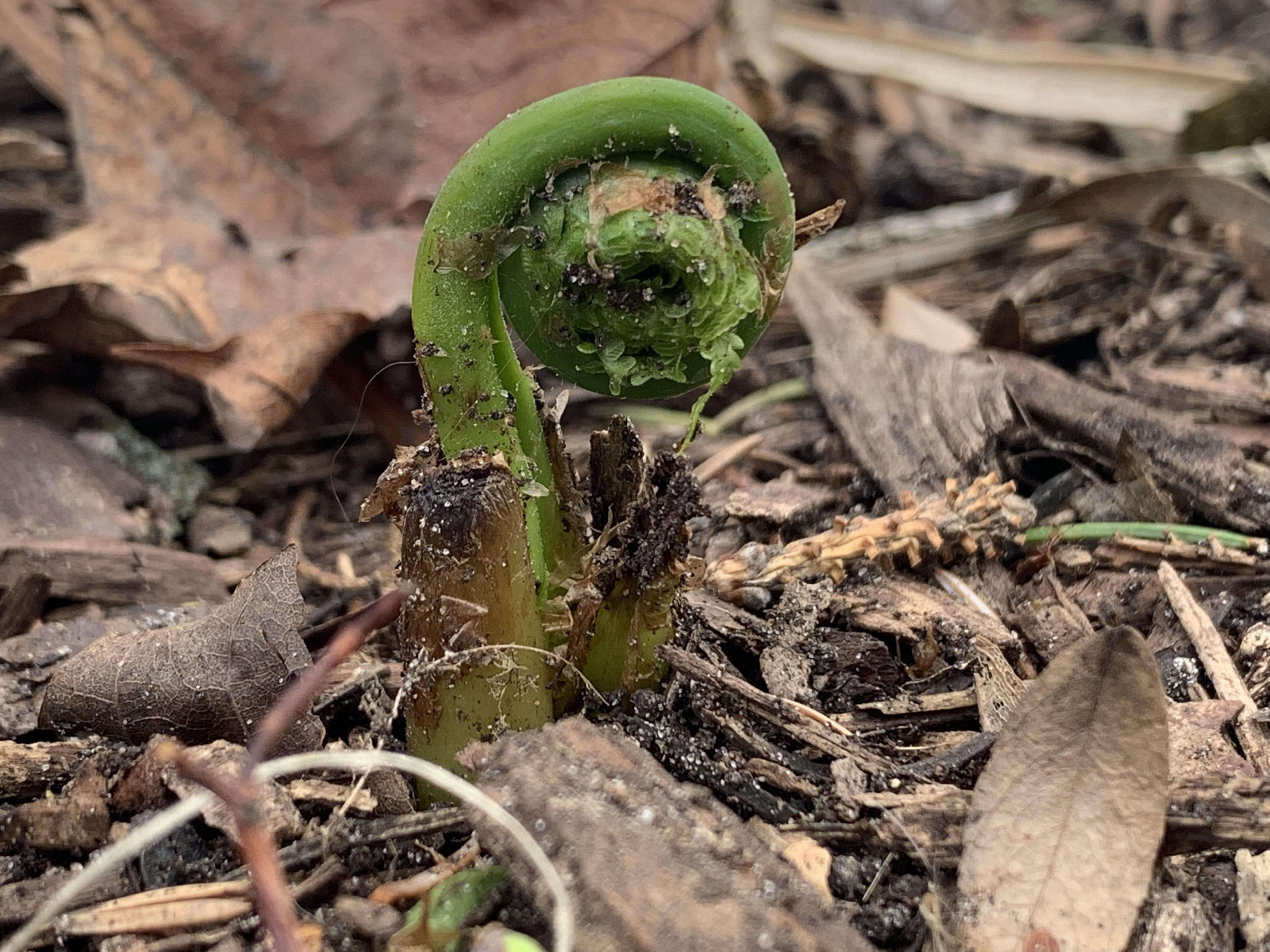
read Kerri’s blogpost about FERNS

like. share. support. subscribe. comment. many thanks.

Disagree [on Merely A Thought Monday]

Months later, she* is still angry with me. I asked her to “stop blowing me off.”

Some things need to be discussed and necessarily require entertaining differing points of view. Finding middle ground or considering alternate possibilities requires hearing what others have to say – and giving others the courtesy of hearing what you have to say. Her standard phrase of choice, when faced with an opinion or idea not her own, is this: “I guess we’ll have to agree to disagree.”

No. I don’t agree to disagree. Especially at the onset of a dialogue. I want to talk about it. I want to hear what you have to say and more importantly why you hold your point of view. I won’t agree to not hearing or being heard.

Opposing points of view, differing opinions, need not be conflicting. They can be highly generative. Mind opening. Thought provoking. “I’ve never thought of that,” is an expression that results when considering a different point of view. In ideal, our nation is based on the notion of two opposing points-of-view extending to each other the courtesy of listening and considering possibilities not yet seen. Yep. And, we are witness to what happens when one side (or the other) rejects the basic premise. Dismissiveness is the strategy of an empty suit.

Why assume conflict?

She followed “I guess we’ll have to agree to disagree,” with the real statement, her actual aim: “You do what you want. I’m going to do what I’ve always done and follow my plan.” In other words, she had no intention of hearing anything that did not support her plan. Why, then, I wondered, did she invite conversation?

When the only tool you have is a hammer, then everything looks like a nail. When the only door you have is a closed door, then every knock sounds like an intruder.

I laughed aloud when I read Bill Murphy’s article in Inc. Magazine about his pet-peeve phrase: “Look, I get it.” He writes, ‘”Look, I get it,'” is almost always inherently untrue…Even worse for our purposes, it’s woefully ineffective.”

It’s dismissive. Just as is “I guess we’ll have to agree to disagree.” The agreement she wanted was for me to agree to be dismissed. An agreement of silence. Why would I – or anyone – agree to that?

[* “She” is not Kerri. We hold each other in high esteem. It’s why the sign in our kitchen reads, “You are my favorite pain-in-the-ass.” We welcome our differing perspectives. Neither one of us dismisses the other nor tolerates being dismissed.]

read Kerri’s blog post about “LOOK, I GET IT.”

Coalesce [on Merely A Thought Monday]

Rich used to tell me that, “People don’t change until the pain of the change is less than the pain of staying the same.” At the time, I thought his mantra was cynical; pain either way. Now, I think it is spot-on.

Discord is the essential ingredient for initiating any creative process. Explorers look at the horizon with a deep need to find-out what’s beyond. Their curiosity outstrips their comfort. Curiosity and comfort. Change and stay-the-same. There’s a tug-of-war in every decision that’s worth making.

Creative tension is a dynamic pull between two poles. Do I add a brushstroke or is the painting finished? This morning I came across a well-known quote by Leonardo da Vinci: Art is never finished, only abandoned. Pain either way. Finishing a work of art is akin to dropping the rope in the creative tug-of-war.

When I was wearing my corporate-consultant-hat, almost daily I repeated a lesson relative to Little Red Riding Hood: without the Wolf there is no story. Too often we try to eliminate our Wolf. We are inundated with messages trumpeting the notion that happiness (or good process) arrives in the absence of discord. It does not. Happiness avails itself when the necessity of the Wolf is understood as the fuel of the story.

People thrive when challenged. We create challenges when we don’t have them. Understanding the role of the Wolf transforms Rich’s mantra into something far less pain-full. The heart yearns. The brain fears. The yearning and the fear will coalesce into some action that may or may not be recognized as a choice. Which is the Wolf? The yearning? The fear? Either way, another day is lived. The story is created.

read Kerri’s blog post about UNCOMFORTABLE

Close The Gap [on Merely A Thought Monday]

kenosha tire sign copy

Do you remember Robert Fulghum’s book, All I Really Need To Know I Learned In Kindergarten? Share everything. Play nice. Don’t hit people. Clean up your own mess. It is filled with simple undeniable wisdom. Here’s an excerpt from the introduction:

Take any one of those items and extrapolate it into sophisticated adult terms and apply it to your family life or your work or your government or your world and it holds true and clear and firm. Think what a better world it would be if we all—the whole world—had cookies and milk about three o’clock every afternoon and then lay down with our blankies for a nap. Or if all governments had as a basic policy to always put things back where they found them and to clean up their own mess.

It’s really not that complicated to get along. Everywhere I look I find credos and guides and statements of belief. Aspirations and inspirations. In fact, we are fairly drowning in statements of how to get along and how to create a better world. We are also awash in news streams screaming about deep division and our inability to play nice.

There’s a gap between our rhetoric and our choices.

It’s not that we have to see from the same point of view or hold a single omnipotent intention. We don’t. We won’t. The genius, the ideal, of our system is the notion that opposing points of view, wildly disparate beliefs, can come to a middle way. Compromise is possible if the common good is more important than winning at all cost. Sharing toys is possible if sharing is among the…shared values. Sharing engenders empathy, the consideration of the other person’s point of view. The things we learned in kindergarten and actually believe enough to enact. Dog-eat-dog, cheating, lying, exploitation, every man or woman for him/herself; these were not among the things I, or anyone else I know, learned in kindergarten. I was never punished for sharing or for service to others. I was never sent to my room for being fair or for speaking a truth – even if it wasn’t popular.

And, so, on this MLK day, in the midst of our mess, we ask again (and again and again), what is the difference between what we say we value and how we actually behave?


read Kerri’s blog post on WHAT THEY VALUE IS ON THE WALL


reflectioninxb website box copy


Think “And”

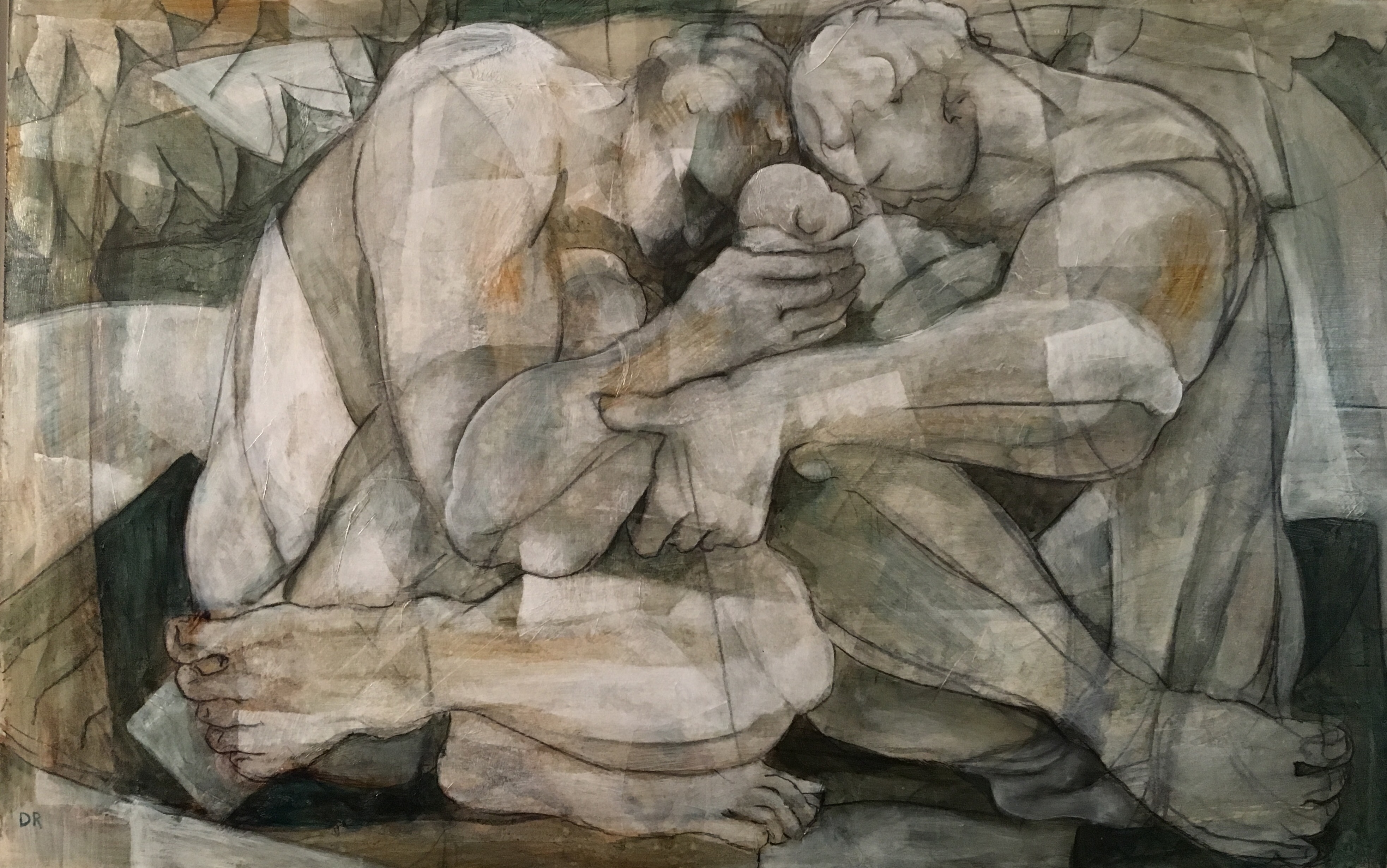
a second version, a second point of view of my painting Shared Fatherhood

I suppose it is the great trap in human nature to define life through oppositions. Was your experience good or bad? Are you liberal or conservative? Are you your brother’s keeper or is it every man for himself? Oppositions provide the illusion that there is a right way or a wrong way, that any issue can be reduced to a simplicity, a singular path. One way. Oppositions are great language devices for dictators and the righteous. They remove the grey tones and blunt the grey matter. With an opposition, us or them, “god” can be exclusively on your side (a small god, indeed) which self-grants permission for all manner of abuses enacted by “us” on “them.” The problematic word when employing oppositions is “or.”

“And” is a much more useful (and honest) term to employ when dancing with oppositions. Can you be your brother’s keeper AND take care of yourself? Certainly. Can you survive entirely by yourself without the participation of your brothers and sisters? Certainly not. No one lives in a vacuum; “or” is the great creator of illusory vacuums. “And” guarantees a conversation and perhaps a host of useful, challenging and robust perspectives. Both/And is always more functional than Either/Or.

AND the first version of Shared Fatherhood

The snag in “Or” is that there is very little truth in any reduction that ultimately lands on just One. This or that. All life is movement and all movement stops in One. Creative tension requires at least two points and a desire for someplace place to go. There is no single arrival station in real life. There is no achievement that stops all the presses. Every answer inspires new questions. Each question opens doors to multiple possibilities. Agreement is a fluid target at best and must be nurtured. Compromise is never an end state; it is a relationship imperative. Life is never found in the static “or.”

Do an experiment: go to the grocery store, choose any item and ask yourself how many people it took to bring your chosen item to the shelf at that moment. If you are not astounded by the complexity of participation, how dependent we are on actions of others, your imagination has most certainly failed you. Skip, entrepreneur extraordinaire and mentor to entrepreneurs taught me that a business cannot succeed until it serves its customer’s customer. Note the word “serves.” Businesses serve. Not simply a customer but the complexity of a customer’s customer. Entrepreneurism is a service to the creative genius of a community and multitudes of communities beyond.

Entrepreneurism, like artistry, ….even, yes, like governance…like all things vital, moving, complex and growing, live in service according to the good graces of AND. Anything else is a mirage.