The Real Promise [David’s blog on Not So Flawed Wednesday]

“Too many of us still believe our differences define us.” ~ John Lewis

I confess, it has been a life-long fascination. Seriously, since I was a little kid, I’ve been amused, confused, and periodically gobsmacked by the swirling contradiction of identity-messaging in these un-United States.

Because we are the single most individualistic culture on the planet, we place high importance on being unique. We are encouraged to stand out. And yet, the first lesson I learned in school was how to stand quietly in line. We buy clothes that are meant to express our own distinct style while hyper-market-pressured to fit our image to the latest trend.

I spent years and years working with people who spent thousands of dollars outfitting home art studios so that they might express their own unique artistry…and then froze in their newly built temple, so fearful of what others might think of their creation. How many times have I heard someone, dressed smartly in their latest Ralph Lauren, tell me that they were looking for their voice?

It’s untenable. It’s no wonder we are perpetually self-discombobulated. The dreadful shadow of our national commitment to bewilderment is the game drawn along the color line that we’ve played since our nation’s inception: If they gain, we lose. If we gain, they lose.

We-the-people wrestle by placing the accent on the hard line of our differences. We wrestle with reaching across the hard line of difference to find our common ground: most recently our reaching has been known as DEI. Diversity. Equity. Inclusion. We strive to be one in our campaign to be individual.

If there is one universal truth I learned in my life as an artist, in my work with people struggling to find their novelty and power, it is this: unique voice is found in service to others. Unique expression is available when the self-serving ego gets out of the way. It’s a paradox.

Personal voice is meaningless unless it helps other people. To guide. To question. To recognize. To join. Actors perform to unite us in a shared story. Poets write to open us to universal truths. Musicians play to bring us together in a common experience. The real power, the promise available in these United States is no different than the promise bubbling inside each individual. Rare and special voice is found in service to the common good.

Artistry and governance share this trait: grace and power is always found in uniting and is invariably lost in dividing. We may someday realize the great promise in these United States if/when we at long last lay down the tired game of manufactured division and find our true, unique and powerful voice by uplifting all unique, diverse, and beautiful voices, a chorus in service to a common center called democracy.

read Kerri’s blogpost about THE BLACK SHEEP
likesharesupportcommentsubscribethankyou

Work A Circle [David’s blog on Not So Flawed Wednesday]

Kerri has gifted me with the practice of looking close-in. Because she notices and photographs detail, I have the great pleasure of seeing things I never would have noticed by myself. I walk through the world seeing connective tissue and pattern, the view from 30,000 feet. I am grateful to regularly have my mind pulled from the clouds to witness the miracle of the minute. In her photographs I see connective tissue and pattern. It’s all one amazing fractal.

This is the very first post I wrote on my new blog named The Direction of Intention. I wrote it in 2010 following a meaningful conversation in a DEI facilitation about the nature of power:

1. Truly powerful people are dedicated to inspiring true power in others.

It goes like this: empowered people empower others.

Think about it.

How powerful must you be to free yourself of the need to diminish others? No more reducing others to elevate your self. No more reducing yourself to fulfill the mistaken belief that, “you are not worthy.”

What if your worth was no longer in question? What if your value was no longer an issue? What would you do with all of that newfound time and energy that previously was dedicated to bullying your self or reducing others?

In later posts I wrote about the distinction between Control and Power. They are not the same thing, in fact, they are opposites. Control is an action taken by the fearful and, ultimately, weak. It is the path of the bully. It necessarily sucks the potency of others. Control is the action of a vampire. Taking.

Power, on the other hand, is the generative creation of many. Empowerment. Giving to a common center. We learn about power after natural disasters: people coming together to help other people.

Control is the preferred action of authoritarians. Empowerment is the ideal behind democracy. Together, we-the-people are capable of creating a more perfect union.

I’d forgotten this tiny detail, the reason why I started writing. I felt as if I had something to say about power and how it is often confused with control. I did not consider myself a writer. It was scary new territory in 2010.

I’ve now put in my ten thousand hours and I find in these past few weeks that I am once again writing about power. I recognize that my words about power sometimes sound like raging, Captain Dan tied to the mast screaming at the storm. This storm is called the abuse of power, an assault on the power of a free people by a malignant leadership enamored with control fantasies. Vampires, all. There is good reason to rage.

My first 498 posts began with this phrase: Join me in inspiring truly powerful people. Each day I will add a new thought, story or idea to support your quest and mine. And so, I work a circle. I return to where I started, to this one tiny detail, the original thought: empowered people empower others. There has never been a time more vital to remember – and serve – this simple imperative.

read Kerri’s blogpost about BEAUTY

likesharecommentsupportsubscribeempowerothers…thankyou.

A Sculpture Worth Making [David’s blog on Two Artists Tuesday]

The question floated across my screen, something I’d asked a group many years ago. I don’t remember the moment so it was a blast from the past of a former me: apparently I asked, “What if no one else has your answers?”

The timing was interesting since I am currently without answers. Well, more accurately – more honestly – I’m standing still surveying the wreckage.

I appreciated my blast from the past because now, at this point in my life-journey, were I working with a group, I’d flip the equation and ask, “What if no one else has your questions?” I’m no longer a big believer in answers.

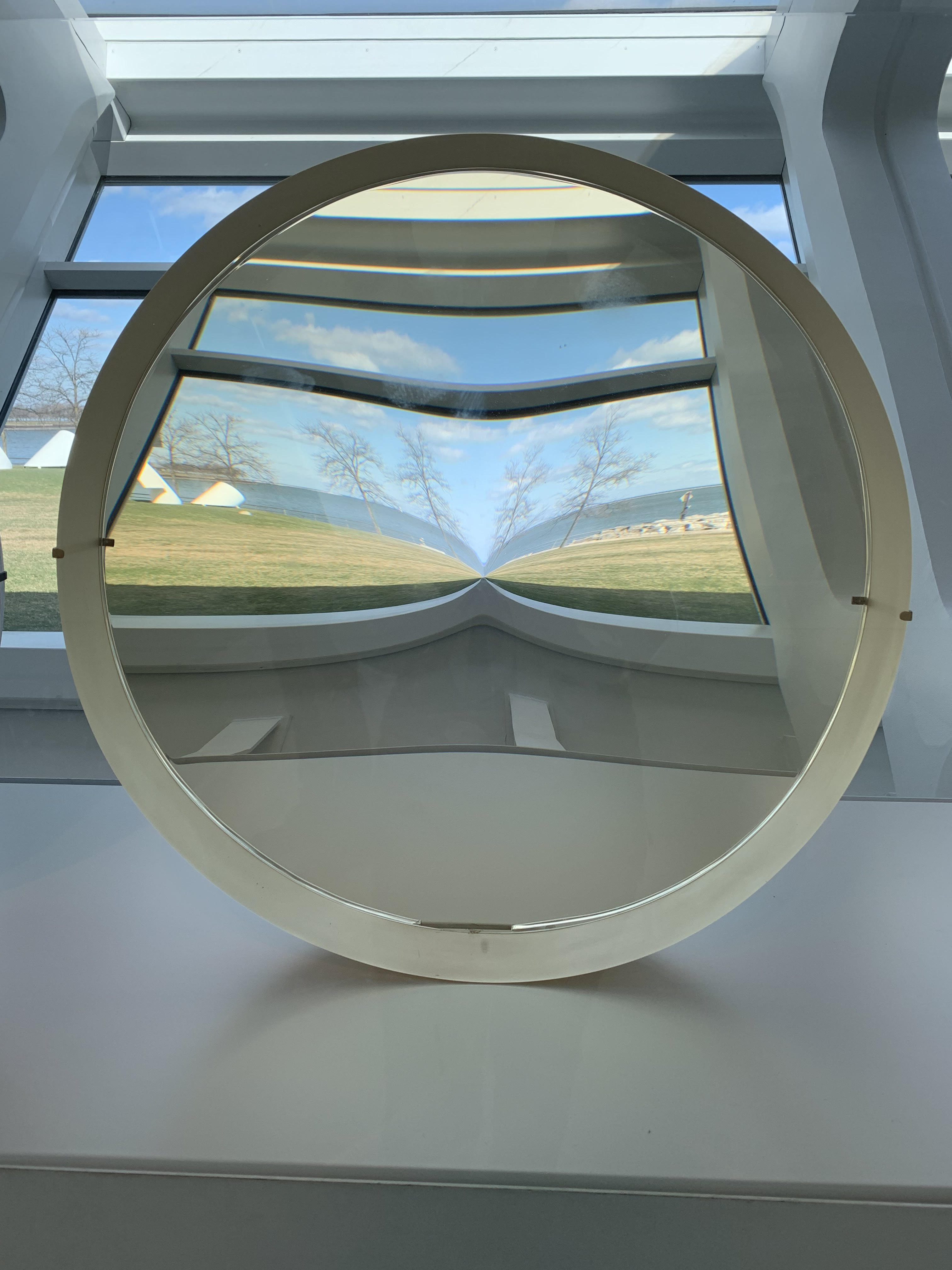
We stopped in the long hallway leading to the contemporary art collection to admire the lens. I didn’t note the title or the name of the artist so I cannot give credit where credit is due. I’ve looked at the piece before but never with the same appreciation. Never from this moment in time. It was suddenly, intensely relevant. All points bend toward a common center. A point of view that generates circles. A single intersection.

“It’s an ego,” I thought. It believes it’s the center of everything that’s happening. It made me laugh. It brought to mind the ubiquitous lesson from Quinn: “There are six billion people on this planet and you are the only one that cares what you think.” Or feel. Or see.

No one else has your questions. No one else has your answers.

Standing before the sculpture I imagined flipping the script and reversing the circle: what would it look like to genuinely care what other people think. Or feel. Or see. With no need to understand it or change it or control it. Only care about it. About them. There’s a common center available in that paradigm, too.

Now, how do I make that lens? That’s a question worth asking, a sculpture worth making.

read Kerri’s blogpost about THE LENS

subscribe. support. share. like. comment. many thanks.

Turn Around And Look [on DR Thursday]

One little line gives reference to the whole. The horizon line. It is how we naturally – visually – orient in space. It is a baseline of perception. It’s the beginning of discernment.

It is a line that disappeared.

Among other things, art is a reflection of its time. In the past century, art leapt into the abstract. We are “post-modern”. Expressions of personal fantasy rule over community truth, a breaking apart of shared ideals, instant doubt of objective theories…we are mirrored in post-modern art. What is art? What is it not? There’s not a whit of agreement to be found.

General distrust is the beating heart of the post-modern ideal. Division, aggression, tribalism, conspiracy…are its blossoms. Our children perform active-shooter-drills in school; a performance we shudder to attend while our leaders smile and look the other way. Post-modernism at its finest. The absence of a baseline.

Shared truth, group trust, community…requires an undeniable horizon line.

What is up? What is down? What has value? What does not? What has merit? What is undeserving? There is a line. Where is it?

Walking through the antique mall, Brad and I discussed chatGPT. I’m playing with it; he’s using it in his work. It’s raising some very big questions. The questions are not new. They are the next step in a series of questions people have been asking for the past 30 years: what is true? A photograph was once proof that something happened. That hasn’t been true for a few decades. A video was once proof an experience occurred. That is no longer true. News – a word that once implied the accurate reporting of an event. No more. No horizon line.

Brad and I turned our discussion to a sorely missing quality in our times: discernment. In the absence of a horizon line, people will – and do – believe anything. We speculated that, with the introduction of chatGPT into our world, perhaps discernment will once again become important. Perhaps the complete absence of a truth-anchor will turn us toward a common center and require us to look at each other, to seek and restore general trust. The post-modern tide will someday turn and we will draw an old/new line in the sand: we’re-all-in-this-together.

I know, I know. Pie-in-the-sky. However, I’d like to point out that shared dreaming brought us here. Shared dreaming is how we stood on the moon. It is how we can talk to someone across the planet using a small device that fits in our pockets. When a dream becomes shared it becomes powerful. Manifest. A shared dream is a form of a horizon line.

If a shared dream isn’t powerful enough to establish trust, try remembering the other one; the original line of discernment. The line that invites curiosity. It need not be debated. Turn around and look. The horizon line is everywhere.

Four-by-Four, 48x48IN, acrylic, (sold)

read Kerri’s blogpost about THE HORIZON

4×4 © 2007 david robinson

Look In [on Not So Flawed Wednesday]

“I want to stand as close to the edge as I can without going over. Out on the edge you can see all kinds of things you can’t see from the center.” ~Kurt Vonnegut

Yesterday I applied for a job that is all about narratives told from the edges of society. I’m not sure why it surprised me to find such a cool-to-me job; our community seems addicted to shattering so there are plenty of small edges to be found. Small edges are fallacious and serve a myriad of false centers. Our survival will depend upon whether or not we can awaken from the shatter-narrative and make the decision to direct our broken focus toward a common center. No small feat.

It is the role of the shaman, the explorer, the artist, the researcher to stand on the edge and report back to the community what is seen and unseen. The voice from the edge is rarely welcome since the report is capable of popping delusions or pulling the sheep’s clothing from the wolf. Page one of the autocrats’ handbook instructs the elimination of artists and educators. Making an enemy of the eyes-that-see, demonizing educators and thinkers – the people who recognize pattern and metaphor. The game of Us-and-Them necessitates silencing the voices capable of calling out the wolf. Autocrats require blind sheep that follow without question.

Some famous edge sitters: Galileo. Cesar Chavez. Rosa Parks. Nelson Mandela. Susan B. Anthony. Albert Einstein. Frederick Douglass, a former slave and leader of the abolitionist movement, wrote extensively about what we call Critical Race Theory; it was clear in his view from the edge. It’s not a new theory. It’s an old pattern with a new name. I think he might denounce his Republican party affiliation were he alive today; they would certainly silence his voice. He would be fired were he a professor in Florida today. As would Martin Luther King, another famous voice from the edge.

Voices of reason are often voices from the edges. Voices of the future are always voices from the edges. Galileo was silenced for suggesting that the earth circled the sun and not the other way around. Over time, the voices from the edge, when authentic, always make the center better, the community stronger. Susan B. Anthony spent her life on the edge, lobbying the center, to secure for women the right to vote.

Progress. Growth. They are rarely inspired from the tight grip at the center. Silence the edges and the community atrophies. Stop the movement and the body dies. That page was left out of the autocrats’ handbook for obvious reasons.

read Kerri’s blogpost about EDGES

Ask A Simple Question [on DR Thursday]

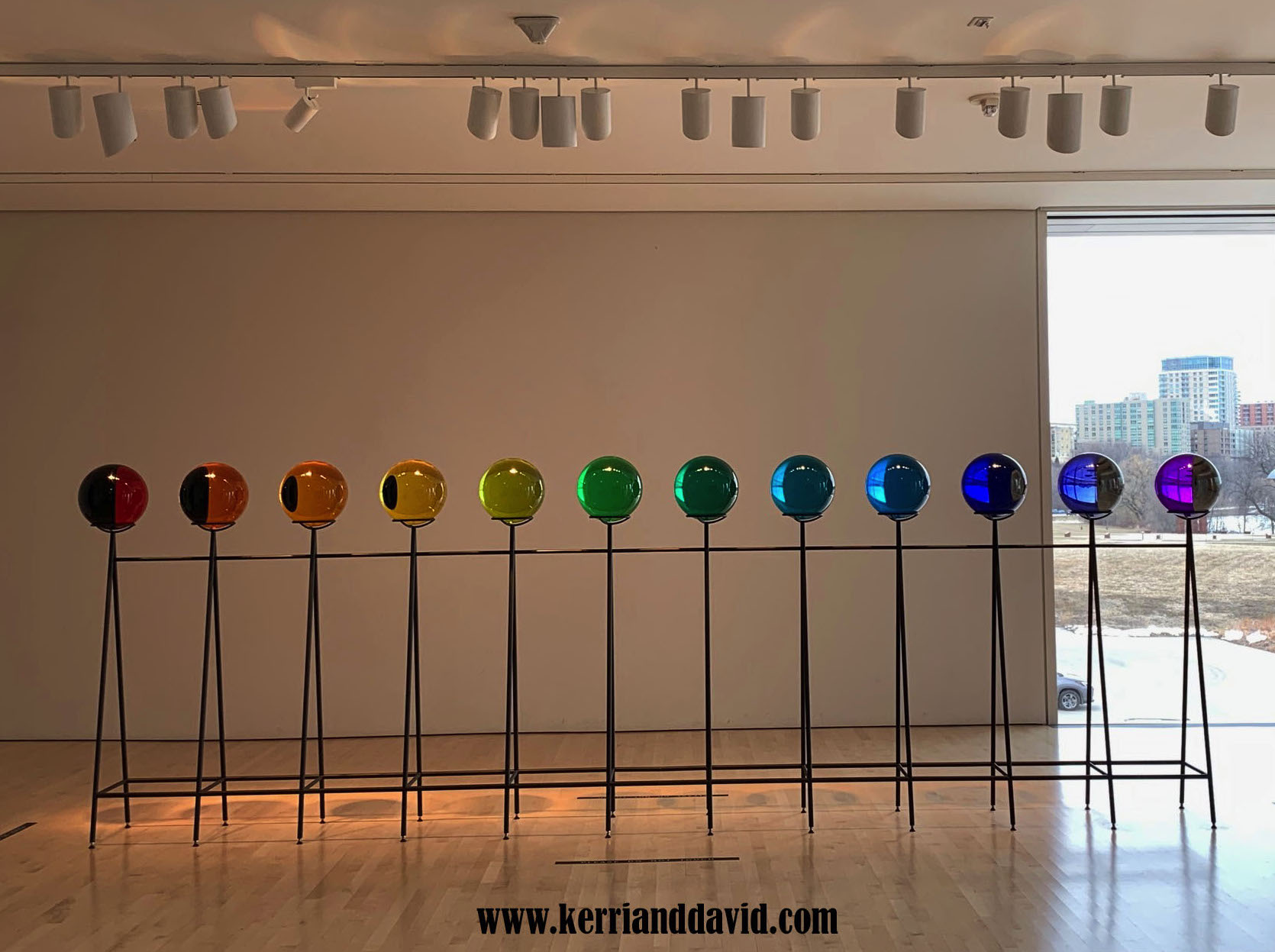
It’s existential. What you see changes depending upon where you stand. That’s true when engaging any piece of sculpture. It’s true when engaging anything in life. Point-of-view is fluid and relational. This sculptural reminder is Olafur Eliasson’s Rainbow Bridge.

In another era of my life facilitating diversity and inclusion workshops, the same surprisingly simple concept was usually a revelation to people. What you call “normal” is merely a point-of-view. Most importantly, it’s not everyone’s point-of-view. Your “normal” is unique to you, not universal. Most hopeful: it’s not fixed in stone. It’s changeable. Relational. Capable of growth. A mature point-of-view recognizes that it need not, it cannot, be the center of the universe. A mature point-of-view necessarily asks an all important question: “What do you see?”

It’s not only possible to look at the same sculpture and see a myriad of differences, it’s necessary. It’s human. Sharing what we see is how we, together, create community. A common center is created by a circle of differing points of view. A common experience is borne of sharing disparate points-of-view of the same event. A common center is made functional when everyone in the circle is capable of asking with sincerity a simple question: What do you see? It is made vibrant when everyone in the circle expects the answers to be different than their answer.

Art is one way of responding to the simple question.

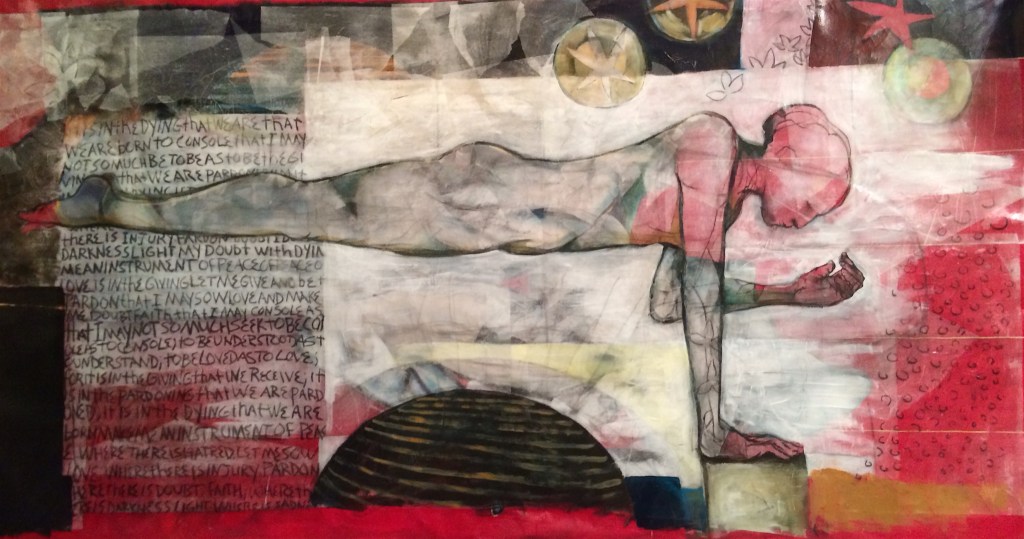
Instrument of Peace, 48x91IN, mixed media

read Kerri’s blogpost about RAINBOW BRIDGE

instrument of peace © 2017 david robinson

Join [on KS Friday]

“I wouldn’t mind turning into a vermillion goldfish.” ~ Henri Matisse

To say we were out of place would be an understatement. Two crows in a seagull bar. The Fat Seagull, to be exact. Two artists step into the watering hole of a lumberjack town. The beginning of a joke.

There was a table of ladies playing a rowdy card game. Big guys leaning into the bar, a row of suspenders and worn baseball caps. Bottles of Miller beer. They wrinkled their brows when they caught sight of us. We sat at the only open table. A high bar table pushed into the walkway. Two stools. We knew we were outliers when we ordered wine. The waiter returned a few minutes later having found an unopened bottle. He explained that the only two wine glasses in the bar were broken. We sipped our wine from tiny cups.

We drove two hours north to see a special show. The last performance of a duo. This bar would be their punctuation point. They began to play and slowly the magic happened. Together, people leaned in to listen. Bodies swiveled and danced on stools. Hands clapped at the end of each number. The musicians wove a spell that brought everyone together. Two crows were no longer aliens but integral to the shared experience.

Our waiter refilled our tiny glasses and stayed to chat. He invited us to come back and try the burgers. We smiled and talked to those sitting nearby. Without inhibition, Kerri took photographs of the crowd, the musicians, the coolers, and the ceiling.

The punchline? The power of art. The magic of music. The easy recognition of common center. It is no less potent in a dive bar than in a stadium or auditorium or gallery. The place is incidental when the performance is pure.

read Kerri’s blogpost about THE FAT SEAGULL

Kerri’s albums are available on iTunes & streaming on Pandora

take flight/this part of the journey © 1998 kerri sherwood

See The Exact Center [on Two Artists Tuesday]

Kerri took this photograph a week ago. We’d set up our pop-up table in the middle of the woods. We had a small cooler with cheese and crackers, tabouli and chips and wine. It was cold. We needed to take off our gloves to eat a bit of our snack and then put them on again, fingertips stinging. Since she is a photography maven, I knew to stand back after setting up so she might take shots of our snack-laden table. She finished, sat, and then pointed her camera to the sky.

Despite what you see in the photo, the trees did not reach to a common center. That is an illusion. Perspective as taught in art school. The point of view of a lens. “Lookit!” she said, red fingertips holding the camera so I could see the image. “We must have found the exact center of the forest,” I thought and smiled.

I often feel like that these days. We must have found the center.

Last night, on an all-too-rare warm evening, we sat with friends on their deck. The Up North Gang. We ate dinner. We laughed. I had my first ever sip of salted caramel whiskey. Dessert as a drink. Time stood still for me and I studied the moment. I wondered if anyone on earth was as fortunate as Kerri and me.

Perspective as taught in art school. Points converge creating the illusion of distance. At one time in history, a crossroads of art and mathematics, this simple recognition was a revolution. Linear perspective. A unique point of view. The accurate portrayal of three dimensions on a two-dimensional surface was powerful – the creation of illusion, shape and distance, produced new intentions and mathematical rules.

It also changed forever the viewer. To see the illusion one must occupy the illusion of a unique center. A new psychology. It’s possible to draw a direct line of descendancy from the hard perspective of the Renaissance to our abstract expressionism. The artist’s point of view, unconscious expression without limit or rule, is all that matters. Two ends of the same pole.

I told Horatio that I am, at long last, learning to keep quiet. To share what I see when asked, and not before (he says as he writes a blogpost about what he sees). I have made a career out of too adamantly trying to get people to see what I see. My adamancy might be traced to the Renaissance and the notion that I occupy a unique center, a specific point of view that makes my illusion of shape and distance somehow privileged and necessary.

Age is helping me challenge and release my investments. It is also a grand teacher of movement and moments. Nothing stands still, especially time. The best we can do is savor the spaces between, always shifting and moving. Children become parents become grandparents. A warm night. A cold day on the trail. It matters less and less what I see and sense-make with my unique hard lines and more and more that I taste the tastes and see the colors, my lens aimed at a common center, sharing the passing moments with others.

read Kerri’s blogpost about THE WOODS

Start Here [on Flawed Wednesday]

Let’s start here: a strange attractor. “Chaos has its own pattern, a peculiar kind of order.” This magical definition pairing chaos and order is from the good folks at Merriam-Webster. They provide definitions of words. Words are a collection of symbols, called “letters,” assigned to specific sounds which, when placed in a sequence, carry meaning. For instance, D-O-G points to something unique and different than, say C-A-T. A collection of words placed in a sequence carries even more complex meaning. Dogs chase cats.

Thought. Expression. It’s nothing short of miraculous if you think about it. And, if you are thinking about it, you, too, are a carrier of meaning. The symbols and their sequence are useless without me and you, reaching to each other, agreeing on the general meaning of the sequence of sounds. And, more to the point, we not only carry but we create meaning. With our magical sounds-in-sequence we are capable of generating the high art of story, the supreme gift of understanding each other. We can reach each other, touch each other, move each other. We can find each other with our words. We shape each other with our words.

From the chaos of all-possible-sound, to the pattern of word and alphabet, to the order of sentence, to the power of story. Anyone who tells you that they are not creative is missing the point of their existence.

I suspect the power of story is infinitely more powerful than we might realize. We take it for granted, this extraordinary capacity, this glorious gift. You’d think we’d have more appreciation for our high art of language, our transcendent ability of speech. You’d think we might honor and protect truth and fact. They are the compass, the map through the forest of all possible tales. You’d think we might use our most powerful accomplishment to find, or better yet, to create shared ground. Common good is an intention, a creation.

You’d think.

There’s a vast difference between disagreement, conflicting points of view, and lie.

The point of a disagreement is to find agreement. After all, single-point-perspective begins from two disparate points of view. It is a “coming together.”

The point of a lie is to mislead. To deceive. To create false impression. False ideals. To foster disagreement. It is a tool for exploitation. It is meant to render apart.

Because we so easily sequence our words, pattern our thoughts, we are capable of using our magic, our ordered language to create…order. We are also capable of using it to create chaos. Disorder.

To help. To hurt. To accomplish. To disrupt. It’s a matter of intention. The direction of intention. How do you intend to use your precious gift?

The real power comes when we learn to think beyond our belief. To question. To ask.

The first rule of education, an essential rule in shaping precious words into thoughts, into actions, is simple: check your sources. Make sure the story you’re embracing, the piper you are following, arises from a well spring of good intention. That it has an ethical center. Check that it seeks to clarify and reach rather than obscure and demonize. Check that your thought-house is not built on a lie.

Check your sources. Of information. You, too, are a source of information, so…check your sources.

With our most powerful capacity to pattern, to create, to think in words and sentences and stories, we can be a carrier of the lie-virus or we can be part of the cure. Reach or reject. It is our choice, through how we use our miracle words and language, what we agree to create together.

Let’s start here.

read Kerri’s blog post on AGREE

UpLift [on Merely A Thought Monday]

cohesion copy

And, what is the opposite of cohesion? Incoherence. The lack of clarity or unity. Fracture.

For a period of time my work on this earth was essentially a meditation on power. Power with. Power over. After a while I understood that power-over was not really power at all; it was control. Control and power are two very different things. They are often confused.

Power is something created with others. Control is something done to others. The equation is simple: the more controlling a person is, the less powerful they actually are. A person who understands his/herself as powerful has no need to assert control over others.

A leader invested in control has only one sure route to controlling: to fracture. To divide. It is the way of the truly powerless. Incoherence and chaos are great tools if control is the aim. Destroy the unity. Play to the disgruntled. Feed the fire of those who are feeling powerless. Promise them control. Pushing others down to elevate the self can only end badly. Everyone drowns.

People secure in their power create cohesion. They unite. They uplift. Power is a force that grows between people. It cannot be owned by one. It is always the province of the community. A person secure in her/his power generates unity. What else? The power they feel within is an expression of the power they experience with.

Community is a word that implies cohesion. To commune. Common. And, what could be more common than a central focus, the intention to support and bring out the best in all.

What is the opposite of a powerful person?


read kerri’s blog post about COHESION


alice's restaurant, california websitebox copy