Cut A New Path

ComfortNow

The latest in my Held In Grace series. This is Comfort Now

It seems to me that most of our days on this earth are spent moving through patterns, conscious or unconscious. These patterns are the rituals of our lives. Some of the rituals are easy to see. For instance, what is the sequence of actions you perform before going to bed each night? What about your ritual of rising each day? The care and feeding of Tripper Dog-Dog-Dog and Babycat are central to my rising and retreating rituals each day. We move through the same actions every morning and evening and I delight in the warmth of the ritual.

Some of the rituals are not so easy to see. Researchers tell us that most of the thoughts we think every day are the same thoughts we had yesterday. We mostly think in patterns (it makes sense once you recognize that language is constructed of category and pattern). We talk to ourselves, cutting paths through the forest of our minds and, once we’ve established a trail, we like to stay on it. Easy is often unconscious. There’s nothing wrong with staying on the easy trail if the path you’ve cut, your repetitious thought-ritual, is self-loving. The rub: ritual paths of self-loathing and self-limitation are also easy, well-worn paths and that makes them both unconscious and hard to leave.

Cutting a new path through the mind forest begins with recognizing that new paths are always available. They just aren’t easy to establish. They require new practices. They require surrender and the first bit of surrender necessary for cutting a new path is the ritual giving-over of needing-to-know-anything; new paths, by definition are unknown.

New paths are not comfortable precisely because they require attention, consciousness.

My teachers taught me that all stories worth telling are stories of transformation. The main character or characters will know something at the end of the story that they did not know at the beginning and the new knowledge will be hard-won. That’s what makes the story worth engaging. Hamlet is a much different character in Act 5 than he was in Act 1. His peace was difficult to come by. He had to learn to surrender. To cut a new path he had to make a practice of peace.

The same ideal applies to the stories we live off the stage.


Stand In It

photo

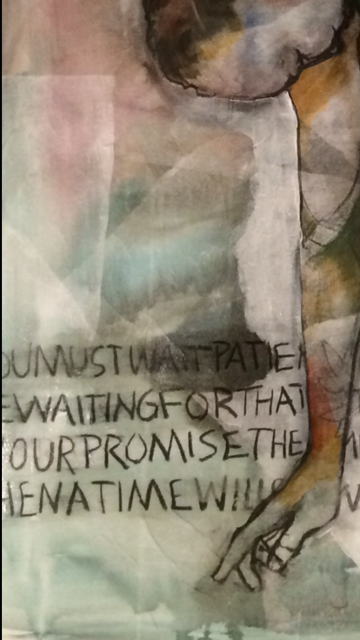
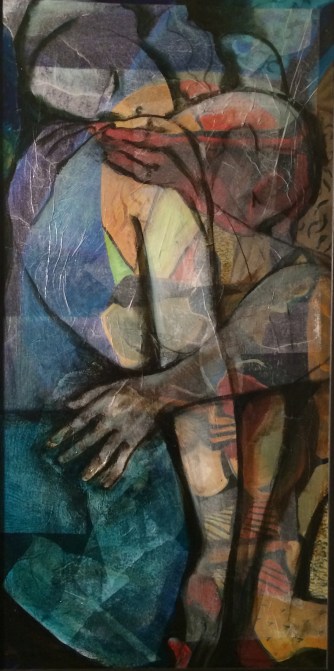
a detail from a recent painting

A surprise package came in the mail. It was a gift from David, my artist’s artist. He sends me things to feed my artist soul, to stir my pot or help me sort out my dilemmas. This gift is more timely than most; it is especially relevant for me now. It is a book of photographs and essays by Walter Kaufmann called Time Is An Artist. I’ve barely cracked the cover and already know it carries the wind that will fill my becalmed life-ship.

This is a quote from the first essay: We always live at the limits, but we are rarely aware of it.

I woke up this morning awash with gratitude for a man who stood in line behind me at an airport ticket counter over 30 years ago. I was returning from Europe. I had a hundred dollars and some lose change in my pocket. I was exhausted. I’d flown from London and landed in a blizzard. My connecting flight from D.C. to Denver was cancelled. Because I was traveling on a cheap open-ended student ticket, the cancelled flight meant I was stuck with no way home. I didn’t know what to do and was too tired to sort it out. I was desperate and lost in my desperation. That’s when the man tapped me on the shoulder. He was a guy in a rumpled business suit. That’s all I remember about him. He was also trying to get home. He’d just heard someone mention an airline offering a cheap flight to Denver. It was $89.00 ($100 with tax). I ran for the ticket counter and snagged one of the few remaining tickets.

That’s it. That’s what I remember about this man who tapped me on the shoulder. To him it was probably a little thing. To me it was enormous. I needed hope beyond desperation. I was investing in a story of limitless problems and was met with a moment of generosity.

It seems that I am in a life course, a graduate school for detachment. Last night P-Tom shared a quote that was important to him when he was doing his chaplaincy in a hospital: Don’t’ just do something, stand there (a reversal of the known quote). Stand there. Amidst the grief and the loss and the mess, sometimes it is essential to do nothing but offer presence. The man at the airport gave me his presence. Beyond his situation he was listening to my struggle.

Detach from your story and the gift will be gratitude. What rolls through our minds is nothing more or less than a story. Eckhart Tolle tells us the story is a force that pulls us out of the Now. Carlos Castaneda writes that Don Juan taught him 3 steps on the warrior’s path: Detach. Make a choice. Own the choice. One of the primary reasons people meditate is to quiet the mind. In the quiet it is possible to see the story as just that, a story. Detachment, in this sense, is not disengagement from life or cold aloofness from reality. It is the doorway to life. Stand in it and not the story of it.

Gratitude lives in the Now. Where else?

photo-2

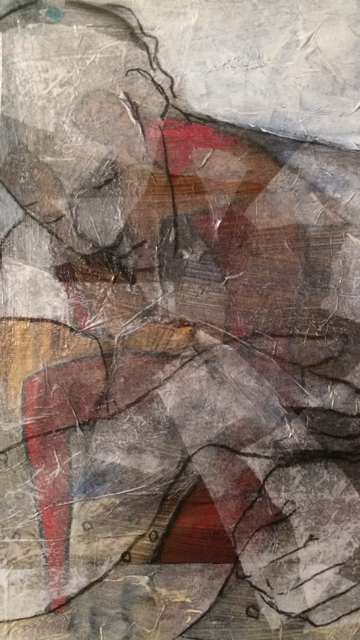
another detail from another painting. kerri says this one looks like gratitude

The man at the airport was on my mind because I have learned in this life-course that gratitude is best served in thimbles: the taste of the pear, the sun on your face. The man tapping your shoulder, “Hey, I just heard….” I thanked him before running but the real gratitude came later. Gratitude came again this morning because I was telling stories of the good angels who’ve populated my path.

Real gratitude for this life lived perpetually on the edge is often lost when the expectation-bar is set too high. To be grateful for your life – your whole life – is… an abstraction. It requires a story that pulls you away from this bite. It is a bucket too big. Savoring is a slow affair, available in the smallest taste, right now.


Focus On The Important Stuff

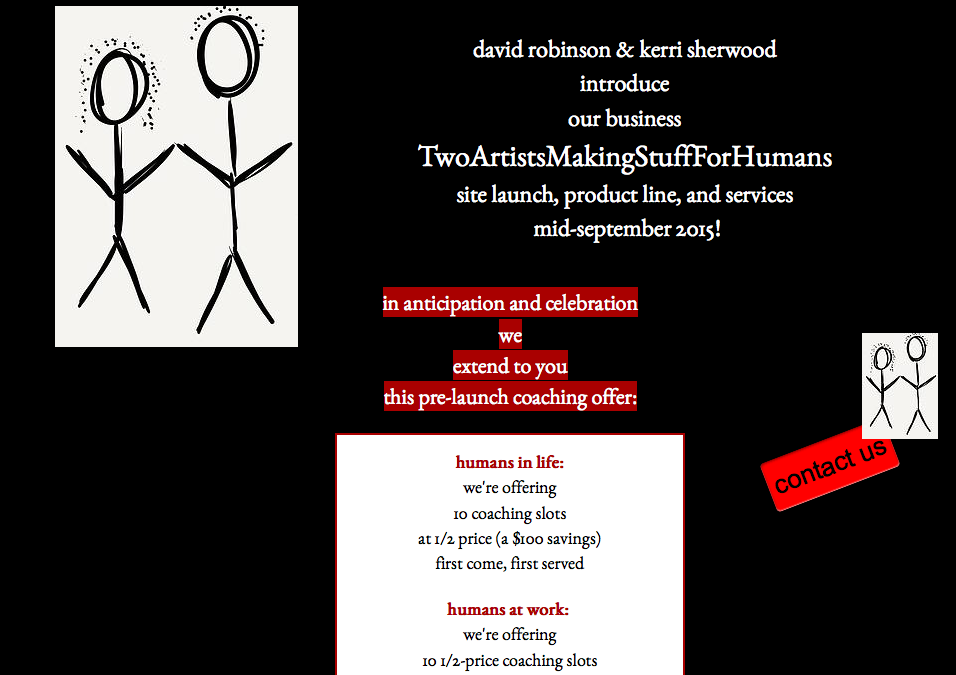
an offer from TwoArtistMakingStuffForHumans

an offer from TwoArtistMakingStuffForHumans

A note from the temporary site of TwoArtistsMakingStuffForHumans:

The waxing moon was muted with fog. It made the air shimmer. Avalon was near. Although it seemed too soon, there was a hint of autumn in the air. We sat next to a chiminea talking to friends. Monica told us of her daughter working in villages in South America. She told Monica that, by our standards, the people there have nothing. They are possession poor. But, they were happy, genuinely happy. They didn’t have much money or stuff but they had the essential thing that many of us lack: peace of mind. They focus on different, more important stuff.

It brought to mind my experiences in Bali. When I arrived all I could see was the poverty. By the time I left several weeks later, I’d have given everything I own or will ever own to have what they have: presence. Ease of mind. They weren’t looking for fulfillment, status, or living for retirement. They were living. Life was fulfillment. In a world where all things are sacred, status is gained by the quality of your giving and not by the size of your piece of the limited pie. It is a different focus.

There is a hidden cost to what dominates our focus, the things that take our attention…as opposed to the things we pay attention to.

As artists, both Kerri and I believe the work of our lives has been, one way or another, to help people focus on the important stuff, to see the extraordinary in the ordinary moment, to find inside what people seek outside. We’ve both worked across the boundaries of business, art, and the fine art of living everyday, there is no lack of necessity to refocus the eye, mind, and heart.

In a few weeks we will be launching our business (details to follow). All the many aspects of our work – if you can call art a product and performing a service – are intended to support, exercise and pay forward a focus on the important stuff, the important moments…sometimes the teeniest things that in the chaos pass unnoticed.

We want to do for others what we do for each other. Check out our pre-launch coaching offer. Take us up on it! Or, if you know someone who might benefit from working with us, pass it on, pay it forward.

Reach To The Light

TODAY’S FEATURED IDEA FOR HUMANS

Reach To The Light

FOR TODAY’S FEATURED PRINT FOR HUMANS, GO HERE.

Stay Open

Illustration from Play-to-Play

Illustration from Play-to-Play

It’s very late. I was deep asleep and am suddenly wide awake. That is happening often these days. My inner light switch is tripped and there is no going back to sleep.

I woke up thinking about something Judy told me yesterday during our phone call. Judy is wise. She told me that she believes the real work in a life is never achieving a goal or arriving at a destination. It is not something with a direction. The real work is to learn to stay open. Stay open to possibility. Stay open to choices. Stay open to feeling. Stay open to changes. Stay open to experiences. Stay open to surprises.

It is not the kind of advice that children generally get in school but it is exactly the kind of advice an elder might impart if asked – and only if asked. Learn to stay open. Life has a way of making us want to close, to armor up, to dull our selves, to turn our backs and whisper, “There’s nothing I can do.”

It sounds too simple, “Stay open to life.” It’s not. What is simple is sinking into the easy chair and falling asleep in front of the television. Simple seems like a good idea until you realize you’ve been doing it for years. That is, of course, the point of the easy chair. The easy chair is a destination. It is a direction.

Staying open is a practice. Turning toward life and facing it with all of its force, heat, and pressure is not simple. Opening to the grief as well as the joy, feeling the pain as well as the pleasure, requires intention. Opening to the full spectrum of living engenders liveliness. Life begets life.

In a recent post I included a quote from Carlos Castaneda that just popped to mind:

“Oppressors and oppressed meet at the end, and the only thing that prevails is that life was altogether too short for both.” Carlos Castaneda, A Separate Reality


Move Your Words

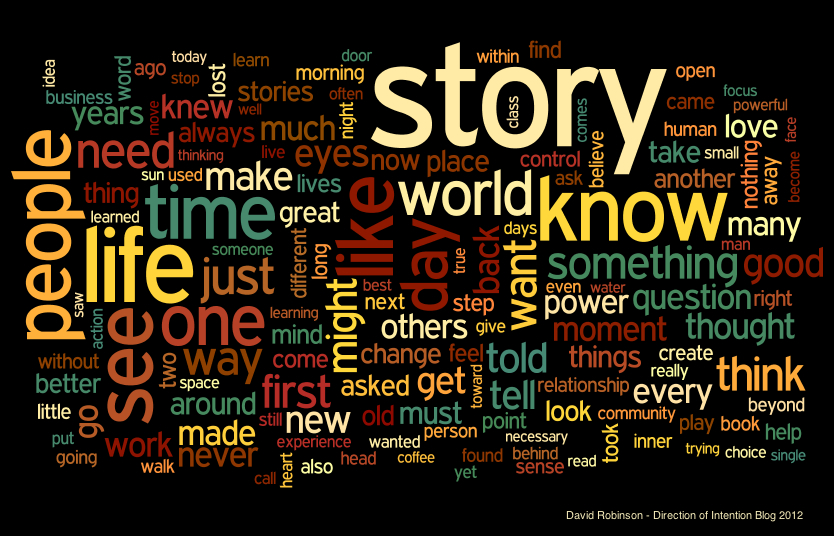
My friend, Mark, made this Wordle of my blog

My friend, Mark, made this Wordle of my blog

I am working with words again today but in another aspect entirely. Now that The Lost Boy has the minimum funding necessary for a production I am working on the play in earnest. Tripper Dog-Dog-Dog cocks his head and wrinkles his brow in wonderment as I talk to myself or dance the words. Sometimes he confuses my work method as an invitation to play and he leaps, catching the cuff of my shirt and pulls me to the ground. “Not now!” I cry out as Dog-Dog stretches my sleeve so that it might fit a giant (a side note: Dog-Dog has altered all of my shirts – he regularly mistakes my work for play. If I do not roll them, my shirt sleeves look as if I am small child wearing an adult extra-large).

I am a kinesthetic learner and realized years ago that working on a script was easier and more productive if I moved or danced the words as I worked with them. To borrow a phrase from a lost friend, my years at school were “fresh hell” because sitting in a desk was painful, it hampered my learning. If I want to have an insight or gain an understanding of something, the best thing for me to do is take a walk. If I move it, I can break down a script in no time. I can memorize anything if I can physicalize the intentions. For me, language, word use, and sense-making are a physical affair.

It is a physical affair for everyone. Try to speak without breathing (an impossibility); breath is movement. Speech is physical. For a real laugh, try to communicate without gesturing. Limit your movements and you will inhibit your capacity to communicate. For more fun, Google the latest statistic about how much of our communication is really non-verbal (we primarily read body language; listening to what is being said is a distant second). The deep mastery of a storyteller is found, not in the words, but the punctuation of a moment: the turn of the head, the intake of breath, the smallest of gesture, the connection made through the eyes; the fire of imagination is fanned when the storyteller, no matter how subtle, dances the story.

Last night I was reminded again of the power of language – the real kinesthetic of it. B is disturbed by the violence and darkness she sees in the world and asked, “How do we push back on it.” I challenged her verb. When we choose our language we also choose a “metaphor path”. Language choices come with images and images are not passive. They define what we see. They define the available options. They are a root for movement. To push back is a verb of resistance. It is counter force, a choice of aggression. “Why push against what you don’t want?” I asked. “Why not put your energy, effort, and imagination into creating what you actually want?”

To push. To create. Which verb will move you?

title_pageGo here to buy hard copies (and Kindle) of my latest book: The Seer: The Mind of the Entrepreneur, Artist, Visionary, Innovator, Seeker, Learner, Leader, Creator,…You.

The PoetFor fine art prints of my paintings, go here.

Peel Off The Laminate

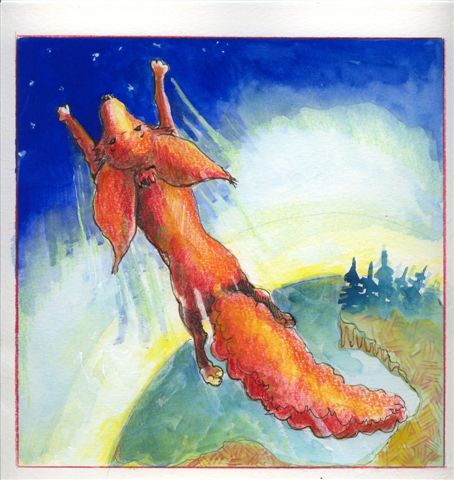
An illustration from my children's book, LUCY AND THE WATERFOX

An illustration from my children’s book, LUCY AND THE WATERFOX

Last week in a fit of frustration I climbed a ladder and scraped the damaged paint off the kitchen ceiling. The paint was compromised a few years ago and needed repair. The peeling paint was on my summer list of things to fix but we were traveling most of the summer. Autumn arrived and the to-do list remained. Scraping and sanding always leads to the necessity of new paint and Kerri said, “If you paint the ceiling it will make the walls look dingy. We better paint the walls, too.”

So, standing in the kitchen, fists filled with paint chips, discussing color possibilities, we realized that all of our color choices were defined by the fading yellow of the ancient kitchen countertop. The counter was at least 50 years old, laminate, and held in place by some well-placed packing tape. We’ve talked often of the day in some distant future when we could afford to replace it and that day seemed very far away.

In that moment, hands filled with paint chip possibilities, we realized that the countertop had became a metaphor. We were defining our choices based on a limitation. Or, said another way, we were limiting our possibilities based on our belief in an obstacle; what we could or could not do.

How often is that the case? What self-imposed limit defines the choices we see? How often do we unwittingly shrink our field of possibility? How often do we allow the things we don’t want to define our actions?

It took less than 30 minutes to pull off the old laminate, break it into pieces, bag it, and get it out of the house. As I wrote in an earlier post, the spontaneous kitchen remodel began when we realized we had the power to remove the limit. We had the capacity to make choices based upon a different set of criteria. Before the spontaneous remodel we believed we couldn’t afford to change the kitchen countertops. The moment of paint-chip revelation made us understand that we couldn’t afford not to change them.

Life is great at applying belief-laminate to us: what we think we can and cannot do. Something profound happens when, in a moment, we understand that we are capable of challenging the limit, of pulling off the laminate, of being forced to step into a greater field of possibility (known from henceforth as the “Now What?”)

It is worth noting that our new countertop, the old plywood support and made exceptionally beautiful with chalk paint and wax, has transformed our kitchen and our actions. We hang out in the kitchen. The colors we are considering using for paint are now based on what we want to create and not on what needs to go with the old yellow laminate.

title_pageGo here to buy hard copies (and Kindle) of my latest book: The Seer: The Mind of the Entrepreneur, Artist, Visionary, Innovator, Seeker, Learner, Leader, Creator,…You.

Go here (Leanpub) for all digital forms of The Seer.

Yoga.ForwardFoldOr, for kicks, go here for Fine Art Prints (and other stuff) of my paintings.


Use Your Key

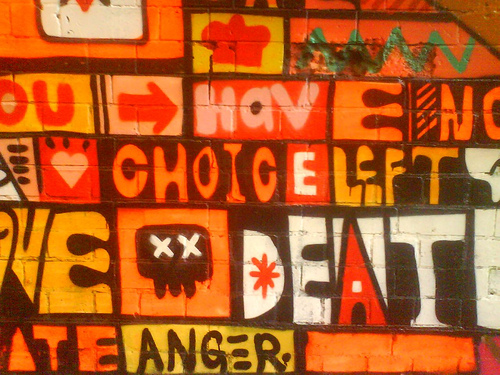
Photo by londonstreetart2

Photo by londonstreetart2

The other day I received an email from a long lost cousin. She spent some time on my website watching old interviews and contemplating my assertion that through our inner monologue we story ourselves. The idea was disturbing to her. How could she be the teller of her story and yet feel so powerless? So many things have happened to her! How could she possibly be responsible for the twists and turns of her life? She asked, “How exactly is one to find empowerment when the door is locked and the key wasn’t left under the mat….”

I’ve been slow in responding to her questions because my impulse to respond was so immediate. I wrote and then deleted, “If you do not have the key, who does?”

Her metaphor is perfect. There is door to life and it is locked. Someone else has the key.

And, to make matters more cruel, there is a mat, a tease, a place where the key should be. The mat is a constant reminder of the absence of the key. Her metaphor gives structure to a very specific story, does it not? It defines the actions of her life, the role in which she has cast herself. In such a story frame there is no access to life, there is no possibility of personal power.

I wonder what she might see if she held a different metaphor? I wonder what she might see if she recognized that she is the keeper of the metaphor and in that way the giver of meaning to her life and not the seeker of meaning? I wonder what she might experience if she saw herself as a locksmith or an opener of doors? I wonder what she might experience if she recognized that life is available on both sides of the door? Life knows no doors. Life needs no key.

Her confusion is also perfect. She has mistaken her circumstance for her story. None of us has control over our circumstances. Cancers come. Hurricanes happen. Empowerment comes when we recognize that we have infinite control over who we are within our circumstance. Empowerment is not given, it is chosen.

The Buddhists recommend joyful participation in the sorrows of the world. No one sails through life without difficulty and hardship. The difficulty and hardship are the very things that bring growth and illumination. Participate joyfully. Or, participate painfully. The sorrows of the world will always be there; how we participate is the story we choose to tell. If there is a key to life, if a key is necessary in your story, in her story, it is simply this choice.

title_pageGo here for my latest book, The Seer

Go here for fine art prints of my paintings.IMG_3185


Know Your Meditation

photo-1Some random thoughts on consciousness:

Last night I read that, according to some traditions, all forms of separation are an illusion. Only the whole is real but to experience the whole, one must experience him or her self as separate from it. What a conundrum!

Or, is it a gift? Tonight we witnessed the most extraordinary sunset. It’s been stormy these past few days and this evening the storms finally broke. The colors of the sunset were subtle, muted, otherworldly. Breathtaking.

We witness all of creation. All of it. And, as witnesses, we experience ourselves as separate from it. A sunset stops us in our tracks because we glimpse the glory of it all. Once, I stood on top of a mountain at sunrise and cried for the sheer beauty of what I was witnessing. Or, perhaps I cried for the feeling; I was, for a brief moment, not separate.

Consciousness is like a flashlight. We point its beam. We see what we illuminate. And, we illuminate what we see. We assign meaning and value where we point our beam. Some experiences – like sunsets – we define as glorious. Some, we define as lacking. Both are forms of meditation. Every choice to aim the beam is a meditation. All assignment of what is found in the light of the beam is a meditation.

What is your meditation?

As Joe said, the entire universe tends toward wholeness. Every time I recall his words I realize a deeper truth in what he said. We tend toward wholeness because we are already whole; the illusion of separation makes us think otherwise. In fact, thinking makes us think otherwise.

The Balinese have an art form, the shadow puppet, called Wayan Kulit. The audience sees the story as shadows cast on a screen. The performance is meant to remind the community that what they see is illusion. It is meant to remind them that they (we) are all casters of shadows. Our minds are screens upon which we play our dramas. Behind the screen, when all the characters are put away, when all the conflict is resolved, when all the separate pieces unified, there is only one artist, and we are….all.

title_pageGo here for my latest book, The Seer

For hard copies, go here.

The latest in the series. This piece is almost 5ft x 5ft

For fine art prints of my paintings, go here.

Stand Rooted

I awoke this morning with this phrase hanging in my dream space: you can’t control your circumstance but you have infinite control over who you are within your circumstance. It is a well-worn phrase for me, like an old sweater, relevant to much of the teaching, coaching and facilitation I’ve done. It is useful to remember when the hurricane hits or the job disappears or life seems to be a festival of obstacles. The ability to discern between circumstance and personal center is of great value. It is a skill that lives atop of Maslow’s hierarchy.

A work in progress: K.Dot & D.Dot See An Owl

A work in progress: K.Dot & D.Dot See An Owl

We have these words in our canon of health: centered, grounded, rooted, conscious, present…. They are all terrific metaphors, earthy with eyes wide open. Flip them over and you get a good sense of what happens when you confuse your self with your circumstance: off center, uprooted, ungrounded, unconscious, not here; up in the air with eyes squeezed shut.

There is a Buddhist phrase that I appreciate: joyful participation in the sorrows of the world. It is necessary to know the difference between self and circumstance to really grasp the meaning of this phrase. Life is going to bring you trials, tribulations, and lessons. You can never know what is just around the corner. As Kerri often reminds me, it is what you don’t know that makes you grow. So, when the storm comes, participate. Stand in it. Love life in all of its forms and textures.

So many times when working with business clients I’ve had to say, “Don’t eliminate the wolf from your story.” In the story of Little Red Riding Hood, the wolf moves the story forward. In fact, without the wolf, there is no story. In business as in life we attempt to protect ourselves from the wolf. We resist the very thing that can bring growth and renewal. Circumstance is often the wolf. The storm comes. The relationship suffocates. The wolf always creates movement where the energy is stuck. It is uncomfortable. It hurts. It is scary. Yes. So, participate. Engage. Be-with-it. Within the circumstance, within the storm, learn to stand rooted, centered: earthy with eyes wide open.

The circumstance will pass and you will remain. You will know more. You will have grown. This simple understanding, that you are separate from your circumstance, allows for the joyful part of participation. Joy lives at the choice point. The world is and always will have plenty of sorrows to help you grow. Things happen. The question is, “How do you choose to participate?”

Go here to get my latest book, The Seer: The Mind of the Entrepreneur, Artist, Visionary, title_pageSeeker, Learner, Leader, Creator…You.

Or, go here for hard copies.