Be Unbearably Small [David’s blog on Two Artists Tuesday]

“We fought so long against small things that we became small ourselves.” Eugene O’Neill

“On my last day of work, the back wheels of my car won’t be out of the parking lot before they erase everything I’ve worked for,” Tom said. He was right, of course. I was there and witnessed the dismantling. His words were not resentful. They were matter-of-fact. He helped me understand that a life’s work is not about achievement. Rather, it is about integrity of process. Relationship. Bringing instead of getting.

“I’ve fought my battles. It’s time for someone younger to pick up the fight,” another in my tribe of dear-wise-guides reminded me when I was pushing him hard to care. I am a few years down the road now and I understand to my bones his position. I have limited time here. I have (mostly) turned my eyes away from the fight and toward the wonder-of-it all. I have no idea how to paint it so I am reticent to touch my brushes. How do you contain – or try to contain in an image or word – the inexplicable? It’s the artist’s dilemma and I love it.

Sitting on the back deck staring into the pastel sky, I thought about their words. Quiet summer nights are prime for reminiscence and reflection. I thought about the battles I have fought in my life. The hills I chose to die on. The art meant to heal or change or provoke. To reach and touch a heart. To shake a sleeper awake.

I have been fortunate to have had such wise guides showing me the way. To give me the rare gift of perspective. I am fortunate to understand how unbearably small I am in this limitless universe. Were I to believe myself grand I would not have access to the awe of this summer night, this rolling pastel sky.

read Kerri’s blogpost about the PASTEL SKY

share. like. comment. support. thanks!

*happy birthday, columbus.

Take A Second Pass [on Not So Flawed Wednesday]

It was the second time we’d walked the loop. The first was many months ago in another season. Though the path was the same it felt as if we were walking an entirely different trail. This time, instead of seeing across brown and yellow winter marshland, we walked through a tunnel of tall viridian reeds. Not able to see the landscape, I looked up through the green at a rain-threatening sky. If our first hike on the boardwalk felt like a discovery, the second pass seemed directed.

The second pass. In life it’s called a memory and it is never the same as the original walk. To begin, it is viewed from a different season. Time alters details, rearranges events, begs questions. The second pass is made with a different purpose-in-mind. To re-view. It is directed, replayed, questioned, run forward and backward. Different endings are tried on for size. Different beginnings, too. Destiny or accident? Did that really happen?

Plotting backward through memory provides ample sense-making. Event chains, choices, that lead to this place, this day, this story called life. Looking forward from the current first pass, this present walk, there is a wide open vista. What if I stepped off the path? Is there a path? It’s all discovery though we rarely experience it that way. The routine of the day or the master to-do-list obscures the newness of each and every step. Same-old-same-old is a sorry reckoning.

Kerri and I are having an ongoing conversation about how quickly and dramatically life can change. Just when you think you know what the day holds a strong wind huffs and puffs, forever altering the arc of your life. The tiniest of choices hold the seeds for the most profound changes. The boardwalk suddenly disappears. Or the opposite, when you are lost and least expect it, a boardwalk magically appears. In a flash a path seems certain.

And, isn’t it awe-some that we are capable of twice-storying this grande life adventure? Giving to each step a meaning and shape the very moment we take them. Giving to each step a different meaning and shape, over and over again, on the return loops, the second pass. Memory.

read Kerri’s blogpost about THE BOARDWALK

support. share. like. comment. all are appreciated.

Discover Again [on Not So Flawed Wednesday]

Some books sit idle on my shelf for years and then, one day, with no warning, they leap forward and demand to be read. And so it is with Vāclav Havel’s book Disturbing The Peace. It is my new 2-page-a-day-meditation-book. I’m only a few pages in but already finding the words of this playwright-become-president of the Czech Republic, published in 1991, speaking clear thoughts to the un-united-united-states of 2023.

“It seems to me that if the world is to change for the better it must start with a change in human consciousness, in the very humanness of modern man.”

The change in consciousness? It is this:

“He must discover again, within himself, a deeper sense of responsibility toward the world, which means responsibility toward something higher than himself.”

He writes that we must extricate ourselves from “the mechanisms of totality” and the “manipulation” of media. We must “rebel against [our] role as a helpless cog in the gigantic and enormous machinery hurtling god knows where.”

Climate change. Attempts to white-wash history rather than learn from it. Populism and a republican party dedicated to authoritarian rule rather than the democratic ideals they are sworn to uphold. The absence of a moral center and, to use a phrase from the past, common courtesy. Courtesy to the commons.

Vāclav Havel led his country through their great chaos, the tension of their divide, power struggles, and the collapse of repressive communism. He was an absurdist playwright. He did not pretend to have answers. He had abundant questions. He argued for the simplicity of confronting the tasks at hand, tasks that are the responsibility of all the people in a nation, tasks like honestly looking at and dealing with their full history. Tasks like turning away from anger-inducing propaganda, conspiracies and lies – and learning to discern what has merit and what does not. In other words, transcending individual-self-serving-belief-bubbles in order to realize and secure the higher ideals of the community.

Every book has its time. I find it extremely hopeful that this book chose this moment to jump off the shelf.

read Kerri’s blog about SKY-THROUGH-TREES

share. like. support. comment. we appreciate it.

Ask A Rhetorical Question [on saturday morning smack-dab.]

Our stove is almost as old as I am. It was made at a time before planned obsolescence, before things were built to break down. I imagine the people that designed and built our stove had a sense of pride in their work. They built it to last. They were from another time, closer-in-spirit to craftsmen and craftswomen than cogs in a fast moving economic wheel. I imagine the pride they felt in their work was directly connected to the loyalty they felt toward their customer and also their employer who paid them a decent wage, union benefits, a pension.

Loyalty is always a two-way street. Pride is like that, too. A job well done is well done for others.

In our times it seems almost everything operates according to the rules of planned obsolescence. Everything is quickly outdated. Replaceable. Including the customer. Including the employee.

Kerri’s question is as sadly current as it is rhetorical: What about loyalty?

read Kerri’s blogpost about LOYALTY

smack-dab © 2023 kerrianddavid.com

like. share. support. comment. thank you.

Split and Emerge [on Two Artists Tuesday]

Although butterflies get all the headlines, the transformation of a cicada is equally astonishing. The cicada doesn’t emerge from a cocoon. It emerges from its own body. The outer shell, a crawling insect, splits and the new form, a miracle with wings, a flying insect, crawls out of its former self to greet the world.

It actually has two emergences. For most of its life it lives underground, feeding on the sap in tree roots. And then, one day, on a cue no scientist has yet discovered, all of the cicadas in the neighborhood crawl to the surface, climb into the air and light, ascend toward the sky, and attach to a tree or some other vertical surface. Once they are firmly attached, the second emergence begins. Like a snake shedding its skin, the cicada sheds its former…form, and enters the last chapter of life completely changed. Air-born.

I’ve never wondered if a butterfly turns and ponders the cocoon. A cocoon seems generic. An envelope. But each time I see the shell of a cicada I can’t help but wonder, as its new wings dry, before it is capable of flight, what it might think, perched atop the old form, staring at what it used to be. Did it know that wings were growing inside all along or is it a complete surprise? A reverse mummy, opening the lid of a body-shaped sarcophagus to venture into the upper regions.

I wonder if it knows the transformation to flight signals the end, only a few more weeks of life. The males begin to sing. The females click their wings. Partnering through an ancient call-and-response. The end of life. The fulfillment of purpose. The beginning of a new cycle of life.

It’s full, full, full of useful metaphors. The old shell appears as if it is hanging on for dear life when dear life was about to burst forth, unrecognizable. Transfigured. And, isn’t that usually the way of the scary new? The old, well-worn shape wants nothing more than to hang on for dear life to what it knows, what it has always been. It’s necessary for the new energy, the new form, to split the frightened shell, wrestle with itself to emerge, and discover life anew. Finally ready to fulfill its purpose, its reason for being.

read Kerri’s blogpost about CICADAS

like it. share it. support it. comment on it. we appreciate it.

Let Go And Breathe [on KS Friday]

We have been slow to reenter life at home. We were only gone for a few days but it feels like months. There is life before the farmhouse and life after. The time away serves as a hard line of distinction. And, because there is now a before, we are finding our reentry a bit disorienting. Nothing is the same yet everything is the same. Unrecognizable because it is familiar.

We are moving slow. We are noise averse. We are reticent to go to the store or drive on a busy road. Too much stimulus fries our wires. It’s as if we are walking through the life we know – we knew – as witnesses. There is a silent accounting: what stays, what we will let go.

Transformation is like that. Snakes shed old skin. Trees drop their leaves. People clean their closets. Letting go creates necessary space for a new rhythm and new rhythms emerge slowly over time.

Sitting on the back deck this morning, the air was still and warm. The birds were singing, the chippies foraged beneath the feeder for discarded seed, Kerri said, “This is the level of sound that I can tolerate right now.” I nodded.

Long ago, when I facilitated retreats, on the last day someone would usually ask, “How do we take what we’ve learned back into our normal lives?” They were changed by their experiences at the retreat but the circumstance of their daily lives remained unaltered. The real question was “How do I bring this feeling of openness and expansion from the protection of the retreat center to the squeeze and turmoil of the realities of life?” There isn’t a single answer to the question. In fact, there isn’t an answer. There’s a practice. There are decisions. What might fall off the list of to-dos? Spaciousness is not magic. Openness is often the result of generosity-to-self. One must slow down to see and hear and taste. Touch takes time. Positive thought takes intention and letting go of grudges. Forgiveness is a choice made again and again and again.

The first day back we walked our trail. We talked of the changes we want to make. The clearing of old baggage. Making space. Kerri stopped to photograph the honeysuckle. I took a deep breath of the sweet fragrance. Nothing more. Nothing less.

old friends revisited © 1995 kerri sherwood

Kerri’s albums are available on iTunes and streaming on Pandora or iHeart Radio

read Kerri’s blogpost about HONEYSUCKLE

if you’d like to support our blogging, writing, cartooning, composing, painting… the QR code below or the link will bring you to our online tip jar;-)

Meditate On It [on Merely A Thought Monday]

I was struck by how important it felt. How could something so routine seem like such a big deal! We used to do it all the time. Without thought. Nothing special. Now, it felt like a significant passage. A step toward “normal”: we took the train to Chicago.

Covid was the great disrupter. Daily patterns exploded. Social norms obliterated. It changed us in ways that we are only now beginning to comprehend. To this day – without thinking – if someone stands too close to me in the grocery store I adjust, creating distance. A dance of protection. That small adjustment away from someone is a titanic statement about how I approach social situations, about how I feel about being with others. Keep-them-at-arms-length.

In other words, I’m meditating on safety all of the time.

I don’t think I’m alone in my meditation. I believe the central meditation in my nation is safety – rather, our lack of safety. We wouldn’t be arming ourselves to the teeth if we felt safe. We wouldn’t be ripping at the seams or tolerating corrupt bullies or gobbling up conspiracies if we felt secure. People do not willingly plant their heads in the sand when times are good. In good times, people look up, people reach toward each other. Generosity of spirit engenders generosity toward others. A poverty of spirit engenders animosity toward others.

In other words, no one meditates alone. The big meditations are shared.

Of course, it is also true that people rarely make significant change when times are good. The gift of disruption is progress though the first phase is often nasty and necessarily looks precarious. I suppose we are in the nasty stage of change.

It was not so long ago that a gathering with friends began with testing to make sure no one was carrying the virus. Testing became the norm. It was routine. Am I safe? Are you? Do you remember washing your groceries or isolating your mail for 24 hours when we did not yet understand how the virus was passed? It fundamentally reoriented our experience of being with others.

I think about my safety when I enter a crowd. I look for exit routes when I enter the grocery store. And, last weekend, we stepped onto a train for the first time since the great disruption. It felt momentous. A marker in time. Rather than taking a step away, we took an intentional step toward.

The journey of a thousand miles begins with a single step and ours was a step onto a train. Each small step toward others, each reach, each moment of listening…matters. It creates the progress borne of the disruption. I look forward to taking many more small steps.

I don’t know about you but I’m more than ready for a different meditation.

read Kerri’s blogpost on THE TRAIN

coffee or share it, like it or talk to us.

Welcome The Muse [on Two Artists Tuesday]

For many years the “sitting room” was a place we passed through en route to the kitchen or our bedroom on the return trip. It was our staging ground while packing for trips. It was the place we put things when we didn’t know where else to put them. I never sat in the sitting room.

And then, one day, a muse-of-calm possessed Kerri. She wanted a space of peace instead of space of clutter. She wanted to sit in the sitting room. She wanted to hang out in the sitting room. She wanted to read and relax in the sitting room. She became a cleaning dervish. She hung meditative paintings. It was a miracle.

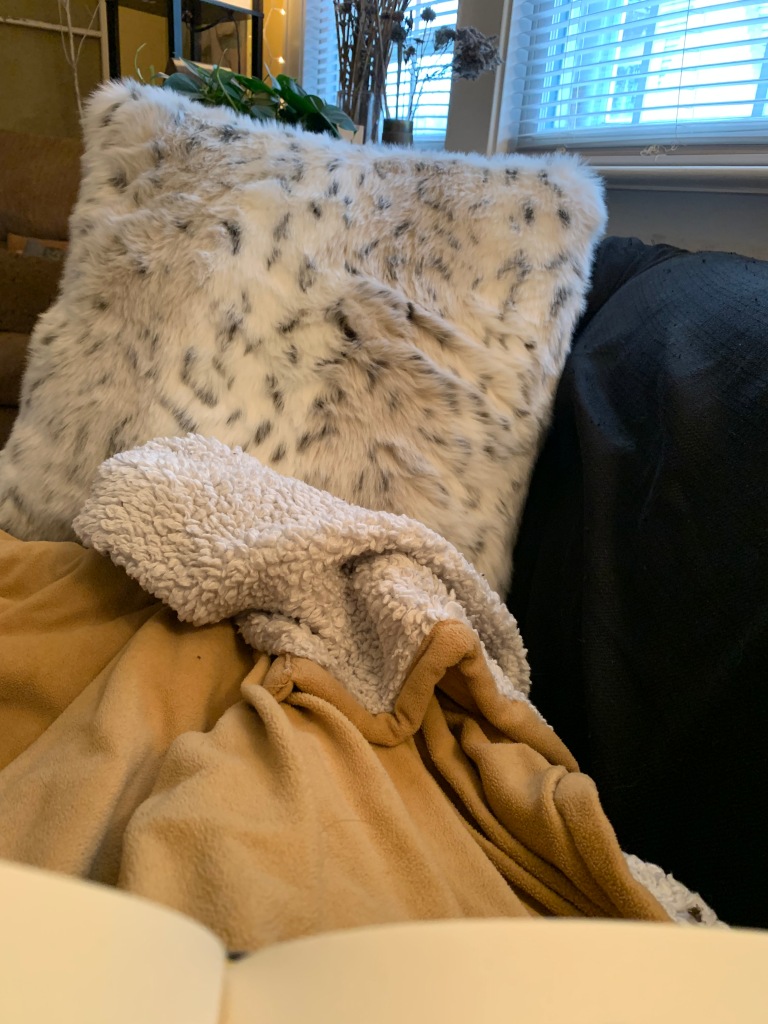
I stopped in my tracks the first time I attempted to pass through the sitting room post-transformation. There was air and light. There were comfy pillows and a throw blanket on the couch. I was filled with an overwhelming desire to sit in the sitting room!

I’d heard rumors of the couch in the corner of sitting room. It was one of BabyCat’s favorite nap spots. Kerri assured me that no creature could sit on that couch without falling into a deep relaxed state. I had my doubts. In my time it was the central repository of clothing overflow. I’d actually never seen the couch. Plus, that BabyCat could sleep anywhere, on any surface. BabyCat was a gifted sleeper.

Kerri appeared behind me. She was holding a book. She, too, had transformed! She was the Siren of the sitting room! I nestled into the couch and cooed, the lap blanket covering my feet. The Siren sat on the other side of the couch. She opened the book and began to read. I was like Dorothy in the poppy field. Eyes drooping. Head bobbing. Incapable of concentration. The last thing I remember was thinking, “So this is what it feels like to be a cat…”

Now, we spend hours in the sitting room, reading on the couch. Falling into a deep relaxed state. Each morning, as I pass through on my way to the kitchen, I slow down and breathe-in the calm.

Sometimes I wonder why we waited so long to create this place of tranquillity. The potential was there all along. The good news? The peace of the sitting room is spilling out into the rest of the house. The sun room is filled with plant-love. The living room is beginning a subtle transformation. We gather around our small table in our tiny kitchen and laugh and tell stories. It’s how change happens. Create the space. Grow the space. It’s how peace happens.

This I know: the muse-of-calm is not yet done with us. I can’t wait to see what happens to the rest of the house and beyond.

read Kerri’s blogpost about THE SITTING ROOM

Ask A Simple Question [on DR Thursday]

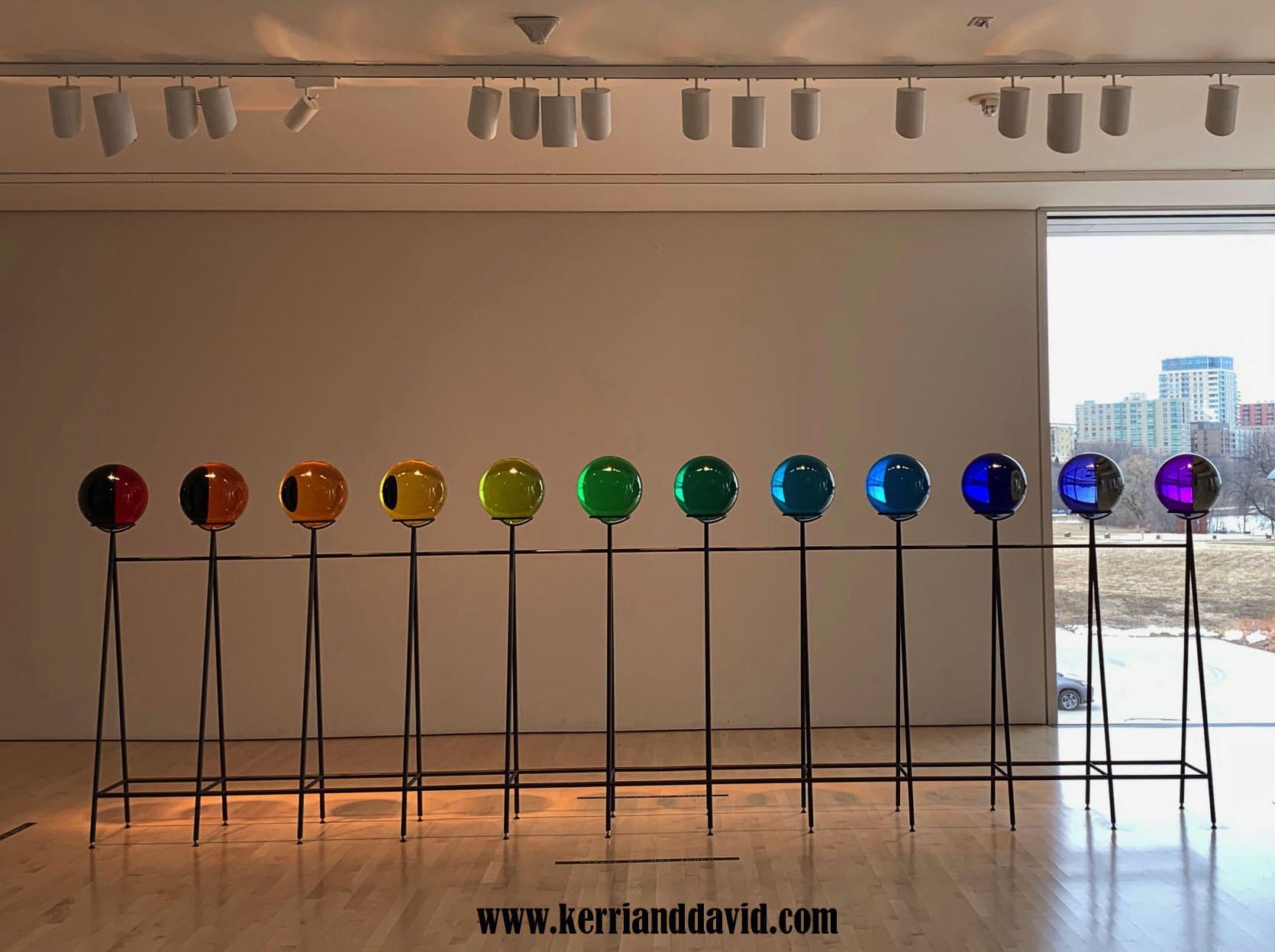
It’s existential. What you see changes depending upon where you stand. That’s true when engaging any piece of sculpture. It’s true when engaging anything in life. Point-of-view is fluid and relational. This sculptural reminder is Olafur Eliasson’s Rainbow Bridge.

In another era of my life facilitating diversity and inclusion workshops, the same surprisingly simple concept was usually a revelation to people. What you call “normal” is merely a point-of-view. Most importantly, it’s not everyone’s point-of-view. Your “normal” is unique to you, not universal. Most hopeful: it’s not fixed in stone. It’s changeable. Relational. Capable of growth. A mature point-of-view recognizes that it need not, it cannot, be the center of the universe. A mature point-of-view necessarily asks an all important question: “What do you see?”

It’s not only possible to look at the same sculpture and see a myriad of differences, it’s necessary. It’s human. Sharing what we see is how we, together, create community. A common center is created by a circle of differing points of view. A common experience is borne of sharing disparate points-of-view of the same event. A common center is made functional when everyone in the circle is capable of asking with sincerity a simple question: What do you see? It is made vibrant when everyone in the circle expects the answers to be different than their answer.

Art is one way of responding to the simple question.

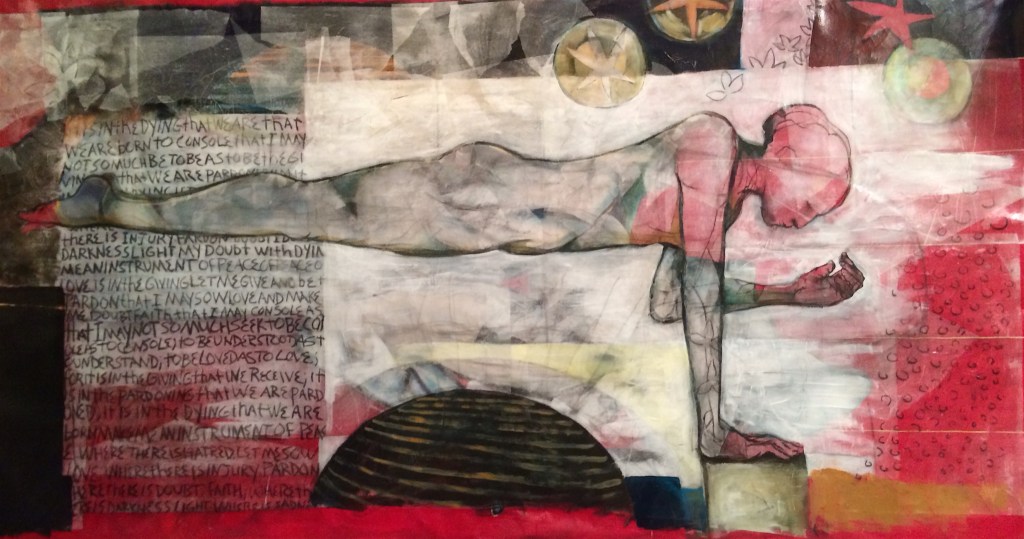
Instrument of Peace, 48x91IN, mixed media

read Kerri’s blogpost about RAINBOW BRIDGE

instrument of peace © 2017 david robinson

Step Off The Path [on DR Thursday]

At first we were horrified. The forest filled with machinery. Trees down and the underbrush annihilated. Our beloved trail decimated. We read that the seeming destruction was part of a woody invasive species clearing project. The clearing would allow the native species to rejuvenate.

Later, after the machinery was removed and the air cleared of diesel fumes, we returned to walk the obliterated forest trail. And, on our walk, I learned – or re-learned – a very valuable lesson. The change pulled us from our well-worn path and invited us to explore. Because we could now see all the way to the river, we left the trail. We stepped into the unknown. What had been comforting and known now beckoned us to see anew. To wake up.

We walked in places where previously we could not because the brush was too dense. We followed an animal trail through the snow into a part of the forest we’d never been. It was a place we’d never before considered investigating. We deviated and hiked all the way to the train tracks. We took photos. We felt the thrill of stepping into new territory. Our eyes wide open, our ears attuned to every nuance of sound, we took nothing for granted. Everything was pristine and unknown.

Change is like that. It makes you pay attention.

Returning to the trail so we could make our way back to the car, enlivened by our off-trail adventure, we wondered aloud about the wildlife. We worried for the deer. And, just as the words left our mouths, Kerri stopped and motioned to the forest’s edge. A deer was watching us. And then there were two. Three. Five. After determining that we were not a threat, they nibbled on branches. We stood very still; quiet appreciation.

It felt like a reward for taking the step off the beaten path. It felt like reassurance that the devastation was akin to a forest fire; necessary for renewal.

From a cue invisible to us, the deer leapt in unison, white tails flashing, and disappeared into the forest. It broke the spell. We returned to the car, eyes scanning the forest in case the deer returned. Our senses keen, I felt fully alive.

Change is like that. A clearing project, disrupting comfortable complacency, nothing can be taken for granted, making way for new seeing and discovery. Anything becomes possible.

a work in progress: train through trees, 48x48IN

read Kerri’s blogpost about RIVER BEND

train through trees (in progress) © 2023 david robinson