Our Dull Ho-Hum [David’s blog on Merely A Thought Monday]

“In spite of indignation and anxiety over what has occurred, I cannot help wondering where we have failed. There was a time during the war when we enjoyed the trust and respect of little and big nations everywhere. What has happened to turn that, in some cases, into suspicion and disdain? We cannot blame our leaders, because we are a democracy. Somehow we the people have failed.” ~ Eleanor Roosevelt, My Day, August 23, 1946

Our conversation was sparked by a post by John Pavlovitz: The people I’m struggling the most with right now are the polite people, the patient people, the people who are acting as though they are above those of us who have f*cking had it.

If our democracy fails – as it now seems is almost inevitable – we could blame the cowardly Republican congress, the unscrupulous executive or the corruption of the Supreme court. What of the responsibility that falls squarely on our shoulders?

We the people voted the corruption into place. For years we’ve tolerated the lies, the meanness of spirit, the grift. We tuned in to news that was more interested in ratings that in factual reporting. We allowed an insurrectionist, rapist, felon to run for the highest office in the land. We did not express outrage when the Supreme Court not only protected the felon, but granted him immunity from the law, elevating him to monarch status.

We’ve normalized the abhorrent. We’ve made the monstrous acceptable, ho-hum.

We have, for a decade, watched the real-time dismantling of democracy like we watch reality tv. We perform the daily doom scroll, seeking, grousing about and then forgetting the latest outrage. I return, again and again, to the forward Neil Postman wrote for his book, Amusing Ourselves to Death:

Orwell warns that we will be overcome by an externally imposed oppression. But in Huxley’s vision, no Big Brother is required to deprive people of their autonomy, maturity, and history. As he saw it, people will come to love their oppression, to adore the technologies that undo their capacities to think.

We are allowing the whitewashing of history, the celebration of ignorance over education. Only an empty-headed society would tolerate the elevation of the most unqualified to positions of leadership. 90 million people yawned and rolled over rather than go to the polls when the very existence of democracy was on the ballot. Congress knowingly confirmed a kakistocracy that made no effort to hide its authoritarian agenda.

Last weekend 4 – 6 million people took to the streets to protest the ho-hum. It was the largest protest in the history of our nation. It had no visible impact on our elected leaders. Ho-hum. They pushed forward their Grossly-Gluttonous-Bill with language that prevents the courts from checking the overreach of the executive. They added language that would make it impossible for a citizen to seek redress from government abuse.

They no longer fear the vote of the people. They are counting on our passivity. They are counting on our dull-minded ho-hum. They are counting on our capacity to change the channel when we don’t like what we are watching.

“We seem to have forgotten to weigh our values and to realize that we have to pay for the things we want. The payment which can bring about friendly and peaceful solutions is infinitely less costly than the payments which will have to be made if we are going to be an enemy to all the world.” ~ Eleanor Roosevelt, My Day, August 23, 1946

read Kerri’s blogpost about HO-HUM
likesharecommenttalktoeachothersupportsubscribeprotestspeakupspeakout…thankyou.

Goodness Is Quiet [David’s blog on Merely A Thought Monday]

What is it to do good? It may at first seem like an inane question until you consider how completely unmoored from simple kindness that we’ve become.

It’s the best concluding sentence in a non-fiction book: “For in the end, he [Aldous Huxley] was telling us that what afflicted the people in Brave New World was not that they were laughing instead of thinking, but that they did not know what they were laughing about and why they had stopped thinking.” ~ Neil Postman, Amusing Ourselves to Death

Like many of my friends, I did not watch the most recent presidential debate. I knew, like we all knew, that it was not really going to be a debate of ideas or an opportunity for serious comparison of party platforms for moving the country forward. It was an entertainment. It was billed with all the hype of a UFO wrestling match. It featured referees called moderators who mostly did nothing but pose and let the contestants trade blows. Think about this: we do not think it odd or sad – or reason for disqualification – that one candidate requires a real time fact-checker because he is renowned for outrageous lying and is a famous bully. He draws a crowd, ups the ratings, and that is more important and far more entertaining than an a thoughtful exchange of plans. One need not be credible if drawing a crowd is the criteria.

“…they did not know what they were laughing about and why they had stopped thinking.”

What is it to do good when we do not expect good from our leaders – or ourselves?

Here are synonyms for doing good: behave morally. Act virtuously. Behave virtuously. Be kind. Do the right thing. Act in good faith. Conduct oneself ethically…There are many, many variations.

Yesterday was our local 4th of July parade. The man who drove around the assembled families in the brown truck with a large flag waving with from back, “F*CK BIDEN, certainly was not concerned with doing good. How did it not occur to him that there might be children at the parade? How is it that he didn’t care? He was, like his role model, not at all concerned with conducting himself ethically. I assume he thought he was doing good for his team and that is precisely my point. Where is the expectation of good? Lost in the entertainment. The bully behavior mirrors the bully behavior.

Here are other synonyms for doing good: stand out. Steal the show. Boom. Reign supreme. Make the big time…There are many, many variations.

What is it to do good?

It is no more or less than what we expect it to be. What we allow it to be. If we want better, we must first be better. Our candidates mirror us, not the other way around. Right now, in the absence of serious debate, awash in noisy entertainment posing as political discourse, all we know is that we have competing ideas of what it means to do good. One is concerned only with itself. One is concerned with helping others.

For me, booming may draw a big crowd, it may be entertaining and sell abundant advertisement, but I will go with ethical every time. Kindness, like genuine goodness is quiet and has no need to draw attention to itself. Doing good, the kind that is focused on helping others, does not grow old.

read Kerri’s blogpost about DO GOOD

share. like. support. comment. subscribe. thank you.

Exactly The Point [David’s blog on Two Artists Tuesday]

Chris wrote that he was taking a break from Facebook. “I’ve spent too much time in this space.”

I told Kerri that after I was finished with my slow re-read of Amusing Ourselves to Death, for a while I was only going to read books that filled me with light. “I’ve had too much of darkness,” I said.

Walter Lippmann posited that “…distorted information was inherent in the human mind. People make up their minds before they define the facts…” In other words, we are more gullible and impressionable than we care to admit, and are too soon planting our belief-flags in the sand. In other-other words, fact checking is not a human forté. Gossip mongering is.

Kerri and I often walk arm and arm along the waterfront, an old-world evening constitutional, a stroll taken slowly enough to notice, an opportunity to say “Hello,” when passing neighbors and friends. More and more I think it an essential to regularly set aside those little screens that dominate our viewpoints, and clear our minds. Every painter knows that perspective is gained by stepping back. I can read streams of opinions all day long but nothing beats the affirmation of real community than a hot summer night, people sitting on porches and a neighborhood mosey.

Families filled the park. The cool breeze off the lake drew them to the shore. Barbecues. Children chasing balls and each other. A feeling of respite was pervasive. Laughter. Shared space. We passed two teenage girls sitting on a bench with a bucket of colored pencils between them, coloring their books and chatting.

The sky morphed from orange and blue to purple and pink. A single bird arced across the sky. “What are you thinking?” I asked.

“Nothing. Nothing at all.” she said. “I’m just enjoying the moment.”

I smiled, thinking, “Yes. And isn’t that exactly the point?”

read Kerri’s blog post about THE PINK SKY

like. support. comment. share. subscribe. thank you!

The Essentials [David’s blog on Merely A Thought Monday]

The interviewer asked me to name three things I love and three things that piss me off. “Ah, here’s the trick question,” I thought. Tom Mck once told me that, when conducting interviews for teaching positions, he’d ask a trick question, “Tell me about your experiences with a bad student?” If the interviewee answered the question, he would not hire them. “There is no such thing as a bad student,” he said. I knew better than to answer the interviewer’s question but I did anyway: “I can’t see my dad anymore and sometimes that really pisses me off.” Of course, I did not get the job.

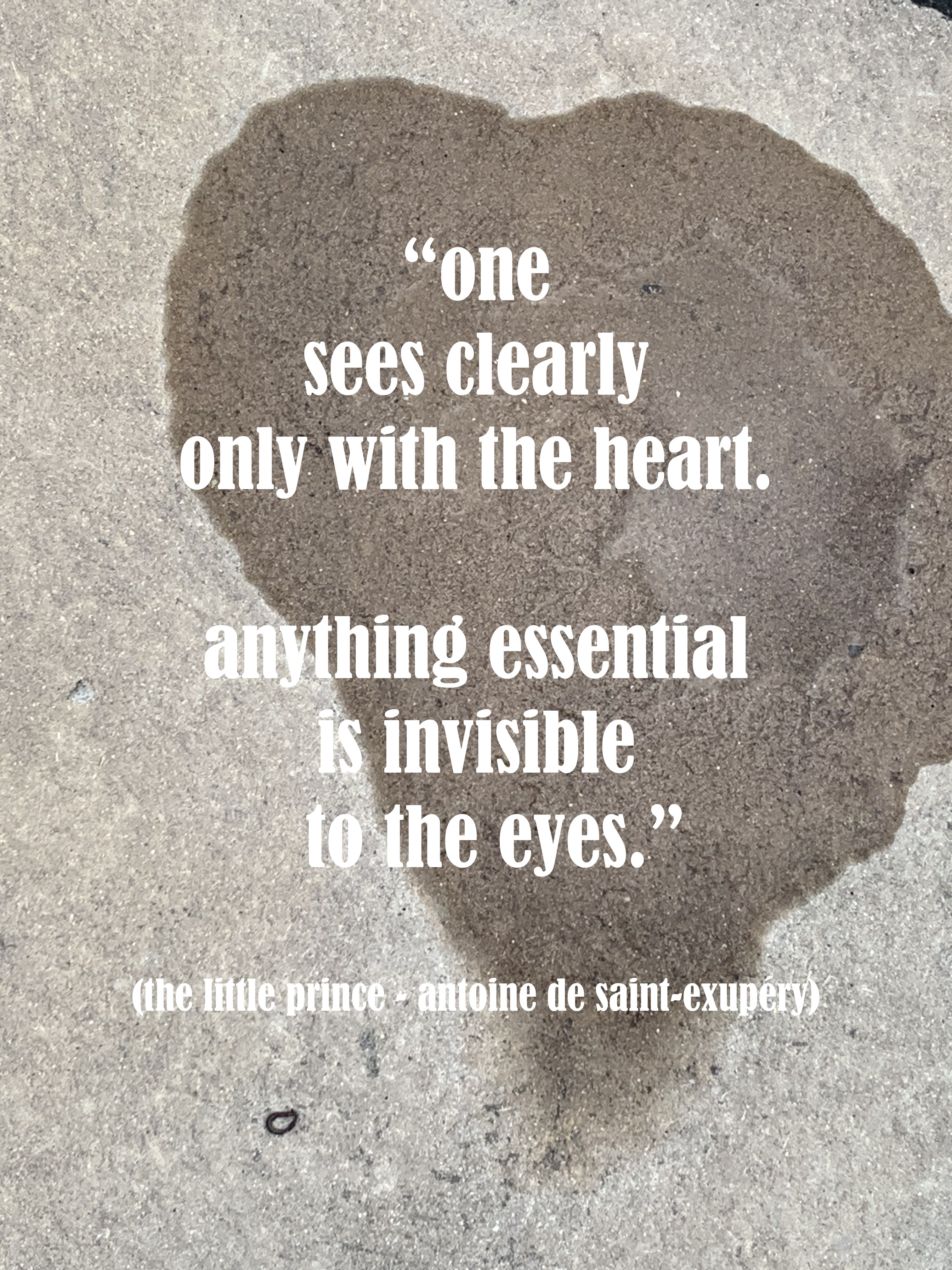
I read The Little Prince, first to myself and then aloud to Kerri. As I turned the last page I saw that she was silently crying. “I forgot how it ended,” she said. So had I. In the book, after the Little Prince is bitten by the yellow snake and dies, the narrator searches the sand but cannot find his body. The author, Antoine de Saint-Exupery, a year after he wrote the book, crashed his plane over the Mediterranean Sea. It was 1944. His plane was later found but not his body.

Neil Postman wrote Amusing Ourselves to Death in 1985. It is more relevant today than when it was written. He predicted our indifference to lies. It’s not that we cannot discern fact from fiction, it is that we do not care to. It’s much more entertaining to spew self-righteous bile and shared discord within the confines of the social-bubble. A free press, the mechanism meant to function as society’s lie-detector, has collapsed and become a terrific magnifier of falsehood. Entertainment. That which can be seen with the eyes but is nowhere detectable with the heart. Wild lies, outrageous claims and blame, blame, blame, blame, blame are much more captivating than essential truth. It’s about numbers: grotesque behavior attracts more audience than genuine discourse so completely dominates the info-stream.

The body politic fragments, like pieces of an airplane tumbling from the sky.

Lately, I hear often – and speak – this common refrain: “I just can’t understand how people don’t see it.”

“Oh, people do see it,” whispers The Little Prince, sweeping clean his volcano, adding, “With their eyes.”. He winks, “Closed hearts are not concerned with the essentials.”

The wind shifted so we sat outside and enjoyed the evening cool after a hot day. Just like my dad used to do. Now, when I close my eyes, I can see him. We made dinner with 20 and ate under the waning light in the sky. It was the solstice. The stars made their slow entrance. Gazing up, I wondered if perhaps Antoine de Saint-Exupery found a way to join The Little Prince on his planet so together they might attend to the vanity of the rose. I hope so. For a moment, we sat in silence and appreciated all that our open hearts could see.

read Kerri’s blogpost about SEEING CLEARLY

like. share. subscribe. comment. support. thank you.

Beyond Words [David’s blog on DR Thursday]

“Truth, like time itself, is a product of a conversation man has with himself about and through the techniques of communication he has invented.” ~ Neil Postman, Amusing Ourselves To Death

I’ve felt for months the need to apologize to J. We were having a conversation about truth – and notions of god – and in his current place-on-the-path he’s necessarily seeking absolutes. For him, relative truth smacks of falsehood or some loosey-goosey scary philosophy. He’s looking for a hard rock on which to build his house of wisdom. I was flip rather than helpful. How do you begin to discuss truth as a cultural orientation or a fluid marker that changes with time? When I was J’s age, truth could be established with a photograph. Not so anymore.

Breck, our little quaking aspen tree has come to represent a form of truth for me. Breck almost didn’t make it. We brought her home from the high mountains of Colorado and for a few years she lived and struggled in a big pot. She barely survived the first place we planted her. It was not a good location so we moved her to different soil where she’d enjoy more sun. And now she is flourishing. Last year she grew more than three feet taller.

Breck’s truth/health has very little to do with hard answers to abstract questions. For her – and me – truth is found in relationships; her environment. The right spot. Good soil. Rejuvenating sun. She brings an impulse to life: perseverance. Tenacity. Adaptability. We love her and I believe she “knows” that, too. Love is a truth that knows no absolute. I couldn’t explain that to J because I was playing with him, bringing levity to his seriousness.

And, in truth (what other word can I use?), I have become a doubter that any serious conversation about truth or gods can happen through something so limited as language. That’s what I should have expressed to J. I should have taken him outside to see the stars.

Now, when I want to have those conversations with myself, when I am seeking a better question, I walk on the trail next to the river. I turn my face to the sun. I try to detach myself from the clocks and lists and tv debates. I look at Breck quaking in the wind. I await each spring for the buds to appear on her limbs. There’s truth-beyond-words in her life-cycle, the return of her leaves and her captivating shimmer dance with the breezes.

read Kerri’s blogpost about BRECK

share. like. subscribe. comment. support. thanks!

Water, Water [David’s blog on DR Thursday]

‘For in the end, he [Huxley] was trying to tell us that what afflicted the people in Brave New World was not that they were laughing instead of thinking, but that they did not know what they were laughing about and why they had stopped thinking.” ~ Neil Postman, Amusing Ourselves To Death

The water rises.

Last week, at dinner, disconcerted by the headlines, 20 asked if I could explain the politics of our day. “Entertainment,” I thought, but did not say. We – the community – talk about politics – the news of the day – as if it was serious business – because we want it to be – we need it to be – but we seem mortally blind to the emptiness of the chatter. Song and dance. The purpose, after all, is not to inform us but to keep us hooked.

“Water, water, everywhere. Nor any drop to drink.” ~ Samuel Taylor Coleridge, Rime of the Ancient Mariner

Thirst. Purpose.

It’s not an insignificant question to ask, “What is the reason for being?” We seem puzzled by our purpose or at least conflicted, as made apparent by our insatiable division. My theory is that our division is a distraction, it’s an old colonialists trick, baked into our national dna. A magician’s sleight of hand. There’s no better way to control a populace than to divide them. A people united – and not distracted – demand purposeful and responsible governance. Honest discourse. They demand it of themselves, too. They live from and in-service to a cohesive and shared narrative. The deep root of integrity. Purpose, after all, when clear and meaning-full, is always about others; it is always about service to the community. The betterment of all.

“You drown not by falling into a river, but by staying submerged in it.” ~Paulo Coehlo

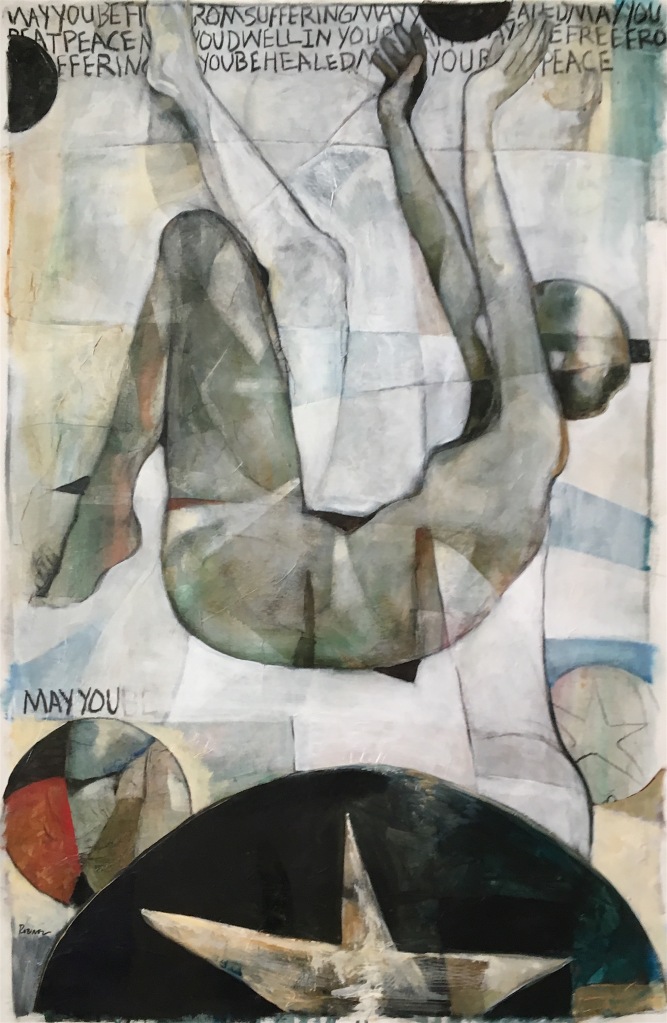
May You, 55″x36″, mixed media

read Kerri’s blogpost about WATER WATER

like. share. comment. subscribe. support. thank you.

Aim The Magic Lens [David’s blog on KS Friday]

“That men do not learn the lessons of history is the most important of all the lessons of history.” ~Aldous Huxley

You may be as amazed as I to learn that Dogwood is not Doll’s Eye. They have a similar creepy Seussian stare but are not kin. In this brave new world, all we need do is aim Google Lens at the question, “What is that?” and, voila! An answer!

I delight that I am living in the time of easy access to information. I could not write as I do without instant access to synonym and antonym, the lighting fast check-of-fact or spelling, the interesting variations-on-a-theme that pop up the minute I jump down a thought-rabbit-hole. Technology has made it possible for me to be a writer. Were I confined to pen and paper my output would be minimal and certainly impossible to read.

Easy information means easy misinformation. It means easy mass-misinformation. If I were the wizard of the universe I’d provide everyone with a Google Lens for information. All we’d need do is aim our magic lens at a pundit, news-bit or politician and, voila!” Accurate or Absurd or somewhere in between! It would make it fairly impossible to toss a lie into the commons and get away with it.

It’s not that I am enamored of just-the-facts. I’m not. I write stories so I prize a good dose of imagination. But in our time, knowing the difference – or caring about the difference – between fact and fantasy – is tantamount.

One of the great challenges of our brave new world is the intentional passing of fantasy for fact. For instance, Florida. If you are a student of history you’ll recognize in Florida (and, now, sadly, other states) the resurrection of the Lost Cause narrative, a history bending education initiative driven hard by the Daughters of the Confederacy at the conclusion of the Civil War. White supremacy sweeping its dark-side under the rug. Lipstick on a history pig.

I’m capable of imagining that my magic Google Info-Lens would put a stop to the cycle of non-sense but it’s starting to dawn on me that Aldous Huxley had it right: at this moment in history, we have the capacity to check every story, to look up every assertion, to scrutinize every source. It may not be as lightning fast as my imagined Lens but it’s close. We simply choose not to use it. It’s so much easier to believe without question than it is to question a belief.

“Huxley feared the truth would be drown in a sea of irrelevance.” Well.

Today on the trail I learned in a nanosecond that a Dogwood is different from a Doll’s Eye. I know it is possible to assert that slavery was on-the-job-training but it takes a dedicated-head-in-the-sand – and a heart full of ugly intention- to drown the truth of history in a sea of utter non-sense.

No lessons learned. No questions asked. Oops. Here we go again.

I Will Hold You (Forever and Ever)/And Goodnight, a lullaby album © 2005 Kerri Sherwood

Kerri’s albums are available on iTunes and streaming on Pandora and iHeart Radio

read Kerri’s blogpost about Dogwood

what you can do: like it. share it. comment on it. support it. we truly appreciate it.

buymeacoffee is a donation “tip jar” where you can support the continued work of the artists you value.

Join The Kerfuffle [on Two Artists Tuesday]

Rob and I have been having a text conversation about AI. For him, an Orwellian curtain is descending. For me it’s a pattern: progress that pushes people into the unknown always ignites a kerfuffle.

Months ago Skip suggested that I jump into the dialogue raging around phrase engineering for AI. Basically, people learning better ways to ask the technology for more efficient and effective results. As a visual artist and a writer, he believed I might be able to stand with a foot in both evolving camps. Cross disciplines. I thought about it. Read everything I could find. I decided against. As an artist, someone who’s taken his artistry into the wilds of organizations, education, change initiatives, DEI, intercultural communication, coaching, software start-ups…a cross-pollinator – I’ve shouted my perceptions at the top of my lungs but rarely found ears that would or could listen. Why should an engineer listen to an artist? Why should a CEO give credence to a theatre artist? There are many many reasons. The notion of doing the same old thing in the same old way in a new context made me…tired.

What is a new way?

I’ve read that the mission of the industrial age was to create technology capable of sparing or lessening human physical labor. The mission of the information age is to create technology capable of sparing us from the rigors of thought. All in service of making life easier.

My last exchange with Rob led me back to Neil Postman’s short forward to his book Amusing Ourselves To Death. “Huxley feared we’d become a trivial culture…” Rereading the forward I thought, “Spot on”. Among the many upsides, having something or someone else think for you definitely has a downside.

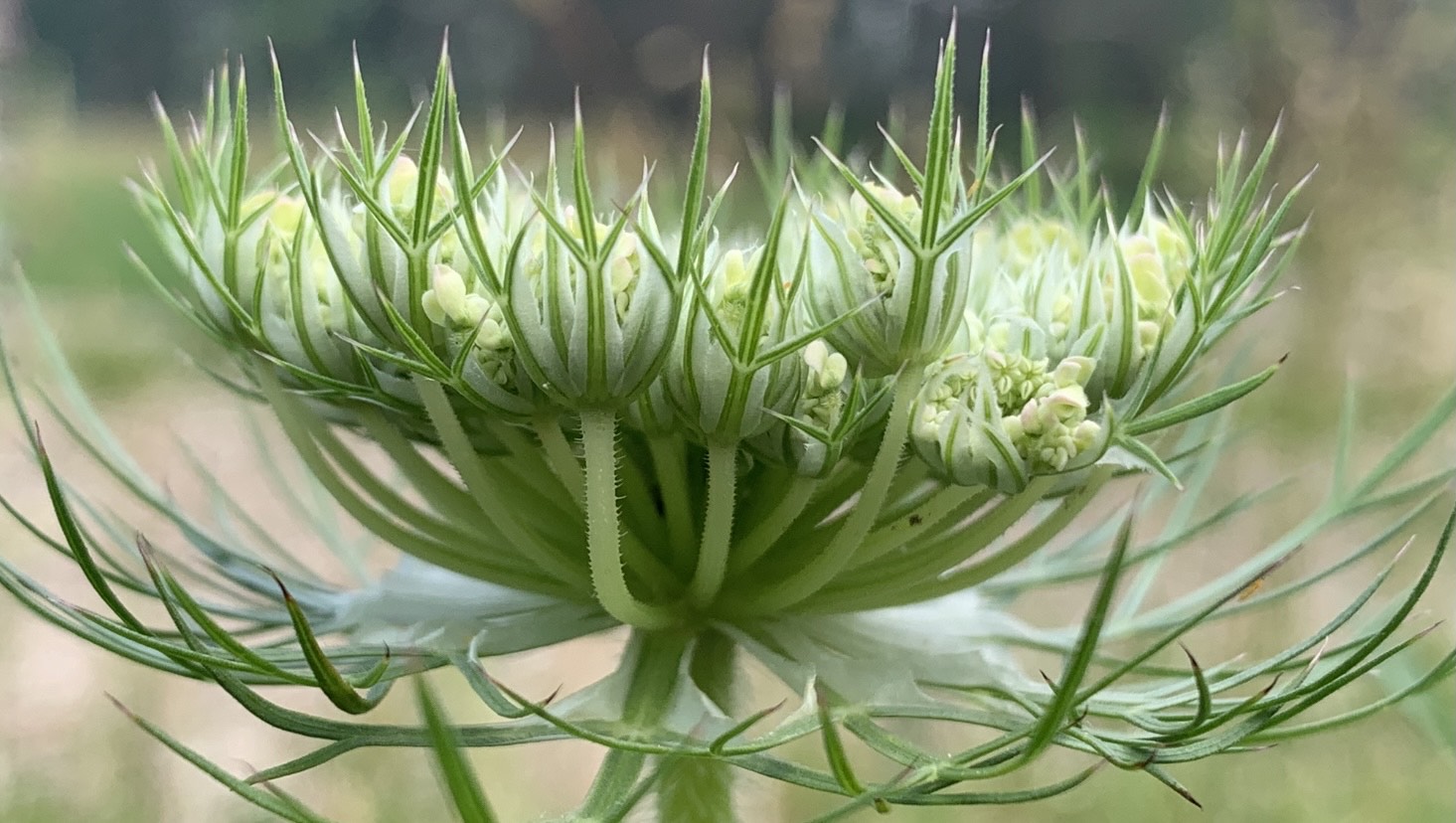
Perhaps our AI era will hold up a mirror so we might better see ourselves as part-of rather than separate-from. Perhaps all the space we gain in our brainpans, as we are spared the rigors of thought, will open new frontiers. It always has in the past. In a miracle of biomimicry, one of Skip’s creations in our start-up was a social network view: a visual of personal connectivity, an active map of all the people a user communicates with. The lines of connectivity were profoundly meaningful to me. The ability to see the thriving network active in my working life was a revelation. A pulsing flower, a wild carrot of interconnectivity. I appreciated my peers – my support system – in new ways because I could see them. My social network view made it undeniable: nothing I do, nothing I think, is independent of my community. We create.

Growth and learning is always in the direction of the unknown. Whether we realize it or not, even amidst the greatest kerfuffle, we take these bold steps together.

read Kerri’s blogpost about WILD CARROT

like it. share it. support it. comment on it. we appreciate it.

Discern [on Flawed Wednesday]

“For in the end, he [Aldous Huxley] was trying to tell us what afflicted the people in ‘Brave New World’ was not that they were laughing instead of thinking, but that they did not know what they were laughing about and why they had stopped thinking.” Neil Postman, Amusing Ourselves To Death: Public Discourse In The Age Of Show Business

Neil Postman wrote Amusing Ourselves To Death in 1985. Cassandra, sounding the alarm to a community too distracted to listen. Were he alive today, he’d think – but would not say – “I told you so.” All the quotes in this post are his.

I read in my daily-news-horror-trawl a quote from a Wyoming man who believes he’s protected from the pandemic because of the color of his hair. It might sound wacky until you consider that his staunch belief in the virus’ preference for hair color is just one of the many misinformation narratives currently being fed to the angry and easily led. He is, without question or thought, breathing the gas of a political party that wants to keep him distracted, fearful and high.

If you are not choking on the fumes of excessive gaslighting, then you are among those whose eyes are burning from the corrosive air it produces. Are you as tired as I am of reading accounts of deathbed appeals for the vaccine? It is too late, in your final moments of life, to realize you’ve been duped. It’s a tragedy. Are you as disgusted as I am, having been witness to the undeniable violence of the insurrection, of listening to the blatant denials? Despite what your eyes saw, it was just another day of tourists wandering through the Capitol. Gaslight tears.

During the first year of the pandemic an acquaintance latched onto a comorbidity table lifted from the CDC website and circulated as “proof” that COVID was less dangerous than the common cold. It was, of course, taken out of context. A quick visit to the CDC website (seriously, less than 30 seconds), viewed in context and with an understanding of the meaning of the word “comorbidity,” easily debunked the claim. Our acquaintance, enraged, doubled down on his claim of “proof” – though he could not be bothered to spend 30 seconds to check the poison gas that he was gulping.

“When a population becomes distracted by trivia, when cultural life is redefined as a perpetual round of entertainments, when serious public conversation becomes a form of baby-talk, when, in short, a people become an audience, and their public business a vaudeville act, then a nation finds itself at risk; culture-death is a clear possibility.”

The legal defense has been successfully used to defend both Tucker Carlson and Rachel Maddow: the courts ruled that reasonable viewers should know the difference between news and opinion. This is news. This is not.

Do we have the ability to differentiate between public business and a vaudeville act? The evidence is not hopeful.

The court’s ruling, then, is likely based on a faulty premise: that people are able to differentiate. That the audience is reason-able or values reason. Able-To-Reason. Reason is the power to think, understand and form judgments through a process of logic. In order to be reasonable one must value reason. One must want it.

Logic and reason, both assume the inclination and capacity to question. Curiosity, real curiosity, does not seek agreement or group think. It seeks to step into the gap between what is espoused and what is lived. It seeks solid ground to build upon so must recognize sand when it sees it.

And, what if “reason” long ago fled the coop? Or, what if “reason,” has never been a dominant trait in the coop in the first place? What if discernment dies in the presence of so much gas?

“Huxley feared the truth would be drowned in a sea of irrelevance.”

read Kerri’s blog post about IT DOESN’T KNOW

Start Thinking [on DR Thursday]

“As Huxley remarked in Brave New World Revisited, the civil libertarians and rationalists, who are ever on the alert to oppose tyranny, ‘failed to take into account man’s almost infinite appetite for distractions.”‘ ~ Neil Postman, Amusing Ourselves To Death

Any day now I’m going to watch the 1976 movie, Network. It’s the film equivalent of a crystal ball to our current predicament. A veteran news anchorman loses it on air, threatens to kill himself, but instead goes on a full-blown rant. The network’s ratings skyrocket. An ambitious producer recognizes and exploits the opportunity by creating more and more outrageous programming. Fact falls prey to profitable fiction sold as truth. Ratings imperatives eclipse the north star of accuracy-in-reporting. Roger Ailes created his Fox News Network on the same premise; no veracity necessary. People like a good train wreck, just ask Jerry Springer. It is why the nation is so divided. The blues use news to sort out the lies; the reds use lies to siphon off the truth.

“Contrary to common belief even among the educated, Huxley [Brave New World] and Orwell [1984] did not prophesy the same thing. Orwell warns that we will be overcome by an externally imposed oppression. But in Huxley‘s vision, no Big Brother is required to deprive people of their autonomy, maturity and history. As he saw it, people will come to love their oppression, to adore the technologies that undo their capacities to think.” ~Neil Postman, Amusing Ourselves To Death

Neil Postman wrote Amusing Ourselves To Death before Facebook and Twitter were glimmers in their inventors’ eyes, before the internet hit the personal computer, before multiple channels on cable networks. We have, as Postman wrote, an infinite appetite for distraction with nary a need for honesty. And, as we are witnessing, distraction has arrived in the halls of Congress. We’ve now a party in government that actively shuns verity and raises funds on peddling fallacy.

“When a population becomes distracted by trivia, when cultural life is redefined as a perpetual round of entertainments, when serious public conversation becomes a form of baby-talk, when, in short, a people become an audience, and their public business a vaudeville act, then a nation finds itself at risk; culture-death is a clear possibility.” Neil Postman, Amusing Ourselves To Death.

We are a nation that finds itself at risk. In my post yesterday I wrote that I no longer wonder how a society can willingly and knowingly take itself down. We have front row seats. And yet, the road to our recovery is as simple (and as difficult) as a collective valuing of the truth over ratings or poll numbers or bubbles. We worship at the wrong altar. We are inundated with info-dross. We would be better off if ratings plummeted every time a pundit ranted, a politician bullied, or a commentator lied. We’d be better off if thinking, if fact-checking, was a prerequisite to posting or tweeting or speaking. We’d find ourselves in a shared center, a place of possibility built on a generous commitment to probity.

“For in the end, he [Huxley] was trying to tell us what afflicted the people in ‘Brave New World’ was not that they were laughing instead of thinking, but that they did not know what they were laughing about and why they had stopped thinking.” ~ Neil Postman, Amusing Ourselves To Death

read Kerri’s much more positive post on LEARNING FROM TV