To be honest, I began writing a post about self-love and bagged it. I don’t really know anything about self-love, which is why I wanted to write about it. Luckily, I realized that it was way too big of a topic for my little, little post.
Tara Brach wrote about her mother’s deathbed confession: “All my life I thought something was wrong with me. What a waste!”
Recently Kerri and I had a conversation about how different we feel – how different our lives have been – from our friends and neighbors. We did not color within the lines. Younger versions of ourselves were split in two: one half following the imperative of our muse, the other half chastising because we didn’t fit in. I’m happy to report that we’ve made peace with the paths we’ve chosen.
We’ve been alive, not necessarily safe.
I used to tell groups I facilitated that “Nothing is broken, nothing needs to be fixed.” I believed it but didn’t necessarily live it. I was looking for what was missing.
It turns out that nothing was missing. My chosen path looked chaotic when compared to the template expectation. It’s a damn hard road when you are both trying to fit in and trying to follow your star. The road was only difficult because I expected pavement when I was a dedicated off road traveler.
What follows is the complete text of my imagined graduation speech to the class of 2025:
If you want to understand the power of story – if you care to discover how every cultural story is both universal and deeply personal, take the time to read and reread and reread Martín Prechtel’s small book, The Disobedience of the Daughter of the Sun. After telling the story, he peels back the layers of understanding, the story of the daughter’s disobedience is a roadmap to an intentional life. It is connective tissue to generational wisdom:
“…that though we as listeners have the illusion that we have jumped into the story, the story has actually jumped into us and uses our lives to tell out its story.”
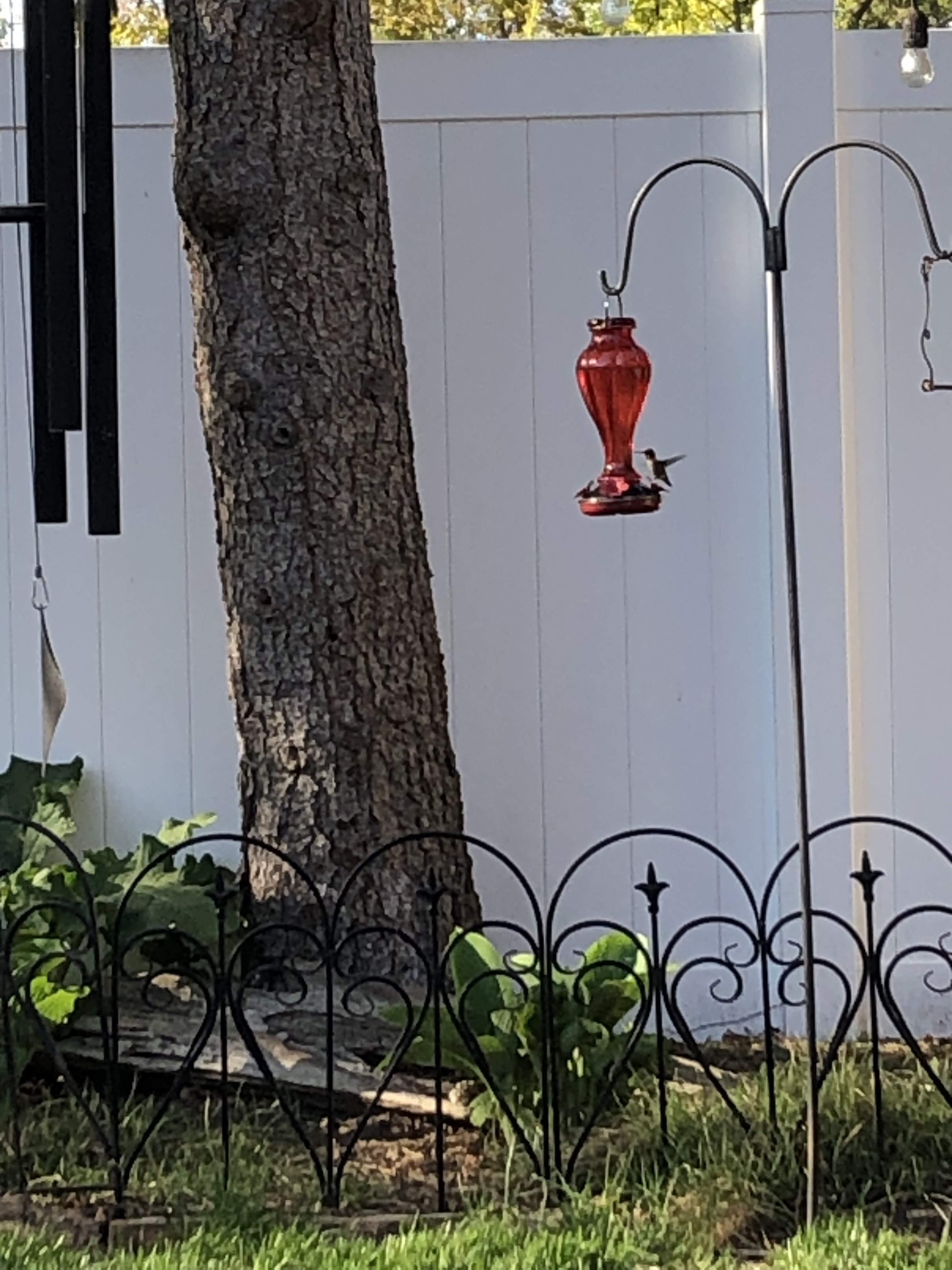
Sitting in our backyard, the sun lowering in the sky, the hummingbird arrived. A hummingbird is featured prominently in the The Disobedience of the Daughter of the Sun and this little visitor brought the story to my mind. Like all deep-story-roots, it is a tale as relevant to us as it is to the Indigenous people who live it – to keep the story alive.
“This is a commentary on the inevitable human problem of tribalism and the tragic results of ethnocentricity. It reminds us that a preoccupation with purity is a sign that a people have lost their real stories, lost their place in history, lost their land and relationship with nature and in an effort to be “someone” they engineer mythologies that are rationalist inventions to corroborate a pure ancestry. This same rationalism probably killed their stories and their Indigenous relationship with the land to begin with.”
Have you ever read anything that so accurately describes our struggle in these un-United States? As we witness the scrubbing of DEI initiatives, the blatant and brutal whitewashing of our nation’s history in order to engineer and perpetuate a mythology of white male purity, a made-up tale planted in the shallow barren soil of nationalist Christianity…we see the undeniable sign that we have lost our real story.
As is true of all great storytellers, Martín guides us toward hope and renewal:
“The story of their cultural loss should be their story, and from that grief they could grow a new culture. If you go back far enough, all people are mixed no matter what they say, and that is no disgrace.”
There is a path. It begins with grieving our loss. Together. And then, there is this:
“The story also says that a peoples’ attachment to their homeland and customs is necessary, wonderful, and life-giving, but should never be allowed to fuel a destructive chauvinism that excludes the rest of the world’s love for its own life and land.”
These are just a few of the lessons carried within an ancient Mayan tale. They are relevant to us today. We need only care enough to open our hearts and listen. And listen again. And then simmer in the slow opportunity that avails itself in the land beyond “problem-solving”.
The promise of our crossroads nation: to grow a new culture. Isn’t that the heart of our matter? Out of many, one.
This quote by Reynolds Price has been on my ABOUT page since I began blogging:
“A need to tell and hear stories is essential to us – second in necessity after nourishment and before love and shelter.”
Since I already know what I am about (mostly) I rarely visit my ABOUT page. I’d all but forgotten this quote was a constant presence on my blog. It is the flag I planted, as much for myself as for others, so I might always have a north star, a way to locate and find my way HOME. I carried it in my pocket long before I enshrined it on my site. I remember typing it into the little “about” box – it felt like a declaration.
Lately the quote has been poking at me. It wants further consideration. It has renewed relevance in our current circumstance.
The disparate bubbles that we occupy, MAGA and WOKE, are stories. Although the characters are different in the respective bubbles, the overriding story is the same: there is a threat to our way of life and the threat is the other bubble.
Although I believe the MAGA bubble is filled with dangerous fascism, they believe the WOKE bubble is socialism run amok. Occupants of both bubbles follow their news-of-the-day as if it was essential, true. Both narratives fuel the division. Both bubbles tell the tale of a heroic fight for good over an evil villain.
This is the third time in our history that these bubbles have formed; irreconcilable narratives housed under a greater umbrella-story, ironically called The United States of America. Robin Diangelo wrote the story of white supremacy requires black inferiority. Conversely, the struggle of equality-for-all is pitted against the story of white supremacy. It is nearly impossible to reconcile the combating sub-narratives: the Manifest Destiny story of god-given superiority (MAGA) with the All Men and Women Are Created Equal (WOKE) story. Our national narrative, our essential umbrella story, is of this struggle for identity: superiority for the few or equality for all. So, here we are.
A need to tell and hear stories is essential to us because stories are the glue that hold us together. Stories are essential because they define “belonging”. In a nation of immigrants, with a long history of bloody fighting over this question of belonging, what might it take for us to recognize that this fight is the greater story that defines us? It is the legacy we perpetuate in our grappling; it is the trace we leave in time. When will we see that the loss of freedom, the collapse of love and shelter is the cost of our shared narrative of seeming irreconcilable difference?
We’ve built our house on a volatile fault line.
However, there is a greater narrative available. It has been on our national ABOUT page since the beginning of our nation. It is our motto, our north star that will guide us HOME. It is printed on our currency. What might it take for us to rise above the bubbles and embrace the story at the center of our rhetorical ideal? What might we need to reconcile to live fully the nourishing story of e pluribus unum?
[this may be my favorite piece by Kerri. If you’re feeling angst or overwhelmed, do yourself a favor: take a short life-break, close your eyes and listen]
It’s that time of year. The air temperature is still cool but the sun, when it makes an appearance, can warm your bones. More than once we’ve donned our jackets, scooched our Adirondack chairs into the sunny spots, and enjoyed the collision. “Oh my god,” I moan.
“Uh-huh,” she sighs. I appreciate that no matter how busy our day appears, we rarely fail to stop the pursuits and immerse in the moment. Against every Puritan commandment, we slow down to maximize productivity.
It’s been 10 years. 2015 was an extraordinary year. We produced and performed The Lost Boy. It was a heart project, a promise to Tom McK that took years and his passing to finally realize. After the production I thought I’d never again do anything more meaningful. Then, within a matter of weeks, we were jamming to illustrate and produce Beaky’s books. Kerri’s mom was 93, a brilliant woman born in a time when women were discouraged from any profession other than “housewife”. Nearing the end of her life she grieved the absence of “letters after my name.” Kerri knew that Beaky had years ago written and submitted for publication three manuscripts. We searched heaven and earth to find them. We produced the first book, self-published it, launched a website, organized and publicized a reading and author-signing event. And then we told Beaky. She was thrilled. Over 70 people attended her reading including the local newspapers. Beaky’s first sale, prior to the event, was in the Netherlands; she was officially an international author. She passed 18 days after her book launch. And then, in the fall of 2015, Kerri and I were married.
It’s 2025 so we are celebrating many anniversaries. In February we marked The Lost Boy. Ten year ago today (I am writing ahead) we held Beaky’s reading/signing event. In eighteen days we will mark the day she passed.
Bitter sweet. Warm cold. No matter how busy our days appear, we never fail to thread our story to the present moment. Today we will take some time and return to our Bristol Woods. We’ll reminisce about the day ten years ago that Beaky, preparing for her event, gave me a lesson in applying blush and lipstick. Kerri laughed and said, “Mom!” My heart was full and warm.
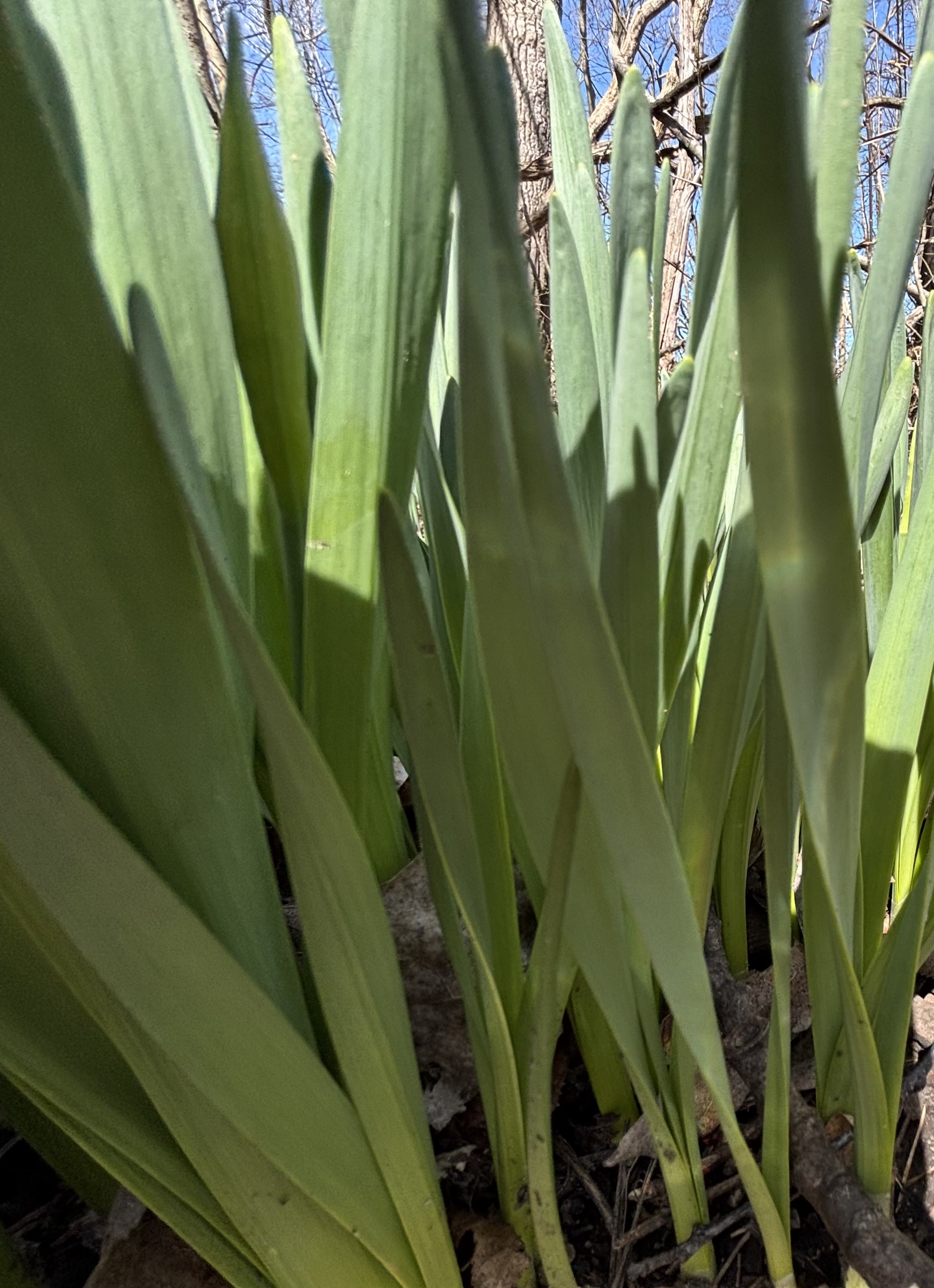
The daffodils feel the sun, too. Even though the air temperature is cool, they are making an appearance, poking their green-green shoots through the muddy soil, stretching their leaves into the promise of a new season.
Posted on February 14, 2025 by davidrobinsoncreative
It’s rapidly becoming folklore week at The Direction of Intention. I blame The Brothers Grimm for inciting a deeper dive into their collection of ancient tales. I somehow missed – or forgot – that the moral of the folk tales is to honor your commitments. Take responsibility for your actions. The stories are driven by transactions-gone-awry. The daughter makes a deal with Rumpelstiltskin: she will give him her first child if he will save her and spin straw into gold.
In another tale, The Pied Piper is hired by the people of Hamelin to save the town from an infestation of rats. He plays his magical flute leading the rats to the river where they drown. Since the town is no longer overrun with rats the leaders decide there is no reason to honor their commitment. They refuse to pay the piper. The Piper once again plays his magic flute and leads the town’s children away. The children are never to be seen again.
Honest dealing. Gratitude. Consequences of actions and choices. Morality tales are told – and have been told across cultures and generations – to instill in the young and affirm in the old the necessity of a moral center. When the moral center collapses, the consequences are far worse than imagined.
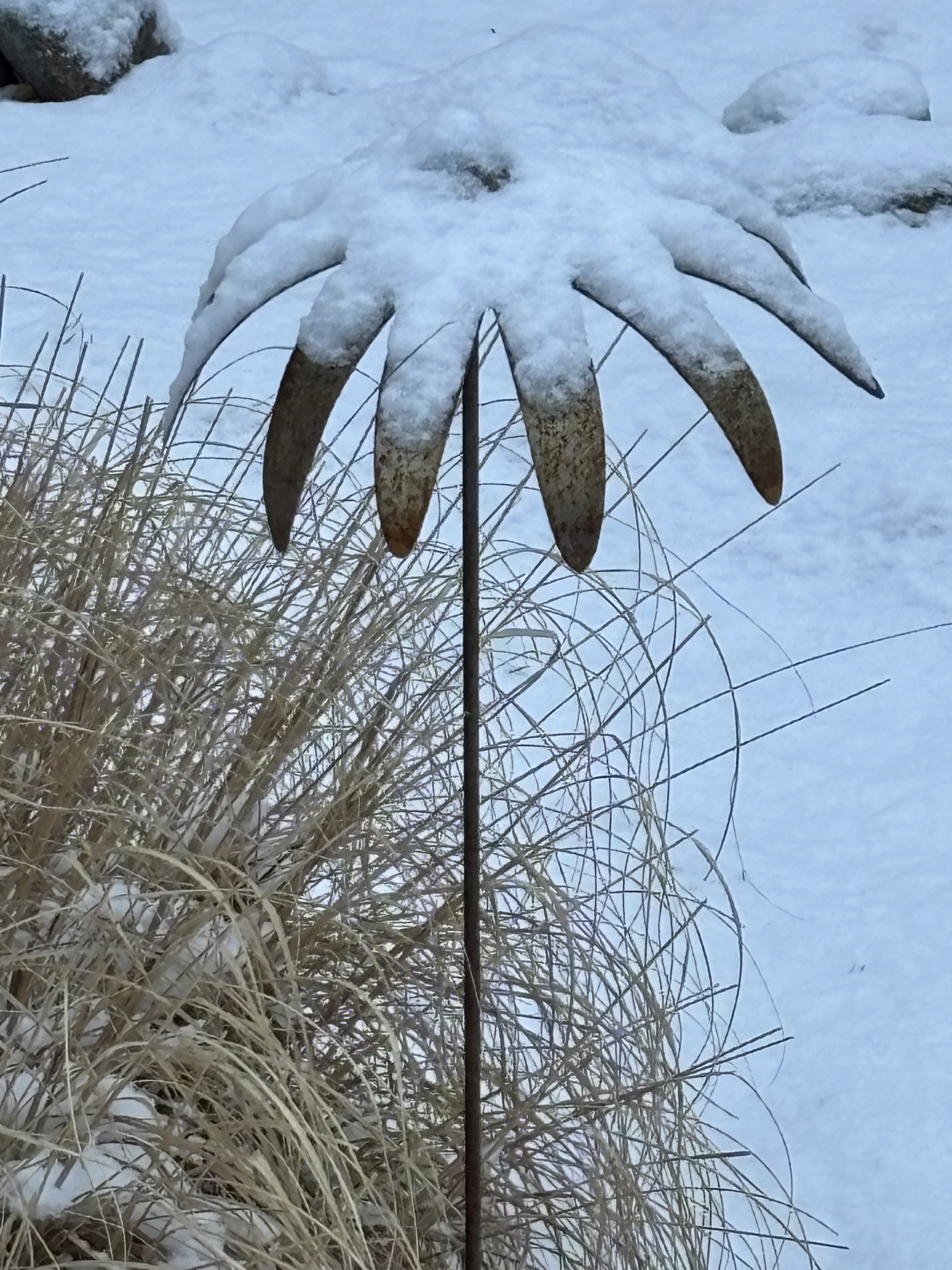
We’ve placed a coneflower sculpture in the garden. We can see it while doing dishes, looking out of our kitchen window. I’ve always loved our little coneflower but in the past month I’ve grown to appreciate it as a reminder, a daily nudge to stand closer to love than I do to fear. Coneflowers are symbols of resilience and strength.
The collapse of decency. The disregard for morality. So many toxic and ill-intended transactions swirling around us. It is only a matter of time before the Piper demands payment. Folklore meets the news of the day.
The coneflower reminds me that this too shall pass. Resilience. Out of the now-inevitable loss-of-our-children will someday arise a renewed commitment to responsibility to the common good. A moral center, after all, is nothing other than attentiveness and concern for the needs of others, and a dedication to ourselves to walk in this world with integrity decency, fairness, and an internal compass – reinforced by the stories and symbols we’ve inherited – that serve as constant companions showing us the way.
Kerri’s albums are available on iTunes and streaming on Pandora
Posted on December 20, 2024 by davidrobinsoncreative
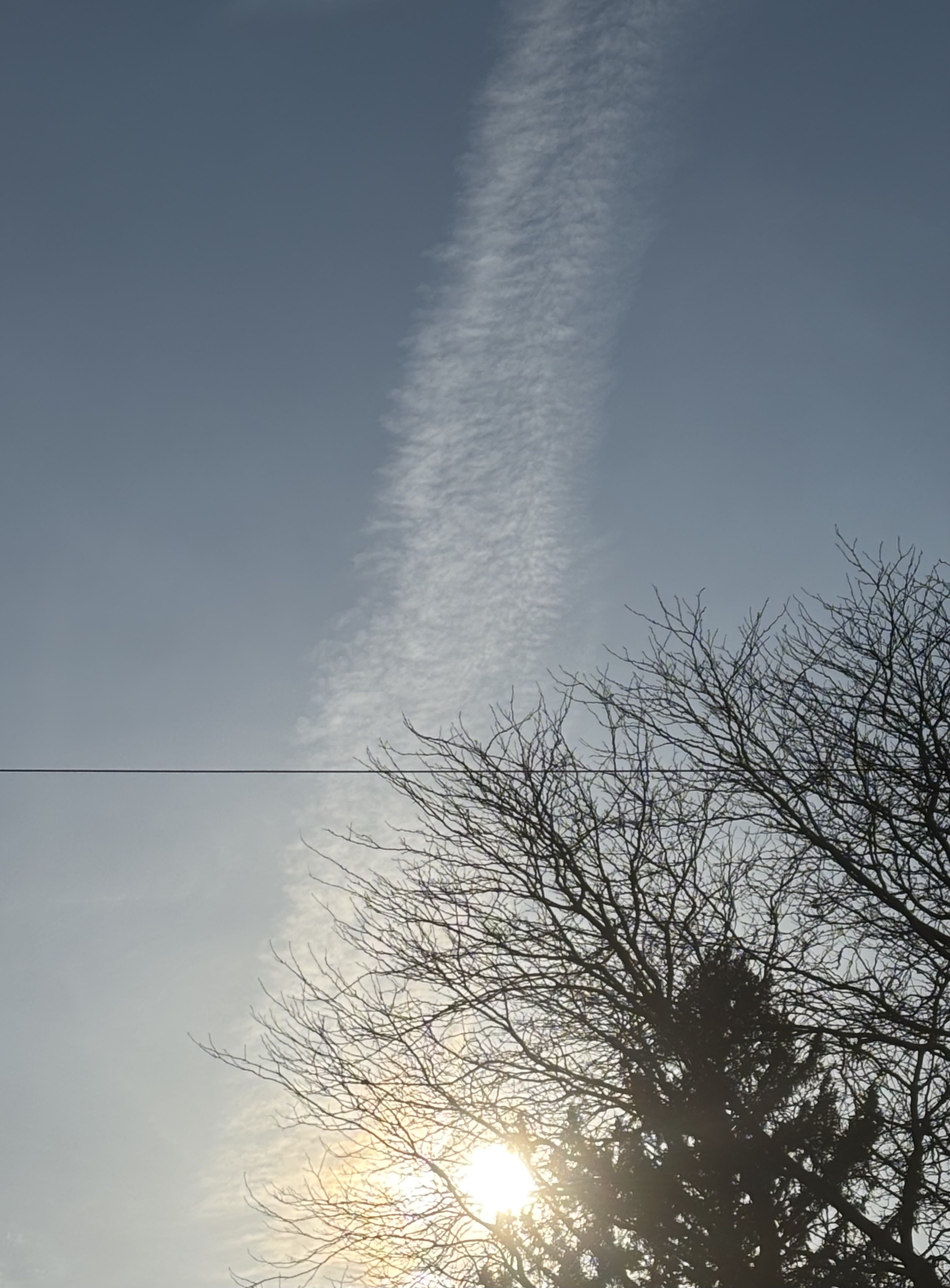
Moon and contrail had a conversation.
One was short-lived, appreciating a few moments of life. The other celebrates birthdays that run into the billions of years.
One is made of water while the other is made of metal and stone.
One moves in circular orbits. The other is known for its straight lines.
One is made by humans in motion. The other is made by planets in motion.
Both experience transformation. One began as tiny vapor and morphed into liquid. The other began as tiny bits of earth-debris and transmuted into a solid orb. A satellite.
Although alien to each other in contrast, they recognized their similarity in comparison: their very existence depends upon the movement of others, forces out of their control. The collision of planets. The exhaust of airplanes. People attempting to “get there”. The pull of gravity. Stars tumbling ever further to find what simply may not exist: the boundary, the end of the universe, creating dust in their tumble that reconstitutes as beings on a teeny-tiny blue planet, people imagining planes that make contrails, and rockets that might reach for the moon.
Posted on November 15, 2024 by davidrobinsoncreative
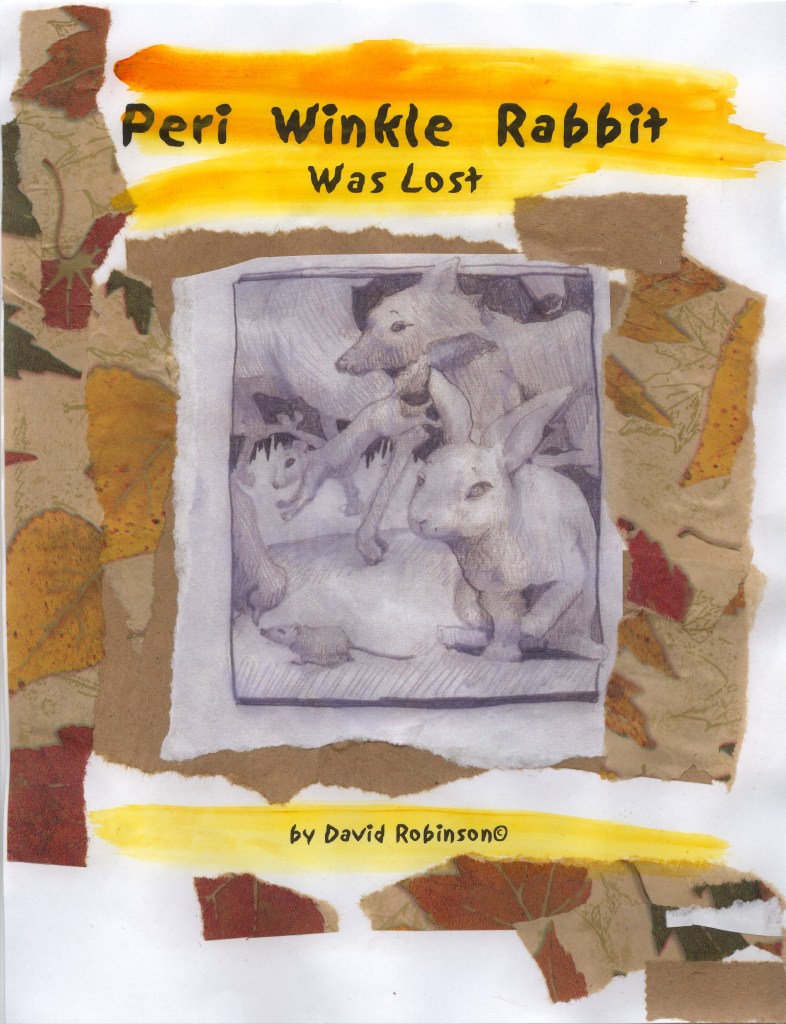
The birds on a wire brought my Periwinkle book to mind. Context is everything. It is now as relevant as the day I wrote it:
Peri Winkle Rabbit was lost.
All the other animals were lost, too!
There had been a fire. Peri Winkle was asleep when grandpa Harry Winkle Rabbit shook her awake and said, “RUN!”
Peri ran. At first, Peri ran with her mom and dad, her sisters and brothers and grandpa Harry Winkle, too.
All the other animals were running, too, the deer and the bears and the foxes and the squirrels. Some were running in circles but most just ran away from the fire.
It was confusing. There were so many legs and paws running this way and that. Peri could no longer see her parents. She couldn’t see her brothers or sisters. Even grandpa Harry Winkle Rabbit was nowhere to be found.
Peri stopped and got knocked down. She hopped back up and called out for her mother. She called for her father. She couldn’t see them anywhere.
A great paw scooped her up and she was suddenly eye to eye with a bear!
“This is no time for still standing, little ears!” said the bear.
“I can’t find my family,” squeaked Peri Winkle Rabbit. The bear was holding her very tight.
“We’ll find your family, little ears,” puffed the running bear, “But first we have to find a place safe and beyond the fire.”
The bear held Peri Winkle Rabbit close to his chest. Peri could hear the boom-Boom of the bear’s big heart as he ran swiftly away from the flames. Peri Winkle Rabbit felt so sad and so tired, she couldn’t help it when she fell fast asleep.
“Good morning, little ears!” The bear smiled as Peri blinked open her eyes.
“Where am I?” asked Peri.
“I don’t rightly know, “ said the bear, “but we’re now safe and far from the fire.”
That’s how Peri Winkle Rabbit came to be lost. She looked around and saw that the forest was gone! The other animals looked and they saw it too. All the green was now black and the mighty trees were charcoal twigs twisted in ruins on the ground.
The animals started to cry. Even the big bear cried. Peri cried, too. Together, they made lots of loud crying sounds and it felt good to wail the loss of their forest home.
And then, they each told their stories of escape from the fire. They told of their lost homes and missing family and friends. They told the stories of their cuts and their bruises, their fears and their worries. They told of how they came to be together, in that place at that time. Peri Winkle Rabbit told her story, too.
“What do we do now?” a red fox asked, which was exactly the question that Peri Winkle Rabbit was thinking!
No one said a word for a very long time. They looked at each other, all covered in soot, dirty and singed and ruffled and tired.
“Well,” a great ram began, “I am sure footed, I can help carry what’s needed.”
A hawk landed on the ram and said, “I can see far away and can help find your missing families and friends.”
The great bear said, “Yes, and I have a nose that can smell good smells for many miles, I will help supply all of my new friends with food!”
“I can gather nuts!” cried the squirrel, rubbing his nose with his hands.
“I have great ears!” cried Peri Winkle Rabbit! “I can hear what is needed and help find who can do it!”
And all the animals offered their great gifts in service to their new friends. They slowly began to do what was needed with whatever they could find. They found water and food. They found shelter from the rain. They looked for their families. They made new friends.
“Remember, a forest must grow back slowly, one day at a time,” said the bear when Peri felt impatient.” Our job is to help it grow.”
“It is all different than before,” said Peri, suddenly missing her old home.
“Yes,” said the bear. “We are all different now, little ears. The fire has changed us forever.”
Peri Winkle Rabbit wrinkled her nose.
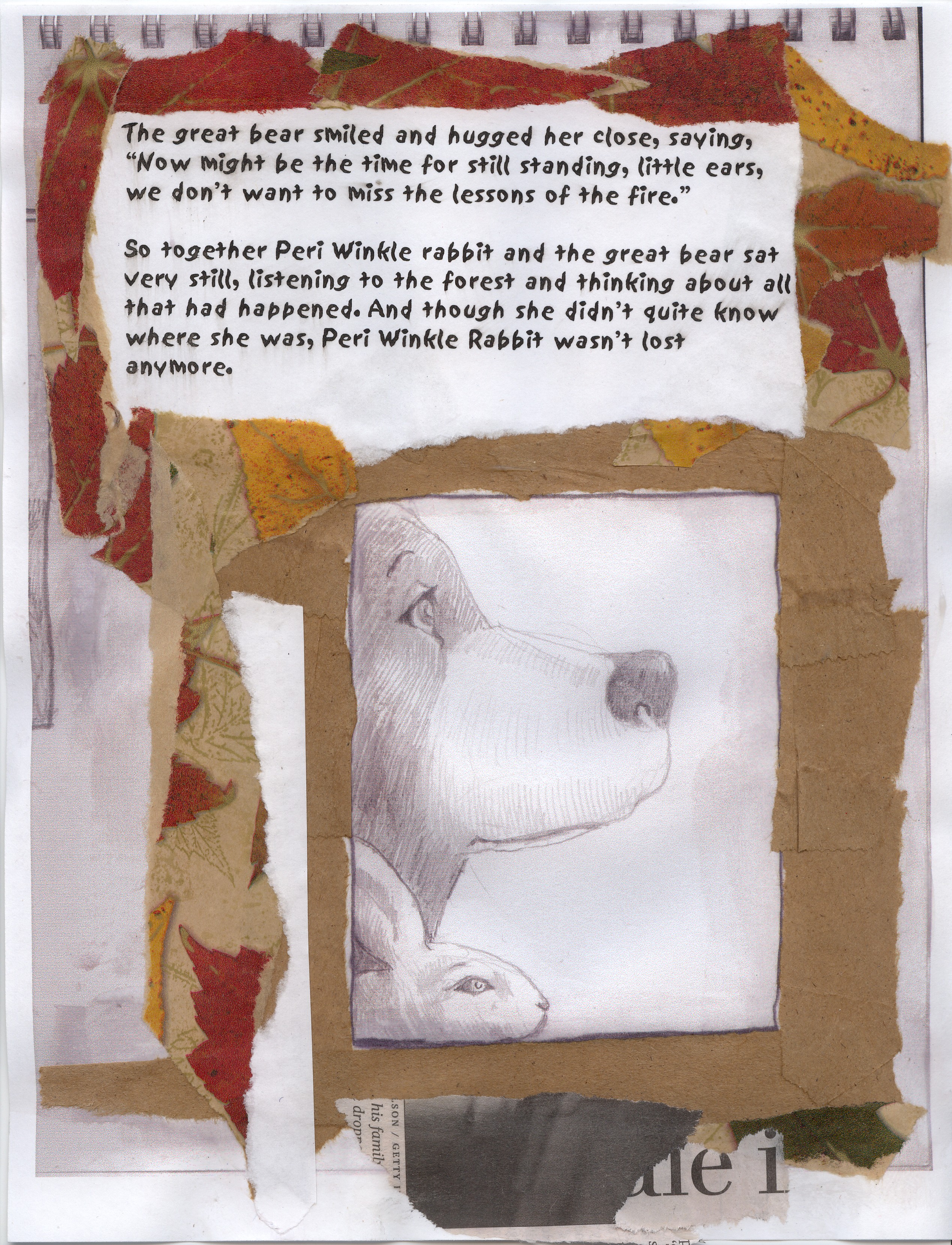
The great bear smiled and hugged her close, saying, “Now might be the time for still standing, little ears, we don’t want to miss the lessons of the fire.”
So together Peri Winkle rabbit and the great bear sat very still, listening to the forest and thinking about all that had happened. And though she didn’t quite know where she was, Peri Winkle Rabbit wasn’t lost anymore.
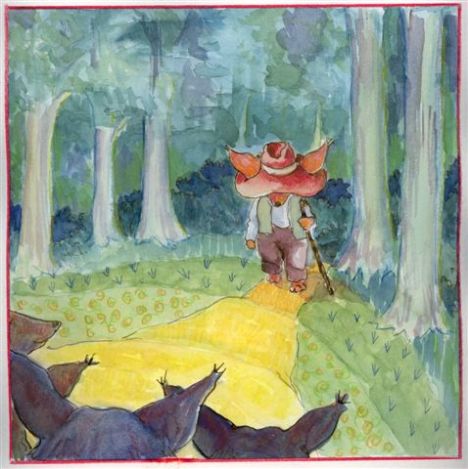
A one-copy book made for a child who lost their family during Hurricane Katrina. I’ve never published the full text but thought it was time. I included photos of a few of the pages.
Kerri’s albums are available on iTunes and streaming on Pandora
Posted on October 25, 2024 by davidrobinsoncreative
“We can disagree and still love each other unless your disagreement is rooted in my oppression and denial of my humanity and right to exist.” ~ James Baldwin
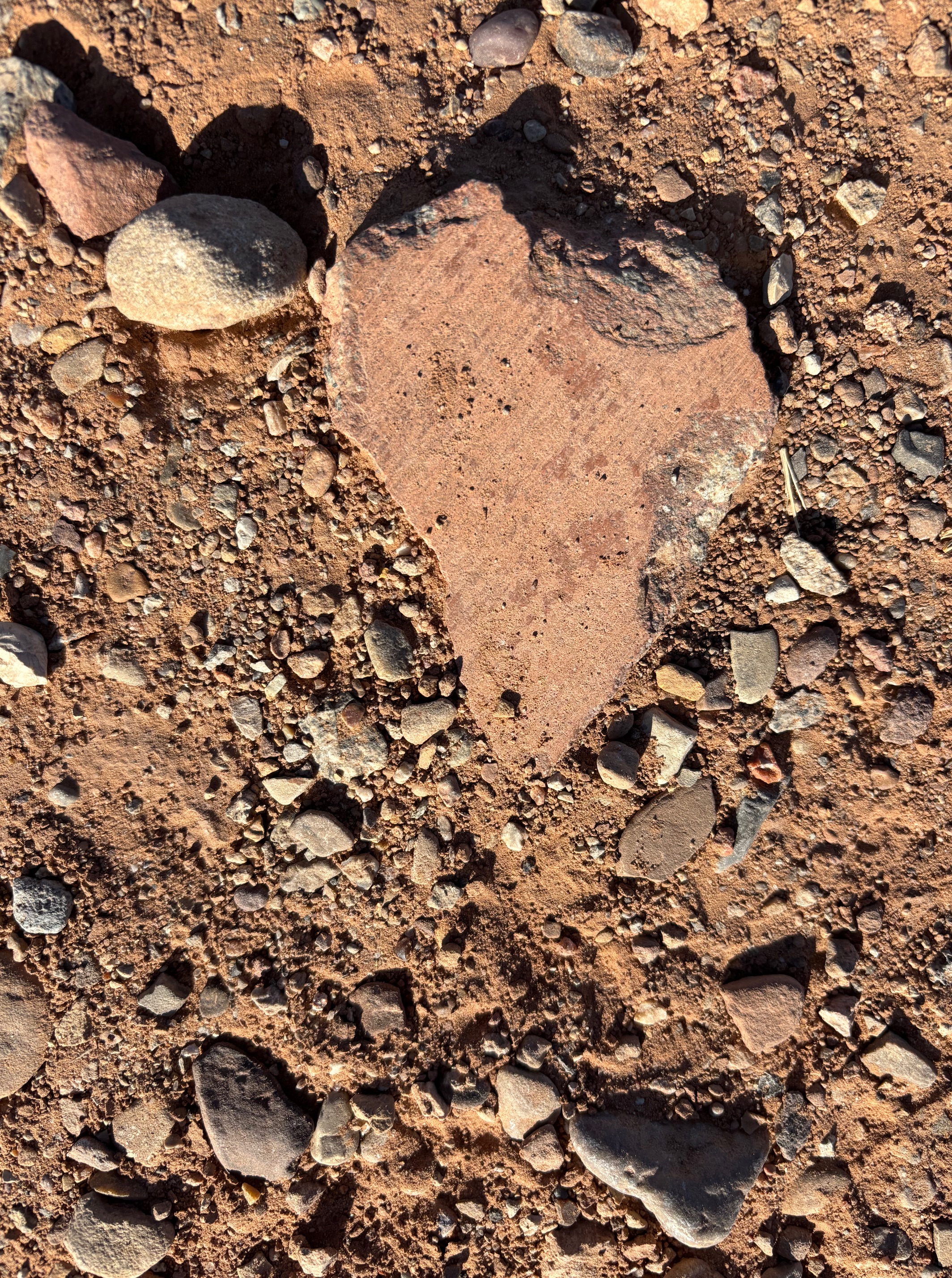
Our Melange posts generally begin with a visual prompt, usually one of Kerri’s recent photographs. Today, for the first time in our Melange history, she offered me a quote. The photograph, the stone heart, came second.
My dad used to tell me that I’d educated myself into stupidity. He was, of course, regurgitating the sentiments of his fox-news source; those were not his words or his thoughts. He was an educated man, early in his life a schoolteacher, yet his entire life he yearned to return to the simple life he remembered, growing up in a small town in Iowa. His yearning was sincere and pervasive. He was kind to his core and generous to everyone he met. He had no idea what to do with the complexity of the contemporary world and so he found solace in rejecting it.
One of my cherished memories of my dad was the day we spent in the cemetery of his small town. He was far down the road of dementia and wanted to visit his beloved small town one last time. I was taken aback that he had no desire to wander the streets but wanted, instead, to wander through the graves – so that is what we did. He’d point to a headstone and tell me the story of the person buried there. To him it wasn’t a graveyard, it was a reunion. He could not remember what he ate for breakfast but he remembered in vivid detail the people that populated his young life, the names on the headstones.
My dad worked most of his life as a foreman of a concrete construction company. His crews were mostly illegal immigrants. For a few summers I worked on his crew and I have never been more proud of him – or learned more from him – than I did watching his dedication to the men who worked for him. He understood their plight, he valued their hard thankless work, and they were as loyal to him as he was to them.
I can only imagine what he would think of the rhetoric of mass deportation, the radical dehumanization of the men he spent his life working with, the racist lies. I wonder if his yearning for simplicity would cloud his perspective or would he recognize the ugly authoritarianism masked in the maga mass-deception.
He was, at his core, kind. Generous. I cannot imagine he would sign on to the oppression and denial of basic humanity that runs rampant through the maga rhetoric. And, since I am “woke”, a progressive, a man dedicated to learning and asking questions, a believer in open minds and hearts, I am now one of the vermin populating the fox-maga-storyline. I doubt he would sign on to that.
I wonder, if we were sitting on the patio drinking a beer, if he’d question, as I do, how his rural America, his imagined simplicity, became so ugly, so lost in the rantings of a fascist. So un-American.
I wonder if he, from his resting place in the graveyard, wishes now for a better story for his small town, for all small towns – the story of generosity and kindness he remembered as hallmarks of the people who populated his early years, the people and narrative who shaped him, his goodness, his life.
Posted on August 29, 2024 by davidrobinsoncreative
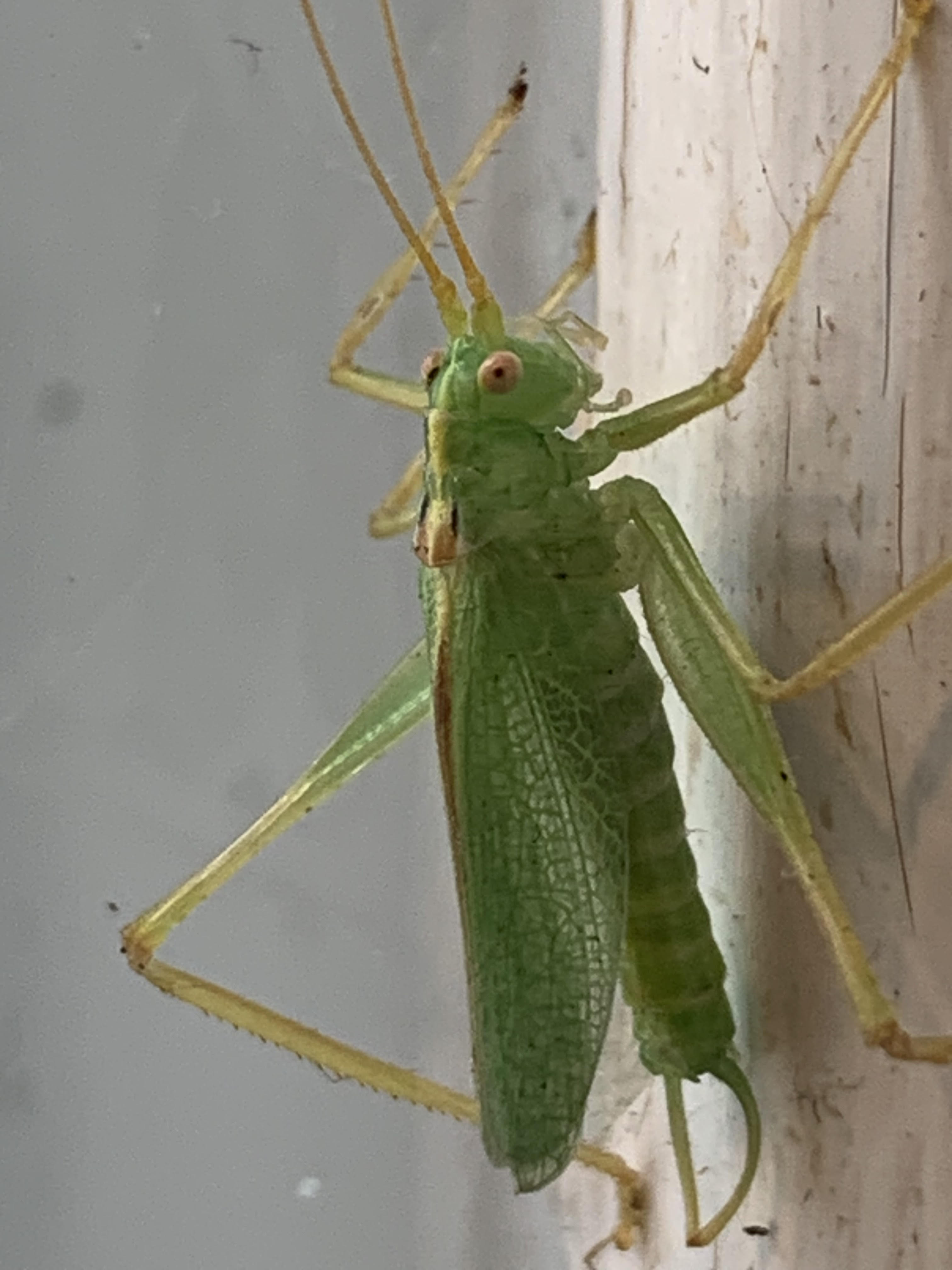
And just how did the katydid get into the kitchen?
It sounds like the question at the heart of a children’s book to me! We have visits from flies and moths and the occasional ant or two. Never before has a katydid been in the kitchen.
Did it ride on the dog or sneak in the open screen door? It there a secret katydid portal, a wardrobe into our kitchen which, to a katydid, must have seemed like a strange new land? Did it wonder how to get back home?
How long had it adventured inside the house? Did it puzzle over inedible carpet and taste-test the plants-in-pots? Did it run from the giants who did not see it? Did it dance to the music that came from nowhere or was the noise thunderous, strange and unnerving?
Did it know it was learning inside from outside? Was the window glass a complete surprise? An impossible impediment to the known world?
Did it understand the giant lady when she marveled at its beauty? Did it pose for its picture? Did it show us its “good side” or did it not-care-in-the-least how it looked?
Was it terrified when the giant lady trapped it? What did it feel when constrained and rushed through the door? Was it disoriented, suddenly finding itself once again in the grassy world it recognized? Was it relieved? Did it think the adventure was a strange dream?
Will it seek the wardrobe again? Will it once again seek passage on the dog to confirm its peek into Wonderland?
Posted on August 13, 2024 by davidrobinsoncreative
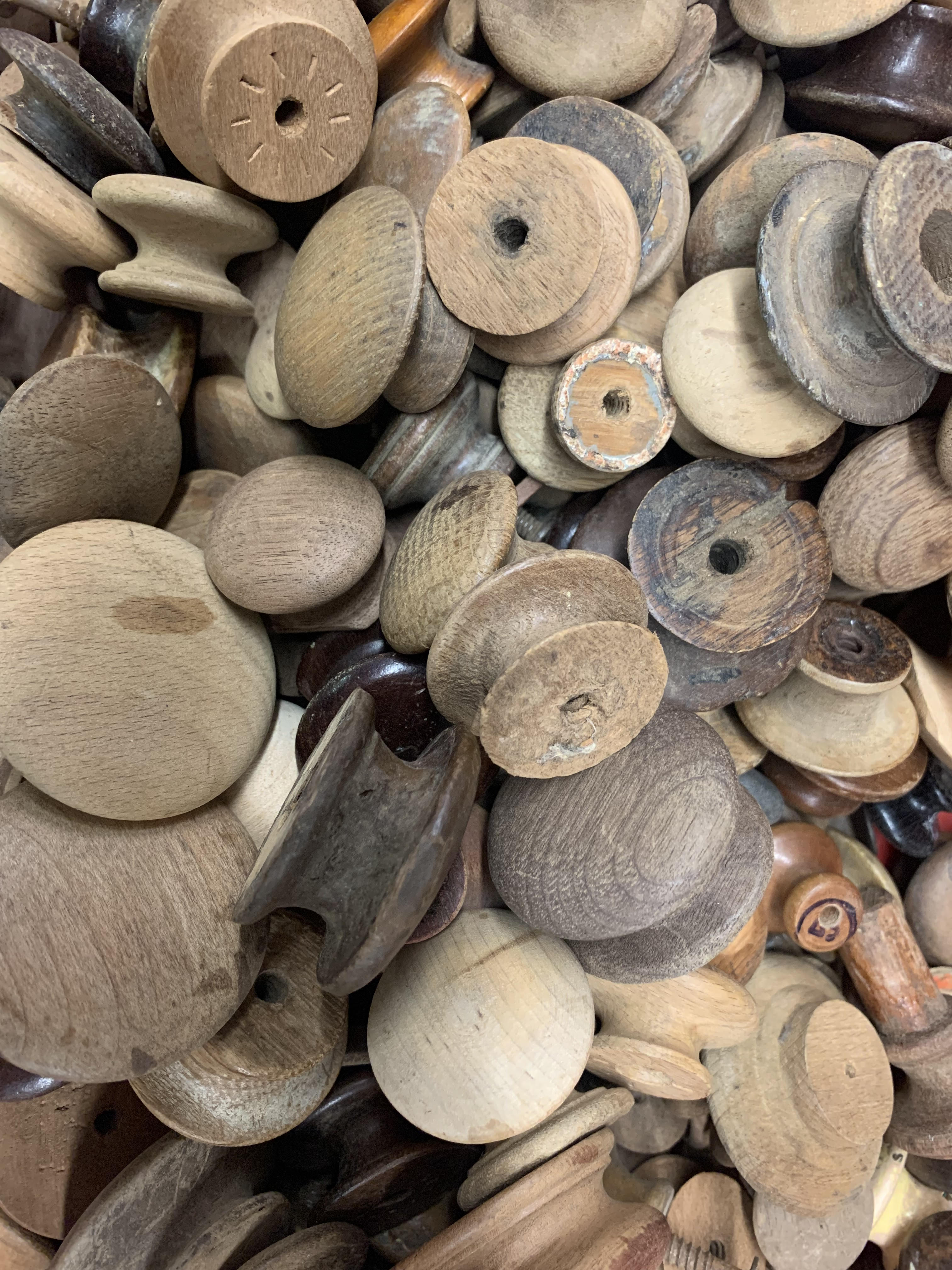
A box of drawer pulls is a box of stories lost to time. Many are worn from long use, polished by human hands. Some have never been used, rarely touched, except by those of us that casually sift through the box.
It’s easy to personify a drawer pull and turn it into a story of yearning. A story of yearning for purpose. A story of being chosen. A story of finding a home.
As I lift a tiny knob from the box I ask, “And what about you?” I am tempted to buy the little knob for no other reason than to get it out of the box. To give it a home. I have already projected a personality onto this tiny pull and laugh heartily at myself.
The shopkeeper eyes me hopefully. It is unusual for the box of knobs to elicit laughter. She’s giving change to another customer.
I rub the tiny knob like a worry-stone and place it back in the box. “Have hope,” I tell the tiny knob. It is worn smooth from a long life of good use. “You’ll find your right place, your next life, someday soon.” I can feel it.
Were I a sculptor, an artist that worked in three dimensions like Louise Nevelson, the whole box would be coming home with me. I know the right artist will find this box and when they do, this little drawer pull, rather than sit forgotten on my shelf, will be delighted to transform, serving a less-functional but more heart-inspired kind of beauty, sublime as a work of art.












 The Direction of Intention