Use Your Chalk [on Two Artists Tuesday]

There are two words floating around in my universe these days: structured and unstructured. Structured data. Unstructured data. Structured time. Unstructured time.

The world as seen through the Puritan lens gives great preference to structure. Unstructured anything is suspect. “Idle hands,” we are taught, “are the devil’s workshop.” Yikes. Apparently it’s dangerous to take a stroll, to sit and ponder, to clear the day and do nothing.

I suspect it explains why our notion of business is hyper-focused on the bottom line and often misses the value of relationships. Bottom lines are easy structure. Relationships, not so much. It is the same with test scores in education. Easy structure. However, stepping into the unknown – the very definition of learning – is largely eschewed because it begins in an unstructured pursuit. Creating the structure, making the meaning, discovering the connectivity is what our hearts and brains like to do. When learning isn’t merely a factory, when business is more than a bottom line, people prosper. They come alive.

Unstructured time. There was a time when time had no structure. Monks attempted to “keep” time by monitoring water through a bucket or sift sand through an “hour” glass. Sometimes the water froze in the bucket so the structure of evening prayer was disrupted. The sand clumped in the hour glass and the measure of time clumped with it.

There are moment on the stage when the actor forgets their lines. It’s called “going up” or “drying.” It is always, in the re-telling, the moment when everything becomes real, alive. It is the moment when the structure becomes unstructured. Hearts race. Eyes widen. The stakes are suddenly palpable. The actor breathes, stands in the vast unstructured universe, and the words return like a swinging bar to a high-flying aerialist. The play is infused with aliveness. Presence is mostly unstructured.

As is common in the structured and unstructured use of the English language, oppositions are easily constructed. Unstructured simply means the meaning has yet to be made. Structured data, structured time, are the tip of a largely unknown iceberg. Love, joy, despair, awe…the full spectrum of experiences, bubble in the unstructured spaces. Numbers can describe a moment in time, can orient for a moment, but will never “explain” yearning or desire or our fundamental need to tell stories (put structure on unfathomable experiences). Structure & Unstructure: they are dancing partners, not combatants.

Where do we come from? What are we here to do? I am going to die, what then? It takes a good deal of unstructured time to sit in these unanswerable questions. There are, of course, plenty of people who will gladly provide structure to your unanswerable – and therefore uncomfortable – questions. Perhaps that is why we adore our structure and demonize the empty spaces? Comfort. Ease.

Kerri cannot pass a hopscotch template chalked on the street. It’s almost automatic. Step, hop, hop, step, hop. The little girl in her connects to the child who chalked the squares on the sidewalk. A simple game. Play. It’s one of the things people do with unstructured time. Set challenges. Make up obstacles. Seek puzzles. Invent. Dream. Connect to the deeper places. Where’s the structured bottom line watching the little-girl-in-my-wife hop and skip and turn in the game-chalked-on-the-sidewalk? The laughter of remembering? The giggle and freedom of the woman hopping the scotch, just because she can?

read Kerri’s blog post about HOPSCOTCH

Look With Honest Eyes [on Not So Flawed Wednesday]

We were sharing pandemic survival stories, the worlds that we explored in our isolation that we otherwise might never have entered. We told Keith of Joey Coconato and how his back country backpacking trips were a nightly fascination. I’m particularly drawn to his hikes through the canyon lands. Keith became animated, saying, “You have to check out the Millennial Farmer!”

I know nothing about farming. Once, sitting on the back porch of a farmhouse Air-B-N-B in Iowa with my dad, I listened intently to his stories from childhood working on the various farms in the community. Had he been able to script his life differently, I think he might have written a farmer’s story. He loved the outdoors. He loved growing things. He always kept a garden and tended flowers. He knew what he was doing! Somehow, I gleaned nothing from his green-thumb-knowledge. I am a plant killer.

In the first short installment of The Millennial Farmer, Zach Johnson tells his audience that he’s making his videos because people know so little about farming and what farmers actually do. He’s a fifth generation farmer in Minnesota. I was, as he predicted, completely gobsmacked watching The First Day Of Planting 2016. I pushed play expecting dirt clods and the rumpled pages of the Farmer’s Almanac and, instead, entered the space age. His tractor was akin to the deck of the Starship Enterprise. His nuanced explanation of the monitors in his cab was enlightening. He’s driving a computer (actually, it mostly drives itself).

My stereotype was completely shattered. I had no idea. And, isn’t that the point of taking a peek into the lives of others? Recognizing that we have no idea about the realities of others lives? Isn’t that the opportunity?

This morning I pondered aloud about how we’ve changed in the months since COVID began. “I don’t know anyone who hasn’t changed.” One of the most profoundly sad awakenings for me during this time of division and dedicated ignorance is how resistant we are – and I believe always have been – of taking a peek into the lives of others in our nation. We simply don’t want to know, so great is the fear of what we will find there.

John Lewis famously said, “We are one people, we are one family, we are one house. And we must keep this house together.” By “keep” he meant to tend. We might become one family when we are willing and able to look with honest eyes into the lives of those who share this house. Our stereotypes, our almanac ideas, keep us fragmented.

Joey and Zach. Both live lives immersed in nature but from diametrically opposed intentions. Both have popped open my eyes to new experiences and bodies of wisdom that I might otherwise never have encountered. Both are following their personal star and sharing what they find on their paths.

As part of our summer planting and backyard oasis, we bought two tomato plants and some basil. Our Boomer farm is not extensive but it is well loved. “Do you think, if we tagged The Millennial Farmer, our tomatoes would stand a better chance?” I asked.

Kerri considered it for a moment, her hands busily potting the basil plants. “It couldn’t hurt.”

read Kerri’s blog post about BOOMER FARMERS

Ask The Gorilla [on DR Thursday]

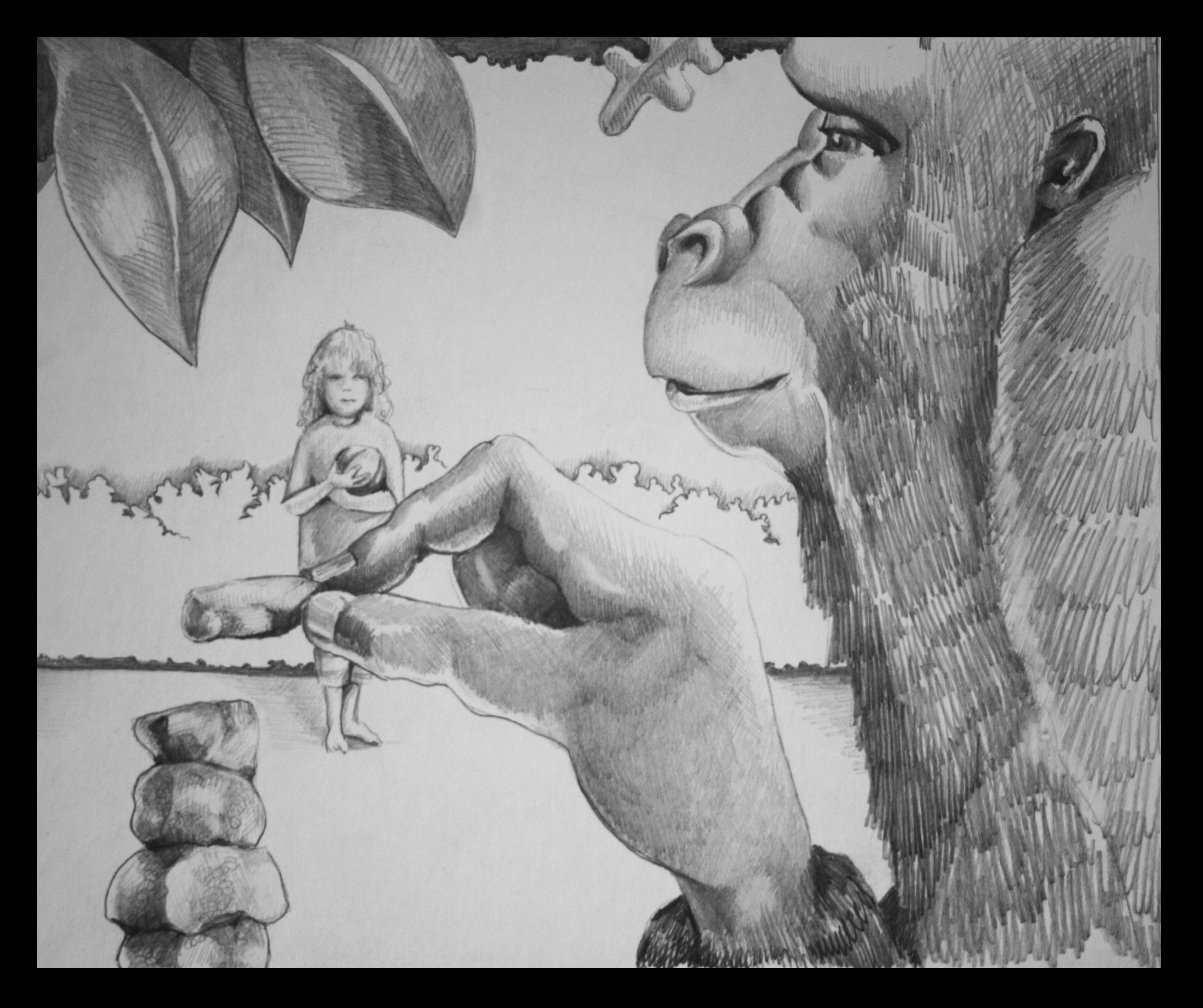
I’m not the first person to use a gorilla as the teacher in a story. This gorilla, in this story, is teaching the little girl the difference between playing-to-win and playing-to-become-a-better-player. The story begins when the girl asks the gorilla, “Do you want to play?” and the gorilla responds, “Well, it depends. What do you mean by ‘play’?”

It’s not a flippant question. It speaks directly to the “why” of what you do. The reason. Simon Sinek put this question at the center of his golden circle. James Carse wrote his philosophical masterpiece, Finite and Infinite Games, about this simple distinction.

Yesterday I had a conversation about success. A conversation about the difference between internal and external motivation. External motivators, like winning-as-your-why, are necessarily grounded in fear. What if you lose? Who are you if you fail? Winning at all cost will eventually lead to quagmires not unlike where the Republican party now finds itself. Obstruct. Lie. Gerrymander. Fix the vote. Fix the game. Any and all deeper value or ethic is sacrificed. There is always a cost when the “why” is as superficial as “to win.” The body seizes-up, loses its freedom of movement when fear of losing is the central driver of action. The nation-body, too.

The path to mastery cannot run through a win-lose “why.” Failure is an essential on a master’s path. Throw many pots, the metaphor from Art & Fear, is a mantra not only for artistic freedom, but for honing skills. Getting better and better at playing. See what happens. Playing to play, to become a better player, transcends and finally removes the word ‘failure.’ The body gains more and more freedom of movement when every action is a learning experience.

I wrote and illustrated this book back in my dark ages when I was facilitating diversity and inclusion trainings. Some companies hired us because they feared being sued. They feared losing money and had no real interest in diversity, inclusion, equality, fair play, betterment for their employees. They feared losing their privilege. Diversity initiatives ask that we stop rigging the game.

Other companies hired us because they truly desired to address the inequities in their organization. They wanted to step into their blind spots and see. They wanted to become better and better players in their communities. Early on we learned to distinguish between the fear-clients and those that were sincere. We became better players by choosing to work with organizations that were honest and sincere about their “why.” Players of infinite games.

I never attempted to publish Play-to-Play, my little illustrated meditation. Over the years I’ve given away some of the illustrations. It is one of the many stones I’ve stacked, pots I’ve thrown, the many projects and paintings that are literally stacked in my studio. It seems more relevant now than ever before. Yesterday, looking again at the illustrations, I told Kerri, “I should draw this again. I’m better now.”

She asked, “Why?”

I said, “Exactly.”

read Kerri’s blog post about STACKING STONES

play to play ©️ 2005 david robinson

Enjoy The Loss [on Not So Flawed Wednesday]

We laughed heartily when we read this phrase in an advertisement. I had two immediate responses: 1) Immortality is not really a thing. No one wins the race against aging. Even vampires have unfortunate sunny days or meetings with silver bullets and so ends their quest to win the race. 2) The best way to win the race against aging is a) to get out of your chair and move, b) laugh a lot. You’ll lose the race either way but mobility and a joyful heart make for a more enjoyable lap around the track.

This life is a temporary, passing thing. I lost the race against infancy and couldn’t wait to blow through those teenage years. I took my twenties and thirties for granted in a festival of unconsciousness. I puffed myself with importance and thought I knew things all the way through my forties and into my fifties. Now that I can spot the finish line I admit to undertaking several measures to slow things down a bit. I’m specifically not entering races and I’m especially not going to try and be something that I am not. Like, for instance, young.

I actually delight in the experiences that life has provided. The lessons learned. I’m especially fond of the needle that life used to pop my inflated notions. I’ll never be a hero. I live in some people’s story as their villain and some people play the role of villain in mine. I’m finding that more time on earth brings greater capacity for compassion and forgiveness. I never meant to be a villain and I suspect the same is true for those I’ve cast in my hall of monsters.

Beaky used to say that aging is not for wimps. We regularly compare our latest wrinkling skin discovery or make up excuses why our clothes no longer fit. It is sometimes a shock to wonder where the time went or to discover that I’ve lost my gazelle-like movement when running across the street. Taking a realistic look at your self and slowing down seem to me to be gifts that come with age and should not be hidden beneath any cream or stretched away by a surgeon. I have learned – and continue to learn – that it is infinitely better to be who you are than to pretend that you are something that you are not. Happiness does not easily nest in illusions.

External motivators might bring the illusion of youth but I guarantee that there’s no way to regain your gazelle. My vote: recognize that the race is made up, like Valentines Day, to sell chocolate and greeting cards. It’s better to love every day of this miracle life rather than pack your love into on a single day called ‘youth.’ There’s nothing like an achy joint to make you appreciate how great it is to be able to move. There’s nothing like seeing the finish line to make you appreciate the first sip of coffee in the morning or kissing your wife on the forehead just-because.

My advice: enjoy every moment of the loss.

read Kerri’s blog post on THE RACE AGAINST AGING

Come Home [on Two Artists Tuesday]

“I search for the realness, the real feeling of a subject, all the texture around it…I always want to see the third dimension of something…I want to come alive with the object.” ~ Andrew Wyeth

The first time I walked into this house, I felt that I’d come home. It was a potent moment because I’d never felt that before, not in my entire life. I was a wanderer, even as a small child.

I’d come to meet this woman named Kerri. I’d been writing emails to her daily for the previous six months. A job afforded me the opportunity to stop over and meet her face-to-face. She picked me up at the airport [she was the one holding the daisy], we held hands and skipped to the car, talked non-stop during the hour-plus drive from O’Hare airport. When we arrived at the house, I laughed when she asked me to wait at the front door. She wanted me to come into the house through the front door but the key hadn’t worked in years, so she ran around back to come through the house to let me in. When the door opened, with my rolly-bag in tow, I stepped into the house and caught my breath. I almost started to cry but inhaled my overwhelm back into my body. Home. I knew this place.

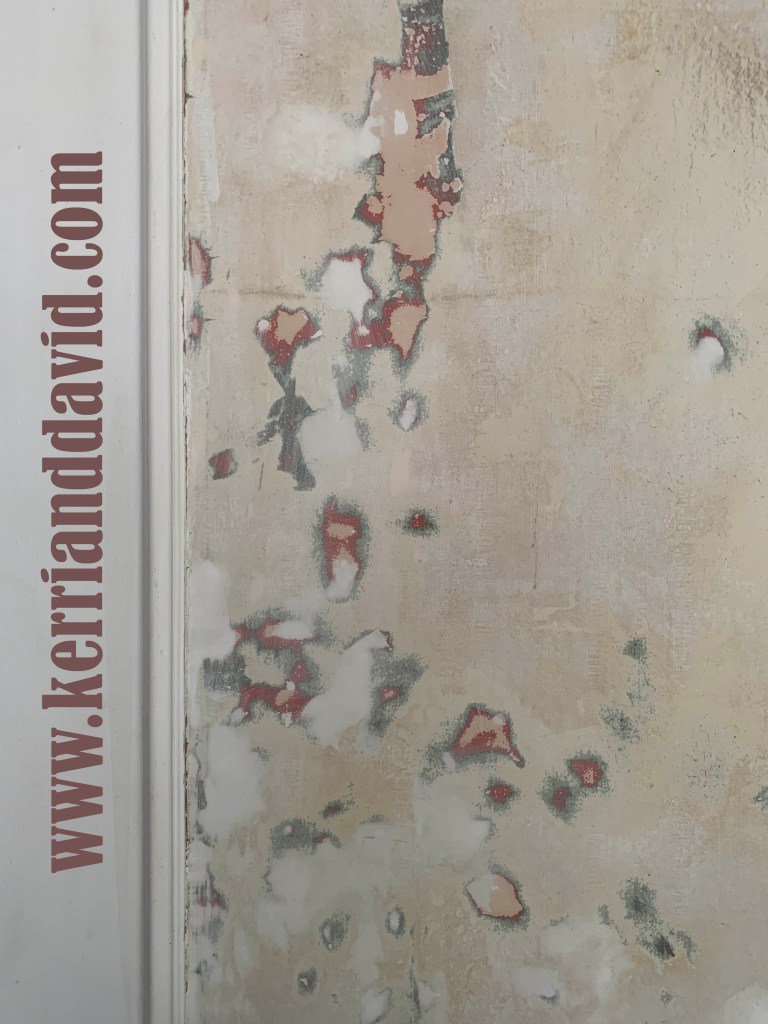
It was a festival of texture. Raw wood exposed through the aging, flaking paint. Immediately I could see that this woman populated her world with stories, surrounded herself with rocks and wood and tin. She lived in a tangible world, loved the raw and the real, and had a designer’s eye. The dining room was a miracle of tortoise-esque pattern made when she stripped the wallpaper. She loved it so much that she abandoned her plan for paint and left the marks exposed.

This was an artist’s house. The hardwood floors creaked. Some of the antique door handles popped off if you pulled too hard. “It’s an old house and has its quirks,” she explained as she pulled a screwdriver from the silverware drawer to tighten the screw that holds the screen door latch in place. I learned over time that there are somethings you fix and others that you don’t because to fix them would interrupt the relationship with the house. Now I, too, weekly pull the screwdriver from the silverware drawer and tighten the aged-nearly-stripped-screw that holds the screen door latch in place.

Shabby-chic. They gave her style a name and she beamed the first time she heard it. “That’s me!” she exclaimed, “Shabby-Chic!”

When my dad came for our wedding, he stood on the back deck and said to me, “If you don’t put a finish on this deck, you’re going to lose it.” I told him that Kerri liked it that way. In fact, she’d throw herself in my path, she’d break my fingers, if I attempted to clean it, let alone paint it. He nodded and said, “Well, that’s all that matters really.”

Home. All that matters. Alive with stories that reach back and back and back. Texture and piles and projects everywhere I look. The lock on the front door still doesn’t work. And, like my wife, Kerri, I wouldn’t have it any other way.

read Kerri’s blog post on SHABBY-CHIC

Look Closer [on Two Artists Tuesday]

Arnie recently sent me a book, Connection by Kristine Klussman. As is my practice these days, I’m reading it slowly, a few pages at a time. I recognize much of what she’s writing about: focus placement, meaning making, cutting through the ‘should’s’…all in the process of re-connecting to what is really important in this life. The book offers specific exercises and process steps to help readers take a closer look at their lives. To identify the gaps between espoused and lived values in order to make different choices and close the gap. Alignment.

In art school, the most valuable lesson (for me) was to learn to see beyond what I ‘think.’ I’ve written about the professor who asked us to look at our yellow #2 pencils and tell him what color were the pencils. A riot of eye rolling ensued but, in the end, he helped us to see that the simple yellow pencil was alive with green and purple and red. Our minds generalize. It requires a bit of slowing down and, dare I write, a bit of presence, to see and experience how rich and alive even the simplest things, a yellow pencil, really are. The dictum applies to each and every day of life, especially the days we generalize into boredom or “same-old-same-old.” Slow down. Look again. There’s more to the yellow pencil than you think.

When Kerri and I arrived home from our trip to move my mother into an independent living community, we poured a glass of wine and opened the box my parents had kept with the artifacts of my life. Old newspaper clippings of play reviews, playbills, gallery opening announcements, elementary school report cards, photographs that reached back through proms and school portraits to blurry black and white infant prints with “David, 4 months” scribbled on the back. It was a poignant exercise of pulling the life-camera in for a closer view. Life-fragments in a box are like the yellow pencil. They require a closer look.

I’ve always appreciated Kerri’s tendency to pull the camera in closer. She is forever taking photographs and then pulling the image this way and that, like so much taffy, looking for the most interesting slice, the most dynamic composition. In her photographic-push-me-pull-you, there is often a discovery. “Look at this color!” she’ll exclaim. Or, “Did you see this! Look at the spines on this plant!” She cultivates surprise. She understands that a closer look will always reveal tiny not-yet-seen-miracles.

Expecting surprise. Taking the time to look beyond yellow-pencil-expectations. Closing the gap between lived and espoused values. Slowing down just enough to realize that there is no such thing as “same-old-same-old.” These are age-old sage suggestions for living a rich and meaningful life. All of it, born of a tender, quiet suggestion to take a deep breath and have a closer look.

read Kerri’s blog post about A CLOSER LOOK

Live A Sockdolager [on Two Artists Tuesday]

Word genius sends me a word everyday. Some I know. Most I do not. Yesterday, my word-of-the-day was sockdolager. Sockdolager is a word that, when typed, is unrecognizable to the vocabulary in my spellcheck and is adorned with a screaming-dotted-red-line meant to notify me that either I spelled the word incorrectly or it’s not a word at all. Language is a fickle companion.

In Seattle, when the rains clear, people are fond of saying, “The mountain is out.” Mount Rainier, hidden in the clouds, makes a grand – almost impossible – appearance when the weather clears. Where there was no mountain, suddenly a Titan appears. It is a sockdolager, an exceptional occurrence. A forceful blow. The first time I saw it I almost crashed my car.

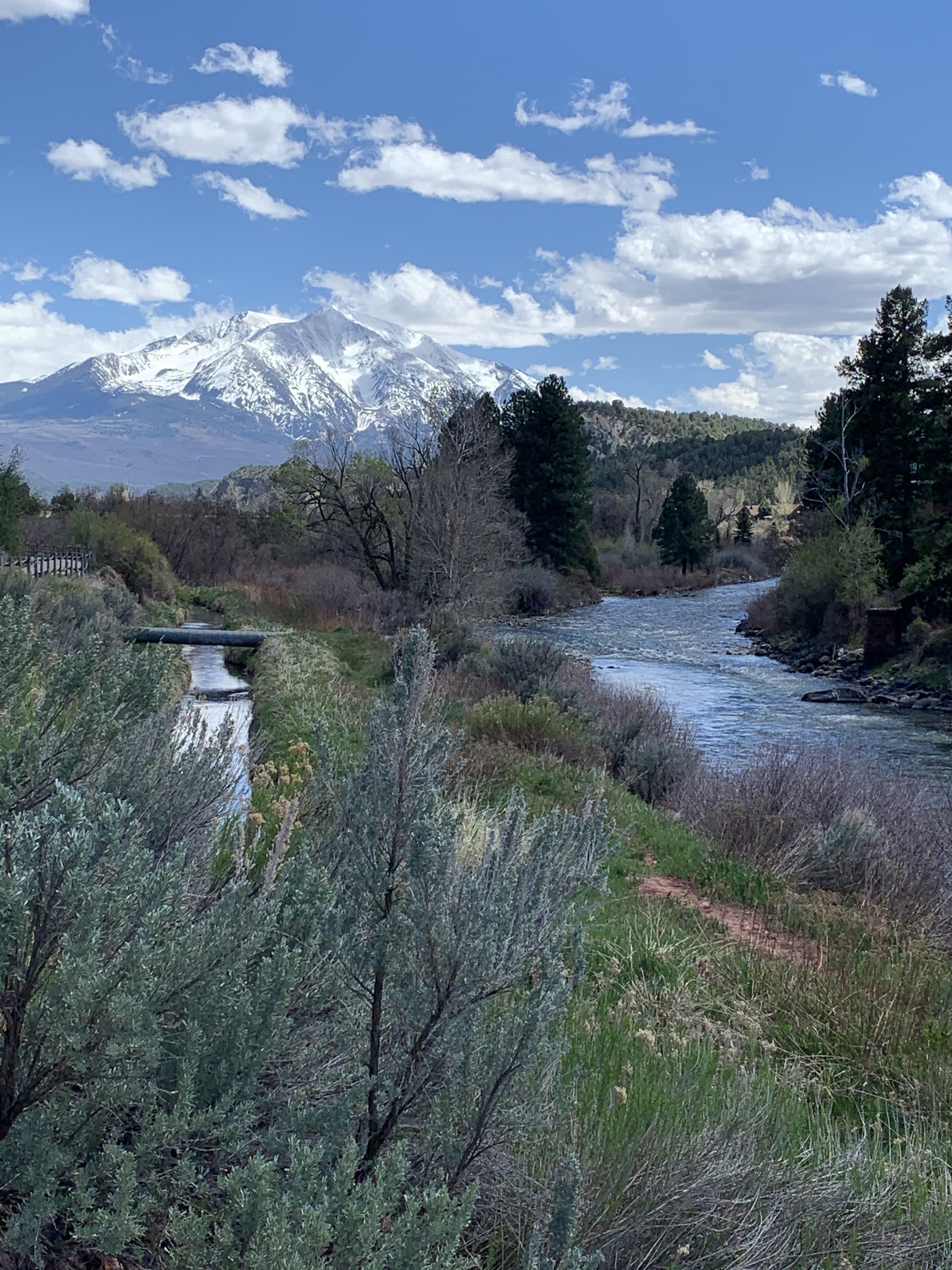
Mount Sopris hit us with a similar wallop. We arrived in Carbondale “in weather.” A day later, making a run to Main Street to meet Kirsten, we rounded a corner and nearly crashed the truck. There was a mountain towering over us where, previously, there was none. Clouds swirled around the summit. The late afternoon light made it glow. Sockdolager! Sockdolager!

I very much appreciate that my snotty spellcheck does not recognize or appreciate my use of sockdolager. No word can adequately capture the experience of being hit by a mountain. “Awe” is a word. So is “amazement.” They fall short, too. Language can reach toward but never quite touch that which it hopes to describe.

The day after the wallop we took a stroll on the Rio Grande Trail. We intentionally walked away from Mount Sopris, knowing that, at some point, to get back to our airbnb, we’d need to turn around and walk toward it. Like Orpheus leading Eurydice, we tried not to turn and peek but the majesty was too much. We’d giggle and turn and gasp. “My god!” we whispered.

We go to the mountains to remind us, to refresh our eyes and hearts and minds. This life. An exceptional event. A forceful blow. Grander than words can describe. Sometimes the mountain is hidden. Sometimes it shows its face. Either way, it never ceases to surprise you, to take your breath away. Sockdolager.

read Kerri’s blog post about THE MOUNTAIN

Seek The Old Gods [on KS Friday]

I’m thinking a lot about gods and goddesses these day. No, it’s not a weird fixation. It’s a project, a story that involves the old gods and the new. The elemental and the angry. The unified and the divided. We make ourselves in the images of the god[s] we embrace. It’s a story about reaching back to the old gods, to a time before the worship of the great divide.

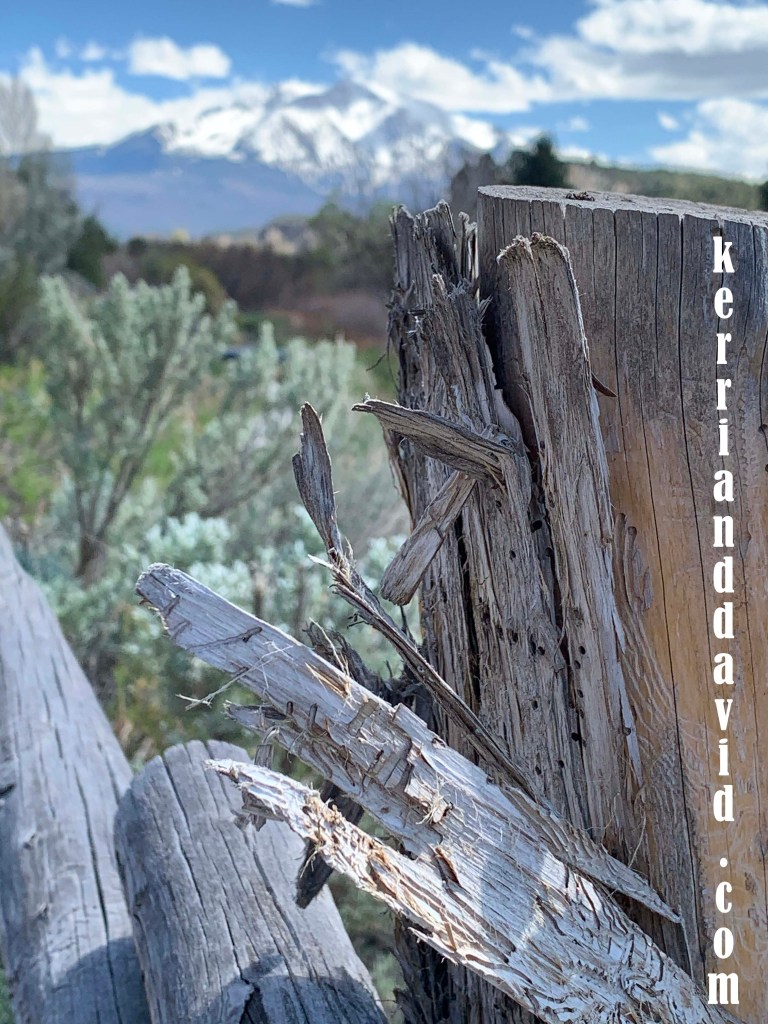
We took a walk along a trail just behind our airbnb. We were only in the mountains for a short time, long enough to have dinner and a day with our daughter and her beau. On the trail we turned and gasped. The mountain towered above all things. It reached to the sky. So majestic in its presence, it did not look real. “Now, there’s an old god,” I whispered to no one. It challenges one to know it, to climb it and participate in the beauty and the ascent – with no opinion at all about who might deem themselves chosen or not. It does not discern nor divide. It reminds. You are this. Climb and breathe the fresh air.

Kerri saw hypericum berries [“You say hypernicum, I say hypericum, let’s call the whole thing off…”] in the grocery store. “These would look lovely on our table!” she exclaimed. They came back to the airbnb with us and found themselves placed in a fine Ball jar sitting in a prime spot on the table. She was right. Lovely. We did a bit of research and discovered that 1) no one can agree on the spelling of the berry [or they’re two different things but we could not discern the difference], and 2) it is often used as a winter wedding flower. Winter’s daisy. Red on green giving its color and presence at unions. “Another old god!” I declared to no one. Elemental. Till death do us part where we will once again unite.

She wrote a note of gratitude and placed the corner beneath the Ball jar that held the hypericum. “Our host will love these!” she said. Gratitude adorned with beauty. We hated to leave but had run out of time. We had to hit the road. We stood at the door and breathed deeply of the mountain air. More gratitude. The blue sky ringing against the red rock of the western slope. Old gods everywhere.

“We’ll be back soon,” I said.

“Maybe we shouldn’t leave,” she whispered.

“But oh if we call the whole thing off then we must part,
And oh, if we ever part, then that might break my heart.”

You say hypernicum. I say hypericum. Winter wedding. Both/And. Gratitude and mountains. Old gods. Old gods everywhere.

read Kerri’s blog post about HYPERICUM

kerri’s albums are available on iTunes

Walk With Dorothy [on Merely A Thought Monday]

I am fond of falling into rabbit holes. For instance, I just wrote the phrase, “racking my brain” and then doubted my spelling and wrote, “wracking my brain.” Was I wracking my brain or racking my brain as I tried to figure out who Lily Tomlin reminded me of? We’ve been binge watching episodes of Grace & Frankie.

This is what the oracle in the temple of google revealed to me: To rack one’s brain is to torture it or to stretch it by thinking very hard. To wrack one’s brain would be to wreck it. This might sort of make sense in some figurative uses, but rack is the standard spelling where the phrase means to think very hard.

After sufficiently stretching my brain on the rack, somewhere in the early episodes of season 2, I realized that Lily Tomlin’s character reminded me of my great aunt Dorothy. Not so much in specific action – but in orientation to life and in appearance. I admired her greatly.

Dorothy lived on the side of a mountain in a small house that may or may not have ever been level. It was a down hill stroll when walking from the kitchen to the living area. She cooked on a cast iron wood burning stove. Her tiny yard, also clinging to the side of the mountain, was a miracle of blue bottles glittering in the sun and brilliant red hummingbird feeders. Poncho, a dog older than god herself, sat in the yard and watched the day go by. My great uncle Del rolled cigarettes and kept his world war 2 army jeep in usable shape.

Dorothy and Del were more interested in living life simply rather than gathering possessions or stacking achievements. The promise of a week with them was a promise of adventure. Catching pollywogs in old coffee cans, building rafts so we could Huck Finn our way across high mountain lakes, bumping in the jeep over ancient gold mining trails, discovering cabins and shelters slowly being reclaimed by the land. There were old graveyards and the hillside that the mountain town considered its dump. Dorothy was famous (to me) for finding treasure there. She had the eyes to see possibilities and potential in the community’s discards.

I often wonder if my love of walking was a gift from Dorothy. I adored walking with her. She was, at the same time, a free spirit and completely grounded. She was dedicated to the appreciation of the moment. No frills. No illusions. The sun on her face was cause for celebration. She never traded simple present joy for some imagined future gain.

When I think of her, I smile. When I think of the many people who have influenced me, Quinn and Tom, Doug, MM, Mark, Judy…they all have a bit of Dorothy in their characters. Outliers. See-ers. Lots of laughter and ideas. The ability to find treasure – or make treasure – in the people and the possessions that society routinely throws away. Appreciators of the moment. Sharers of the riches they find there. Walkers-through-life that pay attention. Each and every one evokes a smile when they wander through my thoughts.

Ask me what makes a good life, what it is I hope to emulate, and leave behind, I will not need to rack or wrack my brain. I will point you to the long river of inspiration and smiles whose headwaters come from a tiny scrappy woman who lived in a tippy house on the side of a mountain surrounded by hummingbirds, colored glass, bacon and wood smoke.

read Kerri’s blog post about SMILE

Come Look! [on Two Artists Tuesday]

“The artist finds, rather than creates and controls.” ~ Declan Donnellan

I’m not sure when I began including floral shapes in my paintings. I’ve always appreciated the shape of symbols and shapes as symbols. One day in my Seattle studio, I lined the walls with my most recent paintings and was surprised to discover leaves and plants and stems etched into figures and the spaces. My charcoal and paint flora was generic; they were not studies of plants nor in any way representational. They were shapes. They were accidental.

Even when my plant-shapes became intentional they remained generic, improvisational. I didn’t go outside and study the shapes of leaves. It never occurred to me to step into the field next to my studio and look at the plant life. I’m slow that way.

And then I met Kerri. We walk almost every day. While my mind wanders into the ethers and gets lost in the sky, she is busy looking at life’s minutiae. She stops often and takes photographs, usually of a tiny treasure. A forest flower. The bud about to burst on a limb. A butterfly nestled into the leaves. “Look!” she exclaims and kneels on the path, camera in hand. She navigates thorns, wades into tall grasses, climbs over rocks, all to get close enough to see, really see the miniature miracle.

Because she sees, I see. She is single-handedly responsible for my ongoing Georgia O’Keeffe revival. And what I’ve re-learned as Kerri beckons me to, “Come Look!” is that my vast imagination is not capable of creating the amazing shapes and colors and delights that surround me. I’ve been walking through this intense world of marvels my whole life and noticed only the smallest slice. The best I can do is pay attention and dance with what I find.

It’s humbling – as it should be. I’ll never be a better creator than nature because I am a creation of nature. In fact, I realize again and again that my job as an artist is not to create, it is to discover what is already right in front of my face. To open eyes – my eyes and others’ eyes – to the enormity of what already exists. The wild shapes, the dancing colors, the glow of life that I’ll never be able to capture, no matter how great my technique or pure my intention. The best I can do is point to the mystery, with symbol, shape and color, and say, as Kerri does for me each and every day, “Look! Come Look!”

read Kerri’s blog post about SUCCULENTS