Eat The Cold [on Merely A Thought Monday]

every storm runs out copy

“Eat the cold!” the Buddhist monk said to the shivering novice. “Eat the cold.” It is” monk-speak for embracing rather than resisting the circumstances of your life.

Non-resistance. Detachment. Hold your self lightly. Presence. Make no assumptions. Be here now. Every spiritual tradition has language for the lesson. Eat the cold. Have the experience. Suspend your judgment. See what is there, not what you think is there. Feel it without condemnation or praise.

When I was a teenager I went on a trip with a school group. The bus broke down in the mountains. We sat on the side of the road bemoaning the state of our affair. The teacher laughed at us. “We’re on an adventure and this is part of it!” he exclaimed. “Rather than fool ourselves into thinking we are stuck, maybe we should fool ourselves into thinking this is exactly where we should be! What’s here? What can we do and create here?” I remember nothing about the rest of that trip but I do remember how much fun we had on the side of the road.

Kerri’s wrists are broken. We find ourselves on a metaphoric roadside. Our patterns are completely disrupted so we are experiencing the gift of mindfulness. Putting on a coat requires complete attention. Lifting a fork. Combing out her gorgeous naturally curly hair. Buckling a seat belt. We have abandoned all notion of rushing. It happens when it happens. When she plays the piano, she does it with full attention; nothing is taken for granted.

What’s here in this storm? Maybe this is exactly where we should be. Amazed at our friendships, our first walk since the accident with Jen and Brad, the sun and wind, laughter with 20, cooing at the meal Joan made for us, flowers, brownies and wine, crawling under the healing quilt that Janet sewed.


read Kerri’s blog post about EVERY STORM 


halfmoonbay CA website box copy

Tickle Open The Closed [on Merely A Thought Monday]

eleanor roosevelt copy

It used to be one of my favorite exercises to facilitate. Ask one person in a small group to tell a story of blame. Ask the rest of the group to invest in the story. In no time the small groups would be indignant, talking over each other in disgruntlement. A klatch of agitated victims, howling.  They’d laugh in their aggravated frenzy. They’d devise clever revenge or ways to torment the object of their blame story. They’d grow a monster.

Blame stories are like sugar. They are easy to eat and highly addictive. There’s rarely any real substance, so much gossip-cotton-candy, but there is an odd pleasure in playing the role of  “the injured party.” The groups would always reflect that the exercise was fun. So much so that they’d often forget it was an exercise. Commiseration and validation, after all, are the point of a blame story. That, and making someone else responsible for how we feel.

Ask the same groups to tell a story of choice or opportunity and most times, after only a minute or two, they’d sit in silence. Their, “Great. That’s really great,” support would dwindle. Feeding an idea is not nearly as easy as feeding a story of blame.

Quinn used to tell me that creativity is not for the faint of heart.

The groups were always shocked to discover how much of their lives were spent chewing the gristle of discontent, of feeding the notion that someone else was to blame for their choices or their circumstance. They’d generally comment on how easy it was to commiserate and how difficult it is to question, challenge or stop the blame-game. Mostly, they were shocked to discover how little of their time they dedicated to feeding ideas, theirs or another persons.

Blame stories are easy because they are reductive. They engender tight little balls of closed minds and closed circles. They close hearts. They take almost no energy at all to spark but, once burning, like a wildfire, they are capable of consuming entire forests.

Idea exploration is expansive. Seeing possibilities requires eyes that look up and out.  It takes much more energy to imagine, to question, to ponder. To try. To experiment. To ask. To challenge what you think you know. Opening minds, opening circles and hearts requires a deep sense of self-responsibility. It requires an even deeper sense of responsibility to others.

One of the purposes of the artist is to open closed circles, to tickle open closed minds. To help their community see anew and entertain never-before-imagined possibilities.

It takes more effort and courage to sail to the edges of the known world than it does to hang out around the water cooler and complain about others. Great minds do not have more capacity than any other mind, but they do require a very different focus.


read Kerri’s blog post about GREAT MINDS & IDEAS


k&dbw backs website box_ copy


FaceTheRain

feel the rain, mixed media, 2019

Snap Your Fingers [on Merely A Thought Monday]

we should be wide awake billboard copy

When I was roaming the world working with corporate types, tilting at windmills, I would tell my be-suited crowd that words matter. I’d relay a story I heard from Don Miguel Ruiz. He told his audience that people in the United States completely misunderstood the word, “spell.” He said, “You think to put a spell on someone is magic, like hocus-pocus. But, that is not it at all. Tell a little girl that she is fat and you will have spelled her forever.”

She will hate her body. That is a powerful spell.

Words matter. Tell the nation that the “Democrats are vicious” or that the news is “the enemy of the people” and the enchantment is undeniable, angry.  Push the spell through a propaganda machine and it magnifies in intensity. Like a ritual drum, the thump-thump whips the glassy eyed adherents into a red frenzy. Insist that long debunked conspiracies are real or that the deep state is out to get us all and the spellbound will see demons threatening everywhere.

The nation body splits and just like the little girl looks with hatred at the other part of itself. A powerful spell.

‘Hoax’ thump-thumped in the face of undeniable fact and the mesmerized fall into line, repeating what they are told to repeat. “Cluck like a chicken!” the hypnotist suggests and the sleepers dutifully cluck. Common sense surrenders to the spell.

Teachers of consciousness use different techniques but are in general agreement about how to awake from a nasty spell. Step back. Doubt what you think. See what is there and not what you think is there. Detach from your attachment to what you want to believe, to what you are being told. The salesman always wants you to buy the car. He is not your friend. He does not have your best interest in mind. He will use his words tell you anything. Despite what you are told, this car will not make you happy, it will not solve all of your problems. It will not make you sexy or powerful or complete. Uncouple from the words, the spell being woven, and see.

If she is lucky, the little girl one day wakes up and realizes that the hatred she experiences is not her own; it was planted in her with a word. The hatred she wields against herself and turns on to others is not of her creation. She learns that she must snap her own fingers and call herself awake. The hypnotist, she understands, only has authority if she continues to cluck and sleep.


read Kerri’s blog post about WAKING UP


luminaria website box copy


Get Off The List [on Merely A Thought Monday]

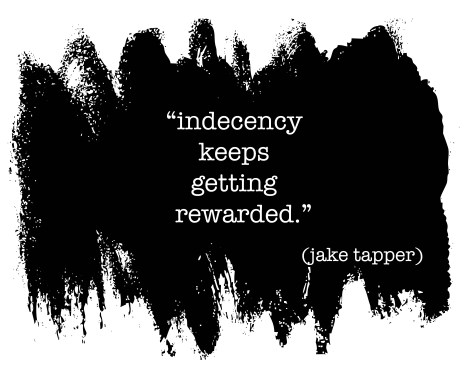
indecency copy

“Are we even aware of our biases anymore?  ~Shawn Langlois, 2018 Marketwatch. Check out the chart.

“What we all feared has happened. Trump has been normalized.” ~ Bill Maher

“I think they’ve been unleashed.” ~ J after listening to the poolside conversations at the YMCA

It was an accident of timing that I was directing a production of the docu-drama, GOD’S COUNTRY, with college students in Santa Fe, NM when George W. Bush was up for re-election. The play chronicles the rise of a white supremacist group and the man they murdered, Allan Berg, a Denver-based talk show radio host. Much of the dialogue is drawn from court documents from the trials of the white supremacists and the transcripts of Allan Berg’s shows. It’s chilling.

The students and I studied hate groups. We studied division. We read studies about how easily a person or community can be slowly drawn into a mindset of hate. It’s a prescription, like slowly boiling a frog. Angry people are an easy mark to be led down the hate path.

One of the studies that stayed with me was Lawrence Britt’s The 14 Characteristics of Fascism (at that time, the USA exhibited many of the characteristics on the list). The list was chilling in 2004 during the production. It is horrifying now that we’ve waded into the swampy waters of #14: Fraudulent Elections. Last week in the USA  an entire political party (with one exception), despite overwhelming evidence, lined up and gave explicit permission to their leader to allow a foreign power to manipulate our elections.

David Neiwert wrote a book, called In God’s Country: The Patriot Movement and The Pacific Northwest. In it are eye-opening tales recounting how a community becomes complicit with its haters. “Boys will be boys.” “Oh, that’s just who they are.” “They didn’t mean any harm by it.” “Turn a blind eye.” Hate crimes rapidly multiply when a community is willing to let it slide. Explain it away. Normalize it. “That’s just who he is.”

And what happens when the enemy, the latest scapegoat that unifies the party-in-lock-step (#3 on the list), is the other half of us, the other party? What happens when indecency is rewarded and ignorance applauded? What happens when fear is the reason the lock-steppers cover their ears and claim that they see no evil? Low-information comes with a very high price.

As they say, history repeats itself. And, somehow, we find ourselves – at least half of our nation – embracing the list.


read Kerri’s blog post about INDECENCY


seagull in fog website box copy


Get Serious [on Merely A Thought Monday]

er or uc copy

Looking back on the experience, I see a map of choices.

Kerri fell. Both wrists were painful. We knew it was bad. In the ski patrol hut, the medic’s advice was to go get x-rays. Choice #1: To get x-rays or to not get x-rays? We had a conversation in all seriousness with the medics, that, given the nature of healthcare in America, it might be a valid option to skip it. To go home. To ignore it and let it heal as it will. The problem with ignoring it: the loss of motion that comes with ignoring what might be broken or torn in her wrists.

So the choice was not actually to get x-rays or to not get x-rays. The choice, the real choice, was financial ruin or loss of motion. Kerri is a pianist. It is her livelihood and her life. So, choice made: financial ruin.

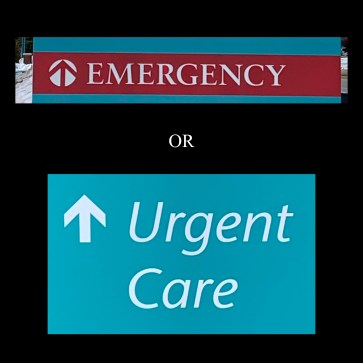
We pulled into the medical center and saw a sign. To the right was the emergency room. To the left was the urgent care center. We sat in the truck and debated the option. While Kerri writhed in pain, in all seriousness, we sat in an idling truck and discussed the merits [or lack thereof] of our insurance policy. If we chose the right hand path, we would meet the vast, gaping deductible. Like Evel Knieval attempting to jump his motorcycle over the Grand Canyon, we’d have to gun our engine and run at the edge. No parachute. So, we chose the left hand path. We went to the desk of the urgent care and asked if they did x-rays.

Choice #2 was not, in truth, the emergency room versus the urgent care. The choice was which canyon did we have the best chance of surviving?

A few days later. An appointment with a great orthopedic doctor. She, in all seriousness, told us that she ignores the part of the patient file that speaks to their health insurance. She explained that there is dilemma that doctors face: do I advise my patient to do what is best for their health or do I advise them to do the thing that might keep them out of bankruptcy? She ignores the file because she wants her patients to hear what is best for them. She told us that she needs to keep herself blind to the financial reality that her best advice might necessitate. “Yet another untenable choice,” I thought.

Our choices reminded me of an experience we had a few years ago. We were shopping for a new washing machine. The salesman, an older man, was embarrassed by the products he was selling. He, in all seriousness, took us down the aisle of appliances and told us what was wrong with each machine. He was convincing us NOT to buy his appliances. Mostly, he told us, they were designed to fail. He said, “We used to know how to make things in this country. Now we make crap on purpose.”

The healthcare in the richest country on earth is just like the appliances sold in the richest country on earth: Designed to fail. Making crap on purpose. The way I am certain that I see clearly? Sit with your wife, a world-class pianist, who has just broken both wrists, and listen to the choices you are considering. Clarity, in all seriousness, comes when the crisis hits.

As we shake our increasingly obese and unhealthy bellies, wave our angry signs and shout about making America great again, it seems we are falling further and further behind. We saw it this week in our senate, did we not? At least our capacity for denial of the truth [in our post-fact, low-information frenzy] is running in front of the rest of the world. I can only hope, as a nation, we break our collective wrists sooner rather than later. In our pain, perhaps we will look at the sign and have a real conversation, in all seriousness, about our choices, about what we can and cannot survive.


Read Kerri’s blog post [written with a cast and a splint!] on CHOICES


snowsteps website box copy

Spin Off Center [on Merely A Thought Monday]

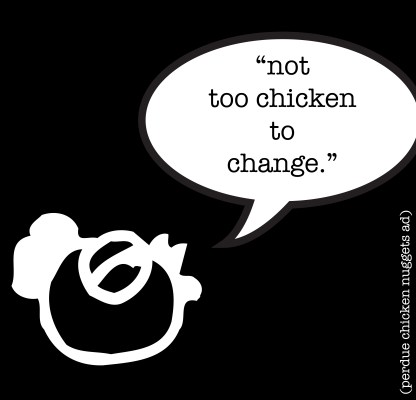
not too chicken copy

I’ve always been a bit mystified by the hyper-charge surrounding the word ‘change.’ It doesn’t matter which way the word slices, it will either evoke great fear and trepidation [we’ve always done it this way!] or it will reach to the deepest depths of yearning and impatience [we need to be different!]. Guard the bastion. Explore new worlds.

Organizations try to manage change. Yet, organizations sell their products as cutting edge. They promote themselves as leaders of change.

We celebrate change-makers. Game changers. We also honor the keepers of the flame. Rule keepers. We pride ourselves on our innovative spirit while pondering the loss of tradition.

Creative tension. Push, pull. It’s a balancing act, yes? A continuum. Where exactly is the hard line between progress and tradition?

Stepping into the unknown is never easy though, isn’t it true that each day of life is, in fact, a step into the unknown? The wheel spins on and on and on.

Growing old is not for wimps. That’s what Beaky said. We all do it. Movement is life and life is change.

We live in an interesting time. Everything is recorded. Evidence of change is everywhere. Actors get old. Politicians vehemently defend the opposite of what they vehemently defended 20 years ago.

The question is not about change or not change.  It is more about what we desire to be  steadfast in the midst of change. Circumstances change. Opinions change. Beliefs change. Traditions change. But, what is in the center of the wheel? Values like ‘honesty’ and ‘truth?’ Agreements of decency? A constitution?

What happens when those hubs are manipulated and simply fall away?


read Kerri’s blog post about CHANGE


snowsteps website box copy

De-Swash Your Font! [on Merely A Thought Monday]

font copy

20 and Kerri can fill an entire evening with conversation about fonts. Serif and sans serif. They grimace and make faces. Some fonts are praised for their simplicity while others are disparaged as presumptuous or gauche. Baseline, Cap line. I listen with amazement. They’re both designers. To get a rise out of them, I tell them that I’ve never really thought much about fonts. They look at me with shock and disdain. Then, one or both slam me with the ultimate insult: “Well, apparently, you’ll read anything.”

At first I thought the font obsession was unique to Kerri and 20 and then I learned that Kirsten caught the font gene from her mother. Kirsten won’t take a book off a shelf if she doesn’t like the font. “Who designed this!” she shouts in the library. “Why would anyone use that font!” she adds to the patrons averting their eyes and scurrying to hide from the dangerous lady.

And then there was the frigid night in Chicago when I realized that it was a family fixation. We were walking with Craig to find the zoo lights when we passed a Barnes & Noble. Craig shook his head and said, “They really need to upgrade their font.” I stopped in my tracks. Thinking my stopped motion was a comment on his font-thought, he added, “Well they do!”

Now I spend my days worried that I, too, will soon become hyper-critical about fonts. I wonder when I will begin to scrutinize stems, ascenders, and shoulders. Will I recoil when confronted with Comic Sans or wrinkle my nose at Didot? Will I find myself asking, “Why didn’t they use Frutiger instead of Futura? Will I contract the font virus?

I pretend. I shake my head when Impact is misused. I snuff when cued at the improper use of a serif, the too-expressive vertex. The pressure to belong is intense! But, in truth, I remain a font goat. Much to the disappointment of 20, Kerri, Kirsten and Craig, I read with pleasure, absent of almost any font awareness, whatever is put in front of me. Gadzook! Bad serif!


read Kerri’s out of control rant about FONTS


feet on the street WI website box copy


Change Your Mantra [on Merely A Thought Monday]

dont try to get it over with copy

It was only after the dive that I realized my folly. Rather than enjoy it I repeated to myself, over and over, to just get through it. I’d be fine once I was back in the boat. I was afraid.

It was a very deep dive, the deepest I’d ever attempted. There were sharks swimming beneath me. There were sharks swimming above me. The Blue Hole. The wall was gorgeous, an explosion of red, orange, and yellow. Looking up was a miracle of sunlight on water. Looking down was a study in the color blue, layers of turquoise, cerulean, disappearing into a bottomless (aptly named) ultramarine.

My mantra, just get through it, was a wall between me and extraordinary beauty of it.

Later, in the boat, I appreciated it. I also appreciated that my experience was unnecessarily fearful. Rather, I understood that the only real danger in The Blue Hole was my doubt in myself. The sharks were not man-eaters. The depth was the limit for amateur divers but not extreme. The dive master was world class. I had plenty of oxygen.  I was safe everywhere but in my imagination.

The dive made me wonder how much of my life I’ve spent telling myself fear tales? Instead of having an experience of wonder, how often have I storied myself in fear? How often have I made up monsters and raced to the other side of the moment, raced to get it over with rather than be in it?

Sitting in the boat, I realized that it wasn’t the fear that I was wrangling with. Fear is natural, especially in alien environments like deep water, especially when sharks are involved. It was my mantra that plagued me. Get through it.

Next time, I told myself, I will have a new mantra. Be in it. Fear is an experience, too. It’s part of life and, at the end of my days, I will be sad if the story of my life was simply getting through it. Or over it. I want to know that I was in it, all of it; the fear, the joy, the ugly, the angry, the beautiful blues, the sad days, and the quiet wandering.


read Kerri’s blog post about GETTING IT OVER WITH


bonfire website box copy

Take One Glorious Step [on Merely A Thought Monday]

make hundreds copy

This post marks the 100th week of our Studio Melange. As it turns out, to my great surprise, the body of work I leave behind in this lifetime will probably have nothing to do with my paintings. I write everyday. I do not paint everyday.

I read that Graham Greene, one of the most prolific writers of the 20th century, wrote 500 words a day. Sometimes those 500 words took an hour. Sometimes they took several hours. Either way. Write 500 words a day, every day, and you, too, will be prolific.

Listen to enough mountain climbers and you’ll receive the same advice. One step at a time. One hand hold at a time. Don’t think of climbing the whole mountain. Rather, pay attention to the next step and the next and the next. The action of stepping will take you farther than the wishing. Step consciously and the summit will cease to be a goal and will become another glorious step en route to another glorious step [and, best of all, your odds of survival will skyrocket].

Were Kerri and I to scrabble together into book form our 100 weeks of writing, we’d have more than a few tomes on the shelf. A single prompt. He said/She said. Mounds of accumulated thoughts. Lots of writing. A few precious and treasured readers. Every once in a while, especially on these dark winter days, one of us asks, “Why do we keep doing this?”  The other will inevitably say, “Well, let’s stop.” The answer is always, “Nooooo! I love doing this!”

Why do it? Why climb the mountain? Why walk toward the horizon? Why paint what no one sees or compose what no one hears? Our answer, after 100 weeks, is becoming clearer and clearer: do what you love. Even better, do it with someone you love. One glorious step en route to another glorious step.


read Kerri’s blog post about MAKING HUNDREDS


feet on the street WI website box copy

Look Before You Bite [on Merely A Thought Monday]

where you stand copy

When John said, “Penny wise, pound foolish,” I would always stop and reconsider my options. John was wise. John was concise. He was a master furniture maker and spoke like a man who necessarily made exact measurements.

If I could slap a label on this era of the USA, I’d call it the penny-wise-pound-foolish-age. Perhaps my label would also apply to the human world at large? I think so. Short term gain is rarely a healthy criteria for determining long term health. Anyone who’s ever experienced a hangover, lashed out in anger, dumped their waste into the drinking water, or jumped into a get-rich-quick scheme will understand.

I read this phrase the other day: Fox is feeding misinformation to an angry populace hungry to consume it. In most mythologies, the fox is a trickster and I couldn’t help but grimace and chuckle at the layers-of-veracity implied. A maker of mischief feeding misinformation to people hungry to gobble it down. Of course, there are two points of view in every fable and it is true of our fable, too: there is the fox and there are those who eat the gruel to fuel their angry point of view. The fox is never without agenda. Control of the point of view of the angry populace is the fox’s agenda. In other words, the fox is not a friend. The fox is like the witch offering the poison apple. Take a bite; it won’t hurt you. Really.

Reds and blues. Post fact era. Foxes in the hen house. Tribes eating tripe. Penny wise, pound foolish.


read Kerri’s blog post about WHERE YOU STAND


donnieandmarie uke website box copy