Stack The Impossible [on Merely A Thought Monday]

We watched the video of Jaxon climbing the ladder of the red plastic slide. His momma said, “Is that your big boy slide?” Jaxon said, “Big boy slide.” Pandemonium. “He said it!” his father exclaimed, “I think he said it!”

Big boy slide. A first phrase. The moment when what’s necessary becomes what’s possible. It’s something we take for granted every day. The utter impossibility of spoken language. Sounds uttered in sequence that somehow make sense. Of course, we’re also quite capable of stringing together sounds that make nonsense, too. Soon, Jaxon will ask his parents for the keys to the car and a wholly different kind of pandemonium will let loose. From climbing a ladder to driving the Volvo. The impossibilities stack one upon the other.

My mother is adjusting to life without my dad. She says often, “I don’t think I can take it, this loneliness.” She is doing what is necessary. In our last chat, she spoke of playing pickleball, of taking a walk, of meeting a friend for tea. Moving with intention out of the apartment to meet other people. The moment when the necessary becomes what’s possible. She will, I am confident, live her way into the impossible.

The impossible rarely happens in a snap. We live our way into it. Jaxon’s pronouncement and subsequent trip down the big boy slide was a long time coming, a step in the process worthy of celebration. And then, the miracles will keep coming. Full sentences. He’ll learn to write. Someday he’ll write love letters and drive the car to pick up his date. He’ll ask someone to marry him. The art of the impossible. This life.

And, the most amazing of the impossibilities, as we stack our lives with the formerly inconceivable, we grow less and less capable of seeing it. Perhaps that is necessary? How would we exist if we saw each other as keepers of the impossible? Experiencers of the unimaginable?

read Kerri’s blogpost about THE IMPOSSIBLE
Call It An Art Piece [on Merely A Thought Monday]

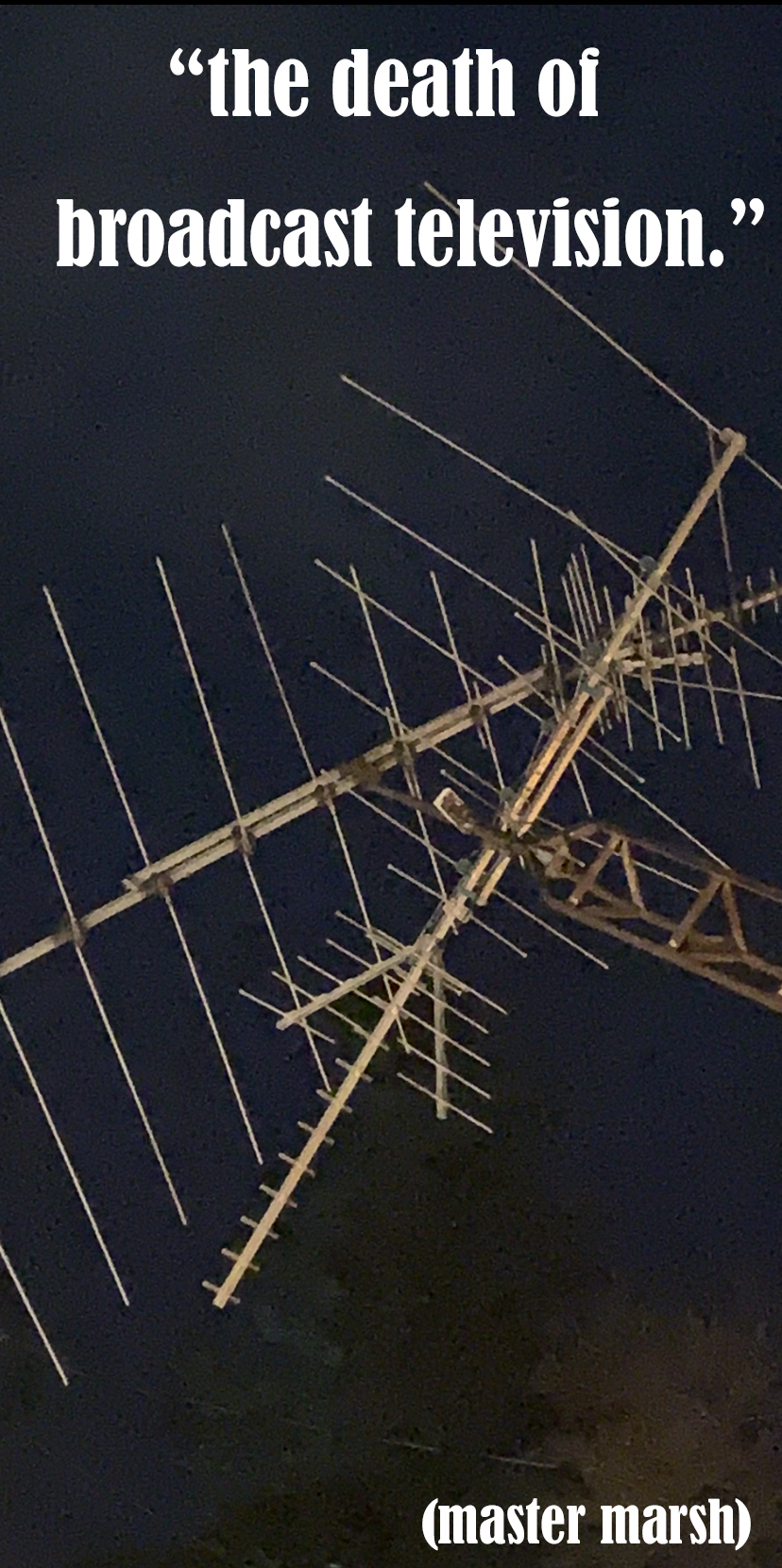
When the ancient television antenna tower fell in the windstorm, it snagged on the neighbor’s fence and tilted precariously above their garage. We did not know what to do – so we did what we always do in similar circumstances: we texted our tribe with a rousing, “HELP!!! And then we asked, “What do we do?”

No one had a clue. This was a first. The insurance company was certainly clueless. Their advice was to (I’m paraphrasing and scrubbing for courtesy) let it fall. The fire department didn’t know. We called a contractor friend who recommended finding a crane. We called tow trucks. We called antenna companies who told us that this problem was out of their league.

A single, sensible, and fantastic piece of advice came as it always does, from Master Marsh. “Just leave it and tell the neighbors it’s an art piece: The Death of Broadcast Television.” Had it not been dangerous, I’d have taken his sage advice. I’d have gone so far as to make a plaque for the base. I’d have sent out a press release. Our art piece might have one day been moved to the permanent collection at The Chicago Art Institute or been featured at Biennale Arte 2022. It would be necessary to compensate the neighbors for a piece of their fence – since it is a crucial element of the statement – but that is a minor detail and certainly worth sorting out for such a prestigious end to our dilemma.

It did make me wonder how many of my life’s tribulations would have been better solved with a bit of rebranding? Call it an art piece and make it all better with plaques emblazoned with clever titles. I laughed when I imagined moving through my life’s calamities as a gallery show. Children asking their grandparents, “What is broadcast?” The raging waterfall through the ceiling would be fantastic!

In the end, rather than art, we opted for a tree service. These amazing guys came, sawed up and carted away our precarious antenna in less than 30 minutes. An entire era of technology disappeared in less than half an hour.

As they say, in our times, the only constant is change and, if you keep asking the right question, “What do we do?” a proper answer is certain to find you. And, if not, there’s always the art route.

read Kerri’s blogpost about BROADCAST TELEVISION

Look At You Look At Me [on Merely A Thought Monday]

It’s taken me this long to discover the source of all cartoon characters: orchids. I’m not kidding. At a recent field trip to the Chicago Botanical Garden’s Orchid Exhibit, I was surrounded by brightly colored fantastic faces, playful and chuckling. “Look at this one!” Kerri exclaimed. “It’s the Imperial Margarine guy!” I thought it was a whacky Pope or funny Cardinal, but the idea was the same.

“The earth laughs in flowers.” Emerson’s quote was stenciled on the wall as we exited the exhibit. And the laughing flowers made me laugh. Truly. I felt like a little kid at Christmas. Surrounded by color and delight and whimsy, I found myself more than once pointing, “Look at this one! Oh My God!” And, I felt like the colorful faces were staring back at me, thrilled to tears by the odd looking human standing before them. I-look-at-you-look-at-me. “Look at that face!” they snickered.

The thought stopped me in my tracks and filled me with wonder. We personify everything, projecting our humanness into everything. The art of animation, the world of Disney, is rooted in our desire to project ourselves onto and into the world. Talking mice. Dancing candlesticks. Humpty Dumpty. Wise old trees. Wouldn’t it be lovely, and isn’t it hopeful, to think the world projects itself into us? I want the orchids to fill me with color and awe. To project themselves into me. I know the forests I walk through infuse me with quiet. I know Dogga pulls love from my deepest soul.

Participants. Relationship, rather than controllers. Dancers rather than dominators. Would we be so invested in killing each other for imagined supremacy if we allowed ourselves to laugh the laugh of the flowers? If we actually understood that nothing is forever, that our warmongering was at best delusional? That the single trait that makes us human is to turn and help someone in need? The very capacity that allows us to project ourselves into the orchids is the same capacity that makes it possible to stand in the shoes of the other. Empathy is a two-way street.

If the earth laughs in flowers, these days it certainly cries in humans. Yet, standing amidst the orchids, I looked at all the human faces, hundreds of people wide-eyed with wonder and alive with astonishment. The laughing orchids looking back at the astonished faces, open and vulnerable, and they were evoking those qualities from the crowd. Earth’s tears. So hopeful, these faces, drinking in each other’s beauty.

read Kerri’s blog post about FACES

Hold The Space [on Merely A Thought Monday]

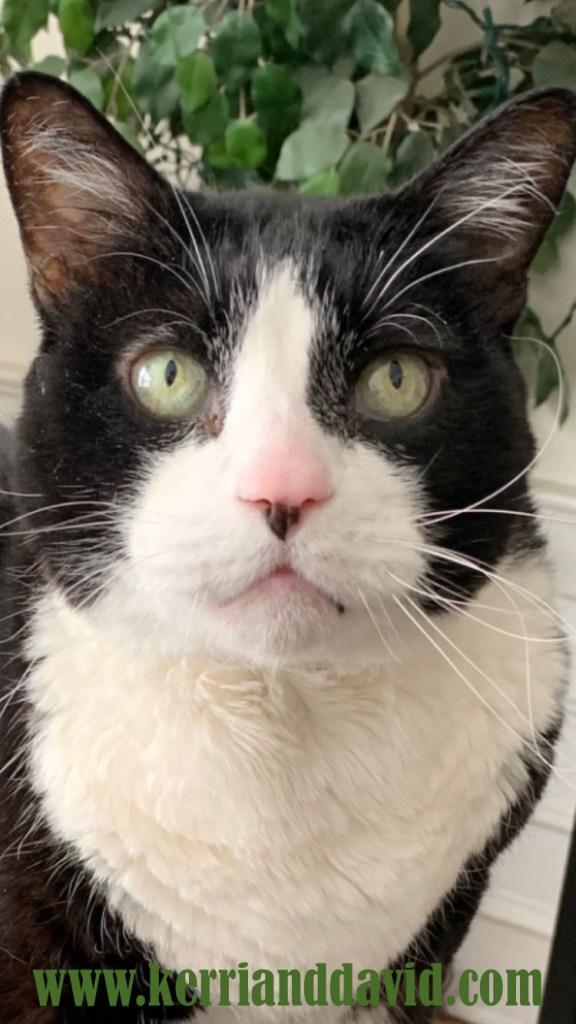
When I met Kerri, the bar of acceptance I had to clear was not with her children, it was the enormous cat with the name of a rapper: BabyCat. If the sumo-sized cat had rejected me, I’d have been shown the door. Thankfully, BabyCat was merely indifferent to my presence so I got to stay. And, after a few years of kitty-aloofness, one night BabyCat crawled into my lap and I knew I was in for good.

Today, BabyCat would have been 13 years old. He left us in a flash almost a year ago though, to this day, I think I hear him upstairs. I’m not the only one: after breakfast every morning, a year later, Dogga returns to his B-Cat meet-up spot in the kitchen and waits for his pal to join him. With full bellies, they would meet, hang out in the kitchen, and sleep the morning away. Now, after a few minutes, Dogga retreats to the back door and pines.

Though Dogga and I miss our BabyCat, Kerri suffers most from his absence. Sometimes I find her standing still in a room, as if she is listening. I wait, holding the space. “I can’t believe he’s gone,” she says. He came into her life in a period of great upheaval and was her constant companion. Through the years that she lived in this big old house all by herself, she was never all by herself. She had her BabyCat. He had her. They were – they are – bonded.

It is the empty space, the surprising change of pattern, the absence of a normal daily sound: the heavy footed cat coming down the stairs to beg a treat, that makes us stop and listen, move to the back door and pine, or tell BCat stories. Today we light a candle and celebrate BabyCat. We pause to fill the empty space with memories and laughter of all we loved about our enormous tuxedo cat with the name of a rapper.

read Kerri’s blog post about BABYCAT

Step Out Of Line [on Merely A Thought Monday]

“…the fountain of creative work is an intelligent questioning of the rules.” ~Alan Watts, Tao: The Watercourse Way

“If someone tells you they know, they most certainly do not.” It’s not a direct quote from Quinn but it’s close enough. Art school almost snuffed the art in me; there were so many rules and nary a hint of curiosity allowed in the studio. I fled into the theatre after a single year for fear of losing my heart to a book of rules. My theatre professors were explorers of nature. Their refreshing mantra was, “Well, let’s find out!”

What if…? What happens if…?

Nature is boundless expression. Boundless expression is human nature, too, until it is taught otherwise. Boys don’t cry. Be a good girl. Sit in your desk. Follow the rules. There’s a right way. My way or the highway…So much effort to force nature – your nature, your curiosity, to stand on a line.

Einstein revolutionized our world because he dared to posit that Newton had it upside-down. Thank goodness, as Alan Watts observed, “The scientist and the mystic both make experiments in which what has been written is subordinate to the observation of what is.” In other words, they look beyond established belief, expectation and entrenched norms into what is.

What is? Curiosity. A desire to know what’s over that hill. No child begins their life-walk by desiring to color within the lines. Lines are a learned thing. The word “wild” was invented by people whose ancestors emerged from the woods and who have forgotten that they, too, are part of nature – so have become afraid of stepping into the woods. What might they – we – find there?

“It’s not an idea problem,” David Burkus wrote in the HBR, “It’s a recognition problem.” Stepping beyond the known – a great definition of curiosity – is too often seen as an aberration or an assault upon authority. Nip it in the bud. Forcing flow into a fixed state invariably causes idea-blindness and the imperative to think-outside-of-the-box. Innovations are too often smothered in the crib by “What we know,” or “We don’t do it that way.” Coloring in the lines, once ingrained, is a life-long-book-to-follow.

I wish I had a nickel for every time I’ve been invited into an organization or hired by a client to help them “see what they cannot see,” and then subtly or not-so-subtly, been rebuked for opening their eyes to what is in plain sight…or the availability of alternative paths. “We want a vital arts program but we only want art that entertains,” said the school board after the student play asked a serious question of their audience. “…the scholastic theologians would not look through Galileo’s telescope because they considered that they already knew, from Scripture, the order of the heavens.” (Alan Watts)

Think outside the box – as long as you stay within the model or the expectation or the rules. So many models. So many lines. So in love with the struggle and afraid of the simple, natural joy of curiosity. Bend your will to the line. See what you are supposed to see and look no further. What, exactly, are we trying to control?

read Kerri’s blog post about CURIOSITY

Live A Great Story [on Merely A Thought Monday]

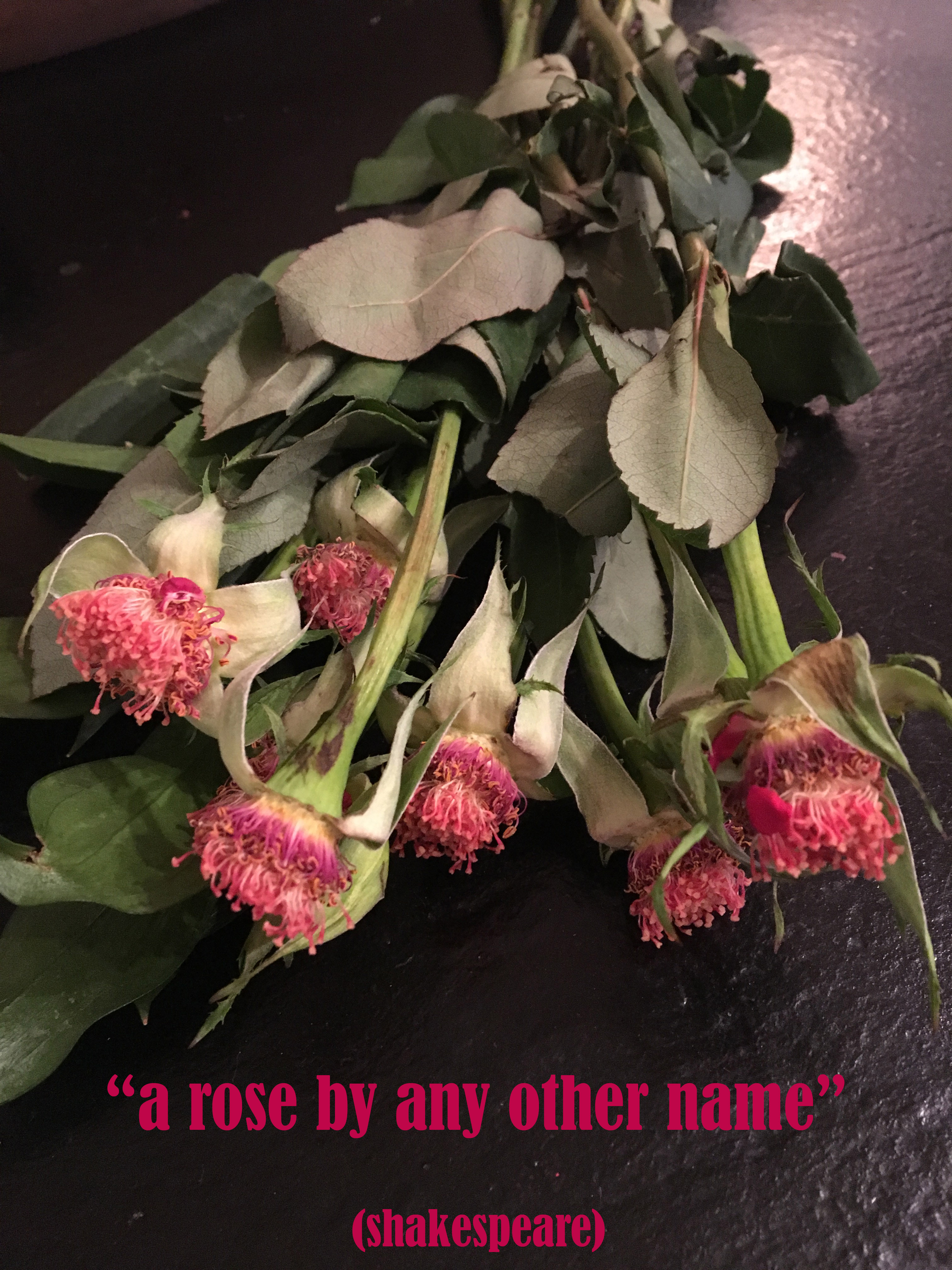
I suppose I must not have seen the small print requiring an extra fee for the petals to actually be attached to the stems. Silly me. I’m not a detail guy so it never occurred to me that ordering flowers was like flying on Frontier Airlines: if you want a seat you need to pay extra. If you want wings on the plane there’s an up-charge. If you want the roses fastened to the stem, it’ll-cost-ya.

Every story has a context. Without the context a story cannot be fully understood. Here’s the context for our sad-rose-tale. Kerri and I have out of necessity lived lean. Very lean. This is the first year since we met that I had the capacity to send my wife roses on Valentine’s Day. Context number two: since we spend 24/7 together and she monitors our expenses like a hawk (a necessary practice that comes from living lean) , it’s nigh-on-impossible to surprise her. Fromyouflowers.com seemed to be a solution for a long overdue surprise. “How bad could it be?” I asked myself. Woof.

Never ask yourself a question when you can ask other trusted people. I could have asked Jen or Gay or Jay. They would have warned me off. I could have asked them to arrange roses from a local florist and I would have secretly paid them after the fact. I did none of the above. I was having a nice conversation with myself and, left to my own devices, I’m perfectly capable of making a dumb idea sound titanically smart.

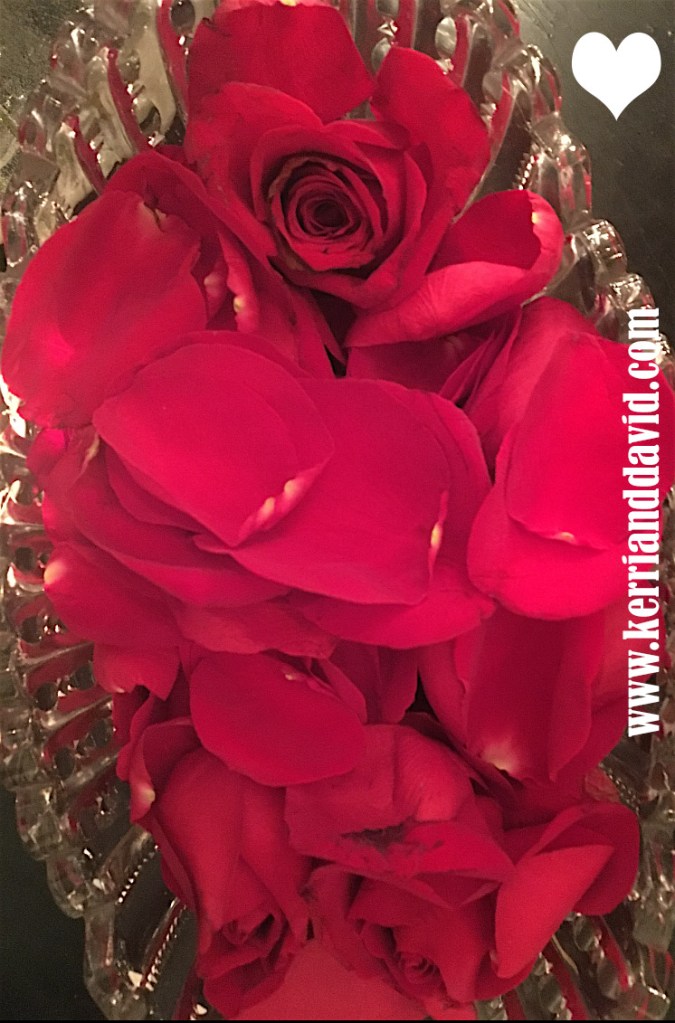
The roses (I use the term loosely) came, not on Valentine’s Day (today), but on Friday. Surprise! Gay’s response after seeing the picture truly captured their state: “Too bad they picked them in August,” she wrote. Even the leaves had abandoned the stems. Brad’s comment was my personal favorite: “How efficient,” he wrote, “you received roses and potpourri in the same order.” Efficiency was, after all, my aim.

Kerri, a gifted transformer of lemons-into-lemonade, separated the dead petals from those few still living and put them in a crystal bowl. And then, she offered me this consolation: “Think of it this way,” she said, “if they’d arrived intact, we’d never remember them. Now we have a great story to tell.”

First roses. A Valentine’s tale. We’ve laughed all weekend [I confess, the humor in the story took me a moment or two to see]. With or without roses, on this day of celebrating true love, this is what I know for certain: we live a great story so we have a great story to tell.

read Kerri’s blogpost about NOT-ROSES

Taste And Adjust [on Merely A Thought Monday]

In our kitchen, I am the sous chef. Second in command. I chop, slice and dice. Then, I place my colorful preparations in glass bowls, carefully arranged relative to the stove so the chef need only reach to add an ingredient to her magic-making. “What’s first?” I ask. “Onions and garlic,” the chef replies, tying on her apron. I know the answer before I ask but it’s our ritual signal, like the kitchen version of “On your mark,” to the runners at the starting line. The onion steps onto the cutting board.

We love to cook together. I have learned through the many phases of my life that my relationship with food mirrors the relationship I have with life. If I attend to the the palette of tastes and textures that I eat, if I take the time to savor and appreciate my food, I carry that attention into every moment of my day. If I rush through and jam any food-like-object into my mouth, I carry that same inattention into my life. Appreciation, savoring, is mindfulness. Slowing down to plan and fully fill the palette of flavor fosters anticipation. Moving through a grocery store or farmer’s market is a wholly different affair when favorite recipes call.

I did not arrive easily at my understanding of food and life. The first recipes I tried were utter disasters. Don’t ask BK about my inaugural batch of lentil soup. It will send him into waves of horror-laughter. I ate it to prove that my cooking was not so bad but could not hide that my soup nearly killed me. And, I remember the moment that I decided to learn to cook. I remember like it was yesterday the understanding that sent me to the stove: I wanted, perhaps for the first time in my life, to take care of myself. More than that, I wanted to fully taste the richness of being alive and to do it, I had first to stop running. One must stand still to fully taste. To savor, one must stand still with others. “What do you think? Kerri asks, “More salt?”

Experimentation, trial and error, are the only way. Taste and adjust. And, isn’t that a terrific life credo?

In the recent past, each week, we try new recipes with 20. We’ve discovered some incredible flavors, our repertoire is expanding. Soups and chilis and stir fry. Mostly, that we intend to make meals together, that we slow down and enjoy each other’s company en route to a new taste, an ingredient that we can’t pronounce, a spice that is unknown. “This might be a disaster,” we say as steaming bowls of deliciousness hit the table. “Well, there’s only one way to find out,” we say as we click together our spoons and dive in.

read Kerri’s blogpost about EATING WELL

a photo from before the pandemic. we can’t wait for this to end so we might create more memories like this one.

Point The Way [on Merely A Thought Monday]

“You can accomplish with kindness what you cannot by force.” ~ Publilius Syrus

It’s one of the most interesting Wikipedia pages I’ve come across. Publilius Syrus. A life described in two sentences that conclude with this: “…but by his wit and talent he won the favor of his master, who freed and educated him. The rest of the page are maxims attributed to him. A Syrian. A Roman slave. An observer of human-kind.

We live in a world of ubiquitous maxims. They are posted everywhere, in stores, billboards, and elementary school signboards. Appeals to our better nature. Choose kindness. There are, of course, plenty of appeals to our worse nature, too. It’s as if our maxims are in a tug-of-war. I imagine that Publilius Syrus experienced in his short life both ends of the rope, the cruel and the kind, which is why he wrote so many maxims.

This quote came across my screen so I wrote it on a lilac colored post-it note and stuck it to my monitor. It may or may not be from Christina Wodtke: “When you make complex things, words eventually fail.” Life is a complex thing that words will always fail to describe or contain. The best a word can do is point to something, or the way to something. A maxim, an ideal, is, after all, a signpost, a direction. A choice of path. A point-of-view is created during those moments of choosing.

Kindness is not a thing. It’s not a word – not the word. The word simply points the way to something so complex, so boundless, that the word will always fail. But, we know it when we see it. We know it when we offer it. We know it when we receive it. We know with certainty when we choose it and when we do not.

read Kerri’s blog post about CHOOSE KINDNESS

Find The Treasure [on Merely A Thought Monday]

Every so often in the grocery store I am struck by how many people are involved in making sure I – we – have food to eat. Pick any item from the shelf and work backwards. It was carried, priced, stocked, delivered, warehoused, produced, picked, manufactured, marketed, accounted, inventoried, scheduled. Imagined. And, I wonder, how many of the hundreds of people involved realized that their labor makes my life – our lives – better?

Sitting in front of my computer yesterday I was swirling in a thought-eddy. Attempting to map a workflow, the mechanics of a process, I was befuddled. There were too many variables. As is my practice when perplexed, I stood up and walked away. Halfway down the stairs my mind jigged. I re-remembered that the only thing that mattered in my silly map was the desire to make someone’s life better, someone I would never meet. I realized (again) that I didn’t need to figure it out. I shouldn’t figure it out. There was and is no single answer. Too many variables simply means I cannot know – but I can intend. I will “know” how it all works after the fact. I know that, if I keep focused on my north star, making a life better, then, at this phase, that is all I need to know. It’s an unbeatable criteria for clarifying what to do.

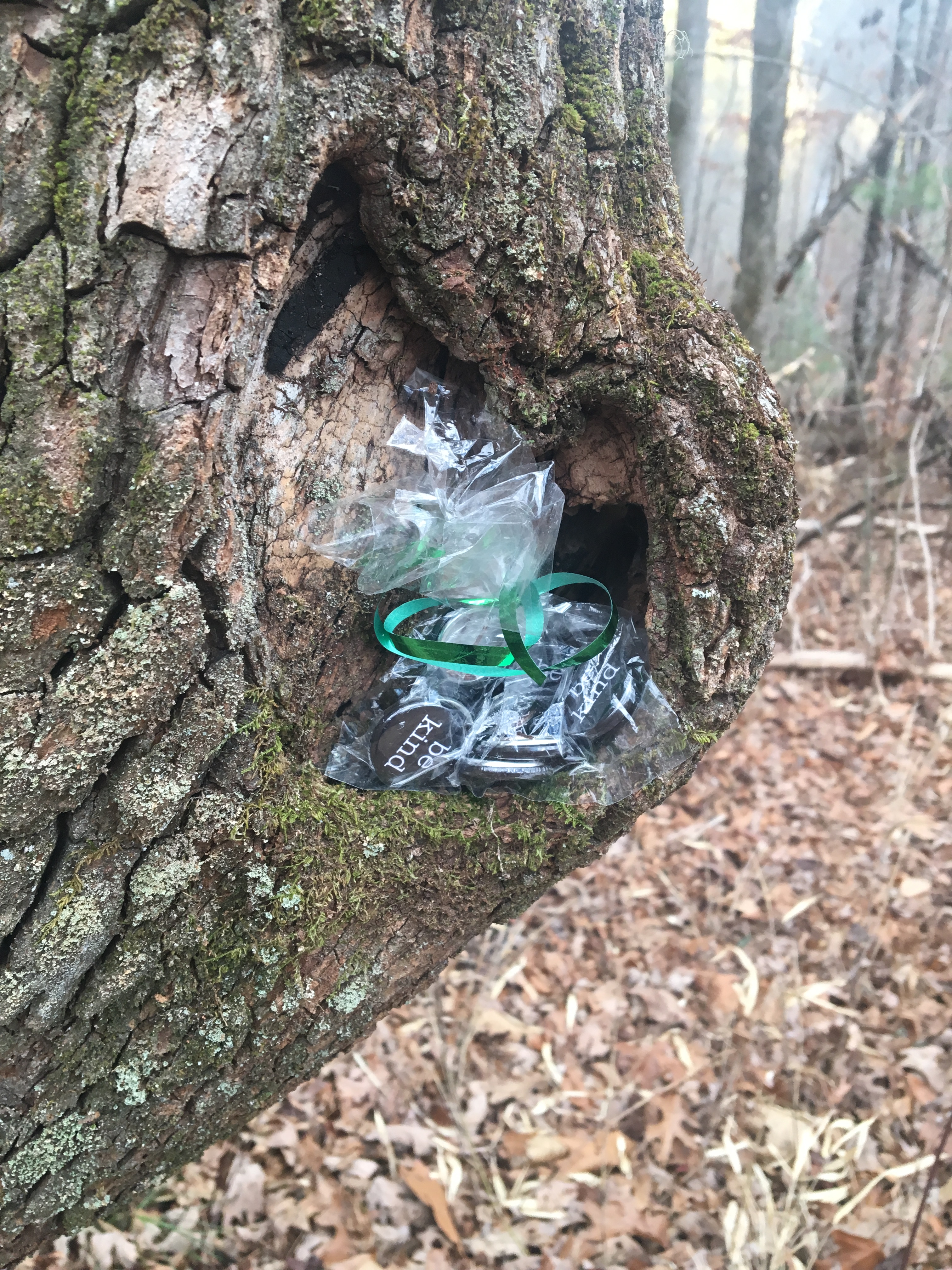
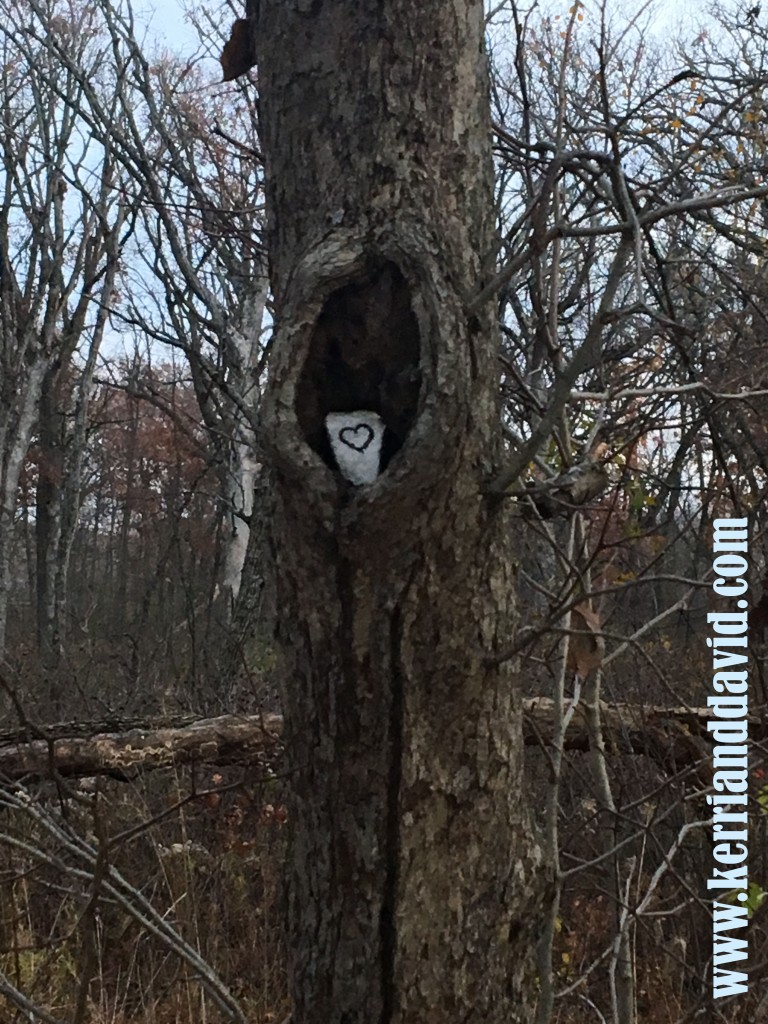
“Do you think someone found our buttons?” she asked. “Do you think they liked them?” On our last hike in North Carolina, she left a small sack of Be-Kind buttons in the knot of a tree. “I wonder who found them,” she giggled.

A small treasure left in the knot of a tree. A sack of potatoes found in the grocery store. Kindness. We get snarky when we divorce our actions – even the smallest action – from the very thing that makes them matter. We get lost when we forget how deeply interrelated are our every action and thought. Cause and effect, as Alan Watts wrote, are not sequential but simultaneous. If you think your actions do not matter or have no purpose, think again. If you think it does not matter how you treat others or that bottom lines are more potent than people, think again. It’s the miracle of a circle or a cycle: where does it begin? Where does it end?

read Kerri’s blogpost about BUTTONS IN A TREE

See The Adventure [on Merely A Thought Monday]

Let the adventure begin. We put the sign on the table when we moved into the little house on Washington Island. Our new job came with housing and we couldn’t have been more fortunate. Even as the job turned into a debacle, the little house grew in our hearts. It was – and is – a very special place. A few years down the road, we never give thought-space to the work-fiasco. We reminisce about the beautiful place we lived, the good people we met, starry nights, mornings in the canoe, the deer, the power of the lake right outside our door.

A few moments ago I was feeling anxious and was complaining – and realized that I have no business complaining about anything. I stopped myself. Adventures are hard. That’s what makes the experience an adventure. When people lack challenges, they create them. Jigsaw puzzles and computer games. I complain when standing on the threshold of learning something new. My complaining – as I realized a few moments ago – runs amok when I don’t know what to do. It marks the line between the fat-comfort of knowing and the utter-discomfort of not-knowing. Complaining provides cover. I expose my obvious not-knowing; I preempt the shame-strike by complaining. The moment I disallowed complaining, I once again saw the adventure. My anxiety dissipated. The adventure is a jigsaw puzzle all akimbo in the box. I’ll figure it out one piece at a time. Or not. The end result is not nearly as important as the spirit in which I bring to the task. To the moment. To my life.

Mihaly Csikzentmihalyi studied, thought, and wrote extensively about flow. The optimal state of being. I’ve often wished I could invite Mihaly and Alan Watts to dinner and listen to their conversation. The psychologist and the Taoist conversing about flow, that magic space that opens when the path is hard, but not too hard, when boredom is no where in sight. The exercise, when either bored or overwhelmed, is to adjust my orientation to the challenge. Amp it up or slow it down. The zone is self-modulated, rarely an accident, which becomes apparent once the complaining stops. The knowledge that I can place myself in the zone is the spirit I hope to bring to every task for the rest of my days. It’s the practice. It is to see and choose the adventure.

Let the adventure begin. The sign now sits on our table in the sunroom where we meet at the end of each day and tell the stories of our day. While I tell my tale, I see the adventure sign, mostly in reflection, the message reversed. Each day an adventure if I choose to see it. Each day an opportunity for flow if I choose to own and modulate my steps, and place myself in flow.

read Kerri’s blogpost about THE ADVENTURE